Synonyms of silhouette include outline, profile, contour, shape, shadow, figure, and form. These words describe the visible outer shape of a person, object, or scene, with each alternative adding a slightly different meaning or tone.
Synonyms of silhouette can make descriptions more vivid. Imagine seeing a person standing against a bright sunset, visible only as a dark outer shape.
A photographer may call that dark shape a silhouette, while a writer might choose outline or figure. Each word creates a slightly different image.
Learning synonyms of silhouette helps students, bloggers, writers, and daily English users describe visual details without repeating one word.
The word is common in photography, fashion, art, storytelling, and design. Knowing its alternatives makes English more flexible and expressive.
What Does “Silhouette” Really Mean?
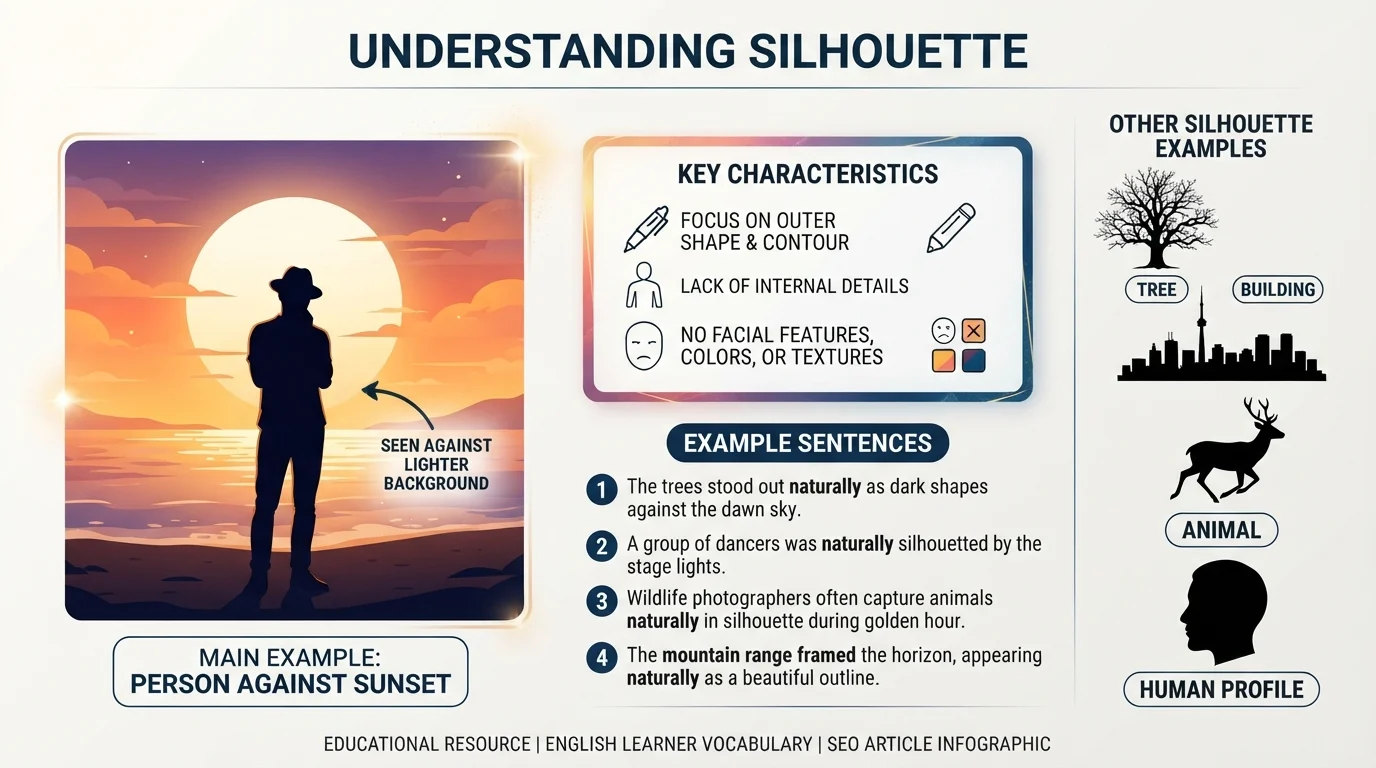
A silhouette is a dark, usually solid-looking shape that shows the outer form of a person or object against a lighter background.
For example, if someone stands in front of a bright window, you may see only their dark outer shape. That shape is a silhouette.
The word can describe both people and objects. It is especially common when the inside details are hidden, and only the boundary or overall form can be seen.
Part of speech: Noun and, less commonly, verb.
Simple definition: The dark outer shape or outline of something seen against a lighter background.
As a verb, silhouette means to show or represent something mainly by its outer shape.
Connotative Meaning
Connotation (the feeling or association a word creates beyond its basic dictionary meaning) can change how silhouette feels in different situations.
Positive Tone
In creative writing and photography, silhouette can suggest beauty, mystery, elegance, romance, or artistic simplicity.
Negative Tone
In some contexts, a silhouette can create feelings of uncertainty, loneliness, secrecy, or danger, especially when a person appears as an unidentified dark figure.
Neutral Tone
In technical descriptions, photography, design, or ordinary observation, silhouette can simply describe an object’s visible outer shape without emotional meaning.
Etymology of Silhouette
The word silhouette comes from French. It was formed from the surname of Étienne de Silhouette, a French finance minister of the eighteenth century.
His name became associated with inexpensive portrait profiles because simple black profile pictures were much cheaper than detailed painted portraits.
English adopted the French word in the eighteenth century. The term gradually became associated with dark profile images and then with the visible outer shape of a person or object.
Old English: 450–1100
The word silhouette was not part of Old English vocabulary. Old English used other words to describe shapes, forms, shadows, and appearances.
Middle English: 1100–1500
The term was still absent from English during the Middle English period. English writers relied on words such as shape, form, shadow, and related vocabulary.
Modern English: 1500–Present
Silhouette entered English during the eighteenth century through French. Its meaning developed from profile portraits to the broader idea of an object’s recognizable outer shape.
Pronunciation
US Pronunciation
silhouette: /ˌsɪluˈet/
UK Pronunciation
silhouette: /ˌsɪluˈet/
Syllables
sil-hou-ette
Affixation Pattern of Silhouette
Root
Silhouette is a borrowing from French and ultimately comes from the surname Silhouette.
Prefix
There is no productive English prefix in silhouette.
Suffix
There is no productive English suffix that can be separated from the borrowed word.
Synonyms List
The following alternatives cover direct synonyms and closely related visual terms. Some are more precise than others depending on context.
1. Outline (Noun) — US /ˈaʊtˌlaɪn/ | UK /ˈaʊtlaɪn/
Meaning: An outline is the outer boundary that shows the basic shape of something.
Tone/Register: Neutral, common, versatile.
Example:
The mountains formed a sharp outline against the evening sky.
She drew the outline of the dancer before adding details.
2. Profile (Noun) — US /ˈproʊfaɪl/ | UK /ˈprəʊfaɪl/
Meaning: A profile shows the side view or distinctive shape of a person or object.
Tone/Register: Neutral, visual, descriptive.
Example:
His profile appeared clearly against the window.
The artist captured her profile with a few simple strokes.
3. Contour (Noun) — US /ˈkɑːntʊr/ | UK /ˈkɒntʊə/
Meaning: A contour is the line or shape that follows the outer edge of something.
Tone/Register: Formal, artistic, technical.
Example:
The artist studied the contour of the face.
Soft lighting emphasized the contours of the hills.
4. Shape (Noun) — US /ʃeɪp/ | UK /ʃeɪp/
Meaning: Shape refers broadly to the visible form or appearance of something.
Tone/Register: Neutral, everyday.
Example:
I could see the shape of a person near the door.
The bright light revealed the shape of the tree.
5. Form (Noun) — US /fɔːrm/ | UK /fɔːm/
Meaning: Form describes the overall physical structure or appearance of something.
Tone/Register: Neutral to formal.
Example:
The sculpture has a graceful form.
Light revealed the form of the statue.
6. Figure (Noun) — US /ˈfɪɡjər/ | UK /ˈfɪɡə/
Meaning: A figure can mean the visible shape of a person, especially when details are unclear.
Tone/Register: Neutral, literary.
Example:
A lone figure stood beneath the streetlight.
The distant figure disappeared into the mist.
7. Shadow (Noun) — US /ˈʃædoʊ/ | UK /ˈʃædəʊ/
Meaning: A shadow is a dark area created when an object blocks light.
Tone/Register: Everyday, neutral.
Example:
Her shadow stretched across the wall.
The tree cast a long shadow over the path.
8. Dark Shape (Noun Phrase) — US /dɑːrk ʃeɪp/ | UK /dɑːk ʃeɪp/
Meaning: A dark shape describes an object that appears mainly as a solid dark form.
Tone/Register: Neutral, descriptive.
Example:
A dark shape moved behind the curtain.
The dark shape turned out to be a bird.
9. Profile Outline (Noun Phrase) — US /ˈproʊfaɪl ˈaʊtlaɪn/ | UK /ˈprəʊfaɪl ˈaʊtlaɪn/
Meaning: A profile outline emphasizes the recognizable boundary of a side view.
Tone/Register: Artistic, descriptive.
Example:
The profile outline of the statue looked elegant.
She sketched the profile outline before shading it.
10. Outer Shape (Noun Phrase) — US /ˈaʊtər ʃeɪp/ | UK /ˈaʊtə ʃeɪp/
Meaning: Outer shape refers to the visible external form of something.
Tone/Register: Neutral, explanatory.
Example:
The outer shape of the building was easy to recognize.
Focus on the outer shape before drawing the details.
11. Border (Noun) — US /ˈbɔːrdər/ | UK /ˈbɔːdə/
Meaning: A border is an edge or boundary separating one area from another.
Tone/Register: Neutral.
Example:
The border of the figure was clearly visible.
Dark lighting created a strong border around the object.
12. Edge (Noun) — US /edʒ/ | UK /edʒ/
Meaning: An edge is the outermost part or boundary of an object.
Tone/Register: Everyday, neutral.
Example:
The light caught the edge of her coat.
The photographer focused on the object’s outer edge.
13. Boundary (Noun) — US /ˈbaʊndəri/ | UK /ˈbaʊndəri/
Meaning: A boundary is a line or limit marking where one shape or area ends.
Tone/Register: Formal, academic.
Example:
The boundary of the object remained visible.
The artist carefully followed the boundary of the form.
14. Impression (Noun) — US /ɪmˈpreʃən/ | UK /ɪmˈpreʃən/
Meaning: Impression can describe the general visual effect created by a shape or figure.
Tone/Register: Neutral, literary.
Example:
The distant figure left a mysterious impression.
The image gives an impression of movement.
15. Representation (Noun) — US /ˌreprɪzenˈteɪʃən/ | UK /ˌreprɪzenˈteɪʃən/
Meaning: Representation refers to an image or visual form used to depict something.
Tone/Register: Formal, academic, artistic.
Example:
The artwork is a simple representation of the dancer.
The designer used a dark representation of the figure.
16. Depiction (Noun) — US /dɪˈpɪkʃən/ | UK /dɪˈpɪkʃən/
Meaning: Depiction means the way a person, object, or scene is represented visually.
Tone/Register: Formal, literary.
Example:
The painting offers a dramatic depiction of the landscape.
Her depiction of the figure uses almost no detail.
17. Image (Noun) — US /ˈɪmɪdʒ/ | UK /ˈɪmɪdʒ/
Meaning: An image is a visual representation of a person, object, or scene.
Tone/Register: Neutral, very common.
Example:
The camera captured a striking image of the runner.
The image showed only the person’s outer form.
18. Portrait (Noun) — US /ˈpɔːrtrət/ | UK /ˈpɔːtrət/
Meaning: A portrait is an artistic or photographic representation of a person.
Tone/Register: Neutral, artistic.
Example:
The artist created a simple portrait in black.
The portrait showed her face in profile.
19. Profile Picture (Noun Phrase) — US /ˈproʊfaɪl ˈpɪktʃər/ | UK /ˈprəʊfaɪl ˈpɪktʃə/
Meaning: A profile picture is an image representing a person, often showing the face or outline.
Tone/Register: Informal, digital.
Example:
Her profile picture shows her against a sunset.
He changed his profile picture to a simple black figure.
20. Cutout (Noun) — US /ˈkʌtaʊt/ | UK /ˈkʌtaʊt/
Meaning: A cutout is a shape made by cutting around the outer form of an object or person.
Tone/Register: Neutral, artistic.
Example:
The children made a paper cutout of a bird.
The black cutout looked like a dancer.
21. Stencil (Noun) — US /ˈstensəl/ | UK /ˈstensəl/
Meaning: A stencil is a template used to reproduce a particular shape or design.
Tone/Register: Artistic, practical.
Example:
She used a stencil to create the figure.
The stencil produced a clean outer shape.
22. Shadow Figure (Noun Phrase) — US /ˈʃædoʊ ˈfɪɡjər/ | UK /ˈʃædəʊ ˈfɪɡə/
Meaning: A shadow figure is a person or object seen mainly as a dark shape.
Tone/Register: Literary, descriptive.
Example:
A shadow figure appeared at the end of the street.
The shadow figure disappeared behind the gate.
23. Shadow Form (Noun Phrase) — US /ˈʃædoʊ fɔːrm/ | UK /ˈʃædəʊ fɔːm/
Meaning: Shadow form describes a visible shape whose details are hidden by darkness.
Tone/Register: Literary, descriptive.
Example:
The shadow form moved across the wall.
Only the shadow form of the tree was visible.
24. Dark Outline (Noun Phrase) — US /dɑːrk ˈaʊtlaɪn/ | UK /dɑːk ˈaʊtlaɪn/
Meaning: A dark outline is a clearly visible boundary appearing darker than its surroundings.
Tone/Register: Neutral, descriptive.
Example:
The bird appeared as a dark outline in the sky.
A dark outline marked the top of the mountain.
25. Visible Form (Noun Phrase) — US /ˈvɪzəbəl fɔːrm/ | UK /ˈvɪzəbəl fɔːm/
Meaning: Visible form refers to the external appearance that can be seen.
Tone/Register: Formal, neutral.
Example:
The visible form changed as the light moved.
The sculpture’s visible form was simple and smooth.
26. External Shape (Noun Phrase) — US /ɪkˈstɜːrnəl ʃeɪp/ | UK /ɪkˈstɜːnəl ʃeɪp/
Meaning: External shape means the outside form of an object.
Tone/Register: Technical, formal.
Example:
The external shape of the machine is distinctive.
The designer changed the external shape slightly.
27. Figure Outline (Noun Phrase) — US /ˈfɪɡjər ˈaʊtlaɪn/ | UK /ˈfɪɡə ˈaʊtlaɪn/
Meaning: A figure outline shows the outer boundary of a person or character.
Tone/Register: Artistic, descriptive.
Example:
The artist traced the figure outline carefully.
The figure outline remained visible against the wall.
28. Shape Profile (Noun Phrase) — US /ʃeɪp ˈproʊfaɪl/ | UK /ʃeɪp ˈprəʊfaɪl/
Meaning: Shape profile refers to the recognizable form or side view of something.
Tone/Register: Technical, descriptive.
Example:
The shape profile of the vehicle is distinctive.
The designer adjusted the shape profile for a cleaner look.
29. Visual Form (Noun Phrase) — US /ˈvɪʒuəl fɔːrm/ | UK /ˈvɪʒuəl fɔːm/
Meaning: Visual form describes the appearance or structure perceived by sight.
Tone/Register: Academic, artistic.
Example:
The artist reduced the subject to a simple visual form.
The visual form communicates movement without details.
30. Visual Shape (Noun Phrase) — US /ˈvɪʒuəl ʃeɪp/ | UK /ˈvɪʒuəl ʃeɪp/
Meaning: Visual shape means the form of something as it appears to the eye.
Tone/Register: Neutral, descriptive.
Example:
The visual shape was easy to recognize.
Light changed the visual shape of the object.
31. Figure Form (Noun Phrase) — US /ˈfɪɡjər fɔːrm/ | UK /ˈfɪɡə fɔːm/
Meaning: Figure form describes the overall physical shape of a person or represented figure.
Tone/Register: Artistic, formal.
Example:
The sculptor simplified the figure form.
The drawing focuses on figure form rather than facial detail.
32. Graphic Outline (Noun Phrase) — US /ˈɡræfɪk ˈaʊtlaɪn/ | UK /ˈɡræfɪk ˈaʊtlaɪn/
Meaning: A graphic outline is a clearly defined visual boundary used in artwork or design.
Tone/Register: Artistic, technical.
Example:
The designer created a clean graphic outline.
The graphic outline made the symbol easy to identify.
33. Linear Form (Noun Phrase) — US /ˈlɪniər fɔːrm/ | UK /ˈlɪniə fɔːm/
Meaning: Linear form emphasizes a shape expressed through lines and boundaries.
Tone/Register: Academic, artistic.
Example:
The drawing relies on linear form.
The artist used linear form to suggest the body.
34. Shadow Outline (Noun Phrase) — US /ˈʃædoʊ ˈaʊtlaɪn/ | UK /ˈʃædəʊ ˈaʊtlaɪn/
Meaning: A shadow outline is an outline created or emphasized by shadow.
Tone/Register: Descriptive, literary.
Example:
The shadow outline of the tree covered the wall.
We could see the shadow outline through the curtain.
35. Dark Profile (Noun Phrase) — US /dɑːrk ˈproʊfaɪl/ | UK /dɑːk ˈprəʊfaɪl/
Meaning: A dark profile is a person’s or object’s side shape shown mainly through darkness.
Tone/Register: Artistic, descriptive.
Example:
Her dark profile stood against the bright sky.
The painting shows his dark profile beside the window.
36. Side View (Noun Phrase) — US /saɪd vjuː/ | UK /saɪd vjuː/
Meaning: Side view means the appearance of something when seen from the side.
Tone/Register: Everyday, neutral.
Example:
The photograph shows the horse in side view.
The side view reveals the shape of the nose.
37. Side Profile (Noun Phrase) — US /saɪd ˈproʊfaɪl/ | UK /saɪd ˈprəʊfaɪl/
Meaning: Side profile specifically describes the visible shape of a person or object from the side.
Tone/Register: Common, descriptive.
Example:
Her side profile looked elegant in the photograph.
The artist sketched his side profile quickly.
38. Shape Boundary (Noun Phrase) — US /ʃeɪp ˈbaʊndəri/ | UK /ʃeɪp ˈbaʊndəri/
Meaning: Shape boundary means the edge that separates a visible shape from its background.
Tone/Register: Technical, academic.
Example:
The software detected the shape boundary.
The shape boundary was clear in the photograph.
39. Outer Contour (Noun Phrase) — US /ˈaʊtər ˈkɑːntʊr/ | UK /ˈaʊtə ˈkɒntʊə/
Meaning: Outer contour refers specifically to the external line surrounding a form.
Tone/Register: Artistic, technical.
Example:
The painter studied the outer contour first.
The outer contour remained visible after the details faded.
40. External Profile (Noun Phrase) — US /ɪkˈstɜːrnəl ˈproʊfaɪl/ | UK /ɪkˈstɜːnəl ˈprəʊfaɪl/
Meaning: External profile describes the visible outside shape or side appearance of something.
Tone/Register: Formal, technical.
Example:
The building has a distinctive external profile.
The designer changed the external profile of the structure.
41. Visual Outline (Noun Phrase) — US /ˈvɪʒuəl ˈaʊtlaɪn/ | UK /ˈvɪʒuəl ˈaʊtlaɪn/
Meaning: Visual outline describes the visible boundary that defines a subject.
Tone/Register: Neutral, artistic.
Example:
The visual outline remained sharp in the photograph.
The artist simplified the visual outline.
42. Dark Figure (Noun Phrase) — US /dɑːrk ˈfɪɡjər/ | UK /dɑːk ˈfɪɡə/
Meaning: A dark figure is a person or object visible mainly as a dark shape.
Tone/Register: Literary, descriptive.
Example:
A dark figure stood near the entrance.
The dark figure slowly walked toward the light.
43. Shadowy Figure (Noun Phrase) — US /ˈʃædoʊi ˈfɪɡjər/ | UK /ˈʃædəʊi ˈfɪɡə/
Meaning: A shadowy figure is a poorly lit or partly hidden person whose identity may be unclear.
Tone/Register: Literary, dramatic.
Example:
A shadowy figure appeared behind the glass.
The story begins with a shadowy figure in an empty street.
44. Shadowy Shape (Noun Phrase) — US /ˈʃædoʊi ʃeɪp/ | UK /ˈʃædəʊi ʃeɪp/
Meaning: A shadowy shape is an indistinct form seen in dim or unclear conditions.
Tone/Register: Literary, atmospheric.
Example:
A shadowy shape moved across the room.
The fog turned the tree into a shadowy shape.
45. Dark Form (Noun Phrase) — US /dɑːrk fɔːrm/ | UK /dɑːk fɔːm/
Meaning: Dark form describes something perceived mainly through its dark external shape.
Tone/Register: Literary, descriptive.
Example:
The dark form of the mountain filled the horizon.
A dark form appeared beyond the doorway.
46. Visual Profile (Noun Phrase) — US /ˈvɪʒuəl ˈproʊfaɪl/ | UK /ˈvɪʒuəl ˈprəʊfaɪl/
Meaning: Visual profile describes the recognizable appearance or shape of something.
Tone/Register: Formal, design-oriented.
Example:
The product has a distinctive visual profile.
The visual profile remained recognizable from a distance.
47. Recognizable Shape (Noun Phrase) — US /ˈrekəɡnaɪzəbəl ʃeɪp/ | UK /ˈrekəɡnaɪzəbəl ʃeɪp/
Meaning: A recognizable shape is a form that can be identified by its external features.
Tone/Register: Neutral.
Example:
The tree has a recognizable shape.
Even in the fog, its recognizable shape was visible.
48. External Form (Noun Phrase) — US /ɪkˈstɜːrnəl fɔːrm/ | UK /ɪkˈstɜːnəl fɔːm/
Meaning: External form means the outward physical appearance of something.
Tone/Register: Formal, academic.
Example:
The sculpture has a simple external form.
The external form changed under different lighting.
49. Graphic Shape (Noun Phrase) — US /ˈɡræfɪk ʃeɪp/ | UK /ˈɡræfɪk ʃeɪp/
Meaning: Graphic shape refers to a visually defined form used in artwork, illustration, or design.
Tone/Register: Artistic, design-focused.
Example:
The logo uses a simple graphic shape.
The artist reduced the person to a graphic shape.
50. Shadow Image (Noun Phrase) — US /ˈʃædoʊ ˈɪmɪdʒ/ | UK /ˈʃædəʊ ˈɪmɪdʒ/
Meaning: A shadow image is an image in which the subject appears mainly through a darkened visual form.
Tone/Register: Artistic, descriptive.
Example:
The photographer captured a beautiful shadow image.
The shadow image showed the dancer’s movement clearly.
Synonyms of Silhouette by Tone
Positive
Words such as profile, contour, graceful form, visual form, and portrait can sound elegant or artistic.
Neutral
Outline, shape, form, figure, edge, and side view are generally neutral and work well in everyday English.
Negative
Shadowy figure, dark figure, and shadowy shape can create mystery, uncertainty, fear, or loneliness depending on the context.
Playful or Informal
Cutout can sound casual and approachable when discussing crafts, paper art, or simple graphic designs.
Tone matters because two words can describe similar visual ideas while creating very different feelings. A photographer may choose silhouette for artistic effect, while a technical writer may prefer outline.
Silhouette vs. Close Alternatives
Silhouette vs. Outline
A silhouette usually suggests a recognizable dark shape against a lighter background. An outline focuses more broadly on the boundary of an object.
Use silhouette for photography, art, and dramatic visual descriptions. Use outline for drawings, diagrams, plans, and general descriptions.
Silhouette vs. Profile
A profile often means a side view, especially of a person’s face. A silhouette does not necessarily require a side view.
Use profile when the viewing angle matters. Use silhouette when the subject is mainly recognized through its dark outer shape.
Silhouette vs. Shadow
A shadow is created when an object blocks light. A silhouette is usually the visible dark shape of the object itself against a lighter background.
This distinction is useful in photography and creative writing.
How Silhouette Changes by Context
Daily Conversation
In everyday English, people often use shape, outline, shadow, or figure instead of silhouette when they simply want to describe what they can see.
For example, someone might say, “I saw the outline of a person,” rather than “I saw a silhouette.”
Writing and Blogging
Writers often choose silhouette when they want a visual description to feel memorable.
For example, “Her silhouette appeared against the sunset” creates a stronger artistic image than simply saying, “She was standing outside.”
Bloggers can use alternatives such as outline, profile, and shape to avoid repeating the same word.
Professional or Academic English
Professional and academic writing often favors precise terms such as outline, contour, external form, and visual profile.
The best choice depends on the field. Art criticism may favor contour, while technical documentation may prefer outline or external shape.
Creative and Informal Use
Creative writing can use shadowy figure, dark form, or shadowy shape to create atmosphere.
These alternatives can suggest mystery without directly explaining what the character looks like.
Common Mistakes Learners Make
Mistake 1: Treating Every Shadow as a Silhouette
Not every shadow is a silhouette. A shadow may appear on the ground or wall, while a silhouette normally emphasizes the recognizable outer shape of the subject.
Mistake 2: Using Profile for Every Silhouette
A profile often shows a side view. A silhouette can show a person, animal, building, tree, or object from many angles.
Mistake 3: Using Outline When You Mean a Dark Figure
An outline focuses on the boundary. It does not necessarily suggest that the entire interior is dark.
Mistake 4: Overusing Silhouette
Using silhouette repeatedly can make descriptive writing sound predictable. Alternate it with outline, figure, form, or profile when the context allows.
Native Usage Note
Native speakers commonly use silhouette in photography, art, fashion, design, and storytelling. In casual conversation, simpler words such as shape and outline are often more natural.
Register Notes
Formal
Contour, external form, visual profile, and representation can work well in formal or academic writing.
Neutral
Silhouette, outline, shape, form, and figure are broadly useful across many contexts.
Informal
Cutout and phrases such as dark shape may sound more conversational.
Spoken English
In everyday speech, shape, outline, and figure are usually easier and more natural.
Written English
In descriptive, artistic, or literary writing, silhouette can add stronger visual detail.
Real-Life Mini Scenarios Using Silhouette and Its Alternatives
Workplace
A graphic designer may describe a logo as a simple silhouette because the subject needs to remain recognizable at a small size.
A technical illustrator may instead use an outline because the boundary is the main concern.
Social Situations
Someone standing outside under a bright streetlight may appear as a dark figure.
If the person’s identity is difficult to see, a shadowy figure may create a stronger sense of uncertainty.
Media and Pop Culture
Movie posters frequently use strong profiles, dark forms, or silhouettes to create mystery around a character.
This technique lets viewers recognize a character without seeing every facial detail.
Writing and Storytelling
A novelist may introduce a mysterious character as a shadowy figure before revealing their identity.
A more neutral description might simply call the person a distant figure.
Why Context Matters When Choosing a Synonym
Choosing a synonym is not simply about replacing one word with another. Meaning, tone, visual accuracy, and register all matter.
For instance, outline is usually better for a diagram. Profile is better for a side view. Contour works well in art. Silhouette is especially effective when a dark shape stands against a lighter background.
Good vocabulary choices make writing more precise. They also help readers create a clearer mental picture.
How Students Can Practice These Words
Students can begin by describing photographs without using the word silhouette. Try using outline, profile, figure, and shape.
Next, write one sentence for each word. Compare the emotional effect of every sentence.
This simple exercise teaches an important vocabulary lesson: synonyms often overlap in meaning, but they are rarely identical in every situation.
How Bloggers and Content Writers Can Use These Alternatives
Bloggers can use different visual terms when describing photographs, fashion designs, artwork, architecture, or landscapes.
Instead of repeating silhouette several times, choose an appropriate alternative based on the exact visual feature being discussed.
A natural variation might use silhouette for the main image, outline for the boundary, and profile for a side-facing subject.
This creates smoother writing without forcing unrelated synonyms into the text.
Conclusion
Learning synonyms of silhouette helps you describe people, objects, landscapes, and artwork with greater precision. Words like outline, profile, contour, and shape can make your writing clearer and more vivid.
Understanding synonyms of silhouette also helps you choose words based on context and tone. A photographer may prefer silhouette, while a student may use outlin,e and a creative writer may choose shadowy figure.
Using synonyms of silhouette naturally can improve essays, blog posts, stories, emails, and everyday conversations. The right alternative prevents repetition while helping readers picture exactly what you mean.
Keep practicing these words in your own sentences and real-life descriptions. Try using them in emails, essays, captions, and daily conversations to build confidence and make your English more expressive.
External Learning Source
For additional vocabulary and dictionary guidance, learners can consult a reputable English dictionary such as Merriam-Webster or Oxford Learner’s Dictionaries when checking pronunciation, usage, and meaning.
Interactive Practice Quiz
Part One
1. Which word best describes a dark shape of a person against a bright sunset?
A. Outline
B. Silhouette
C. Border
D. Boundary
2. Which word is most suitable for the side view of someone’s face?
A. Profile
B. Shadow
C. Edge
D. Cutout
3. Which word commonly describes the outer line of an object?
A. Portrait
B. Figure
C. Outline
D. Image
4. Which term sounds most suitable for an art discussion about the curved lines surrounding a form?
A. Contour
B. Shadow
C. Side view
D. Picture
5. A person standing in a dark doorway is difficult to identify. Which phrase creates the strongest mysterious feeling?
A. Clear outline
B. Shadowy figure
C. Side view
D. Outer edge
6. Which word is most general and everyday?
A. Shape
B. Contour
C. Depiction
D. Representation
7. A drawing made by cutting around a person’s shape is best called a:
A. Profile
B. Cutout
C. Border
D. Impression
Part Two
8. Which word specifically emphasizes a person’s side appearance?
A. Side profile
B. Shadow image
C. External form
D. Graphic shape
9. Which word is most appropriate for a technical description of an object’s outside form?
A. External shape
B. Shadowy figure
C. Portrait
D. Impression
10. Which word refers to an image used to represent something?
A. Representation
B. Edge
C. Border
D. Contour
11. Which term can create a dramatic or mysterious atmosphere?
A. Shadowy figure
B. Shape
C. Boundary
D. Side view
12. Which word is generally neutral and useful in everyday English?
A. Shape
B. Shadowy form
C. Linear form
D. Depiction
13. A designer wants to describe the recognizable outside appearance of a product. Which term fits best?
A. Visual profile
B. Shadow
C. Cutout
D. Figure
14. Which word is especially useful for describing an artistic representation of a person?
A. Portrait
B. Boundary
C. Edge
D. Shape boundary
15. Write one sentence using silhouette, outline, profile, or contour to describe something you saw today.
Answer Key
1-B | 2-A | 3-C | 4-A | 5-B | 6-A | 7-B | 8-A | 9-A | 10-A | 11-A | 12-A | 13-A | 14-A
FAQs
1. What is the closest synonym for silhouette in everyday English?
The closest everyday alternatives are outline, shape, and figure, depending on the sentence. Outline focuses on the outer boundary, while shape is broader. Figure often refers to a person or recognizable form. Silhouette is more specific because it commonly suggests a dark shape seen against a lighter background.
2. What is the difference between silhouette and outline?
A silhouette usually presents the recognizable outer shape of a subject, often as a dark form against a lighter background. An outline mainly refers to the boundary around something. For example, a black figure against a sunset is a silhouette, while a line around a drawing is an outline.
3. Can silhouette be used for objects as well as people?
Yes. A silhouette can describe people, animals, buildings, trees, vehicles, mountains, and many other objects. The important feature is the recognizable outer shape. For example, a mountain can appear as a silhouette when it is seen as a dark form against a bright sky.
4. What is a good synonym for silhouette in photography?
In photography, outline, profile, dark figure, and shadow form may work depending on the image. However, silhouette is often the most precise term when the subject appears dark because it is backlit and its interior details are largely hidden.
5. Is profile the same as silhouette?
No. The words overlap, but they describe different visual ideas. A profile usually means a side view, especially of a person’s face. A silhouette focuses on the recognizable outer shape, usually without visible interior details. A silhouette can be viewed from the front, side, or another angle.
6. What is the difference between a silhouette and a shadow?
A shadow is an area of darkness produced when an object blocks light. A silhouette is the visible outer shape of a person or object, commonly appearing dark against a lighter background. They can look similar, but the terms describe different visual relationships with light.
7. Which synonym of silhouette is best for formal writing?
The best choice depends on the subject. Outline, contour, external form, and visual profile can work in formal writing. Contour is particularly useful in art and design, while outline is broadly understandable. Always choose the term that precisely describes the visual feature you mean.
8. How can I avoid repeating the word silhouette in an essay?
Use alternatives according to context rather than replacing every occurrence mechanically. You might use outline for a boundary, profile for a side view, figure for a person, and form for general appearance. This creates natural variation while preserving the intended meaning.

Mehtab Yasir is a passionate writer and English language enthusiast dedicated to making vocabulary learning simple, practical, and enjoyable. As an author at SynonymDesk.com, she creates helpful content covering synonyms, antonyms, word meanings, vocabulary, phrases, and everyday English usage. Her goal is to provide clear and easy-to-understand information that helps students, writers, professionals, and English learners choose the right words and communicate with greater confidence. Mehtab believes that a strong vocabulary can improve both writing and communication skills. She enjoys researching new words, exploring their meanings and uses, and turning complex language concepts into useful, reader-friendly content. Through her work, she strives to make SynonymDesk.com a reliable resource for anyone looking to improve their English vocabulary and language skills.