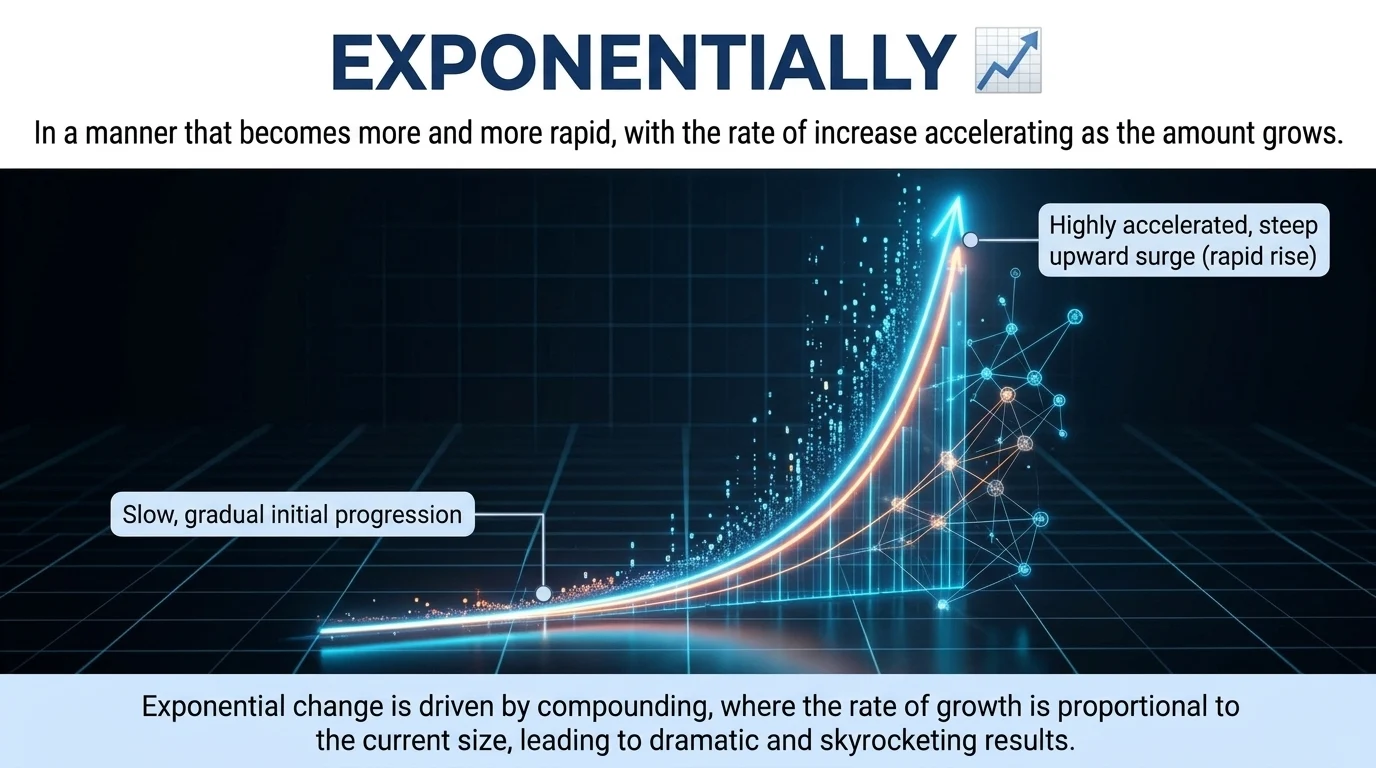
Synonyms of exponentially include rapidly, dramatically, increasingly, sharply, swiftly, and at an accelerating rate. These alternatives describe growth, expansion, or change, but they do not always express the same mathematical meaning. Exponentially specifically describes growth proportional to an amount’s current size. The best replacement depends on the sentence and its context.
Imagine a small online store gaining hundreds of customers within weeks. Its owner might say that sales are growing exponentially as the business expands.
The word appears frequently in technology, science, economics, and everyday conversations. It helps describe changes that become increasingly significant over time.
Learning synonyms of exponentially helps students explain growth clearly. Bloggers and content writers can also use these alternatives to make their sentences more engaging.
Understanding synonyms of exponentially also improves everyday communication. Choosing the right expression helps readers understand whether growth is fast, dramatic, or truly exponential.
What Does Exponentially Really Mean?
Exponentially is an adverb that describes growth or change occurring at a rate proportional to the current amount.
In simple English, something grows exponentially when its increase becomes larger as the existing amount grows.
For example, imagine a population doubling every year:
- Year 1: 100
- Year 2: 200
- Year 3: 400
- Year 4: 800
- Year 5: 1,600
This pattern represents exponential growth because the population increases by the same percentage during each period.
In everyday English, people also use exponentially to emphasize extremely fast or dramatic increases.
However, rapid growth is not automatically exponential in the mathematical sense.
Part of Speech
Exponentially (Adverb)
Definition: In a way that increases or changes according to an exponential pattern.
It modifies verbs such as grow, increase, expand, rise, and multiply.
Example 1: The number of online shoppers increased exponentially.
Example 2: Computing capacity expanded exponentially over several decades.
Connotative Meaning of Exponentially
(Connotation refers to the feelings, attitudes, or associations a word suggests beyond its literal definition.)
Exponentially is generally neutral. Its emotional meaning depends on what is increasing.
Positive Tone
It can suggest exciting progress, impressive development, or expanding opportunities.
Example: The company’s customer base grew exponentially after its successful launch.
Negative Tone
It can describe alarming increases in problems, risks, expenses, or environmental damage.
Example: The number of fraudulent messages increased exponentially during the outbreak.
Neutral Tone
In scientific and mathematical writing, exponentially describes a measurable growth pattern without expressing emotion.
Example: Under the model, the bacterial population increases exponentially.
Etymology of Exponentially
The word exponentially developed from exponential, which comes from exponent.
Exponent traces back to the Latin word exponere, meaning to put forth, set out, or explain.
The Latin elements are ex- (out) and ponere (to place).
In mathematics, an exponent indicates the power to which a number is raised.
The adverb exponentially developed through the addition of the suffix -ly.
Old English Period (450–1100)
Exponentially did not exist in Old English. Mathematical ideas involving multiplication existed, but this modern term had not entered the language.
Middle English Period (1100–1500)
The modern word was still absent. Its Latin foundations existed independently of the later English mathematical terminology.
Modern English Period (1500–Present)
Exponent entered English through mathematical and scholarly usage.
Exponential later became associated with powers and mathematical functions.
Exponentially developed as an adverb and became increasingly common in mathematics, economics, science, and technology.
Today, it also appears in everyday descriptions of dramatic growth.
Pronunciation of Exponentially
- US IPA: /ˌek.spəˈnen.ʃəl.i/
- UK IPA: /ˌek.spəˈnen.ʃəl.i/
The main stress falls on NEN.
Syllables
ex-po-nen-tial-ly
The word has five syllables.
Affixation Pattern
Root: Exponent
Prefix: No productive English prefix is added to the modern base word. Historically, the Latin source contains ex-.
Suffixes: -ial + -ly
Word Formation:
Exponent + -ial → Exponential
Exponential + -ly → Exponentially
The suffix -ly changes the adjective into an adverb.
50 Synonyms of Exponentially With Meanings and Examples
The following alternatives help describe rapid growth, acceleration, multiplication, and increasing intensity.
Important vocabulary note: Exponentially has a precise mathematical meaning. Most alternatives below are contextual synonyms rather than exact mathematical equivalents. Some describe speed, while others emphasize scale, intensity, or multiplication.
Choose each expression according to the intended meaning.
1. Rapidly (Adverb) — US /ˈræp.ɪd.li/ | UK /ˈræp.ɪd.li/
Meaning: At a fast speed or within a short period.
Tone/Register: Neutral, everyday, professional.
Example 1: The city’s population is growing rapidly.
Example 2: Her small business expanded rapidly after the campaign.
2. Quickly (Adverb) — US /ˈkwɪk.li/ | UK /ˈkwɪk.li/
Meaning: At a fast pace without taking much time.
Tone/Register: Neutral, conversational.
Example 1: The video quickly gained thousands of views.
Example 2: Demand for electric vehicles increased quickly.
3. Swiftly (Adverb) — US /ˈswɪft.li/ | UK /ˈswɪft.li/
Meaning: With noticeable speed or promptness.
Tone/Register: Neutral, slightly formal.
Example 1: The company swiftly expanded into new markets.
Example 2: Public interest grew swiftly after the announcement.
4. Dramatically (Adverb) — US /drəˈmæt̬.ɪ.kəl.i/ | UK /drəˈmæt.ɪ.kəl.i/
Meaning: By a large, noticeable, or striking amount.
Tone/Register: Professional, academic, general.
Example 1: Website traffic increased dramatically last month.
Example 2: The cost of living rose dramatically.
5. Sharply (Adverb) — US /ˈʃɑːrp.li/ | UK /ˈʃɑːp.li/
Meaning: Suddenly or considerably in amount or degree.
Tone/Register: Business, journalistic.
Example 1: Energy consumption rose sharply during summer.
Example 2: Online orders increased sharply before the holiday.
6. Steeply (Adverb) — US /ˈstiːp.li/ | UK /ˈstiːp.li/
Meaning: At a particularly high or pronounced rate.
Tone/Register: Academic, financial.
Example 1: Housing prices climbed steeply over five years.
Example 2: Subscription numbers rose steeply after the launch.
7. Significantly (Adverb) — US /sɪɡˈnɪf.ɪ.kənt.li/ | UK /sɪɡˈnɪf.ɪ.kənt.li/
Meaning: By an amount large enough to be important or noticeable.
Tone/Register: Formal, academic, business.
Example 1: The school’s enrollment increased significantly.
Example 2: Production improved significantly after the upgrade.
8. Substantially (Adverb) — US /səbˈstæn.ʃəl.i/ | UK /səbˈstæn.ʃəl.i/
Meaning: By a considerable amount or degree.
Tone/Register: Formal, professional.
Example 1: The company’s revenue grew substantially.
Example 2: Demand for remote services increased substantially.
9. Considerably (Adverb) — US /kənˈsɪd.ɚ.ə.bli/ | UK /kənˈsɪd.ər.ə.bli/
Meaning: To a fairly large or important extent.
Tone/Register: Neutral, formal.
Example 1: The number of participants increased considerably.
Example 2: Her confidence grew considerably after graduation.
10. Markedly (Adverb) — US /ˈmɑːr.kɪd.li/ | UK /ˈmɑː.kɪd.li/
Meaning: In a clearly noticeable or measurable way.
Tone/Register: Academic, professional.
Example 1: Customer engagement improved markedly.
Example 2: Internet usage rose markedly during the study.
11. Noticeably (Adverb) — US /ˈnoʊ.t̬ɪ.sə.bli/ | UK /ˈnəʊ.tɪ.sə.bli/
Meaning: In a way that people can easily observe.
Tone/Register: Neutral, everyday.
Example 1: The audience grew noticeably larger each week.
Example 2: Her speaking skills improved noticeably.
12. Immensely (Adverb) — US /ɪˈmens.li/ | UK /ɪˈmens.li/
Meaning: To an extremely large degree.
Tone/Register: Expressive, general.
Example 1: The brand’s popularity increased immensely.
Example 2: His influence grew immensely after the interview.
13. Enormously (Adverb) — US /ɪˈnɔːr.məs.li/ | UK /ɪˈnɔː.məs.li/
Meaning: By a very large amount or to a great extent.
Tone/Register: Neutral, expressive.
Example 1: The gaming community expanded enormously.
Example 2: Public awareness increased enormously during the campaign.
14. Tremendously (Adverb) — US /trəˈmen.dəs.li/ | UK /trəˈmen.dəs.li/
Meaning: To an exceptionally great degree.
Tone/Register: Conversational, expressive.
Example 1: The podcast’s audience grew tremendously.
Example 2: Her vocabulary improved tremendously through reading.
15. Massively (Adverb) — US /ˈmæs.ɪv.li/ | UK /ˈmæs.ɪv.li/
Meaning: On a very large scale or by a huge amount.
Tone/Register: Informal, media, business.
Example 1: The platform’s user base expanded massively.
Example 2: Interest in the event increased massively overnight.
16. Vastly (Adverb) — US /ˈvæst.li/ | UK /ˈvɑːst.li/
Meaning: By an extremely large degree or extent.
Tone/Register: Formal, descriptive.
Example 1: The company’s international reach grew vastly.
Example 2: The available information increased vastly over time.
17. Greatly (Adverb) — US /ˈɡreɪt.li/ | UK /ˈɡreɪt.li/
Meaning: To a large or important extent.
Tone/Register: Neutral, professional.
Example 1: Demand for digital education increased greatly.
Example 2: The community grew greatly after the festival.
18. Exceptionally (Adverb) — US /ɪkˈsep.ʃən.əl.i/ | UK /ɪkˈsep.ʃən.əl.i/
Meaning: To an unusually high degree compared with normal expectations.
Tone/Register: Formal, descriptive.
Example 1: The startup performed exceptionally well during its first year.
Example 2: Sales grew at an exceptionally fast pace.
19. Remarkably (Adverb) — US /rɪˈmɑːr.kə.bli/ | UK /rɪˈmɑː.kə.bli/
Meaning: In a way that attracts attention because it is unusual or impressive.
Tone/Register: Neutral, expressive.
Example 1: The app’s popularity increased remarkably.
Example 2: Her online following grew remarkably within months.
20. Astonishingly (Adverb) — US /əˈstɑː.nɪ.ʃɪŋ.li/ | UK /əˈstɒn.ɪ.ʃɪŋ.li/
Meaning: To a degree that causes great surprise.
Tone/Register: Expressive, literary.
Example 1: The charity’s support grew astonishingly fast.
Example 2: The number of registrations increased at an astonishingly high rate.
21. Explosively (Adverb) — US /ɪkˈsploʊ.sɪv.li/ | UK /ɪkˈspləʊ.sɪv.li/
Meaning: With sudden, powerful, or extremely rapid expansion.
Tone/Register: Media, informal, business.
Example 1: The mobile gaming industry grew explosively.
Example 2: Interest in the new series increased explosively.
22. Meteorically (Adverb) — US /ˌmiː.t̬i.əˈrɪk.li/ | UK /ˌmiː.ti.əˈrɪk.li/
Meaning: With extraordinary speed, especially when describing rising success.
Tone/Register: Journalistic, expressive.
Example 1: The young singer’s popularity rose meteorically.
Example 2: The startup grew meteorically after receiving international attention.
23. Acceleratingly (Adverb) — US /əkˈsel.ə.reɪ.tɪŋ.li/ | UK /əkˈsel.ə.reɪ.tɪŋ.li/
Meaning: In a manner involving an increasing rate of speed or change.
Tone/Register: Rare, technical.
Example 1: The process advanced at an accelerating rate.
Example 2: The simulation showed acceleratingly rapid growth.
Usage note: Acceleratingly is uncommon. Native speakers usually prefer at an accelerating rate.
24. Progressively (Adverb) — US /prəˈɡres.ɪv.li/ | UK /prəˈɡres.ɪv.li/
Meaning: Gradually through successive stages of development.
Tone/Register: Academic, professional.
Example 1: The workload became progressively heavier.
Example 2: The organization grew progressively larger.
25. Increasingly (Adverb) — US /ɪnˈkriː.sɪŋ.li/ | UK /ɪnˈkriː.sɪŋ.li/
Meaning: To a greater degree as time passes.
Tone/Register: Neutral, academic.
Example 1: Online learning became increasingly popular.
Example 2: The business grew increasingly dependent on digital sales.
26. Continuously (Adverb) — US /kənˈtɪn.ju.əs.li/ | UK /kənˈtɪn.ju.əs.li/
Meaning: Without interruption throughout a period.
Tone/Register: Neutral, technical.
Example 1: The system continuously collected new information.
Example 2: Demand increased continuously throughout the experiment.
27. Unceasingly (Adverb) — US /ʌnˈsiː.sɪŋ.li/ | UK /ʌnˈsiː.sɪŋ.li/
Meaning: Without stopping or coming to an end.
Tone/Register: Formal, literary.
Example 1: Requests for assistance increased unceasingly.
Example 2: The fictional city’s population grew unceasingly.
28. Relentlessly (Adverb) — US /rɪˈlent.ləs.li/ | UK /rɪˈlent.ləs.li/
Meaning: In a persistent manner without slowing or stopping.
Tone/Register: Expressive, professional.
Example 1: Competition intensified relentlessly.
Example 2: The pressure on local hospitals increased relentlessly.
29. Incessantly (Adverb) — US /ɪnˈses.ənt.li/ | UK /ɪnˈses.ənt.li/
Meaning: Constantly, often to an excessive or irritating degree.
Tone/Register: Formal, often negative.
Example 1: Notifications multiplied incessantly throughout the afternoon.
Example 2: Complaints increased incessantly during the service disruption.
30. Uninterruptedly (Adverb) — US /ˌʌn.ɪn.t̬əˈrʌp.tɪd.li/ | UK /ˌʌn.ɪn.təˈrʌp.tɪd.li/
Meaning: Without breaks or interruptions.
Tone/Register: Formal, technical.
Example 1: The population increased uninterruptedly during the observed period.
Example 2: The production line operated uninterruptedly throughout the night.
31. Multiplicatively (Adverb) — US /ˌmʌl.tə.plɪˈkeɪ.tɪv.li/ | UK /ˌmʌl.tɪ.plɪˈkeɪ.tɪv.li/
Meaning: Through multiplication rather than simple addition.
Tone/Register: Mathematical, academic.
Example 1: The model combines several factors multiplicatively.
Example 2: The investment simulation applies growth rates multiplicatively.
32. Geometrically (Adverb) — US /ˌdʒiː.əˈmet.rɪ.kəl.i/ | UK /ˌdʒiː.əˈmet.rɪ.kəl.i/
Meaning: According to a geometric progression involving repeated multiplication by a constant ratio.
Tone/Register: Mathematical, academic.
Example 1: The sequence grows geometrically with a common ratio of three.
Example 2: The modeled population increases geometrically each generation.
33. Compoundingly (Adverb) — US /kəmˈpaʊn.dɪŋ.li/ | UK /kəmˈpaʊn.dɪŋ.li/
Meaning: In a manner where successive increases build upon previous increases.
Tone/Register: Rare, financial.
Example 1: The savings accumulated through compounding returns.
Example 2: The modeled amount increased in a compounding manner.
Usage note: Compoundingly is rare. Through compounding is more natural in standard English.
34. Proportionally (Adverb) — US /prəˈpɔːr.ʃən.əl.i/ | UK /prəˈpɔː.ʃən.əl.i/
Meaning: In a way that maintains a particular mathematical relationship between quantities.
Tone/Register: Academic, technical.
Example 1: The growth rate remained proportional to the existing population.
Example 2: The model increased the quantity proportionally to its current size.
35. Repeatedly (Adverb) — US /rɪˈpiː.tɪd.li/ | UK /rɪˈpiː.tɪd.li/
Meaning: Again and again over successive occasions.
Tone/Register: Neutral, everyday.
Example 1: The program repeatedly doubled the starting value.
Example 2: The experiment repeatedly multiplied the sample count by two.
36. Successively (Adverb) — US /səkˈses.ɪv.li/ | UK /səkˈses.ɪv.li/
Meaning: In consecutive stages or one after another.
Tone/Register: Formal, academic.
Example 1: The researchers successively doubled the simulated population.
Example 2: Each generation successively multiplied the original quantity.
37. Cumulatively (Adverb) — US /ˈkjuː.mjə.lə.tɪv.li/ | UK /ˈkjuː.mjə.lə.tɪv.li/
Meaning: Through the combined effect of successive additions or changes.
Tone/Register: Academic, financial.
Example 1: The project’s total expenses increased cumulatively.
Example 2: Small improvements cumulatively produced a major result.
38. Abundantly (Adverb) — US /əˈbʌn.dənt.li/ | UK /əˈbʌn.dənt.li/
Meaning: In large quantities or more than sufficient amounts.
Tone/Register: Neutral, descriptive.
Example 1: Wildflowers multiplied abundantly across the meadow.
Example 2: Resources became abundantly available after the harvest.
39. Profusely (Adverb) — US /prəˈfjuːs.li/ | UK /prəˈfjuːs.li/
Meaning: In unusually large or generous quantities.
Tone/Register: Descriptive, literary.
Example 1: The plants spread profusely after the rainfall.
Example 2: Flowers multiplied profusely throughout the garden.
40. Extensively (Adverb) — US /ɪkˈsten.sɪv.li/ | UK /ɪkˈsten.sɪv.li/
Meaning: Over a wide area or to a considerable extent.
Tone/Register: Formal, professional.
Example 1: The network expanded extensively across rural communities.
Example 2: The service grew extensively throughout the region.
41. Widely (Adverb) — US /ˈwaɪd.li/ | UK /ˈwaɪd.li/
Meaning: Across a broad area, population, or range.
Tone/Register: Neutral, everyday.
Example 1: The educational program spread widely.
Example 2: News of the discovery circulated widely online.
42. Broadly (Adverb) — US /ˈbrɑːd.li/ | UK /ˈbrɔːd.li/
Meaning: Across a wide range or extensive scope.
Tone/Register: Professional, neutral.
Example 1: The initiative expanded broadly across several industries.
Example 2: The company’s services became broadly available.
43. Intensely (Adverb) — US /ɪnˈtens.li/ | UK /ɪnˈtens.li/
Meaning: To a particularly strong or extreme degree.
Tone/Register: Descriptive, expressive.
Example 1: Competition grew intensely fierce during the final round.
Example 2: Public interest increased intensely after the announcement.
44. Disproportionately (Adverb) — US /ˌdɪs.prəˈpɔːr.ʃən.ət.li/ | UK /ˌdɪs.prəˈpɔː.ʃən.ət.li/
Meaning: To an extent that is unusually large compared with another quantity.
Tone/Register: Academic, analytical.
Example 1: Housing costs rose disproportionately compared with wages.
Example 2: Demand increased disproportionately in urban areas.
45. Overwhelmingly (Adverb) — US /ˌoʊ.vɚˈwel.mɪŋ.li/ | UK /ˌəʊ.vəˈwel.mɪŋ.li/
Meaning: To an extremely large or dominant degree.
Tone/Register: Formal, expressive.
Example 1: Support for the proposal grew overwhelmingly strong.
Example 2: Public interest became overwhelmingly positive.
46. At an Accelerating Rate (Adverbial Phrase) — US /ət ən əkˈsel.ə.reɪ.tɪŋ reɪt/ | UK /ət ən əkˈsel.ə.reɪ.tɪŋ reɪt/
Meaning: With the speed of increase becoming greater over time.
Tone/Register: Academic, business, general.
Example 1: The number of subscribers grew at an accelerating rate.
Example 2: Demand for renewable energy increased at an accelerating rate.
47. At an Increasing Pace (Adverbial Phrase) — US /ət ən ɪnˈkriː.sɪŋ peɪs/ | UK /ət ən ɪnˈkriː.sɪŋ peɪs/
Meaning: With the pace of development becoming progressively faster.
Tone/Register: Professional, neutral.
Example 1: New businesses opened at an increasing pace.
Example 2: The research project expanded at an increasing pace.
48. By Leaps and Bounds (Adverbial Idiom) — US /baɪ liːps ən baʊndz/ | UK /baɪ liːps ən baʊndz/
Meaning: Very quickly and through impressive improvements or advances.
Tone/Register: Informal, conversational.
Example 1: Her English improved by leaps and bounds.
Example 2: The team’s performance developed by leaps and bounds.
49. At a Breakneck Pace (Adverbial Phrase) — US /ət ə ˈbreɪk.nek peɪs/ | UK /ət ə ˈbreɪk.nek peɪs/
Meaning: At an extremely fast and sometimes risky speed.
Tone/Register: Informal, expressive.
Example 1: The technology industry expanded at a breakneck pace.
Example 2: The city developed at a breakneck pace.
50. By Multiples (Adverbial Phrase) — US /baɪ ˈmʌl.tə.pəlz/ | UK /baɪ ˈmʌl.tɪ.pəlz/
Meaning: Through increases involving several times an original amount.
Tone/Register: Business, mathematical.
Example 1: The investment grew by multiples of its starting value.
Example 2: The experimental quantity increased by multiples during each stage.
Vocabulary accuracy note: The expressions in this collection are not universally interchangeable. Geometrically is especially close in discrete mathematical contexts. Words such as widely, continuously, and intensely describe related dimensions of growth rather than its exponential pattern.
Synonyms of Exponentially by Tone
Tone matters because the same increase can represent progress, danger, surprise, or an ordinary measurable change.
A carefully selected synonym helps readers understand both the information and the writer’s attitude.
Positive Tone
- Remarkably
- Tremendously
- Significantly
- Meteorically
- By leaps and bounds
- Exceptionally
- Greatly
These expressions work well when discussing success, learning, achievement, or positive development.
Neutral Tone
- Rapidly
- Quickly
- Progressively
- Increasingly
- Geometrically
- Multiplicatively
- At an accelerating rate
- Proportionally
These choices are useful when describing growth without adding strong emotional judgment.
Negative Tone
- Relentlessly
- Incessantly
- Sharply
- Disproportionately
- Explosively
- At a breakneck pace
These alternatives can describe rising expenses, environmental damage, growing risks, or situations becoming difficult to control.
Playful and Informal Tone
- Massively
- Enormously
- Astonishingly
- By leaps and bounds
- At a breakneck pace
These expressions can make casual writing more lively.
For example:
“My unread messages are multiplying at a breakneck pace!”
The sentence sounds playful while emphasizing a familiar everyday frustration.
Exponentially vs Close Alternatives
Exponentially, rapidly, geometrically, and dramatically can all appear in descriptions of growth. However, their meanings differ.
| Expression | Meaning Difference | Tone | Best Use |
|---|---|---|---|
| Exponentially | Growth proportional to the current quantity | Mathematical, neutral | Scientific and measurable growth |
| Rapidly | Growth occurring quickly | Neutral | Everyday descriptions |
| Geometrically | Growth through a repeated constant ratio | Mathematical | Discrete sequences and models |
| Dramatically | A large or striking change | Expressive | Emphasizing noticeable results |
Exponentially vs Rapidly
Rapidly describes speed.
Exponentially describes a specific mathematical relationship.
A company’s sales can increase rapidly without increasing exponentially.
Exponentially vs Geometrically
These expressions are closely related in mathematical discussions.
Geometric growth usually describes a discrete sequence. Exponential growth is often modeled using a continuous function or repeated proportional growth.
For example, a sequence that doubles each year is geometric. Its values can also be represented using an exponential expression.
Exponentially vs Dramatically
Dramatically highlights the size or impact of a change.
It does not explain the mathematical pattern behind that change.
Use dramatically when the exact growth model is unknown.
How Exponentially Changes by Context
Daily Conversation
In casual English, exponentially often emphasizes an increase that feels surprisingly fast.
Example: “My workload has grown exponentially this month.”
The speaker probably means that their responsibilities have increased considerably.
Writing and Blogging
Content writers use exponentially when discussing audience growth, digital trends, business development, and technology.
However, rapidly or dramatically may sound more natural when the article does not provide mathematical evidence.
Example: “Interest in sustainable fashion has increased dramatically.”
Professional and Academic Writing
Academic writing requires greater precision.
Use exponentially when evidence supports an exponential relationship.
Example: “Under ideal conditions, the modeled bacterial population grows exponentially.”
If the evidence only indicates a substantial increase, use significantly, sharply, or considerably.
Creative and Informal Writing
Creative writers can use more expressive alternatives.
Example: “Her excitement grew by leaps and bounds as the concert approached.”
This expression communicates enthusiasm without making a mathematical claim.
Common Mistakes Learners Make
Mistake 1: Treating Every Fast Increase as Exponential
Incorrect: “My salary increased exponentially because I received a small raise.”
Better: “My salary increased slightly after my annual review.”
A single increase does not establish exponential growth.
Mistake 2: Confusing Exponential and Linear Growth
Linear growth adds a constant amount during equal intervals.
Exponential growth increases by a constant proportion during equal intervals.
For example:
| Year | Linear Growth | Exponential Growth |
|---|---|---|
| 1 | 100 | 100 |
| 2 | 200 | 200 |
| 3 | 300 | 400 |
| 4 | 400 | 800 |
| 5 | 500 | 1,600 |
The first sequence adds 100 each year.
The second sequence doubles each year.
Mistake 3: Using Exponentially as an Adjective
Incorrect: “The company experienced an exponentially increase.”
Correct: “The company experienced an exponential increase.”
Correct: “The company’s revenue increased exponentially.”
Exponential is an adjective. Exponentially is an adverb.
Mistake 4: Using Dramatic Alternatives in Every Sentence
Words such as massively, enormously, and astonishingly can make writing sound exaggerated when overused.
Choose neutral vocabulary when the facts do not justify strong emphasis.
Mistake 5: Confusing Continuous Growth With Exponential Growth
Continuous growth simply means growth that occurs without interruption.
It does not necessarily indicate an increasing rate.
A quantity can increase continuously at a constant rate.
Native Usage and Register Notes
Formal English
Formal and academic writers commonly use:
- Exponentially
- Significantly
- Substantially
- Geometrically
- Multiplicatively
- At an accelerating rate
These expressions suit reports, research papers, and analytical discussions.
Informal English
In everyday conversation, speakers often prefer:
- Rapidly
- Quickly
- Massively
- Enormously
- By leaps and bounds
These alternatives are easier to understand in casual situations.
Spoken vs Written English
Exponentially appears in both spoken and written English.
However, it is particularly common in discussions involving science, technology, economics, and data.
In ordinary speech, people may simply say “really fast” or “much faster.”
For further vocabulary practice, explore the related topic of synonyms of rapidly.
Real-Life Examples Using Exponentially
Workplace Scenario
A marketing manager notices that the company’s online audience doubles every month.
She says:
“Our social media following is growing exponentially.”
The expression is appropriate if the doubling pattern continues.
Social Situation
A student joins a language club and becomes much more confident.
A friend says:
“Your English has improved by leaps and bounds!”
The idiom sounds natural because it describes impressive progress.
Media and Pop Culture
A new television series suddenly attracts millions of viewers.
A journalist writes:
“The show’s popularity rose meteorically after its premiere.”
Meteorically emphasizes the surprising speed of its success.
Writing and Storytelling
A writer describes a fictional city experiencing a mysterious outbreak.
“The number of infections multiplied at an accelerating rate.”
This expression creates urgency without requiring the writer to establish an exact exponential model.
Interactive Practice Quiz: Test Your Vocabulary
Choose the most suitable answer for each situation.
Part One: Meaning and Context
1. A scientist observes a population doubling every hour. Which word best describes its growth?
A) Slowly
B) Exponentially
C) Randomly
D) Occasionally
2. A blogger wants to describe a large, noticeable increase in website traffic without claiming a mathematical pattern.
A) Dramatically
B) Quietly
C) Rarely
D) Casually
3. A student’s English improves very quickly. Which expression sounds most natural?
A) By leaps and bounds
B) Disproportionately
C) Geometrically
D) Incessantly
4. A company experiences a sudden and powerful expansion. Which word fits best?
A) Gradually
B) Explosively
C) Slightly
D) Normally
5. A report describes an increase that is important and measurable. Which alternative is most appropriate?
A) Playfully
B) Significantly
C) Accidentally
D) Silently
6. A mathematical sequence repeatedly multiplies each term by three. Which word best describes its growth?
A) Geometrically
B) Randomly
C) Broadly
D) Gently
Part Two: Tone and Real-Life Usage
7. A journalist describes a singer’s unusually fast rise to fame.
A) Uninterruptedly
B) Meteorically
C) Proportionally
D) Cumulatively
8. Housing costs rise much faster than average wages. Which word highlights the imbalance?
A) Equally
B) Disproportionately
C) Smoothly
D) Normally
9. A company expands extremely quickly, creating pressure on its employees.
A) At a breakneck pace
B) At a relaxed pace
C) Occasionally
D) Slightly
10. A researcher wants to describe growth becoming faster over time without claiming a specific mathematical pattern.
A) At an accelerating rate
B) At a constant rate
C) Without change
D) At random
11. A business gains customers very quickly. Which simple everyday alternative is suitable?
A) Rapidly
B) Rarely
C) Quietly
D) Separately
12. A writer describes problems increasing continuously without relief.
A) Relentlessly
B) Cheerfully
C) Briefly
D) Casually
13. A student wants to describe a surprisingly large improvement.
A) Astonishingly
B) Minimally
C) Normally
D) Slightly
14. A financial model calculates returns by multiplying successive growth factors. Which word fits best?
A) Multiplicatively
B) Accidentally
C) Emotionally
D) Casually
15. A report shows that a company’s revenue increased by a large amount, but its growth pattern is unknown.
A) Significantly
B) Exponentially
C) Geometrically
D) Randomly
Answer Key
1-B | 2-A | 3-A | 4-B | 5-B | 6-A | 7-B | 8-B | 9-A | 10-A | 11-A | 12-A | 13-A | 14-A | 15-A
Reflection and Application Task
Think about something that has grown or improved in your life.
It could be your confidence, vocabulary, social media audience, or professional skills.
Write one original sentence using an alternative to exponentially.
Then explain why your chosen expression fits the situation.
Suggested External Reference
Cambridge Dictionary: Exponentially — Meaning and Pronunciation
This dictionary is a useful reference for checking the word’s definition, pronunciation, grammatical role, and standard English usage.
Conclusion
Learning synonyms of exponentially helps you describe growth with greater confidence. Each alternative offers a different way to express speed, scale, or intensity.
The right vocabulary makes your writing clearer and your blogging more engaging. It also helps you explain ideas naturally without exaggerating important details.
Strong word choices improve speaking and everyday communication. Understanding small differences between similar expressions helps your message feel more precise.
Practice these words in emails, essays, and daily conversations. Try replacing familiar expressions with suitable alternatives and watch your vocabulary grow.
Frequently Asked Questions About Exponentially
1. What is another word for exponentially in business writing?
In business writing, suitable alternatives include rapidly, substantially, significantly, dramatically, and at an accelerating rate.
Choose significantly when discussing an important measurable change. Use rapidly when emphasizing speed. At an accelerating rate is useful when the pace of growth itself increases.
Exponentially remains appropriate when business data supports a proportional growth pattern.
2. Can exponentially be used to describe negative growth?
Yes. Exponentially can describe exponential decay as well as exponential growth.
For example, a radioactive substance may decrease exponentially over time.
However, a negative growth rate does not automatically establish an exponential pattern. The quantity must follow the relevant mathematical relationship.
In everyday English, exponentially is more frequently associated with increasing quantities.
3. What is the difference between exponentially and exponentially faster?
Exponentially describes a pattern of growth or change.
Exponentially faster suggests that speed itself increases according to an exponential relationship.
For example, saying that a computer is exponentially faster than an older model may sound impressive, but the statement needs a clear mathematical basis to be technically precise.
In ordinary comparisons, much faster or significantly faster is often clearer.
4. Is exponentially an appropriate word for describing social media growth?
Yes, provided the context supports its use.
A social media account that repeatedly doubles its audience over equal periods may demonstrate approximately exponential growth.
However, gaining thousands of followers after one viral post does not automatically establish that pattern.
For general descriptions, rapidly, dramatically, or explosively may communicate the situation more accurately.
5. What are the best simple alternatives to exponentially for ESL learners?
Rapidly, quickly, sharply, and dramatically are useful starting points.
Rapidly and quickly describe speed. Sharply describes a pronounced increase or decrease. Dramatically emphasizes a striking change.
These words are common in news articles, conversations, and professional writing.
Learning their differences helps English learners communicate growth without relying on complicated mathematical vocabulary.
6. Does exponentially always mean doubling?
No. Exponential growth does not require a quantity to double.
It can involve repeated increases of 5%, 10%, 20%, or another constant percentage over equal periods.
Doubling is simply one familiar example.
The essential feature is that the change remains proportional to the existing quantity, rather than adding the same fixed amount each time.
7. What is the opposite of exponentially?
There is no single opposite that works in every context.
Linearly is a useful contrast when comparing mathematical growth patterns. It describes change by a constant amount during equal intervals.
For speed-related contexts, slowly or gradually may express the intended contrast.
Exponentially decreasing is not the opposite of exponential behavior. It is another form of an exponential relationship.
8. Is exponentially overused in modern English?
Exponentially is sometimes used loosely to describe any dramatic increase, especially in marketing, technology discussions, and everyday conversation.
This usage is understandable, but it can reduce precision.
When the mathematical pattern is unknown, alternatives such as rapidly, significantly, or dramatically may be more suitable.
Accurate vocabulary makes informative writing more credible and easier to understand.

Mehtab Yasir is a passionate writer and English language enthusiast dedicated to making vocabulary learning simple, practical, and enjoyable. As an author at SynonymDesk.com, she creates helpful content covering synonyms, antonyms, word meanings, vocabulary, phrases, and everyday English usage. Her goal is to provide clear and easy-to-understand information that helps students, writers, professionals, and English learners choose the right words and communicate with greater confidence. Mehtab believes that a strong vocabulary can improve both writing and communication skills. She enjoys researching new words, exploring their meanings and uses, and turning complex language concepts into useful, reader-friendly content. Through her work, she strives to make SynonymDesk.com a reliable resource for anyone looking to improve their English vocabulary and language skills.