Synonyms of grossly include excessively, severely, extremely, outrageously, blatantly, significantly, shockingly, and enormously. Grossly is an adverb used to describe something done to an unacceptable, extreme, or unusually large degree. The best alternative depends on context, especially whether you are describing a serious mistake, unfair behavior, exaggerated information, or excessive amounts.
Imagine receiving a grossly inaccurate bill. The total is much higher than expected, and several charges are incorrect. One word captures the seriousness of the problem.
Expressions such as grossly unfair and grossly exaggerated appear frequently in news, academic discussions, business reports, and everyday English.
Learning synonyms of grossly helps students, bloggers, content writers, and English learners communicate more precisely without repeating the same expression.
This guide explores 50 related alternatives, their meanings, pronunciations, and examples. You will also discover how to choose each word naturally.
What Does Grossly Really Mean?
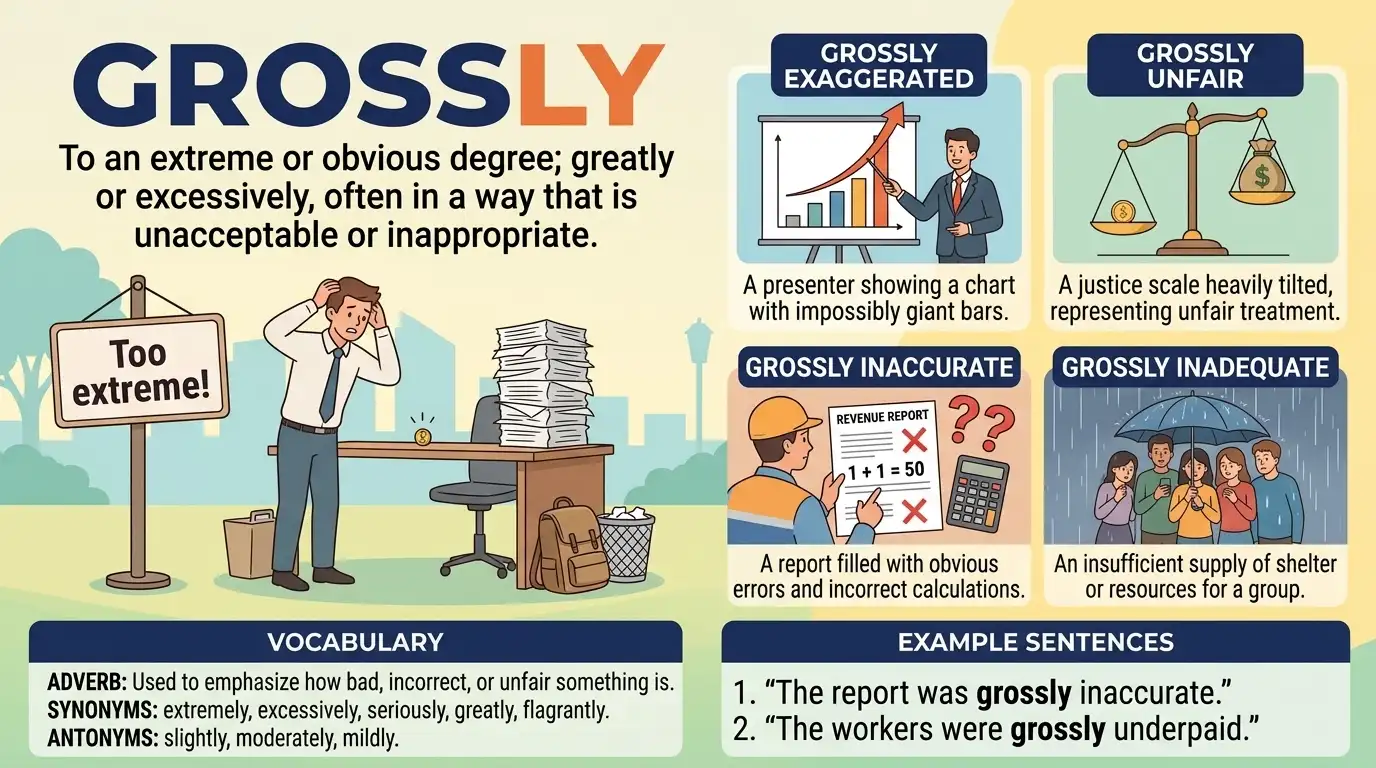
Grossly means to an extreme, excessive, obvious, or unacceptable degree. It usually emphasizes that something is seriously wrong, unusually large, or far beyond reasonable limits.
It is particularly useful when describing errors, unfairness, negligence, exaggeration, and inappropriate behavior.
For example:
- The report was grossly inaccurate.
- The workers were grossly underpaid.
- His comments were grossly inappropriate.
- The company grossly underestimated its expenses.
In these examples, grossly communicates more than ordinary intensity. It suggests that the situation deserves attention because the degree is unusually serious.
Part of Speech
Grossly: Adverb
An adverb modifies a verb, adjective, or another adverb.
Grossly commonly modifies adjectives such as inaccurate, unfair, negligent, misleading, exaggerated, and inappropriate.
Simple definition: In an extremely serious, excessive, or unacceptable way.
How Native Speakers Understand Grossly
Native speakers generally interpret grossly as a strong intensifier.
Consider these sentences:
“The information was inaccurate.”
“The information was grossly inaccurate.”
The second sentence suggests a much greater problem. The information may be seriously misleading rather than slightly incorrect.
Grossly can also describe an obvious or shocking violation of acceptable standards.
Connotative Meaning of Grossly
(Connotation is the emotional or cultural meaning a word suggests beyond its basic dictionary definition.)
Grossly usually carries a negative connotation. However, its emotional effect depends on the expression surrounding it.
Positive Tone
Grossly rarely expresses something positive.
A phrase such as “grossly successful” sounds unnatural in standard English because grossly commonly suggests excess or disapproval.
For positive emphasis, words such as exceptionally, remarkably, and extraordinarily are usually better choices.
Negative Tone
This is the most common use.
Grossly can express criticism, disappointment, shock, or serious concern.
Example: The manager was grossly negligent when handling customer information.
The sentence suggests that the negligence was especially serious.
Neutral Tone
Grossly can appear in factual or technical statements about substantial differences.
Example: The initial estimate grossly exceeded the actual cost.
Although the sentence is factual, grossly still emphasizes an unusually large discrepancy.
Etymology of Grossly
Grossly developed from the adjective gross, combined with the English adverb-forming suffix -ly.
The adjective gross entered English through Old French gros, meaning large, thick, or coarse. Its earlier Latin source is grossus, meaning thick or coarse.
Over time, gross acquired additional meanings connected with seriousness, excess, and unacceptable behavior.
Old English (450–1100)
Grossly did not exist as an established English word during the Old English period.
However, Old English already used forms that later contributed to the productive adverb-forming suffix -ly.
Middle English (1100–1500)
The adjective gross entered Middle English through French influence.
It initially described physical qualities such as thickness, size, and coarseness.
The related adverb developed with meanings connected to coarseness and lack of refinement.
Modern English (1500–Present)
Grossly gradually developed broader figurative meanings.
Today, speakers commonly use it to emphasize serious errors, excessive quantities, unacceptable conduct, and substantial misjudgments.
Expressions such as grossly misleading and grossly unfair are established in modern English.
Pronunciation of Grossly
American English (US)
IPA: /ˈɡroʊs.li/
British English (UK)
IPA: /ˈɡrəʊs.li/
The main stress falls on the first syllable.
Syllables
Gross-ly
Total syllables: 2
Affixation Pattern of Grossly
Root: Gross
Prefix: None
Suffix: -ly
Formation: Gross (adjective) + -ly (adverb)
The suffix transforms the adjective into an adverb describing manner or degree.
Synonyms List
The following collection includes 50 alternatives and closely related expressions.
Because grossly has several shades of meaning, these words are organized through individual explanations. Some replace grossly when describing extreme intensity, while others work better for obvious wrongdoing, excessive quantities, or serious inaccuracies.
Not every alternative is interchangeable in every sentence. Always consider the adjective or verb that follows it.
1. Excessively (Adverb) — US /ɪkˈses.ɪv.li/ | UK /ɪkˈses.ɪv.li/
Meaning: To a degree that goes beyond what is reasonable, necessary, or acceptable.
Tone/Register: Neutral, formal, professional.
Example 1: The hotel charged excessively for basic services.
Example 2: She was excessively critical of minor mistakes.
2. Extremely (Adverb) — US /ɪkˈstriːm.li/ | UK /ɪkˈstriːm.li/
Meaning: To a very high degree or intensity.
Tone/Register: Neutral, everyday English.
Example 1: The instructions were extremely confusing.
Example 2: The new schedule was extremely inconvenient.
3. Severely (Adverb) — US /səˈvɪr.li/ | UK /sɪˈvɪə.li/
Meaning: To a serious, harsh, or damaging degree.
Tone/Register: Formal, professional, academic.
Example 1: The storm severely damaged several houses.
Example 2: The company severely underestimated the risks.
4. Outrageously (Adverb) — US /aʊtˈreɪ.dʒəs.li/ | UK /aʊtˈreɪ.dʒəs.li/
Meaning: Shockingly or unacceptably that exceeds reasonable limits.
Tone/Register: Strong, emotional, critical.
Example 1: The tickets were outrageously expensive.
Example 2: The official behaved outrageously during the interview.
5. Blatantly (Adverb) — US /ˈbleɪ.tənt.li/ | UK /ˈbleɪ.tənt.li/
Meaning: In an obvious and often shameless way, especially when doing something wrong.
Tone/Register: Critical, journalistic, formal.
Example 1: The advertisement was blatantly misleading.
Example 2: He blatantly ignored the safety instructions.
6. Egregiously (Adverb) — US /ɪˈɡriː.dʒəs.li/ | UK /ɪˈɡriː.dʒəs.li/
Meaning: In an exceptionally bad or unacceptable manner.
Tone/Register: Formal, legal, academic.
Example 1: The organization behaved egregiously toward its employees.
Example 2: The article was egregiously inaccurate.
7. Shockingly (Adverb) — US /ˈʃɑː.kɪŋ.li/ | UK /ˈʃɒk.ɪŋ.li/
Meaning: To a degree that causes surprise, concern, or disbelief.
Tone/Register: Emotional, journalistic.
Example 1: The hospital was shockingly understaffed.
Example 2: The survey results were shockingly inaccurate.
8. Appallingly (Adverb) — US /əˈpɑː.lɪŋ.li/ | UK /əˈpɔː.lɪŋ.li/
Meaning: In an extremely bad way that causes strong disapproval or horror.
Tone/Register: Strong, critical, formal.
Example 1: The building was appallingly maintained.
Example 2: The passengers were treated appallingly.
9. Terribly (Adverb) — US /ˈter.ə.bli/ | UK /ˈter.ə.bli/
Meaning: To a very serious or unpleasant degree.
Tone/Register: Conversational, emotional.
Example 1: The entire project was terribly organized.
Example 2: I felt terribly embarrassed after the mistake.
10. Dreadfully (Adverb) — US /ˈdred.fəl.i/ | UK /ˈdred.fəl.i/
Meaning: To an extremely bad or unpleasant extent.
Tone/Register: Expressive, conversational, sometimes literary.
Example 1: The event was dreadfully planned.
Example 2: The children were dreadfully disappointed.
11. Awfully (Adverb) — US /ˈɑː.fəl.i/ | UK /ˈɔː.fəl.i/
Meaning: Very or extremely, especially when emphasizing an unpleasant situation.
Tone/Register: Informal, conversational.
Example 1: The room was awfully crowded.
Example 2: The service was awfully slow yesterday.
12. Horribly (Adverb) — US /ˈhɔːr.ə.bli/ | UK /ˈhɒr.ə.bli/
Meaning: In an extremely unpleasant, offensive, or unsuccessful way.
Tone/Register: Emotional, everyday English.
Example 1: The interview went horribly wrong.
Example 2: The customers were horribly mistreated.
13. Abominably (Adverb) — US /əˈbɑː.mə.nə.bli/ | UK /əˈbɒm.ɪ.nə.bli/
Meaning: In an exceptionally bad or offensive manner.
Tone/Register: Strong, literary, formal.
Example 1: The prisoners were treated abominably.
Example 2: The restaurant was abominably managed.
14. Atrociously (Adverb) — US /əˈtroʊ.ʃəs.li/ | UK /əˈtrəʊ.ʃəs.li/
Meaning: In an extremely bad or unacceptable way.
Tone/Register: Strong, critical.
Example 1: The match was atrociously refereed.
Example 2: The residents were atrociously neglected.
15. Disgracefully (Adverb) — US /dɪsˈɡreɪs.fəl.i/ | UK /dɪsˈɡreɪs.fəl.i/
Meaning: In a shameful manner that falls below expected standards.
Tone/Register: Critical, formal.
Example 1: The complaint was disgracefully ignored.
Example 2: Several customers were disgracefully mistreated.
16. Shamefully (Adverb) — US /ˈʃeɪm.fəl.i/ | UK /ˈʃeɪm.fəl.i/
Meaning: In a way that deserves criticism or embarrassment.
Tone/Register: Moral, critical.
Example 1: The workers were shamefully underpaid.
Example 2: The incident was shamefully concealed.
17. Scandalously (Adverb) — US /ˈskæn.dəl.əs.li/ | UK /ˈskæn.dəl.əs.li/
Meaning: In a shocking or improper manner that may provoke public criticism.
Tone/Register: Journalistic, formal.
Example 1: The facilities were scandalously inadequate.
Example 2: The charity’s funds were scandalously mismanaged.
18. Unacceptably (Adverb) — US /ˌʌn.əkˈsep.tə.bli/ | UK /ˌʌn.əkˈsep.tə.bli/
Meaning: To a degree that fails to meet reasonable or established standards.
Tone/Register: Professional, formal.
Example 1: The delivery was unacceptably late.
Example 2: The emergency response was unacceptably slow.
19. Intolerably (Adverb) — US /ɪnˈtɑː.lɚ.ə.bli/ | UK /ɪnˈtɒl.ər.ə.bli/
Meaning: To such an unpleasant degree that something becomes difficult to endure.
Tone/Register: Formal, emotional.
Example 1: The apartment became intolerably hot.
Example 2: The working conditions were intolerably harsh.
20. Unreasonably (Adverb) — US /ʌnˈriː.zən.ə.bli/ | UK /ʌnˈriː.zən.ə.bli/
Meaning: Beyond what is fair, sensible, or justified.
Tone/Register: Professional, critical.
Example 1: The landlord raised the rent unreasonably.
Example 2: The supervisor was unreasonably demanding.
21. Unduly (Adverb) — US /ʌnˈduː.li/ | UK /ʌnˈdjuː.li/
Meaning: To an excessive or inappropriate degree.
Tone/Register: Formal, legal, academic.
Example 1: The decision unduly affected smaller businesses.
Example 2: The application process was unduly complicated.
22. Inordinately (Adverb) — US /ɪnˈɔːr.dən.ət.li/ | UK /ɪnˈɔː.dɪ.nət.li/
Meaning: To an unusually excessive or unreasonable degree.
Tone/Register: Formal, literary.
Example 1: The repairs took an inordinately long time.
Example 2: The project became inordinately expensive.
23. Immoderately (Adverb) — US /ɪˈmɑː.dɚ.ət.li/ | UK /ɪˈmɒd.ər.ət.li/
Meaning: Without reasonable limits or moderation.
Tone/Register: Formal, literary.
Example 1: He spent immoderately during the holiday.
Example 2: The proposal was immoderately ambitious.
24. Exorbitantly (Adverb) — US /ɪɡˈzɔːr.bə.tənt.li/ | UK /ɪɡˈzɔː.bɪ.tənt.li/
Meaning: To an excessively high or unreasonable degree, especially concerning costs.
Tone/Register: Business, formal.
Example 1: The airport restaurant was exorbitantly expensive.
Example 2: The supplier charged exorbitantly for replacement parts.
25. Extravagantly (Adverb) — US /ɪkˈstræv.ə.ɡənt.li/ | UK /ɪkˈstræv.ə.ɡənt.li/
Meaning: In an excessive or unusually elaborate manner.
Tone/Register: Neutral to critical, descriptive.
Example 1: The wedding was extravagantly decorated.
Example 2: The campaign was extravagantly funded.
26. Disproportionately (Adverb) — US /ˌdɪs.prəˈpɔːr.ʃən.ət.li/ | UK /ˌdɪs.prəˈpɔː.ʃən.ət.li/
Meaning: To a degree that is too large or too small compared with something else.
Tone/Register: Academic, professional.
Example 1: Small businesses were disproportionately affected.
Example 2: The punishment was disproportionately severe.
27. Overwhelmingly (Adverb) — US /ˌoʊ.vɚˈwel.mɪŋ.li/ | UK /ˌəʊ.vəˈwel.mɪŋ.li/
Meaning: To an extremely great or dominant degree.
Tone/Register: Neutral, academic, journalistic.
Example 1: The feedback was overwhelmingly negative.
Example 2: The evidence was overwhelmingly against the proposal.
28. Enormously (Adverb) — US /ɪˈnɔːr.məs.li/ | UK /ɪˈnɔː.məs.li/
Meaning: To a very great extent or degree.
Tone/Register: Neutral, everyday English.
Example 1: The renovation costs increased enormously.
Example 2: The workload grew enormously after the merger.
29. Immensely (Adverb) — US /ɪˈmens.li/ | UK /ɪˈmens.li/
Meaning: To an exceptionally great degree.
Tone/Register: Neutral, descriptive.
Example 1: The assignment became immensely difficult.
Example 2: The decision was immensely unpopular.
30. Vastly (Adverb) — US /ˈvæst.li/ | UK /ˈvɑːst.li/
Meaning: By a very large amount or degree.
Tone/Register: Neutral, academic, professional.
Example 1: The company vastly underestimated demand.
Example 2: The original figures were vastly different.
31. Greatly (Adverb) — US /ˈɡreɪt.li/ | UK /ˈɡreɪt.li/
Meaning: To a considerable or important extent.
Tone/Register: Neutral, formal.
Example 1: The announcement greatly disappointed investors.
Example 2: The error greatly affected the final results.
32. Significantly (Adverb) — US /sɪɡˈnɪf.ɪ.kənt.li/ | UK /sɪɡˈnɪf.ɪ.kənt.li/
Meaning: To a noticeable, meaningful, or important degree.
Tone/Register: Academic, professional.
Example 1: The report significantly underestimated expenses.
Example 2: The delay significantly affected production.
33. Substantially (Adverb) — US /səbˈstæn.ʃəl.i/ | UK /səbˈstæn.ʃəl.i/
Meaning: By a large or important amount.
Tone/Register: Formal, business, academic.
Example 1: The figures were substantially incorrect.
Example 2: The final cost substantially exceeded the budget.
34. Considerably (Adverb) — US /kənˈsɪd.ɚ.ə.bli/ | UK /kənˈsɪd.ər.ə.bli/
Meaning: To a fairly large or noticeable degree.
Tone/Register: Neutral, professional.
Example 1: The project was considerably delayed.
Example 2: The actual expenses were considerably higher.
35. Markedly (Adverb) — US /ˈmɑːr.kɪd.li/ | UK /ˈmɑː.kɪd.li/
Meaning: To a clearly noticeable or significant degree.
Tone/Register: Academic, formal.
Example 1: The second estimate was markedly inaccurate.
Example 2: Customer satisfaction declined markedly.
36. Profoundly (Adverb) — US /prəˈfaʊnd.li/ | UK /prəˈfaʊnd.li/
Meaning: To a deep, serious, or far-reaching degree.
Tone/Register: Formal, emotional, academic.
Example 1: The announcement was profoundly misleading.
Example 2: The decision profoundly affected the community.
37. Radically (Adverb) — US /ˈræd.ɪ.kəl.i/ | UK /ˈræd.ɪ.kəl.i/
Meaning: To an extreme or fundamental degree, especially when describing differences or changes.
Tone/Register: Academic, professional.
Example 1: The actual results were radically different.
Example 2: The revised figures radically changed our understanding.
38. Drastically (Adverb) — US /ˈdræs.tɪ.kəl.i/ | UK /ˈdræs.tɪ.kəl.i/
Meaning: To an extreme or substantial degree, often involving serious changes.
Tone/Register: Professional, journalistic.
Example 1: The organization drastically reduced its workforce.
Example 2: The final figures differed drastically from the estimates.
39. Wildly (Adverb) — US /ˈwaɪld.li/ | UK /ˈwaɪld.li/
Meaning: To an extreme, uncontrolled, or unreasonable degree.
Tone/Register: Informal, expressive.
Example 1: The journalist’s prediction was wildly inaccurate.
Example 2: The online rumors were wildly exaggerated.
40. Ridiculously (Adverb) — US /rɪˈdɪk.jə.ləs.li/ | UK /rɪˈdɪk.jə.ləs.li/
Meaning: To such an excessive degree that something seems unreasonable or absurd.
Tone/Register: Informal, critical, sometimes playful.
Example 1: The parking fees were ridiculously high.
Example 2: The instructions were ridiculously complicated.
41. Absurdly (Adverb) — US /əbˈsɝːd.li/ | UK /əbˈsɜːd.li/
Meaning: To an unreasonable or extreme degree that seems illogical.
Tone/Register: Critical, conversational.
Example 1: The deadline was absurdly short.
Example 2: The apartment was absurdly overpriced.
42. Ludicrously (Adverb) — US /ˈluː.də.krəs.li/ | UK /ˈluː.dɪ.krəs.li/
Meaning: To an extreme degree that appears foolish or unreasonable.
Tone/Register: Expressive, critical.
Example 1: The original estimate was ludicrously low.
Example 2: The application requirements were ludicrously complicated.
43. Flagrantly (Adverb) — US /ˈfleɪ.ɡrənt.li/ | UK /ˈfleɪ.ɡrənt.li/
Meaning: In an obvious and offensive way, especially when violating rules or standards.
Tone/Register: Formal, legal, critical.
Example 1: The contractor flagrantly violated safety regulations.
Example 2: The organization flagrantly ignored the agreement.
44. Glaringly (Adverb) — US /ˈɡler.ɪŋ.li/ | UK /ˈɡleə.rɪŋ.li/
Meaning: In an extremely obvious or conspicuous manner, often highlighting a fault.
Tone/Register: Formal, descriptive.
Example 1: The financial report was glaringly inaccurate.
Example 2: The explanation was glaringly incomplete.
45. Conspicuously (Adverb) — US /kənˈspɪk.ju.əs.li/ | UK /kənˈspɪk.ju.əs.li/
Meaning: In a way that is especially noticeable or difficult to overlook.
Tone/Register: Formal, descriptive.
Example 1: Important details were conspicuously absent.
Example 2: The proposal was conspicuously lacking in evidence.
46. Manifestly (Adverb) — US /ˈmæn.ə.fest.li/ | UK /ˈmæn.ɪ.fest.li/
Meaning: In a way that is clearly or unmistakably evident.
Tone/Register: Formal, legal, academic.
Example 1: The decision was manifestly unfair.
Example 2: The original conclusion was manifestly incorrect.
47. Patently (Adverb) — US /ˈpeɪ.tənt.li/ | UK /ˈpeɪ.tənt.li/
Meaning: In a clearly obvious way that leaves little room for reasonable doubt.
Tone/Register: Formal, critical.
Example 1: The claim was patently false.
Example 2: His explanation was patently misleading.
48. Heinously (Adverb) — US /ˈheɪ.nəs.li/ | UK /ˈheɪ.nəs.li/
Meaning: In an extremely wicked or morally offensive manner.
Tone/Register: Strongly negative, legal, literary.
Example 1: The victims were heinously mistreated.
Example 2: The offenders acted heinously toward vulnerable residents.
49. Monstrously (Adverb) — US /ˈmɑːn.strəs.li/ | UK /ˈmɒn.strəs.li/
Meaning: To a shocking, excessive, or morally unacceptable degree.
Tone/Register: Strong, literary, expressive.
Example 1: The families were treated monstrously.
Example 2: The entire arrangement was monstrously unfair.
50. Unconscionably (Adverb) — US /ʌnˈkɑːn.ʃən.ə.bli/ | UK /ʌnˈkɒn.ʃən.ə.bli/
Meaning: To an excessive or morally unacceptable degree that goes against fairness or conscience.
Tone/Register: Formal, legal, ethical.
Example 1: The employees were unconscionably underpaid.
Example 2: The contract imposed unconscionably harsh conditions.
Synonyms for Grossly by Tone
Choosing the right synonym requires more than understanding its dictionary meaning.
Tone helps readers understand whether you are describing a serious problem, presenting a neutral observation, or expressing personal frustration.
Positive Tone
Grossly is rarely positive. However, some alternatives can describe positive situations when paired with suitable words.
- Immensely
- Enormously
- Greatly
- Overwhelmingly
- Significantly
- Profoundly
Example: The community benefited immensely from the project.
These alternatives communicate strong intensity without automatically suggesting wrongdoing.
Neutral Tone
These words work well when describing measurable differences, changes, or substantial effects.
- Considerably
- Substantially
- Markedly
- Vastly
- Significantly
- Greatly
Example: The actual cost was substantially higher than expected.
Negative Tone
These alternatives emphasize serious errors, unacceptable conduct, or excessive behavior.
- Egregiously
- Appallingly
- Outrageously
- Shamefully
- Disgracefully
- Unacceptably
- Flagrantly
- Unconscionably
Example: The organization acted egregiously during the investigation.
Playful or Informal Tone
These expressions can make everyday communication sound more expressive.
- Wildly
- Ridiculously
- Absurdly
- Awfully
- Terribly
- Ludicrously
Example: That restaurant was ridiculously crowded on Saturday.
Remember that informal words can sometimes sound humorous, even when describing an unpleasant experience.
Grossly vs Close Alternatives
Grossly, severely, blatantly, and excessively share certain meanings. However, each highlights a different aspect of a situation.
| Word | Main emphasis | Typical tone | Best use |
|---|---|---|---|
| Grossly | Extreme degree, often unacceptable | Strong, critical | Serious mistakes or unfairness |
| Severely | Seriousness or harmful impact | Formal | Damage, restrictions, criticism |
| Blatantly | Obvious wrongdoing | Critical | Dishonesty or rule violations |
| Excessively | Going beyond reasonable limits | Neutral to negative | Amounts, behavior, intensity |
Grossly vs Severely
Grossly emphasizes the extreme or unacceptable degree of something.
Severely emphasizes seriousness, harshness, or harmful impact.
Grossly: The figures were grossly inaccurate.
Severely: The accident severely damaged the vehicle.
Use severely when discussing serious damage, restrictions, or consequences.
Grossly vs Blatantly
Grossly emphasizes degree.
Blatantly emphasizes how obvious something is, especially wrongdoing.
Grossly: The article was grossly misleading.
Blatantly: The advertisement was blatantly dishonest.
A misleading statement can be grossly inaccurate without its inaccuracy being immediately obvious.
Grossly vs Excessively
Both words describe something beyond ordinary limits.
However, excessively focuses more directly on unnecessary or unreasonable amounts.
Grossly: The workers were grossly underpaid.
Excessively: The manager was excessively demanding.
Excessively is generally more flexible when discussing quantities, intensity, or repeated behavior.
How Grossly Changes by Context
Grossly appears across several communication settings. Understanding these contexts helps you select alternatives that sound natural.
Daily Conversation
In everyday speech, grossly adds strong emphasis when describing something seriously wrong.
Example: That review was grossly unfair to the restaurant.
You could also say:
“That review was ridiculously unfair.”
The second version sounds more conversational.
Writing and Blogging
Content writers use grossly when emphasizing inaccuracies, exaggeration, or unacceptable differences.
Example: The online article grossly exaggerated the product’s benefits.
Alternatives such as wildly, significantly, and outrageously can help writers adjust their tone.
Professional Communication
In professional settings, grossly often appears in reports, complaints, evaluations, and formal correspondence.
Example: The supplier grossly underestimated the delivery requirements.
A less emotionally charged alternative might be:
“The supplier substantially underestimated the delivery requirements.”
Choose the second version when the size of the error matters more than expressing criticism.
Academic Writing
Academic writing benefits from precise language.
Grossly may be appropriate when an error is unusually large, but it should be supported by evidence.
Example: The original model grossly underestimated population growth.
If the evidence only shows a noticeable difference, significantly or substantially may be more suitable.
Creative and Informal Writing
Creative writers can use grossly to emphasize injustice, exaggeration, or a character’s emotional reaction.
Example: The detective had been grossly mistaken about the suspect.
A more dramatic alternative would be:
“The detective had been disastrously wrong about the suspect.”
The latter changes the emphasis toward consequences rather than degree.
Common Mistakes Learners Make
Mistake 1: Using Grossly for Every Strong Emotion
Grossly does not naturally replace very in every sentence.
Incorrect: She was grossly happy about her birthday.
Correct: She was extremely happy about her birthday.
Grossly generally suggests something excessive, serious, or unacceptable.
Mistake 2: Confusing Grossly With Gross
Gross is an adjective. Grossly is an adverb.
Incorrect: The report contained grossly errors.
Correct: The report contained gross errors.
Also correct: The report was grossly inaccurate.
Use gross to modify a noun and grossly to modify an adjective or suitable verb.
Mistake 3: Treating Grossly and Blatantly as Identical
Grossly inaccurate means extremely inaccurate.
Blatantly inaccurate emphasizes that the inaccuracy is obvious.
The distinction matters in professional and academic communication.
Mistake 4: Using Grossly Without Evidence
Calling something grossly inaccurate is a strong judgment.
In factual writing, explain why the mistake is substantial.
For example:
“The forecast grossly underestimated demand. Actual sales were nearly three times the predicted figure.”
Mistake 5: Overusing Strong Intensifiers
Repeatedly using grossly, extremely, and outrageously can make writing sound exaggerated.
Choose strong words only when the situation justifies them.
A precise description often communicates more effectively than repeated emotional emphasis.
Register Notes: Formal vs Informal English
Formal English
Grossly is suitable for professional and formal communication.
Common alternatives include:
- Egregiously
- Substantially
- Significantly
- Unduly
- Disproportionately
- Manifestly
These words help describe serious problems while maintaining a professional tone.
Informal English
In casual conversation, speakers may prefer simpler expressions.
Common choices include:
- Wildly
- Ridiculously
- Terribly
- Awfully
- Extremely
Example: The movie’s ending was wildly unrealistic.
Spoken vs Written English
Grossly is more common in serious written statements than in relaxed conversation.
People frequently encounter it in news reports, official complaints, business documents, and legal discussions.
For additional vocabulary practice, explore related expressions in an article about synonyms of exaggerated.
Real-Life Examples Using Grossly
Workplace Scenario
A manager discovers that the quarterly report contains major calculation errors.
Sentence: The department grossly underestimated its operating expenses.
Here, grossly highlights the seriousness of the mistake.
Social Situation
A person receives unfair criticism after a minor misunderstanding.
Sentence: Her actions were grossly misinterpreted by the group.
The expression suggests that others misunderstood her behavior to an extreme degree.
Media and Pop Culture
An entertainment website publishes an exaggerated story about a celebrity.
Sentence: The headline grossly exaggerated what actually happened.
Wildly would also work naturally in this context.
Writing and Storytelling
A novelist describes a character facing serious injustice.
Sentence: The young employee was grossly mistreated by his employer.
Shamefully and appallingly could create similar emotional effects.
Educational Setting
A teacher reviews an essay containing a serious factual error.
Sentence: The student’s explanation was grossly inaccurate.
Substantially inaccurate would sound slightly less judgmental.
Common Collocations With Grossly
A collocation is a combination of words that naturally appear together.
Learning collocations makes your vocabulary sound more fluent and authentic.
Grossly Inaccurate
Describes information containing major errors.
Example: The original population estimate was grossly inaccurate.
Grossly Unfair
Describes a situation that violates reasonable expectations of fairness.
Example: The disciplinary decision was grossly unfair.
Grossly Misleading
Describes information that creates a seriously incorrect impression.
Example: The advertisement was grossly misleading.
Grossly Exaggerated
Describes something presented as much greater or more serious than reality.
Example: The rumors were grossly exaggerated.
Grossly Negligent
Describes an especially serious failure to exercise reasonable care.
Example: The investigation described the supervisor as grossly negligent.
In legal contexts, gross negligence may have a specific meaning that varies by jurisdiction.
Grossly Underestimated
Describes an estimate that falls far below the actual amount or importance.
Example: The planners grossly underestimated attendance.
Grossly Inappropriate
Describes behavior that is seriously unsuitable for a particular situation.
Example: His remarks were grossly inappropriate for a formal meeting.
Grossly Overpriced
Describes something priced far above what seems reasonable.
Example: The apartment was grossly overpriced.
Interactive Practice Quiz
Choose the most suitable answer for each situation. Focus on meaning, tone, and natural usage.
Part One: Choose the Best Alternative
1. A financial report contains several major errors. Which sentence sounds most natural?
A) The report was grossly delicious.
B) The report was grossly inaccurate.
C) The report was grossly cheerful.
D) The report was grossly beautiful.
2. A company charges an unreasonable amount for a simple service. Which alternative works best?
A) Quietly
B) Gently
C) Exorbitantly
D) Politely
3. A supervisor openly ignores important safety rules. Which word emphasizes obvious wrongdoing?
A) Blatantly
B) Considerably
C) Immensely
D) Greatly
4. An employee receives extremely unfair treatment. Which expression communicates strong moral criticism?
A) Markedly treated
B) Neutrally treated
C) Slightly treated
D) Shamefully treated
5. A blogger wants to describe an unusually large difference between two estimates. Which word sounds professional?
A) Playfully
B) Substantially
C) Cheerfully
D) Kindly
6. A prediction is extremely inaccurate. Which informal expression sounds natural?
A) Wildly inaccurate
B) Politely inaccurate
C) Softly inaccurate
D) Happily inaccurate
Part Two: Tone and Context Practice
7. Which word best describes an exceptionally bad professional mistake?
A) Casually
B) Gently
C) Egregiously
D) Pleasantly
8. A customer finds a service unacceptable because it takes too long. Which expression fits?
A) Beautifully slow
B) Unacceptably slow
C) Happily slow
D) Politely slow
9. A writer wants to emphasize that a statement is clearly false. Which word is suitable?
A) Quietly
B) Randomly
C) Comfortably
D) Patently
10. Which alternative works best in a formal report about a measurable increase?
A) Ridiculously
B) Awfully
C) Significantly
D) Horribly
11. A student wants to describe an extremely unreasonable deadline in conversational English.
A) Absurdly short
B) Kindly short
C) Gently short
D) Pleasantly short
12. Which expression best describes a punishment that is too severe compared with the offense?
A) Cheerfully severe
B) Disproportionately severe
C) Comfortably severe
D) Softly severe
13. A journalist describes conditions that cause strong shock and disapproval.
A) Casually maintained
B) Nicely maintained
C) Quietly maintained
D) Appallingly maintained
14. A professional report describes an estimate that was much too low. Which sentence is most appropriate?
A) The estimate was grossly cheerful.
B) The estimate was politely calculated.
C) The estimate grossly underestimated demand.
D) The estimate was happily mistaken.
15. Which word emphasizes an obvious violation of accepted standards?
A) Flagrantly
B) Mildly
C) Comfortably
D) Pleasantly
Answer Key
1-B | 2-C | 3-A | 4-D | 5-B | 6-A | 7-C | 8-B | 9-D | 10-C | 11-A | 12-B | 13-D | 14-C | 15-A
Reflection and Application Task
Write two original sentences.
Use grossly in the first sentence to describe a serious mistake or unfair situation.
In the second sentence, replace grossly with an appropriate synonym while keeping the original meaning as close as possible.
Consider whether the new word changes the emotional tone.
Suggested External Reference
For further vocabulary verification, consult the Cambridge Dictionary:
https://dictionary.cambridge.org/dictionary/english/grossly
It provides pronunciation guidance, grammatical information, definitions, and authentic examples that can help learners understand how grossly functions in modern English.
Conclusion
Understanding synonyms of grossly helps you express serious mistakes, excessive behavior, and unfair situations with greater confidence and accuracy.
Each alternative adds a different shade of meaning. Choosing carefully makes your writing, blogging, speaking, and everyday communication clearer and more natural.
The right vocabulary can turn an ordinary sentence into a powerful message. Learning these distinctions also helps you recognize emotional tone in English.
Keep practicing synonyms of grossly in emails, essays, and daily conversations. Try one new alternative each day and notice how naturally your vocabulary grows.
Frequently Asked Questions About Grossly
1. What is another word for grossly inaccurate in professional writing?
Substantially inaccurate, significantly inaccurate, and seriously inaccurate are useful alternatives.
Substantially emphasizes a large difference from the correct information. Significantly highlights an important or noticeable error. Seriously communicates the gravity of the problem.
For particularly obvious errors, glaringly inaccurate may be appropriate. Choose your wording according to the evidence and the level of criticism you intend.
2. Can grossly be used to describe someone’s salary?
Yes. Grossly commonly appears in expressions such as grossly underpaid and grossly overpaid.
Grossly underpaid suggests that someone receives far less compensation than their work reasonably deserves.
For example, “The experienced employees were grossly underpaid compared with others in similar positions.”
Do not confuse grossly with gross salary, which refers to earnings before deductions.
3. Is grossly a rude word in English?
Grossly is not inherently rude or offensive. However, it can make criticism sound particularly strong.
Calling someone’s explanation grossly inaccurate suggests a serious problem rather than a small misunderstanding.
In sensitive conversations, consider alternatives such as significantly incorrect or substantially different. These expressions may communicate the issue without sounding unnecessarily confrontational.
4. What is the difference between grossly exaggerated and highly exaggerated?
Grossly exaggerated usually suggests that something has been exaggerated to an unreasonable or seriously misleading degree.
Highly exaggerated emphasizes a large amount of exaggeration but may sound less directly judgmental.
For example, a news report might describe misleading claims as grossly exaggerated. A casual speaker might say a friend’s story was highly exaggerated.
The best choice depends on the seriousness of the situation.
5. Can grossly be used in legal documents?
Yes. Grossly appears in formal legal language, especially in expressions involving serious negligence, unfairness, or inappropriate conduct.
For example, grossly negligent may describe conduct involving a particularly serious failure of care.
However, legal definitions depend on the relevant jurisdiction. In legal writing, avoid treating grossly as a simple substitute for extremely when a specific legal standard applies.
6. What is the opposite of grossly when describing an error?
The most suitable opposite depends on the sentence.
For grossly inaccurate, alternatives include slightly inaccurate, marginally inaccurate, and largely accurate, depending on the intended meaning.
For grossly exaggerated, you might use mildly exaggerated or only slightly overstated.
There is no single antonym that works naturally in every context because grossly expresses several related meanings.
7. Why is grossly often used with underestimated and overestimated?
Grossly emphasizes a substantial difference between an estimate and the actual result.
Grossly underestimated means the original prediction was far below reality.
For example, “The organizers grossly underestimated the number of visitors.”
The expression is useful when ordinary words such as slightly or somewhat would fail to communicate the size of the error.
8. Can I replace grossly with very in every sentence?
No. Very and grossly both express degree, but they do not always communicate the same attitude.
Very is a general intensifier. Grossly often adds criticism or suggests an unacceptable extreme.
For example, very inaccurate is grammatically correct, but grossly inaccurate communicates a stronger judgment. Similarly, very happy is natural, while grossly happy is not standard usage.

Mehtab Yasir is a passionate writer and English language enthusiast dedicated to making vocabulary learning simple, practical, and enjoyable. As an author at SynonymDesk.com, she creates helpful content covering synonyms, antonyms, word meanings, vocabulary, phrases, and everyday English usage. Her goal is to provide clear and easy-to-understand information that helps students, writers, professionals, and English learners choose the right words and communicate with greater confidence. Mehtab believes that a strong vocabulary can improve both writing and communication skills. She enjoys researching new words, exploring their meanings and uses, and turning complex language concepts into useful, reader-friendly content. Through her work, she strives to make SynonymDesk.com a reliable resource for anyone looking to improve their English vocabulary and language skills.