Synonyms of fluency include eloquence, proficiency, articulateness, smoothness, command, expressiveness, and verbal ease. These words describe the ability to speak, write, or perform smoothly and effectively. However, each carries a slightly different meaning. Some emphasize language skills, while others highlight confidence, clarity, natural expression, or effortless performance.
Imagine giving a presentation without stopping to search for words. Your ideas flow naturally, and everyone understands you. That is fluency in action.
Learning synonyms of fluency helps you describe communication skills more accurately. It also makes your English sound natural, expressive, and confident.
Fluency is common in language learning, education, interviews, and professional communication. Students and everyday English users benefit from understanding its alternatives.
Bloggers and content writers can also use synonyms of fluency to avoid repetition, improve sentence variety, and explain different levels of communication skill.
What Does Fluency Really Mean?
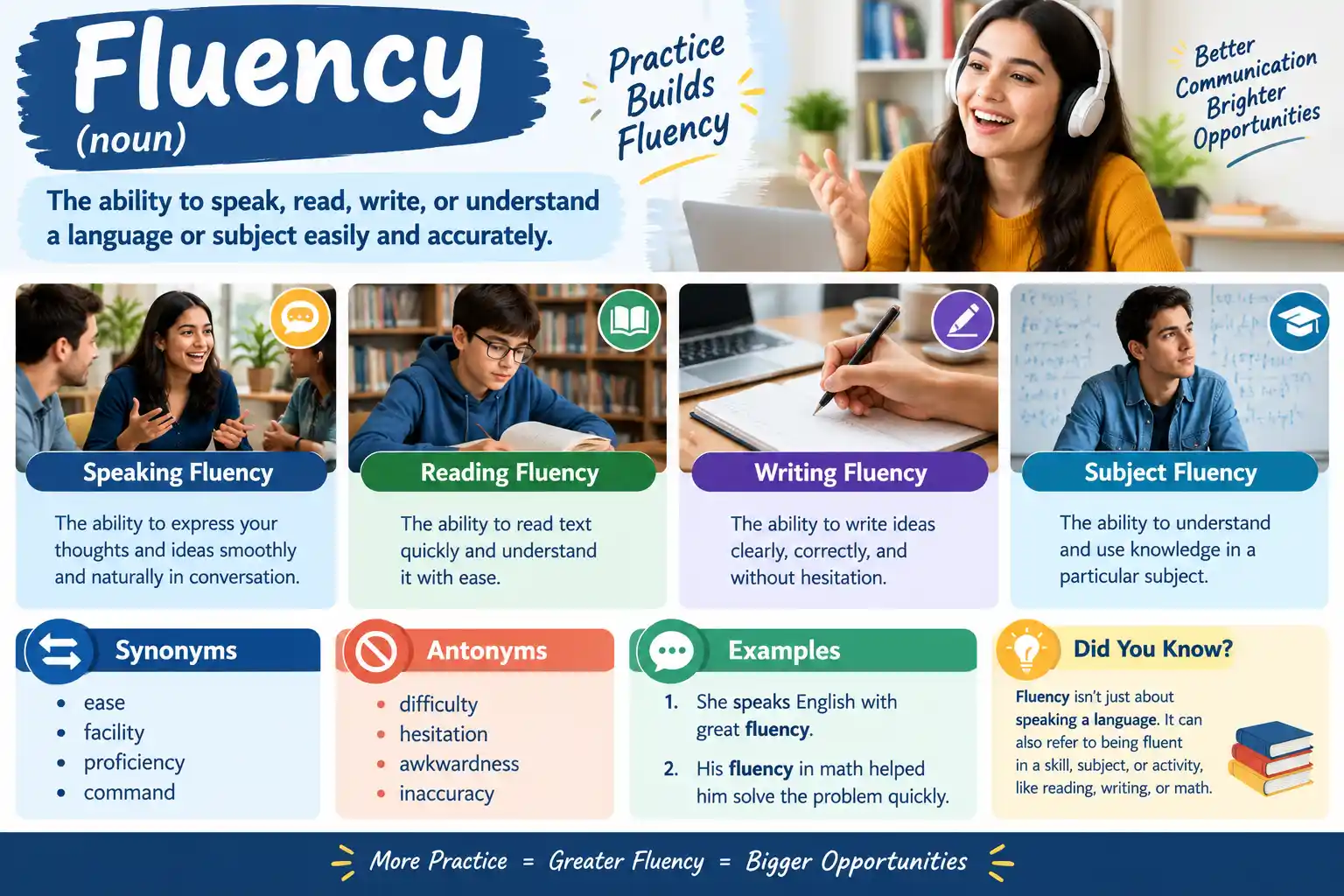
Fluency is the ability to speak, write, read, or perform something smoothly, naturally, and with relative ease.
In language learning, fluency usually refers to communicating without excessive hesitation or interruption.
A fluent speaker can express ideas at a natural pace. This does not mean the person always uses perfect grammar.
Native English speakers also use fluency beyond language.
For example:
- She speaks Spanish with remarkable fluency.
- His fluency in public speaking impressed the audience.
- The pianist performed the difficult piece with fluency.
Part of Speech
Fluency is a noun.
Its related adjective is fluent, while its adverb form is fluently.
Simple definition: The quality of expressing or performing something smoothly and easily.
Connotative Meaning of Fluency
(Connotation means the feelings, attitudes, or associations connected with a word beyond its basic dictionary definition.)
Positive Tone
Fluency often suggests confidence, competence, natural ability, and effective communication.
Example: Her fluency in English helped her succeed during the interview.
Negative Tone
Fluency has no inherently negative meaning.
However, fluent communication can sometimes be used to conceal weak arguments or create a misleading impression of expertise.
Example: His verbal fluency made the explanation sound convincing, despite its factual errors.
Neutral Tone
In education and assessment, fluency simply describes how smoothly someone communicates or performs a task.
Example: The teacher evaluated each student’s reading fluency.
Etymology of Fluency
The word fluency comes from the Latin verb fluere, meaning “to flow.”
This Latin root also gave English words such as fluid, fluent, and influence.
The original idea of flowing gradually developed into the modern concept of smooth expression.
Old English (450–1100)
The modern word fluency did not exist in Old English.
However, English speakers already had vocabulary for flowing movement and speech.
Middle English (1100–1500)
During this period, English absorbed many French and Latin expressions.
These linguistic influences helped establish the vocabulary from which later words such as fluent developed.
Modern English (1500–Present)
Fluent entered English during the early Modern English period. The noun fluency appeared later.
Today, the word describes language ability, reading performance, writing, and other smoothly performed skills.
Pronunciation of Fluency
- US: /ˈfluː.ən.si/
- UK: /ˈfluː.ən.si/
Syllables
Flu-en-cy
The word contains three syllables.
The primary stress falls on the first syllable: FLU-en-cy.
Affixation Pattern of Fluency
Root: flu- (from Latin fluere, meaning to flow)
Prefix: None
Suffix: -ency (a noun-forming ending that expresses a quality or state)
The word belongs to the same family as fluent and fluently.
Synonyms List
English offers several ways to describe smooth communication, language ability, and effortless performance.
Not every alternative is interchangeable. Some are direct synonyms, while others describe a particular aspect of fluency.
The following 45 words and expressions are grouped by their natural usage.
1. Eloquence (Noun) — US /ˈel.ə.kwəns/ | UK /ˈel.ə.kwəns/
Meaning: The ability to express ideas clearly, beautifully, and persuasively.
Tone/Register: Positive, formal, literary.
Example 1: Her eloquence impressed everyone at the conference.
Example 2: The speaker’s eloquence made the difficult topic interesting.
2. Proficiency (Noun) — US /prəˈfɪʃ.ən.si/ | UK /prəˈfɪʃ.ən.si/
Meaning: A high level of ability gained through learning and practice.
Tone/Register: Formal, academic, professional.
Example 1: His proficiency in German helped him secure the position.
Example 2: The course measures students’ language proficiency.
3. Articulateness (Noun) — US /ɑːrˈtɪk.jə.lət.nəs/ | UK /ɑːˈtɪk.jə.lət.nəs/
Meaning: The quality of expressing thoughts clearly and effectively.
Tone/Register: Positive, professional.
Example 1: Her articulateness made the interview memorable.
Example 2: The manager appreciated his articulateness during meetings.
4. Smoothness (Noun) — US /ˈsmuːð.nəs/ | UK /ˈsmuːð.nəs/
Meaning: The quality of happening or being expressed without noticeable interruption.
Tone/Register: Neutral, everyday.
Example 1: The smoothness of her delivery impressed the audience.
Example 2: Daily reading improved the smoothness of his speech.
5. Command (Noun) — US /kəˈmænd/ | UK /kəˈmɑːnd/
Meaning: Strong knowledge and confident control of a language or skill.
Tone/Register: Formal, academic, professional.
Example 1: She has an excellent command of English.
Example 2: His command of technical vocabulary is impressive.
6. Expressiveness (Noun) — US /ɪkˈspres.ɪv.nəs/ | UK /ɪkˈspres.ɪv.nəs/
Meaning: The ability to communicate thoughts and feelings vividly.
Tone/Register: Positive, creative.
Example 1: Her expressiveness brings every story to life.
Example 2: The actor’s expressiveness strengthened the performance.
7. Verbal Ease (Noun Phrase) — US /ˈvɝː.bəl iːz/ | UK /ˈvɜː.bəl iːz/
Meaning: The ability to speak naturally without struggling to find words.
Tone/Register: Neutral, descriptive.
Example 1: Her verbal ease helped her lead the discussion.
Example 2: Regular conversation improved his verbal ease.
8. Facility (Noun) — US /fəˈsɪl.ə.ti/ | UK /fəˈsɪl.ə.ti/
Meaning: A natural or developed ability to perform something easily.
Tone/Register: Formal, academic.
Example 1: She has a remarkable facility with languages.
Example 2: His facility for public speaking developed early.
9. Mastery (Noun) — US /ˈmæs.tɚ.i/ | UK /ˈmɑː.stər.i/
Meaning: Complete or exceptionally strong control of a subject or skill.
Tone/Register: Positive, academic, professional.
Example 1: Her mastery of French took years of practice.
Example 2: The writer demonstrated mastery of descriptive language.
10. Competence (Noun) — US /ˈkɑːm.pə.təns/ | UK /ˈkɒm.pɪ.təns/
Meaning: The ability to perform a task successfully at an acceptable standard.
Tone/Register: Neutral, professional.
Example 1: The assessment measures communication competence.
Example 2: His competence in English supports his daily work.
11. Skillfulness (Noun) — US /ˈskɪl.fəl.nəs/ | UK /ˈskɪl.fəl.nəs/
Meaning: The quality of performing something with developed ability and control.
Tone/Register: Positive, general.
Example 1: Her skillfulness as a presenter was easy to notice.
Example 2: The teacher praised his skillfulness in storytelling.
12. Dexterity (Noun) — US /dekˈster.ə.ti/ | UK /dekˈster.ə.ti/
Meaning: The ability to handle a task quickly and skillfully, especially with the hands or mind.
Tone/Register: Formal, descriptive.
Example 1: The translator showed remarkable verbal dexterity.
Example 2: Her linguistic dexterity helped her explain complex ideas.
13. Naturalness (Noun) — US /ˈnætʃ.ɚ.əl.nəs/ | UK /ˈnætʃ.ər.əl.nəs/
Meaning: The quality of sounding relaxed, genuine, and effortless.
Tone/Register: Positive, conversational.
Example 1: The naturalness of her English surprised the examiner.
Example 2: His pronunciation gained naturalness through daily practice.
14. Fluidity (Noun) — US /fluˈɪd.ə.ti/ | UK /fluˈɪd.ə.ti/
Meaning: The quality of moving or progressing smoothly without interruption.
Tone/Register: Neutral, academic, creative.
Example 1: The fluidity of her speech made the lesson enjoyable.
Example 2: Practice improved the fluidity of his presentation.
15. Clarity (Noun) — US /ˈkler.ə.ti/ | UK /ˈklær.ə.ti/
Meaning: The quality of making information easy to understand.
Tone/Register: Positive, academic, professional.
Example 1: Her clarity helped everyone understand the instructions.
Example 2: The editor improved the clarity of the article.
16. Coherence (Noun) — US /koʊˈhɪr.əns/ | UK /kəʊˈhɪə.rəns/
Meaning: The quality of connecting ideas logically and understandably.
Tone/Register: Academic, formal.
Example 1: His explanation had excellent coherence.
Example 2: The teacher encouraged greater coherence in her essays.
17. Readiness (Noun) — US /ˈred.i.nəs/ | UK /ˈred.i.nəs/
Meaning: The ability or willingness to respond without unnecessary delay.
Tone/Register: Neutral, general.
Example 1: Her readiness to answer showed strong preparation.
Example 2: The speaker responded with impressive readiness.
18. Effortlessness (Noun) — US /ˈef.ɚt.ləs.nəs/ | UK /ˈef.ət.ləs.nəs/
Meaning: The appearance of performing something without visible difficulty.
Tone/Register: Positive, descriptive.
Example 1: The effortlessness of her delivery amazed the audience.
Example 2: His English had an effortlessness that came from years of use.
19. Ease (Noun) — US /iːz/ | UK /iːz/
Meaning: The quality of doing something without difficulty or strain.
Tone/Register: Neutral, everyday.
Example 1: She speaks Italian with ease.
Example 2: He explained the new policy with surprising ease.
20. Flow (Noun) — US /floʊ/ | UK /fləʊ/
Meaning: Smooth and continuous movement from one word, idea, or action to another.
Tone/Register: Neutral, conversational, creative.
Example 1: Her speech had a natural flow.
Example 2: Reading aloud helped improve the flow of his sentences.
21. Volubility (Noun) — US /ˌvɑː.ljəˈbɪl.ə.ti/ | UK /ˌvɒl.jəˈbɪl.ə.ti/
Meaning: The quality of speaking easily, rapidly, and at length.
Tone/Register: Formal, sometimes negative.
Example 1: His volubility kept the discussion lively.
Example 2: The interviewer’s volubility left little time for answers.
22. Glibness (Noun) — US /ˈɡlɪb.nəs/ | UK /ˈɡlɪb.nəs/
Meaning: Smooth and confident speech that may sound superficial or insincere.
Tone/Register: Negative, critical.
Example 1: His glibness failed to convince the experienced panel.
Example 2: The politician’s glibness frustrated several listeners.
23. Loquacity (Noun) — US /loʊˈkwæs.ə.ti/ | UK /ləʊˈkwæs.ə.ti/
Meaning: The tendency to speak freely and at considerable length.
Tone/Register: Formal, literary, sometimes humorous.
Example 1: Her loquacity made every family dinner entertaining.
Example 2: His unexpected loquacity surprised the quiet classroom.
24. Verbosity (Noun) — US /vɚˈbɑː.sə.ti/ | UK /vɜːˈbɒs.ə.ti/
Meaning: The use of more words than necessary when expressing an idea.
Tone/Register: Negative, formal.
Example 1: The editor reduced the verbosity of the report.
Example 2: His verbosity made a simple explanation difficult to follow.
25. Persuasiveness (Noun) — US /pɚˈsweɪ.sɪv.nəs/ | UK /pəˈsweɪ.sɪv.nəs/
Meaning: The ability to communicate in a way that influences someone’s beliefs or decisions.
Tone/Register: Positive, professional.
Example 1: Her persuasiveness helped the team accept the proposal.
Example 2: The speech gained persuasiveness through clear examples.
26. Verbal Agility (Noun Phrase) — US /ˈvɝː.bəl əˈdʒɪl.ə.ti/ | UK /ˈvɜː.bəl əˈdʒɪl.ə.ti/
Meaning: The ability to use words quickly and adapt speech to different situations.
Tone/Register: Positive, professional.
Example 1: The debate required considerable verbal agility.
Example 2: Her verbal agility helped her handle unexpected questions.
27. Linguistic Ability (Noun Phrase) — US /lɪŋˈɡwɪs.tɪk əˈbɪl.ə.ti/ | UK /lɪŋˈɡwɪs.tɪk əˈbɪl.ə.ti/
Meaning: The capacity to understand and use language effectively.
Tone/Register: Academic, neutral.
Example 1: The examination evaluates students’ linguistic ability.
Example 2: Living abroad strengthened her linguistic ability.
28. Language Proficiency (Noun Phrase) — US /ˈlæŋ.ɡwɪdʒ prəˈfɪʃ.ən.si/ | UK /ˈlæŋ.ɡwɪdʒ prəˈfɪʃ.ən.si/
Meaning: The overall level of someone’s ability to understand and use a language.
Tone/Register: Academic, professional.
Example 1: The university requires evidence of English language proficiency.
Example 2: His language proficiency improved during the exchange program.
29. Verbal Proficiency (Noun Phrase) — US /ˈvɝː.bəl prəˈfɪʃ.ən.si/ | UK /ˈvɜː.bəl prəˈfɪʃ.ən.si/
Meaning: Developed skill in using spoken language effectively.
Tone/Register: Formal, academic.
Example 1: The interview tested her verbal proficiency.
Example 2: Regular discussions strengthened his verbal proficiency.
30. Speaking Ability (Noun Phrase) — US /ˈspiː.kɪŋ əˈbɪl.ə.ti/ | UK /ˈspiː.kɪŋ əˈbɪl.ə.ti/
Meaning: A person’s capacity to communicate ideas through speech.
Tone/Register: Neutral, educational.
Example 1: Her speaking ability improved after joining the debate club.
Example 2: The instructor assessed each learner’s speaking ability.
31. Conversational Ease (Noun Phrase) — US /ˌkɑːn.vɚˈseɪ.ʃən.əl iːz/ | UK /ˌkɒn.vəˈseɪ.ʃən.əl iːz/
Meaning: The ability to participate in conversations comfortably and naturally.
Tone/Register: Positive, everyday.
Example 1: Her conversational ease helped her make new friends.
Example 2: Weekly language exchanges improved his conversational ease.
32. Articulation (Noun) — US /ɑːrˌtɪk.jəˈleɪ.ʃən/ | UK /ɑːˌtɪk.jəˈleɪ.ʃən/
Meaning: The clear production of speech sounds or expression of ideas.
Tone/Register: Neutral, professional, academic.
Example 1: Her clear articulation made the recording easy to understand.
Example 2: The coach helped him improve his articulation.
33. Oratory (Noun) — US /ˈɔːr.ə.tɔːr.i/ | UK /ˈɒr.ə.tər.i/
Meaning: The skill or art of delivering effective public speeches.
Tone/Register: Formal, rhetorical.
Example 1: Her oratory inspired the graduating students.
Example 2: The competition celebrated excellence in oratory.
34. Rhetorical Skill (Noun Phrase) — US /rɪˈtɔːr.ɪ.kəl skɪl/ | UK /rɪˈtɒr.ɪ.kəl skɪl/
Meaning: The ability to use language effectively to inform, influence, or persuade.
Tone/Register: Formal, academic.
Example 1: His rhetorical skill made the argument memorable.
Example 2: The professor praised her rhetorical skill.
35. Verbal Facility (Noun Phrase) — US /ˈvɝː.bəl fəˈsɪl.ə.ti/ | UK /ˈvɜː.bəl fəˈsɪl.ə.ti/
Meaning: The ability to use spoken language easily and effectively.
Tone/Register: Formal, professional.
Example 1: The presenter demonstrated excellent verbal facility.
Example 2: Her verbal facility helped her explain unfamiliar concepts.
36. Communicative Competence (Noun Phrase) — US /kəˈmjuː.nɪ.keɪ.tɪv ˈkɑːm.pə.təns/ | UK /kəˈmjuː.nɪ.kə.tɪv ˈkɒm.pɪ.təns/
Meaning: The ability to use language appropriately and effectively in different social situations.
Tone/Register: Academic, educational.
Example 1: Role-playing activities develop communicative competence.
Example 2: The course emphasizes communicative competence over memorization.
37. Reading Fluency (Noun Phrase) — US /ˈriː.dɪŋ ˈfluː.ən.si/ | UK /ˈriː.dɪŋ ˈfluː.ən.si/
Meaning: The ability to read text accurately, smoothly, and at an appropriate pace.
Tone/Register: Educational, academic.
Example 1: Daily reading improved the child’s reading fluency.
Example 2: The teacher measured reading fluency during the lesson.
38. Writing Fluency (Noun Phrase) — US /ˈraɪ.tɪŋ ˈfluː.ən.si/ | UK /ˈraɪ.tɪŋ ˈfluː.ən.si/
Meaning: The ability to produce written language smoothly without excessive hesitation.
Tone/Register: Academic, educational.
Example 1: Journaling helped improve her writing fluency.
Example 2: The workshop focused on writing fluency and idea development.
39. Automaticity (Noun) — US /ˌɔː.tə.məˈtɪs.ə.ti/ | UK /ˌɔː.tə.məˈtɪs.ə.ti/
Meaning: The ability to perform a learned task with little conscious effort.
Tone/Register: Academic, psychological, educational.
Example 1: Repeated practice helped him develop automaticity in reading.
Example 2: Automaticity allows experienced speakers to retrieve familiar words quickly.
40. Spontaneity (Noun) — US /ˌspɑːn.təˈneɪ.ə.ti/ | UK /ˌspɒn.təˈneɪ.ə.ti/
Meaning: The quality of responding naturally without extensive preparation.
Tone/Register: Positive, creative, conversational.
Example 1: Her spontaneity made the conversation enjoyable.
Example 2: The teacher encouraged spontaneity during speaking practice.
41. Poise (Noun) — US /pɔɪz/ | UK /pɔɪz/
Meaning: Calm confidence and self-control during communication or performance.
Tone/Register: Positive, professional.
Example 1: She answered the difficult question with poise.
Example 2: His poise helped him deliver a confident presentation.
42. Gracefulness (Noun) — US /ˈɡreɪs.fəl.nəs/ | UK /ˈɡreɪs.fəl.nəs/
Meaning: The quality of expressing or performing something smoothly and elegantly.
Tone/Register: Positive, literary.
Example 1: The gracefulness of her delivery impressed the judges.
Example 2: His writing has a quiet gracefulness.
43. Versatility (Noun) — US /ˌvɝː.səˈtɪl.ə.ti/ | UK /ˌvɜː.səˈtɪl.ə.ti/
Meaning: The ability to adapt one’s skills or communication style to different situations.
Tone/Register: Positive, professional.
Example 1: Her linguistic versatility helps her communicate with diverse audiences.
Example 2: The writer’s versatility is clear across different genres.
44. Lucidity (Noun) — US /luːˈsɪd.ə.ti/ | UK /luːˈsɪd.ə.ti/
Meaning: The quality of expressing ideas in a clear and easily understood way.
Tone/Register: Formal, academic, literary.
Example 1: The lucidity of her explanation helped the entire class.
Example 2: His writing is admired for its lucidity.
45. Fluency of Expression (Noun Phrase) — US /ˈfluː.ən.si əv ɪkˈspreʃ.ən/ | UK /ˈfluː.ən.si əv ɪkˈspreʃ.ən/
Meaning: The ability to communicate thoughts smoothly through spoken or written language.
Tone/Register: Formal, descriptive.
Example 1: Her fluency of expression strengthened the presentation.
Example 2: Reading widely helped him develop fluency of expression.
Usage note: The list includes direct synonyms, near-synonyms, specialized expressions, and related communication qualities. Terms such as verbosity, glibness, and loquacity describe particular speaking styles rather than fluency itself. Similarly, reading fluency and writing fluency identify specific types of fluency.
Synonyms for Fluency by Tone
Choosing a synonym involves more than finding a similar definition.
Tone affects how readers interpret a person’s abilities, personality, and communication style.
Positive Synonyms
These words suggest impressive communication or developed ability.
- Eloquence
- Mastery
- Articulateness
- Expressiveness
- Verbal agility
- Effortlessness
- Naturalness
- Conversational ease
- Poise
- Gracefulness
Use these expressions when praising someone’s communication.
Neutral Synonyms
These words describe ability without adding strong emotion.
- Proficiency
- Competence
- Smoothness
- Facility
- Flow
- Language proficiency
- Speaking ability
- Reading fluency
- Writing fluency
- Automaticity
They work particularly well in educational and professional writing.
Negative Synonyms and Related Expressions
Fluency itself is generally positive. However, some related speaking qualities can carry criticism.
- Glibness
- Verbosity
- Volubility
- Loquacity
Glibness may suggest insincerity, while verbosity suggests unnecessary wordiness.
Volubility and loquacity can also sound critical when someone talks excessively.
Playful or Informal Alternatives
Everyday English often uses short phrases instead of formal nouns.
Common expressions include:
- A way with words
- Smooth talk
- The gift of the gab
- Talking with ease
- Words flowing naturally
For example:
“She’s got the gift of the gab!”
This British expression describes someone who speaks easily and persuasively. It can sound admiring or teasing.
Fluency vs Close Alternatives
Fluency, proficiency, eloquence, and articulateness are closely connected.
However, they describe different aspects of communication.
| Word | Main Meaning | Tone | Best Context |
|---|---|---|---|
| Fluency | Smooth, continuous expression | Positive or neutral | Speaking, reading, writing |
| Proficiency | Developed ability or competence | Formal | Education and assessment |
| Eloquence | Powerful and persuasive expression | Positive | Speeches and creative writing |
| Articulateness | Clear expression of thoughts | Positive | Interviews and discussions |
Fluency vs Proficiency
Fluency focuses mainly on smooth communication.
Proficiency covers broader language ability. It may include grammar, vocabulary, comprehension, and writing skills.
A person can speak fluently while still making grammatical mistakes.
Fluency vs Eloquence
Fluency means communicating smoothly.
Eloquence adds elegance, clarity, and persuasive power.
A fluent speaker is not necessarily eloquent. An eloquent speaker uses language in a particularly effective way.
Fluency vs Articulateness
Fluency concerns the continuous flow of communication.
Articulateness emphasizes expressing ideas clearly.
Someone may speak slowly but remain highly articulate.
How Fluency Changes by Context
The best synonym depends on what you want to describe.
Daily Conversation
In casual conversations, people usually prefer simple expressions.
Instead of saying:
“She demonstrates exceptional linguistic fluency.”
You might say:
“She speaks English really well.”
Other natural choices include ease, flow, and conversational ease.
Writing and Blogging
Bloggers often use clarity, flow, coherence, and smoothness when discussing writing quality.
Example:
“The article has a natural flow that keeps readers interested.”
These expressions help describe how smoothly ideas connect.
Professional Communication
Professional writing often favors proficiency, command, competence, and verbal facility.
Example:
“The candidate demonstrated strong English proficiency during the interview.”
Such wording sounds measured and appropriate for workplace evaluations.
Academic Communication
Academic contexts require precise terminology.
For example, reading fluency refers to accurate reading at an appropriate pace, often with suitable expression.
Communicative competence is broader. It includes using language appropriately in social situations.
Creative and Informal Writing
Creative writers may choose eloquence, fluidity, expressiveness, or gracefulness.
Example:
“Her words flowed through the room like a familiar melody.”
These alternatives add imagery without changing the central idea of smooth expression.
Common Mistakes Learners Make
Mistake 1: Treating Fluency and Accuracy as Identical
Fluency describes smooth communication.
Accuracy describes how correctly someone uses grammar, vocabulary, and pronunciation.
A learner may communicate fluently while making occasional errors.
Both qualities matter, but they are not interchangeable.
Mistake 2: Using Eloquence for Every Fluent Speaker
Eloquence suggests more than speaking comfortably.
It often involves expressive, effective, or persuasive language.
Use fluency when you simply mean that someone communicates smoothly.
Mistake 3: Confusing Fluent With Voluble
A fluent person communicates without excessive hesitation.
A voluble person talks freely and often at length.
Speaking more does not automatically mean communicating better.
Mistake 4: Using Glibness as a Compliment
Glibness often suggests speech that sounds polished but lacks sincerity or depth.
Instead of saying:
“Her glibness impressed the interviewer.”
Say:
“Her eloquence impressed the interviewer.”
The second sentence communicates genuine praise.
Mistake 5: Overusing Fluency in Writing
Repeating the same noun can make an article sound mechanical.
Compare:
- “Her fluency improved.
- Her fluency helped her communicate.
- Her fluency impressed her teacher.”
A more natural version is:
“Her fluency improved through practice. She now communicates with greater ease, and her teacher appreciates her growing confidence.”
Register Notes
Formal English: Proficiency, mastery, verbal facility, communicative competence.
Informal English: Ease, flow, a way with words.
Spoken English: Fluent, smooth, natural, comfortable speaking.
Written English: Fluency, coherence, lucidity, expressiveness.
For related vocabulary practice, readers can also explore synonyms of articulateness to understand how clear expression differs from fluent speech.
Real-Life Examples Using Fluency
Workplace Scenario
A manager interviews two applicants.
Both understand English, but one answers questions more naturally and confidently.
The manager says:
“Her fluency helped her communicate her experience effectively.”
Here, fluency highlights smooth professional communication.
Social Situation
A student joins an international conversation group.
At first, speaking feels difficult. After several weeks, the student becomes more comfortable.
A friend notices:
“Your conversational ease has improved so much!”
This expression highlights natural social interaction.
Media and Pop Culture
A television presenter delivers a live introduction without noticeable hesitation.
A viewer comments:
“Her eloquence makes every interview interesting.”
The word emphasizes polished and effective expression.
Writing and Storytelling
A blogger revises an article with awkward transitions.
After editing, the ideas connect more naturally.
An editor says:
“The writing has much better flow now.”
Here, flow describes the smooth movement between ideas.
Practice Quiz
Choose the most suitable answer for each situation.
Part One: Meaning and Word Choice
1. A student speaks English smoothly without frequent hesitation. Which word best describes this quality?
A) Verbosity
B) Fluency
C) Silence
D) Confusion
2. A speaker uses beautiful and persuasive language. Which word fits best?
A) Eloquence
B) Readiness
C) Glibness
D) Automaticity
3. A university measures a student’s overall English ability. Which term is most appropriate?
A) Loquacity
B) Gracefulness
C) Language proficiency
D) Spontaneity
4. A person speaks confidently but sounds superficial and insincere. Which word fits?
A) Mastery
B) Clarity
C) Coherence
D) Glibness
5. A writer connects paragraphs naturally. Which quality is being demonstrated?
A) Verbosity
B) Flow
C) Volubility
D) Poise
6. A speaker explains difficult ideas clearly and understandably. Which word best describes this quality?
A) Loquacity
B) Readiness
C) Lucidity
D) Glibness
Part Two: Tone and Real-Life Context
7. An employee remains calm and confident during a challenging presentation.
A) Verbosity
B) Glibness
C) Poise
D) Loquacity
8. A learner can read accurately at a suitable pace with natural expression.
A) Reading fluency
B) Rhetorical skill
C) Conversational ease
D) Versatility
9. A teacher wants students to respond naturally without preparing every sentence.
A) Mastery
B) Spontaneity
C) Verbosity
D) Oratory
10. A candidate demonstrates strong control of English vocabulary and grammar.
A) Volubility
B) Glibness
C) Gracefulness
D) Command
11. An editor removes unnecessary words from a lengthy article. What problem is being corrected?
A) Fluency
B) Verbosity
C) Articulation
D) Automaticity
12. A speaker changes vocabulary and style easily for different audiences.
A) Versatility
B) Silence
C) Glibness
D) Verbosity
13. A student can express complex thoughts clearly during a discussion.
A) Loquacity
B) Volubility
C) Articulateness
D) Readiness
14. A pianist performs a difficult piece smoothly without noticeable strain.
A) Verbosity
B) Persuasiveness
C) Communicative competence
D) Effortlessness
15. A learner can produce familiar English phrases with little conscious effort.
A) Oratory
B) Automaticity
C) Glibness
D) Lucidity
Answer Key
1-B | 2-A | 3-C | 4-D | 5-B | 6-C | 7-C | 8-A | 9-B | 10-D | 11-B | 12-A | 13-C | 14-D | 15-B
Reflection and Application Task
Choose three synonyms from this article.
Write one original sentence using each word.
Try using one formal expression, one everyday alternative, and one word that describes a specific communication quality.
Read your sentences aloud. Notice how changing vocabulary affects meaning and tone.
Suggested External Reference
For additional linguistic guidance, consult the Cambridge Dictionary entry for fluency:
https://dictionary.cambridge.org/dictionary/english/fluency
It provides a useful reference for checking the word’s definition, pronunciation, and standard English usage.
Conclusion
Learning synonyms of fluency helps you express ideas with greater confidence. Each alternative reveals a different quality of smooth and effective communication.
Strong vocabulary improves writing, blogging, and speaking. Choosing precise words also helps readers understand your message without unnecessary confusion.
Fluency grows through patience and regular use. Small improvements in vocabulary can make emails, essays, presentations, and everyday conversations more natural.
Keep practicing synonyms of fluency in your daily English. Try one new expression in an email, essay, or conversation, and let your confidence grow naturally.
FAQs
1. What is the best synonym for fluency on a resume?
Proficiency is usually a suitable alternative when describing language ability on a resume. It sounds professional and indicates developed competence. You can also use command when describing strong knowledge of a particular language. For example, “Strong command of written and spoken English” communicates a clear professional skill.
2. Can someone be fluent in English without sounding like a native speaker?
Yes. Fluency does not require a native accent. Someone can speak English smoothly while retaining pronunciation features from another language. Effective communication depends on several qualities, including intelligibility, vocabulary, comprehension, and the ability to express ideas. A native-like accent is not a necessary condition for fluent communication.
3. What is the difference between fluency and bilingualism?
Fluency describes how smoothly someone uses a language. Bilingualism refers to the ability to use two languages. A bilingual person may have different proficiency levels in each language. Similarly, someone may become fluent in an additional language without using it as frequently as their first language.
4. Which synonyms of fluency are suitable for describing a child’s reading development?
Reading fluency, smoothness, and automaticity are useful terms in literacy education. Reading fluency involves accuracy, suitable speed, and expression. Automaticity refers to recognizing familiar words with little conscious effort. Teachers should select the term that matches the specific reading skill being assessed rather than treating all these qualities as identical.
5. Is fluency more important than vocabulary when learning English?
Both are important, but they serve different purposes. Vocabulary gives learners the words needed to express ideas. Fluency helps them use those words smoothly during communication. A large vocabulary alone does not guarantee fluent speech. Combining vocabulary practice with regular conversation and listening activities supports balanced language development.
6. What is a natural alternative to “improve your fluency” in everyday English?
You can say “speak more smoothly,” “become more comfortable speaking,” or “develop greater ease in conversation.” These expressions sound natural in informal situations. For example, “I want to become more comfortable speaking English” communicates a practical goal without sounding overly academic or formal.
7. Can fluency describe skills other than speaking and writing?
Yes. Fluency can describe smooth performance in several learned activities. For example, educators discuss mathematical fluency when students solve familiar problems accurately and efficiently. Musicians may also demonstrate fluency during performance. In each case, the central idea involves performing a developed skill with smoothness and relative ease.
8. How can I describe someone who speaks fluently but uses too many words?
You can describe the person as voluble, loquacious, or verbose, depending on your intended meaning. Voluble suggests easy and continuous speech. Loquacious describes someone who enjoys talking at length. Verbose is more critical because it suggests unnecessary wordiness. Choose carefully because these expressions do not simply mean fluent.

Mehtab Yasir is a passionate writer and English language enthusiast dedicated to making vocabulary learning simple, practical, and enjoyable. As an author at SynonymDesk.com, she creates helpful content covering synonyms, antonyms, word meanings, vocabulary, phrases, and everyday English usage. Her goal is to provide clear and easy-to-understand information that helps students, writers, professionals, and English learners choose the right words and communicate with greater confidence. Mehtab believes that a strong vocabulary can improve both writing and communication skills. She enjoys researching new words, exploring their meanings and uses, and turning complex language concepts into useful, reader-friendly content. Through her work, she strives to make SynonymDesk.com a reliable resource for anyone looking to improve their English vocabulary and language skills.