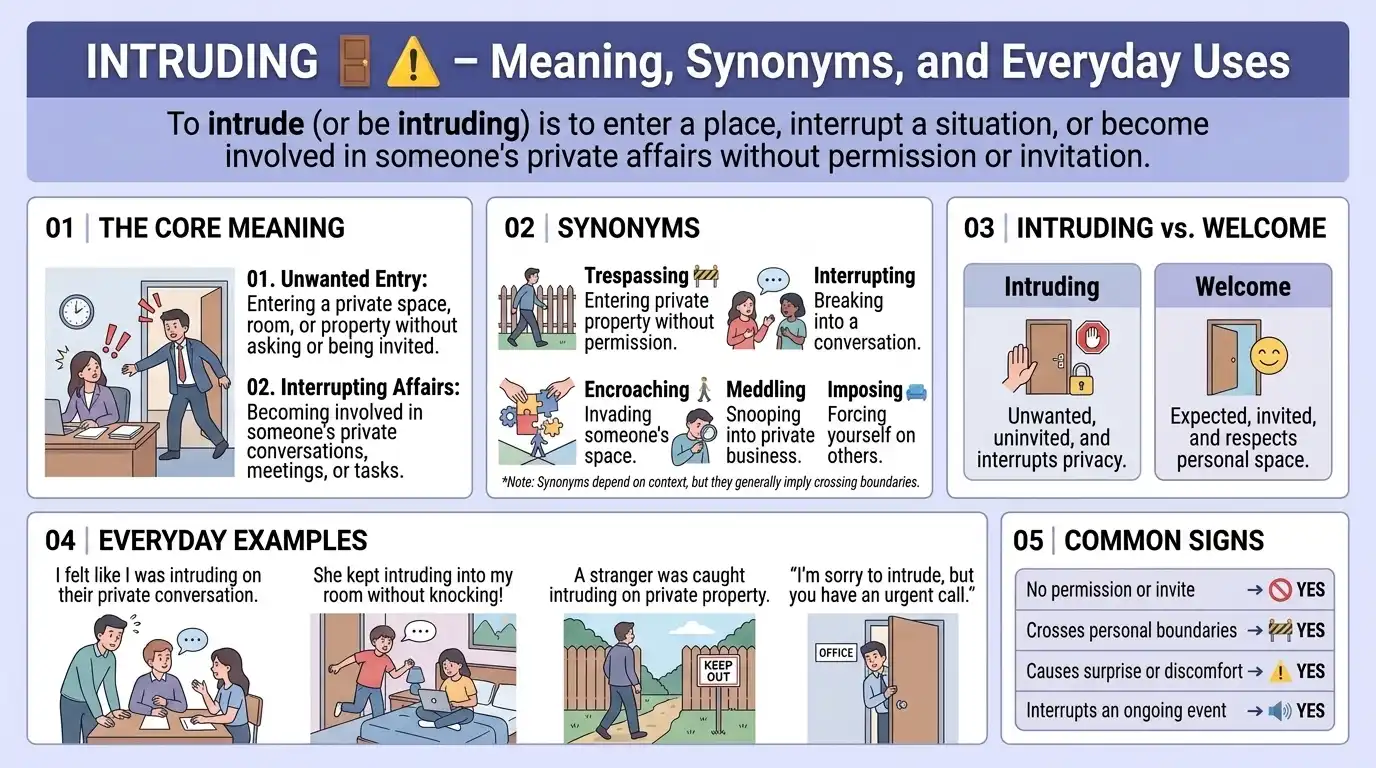
Synonyms of intruding include interrupting, interfering, invading, encroaching, trespassing, barging in, and imposing. These words describe entering a place, conversation, or private situation without permission or welcome. Some suggest physical entry, while others describe unwanted involvement. Choosing the right alternative depends on the situation, intention, and emotional tone.
Imagine enjoying a quiet evening when someone suddenly enters your room without knocking. That uncomfortable moment perfectly explains intruding.
Learning synonyms of intruding helps you describe unwanted interruptions more clearly. Each alternative adds a different shade of meaning to your vocabulary.
The word often appears in conversations about privacy, personal boundaries, workplaces, and social situations. It helps people express discomfort politely.
Students, bloggers, content writers, and everyday English users benefit from understanding these alternatives. Better word choices make communication natural.
What Does Intruding Really Mean?
Intruding means entering a place, conversation, activity, or private situation without being invited, welcomed, or permitted.
It often describes someone crossing a physical, emotional, or social boundary.
For example:
- A stranger entering your garden without permission is intruding.
- Someone asking deeply personal questions may be intruding on your privacy.
Native English speakers commonly use this word when discussing privacy, interruptions, unwanted attention, and personal space.
The word usually suggests that someone’s presence or involvement is inappropriate.
Part of Speech
Intruding is the present participle of the verb intrude. It can also function as part of a continuous verb phrase.
Base Verb: Intrude
Present Participle: Intruding
Past Tense: Intruded
Example 1: Someone is intruding on our conversation.
Example 2: I apologized for intruding during the meeting.
The word can also appear in descriptive phrases, such as intruding thoughts or intruding visitors.
Connotative Meaning of Intruding
(Connotation refers to the feelings, attitudes, or associations a word suggests beyond its basic dictionary meaning.)
Intruding usually carries an uncomfortable or negative emotional meaning. However, its tone can change with context.
Positive Tone
Intruding rarely has a genuinely positive meaning.
However, a person may interrupt an activity to prevent danger or offer urgent assistance.
Example: The firefighter apologized for intruding before checking the building.
The action may be helpful even though the interruption is unwanted.
Negative Tone
This is the most common emotional association.
Intruding may suggest disrespect, interference, invasion of privacy, or unwanted attention.
Example: The reporter kept intruding into the family’s private affairs.
Neutral Tone
In some situations, the word simply describes an interruption without strongly criticizing anyone.
Example: Sorry for intruding. Is this the correct classroom?
Here, the speaker uses polite language to acknowledge a possible interruption.
Etymology and Word Origin of Intruding
The word intruding comes from the verb intrude.
Its roots trace back to Latin intrudere, meaning to thrust or push inward.
The Latin form combines in- (into) and trudere (to thrust or push).
Over time, English speakers extended its meaning from physical entry to unwanted involvement in conversations, relationships, and private matters.
Old English (450–1100)
The modern word intrude was not part of the established Old English vocabulary.
Speakers expressed similar ideas through native words describing entry, interruption, and forceful movement.
Middle English (1100–1500)
The word entered English during the Middle English period through Latin and French influence.
Its early meanings involved forcing oneself into a position or place without proper authority.
Modern English (1500–Present)
The meaning gradually expanded beyond physical entry.
Today, intruding commonly describes unwanted participation, personal questions, privacy violations, and digital interruptions.
Pronunciation of Intruding
American English (US)
IPA: /ɪnˈtruːdɪŋ/
British English (UK)
IPA: /ɪnˈtruːdɪŋ/
Both varieties use essentially the same pronunciation.
The main stress falls on the second syllable.
Syllables
in-trud-ing
Number of syllables: 3
Stress pattern: in-TRUD-ing
Affixation Pattern of Intruding
Root: Latin trudere, meaning to push or thrust.
Prefix: in- (meaning into or inward).
Suffix: -ing (forms the present participle).
Word Formation: intrude + -ing → intruding.
The final silent e disappears before adding -ing.
Synonyms List
The following 40 alternatives cover physical entry, unwanted involvement, interruptions, and violations of personal boundaries.
1. Interrupting (Verb) — US /ˌɪntəˈrʌptɪŋ/ | UK /ˌɪntəˈrʌptɪŋ/
Meaning: Stopping or disturbing someone while they are speaking or completing an activity.
Tone/Register: Neutral to negative; everyday and professional.
Example 1: Please stop interrupting while I explain the problem.
Example 2: His phone kept interrupting our discussion.
2. Interfering (Verb) — US /ˌɪntərˈfɪrɪŋ/ | UK /ˌɪntəˈfɪərɪŋ/
Meaning: Becoming involved in another person’s affairs without being wanted or needed.
Tone/Register: Negative; everyday and formal.
Example 1: Her relatives kept interfering in her decisions.
Example 2: The manager dislikes people interfering with his work.
3. Invading (Verb) — US /ɪnˈveɪdɪŋ/ | UK /ɪnˈveɪdɪŋ/
Meaning: Entering or occupying someone’s space, territory, or privacy without permission.
Tone/Register: Strongly negative; formal and everyday.
Example 1: The photographer was invading the actor’s privacy.
Example 2: Unknown visitors were invading the restricted area.
4. Encroaching (Verb) — US /ɪnˈkroʊtʃɪŋ/ | UK /ɪnˈkrəʊtʃɪŋ/
Meaning: Gradually entering another person’s space, territory, or rights without proper permission.
Tone/Register: Formal; negative.
Example 1: New construction is encroaching on protected land.
Example 2: Work responsibilities are encroaching on her family time.
5. Trespassing (Verb) — US /ˈtrespæsɪŋ/ | UK /ˈtrespəsɪŋ/
Meaning: Entering someone’s property without permission or legal authority.
Tone/Register: Legal and formal; negative.
Example 1: The teenagers were trespassing on private farmland.
Example 2: A warning sign prohibited trespassing near the factory.
6. Imposing (Verb) — US /ɪmˈpoʊzɪŋ/ | UK /ɪmˈpəʊzɪŋ/
Meaning: Placing unwanted demands on someone’s time, attention, or hospitality.
Tone/Register: Polite to negative; social and professional.
Example 1: I hope I’m not imposing by staying another hour.
Example 2: He felt uncomfortable imposing on his neighbors.
7. Meddling (Verb) — US /ˈmedəlɪŋ/ | UK /ˈmedəlɪŋ/
Meaning: Becoming involved in matters that do not concern you.
Tone/Register: Negative; informal and everyday.
Example 1: Stop meddling in your sister’s relationship.
Example 2: His friends were meddling in his career choices.
8. Disrupting (Verb) — US /dɪsˈrʌptɪŋ/ | UK /dɪsˈrʌptɪŋ/
Meaning: Disturbing the normal progress of an activity or situation.
Tone/Register: Neutral to negative; professional and academic.
Example 1: Loud conversations were disrupting the lecture.
Example 2: The unexpected visitor kept disrupting our schedule.
9. Disturbing (Verb) — US /dɪˈstɝːbɪŋ/ | UK /dɪˈstɜːbɪŋ/
Meaning: Interrupting someone’s peace, concentration, or private activity.
Tone/Register: Neutral to negative; everyday.
Example 1: Sorry for disturbing you during lunch.
Example 2: The children were disturbing their sleeping grandfather.
10. Bothering (Verb) — US /ˈbɑːðərɪŋ/ | UK /ˈbɒðərɪŋ/
Meaning: Giving someone unwanted attention or interrupting their comfort.
Tone/Register: Informal; mild to negative.
Example 1: Am I bothering you with these questions?
Example 2: The salesperson kept bothering customers outside the shop.
11. Obtruding (Verb) — US /əbˈtruːdɪŋ/ | UK /əbˈtruːdɪŋ/
Meaning: Forcing oneself or one’s opinions into a situation where they are unwelcome.
Tone/Register: Formal and literary; negative.
Example 1: He was obtruding his personal beliefs into the debate.
Example 2: Unwanted memories kept intruding into her thoughts.
12. Infringing (Verb) — US /ɪnˈfrɪndʒɪŋ/ | UK /ɪnˈfrɪndʒɪŋ/
Meaning: Violating or interfering with someone’s established rights or freedoms.
Tone/Register: Formal, legal, and academic.
Example 1: The new policy risks infringing on personal privacy.
Example 2: The company was accused of infringing on workers’ rights.
13. Overstepping (Verb) — US /ˌoʊvərˈstepɪŋ/ | UK /ˌəʊvəˈstepɪŋ/
Meaning: Going beyond acceptable personal, professional, or social boundaries.
Tone/Register: Professional and everyday; negative.
Example 1: He realized he was overstepping by asking about her salary.
Example 2: The supervisor apologized for overstepping his authority.
14. Intervening (Verb) — US /ˌɪntərˈviːnɪŋ/ | UK /ˌɪntəˈviːnɪŋ/
Meaning: Becoming involved in an ongoing situation to influence what happens.
Tone/Register: Neutral or positive; formal and professional.
Example 1: The teacher avoided intervening in the private disagreement.
Example 2: A security officer intervened before the argument became violent.
15. Insinuating Oneself (Verb Phrase) — US /ɪnˈsɪnjueɪtɪŋ wʌnˈself/ | UK /ɪnˈsɪnjueɪtɪŋ wʌnˈself/
Meaning: Gradually entering a group or situation through subtle or calculated behavior.
Tone/Register: Formal; usually negative.
Example 1: He was insinuating himself into the executive’s social circle.
Example 2: The stranger kept insinuating herself into private discussions.
16. Prying (Verb) — US /ˈpraɪɪŋ/ | UK /ˈpraɪɪŋ/
Meaning: Trying to discover private information that someone does not want to share.
Tone/Register: Negative; everyday.
Example 1: Stop prying into your colleague’s personal life.
Example 2: The journalist was accused of prying into family matters.
17. Snooping (Verb) — US /ˈsnuːpɪŋ/ | UK /ˈsnuːpɪŋ/
Meaning: Secretly investigating someone’s belongings, activities, or private information.
Tone/Register: Informal; negative.
Example 1: Her roommate was snooping through her messages.
Example 2: He caught his brother snooping around the bedroom.
18. Eavesdropping (Verb) — US /ˈiːvzdrɑːpɪŋ/ | UK /ˈiːvzdrɒpɪŋ/
Meaning: Secretly listening to a private conversation without permission.
Tone/Register: Everyday; negative.
Example 1: Someone was eavesdropping outside the office.
Example 2: She disliked people eavesdropping on her phone calls.
19. Butting In (Phrasal Verb) — US /ˌbʌtɪŋ ˈɪn/ | UK /ˌbʌtɪŋ ˈɪn/
Meaning: Entering a conversation or situation without being invited.
Tone/Register: Informal; mildly negative.
Example 1: Sorry for butting in, but I have a quick question.
Example 2: His cousin kept butting in during dinner.
20. Barging In (Phrasal Verb) — US /ˌbɑːrdʒɪŋ ˈɪn/ | UK /ˌbɑːdʒɪŋ ˈɪn/
Meaning: Entering a place or conversation suddenly and without considering others.
Tone/Register: Informal; strongly negative.
Example 1: He came barging in without knocking.
Example 2: Nobody appreciated her barging in during the interview.
21. Breaking In (Phrasal Verb) — US /ˌbreɪkɪŋ ˈɪn/ | UK /ˌbreɪkɪŋ ˈɪn/
Meaning: Entering a place unlawfully or interrupting an ongoing conversation.
Tone/Register: Everyday; context-dependent.
Example 1: Someone was breaking in through the back window.
Example 2: Sorry for breaking in, but the meeting starts soon.
22. Cutting In (Phrasal Verb) — US /ˌkʌtɪŋ ˈɪn/ | UK /ˌkʌtɪŋ ˈɪn/
Meaning: Interrupting someone who is already speaking or participating in an activity.
Tone/Register: Informal; neutral to negative.
Example 1: She kept cutting in before I finished speaking.
Example 2: Please avoid cutting in during the presentation.
23. Muscling In (Phrasal Verb) — US /ˌmʌsəlɪŋ ˈɪn/ | UK /ˌmʌsəlɪŋ ˈɪn/
Meaning: Forcing oneself into a situation, opportunity, or activity through pressure.
Tone/Register: Informal; negative.
Example 1: Another company was muscling in on their market.
Example 2: He tried muscling in on the team’s successful project.
24. Crowding In (Phrasal Verb) — US /ˌkraʊdɪŋ ˈɪn/ | UK /ˌkraʊdɪŋ ˈɪn/
Meaning: Entering or pressing into an area until personal space becomes limited.
Tone/Register: Everyday; neutral to negative.
Example 1: Curious visitors were crowding in around the performer.
Example 2: Reporters kept crowding in near the hospital entrance.
25. Forcing One’s Way In (Verb Phrase) — US /ˈfɔːrsɪŋ wʌnz weɪ ˈɪn/ | UK /ˈfɔːsɪŋ wʌnz weɪ ˈɪn/
Meaning: Entering a place or situation despite resistance or a lack of permission.
Tone/Register: Strongly negative; everyday and formal.
Example 1: The stranger was forcing his way in through the doorway.
Example 2: Several spectators tried forcing their way into the stadium.
26. Gatecrashing (Verb) — US /ˈɡeɪtkræʃɪŋ/ | UK /ˈɡeɪtkræʃɪŋ/
Meaning: Attending a private party or event without an invitation.
Tone/Register: Informal; playful or negative.
Example 1: Two strangers were gatecrashing the wedding reception.
Example 2: His friends joked about gatecrashing the birthday party.
27. Infiltrating (Verb) — US /ˈɪnfɪltreɪtɪŋ/ | UK /ˈɪnfɪltreɪtɪŋ/
Meaning: Secretly entering a group, organization, or place to gain access or information.
Tone/Register: Formal; often negative.
Example 1: The investigator was infiltrating the criminal network.
Example 2: An outsider succeeded in infiltrating the private online group.
28. Penetrating (Verb) — US /ˈpenətreɪtɪŋ/ | UK /ˈpenɪtreɪtɪŋ/
Meaning: Entering or passing through a protected area, barrier, or space.
Tone/Register: Formal, technical, or descriptive.
Example 1: The intruders were penetrating the building’s outer defenses.
Example 2: Unwanted light was penetrating the bedroom curtains.
29. Impinging (Verb) — US /ɪmˈpɪndʒɪŋ/ | UK /ɪmˈpɪndʒɪŋ/
Meaning: Having an unwanted effect on someone’s rights, freedom, or personal space.
Tone/Register: Formal and academic; negative.
Example 1: Longer working hours were impinging on her family life.
Example 2: The restrictions risk impinging on individual freedom.
30. Entrenching (Verb) — US /ɪnˈtrentʃɪŋ/ | UK /ɪnˈtrentʃɪŋ/
Meaning: Encroaching upon established rights, privileges, or boundaries.
Tone/Register: Rare, formal, and legal.
Example 1: The proposed rule was entrenching upon established freedoms.
Example 2: Critics warned against encroaching on constitutional protections.
Usage note: This is a rare alternative. Encroaching or infringing sounds more natural in most modern contexts.
31. Intruding Upon (Verb Phrase) — US /ɪnˈtruːdɪŋ əˈpɑːn/ | UK /ɪnˈtruːdɪŋ əˈpɒn/
Meaning: Entering or affecting someone’s private space, time, or affairs without welcome.
Tone/Register: Formal and polite; usually negative.
Example 1: I apologize for intruding upon your personal time.
Example 2: The investigation risked intruding upon confidential matters.
32. Pushing In (Phrasal Verb) — US /ˌpʊʃɪŋ ˈɪn/ | UK /ˌpʊʃɪŋ ˈɪn/
Meaning: Entering a space or group without waiting or respecting others.
Tone/Register: Informal; negative.
Example 1: Several passengers were pushing in before others could leave.
Example 2: Stop pushing in while everyone is waiting patiently.
33. Stepping In (Phrasal Verb) — US /ˌstepɪŋ ˈɪn/ | UK /ˌstepɪŋ ˈɪn/
Meaning: Entering or becoming involved in a situation, sometimes without being requested.
Tone/Register: Neutral or positive; everyday and professional.
Example 1: The supervisor avoided stepping in during the private discussion.
Example 2: Her friend was stepping in to calm the argument.
34. Inserting Oneself (Verb Phrase) — US /ɪnˈsɝːtɪŋ wʌnˈself/ | UK /ɪnˈsɜːtɪŋ wʌnˈself/
Meaning: Deliberately becoming involved in a situation where one’s participation may be unwanted.
Tone/Register: Formal; neutral to negative.
Example 1: He kept inserting himself into conversations about management.
Example 2: She regretted inserting herself into the family disagreement.
35. Worming One’s Way In (Idiom) — US /ˈwɝːmɪŋ wʌnz weɪ ˈɪn/ | UK /ˈwɜːmɪŋ wʌnz weɪ ˈɪn/
Meaning: Gradually gaining entry or involvement through indirect or dishonest methods.
Tone/Register: Informal; negative.
Example 1: He was worming his way into the exclusive social group.
Example 2: The stranger tried worming his way into their private gathering.
36. Poking One’s Nose In (Idiom) — US /ˈpoʊkɪŋ wʌnz noʊz ˈɪn/ | UK /ˈpəʊkɪŋ wʌnz nəʊz ˈɪn/
Meaning: Becoming unnecessarily involved in someone else’s private business.
Tone/Register: Informal; mildly negative or playful.
Example 1: Stop poking your nose in my personal affairs.
Example 2: Her neighbor kept poking his nose into family matters.
37. Sticking One’s Nose In (Idiom) — US /ˈstɪkɪŋ wʌnz noʊz ˈɪn/ | UK /ˈstɪkɪŋ wʌnz nəʊz ˈɪn/
Meaning: Interfering in a situation that does not concern you.
Tone/Register: Informal; negative.
Example 1: He was always sticking his nose into office gossip.
Example 2: Nobody asked her to stick her nose into the dispute.
38. Horning In (Phrasal Verb) — US /ˌhɔːrnɪŋ ˈɪn/ | UK /ˌhɔːnɪŋ ˈɪn/
Meaning: Joining an activity or conversation without invitation, often to gain an advantage.
Tone/Register: Informal; mainly American English.
Example 1: He kept horning in on our weekend plans.
Example 2: Another vendor was horning in on their business opportunity.
39. Encroaching Upon (Verb Phrase) — US /ɪnˈkroʊtʃɪŋ əˈpɑːn/ | UK /ɪnˈkrəʊtʃɪŋ əˈpɒn/
Meaning: Gradually interfering with someone’s territory, rights, or personal boundaries.
Tone/Register: Formal; negative.
Example 1: The development was encroaching upon protected wildlife habitats.
Example 2: Additional duties were encroaching upon his personal time.
40. Uninvitedly Entering (Descriptive Phrase) — US /ˌʌnɪnˈvaɪtɪdli ˈentərɪŋ/ | UK /ˌʌnɪnˈvaɪtɪdli ˈentərɪŋ/
Meaning: Entering a place or situation without receiving an invitation.
Tone/Register: Descriptive and formal; uncommon phrasing.
Example 1: The guest was entering the private gathering uninvited.
Example 2: A stranger entered the restricted room without an invitation.
Usage note: This is a descriptive alternative rather than a standard dictionary synonym. In natural English, “entering uninvited” sounds better than “uninvitedly entering.”
Synonyms for Intruding by Tone
Tone helps readers understand whether an action is harmless, impolite, aggressive, or genuinely helpful.
Choosing the wrong alternative can make a minor interruption sound like a serious violation.
Positive or Helpful Tone
- Intervening
- Stepping in
These words can describe involvement intended to protect or assist someone.
Example: The counselor was stepping in to resolve the disagreement.
Neither word automatically implies unwanted interference.
Neutral Tone
- Interrupting
- Disturbing
- Cutting in
- Inserting oneself
- Breaking in
These alternatives can describe ordinary interruptions without suggesting serious misconduct.
Example: Sorry for interrupting your discussion.
Negative Tone
- Invading
- Interfering
- Meddling
- Trespassing
- Prying
- Snooping
- Overstepping
- Encroaching
- Infringing
- Barging in
These words emphasize unwanted behavior, disrespect, or boundary violations.
Example: The journalist was invading the family’s privacy.
Playful or Informal Tone
- Butting in
- Gatecrashing
- Horning in
- Poking one’s nose in
- Sticking one’s nose in
- Muscling in
These expressions suit relaxed conversations and storytelling.
Example: Are you gatecrashing our movie night again?
They may sound humorous among friends but rude in serious situations.
Intruding vs. Close Alternatives
Three closely related words are intruding, interfering, and invading.
Although their meanings overlap, native speakers use them differently.
| Word | Main Meaning | Tone | Best Context |
|---|---|---|---|
| Intruding | Entering or becoming involved without welcome | Usually negative | Privacy and personal space |
| Interfering | Unnecessarily influencing another person’s affairs | Negative | Decisions and relationships |
| Invading | Entering or violating someone’s space or territory | Strongly negative | Serious privacy violations |
Intruding vs. Interfering
Intruding emphasizes unwanted presence or involvement.
Interfering emphasizes unwanted influence over an activity or decision.
Intruding: Someone entered our private discussion.
Interfering: Someone tried to control our decision.
Use intruding when the boundary itself matters. Choose interfering when the person’s actions affect an ongoing process.
Intruding vs. Invading
Invading usually sounds stronger than intruding.
It suggests a more serious violation of space, territory, or privacy.
Intruding: A visitor entered the room without knocking.
Invading: Reporters followed the family into their private residence.
Choose invading when the action feels particularly forceful or invasive.
How Intruding Changes by Context
The meaning of intruding becomes more precise when you consider where and how the unwanted involvement occurs.
Daily Conversation
People commonly use intruding when apologizing for an interruption or describing uncomfortable social behavior.
Example: I hope I’m not intruding on your family dinner.
In casual speech, bothering, butting in, and interrupting often sound more natural.
Writing and Blogging
Bloggers may use intruding to discuss personal boundaries, digital privacy, or unwanted social pressure.
Example: Constant notifications can feel like technology intruding on personal time.
Alternatives such as encroaching and invading help create a stronger emotional effect.
Professional and Academic Writing
Formal writing often requires precise vocabulary.
Words such as infringing, interfering, impinging, and encroaching communicate specific types of unwanted involvement.
Example: The proposed regulations may infringe upon individual rights.
Avoid replacing every instance of intruding with a more dramatic word.
Creative and Informal Writing
Storytelling benefits from expressive alternatives.
Barging in creates a sudden image. Snooping suggests secret curiosity. Gatecrashing describes unexpected attendance.
Example: The detective caught someone snooping around the abandoned house.
The best word helps readers imagine the action without needing extra explanation.
Common Mistakes Learners Make
Learning synonyms involves understanding how native speakers combine words naturally.
Several mistakes appear frequently in ESL writing.
Mistake 1: Confusing Intruding With Interrupting
Not every interruption counts as intruding.
Interrupting means stopping an activity or conversation.
Intruding adds the idea of unwanted entry or involvement.
Incorrect meaning: Every person who interrupts a speaker is necessarily intruding on their privacy.
Better understanding: An interruption may be harmless, while intruding usually suggests crossing a boundary.
Mistake 2: Using Invading for Minor Interruptions
Invading can sound unnecessarily dramatic.
Too strong: My friend invaded my conversation to ask the time.
Natural: My friend interrupted my conversation to ask the time.
Use stronger vocabulary only when the situation supports it.
Mistake 3: Confusing Prying and Snooping
Prying usually involves seeking private information through questions or investigation.
Snooping often suggests secret searching or observation.
Prying: Why do you keep asking about my salary?
Snooping: Why were you secretly reading my messages?
Mistake 4: Using the Wrong Preposition
Intrude commonly appears with on, upon, or into.
Examples:
- Intruding on someone’s privacy.
- Intruding upon someone’s personal space.
- Intruding into a private conversation.
On and upon are especially common when discussing personal time, privacy, and activities.
Mistake 5: Overusing Intruding
Repeating the same word can make an article sound unnatural.
Consider the situation before selecting an alternative.
Use interrupting for conversations, trespassing for unauthorized property entry, and meddling for unwanted involvement in personal affairs.
Native English Usage and Register Notes
Register describes how formal or informal a word sounds.
Formal English
Suitable choices include:
- Encroaching
- Infringing
- Impinging
- Interfering
- Overstepping
These words work well in academic essays, workplace reports, and policy discussions.
Informal English
Common choices include:
- Butting in
- Barging in
- Bothering
- Snooping
- Poking one’s nose in
These expressions sound natural in everyday conversations.
Spoken English
Native speakers frequently soften the idea of intruding with polite phrases.
Example: Sorry to interrupt. Do you have a minute?
Example: I don’t mean to intrude, but is everything okay?
Written English
Formal writing benefits from choosing words that describe the exact violation.
For additional vocabulary practice, explore related synonyms of interference to understand how unwanted involvement differs across contexts.
Real-Life Examples Using Intruding
Workplace Scenario
An employee enters a confidential management meeting without permission.
Sentence: The employee apologized for intruding on the private meeting.
Alternative: The employee apologized for interrupting the confidential discussion.
Social Situation
A neighbor repeatedly asks uncomfortable questions about someone’s relationship.
Sentence: She felt her neighbor was intruding into her personal life.
Alternative: She disliked her neighbor prying into private matters.
Media and Pop Culture
A celebrity notices photographers following their children.
Sentence: The photographers were intruding on the family’s private moments.
Alternative: The photographers were invading the family’s privacy.
Writing and Storytelling
A mysterious character enters a locked room during a tense scene.
Sentence: An unknown visitor was intruding into the abandoned mansion.
Alternative: A stranger was forcing his way into the deserted building.
Interactive Practice Quiz: Synonyms of Intruding
Test your understanding with these 15 scenario-based multiple-choice questions.
Choose the most natural answer for each situation.
Part One: Everyday Meaning and Word Choice
1. Someone enters a private house without permission. Which word is most suitable?
A) Supporting
B) Trespassing
C) Celebrating
D) Encouraging
2. A person keeps asking unwanted questions about your income. What are they doing?
A) Prying
B) Helping
C) Welcoming
D) Explaining
3. Someone suddenly enters your office without knocking. Which expression fits best?
A) Stepping away
B) Looking after
C) Barging in
D) Moving forward
4. A colleague repeatedly becomes involved in decisions that do not concern them.
A) Relaxing
B) Meddling
C) Cooperating
D) Listening
5. A stranger secretly listens to your private conversation.
A) Eavesdropping
B) Celebrating
C) Negotiating
D) Advising
6. Someone attends a private wedding without receiving an invitation.
A) Reporting
B) Gatecrashing
C) Hosting
D) Planning
7. A supervisor asks questions that go beyond acceptable professional boundaries.
A) Supporting
B) Organizing
C) Overstepping
D) Motivating
8. A friend speaks before you finish your sentence.
A) Trespassing
B) Infiltrating
C) Protecting
D) Cutting in
Part Two: Tone and Context
9. Which word best describes a gradual violation of personal boundaries?
A) Encroaching
B) Celebrating
C) Welcoming
D) Assisting
10. A person secretly searches through someone else’s belongings.
A) Helping
B) Snooping
C) Explaining
D) Advising
11. Which alternative sounds most appropriate in a formal discussion about violating legal rights?
A) Butting in
B) Gatecrashing
C) Infringing
D) Bothering
12. A teacher becomes involved to prevent a serious classroom argument.
A) Trespassing
B) Snooping
C) Gatecrashing
D) Intervening
13. Someone repeatedly forces their opinions into a discussion.
A) Obtruding
B) Resting
C) Celebrating
D) Cooperating
14. Which expression sounds informal and means unnecessarily interfering in someone’s business?
A) Protecting someone’s rights
B) Poking one’s nose in
C) Giving permission
D) Offering support
15. A competitor aggressively enters another company’s business territory.
A) Relaxing
B) Listening
C) Muscling in
D) Apologizing
Answer Key
1-B | 2-A | 3-C | 4-B | 5-A | 6-B | 7-C | 8-D | 9-A | 10-B | 11-C | 12-D | 13-A | 14-B | 15-C
Reflection and Application Task
Write one original sentence using a synonym of intruding.
Choose a real-life situation involving privacy, work, friendship, or personal boundaries.
Then explain why your chosen word fits better than intruding.
Try using the sentence naturally in your next conversation or writing exercise.
Recommended External Reference
For additional linguistic accuracy, readers can consult the Cambridge Dictionary.
It provides standard definitions, British and American pronunciations, grammar guidance, and natural examples of English vocabulary.
Suggested reference: https://dictionary.cambridge.org/dictionary/english/intrude
This authoritative dictionary is useful for checking how intrude and its related forms appear in contemporary English.
Conclusion
Understanding synonyms of intruding helps you describe personal boundaries, unwanted attention, and uncomfortable situations with greater confidence.
Each alternative offers a different emotional shade. Choosing carefully makes your writing, blogging, speaking, and everyday communication clearer.
Learning synonyms of intruding also helps you recognize subtle differences between harmless interruptions and serious violations of privacy.
Practice synonyms of intruding in emails, essays, and daily conversations. Start with one new word today and gradually build a stronger vocabulary.
Frequently Asked Questions About Intruding
1. What is a polite way to say someone is intruding on your time?
You can use expressions such as interrupting, taking up your time, or bothering you. These sound softer than accusing someone of intruding.
For example, say, “I appreciate your interest, but I need some uninterrupted time.” This communicates your boundary without sounding unnecessarily rude. Polite alternatives are particularly useful in professional and social situations.
2. What is the difference between intruding and being intrusive?
Intruding describes an action, while intrusive is an adjective describing unwanted or excessive involvement.
For example, “He is intruding on our conversation” describes what someone is doing. “His questions are intrusive” describes the nature of those questions.
Both words relate to unwanted involvement, but their grammatical functions differ. Intrusive can also describe thoughts, advertisements, or behavior.
3. Can intruding describe unwanted thoughts or memories?
Yes. Intruding can describe thoughts, memories, or images that unexpectedly enter someone’s mind.
For example, “Memories of the accident kept intruding on her concentration.”
In everyday English, intrusive thoughts are a more familiar expression. However, the two forms are grammatically different. Intruding describes an action, while intrusive describes the thoughts themselves.
4. What are the best alternatives to intruding in business emails?
The most suitable alternatives include interrupting, disturbing, imposing, and interfering. Your choice depends on the message.
For example, “I apologize for interrupting your schedule” sounds professional and respectful.
When requesting a favor, “I hope I’m not imposing” is another natural option. Avoid expressions such as butting in or poking my nose in in formal correspondence.
5. Is intruding always considered rude in English?
No. Although intruding usually suggests unwanted involvement, speakers sometimes use it simply to acknowledge a possible interruption.
For example, “I hope I’m not intruding” is a polite expression. It shows consideration for another person’s privacy or time.
The situation and intention determine whether the action sounds genuinely disrespectful or merely inconvenient.
6. Which word describes intruding into someone’s online privacy?
Invading, snooping, accessing without permission, and infringing may fit different digital privacy situations.
Snooping describes secretly examining personal information. Invading emphasizes a broader violation of privacy.
For example, “Reading someone’s private messages without consent is an invasion of privacy.”
When discussing legal rights, infringing may be more appropriate, depending on the circumstances.
7. How can I describe someone who keeps intruding into conversations?
You can call the person an interrupter, a meddler, or someone who frequently butts in.
The best choice depends on their behavior. An interrupter repeatedly stops others from speaking. A meddler becomes involved in matters that do not concern them.
For a less confrontational description, say, “They often join conversations without waiting for an invitation.”
8. What is the difference between intruding on and intruding into?
Both expressions are correct, but their usage differs slightly.
Intruding on commonly describes interference with someone’s time, privacy, or activities. For example, “I don’t want to intrude on your evening.”
Intruding into often emphasizes entry into a private space, discussion, or situation.
For example, “He kept intruding into their family conversations.”
Both forms may overlap in natural English.

Mehtab Yasir is a passionate writer and English language enthusiast dedicated to making vocabulary learning simple, practical, and enjoyable. As an author at SynonymDesk.com, she creates helpful content covering synonyms, antonyms, word meanings, vocabulary, phrases, and everyday English usage. Her goal is to provide clear and easy-to-understand information that helps students, writers, professionals, and English learners choose the right words and communicate with greater confidence. Mehtab believes that a strong vocabulary can improve both writing and communication skills. She enjoys researching new words, exploring their meanings and uses, and turning complex language concepts into useful, reader-friendly content. Through her work, she strives to make SynonymDesk.com a reliable resource for anyone looking to improve their English vocabulary and language skills.