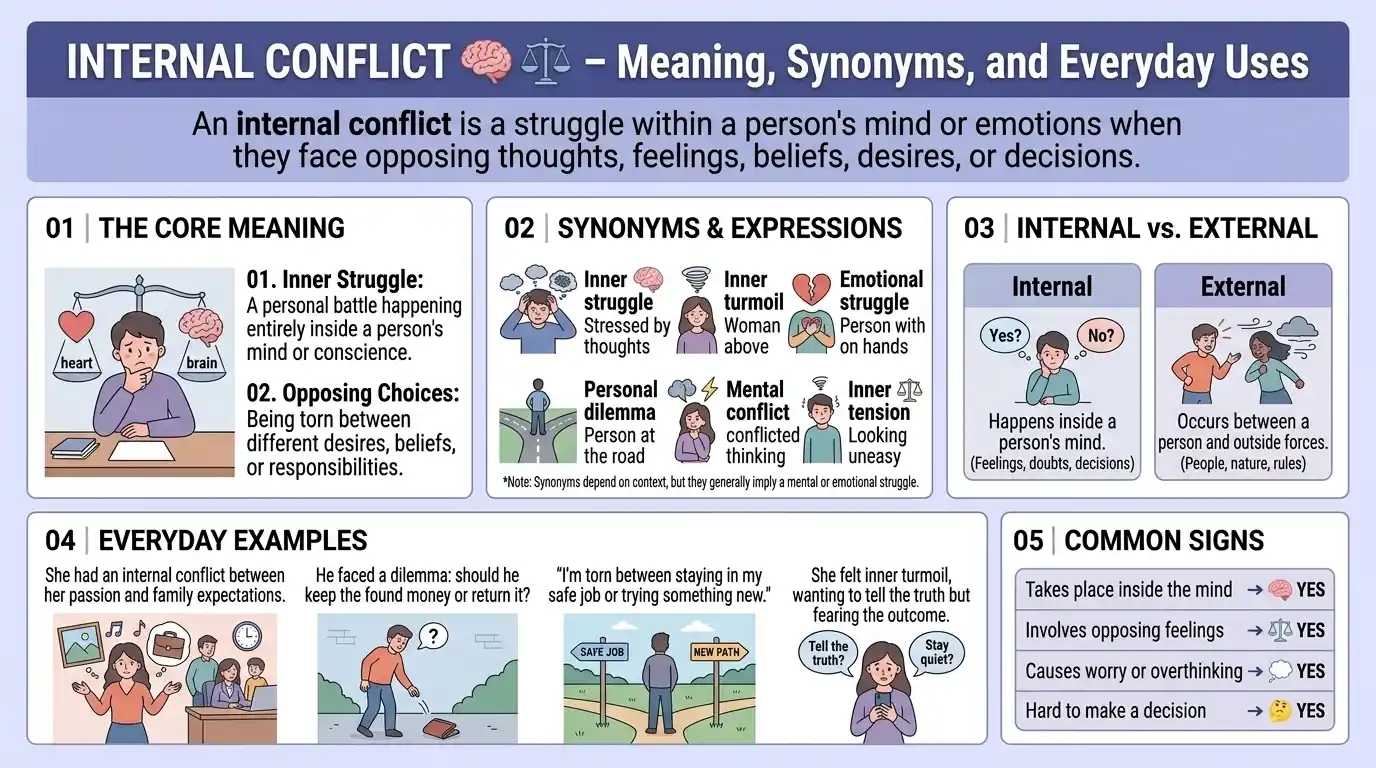
Synonyms of internal conflict include inner turmoil, inner struggle, emotional conflict, mental conflict, inner tension, and divided feelings. These expressions describe a struggle within someone’s mind or emotions. They often appear when personal values, desires, beliefs, or responsibilities compete. The best alternative depends on the situation and the emotional intensity involved.
Imagine receiving a dream job offer far from your family. You feel excited about your future but sad about leaving home. Both feelings pull you in different directions.
This emotional struggle explains why synonyms of internal conflict matter. They help you describe difficult decisions, mixed emotions, and personal challenges more clearly.
Students, bloggers, and content writers use these expressions to explain human behavior. Daily English users also need them to discuss feelings and choices.
Learning synonyms of internal conflict improves your vocabulary. It helps you express complicated thoughts naturally without repeating the same phrase in every sentence.
What Does Internal Conflict Really Mean?
Internal conflict is a struggle that happens inside a person’s mind. It occurs when someone experiences opposing emotions, desires, beliefs, values, or thoughts.
A person may want two different things at once. They may also feel torn between doing what they want and doing what they believe is right.
For example:
- Sarah wants to accept a promotion, but she fears losing time with her children.
- David wants to forgive his friend, but he still feels deeply hurt.
Both situations demonstrate internal conflict.
Native English speakers commonly use this expression when discussing personal decisions, emotional struggles, moral questions, and character development.
The phrase appears frequently in psychology, literature, education, and everyday conversations.
Part of Speech
Internal conflict is a noun phrase.
- Internal: Adjective
- Conflict: Noun
Together, these words describe an opposing force or struggle within a person.
Simple definition: A mental or emotional struggle between competing thoughts, feelings, values, or desires.
Connotative Meaning of Internal Conflict
(Connotation refers to the emotional meaning or associations a word carries beyond its basic dictionary definition.)
The phrase internal conflict generally suggests emotional difficulty. However, its meaning can change depending on the situation.
Positive Tone
Internal conflict can encourage personal growth, reflection, and better decisions.
Example: Her internal conflict helped her understand what truly mattered in life.
Negative Tone
It may suggest distress, uncertainty, emotional pain, or psychological pressure.
Example: His internal conflict made it difficult to concentrate at work.
Neutral Tone
The expression can simply describe competing thoughts without suggesting that the experience is good or bad.
Example: The researcher examined internal conflict during important decision-making.
Etymology of Internal Conflict
The expression combines two words with different linguistic histories.
Internal comes from Latin internus, meaning inward or within.
Conflict comes from Latin conflictus, associated with striking together or clashing. It developed from confligere, meaning to strike together.
Together, the words describe opposing forces within something or someone.
Old English Period (450–1100)
The modern expression did not exist during this period.
Old English speakers used native vocabulary to discuss disagreement, struggle, and emotional suffering.
Middle English Period (1100–1500)
The word conflict entered English through French and Latin influence during the later Middle English period.
Its early meanings were associated with fighting, confrontation, and opposition.
Modern English Period (1500–Present)
The meanings of internal and conflict developed further in English.
The combined expression became useful for describing struggles within individuals, organizations, and other systems.
Today, internal conflict is particularly common in psychology, literature, and discussions about personal development.
Pronunciation of Internal Conflict
American English (US)
IPA: /ɪnˈtɝː.nəl ˈkɑːn.flɪkt/
British English (UK)
IPA: /ɪnˈtɜː.nəl ˈkɒn.flɪkt/
The main stress falls on the second syllable of internal and the first syllable of conflict.
Syllable Breakdown
in-TER-nal CON-flict
Total: Five syllables.
Affixation Pattern of Internal Conflict
The expression contains an adjective followed by a noun.
Internal:
- Root: intern-
- Prefix: None in the modern English word
- Suffix: -al
Conflict:
- Historical elements: Latin con- (together) + fligere (to strike)
- Modern English suffix: None
The expression follows this grammatical pattern:
Adjective + Noun = Internal Conflict
Synonyms List
Not every alternative is interchangeable in every sentence. Some describe emotional struggles, while others emphasize moral choices, uncertainty, or opposing desires.
The following 45 words and expressions cover the most useful meanings and closely related shades of internal conflict.
1. Inner Turmoil (Noun Phrase)
US: /ˈɪn.ɚ ˈtɝː.mɔɪl/
UK: /ˈɪn.ə ˈtɜː.mɔɪl/
Meaning: Deep emotional disturbance caused by conflicting feelings or thoughts.
Tone/Register: Emotional, literary, conversational.
Example 1: She experienced inner turmoil after rejecting the offer.
Example 2: His calm smile concealed years of inner turmoil.
2. Inner Struggle (Noun Phrase)
US: /ˈɪn.ɚ ˈstrʌɡ.əl/
UK: /ˈɪn.ə ˈstrʌɡ.əl/
Meaning: A personal battle between competing feelings, beliefs, or desires.
Tone/Register: Neutral, conversational, literary.
Example 1: His inner struggle became clear during the interview.
Example 2: Maya faced an inner struggle over leaving her hometown.
3. Emotional Conflict (Noun Phrase)
US: /ɪˈmoʊ.ʃən.əl ˈkɑːn.flɪkt/
UK: /ɪˈməʊ.ʃən.əl ˈkɒn.flɪkt/
Meaning: A clash between two or more competing emotions.
Tone/Register: Neutral, psychological, academic.
Example 1: She felt emotional conflict about ending the friendship.
Example 2: His emotional conflict affected his confidence.
4. Mental Conflict (Noun Phrase)
US: /ˈmen.təl ˈkɑːn.flɪkt/
UK: /ˈmen.təl ˈkɒn.flɪkt/
Meaning: A struggle between opposing ideas, thoughts, or decisions.
Tone/Register: Neutral, academic.
Example 1: The decision created mental conflict for the young lawyer.
Example 2: He experienced mental conflict while considering both arguments.
5. Inner Tension (Noun Phrase)
US: /ˈɪn.ɚ ˈten.ʃən/
UK: /ˈɪn.ə ˈten.ʃən/
Meaning: Psychological pressure caused by opposing thoughts or feelings.
Tone/Register: Neutral, psychological.
Example 1: Her inner tension increased before the meeting.
Example 2: The character’s inner tension shapes the entire novel.
6. Internal Struggle (Noun Phrase)
US: /ɪnˈtɝː.nəl ˈstrʌɡ.əl/
UK: /ɪnˈtɜː.nəl ˈstrʌɡ.əl/
Meaning: An ongoing personal struggle involving conflicting motivations or emotions.
Tone/Register: Neutral, literary, academic.
Example 1: He faced an internal struggle between loyalty and ambition.
Example 2: Her internal struggle continued throughout the summer.
7. Moral Dilemma (Noun Phrase)
US: /ˈmɔːr.əl dɪˈlem.ə/
UK: /ˈmɒr.əl dɪˈlem.ə/
Meaning: A difficult choice between competing moral duties or values.
Tone/Register: Academic, ethical, formal.
Example 1: The journalist faced a moral dilemma about revealing the source.
Example 2: Helping his friend meant breaking an important promise.
8. Ethical Conflict (Noun Phrase)
US: /ˈeθ.ɪ.kəl ˈkɑːn.flɪkt/
UK: /ˈeθ.ɪ.kəl ˈkɒn.flɪkt/
Meaning: A clash between ethical principles, responsibilities, or beliefs.
Tone/Register: Formal, professional, academic.
Example 1: The manager experienced ethical conflict over the company’s decision.
Example 2: Personal loyalty challenged her professional responsibilities.
9. Cognitive Dissonance (Noun Phrase)
US: /ˈkɑːɡ.nə.tɪv ˈdɪs.ə.nəns/
UK: /ˈkɒɡ.nɪ.tɪv ˈdɪs.ə.nəns/
Meaning: Psychological discomfort caused by inconsistent beliefs, attitudes, or behavior.
Tone/Register: Psychological, academic.
Example 1: He experienced cognitive dissonance after acting against his values.
Example 2: She supported honesty but kept making excuses for her lies.
10. Psychological Conflict (Noun Phrase)
US: /ˌsaɪ.kəˈlɑː.dʒɪ.kəl ˈkɑːn.flɪkt/
UK: /ˌsaɪ.kəˈlɒdʒ.ɪ.kəl ˈkɒn.flɪkt/
Meaning: Opposition between competing mental processes, motives, or desires.
Tone/Register: Academic, psychological.
Example 1: The film explores psychological conflict within its main character.
Example 2: His desire for freedom clashes with his need for security.
11. Personal Dilemma (Noun Phrase)
US: /ˈpɝː.sən.əl dɪˈlem.ə/
UK: /ˈpɜː.sən.əl dɪˈlem.ə/
Meaning: A difficult personal choice involving competing needs or priorities.
Tone/Register: Neutral, conversational.
Example 1: Nina faced a personal dilemma about moving abroad.
Example 2: He struggled to choose between family and career.
12. Divided Feelings (Noun Phrase)
US: /dɪˈvaɪ.dɪd ˈfiː.lɪŋz/
UK: /dɪˈvaɪ.dɪd ˈfiː.lɪŋz/
Meaning: Opposing emotions experienced toward the same situation.
Tone/Register: Conversational, neutral.
Example 1: I have divided feelings about selling our childhood home.
Example 2: She felt proud of her promotion but sad about leaving her team.
13. Ambivalence (Noun)
US: /æmˈbɪv.ə.ləns/
UK: /æmˈbɪv.ə.ləns/
Meaning: The experience of having opposing feelings or attitudes toward something.
Tone/Register: Formal, psychological, academic.
Example 1: Her ambivalence about marriage surprised her friends.
Example 2: He expressed ambivalence toward the proposed changes.
14. Self-Doubt (Noun)
US: /ˌselfˈdaʊt/
UK: /ˌselfˈdaʊt/
Meaning: Inner uncertainty about one’s abilities, decisions, or judgment.
Tone/Register: Conversational, psychological.
Example 1: Self-doubt made him question his career choice.
Example 2: She battled self-doubt before accepting the leadership role.
15. Inner Discord (Noun Phrase)
US: /ˈɪn.ɚ ˈdɪs.kɔːrd/
UK: /ˈɪn.ə ˈdɪs.kɔːd/
Meaning: A lack of inner harmony caused by competing thoughts or feelings.
Tone/Register: Literary, formal.
Example 1: His inner discord became stronger after the argument.
Example 2: The poet describes inner discord through contrasting images.
16. Internal Discord (Noun Phrase)
US: /ɪnˈtɝː.nəl ˈdɪs.kɔːrd/
UK: /ɪnˈtɜː.nəl ˈdɪs.kɔːd/
Meaning: Disharmony between opposing forces within a person or group.
Tone/Register: Formal, literary.
Example 1: Internal discord prevented him from making a confident choice.
Example 2: The novel reveals the hero’s internal discord.
17. Emotional Turmoil (Noun Phrase)
US: /ɪˈmoʊ.ʃən.əl ˈtɝː.mɔɪl/
UK: /ɪˈməʊ.ʃən.əl ˈtɜː.mɔɪl/
Meaning: Intense emotional disturbance that may arise from conflicting feelings.
Tone/Register: Emotional, literary.
Example 1: The breakup left her in emotional turmoil.
Example 2: He experienced emotional turmoil while deciding whether to return.
18. Mental Turmoil (Noun Phrase)
US: /ˈmen.təl ˈtɝː.mɔɪl/
UK: /ˈmen.təl ˈtɜː.mɔɪl/
Meaning: Severe mental disturbance involving troubled or competing thoughts.
Tone/Register: Emotional, descriptive.
Example 1: His mental turmoil made the decision feel impossible.
Example 2: She hid her mental turmoil behind a cheerful expression.
19. Inner Conflict (Noun Phrase)
US: /ˈɪn.ɚ ˈkɑːn.flɪkt/
UK: /ˈɪn.ə ˈkɒn.flɪkt/
Meaning: A struggle between opposing emotions, thoughts, or motivations within someone.
Tone/Register: Neutral, literary, academic.
Example 1: The protagonist’s inner conflict drives the story.
Example 2: He feels torn between honesty and friendship.
20. Conflict of Values (Noun Phrase)
US: /ˈkɑːn.flɪkt əv ˈvæl.juːz/
UK: /ˈkɒn.flɪkt əv ˈvæl.juːz/
Meaning: A clash between two or more principles that someone considers important.
Tone/Register: Academic, ethical, professional.
Example 1: She experienced a conflict of values at work.
Example 2: His belief in fairness challenged his loyalty to the company.
21. Conflict of Desires (Noun Phrase)
US: /ˈkɑːn.flɪkt əv dɪˈzaɪ.ɚz/
UK: /ˈkɒn.flɪkt əv dɪˈzaɪ.əz/
Meaning: A struggle between different wants that cannot easily be satisfied together.
Tone/Register: Psychological, descriptive.
Example 1: His conflict of desires made choosing a university difficult.
Example 2: She wanted independence but also longed for familiar surroundings.
22. Inner Battle (Noun Phrase)
US: /ˈɪn.ɚ ˈbæt.əl/
UK: /ˈɪn.ə ˈbæt.əl/
Meaning: A strong personal struggle against opposing thoughts, emotions, or impulses.
Tone/Register: Emotional, conversational, literary.
Example 1: He fought an inner battle before admitting his mistake.
Example 2: Her inner battle between fear and hope lasted for months.
23. Internal Battle (Noun Phrase)
US: /ɪnˈtɝː.nəl ˈbæt.əl/
UK: /ɪnˈtɜː.nəl ˈbæt.əl/
Meaning: A difficult struggle between opposing forces within someone’s mind.
Tone/Register: Descriptive, emotional.
Example 1: The athlete faced an internal battle over retirement.
Example 2: He wanted to speak up but feared the consequences.
24. Moral Conflict (Noun Phrase)
US: /ˈmɔːr.əl ˈkɑːn.flɪkt/
UK: /ˈmɒr.əl ˈkɒn.flɪkt/
Meaning: A struggle between competing moral beliefs or obligations.
Tone/Register: Formal, ethical, literary.
Example 1: The doctor experienced moral conflict over the difficult decision.
Example 2: Her sense of duty clashed with her personal beliefs.
25. Emotional Dilemma (Noun Phrase)
US: /ɪˈmoʊ.ʃən.əl dɪˈlem.ə/
UK: /ɪˈməʊ.ʃən.əl dɪˈlem.ə/
Meaning: A difficult choice shaped by opposing emotional needs.
Tone/Register: Conversational, descriptive.
Example 1: He faced an emotional dilemma about reconnecting with his father.
Example 2: She missed her old friends but enjoyed her new life.
26. Mental Struggle (Noun Phrase)
US: /ˈmen.təl ˈstrʌɡ.əl/
UK: /ˈmen.təl ˈstrʌɡ.əl/
Meaning: A difficult effort to manage or resolve competing thoughts.
Tone/Register: Neutral, conversational.
Example 1: The decision caused a mental struggle for the graduate.
Example 2: He wrestled with two very different career plans.
27. Inner Unrest (Noun Phrase)
US: /ˈɪn.ɚ ʌnˈrest/
UK: /ˈɪn.ə ʌnˈrest/
Meaning: A feeling of internal unease that can result from unresolved conflict.
Tone/Register: Literary, emotional.
Example 1: Inner unrest followed her decision to leave.
Example 2: He felt uneasy despite achieving his biggest goal.
28. Inner Division (Noun Phrase)
US: /ˈɪn.ɚ dɪˈvɪʒ.ən/
UK: /ˈɪn.ə dɪˈvɪʒ.ən/
Meaning: A state of being mentally or emotionally split between opposing positions.
Tone/Register: Literary, formal.
Example 1: Her inner division prevented a clear decision.
Example 2: The character feels split between tradition and independence.
29. Internal Division (Noun Phrase)
US: /ɪnˈtɝː.nəl dɪˈvɪʒ.ən/
UK: /ɪnˈtɜː.nəl dɪˈvɪʒ.ən/
Meaning: Separation between opposing beliefs, desires, or motivations within a person.
Tone/Register: Formal, analytical.
Example 1: His internal division became obvious during the discussion.
Example 2: She struggled to balance ambition with personal happiness.
30. Conflicting Emotions (Noun Phrase)
US: /kənˈflɪk.tɪŋ ɪˈmoʊ.ʃənz/
UK: /kənˈflɪk.tɪŋ ɪˈməʊ.ʃənz/
Meaning: Different emotions that oppose each other in the same situation.
Tone/Register: Neutral, conversational.
Example 1: He experienced conflicting emotions at his daughter’s graduation.
Example 2: She felt relief and sadness after resigning.
31. Conflicting Thoughts (Noun Phrase)
US: /kənˈflɪk.tɪŋ θɔːts/
UK: /kənˈflɪk.tɪŋ θɔːts/
Meaning: Opposing ideas that make reaching a clear judgment difficult.
Tone/Register: Neutral, everyday English.
Example 1: Conflicting thoughts kept him awake that night.
Example 2: She could see strong reasons for both choices.
32. Conflicting Desires (Noun Phrase)
US: /kənˈflɪk.tɪŋ dɪˈzaɪ.ɚz/
UK: /kənˈflɪk.tɪŋ dɪˈzaɪ.əz/
Meaning: Competing wants that pull someone toward different outcomes.
Tone/Register: Neutral, psychological.
Example 1: His conflicting desires complicated the relationship.
Example 2: She wanted adventure but also valued stability.
33. Divided Loyalties (Noun Phrase)
US: /dɪˈvaɪ.dɪd ˈlɔɪ.əl.tiz/
UK: /dɪˈvaɪ.dɪd ˈlɔɪ.əl.tiz/
Meaning: A conflict caused by feeling loyal to two competing people, groups, or responsibilities.
Tone/Register: Professional, literary, conversational.
Example 1: The employee had divided loyalties between two departments.
Example 2: He wanted to support both his brother and his best friend.
34. Inner Dilemma (Noun Phrase)
US: /ˈɪn.ɚ dɪˈlem.ə/
UK: /ˈɪn.ə dɪˈlem.ə/
Meaning: A difficult personal choice involving opposing thoughts or feelings.
Tone/Register: Descriptive, literary.
Example 1: Her inner dilemma delayed the final decision.
Example 2: He could not decide whether to confess or remain silent.
35. Internal Turmoil (Noun Phrase)
US: /ɪnˈtɝː.nəl ˈtɝː.mɔɪl/
UK: /ɪnˈtɜː.nəl ˈtɜː.mɔɪl/
Meaning: Intense disturbance within someone’s thoughts or emotions.
Tone/Register: Literary, emotional.
Example 1: The unexpected news caused internal turmoil.
Example 2: She appeared confident despite her internal turmoil.
36. Emotional Struggle (Noun Phrase)
US: /ɪˈmoʊ.ʃən.əl ˈstrʌɡ.əl/
UK: /ɪˈməʊ.ʃən.əl ˈstrʌɡ.əl/
Meaning: Difficulty managing or resolving competing emotions.
Tone/Register: Conversational, emotional.
Example 1: Forgiving her former friend became an emotional struggle.
Example 2: He wanted to celebrate but still felt disappointed.
37. Inner Contradiction (Noun Phrase)
US: /ˈɪn.ɚ ˌkɑːn.trəˈdɪk.ʃən/
UK: /ˈɪn.ə ˌkɒn.trəˈdɪk.ʃən/
Meaning: An inconsistency between someone’s opposing beliefs, desires, or attitudes.
Tone/Register: Literary, analytical.
Example 1: His inner contradiction became clear when he defended the policy.
Example 2: She valued independence but feared making decisions alone.
38. Internal Contradiction (Noun Phrase)
US: /ɪnˈtɝː.nəl ˌkɑːn.trəˈdɪk.ʃən/
UK: /ɪnˈtɜː.nəl ˌkɒn.trəˈdɪk.ʃən/
Meaning: A clash between inconsistent ideas or principles within a person or system.
Tone/Register: Formal, academic.
Example 1: The argument reveals an internal contradiction in his beliefs.
Example 2: Her actions challenged the values she publicly supported.
39. Moral Struggle (Noun Phrase)
US: /ˈmɔːr.əl ˈstrʌɡ.əl/
UK: /ˈmɒr.əl ˈstrʌɡ.əl/
Meaning: A personal struggle over what is morally right or wrong.
Tone/Register: Ethical, literary.
Example 1: His moral struggle began when he discovered the truth.
Example 2: She wanted to protect her colleague without hiding the facts.
40. Internal Tension (Noun Phrase)
US: /ɪnˈtɝː.nəl ˈten.ʃən/
UK: /ɪnˈtɜː.nəl ˈten.ʃən/
Meaning: Pressure created by opposing forces within a person or organization.
Tone/Register: Neutral, academic, professional.
Example 1: The difficult choice created internal tension.
Example 2: His competing responsibilities made him feel increasingly unsettled.
41. Being Torn (Verb Phrase)
US: /ˈbiː.ɪŋ tɔːrn/
UK: /ˈbiː.ɪŋ tɔːn/
Meaning: Feeling unable to choose between two competing options or emotions.
Tone/Register: Informal, conversational.
Example 1: I’m torn between studying abroad and staying near my parents.
Example 2: She’s torn about accepting the new position.
42. Wrestling With Oneself (Verb Phrase)
US: /ˈres.lɪŋ wɪð wʌnˈself/
UK: /ˈres.lɪŋ wɪð wʌnˈself/
Meaning: Struggling internally with one’s own feelings, beliefs, or decisions.
Tone/Register: Figurative, literary.
Example 1: He spent the evening wrestling with himself over the decision.
Example 2: She wrestled with herself before revealing the secret.
43. Feeling Conflicted (Verb Phrase)
US: /ˈfiː.lɪŋ kənˈflɪk.tɪd/
UK: /ˈfiː.lɪŋ kənˈflɪk.tɪd/
Meaning: Experiencing opposing feelings or opinions about something.
Tone/Register: Conversational, neutral.
Example 1: I’m feeling conflicted about leaving my current job.
Example 2: He felt conflicted after hearing both sides of the story.
44. Mixed Feelings (Noun Phrase)
US: /mɪkst ˈfiː.lɪŋz/
UK: /mɪkst ˈfiː.lɪŋz/
Meaning: Different or opposing emotions experienced toward one situation.
Tone/Register: Informal, conversational.
Example 1: I have mixed feelings about moving to another city.
Example 2: She was excited about graduation but sad to leave her classmates.
45. Torn Between Two Choices (Adjectival Phrase)
US: /tɔːrn bɪˈtwiːn tuː ˈtʃɔɪ.sɪz/
UK: /tɔːn bɪˈtwiːn tuː ˈtʃɔɪ.sɪz/
Meaning: Feeling pulled toward two different options without knowing which to choose.
Tone/Register: Conversational, descriptive.
Example 1: He was torn between two choices after receiving both offers.
Example 2: She could either follow her passion or accept a stable job.
Synonyms for Internal Conflict by Tone
Choosing the correct synonym involves more than matching dictionary meanings.
Tone helps readers understand whether a struggle feels serious, emotional, thoughtful, or relatively mild.
Positive or Reflective Tone
These expressions can suggest personal reflection or growth when used in a constructive context.
- Inner struggle
- Moral dilemma
- Moral struggle
- Conflict of values
- Personal dilemma
- Inner battle
Example: Her inner struggle encouraged her to reconsider her priorities.
These expressions are not automatically positive. Their tone depends on the surrounding sentence.
Neutral Tone
These alternatives describe opposing thoughts or feelings without necessarily suggesting severe distress.
- Inner conflict
- Mental conflict
- Ambivalence
- Divided feelings
- Conflicting thoughts
- Conflicting desires
- Internal tension
- Mixed feelings
- Feeling conflicted
Example: He had mixed feelings about changing universities.
Negative or Intense Tone
These expressions emphasize emotional discomfort, pressure, or disturbance.
- Inner turmoil
- Emotional turmoil
- Mental turmoil
- Internal turmoil
- Inner discord
- Inner unrest
- Emotional struggle
- Psychological conflict
Example: The unexpected decision caused intense emotional turmoil.
Playful or Informal Tone
Internal conflict is usually a serious subject. However, everyday speakers sometimes describe minor dilemmas humorously.
Useful expressions include:
- Being torn
- Mixed feelings
- Feeling conflicted
- Torn between two choices
Example: I’m torn between ordering pizza and saving room for dessert.
This sentence describes a small everyday dilemma rather than serious psychological distress.
Internal Conflict vs Close Alternatives
Several expressions look interchangeable. However, each emphasizes a slightly different experience.
| Expression | Main Meaning | Tone | Best Use |
|---|---|---|---|
| Internal conflict | Opposing thoughts, feelings, or desires | Neutral | General personal struggles |
| Inner turmoil | Intense emotional disturbance | Strong, emotional | Deep distress |
| Ambivalence | Simultaneous opposing attitudes or feelings | Neutral, academic | Mixed attitudes |
| Cognitive dissonance | Discomfort from inconsistent beliefs or behavior | Psychological | Belief-behavior contradictions |
Internal Conflict vs Inner Turmoil
Internal conflict describes opposing forces within someone’s mind.
Inner turmoil emphasizes the emotional disturbance that may result.
Example: She experienced internal conflict about moving away.
Example: The thought of leaving her children caused inner turmoil.
The first sentence highlights competing motivations. The second emphasizes emotional intensity.
Internal Conflict vs Ambivalence
Ambivalence describes having opposing feelings or attitudes toward the same thing.
Internal conflict is broader. It can involve values, duties, desires, and decisions.
Example: He felt ambivalence toward his new responsibilities.
Use ambivalence when mixed attitudes are the central issue.
Internal Conflict vs Cognitive Dissonance
Cognitive dissonance has a more specific psychological meaning.
It describes discomfort associated with inconsistent beliefs, attitudes, or actions.
For example, someone may believe honesty is essential but regularly tell lies.
That inconsistency can create cognitive dissonance.
Use internal conflict when discussing a broader personal struggle.
How Internal Conflict Changes by Context
The expression appears in many communication settings. Its meaning stays connected to opposing internal forces, but the emphasis changes.
Daily Conversation
Everyday speakers usually prefer simple alternatives.
Common choices include feeling conflicted, mixed feelings, and being torn.
Example: I’m torn between visiting my friends and staying home.
These expressions sound natural in casual conversations.
Writing and Blogging
Bloggers often describe emotional experiences, personal growth, and difficult decisions.
Expressions such as inner struggle and emotional conflict help readers connect with personal stories.
Example: Her inner struggle taught her the importance of setting boundaries.
Choose language that matches the seriousness of the topic.
Professional Communication
Professional writing often requires measured language.
Useful expressions include ethical conflict, conflict of values, and internal tension.
Example: The employee experienced an ethical conflict regarding the reporting process.
These alternatives describe complicated situations without unnecessary drama.
Academic Writing
Academic discussions may require greater precision.
Psychological conflict, ambivalence, and cognitive dissonance can be appropriate when their specific meanings apply.
Example: The study examined ambivalence during complex decision-making.
Avoid treating these terms as identical psychological concepts.
Creative Writing
Internal conflict is an important storytelling element.
Writers use it to show what characters want, fear, believe, or regret.
Example: The detective wanted justice but feared exposing his closest friend.
This struggle creates emotional depth and gives readers a reason to follow the character’s choices.
Informal or Humorous Writing
Minor everyday dilemmas can also be described through internal-conflict language.
Example: My inner battle today is choosing between coffee and another hour of sleep.
This playful use creates humor through exaggeration.
Common Mistakes Learners Make
Mistake 1: Confusing Internal Conflict With External Conflict
Internal conflict occurs within a person.
External conflict involves opposition between a person and an outside force.
Internal: She struggles between telling the truth and protecting her friend.
External: She argues with her manager about the new policy.
The distinction is especially important in literature.
Mistake 2: Using Cognitive Dissonance for Every Difficult Decision
Not every difficult choice involves cognitive dissonance.
The term refers specifically to discomfort associated with inconsistent beliefs, attitudes, or actions.
Use a personal dilemma for a difficult choice without that specific psychological element.
Mistake 3: Treating Inner Turmoil as Mild Uncertainty
Inner turmoil suggests significant emotional disturbance.
It may sound exaggerated when describing a small decision.
Too dramatic: I experienced deep inner turmoil over choosing a sandwich.
More natural: I couldn’t decide which sandwich to order.
Mistake 4: Using Conflict and Conflicted Interchangeably
These words have different grammatical functions.
Correct: She experienced internal conflict.
Correct: She felt conflicted.
Incorrect: She experienced internal conflicted.
Use conflict as a noun and conflicted as an adjective.
Mistake 5: Repeating Internal Conflict Too Often
Using the same expression repeatedly can make writing feel unnatural.
Replace it with an accurate alternative when the context allows.
For example:
Repetitive: His internal conflict increased. His internal conflict affected his decisions.
Improved: His internal conflict intensified. This inner struggle affected his decisions.
Native English Usage and Register Notes
Formal English
Formal contexts commonly use:
- Internal conflict
- Psychological conflict
- Ethical conflict
- Cognitive dissonance
- Ambivalence
These expressions are useful in essays, research discussions, and professional communication.
Informal English
Native speakers often prefer simpler expressions during everyday conversations.
Natural examples include:
- I feel torn.
- I have mixed feelings.
- I’m feeling conflicted.
- Part of me wants to go, but another part wants to stay.
These expressions communicate the same general experience without sounding overly academic.
Spoken vs Written English
In spoken English, I’m torn often sounds more natural than I’m experiencing internal conflict.
In academic writing, the full expression may be more appropriate because it clearly identifies the concept being discussed.
The best choice depends on the audience, context, and intended emotional effect.
For further vocabulary development, explore related expressions in an article about synonyms of unemotional.
Real-Life Examples Using Internal Conflict
Understanding a phrase becomes easier when you see how it works in familiar situations.
Workplace Scenario
A manager discovers that a close colleague has broken an important company rule.
She wants to protect her friend but also believes in professional honesty.
Best expression: Ethical conflict.
Sentence: The manager faced an ethical conflict between friendship and responsibility.
Social Situation
A student receives an invitation to study abroad.
He feels excited about the opportunity but worries about leaving his family.
Best expression: Divided feelings.
Sentence: He had divided feelings about studying overseas.
Media and Pop Culture
A fictional superhero wants to protect the city but fears placing loved ones in danger.
Both motivations influence the character’s decisions.
Best expression: Inner conflict.
Sentence: The superhero’s inner conflict adds emotional depth to the story.
Writing and Storytelling
A novelist creates a character who values freedom but also fears loneliness.
These opposing desires shape the character’s behavior.
Best expression: Conflict of desires.
Sentence: Her conflict of desires becomes the central theme of the novel.
Everyday Decision
Someone receives two attractive job offers.
One provides better career growth. The other allows more time with family.
Best expression: Torn between two choices.
Sentence: She was torn between two choices and needed more time to decide.
Interactive Practice Quiz
Choose the most suitable answer for each real-life situation.
Part One: Meaning and Context
1. Emma wants to move abroad but also wants to stay close to her parents. What is she experiencing?
A) External conflict
B) Internal conflict
C) Physical conflict
D) Public disagreement
2. A person feels uncomfortable because their actions contradict their beliefs. Which term fits best?
A) Cognitive dissonance
B) Celebration
C) Cooperation
D) Satisfaction
3. Which expression suggests intense emotional disturbance?
A) Inner turmoil
B) Mild interest
C) Agreement
D) Confidence
4. A manager must choose between protecting a friend and following professional principles. What describes this situation?
A) Physical tension
B) Ethical conflict
C) Friendly competition
D) Social harmony
5. Which expression sounds most natural in casual conversation?
A) Psychological contradiction
B) Internal discord
C) I’m feeling conflicted
D) Cognitive inconsistency
6. A character wants independence but fears being alone. Which expression best describes the competing wants?
A) Conflict of desires
B) External pressure
C) Public criticism
D) Physical struggle
Part Two: Tone and Practical Usage
7. Which expression is most suitable for an academic discussion of opposing feelings toward something?
A) Ambivalence
B) Happiness
C) Agreement
D) Excitement
8. Which sentence uses internal conflict correctly?
A) She internal conflicted yesterday.
B) He experienced internal conflict.
C) They internal conflict happy.
D) I am an internal conflict person.
9. Which expression best describes loyalty to two competing groups?
A) Inner peace
B) Divided loyalties
C) Emotional stability
D) Shared success
10. A person cannot decide between two attractive job offers. Which expression sounds natural?
A) Feeling torn
B) Feeling victorious
C) Feeling united
D) Feeling certain
11. Which phrase emphasizes a struggle over right and wrong?
A) Moral struggle
B) Physical competition
C) Friendly discussion
D) Financial growth
12. A novelist wants to describe intense emotional disturbance within a character. Which phrase is most suitable?
A) Inner harmony
B) Emotional turmoil
C) Clear judgment
D) Shared agreement
13. Which expression is usually less intense than inner turmoil?
A) Mixed feelings
B) Severe distress
C) Emotional devastation
D) Deep anguish
14. Which sentence demonstrates an internal rather than external conflict?
A) Two neighbors argue about parking.
B) A company competes with another business.
C) A student struggles between ambition and family responsibilities.
D) Two teams compete in a tournament.
15. Which phrase best describes opposing personal principles?
A) Conflict of values
B) Physical disagreement
C) Shared opinion
D) Emotional satisfaction
Answer Key
1-B | 2-A | 3-A | 4-B | 5-C | 6-A | 7-A | 8-B | 9-B | 10-A | 11-A | 12-B | 13-A | 14-C | 15-A
Reflection and Application Task
Think about a situation where you experienced competing emotions or faced a difficult personal choice.
Write two sentences describing that situation.
Use one synonym from this article in the first sentence. Use a different expression in the second sentence.
Then compare their emotional tones.
This short exercise will help you understand which alternatives sound most natural in real communication.
Suggested External Reference
For additional vocabulary guidance, consult the Cambridge Dictionary:
https://dictionary.cambridge.org/dictionary/english/conflict
It provides pronunciation, grammatical information, definitions, and examples that help English learners understand how conflict functions in different contexts.
Conclusion
Learning synonyms of internal conflict helps you describe the quiet battles people face. Every expression adds a different emotional shade to your writing.
These alternatives make essays, blogs, and stories more meaningful. They also help you discuss difficult feelings without repeating the same words.
Understanding synonyms of internal conflict improves speaking and communication. You can express personal struggles with greater confidence and clarity.
Keep practicing synonyms of internal conflict in emails, essays, and daily conversations. Try a new expression each day and notice how your vocabulary grows.
FAQs
1. What is the best single-word synonym for internal conflict?
Ambivalence is a useful single-word alternative when someone experiences opposing feelings or attitudes toward the same situation.
However, it does not cover every type of internal conflict. The broader expression may also involve competing duties, moral principles, or personal desires. Choose ambivalence when mixed feelings are central to the experience.
2. What is another word for internal conflict in a relationship?
In relationships, useful alternatives include emotional conflict, mixed feelings, divided loyalties, and inner struggle.
For example, someone may love their partner but feel uncertain about their future together. This situation could be described as emotional conflict. If the person feels loyalty toward two competing relationships, divided loyalties may be more precise.
3. How can you describe internal conflict without directly naming it?
You can show internal conflict through contrasting thoughts, actions, or emotions.
For example: “She reached for her phone, then stopped. She wanted to apologize, but her pride held her back.”
This technique is especially effective in creative writing. It allows readers to recognize the character’s struggle through behavior rather than direct explanation.
4. Can internal conflict happen without a person realizing it?
Yes. Someone may experience competing motivations without immediately recognizing why they feel uncomfortable or indecisive.
For example, a person might repeatedly avoid an opportunity despite wanting to succeed. Further reflection may reveal a competing fear of failure. However, hesitation alone does not prove internal conflict.
5. What are the three common types of internal conflict in literature?
A common literary classification identifies three types:
Person vs. Self: A character struggles with personal feelings, beliefs, or desires.
Moral Conflict: A character faces competing ethical responsibilities.
Emotional Conflict: A character experiences opposing emotions.
These categories can overlap. Different educational frameworks may organize internal conflict differently.
6. Is internal conflict always a negative experience?
No. Internal conflict can feel uncomfortable, but it may also encourage reflection and personal development.
For example, questioning an important decision can help someone identify their priorities. A conflict between ambition and family responsibilities may lead to a healthier balance. The outcome depends on the situation and how the person responds.
7. How do you use internal conflict in a professional email?
Use the phrase when describing competing priorities, responsibilities, or considerations. Keep the wording clear and measured.
For example: “I am experiencing some internal conflict regarding the proposed transition because both options offer important benefits.”
In highly formal communication, competing priorities or conflicting responsibilities may sound more precise when the issue is practical rather than emotional.
8. What is the difference between internal conflict and indecision?
Internal conflict involves opposing thoughts, feelings, values, or motivations. Indecision simply means difficulty making a choice.
A person may feel indecisive because they lack enough information. That does not necessarily indicate internal conflict. However, competing personal desires can create internal conflict that eventually leads to indecision.

Mehtab Yasir is a passionate writer and English language enthusiast dedicated to making vocabulary learning simple, practical, and enjoyable. As an author at SynonymDesk.com, she creates helpful content covering synonyms, antonyms, word meanings, vocabulary, phrases, and everyday English usage. Her goal is to provide clear and easy-to-understand information that helps students, writers, professionals, and English learners choose the right words and communicate with greater confidence. Mehtab believes that a strong vocabulary can improve both writing and communication skills. She enjoys researching new words, exploring their meanings and uses, and turning complex language concepts into useful, reader-friendly content. Through her work, she strives to make SynonymDesk.com a reliable resource for anyone looking to improve their English vocabulary and language skills.