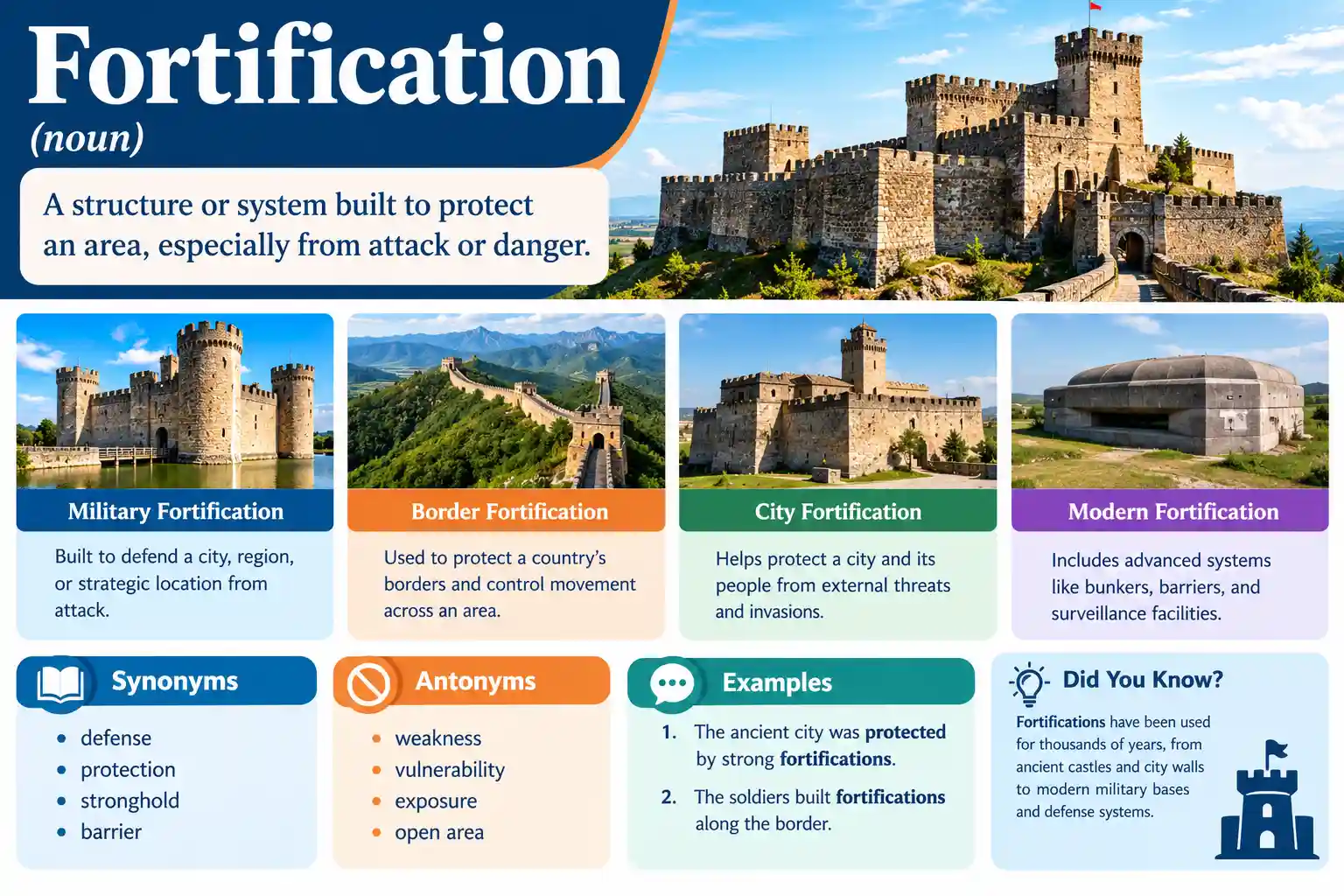
Synonyms of fortification include strengthening, reinforcement, protection, defense, safeguarding, and consolidation. Fortification refers to making something stronger, safer, or better protected against threats. It can describe military structures, physical barriers, emotional resilience, or nutritional improvement. The best alternative depends on whether you mean building defenses, increasing strength, or improving security.
Imagine a town preparing for a dangerous storm. Workers strengthen its walls and install protective barriers. This process is called fortification.
Learning synonyms of fortification helps you express different types of protection and strength without using the same word repeatedly.
Students, bloggers, and content writers often encounter this word in history, science, health, and professional discussions. Its meaning changes slightly with context.
Understanding synonyms of fortification also improves everyday communication. You can describe stronger relationships, safer buildings, and improved systems more precisely.
What Does Fortification Really Mean?
Fortification is the process of making something stronger or more resistant to damage, attack, weakness, or outside pressure.
It can also refer to a defensive structure designed to protect a particular location.
Part of Speech: Noun
Simple Definition: The act of strengthening or protecting something, or a structure built for defense.
Fortification is commonly used in military discussions, architecture, nutrition, cybersecurity, and personal development.
For example:
- The fortification of the castle protected its residents.
- Food fortification helps improve nutritional value.
The first sentence describes physical defense. The second refers to adding nutrients to food.
Native English speakers generally understand fortification as a process that increases strength, protection, or resistance.
Connotative Meaning of Fortification
(Connotation means the feelings, attitudes, or associations a word suggests beyond its basic dictionary meaning.)
Positive Tone
Fortification often suggests safety, preparation, improvement, and resilience.
Example: The fortification of the hospital improved its ability to handle emergencies.
Negative Tone
In military or political contexts, fortification may suggest conflict, fear, aggression, or preparation for an attack.
Example: The sudden fortification of the border increased tensions between neighboring countries.
Neutral Tone
In technical writing, fortification simply describes strengthening something without expressing approval or criticism.
Example: The company completed the fortification of its digital infrastructure.
Etymology of Fortification
The word fortification developed from Latin roots associated with strength and protection.
It comes through French from Latin fortificare, meaning to make strong.
The Latin word combines fortis (strong) and facere (to make or do).
Its history reflects the long-standing human need to protect settlements, resources, and important locations.
Old English Period (450–1100)
The modern word fortification was not part of Old English vocabulary.
However, Anglo-Saxon communities used defensive walls, earthworks, and fortified settlements.
The Old English word burh referred to a fortified place or stronghold.
Middle English Period (1100–1500)
Following the Norman Conquest, French military vocabulary increasingly influenced English.
Words related to fortifying and defensive construction entered English through Anglo-French and Latin.
The vocabulary gradually developed into forms recognizable in modern English.
Modern English Period (1500–Present)
Fortification became established in English as a term for defensive construction and strengthening.
Its meaning later expanded beyond military architecture.
Today, it also appears in nutrition, cybersecurity, engineering, and discussions of personal resilience.
Pronunciation of Fortification
- US: /ˌfɔːr.t̬ə.fəˈkeɪ.ʃən/
- UK: /ˌfɔː.tɪ.fɪˈkeɪ.ʃən/
The strongest stress falls on KAY.
Syllables
for-ti-fi-ca-tion
Total: Five syllables.
Affixation Pattern of Fortification
Root: Fort-, meaning strong.
Prefix: No separate prefix.
Suffix: -ification, a noun-forming ending associated with a process or action.
Word formation: Fortify + -cation → fortification, with the spelling adjusted during noun formation.
Related words include:
- Fortify (verb)
- Fortified (adjective)
- Fortifying (adjective or verb form)
- Fortifier (noun)
Synonyms List
Fortification has several related meanings. Some alternatives describe physical defenses. Others refer to strengthening, protection, or improvement.
The following 40 words and expressions cover these meanings. Not every alternative is interchangeable in every sentence.
Choose the word that matches your intended context.
1. Reinforcement (Noun) — US /ˌriː.ɪnˈfɔːrs.mənt/ | UK /ˌriː.ɪnˈfɔːs.mənt/
Meaning: The process of making something stronger by adding support or extra material.
Tone/Register: Neutral, Technical, Professional.
Example 1: The bridge needed reinforcement before winter.
Example 2: Additional reinforcement made the roof more secure.
2. Strengthening (Noun) — US /ˈstreŋ.θən.ɪŋ/ | UK /ˈstreŋ.θən.ɪŋ/
Meaning: The process of increasing the strength, effectiveness, or resistance of something.
Tone/Register: Neutral, Everyday, Professional.
Example 1: Strengthening the building became a priority.
Example 2: The team focused on strengthening customer relationships.
3. Defense (Noun) — US /dɪˈfens/ | UK /dɪˈfens/
Meaning: Protection against attack, danger, criticism, or other threats.
Tone/Register: Neutral, Military, Formal.
Example 1: The soldiers prepared their defense before sunrise.
Example 2: Strong passwords provide an important defense against hackers.
4. Protection (Noun) — US /prəˈtek.ʃən/ | UK /prəˈtek.ʃən/
Meaning: The act of keeping someone or something safe from harm or damage.
Tone/Register: Neutral, Everyday.
Example 1: The new barrier offers better protection from flooding.
Example 2: Children need protection from harmful online content.
5. Safeguarding (Noun) — US /ˈseɪfˌɡɑːr.dɪŋ/ | UK /ˈseɪfˌɡɑː.dɪŋ/
Meaning: The process of preventing harm and protecting something valuable or vulnerable.
Tone/Register: Formal, Professional.
Example 1: Safeguarding customer information is essential.
Example 2: The school introduced new safeguarding procedures.
6. Consolidation (Noun) — US /kənˌsɑː.ləˈdeɪ.ʃən/ | UK /kənˌsɒl.ɪˈdeɪ.ʃən/
Meaning: The process of combining or securing existing elements to create greater strength or stability.
Tone/Register: Formal, Business, Academic.
Example 1: Consolidation helped the company improve its position.
Example 2: The army began the consolidation of its defenses.
7. Buttressing (Noun) — US /ˈbʌt.rə.sɪŋ/ | UK /ˈbʌt.rə.sɪŋ/
Meaning: The act of providing additional support to strengthen a structure, position, or argument.
Tone/Register: Formal, Architectural, Academic.
Example 1: Buttressing prevented the old wall from collapsing.
Example 2: New evidence provided buttressing for her argument.
8. Bolstering (Noun) — US /ˈboʊl.stɚ.ɪŋ/ | UK /ˈbəʊl.stər.ɪŋ/
Meaning: The act of supporting or improving something to make it stronger or more effective.
Tone/Register: Professional, Neutral.
Example 1: Bolstering public confidence became the manager’s goal.
Example 2: The organization invested in bolstering its security.
9. Security (Noun) — US /səˈkjʊr.ə.t̬i/ | UK /sɪˈkjʊə.rə.ti/
Meaning: A state of safety or the measures used to prevent danger and unauthorized access.
Tone/Register: Neutral, Professional.
Example 1: The airport increased security during the event.
Example 2: Better security helped protect the company’s records.
10. Fortifying (Noun/Gerund) — US /ˈfɔːr.t̬ə.faɪ.ɪŋ/ | UK /ˈfɔː.tɪ.faɪ.ɪŋ/
Meaning: The process of making something stronger, more resistant, or better protected.
Tone/Register: Neutral, Technical.
Example 1: Fortifying the coastline reduced storm damage.
Example 2: Fortifying breakfast cereal can improve its nutrient content.
11. Hardening (Noun) — US /ˈhɑːr.dən.ɪŋ/ | UK /ˈhɑː.dən.ɪŋ/
Meaning: The process of making something physically tougher or more resistant to threats.
Tone/Register: Technical, Engineering, Cybersecurity.
Example 1: System hardening reduced several security risks.
Example 2: The engineers recommended hardening the outer surface.
12. Stabilization (Noun) — US /ˌsteɪ.bə.ləˈzeɪ.ʃən/ | UK /ˌsteɪ.bɪ.laɪˈzeɪ.ʃən/
Meaning: The process of making something steady and less likely to fail or change unexpectedly.
Tone/Register: Technical, Academic, Professional.
Example 1: Soil stabilization protected the hillside.
Example 2: Economic stabilization helped restore investor confidence.
13. Support (Noun) — US /səˈpɔːrt/ | UK /səˈpɔːt/
Meaning: Assistance or structural strength that helps something remain stable or effective.
Tone/Register: Neutral, Everyday.
Example 1: The damaged roof needed additional support.
Example 2: Her family’s support helped her overcome the challenge.
14. Shoring Up (Noun Phrase) — US /ˌʃɔːr.ɪŋ ˈʌp/ | UK /ˌʃɔː.rɪŋ ˈʌp/
Meaning: The process of adding support to prevent weakness, failure, or collapse.
Tone/Register: Neutral, Business, Engineering.
Example 1: Shoring up the foundation prevented further damage.
Example 2: The bank focused on shoring up its finances.
15. Reinforcing (Noun/Gerund) — US /ˌriː.ɪnˈfɔːr.sɪŋ/ | UK /ˌriː.ɪnˈfɔː.sɪŋ/
Meaning: The act of adding strength, support, or resistance to something.
Tone/Register: Neutral, Technical.
Example 1: Reinforcing the windows improved home safety.
Example 2: Reinforcing workplace rules reduced confusion.
16. Armoring (Noun/Gerund) — US /ˈɑːr.mɚ.ɪŋ/ | UK /ˈɑː.mə.rɪŋ/ (Armouring)
Meaning: The process of covering something with protective material to resist damage or attack.
Tone/Register: Military, Technical.
Example 1: Armoring the vehicle improved passenger safety.
Example 2: The project involved armoring important equipment.
17. Entrenchment (Noun) — US /ɪnˈtrentʃ.mənt/ | UK /ɪnˈtrentʃ.mənt/
Meaning: The act of establishing a secure defensive position or making an existing position harder to challenge.
Tone/Register: Formal, Military, Political.
Example 1: Entrenchment helped the troops defend their position.
Example 2: The entrenchment of old policies slowed reform.
18. Barricading (Noun/Gerund) — US /ˌber.əˈkeɪ.dɪŋ/ | UK /ˌbær.ɪˈkeɪ.dɪŋ/
Meaning: The act of blocking an entrance or area with barriers to prevent access.
Tone/Register: Neutral, Security.
Example 1: Barricading the entrance kept unauthorized visitors outside.
Example 2: Workers began barricading the damaged street.
19. Reinforcement Work (Noun Phrase) — US /ˌriː.ɪnˈfɔːrs.mənt wɝːk/ | UK /ˌriː.ɪnˈfɔːs.mənt wɜːk/
Meaning: Practical construction work performed to increase the strength of an existing structure.
Tone/Register: Technical, Construction.
Example 1: Reinforcement work continued throughout the summer.
Example 2: The contractor completed reinforcement work on the bridge.
20. Defensive Construction (Noun Phrase) — US /dɪˈfen.sɪv kənˈstrʌk.ʃən/ | UK /dɪˈfen.sɪv kənˈstrʌk.ʃən/
Meaning: The building of structures intended to protect a place against attack.
Tone/Register: Formal, Military, Architectural.
Example 1: Defensive construction transformed the coastal settlement.
Example 2: The museum displayed examples of medieval defensive construction.
21. Stronghold (Noun) — US /ˈstrɔːŋ.hoʊld/ | UK /ˈstrɒŋ.həʊld/
Meaning: A strongly protected place used as a secure base or defensive position.
Tone/Register: Military, Historical.
Example 1: The ancient stronghold overlooked the valley.
Example 2: The soldiers retreated to their mountain stronghold.
22. Fortress (Noun) — US /ˈfɔːr.trəs/ | UK /ˈfɔː.trəs/
Meaning: A large, strongly defended building or place designed to resist attacks.
Tone/Register: Historical, Military.
Example 1: The fortress protected the city for centuries.
Example 2: Tourists explored the old stone fortress.
23. Bulwark (Noun) — US /ˈbʊl.wɚk/ | UK /ˈbʊl.wək/
Meaning: A defensive barrier or something that provides strong protection against danger.
Tone/Register: Formal, Literary.
Example 1: The sea wall served as a bulwark against flooding.
Example 2: Independent journalism can be a bulwark against misinformation.
24. Rampart (Noun) — US /ˈræm.pɑːrt/ | UK /ˈræm.pɑːt/
Meaning: A defensive wall or raised bank surrounding a fortified place.
Tone/Register: Historical, Architectural.
Example 1: Guards watched the valley from the rampart.
Example 2: The castle’s rampart remained surprisingly intact.
25. Bastion (Noun) — US /ˈbæs.tʃən/ | UK /ˈbæs.ti.ən/
Meaning: A projecting defensive structure or something that strongly protects a principle or position.
Tone/Register: Formal, Military, Literary.
Example 1: The bastion allowed soldiers to defend the outer wall.
Example 2: The library became a bastion of independent learning.
26. Redoubt (Noun) — US /rɪˈdaʊt/ | UK /rɪˈdaʊt/
Meaning: A small defensive structure or secure military position.
Tone/Register: Military, Historical.
Example 1: The troops occupied a redoubt near the river.
Example 2: The old redoubt is now a protected historical site.
27. Citadel (Noun) — US /ˈsɪt̬.ə.del/ | UK /ˈsɪt.ə.del/
Meaning: A strongly fortified central area that protects a city or settlement.
Tone/Register: Historical, Architectural.
Example 1: The citadel stood above the crowded marketplace.
Example 2: Visitors admired the ancient citadel at sunset.
28. Stockade (Noun) — US /stɑːˈkeɪd/ | UK /stɒˈkeɪd/
Meaning: A protective enclosure formed by strong wooden posts.
Tone/Register: Historical, Military.
Example 1: Settlers built a stockade around their homes.
Example 2: The wooden stockade protected the temporary camp.
29. Palisade (Noun) — US /ˌpæl.ɪˈseɪd/ | UK /ˌpæl.ɪˈseɪd/
Meaning: A defensive fence made from upright wooden stakes or similar materials.
Tone/Register: Historical, Architectural.
Example 1: A tall palisade surrounded the village.
Example 2: Archaeologists discovered remains of an early palisade.
30. Earthwork (Noun) — US /ˈɝːθ.wɝːk/ | UK /ˈɜːθ.wɜːk/
Meaning: A defensive structure formed by moving and shaping soil or earth.
Tone/Register: Military, Archaeological.
Example 1: The soldiers constructed an earthwork near the road.
Example 2: The ancient earthwork remains visible today.
31. Breastwork (Noun) — US /ˈbrest.wɝːk/ | UK /ˈbrest.wɜːk/
Meaning: A low defensive wall or barrier that protects during combat.
Tone/Register: Military, Historical.
Example 1: The troops sheltered behind a breastwork.
Example 2: Workers restored the historic breastwork.
32. Defensive Wall (Noun Phrase) — US /dɪˈfen.sɪv wɔːl/ | UK /dɪˈfen.sɪv wɔːl/
Meaning: A wall built specifically to protect a place from attack or intrusion.
Tone/Register: Neutral, Architectural.
Example 1: The defensive wall surrounded the entire settlement.
Example 2: Engineers inspected the defensive wall after the earthquake.
33. Barrier (Noun) — US /ˈber.i.ɚ/ | UK /ˈbær.i.ə/
Meaning: A physical or figurative obstacle that blocks access or prevents danger.
Tone/Register: Neutral, Everyday.
Example 1: The concrete barrier protected nearby homes.
Example 2: Language can become a barrier to communication.
34. Ramparting (Noun/Gerund) — US /ˈræm.pɑːr.tɪŋ/ | UK /ˈræm.pɑː.tɪŋ/
Meaning: The act of constructing or protecting an area with defensive ramparts.
Tone/Register: Rare, Historical, Architectural.
Example 1: Ramparting strengthened the settlement’s outer boundary.
Example 2: The historical study examined early methods of ramparting.
35. Enhancement (Noun) — US /ɪnˈhæns.mənt/ | UK /ɪnˈhɑːns.mənt/
Meaning: The process of improving an existing quality, feature, or capability.
Tone/Register: Neutral, Professional.
Example 1: Security enhancement reduced the risk of unauthorized access.
Example 2: The project focused on enhancing structural safety.
36. Improvement (Noun) — US /ɪmˈpruːv.mənt/ | UK /ɪmˈpruːv.mənt/
Meaning: A change that makes something better, stronger, or more effective.
Tone/Register: Neutral, Everyday.
Example 1: The improvement in building safety impressed residents.
Example 2: Regular training led to noticeable improvement.
37. Enrichment (Noun) — US /ɪnˈrɪtʃ.mənt/ | UK /ɪnˈrɪtʃ.mənt/
Meaning: The process of increasing value or nutritional content by adding beneficial elements.
Tone/Register: Academic, Nutrition, Professional.
Example 1: Flour enrichment helps replace certain nutrients lost during processing.
Example 2: The report discussed nutrient enrichment in staple foods.
38. Nutrient Addition (Noun Phrase) — US /ˈnuː.tri.ənt əˈdɪʃ.ən/ | UK /ˈnjuː.tri.ənt əˈdɪʃ.ən/
Meaning: The process of adding vitamins, minerals, or other nutrients to a food product.
Tone/Register: Scientific, Nutritional.
Example 1: Nutrient addition improved the cereal’s nutritional profile.
Example 2: The researchers studied nutrient addition in everyday foods.
39. Resilience Building (Noun Phrase) — US /rɪˈzɪl.jəns ˈbɪl.dɪŋ/ | UK /rɪˈzɪl.i.əns ˈbɪl.dɪŋ/
Meaning: The process of developing greater resistance to difficulties, stress, or disruption.
Tone/Register: Professional, Psychological.
Example 1: Resilience building helped employees manage workplace pressure.
Example 2: The community introduced resilience-building activities after the flood.
40. Securement (Noun) — US /sɪˈkjʊr.mənt/ | UK /sɪˈkjʊə.mənt/
Meaning: The act of making something secure or firmly fixed in place.
Tone/Register: Formal, Technical; less common in everyday English.
Example 1: Proper securement prevented the equipment from moving.
Example 2: The inspection included securement of the storage units.
Vocabulary Note: The closest general synonyms are reinforcement, strengthening, and protection. Words such as citadel, stockade, and rampart refer specifically to defensive structures. Technical alternatives such as nutrient addition apply only to particular meanings of fortification.
Synonyms for Fortification by Tone
Tone matters because two words can describe similar ideas while creating different impressions.
For example, protection sounds reassuring, while entrenchment may suggest resistance to change.
Positive Tone
- Strengthening
- Protection
- Safeguarding
- Reinforcement
- Bolstering
- Enhancement
- Improvement
- Resilience building
- Enrichment
These alternatives emphasize improvement, safety, support, or progress.
Neutral Tone
- Fortifying
- Security
- Support
- Stabilization
- Consolidation
- Defensive construction
- Barrier
- Reinforcing
- Nutrient addition
- Securement
These words generally describe actions, processes, or conditions without expressing strong emotions.
Negative or Threat-Associated Tone
- Entrenchment
- Barricading
- Hardening
- Armoring
- Defense
- Stronghold
These words are not inherently negative. However, they can suggest conflict, exclusion, resistance, or preparation for danger.
Playful or Informal Tone
Fortification is usually a serious word. Most of its direct alternatives also sound technical or formal.
In casual speech, people may use expressions such as:
- Shoring up
- Adding extra protection
- Making something stronger
- Building stronger defenses
For example:
“We need to shore up our plans before the big event.”
This sounds more natural in conversation than saying, “We require additional fortification of our arrangements.”
Fortification vs Close Alternatives
Three words deserve special attention because they share closely related meanings.
| Word | Main Meaning | Tone | Best Context |
|---|---|---|---|
| Fortification | Making something stronger or more defensible | Formal, Technical | Military defense, nutrition, security |
| Reinforcement | Adding support to increase existing strength | Neutral, Technical | Construction, systems, structures |
| Strengthening | Increasing strength or effectiveness | Neutral, Everyday | Relationships, buildings, organizations |
| Protection | Preventing harm or damage | Neutral, Reassuring | Safety, people, property |
Fortification vs Reinforcement
Fortification emphasizes making something stronger against a possible threat.
Reinforcement focuses on adding support to an existing structure or system.
Example: The fortification of the coastal town improved its defenses.
Example: Reinforcement of the bridge increased its load capacity.
Fortification vs Strengthening
Strengthening is broader and more conversational.
Fortification often suggests deliberate preparation against danger or weakness.
Example: The government approved the fortification of the border.
Example: The organization prioritized strengthening its leadership team.
Fortification vs Protection
Protection describes keeping something safe.
Fortification refers more specifically to making something stronger or more defensible.
Example: The workers completed the fortification of the shelter.
Example: The shelter protected during the storm.
How Fortification Changes by Context
The meaning of fortification becomes clearer when you examine the situation in which it appears.
Daily Conversation
In everyday speech, people usually prefer simpler alternatives such as strengthening, protection, or extra support.
Example: We need stronger protection around the garden.
This sounds more conversational than describing ordinary garden repairs as fortification.
Writing or Blogging
Bloggers can use fortification when discussing preparedness, security, architecture, or health.
Example: Home fortification can reduce certain risks during severe weather.
Use specific alternatives when readers need a clearer explanation.
Professional or Academic Writing
Fortification appears in engineering, defense studies, cybersecurity, and nutritional research.
Example: The study examined the effects of iron fortification on nutritional intake.
In academic writing, precision matters more than stylistic variety.
Creative or Informal Writing
Creative writers may use fortification metaphorically to describe emotional protection.
Example: Years of disappointment had become a fortification around his heart.
This creates a stronger image than simply saying that he became emotionally guarded.
Common Mistakes Learners Make
Mistake 1: Treating Every Synonym as Interchangeable
A fortress is a physical defensive structure.
Strengthening describes a process.
These words cannot always replace each other.
Incorrect: The company completed a fortress of its cybersecurity.
Correct: The company completed the strengthening of its cybersecurity systems.
Mistake 2: Confusing Fortification With Fortitude
These words share a connection with strength, but their meanings differ.
Fortification: Strengthening or protecting something.
Fortitude: Mental courage during hardship.
Example: She showed remarkable fortitude during the crisis.
Mistake 3: Using Fortification for Every Improvement
Fortification usually suggests strengthening, defense, or added nutrients.
An ordinary improvement does not automatically qualify as fortification.
Instead of saying “the fortification of the website’s colors,” say “the improvement of the website’s design.”
Mistake 4: Ignoring the Nutritional Meaning
In food science, fortification means adding nutrients to food.
It does not mean constructing barriers or making food physically harder.
Example: Vitamin D fortification increases the vitamin D content of certain foods.
Mistake 5: Overusing Formal Vocabulary
Fortification can sound unnecessarily technical in casual situations.
Instead of saying:
“The fortification of our friendship is important.”
Try:
“Strengthening our friendship is important.”
The second sentence sounds more natural.
Register Notes: Formal vs Informal English
Formal English
Fortification, consolidation, entrenchment, and reinforcement commonly appear in academic, technical, historical, and professional writing.
Example: The fortification of the facility improved its resistance to external threats.
Informal English
Strengthening, support, protection, and shoring up are often easier to understand in daily conversation.
Example: We need to strengthen the fence before the next storm.
Spoken vs Written English
Native speakers generally use fortification more often in specialized writing than in ordinary conversation.
In spoken English, strengthening or adding protection often communicates the same idea more naturally.
For additional vocabulary practice, explore related synonyms of inhibitor to understand how English expresses resistance and prevention.
Real-Life Examples Using Fortification
Workplace Scenario
A company discovers weaknesses in its digital security.
Management approves the fortification of its internal systems.
Here, fortification refers to strengthening defenses against potential cyber threats.
Social Situation
A neighborhood prepares for seasonal flooding.
Residents reinforce doors and install temporary protective barriers.
These actions contribute to the fortification of vulnerable homes.
Media and Pop Culture
A historical documentary explores how ancient civilizations protected their cities.
The narrator explains the fortification of castles, walls, and military settlements.
Here, the word describes defensive architecture.
Writing and Storytelling
A novelist describes a character who avoids emotional vulnerability.
“Silence became her fortification against disappointment.”
The word creates a metaphorical image of emotional protection.
Interactive Practice Quiz:
Part One: Meaning and Context
1. Engineers add steel supports to an old bridge. Which word best describes this action?
A) Enrichment
B) Reinforcement
C) Entrenchment
D) Palisade
2. A town builds strong walls to protect itself from attacks. What is this process called?
A) Fortification
B) Decoration
C) Communication
D) Exploration
3. A cereal manufacturer adds iron and vitamins to its product. Which term fits best?
A) Barricading
B) Nutrient fortification
C) Entrenchment
D) Armoring
4. A company introduces stronger passwords and access controls. What is it improving?
A) Security
B) Nutrition
C) Architecture
D) Entertainment
5. Which word describes a large defensive building?
A) Enhancement
B) Fortress
C) Improvement
D) Enrichment
6. A coastal community builds a protective sea wall. Which word can describe its function?
A) Bulwark
B) Fortitude
C) Nutrition
D) Decoration
Part Two: Tone and Natural Usage
7. Which alternative sounds most natural when discussing better personal relationships?
A) Barricading
B) Strengthening
C) Armoring
D) Stockade
8. A writer describes a secure central area inside an ancient city. Which word fits best?
A) Citadel
B) Improvement
C) Support
D) Enrichment
9. Which expression is most suitable for a casual workplace conversation?
A) We must commence defensive construction.
B) We should shore up our plans.
C) We require a military redoubt.
D) We need nutritional fortification.
10. Which word best describes developing greater stress resistance?
A) Rampart
B) Resilience building
C) Stockade
D) Palisade
11. Workers construct a defensive fence using upright wooden stakes. What have they built?
A) Bastion
B) Palisade
C) Citadel
D) Earthwork
12. A historian describes a projecting defensive section of an old fortress. Which term is most accurate?
A) Bastion
B) Improvement
C) Support
D) Enrichment
13. Which word best describes making a computer system more resistant to attacks?
A) Hardening
B) Nourishment
C) Decoration
D) Expansion
14. Which word can suggest that an existing political position has become difficult to challenge?
A) Enrichment
B) Entrenchment
C) Stabilization
D) Safeguarding
15. A damaged foundation needs temporary structural support. Which expression fits best?
A) Shoring up
B) Nutrient addition
C) Emotional enrichment
D) Armoring
Answer Key
1-B | 2-A | 3-B | 4-A | 5-B | 6-A | 7-B | 8-A | 9-B | 10-B | 11-B | 12-A | 13-A | 14-B | 15-A
Reflection and Application Task
Write one original sentence using reinforcement, fortification, or strengthening.
Choose a familiar situation, such as improving home security, supporting a friend, or preparing a building for severe weather.
Then explain why your selected word fits that context.
Conclusion
Understanding synonyms of fortification gives you more ways to describe safety, strength, and resilience. Each alternative adds a slightly different meaning.
Choosing precise vocabulary makes your writing clearer and more engaging. It also helps bloggers and students explain difficult ideas with greater confidence.
These words can improve your speaking and everyday communication. With regular practice, you will recognize which expression sounds natural in each situation.
Try using synonyms of fortification in your next email, essay, or daily conversation. Start with one new word and gradually build a stronger vocabulary.
Suggested External Reference
For additional linguistic authority and verification, use the Merriam-Webster Dictionary – Fortification as an external reference. It provides dictionary definitions and usage information for the primary keyword.
FAQs
1. What is the best synonym for fortification in a military context?
The best alternative depends on whether you mean a defensive process or a physical structure.
For the process, reinforcement and defensive construction are suitable choices. For a fortified place, use stronghold, fortress, or citadel. Military historians may also use rampart, bastion, and redoubt when describing specific defensive features.
2. What does fortification mean in food and nutrition?
Food fortification means adding essential vitamins or minerals to improve a food’s nutritional content.
Common examples include adding iodine to salt, vitamin D to milk, and iron to certain cereal products. The process aims to improve nutrient intake and help address nutritional deficiencies. In this context, nutrient addition is a useful explanatory alternative.
3. Can fortification be used to describe emotional strength?
Yes. Fortification can be used metaphorically to describe building emotional resistance against stress, disappointment, or difficult experiences.
However, resilience building, emotional strengthening, and developing inner strength usually sound more natural. Fortification is especially effective in creative writing because it suggests a protective barrier around someone’s feelings.
4. What is the difference between fortification and fortitude?
Fortification refers to strengthening or protecting something against potential threats. Fortitude describes the mental courage needed to endure hardship.
For example, constructing protective barriers around a settlement involves fortification. Remaining calm and determined during a difficult experience demonstrates fortitude.
The two words share an association with strength but serve different grammatical and semantic purposes.
5. What is another word for fortification in cybersecurity?
In cybersecurity, useful alternatives include system hardening, security reinforcement, protection, and safeguarding.
System hardening is especially precise when discussing the reduction of vulnerabilities in software, networks, or devices. Security reinforcement is broader and may describe adding protective measures. Choose the term that accurately reflects the technical action being discussed.
6. Is fortification a positive or negative word?
Fortification is generally neutral, although its emotional meaning changes with context.
In healthcare, construction, and disaster preparedness, it often suggests improvement and protection. In military or political discussions, it may suggest rising tensions or defensive preparation. The surrounding sentence determines whether readers interpret it positively, negatively, or simply as a factual description.
7. What is the plural form of fortification, and when should it be used?
The plural form is fortifications.
Use the singular form when discussing the general process of strengthening something. Use the plural when referring to multiple defensive structures, walls, barriers, or protective installations.
For example, “The fortification of the city took several years” describes a process. “The city’s fortifications remain visible” refers to its defensive structures.
8. What is the opposite of fortification in English?
Possible opposites include weakening, dismantling, exposure, vulnerability, and demolition.
The correct antonym depends on context. Weakening describes reducing strength, while dismantling means taking a structure apart. Demolition refers to destroying a building or construction.
In security discussions, reducing protection may be described as weakening defenses rather than simply removing fortification.

Mehtab Yasir is a passionate writer and English language enthusiast dedicated to making vocabulary learning simple, practical, and enjoyable. As an author at SynonymDesk.com, she creates helpful content covering synonyms, antonyms, word meanings, vocabulary, phrases, and everyday English usage. Her goal is to provide clear and easy-to-understand information that helps students, writers, professionals, and English learners choose the right words and communicate with greater confidence. Mehtab believes that a strong vocabulary can improve both writing and communication skills. She enjoys researching new words, exploring their meanings and uses, and turning complex language concepts into useful, reader-friendly content. Through her work, she strives to make SynonymDesk.com a reliable resource for anyone looking to improve their English vocabulary and language skills.