Synonyms of exhilaration include excitement, elation, euphoria, thrill, joy, delight, jubilation, and exhilarated happiness. These words describe strong feelings of pleasure, energy, or emotional uplift. Although they share a similar meaning, each expresses a different level of intensity. Choosing the right synonym helps you describe joyful experiences more naturally and accurately.
Imagine crossing the finish line after months of training. Your heart races, and you cannot stop smiling. That powerful feeling is exhilaration.
Learning synonyms of exhilaration helps you describe exciting moments without repeating the same expressions. It also makes emotional writing more engaging.
The word often appears in conversations about achievements, adventures, sports, and celebrations. It captures happiness mixed with excitement and energy.
Students, bloggers, content writers, and everyday English users can explore synonyms of exhilaration to express feelings with greater confidence and clarity.
What Does Exhilaration Really Mean?
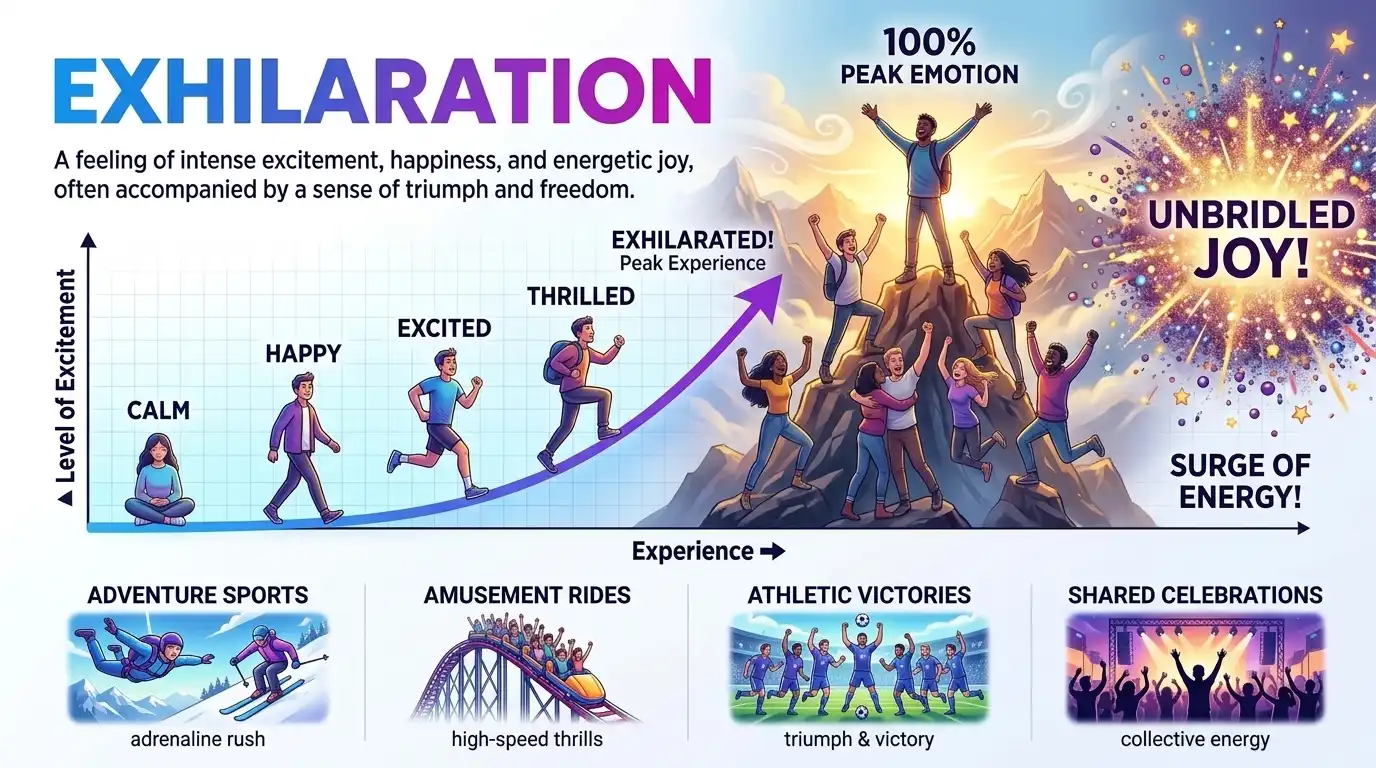
Exhilaration is a noun that describes a strong feeling of happiness, excitement, and renewed energy.
It is more intense than ordinary happiness. People experience exhilaration when something makes them feel unusually alive, enthusiastic, or emotionally uplifted.
For example:
- Winning an important competition can bring exhilaration.
- Riding a roller coaster may create a sudden feeling of exhilaration.
- Receiving unexpected good news can fill someone with exhilaration.
Native English speakers commonly associate this word with memorable achievements, exciting adventures, personal victories, and thrilling experiences.
Part of Speech
- Word: Exhilaration
- Part of Speech: Noun
- Word Form: Usually uncountable
- Related Verb: Exhilarate
- Related Adjective: Exhilarating
- Related Past Participle: Exhilarated
Simple definition: A powerful feeling of happiness and excitement that makes someone feel energetic and alive.
Connotative Meaning of Exhilaration
(Connotation refers to the emotional feelings or associations a word carries beyond its literal dictionary meaning.)
Positive Tone
Exhilaration usually expresses intense happiness, enthusiasm, confidence, and emotional freedom.
Example: The exhilaration of reaching the mountain summit made every difficult step worthwhile.
Negative Tone
The word itself is generally positive. However, exhilaration can describe excitement connected with dangerous or irresponsible behavior.
Example: He felt exhilaration while driving recklessly through the empty streets.
Here, the feeling is positive for the person experiencing it, but the situation is unsafe.
Neutral Tone
In descriptive or academic writing, exhilaration can identify a psychological state without praising or criticizing it.
Example: Researchers examined the exhilaration experienced during high-intensity recreational activities.
Etymology of Exhilaration
The word exhilaration comes from Latin.
Its origin connects to the Latin verb exhilarare, meaning to make cheerful, gladden, or enliven.
The Latin element hilarare relates to cheerfulness and happiness.
Old English Period (450–1100)
The modern English word exhilaration did not exist during this period.
Old English speakers expressed similar feelings through words connected with gladness, joy, and happiness.
Middle English Period (1100–1500)
English absorbed many French and Latin expressions during this period.
However, exhilaration was not yet an established everyday English word.
Modern English Period (1500–Present)
The verb exhilarate entered English during the late 16th century through Latin influence.
The noun exhilaration subsequently developed to describe the state or feeling of being exhilarated.
Today, it commonly describes emotional excitement, intense pleasure, and energetic happiness.
Pronunciation of Exhilaration
- US: /ɪɡˌzɪləˈreɪʃən/
- UK: /ɪɡˌzɪləˈreɪʃən/
The pronunciation is broadly similar in American and British English.
The strongest stress falls on RAY.
Syllables
ex-hil-a-ra-tion
The word contains five syllables.
Affixation Pattern of Exhilaration
- Root/Base: Exhilarate
- Prefix: No productive English prefix in the modern word
- Suffix: -ion
- Formation: Exhilarate + -ion → Exhilaration
The suffix changes the verb into a noun describing a state or experience.
Synonyms List
The following vocabulary includes direct synonyms and close contextual alternatives.
Not every word is interchangeable in every sentence. Some emphasize excitement, while others describe happiness, triumph, emotional uplift, or energetic pleasure.
Each entry explains its particular meaning and natural usage.
1. Excitement (Noun) — US /ɪkˈsaɪtmənt/ | UK /ɪkˈsaɪtmənt/
Meaning: A strong feeling of enthusiasm or eagerness about something interesting or enjoyable.
Tone/Register: Positive, everyday, neutral.
Example 1: The children shouted with excitement before their school trip.
Example 2: Her excitement grew as the concert approached.
2. Elation (Noun) — US /ɪˈleɪʃən/ | UK /ɪˈleɪʃən/
Meaning: An intense feeling of happiness, usually following success or wonderful news.
Tone/Register: Positive, literary, formal.
Example 1: She felt pure elation after passing her final examination.
Example 2: His promotion brought a wonderful sense of elation.
3. Euphoria (Noun) — US /juːˈfɔːriə/ | UK /juːˈfɔːriə/
Meaning: An unusually intense state of happiness, pleasure, or emotional well-being.
Tone/Register: Positive, psychological, formal.
Example 1: A wave of euphoria swept through the stadium after the victory.
Example 2: He experienced euphoria after completing his first marathon.
4. Thrill (Noun) — US /θrɪl/ | UK /θrɪl/
Meaning: A sudden feeling of intense excitement or pleasure.
Tone/Register: Positive, everyday, informal.
Example 1: Flying over the mountains gave her an unforgettable thrill.
Example 2: He felt a thrill when his name appeared on the winners’ list.
5. Joy (Noun) — US /dʒɔɪ/ | UK /dʒɔɪ/
Meaning: A deep feeling of happiness and emotional pleasure.
Tone/Register: Positive, universal.
Example 1: Her face showed pure joy when she met her newborn niece.
Example 2: The family celebrated their reunion with tears of joy.
6. Delight (Noun) — US /dɪˈlaɪt/ | UK /dɪˈlaɪt/
Meaning: Great pleasure caused by something enjoyable or satisfying.
Tone/Register: Positive, polite, everyday.
Example 1: The surprise birthday party filled him with delight.
Example 2: She watched the colorful fireworks with obvious delight.
7. Jubilation (Noun) — US /ˌdʒuːbɪˈleɪʃən/ | UK /ˌdʒuːbɪˈleɪʃən/
Meaning: A strong expression of happiness following an important achievement or victory.
Tone/Register: Positive, formal, celebratory.
Example 1: Jubilation filled the streets after the national team’s victory.
Example 2: The announcement sparked jubilation among the graduating students.
8. Exultation (Noun) — US /ˌeɡzʌlˈteɪʃən/ | UK /ˌeɡzʌlˈteɪʃən/
Meaning: Intense happiness and pride following success or triumph.
Tone/Register: Literary, formal, positive.
Example 1: The athlete raised her arms in exultation.
Example 2: His exultation was clear when the final results arrived.
9. Ecstasy (Noun) — US /ˈekstəsi/ | UK /ˈekstəsi/
Meaning: An overwhelming feeling of happiness or emotional pleasure.
Tone/Register: Intense, literary, expressive.
Example 1: The audience was in ecstasy during the final performance.
Example 2: She experienced pure ecstasy when she heard the wonderful news.
10. Rapture (Noun) — US /ˈræptʃər/ | UK /ˈræptʃə/
Meaning: An intense feeling of pleasure or happiness that absorbs someone’s attention.
Tone/Register: Literary, poetic, emotional.
Example 1: The musician listened in rapture to the beautiful melody.
Example 2: The breathtaking landscape filled the travelers with rapture.
11. Bliss (Noun) — US /blɪs/ | UK /blɪs/
Meaning: Complete happiness and deep emotional satisfaction.
Tone/Register: Positive, romantic, literary.
Example 1: They enjoyed a peaceful afternoon of bliss beside the lake.
Example 2: Holding her baby brought her a moment of absolute bliss.
12. Glee (Noun) — US /ɡliː/ | UK /ɡliː/
Meaning: Lively happiness that someone often expresses through laughter or excitement.
Tone/Register: Informal, cheerful, playful.
Example 1: The children screamed with glee when school closed early.
Example 2: He opened his unexpected gift with obvious glee.
13. Merriment (Noun) — US /ˈmerimənt/ | UK /ˈmerimənt/
Meaning: Cheerful enjoyment expressed through laughter, celebration, or social activity.
Tone/Register: Positive, slightly literary.
Example 1: Music and merriment filled the wedding hall.
Example 2: Their reunion became an evening of laughter and merriment.
14. Cheerfulness (Noun) — US /ˈtʃɪrfəlnəs/ | UK /ˈtʃɪəfəlnəs/
Meaning: A pleasant emotional state marked by happiness and optimism.
Tone/Register: Positive, everyday.
Example 1: Her cheerfulness made the difficult morning easier for everyone.
Example 2: He greeted his colleagues with his usual cheerfulness.
15. High Spirits (Noun Phrase) — US /haɪ ˈspɪrɪts/ | UK /haɪ ˈspɪrɪts/
Meaning: A lively and energetic mood filled with happiness or enthusiasm.
Tone/Register: Informal, conversational.
Example 1: The students were in high spirits after finishing their exams.
Example 2: Everyone arrived at the picnic in high spirits.
16. Exuberance (Noun) — US /ɪɡˈzuːbərəns/ | UK /ɪɡˈzjuːbərəns/
Meaning: Energetic happiness expressed through lively behavior and enthusiasm.
Tone/Register: Positive, descriptive, formal.
Example 1: Her youthful exuberance made the entire event more enjoyable.
Example 2: The dancers performed with remarkable exuberance.
17. Enthusiasm (Noun) — US /ɪnˈθuːziæzəm/ | UK /ɪnˈθjuːziæzəm/
Meaning: Strong interest and eager excitement about an activity or idea.
Tone/Register: Positive, everyday, professional.
Example 1: The volunteers showed great enthusiasm for the community project.
Example 2: His enthusiasm encouraged everyone to participate.
18. Exhilarated Happiness (Noun Phrase) — US /ɪɡˈzɪləreɪtɪd ˈhæpinəs/ | UK /ɪɡˈzɪləreɪtɪd ˈhæpinəs/
Meaning: An intense form of happiness accompanied by excitement and renewed energy.
Tone/Register: Descriptive, expressive.
Example 1: She experienced exhilarated happiness after completing the mountain climb.
Example 2: His exhilarated happiness was impossible to hide.
Usage note: This is a descriptive alternative rather than a standard single-word synonym.
19. Triumph (Noun) — US /ˈtraɪʌmf/ | UK /ˈtraɪʌmf/
Meaning: The joy and satisfaction associated with achieving an important victory.
Tone/Register: Positive, motivational, formal.
Example 1: She felt a sense of triumph after overcoming her biggest fear.
Example 2: The team celebrated its unexpected triumph.
20. Transport (Noun) — US /ˈtrænspɔːrt/ | UK /ˈtrænspɔːt/
Meaning: An overwhelming state of emotional pleasure or excitement.
Tone/Register: Literary, uncommon in everyday speech.
Example 1: The audience listened to the orchestra in transports of delight.
Example 2: The beautiful performance sent her into transports of joy.
Usage note: This emotional meaning usually appears in phrases such as transports of joy.
21. Rapturous Joy (Noun Phrase) — US /ˈræptʃərəs dʒɔɪ/ | UK /ˈræptʃərəs dʒɔɪ/
Meaning: Extremely intense happiness that feels almost overwhelming.
Tone/Register: Literary, emotional.
Example 1: Rapturous joy filled the room when the family reunited.
Example 2: The announcement brought rapturous joy to the supporters.
22. Felicity (Noun) — US /fəˈlɪsəti/ | UK /fəˈlɪsəti/
Meaning: Great happiness, particularly a pleasant state of emotional satisfaction.
Tone/Register: Formal, literary.
Example 1: The peaceful surroundings gave her a rare sense of felicity.
Example 2: He remembered those childhood summers with feelings of felicity.
23. Gladness (Noun) — US /ˈɡlædnəs/ | UK /ˈɡlædnəs/
Meaning: A warm feeling of happiness or pleasure.
Tone/Register: Positive, traditional, everyday.
Example 1: Gladness filled her heart when her brother returned home.
Example 2: The wonderful announcement brought gladness to the family.
24. Buoyancy (Noun) — US /ˈbɔɪənsi/ | UK /ˈbɔɪənsi/
Meaning: A cheerful and energetic emotional state, often marked by optimism.
Tone/Register: Descriptive, formal.
Example 1: Her emotional buoyancy helped the group remain positive.
Example 2: The successful presentation restored his usual buoyancy.
25. Animation (Noun) — US /ˌænəˈmeɪʃən/ | UK /ˌænɪˈmeɪʃən/
Meaning: Lively energy and excitement shown through someone’s expressions or behavior.
Tone/Register: Descriptive, literary.
Example 1: She described her adventure with remarkable animation.
Example 2: His face showed sudden animation when the discussion turned to football.
26. Zest (Noun) — US /zest/ | UK /zest/
Meaning: Energetic enjoyment and enthusiasm for an activity or experience.
Tone/Register: Positive, lively, everyday.
Example 1: She approached her new job with genuine zest.
Example 2: Traveling gave him a renewed zest for life.
27. Vivacity (Noun) — US /vɪˈvæsəti/ | UK /vɪˈvæsəti/
Meaning: A lively and cheerful quality expressed through energy and enthusiasm.
Tone/Register: Formal, descriptive.
Example 1: Her natural vivacity made the gathering more enjoyable.
Example 2: The speaker’s vivacity kept the audience interested.
28. Eagerness (Noun) — US /ˈiːɡərnəs/ | UK /ˈiːɡənəs/
Meaning: An enthusiastic feeling of wanting something exciting to happen.
Tone/Register: Neutral, positive, everyday.
Example 1: The children waited with eagerness for the holiday celebrations.
Example 2: Her eagerness increased as the departure date approached.
29. Exultant Joy (Noun Phrase) — US /ɪɡˈzʌltənt dʒɔɪ/ | UK /ɪɡˈzʌltənt dʒɔɪ/
Meaning: Powerful happiness associated with pride, achievement, or victory.
Tone/Register: Literary, celebratory.
Example 1: Exultant joy spread through the crowd after the winning goal.
Example 2: She embraced her teammates with exultant joy.
30. Rapture of Delight (Noun Phrase) — US /ˈræptʃər əv dɪˈlaɪt/ | UK /ˈræptʃə əv dɪˈlaɪt/
Meaning: An overwhelming experience of emotional pleasure and happiness.
Tone/Register: Poetic, expressive.
Example 1: The young artist stared at her award in a rapture of delight.
Example 2: The children watched the magical performance in a rapture of delight.
31. Elatedness (Noun) — US /ɪˈleɪtɪdnəs/ | UK /ɪˈleɪtɪdnəs/
Meaning: The state of feeling extremely happy or emotionally uplifted.
Tone/Register: Descriptive, uncommon.
Example 1: Her elatedness was clear after receiving the scholarship.
Example 2: His unexpected success created a lasting feeling of elatedness.
Usage note: Elation is considerably more natural in everyday English.
32. Cheer (Noun) — US /tʃɪr/ | UK /tʃɪə/
Meaning: A feeling or atmosphere of happiness and positive energy.
Tone/Register: Positive, conversational.
Example 1: The festive decorations brought cheer to the neighborhood.
Example 2: Her encouraging words filled the room with cheer.
33. Festivity (Noun) — US /feˈstɪvəti/ | UK /feˈstɪvəti/
Meaning: A joyful atmosphere associated with celebrations and special occasions.
Tone/Register: Positive, social, celebratory.
Example 1: The town square was filled with music and festivity.
Example 2: Colorful lights added festivity to the evening celebration.
34. Rejoicing (Noun) — US /rɪˈdʒɔɪsɪŋ/ | UK /rɪˈdʒɔɪsɪŋ/
Meaning: The expression of great happiness, especially after welcome news or success.
Tone/Register: Formal, celebratory, sometimes religious.
Example 1: There was widespread rejoicing after the missing hikers returned safely.
Example 2: The community joined in rejoicing after the announcement.
35. Pleasure (Noun) — US /ˈpleʒər/ | UK /ˈpleʒə/
Meaning: A feeling of enjoyment or satisfaction caused by a pleasant experience.
Tone/Register: Neutral, everyday, versatile.
Example 1: She took great pleasure in completing her first painting.
Example 2: The unexpected compliment gave him genuine pleasure.
36. Happiness (Noun) — US /ˈhæpinəs/ | UK /ˈhæpinəs/
Meaning: A positive emotional state involving joy, satisfaction, or well-being.
Tone/Register: Positive, universal.
Example 1: Her happiness was obvious when she received the acceptance letter.
Example 2: Spending time with old friends brought him lasting happiness.
37. Exhilarating Excitement (Noun Phrase) — US /ɪɡˈzɪləreɪtɪŋ ɪkˈsaɪtmənt/ | UK /ɪɡˈzɪləreɪtɪŋ ɪkˈsaɪtmənt/
Meaning: Powerful excitement that produces a feeling of energy and emotional uplift.
Tone/Register: Descriptive, expressive.
Example 1: Exhilarating excitement filled the air before the championship final.
Example 2: The unexpected adventure brought exhilarating excitement to their weekend.
Usage note: This phrase emphasizes the meaning rather than replacing the original word economically.
38. Rush (Noun) — US /rʌʃ/ | UK /rʌʃ/
Meaning: A sudden and powerful burst of excitement or pleasurable energy.
Tone/Register: Informal, conversational.
Example 1: She felt an incredible rush as the roller coaster dropped.
Example 2: Winning the final round gave him an unforgettable rush.
39. Buzz (Noun) — US /bʌz/ | UK /bʌz/
Meaning: An enjoyable feeling of excitement or lively anticipation.
Tone/Register: Informal, modern, conversational.
Example 1: He got a real buzz from performing on stage.
Example 2: There was a wonderful buzz around the music festival.
40. Adrenaline Rush (Noun Phrase) — US /əˈdrenəlɪn rʌʃ/ | UK /əˈdrenəlɪn rʌʃ/
Meaning: A sudden feeling of intense energy and excitement, often triggered by danger or thrilling activity.
Tone/Register: Informal, sports, adventure.
Example 1: Skydiving gave her an unforgettable adrenaline rush.
Example 2: He experienced an adrenaline rush during the final seconds of the race.
Usage note: This expression emphasizes physical arousal. It does not always imply happiness.
Synonyms for Exhilaration by Tone
The emotional tone of a synonym influences how readers understand a sentence.
For example, bliss suggests peaceful happiness, while rush describes sudden excitement.
Choosing the right expression helps your writing sound accurate and natural.
Positive Synonyms
- Elation
- Joy
- Delight
- Jubilation
- Bliss
- Gladness
- Happiness
- Felicity
- Rejoicing
- Cheer
These expressions work well when describing achievements, meaningful relationships, and enjoyable experiences.
Neutral or Context-Dependent Synonyms
- Excitement
- Enthusiasm
- Eagerness
- Animation
- Pleasure
- Buoyancy
- Zest
- Thrill
These words may describe positive emotions, but their exact meaning depends on the situation.
Potentially Negative or Overwhelming Associations
- Euphoria
- Ecstasy
- Rush
- Adrenaline rush
- Exultation
These expressions are not inherently negative.
However, they may describe overwhelming emotions, risky excitement, or pleasure connected with another person’s defeat.
Playful and Informal Synonyms
- Glee
- Buzz
- High spirits
- Thrill
- Rush
- Merriment
These choices are especially useful in friendly conversations, social media captions, and informal storytelling.
Exhilaration vs Close Alternatives
Exhilaration, elation, and euphoria describe strong positive feelings. Their meanings overlap, but they are not identical.
| Word | Meaning Difference | Emotional Tone | Best Context |
|---|---|---|---|
| Exhilaration | Happiness mixed with intense excitement and energy | Lively and uplifting | Adventures, sports, achievements |
| Elation | Extreme happiness, often following success | Joyful and triumphant | Promotions, victories, good news |
| Euphoria | Exceptionally intense happiness or well-being | Overwhelming or heightened | Emotional peaks, psychology, celebrations |
| Thrill | Sudden excitement or pleasurable stimulation | Energetic and immediate | Surprises, performances, adventure |
Exhilaration vs Elation
Exhilaration often includes physical energy and excitement.
Elation focuses more strongly on emotional happiness after something wonderful happens.
Example: The exhilarating mountain ride left her breathless.
Example: She felt elation after receiving her graduation results.
Exhilaration vs Euphoria
Euphoria suggests an unusually intense state of happiness.
Exhilaration is more commonly associated with stimulating experiences and energetic enjoyment.
Example: The adventure filled him with exhilaration.
Example: The unexpected victory created widespread euphoria.
Exhilaration vs Thrill
A thrill is often brief and sudden.
Exhilaration can describe a broader emotional experience that continues throughout an activity.
Example: The first drop of the roller coaster gave her a thrill.
Example: She experienced exhilaration throughout the entire ride.
How Exhilaration Changes by Context
Daily Conversation
People often choose simpler alternatives such as excitement, thrill, or buzz in casual speech.
Example: I got such a buzz from meeting my favorite singer.
The sentence sounds friendly and natural.
Writing and Blogging
Exhilaration adds emotional depth to travel blogs, lifestyle articles, and personal stories.
Example: The exhilaration of exploring a new country made the journey unforgettable.
Writers can alternate between exhilaration, joy, and excitement to maintain variety.
Professional or Academic Writing
Formal writing benefits from precise expressions such as elation, enthusiasm, and euphoria.
Example: Participants reported increased enthusiasm following the successful workshop.
Euphoria is particularly useful when discussing unusually intense emotional states.
Creative and Informal Writing
Storytelling allows more expressive vocabulary.
Words such as rapture, exultation, and ecstasy can communicate powerful emotions.
Example: She stood beneath the fireworks, overcome with rapture.
Informal writing may instead use rush or buzz to create a modern conversational voice.
Common Mistakes Learners Make
Mistake 1: Treating Every Positive Emotion as Exhilaration
Exhilaration describes intense happiness with excitement or energy.
A peaceful afternoon might bring contentment or bliss rather than exhilaration.
Less natural: I felt exhilaration while sitting quietly and feeling relaxed.
Better: I felt complete contentment while sitting quietly.
The original sentence is possible if the person genuinely experienced energetic excitement, but it is not the usual choice for simple relaxation.
Mistake 2: Confusing Exhilaration With Anxiety
Excitement and anxiety can both involve increased energy.
However, anxiety generally includes worry, fear, or uncertainty.
Incorrect: She experienced exhilaration because she was terrified of failing.
Better: She experienced anxiety because she was terrified of failing.
Mistake 3: Using Exhilaration as an Adjective
Exhilaration is a noun.
Use exhilarating when describing an exciting experience.
Incorrect: The trip was exhilaration.
Correct: The trip was exhilarating.
Mistake 4: Overusing Strong Emotional Vocabulary
Using exhilaration in every sentence can make ordinary events sound unnecessarily dramatic.
For everyday happiness, choose simpler words such as joy, pleasure, or excitement.
Reserve stronger expressions for experiences that genuinely justify them.
Mistake 5: Confusing Exhilarated and Exhilarating
These adjectives have different grammatical functions.
- Exhilarated describes how someone feels.
- Exhilarating describes something that produces the feeling.
Example: I felt exhilarated after the race.
Example: The race was exhilarating.
Native Usage and Register Notes
Formal English
Exhilaration, elation, jubilation, and euphoria suit formal descriptions when their meanings fit the situation.
Example: The successful launch generated considerable excitement and elation among the researchers.
Informal English
Native speakers often prefer simpler expressions in conversation.
Example: That concert gave me such a rush!
This sounds more conversational than describing the experience as a state of profound exhilaration.
Spoken English
Common expressions include:
- I was thrilled.
- What an incredible rush!
- I was so excited.
- I couldn’t stop smiling.
Written English
Exhilaration works particularly well in travel writing, personal essays, biographies, and descriptive passages.
For further vocabulary development, explore related synonyms of excitement and their differences in emotional intensity.
Real-Life Examples Using Exhilaration
Workplace Scenario
A marketing team finally completes a challenging project.
The manager announces that their campaign exceeded expectations.
The team experiences exhilaration after seeing the results of months of hard work.
Suitable alternatives: Elation, jubilation, excitement.
Social Situation
A group of friends plans a surprise reunion.
One friend enters the room and discovers everyone waiting.
The unexpected celebration creates a wonderful feeling of exhilaration.
Suitable alternatives: Joy, delight, glee.
Media and Pop Culture
A singer performs before thousands of fans for the first time.
The crowd cheers as the opening song begins.
The artist experiences exhilaration while standing beneath the stage lights.
Suitable alternatives: Thrill, rush, euphoria.
Writing and Storytelling
A young explorer finally reaches a hidden waterfall after a difficult journey.
The surrounding landscape leaves her breathless.
A powerful sense of exhilaration replaces her earlier exhaustion.
Suitable alternatives: Rapture, elation, exuberance.
Interactive Practice Quiz
Choose the most suitable answer for each real-life situation.
Part One: Meaning and Word Choice
1. A student receives an unexpected scholarship and feels extremely happy. Which word fits best?
A) Anxiety B) Elation C) Boredom D) Confusion
2. Which word describes sudden excitement during a roller-coaster ride?
A) Contentment B) Sadness C) Thrill D) Patience
3. A football team wins an international championship. The supporters celebrate loudly. Which word fits?
A) Jubilation B) Hesitation C) Loneliness D) Disappointment
4. Which word describes complete and peaceful happiness?
A) Tension B) Fear C) Anger D) Bliss
5. A performer feels a sudden burst of energy before stepping onto the stage. Which informal word fits?
A) Silence B) Rush C) Doubt D) Fatigue
6. Which word best describes cheerful, energetic behavior?
A) Exuberance B) Exhaustion C) Uncertainty D) Melancholy
Part Two: Tone and Real-Life Usage
7. Which expression sounds most natural in an informal conversation?
A) Profound felicity B) Exceptional exultation C) I got a real buzz! D) Considerable emotional animation
8. A writer describes overwhelming happiness after a historic victory. Which word is suitable?
A) Apathy B) Euphoria C) Frustration D) Indifference
9. Which sentence uses exhilaration correctly?
A) The journey was exhilaration. B) She exhilaration after the match. C) He was very exhilaration. D) She felt exhilaration after completing the climb.
10. Which word is most suitable for lively happiness during a children’s celebration?
A) Glee B) Regret C) Anxiety D) Discomfort
11. A speaker shows strong interest in a new educational project. Which word fits?
A) Misery B) Confusion C) Enthusiasm D) Fear
12. Which expression most clearly suggests intense excitement linked to a thrilling physical activity?
A) Quiet satisfaction B) Adrenaline rush C) Gentle contentment D) Mild pleasure
13. A writer wants a literary word for overwhelming pleasure while listening to beautiful music. Which is best?
A) Rapture B) Boredom C) Concern D) Uncertainty
14. Which adjective correctly describes an experience that produces exhilaration?
A) Exhilaration B) Exhilarated C) Exhilarating D) Exhilarate
15. A person feels cheerful and optimistic after receiving encouraging news. Which noun can describe this mood?
A) Despair B) Confusion C) Weariness D) Buoyancy
Answer Key
1-B | 2-C | 3-A | 4-D | 5-B | 6-A | 7-C | 8-B | 9-D | 10-A | 11-C | 12-B | 13-A | 14-C | 15-D
Reflection and Application Task
Think about a moment when you experienced intense happiness or excitement.
Choose one synonym from the article and write a sentence describing that experience.
Try replacing your chosen word with another alternative. Notice how the emotional tone changes.
Suggested External Reference
For additional linguistic accuracy, explore the Cambridge Dictionary definition of exhilaration.
It provides a useful reference for understanding the word’s meaning, pronunciation, and natural English usage.
FAQs
1. What is the strongest synonym for exhilaration in English?
Euphoria and ecstasy are among the strongest alternatives for exhilaration. Both describe exceptionally intense positive emotions.
Euphoria emphasizes an unusually heightened state of happiness or well-being. Ecstasy suggests overwhelming pleasure.
However, the strongest synonym depends on the situation. For an important personal victory, elation or jubilation may communicate the intended emotion more accurately.
2. What is another word for exhilaration after achieving a goal?
Elation, triumph, exultation, and jubilation are suitable choices when describing happiness after achieving a goal.
Elation highlights intense personal happiness. Triumph emphasizes victory and accomplishment.
Jubilation works especially well when a group celebrates success together.
For example, a student receiving a prestigious scholarship might experience elation, while an entire team winning a championship might express jubilation.
3. Can exhilaration describe romantic feelings?
Yes. Exhilaration can describe the excitement and emotional energy associated with romantic experiences.
For example, someone might feel exhilaration during an unforgettable first date or an unexpected romantic reunion.
However, bliss, rapture, and delight may be more appropriate when the intended meaning emphasizes affection, deep happiness, or emotional satisfaction rather than energetic excitement.
4. What is a simple synonym for exhilaration for beginners?
Excitement is usually the simplest and most practical alternative.
It is familiar, easy to understand, and suitable for many everyday situations.
Joy and happiness are also useful, although they do not always express the same intensity.
For example, beginners can replace “She experienced exhilaration before the concert” with “She felt great excitement before the concert.”
5. Is exhilaration stronger than happiness?
Generally, yes. Happiness describes a broad positive emotional state, while exhilaration suggests a more intense experience involving excitement and energy.
A person may feel happy while enjoying a peaceful morning.
That same person might experience exhilaration after completing a challenging adventure.
The distinction involves emotional intensity and stimulation rather than simply how pleasant an experience feels.
6. What are the best synonyms for exhilaration in creative writing?
Rapture, ecstasy, elation, exultation, and exuberance can enrich creative descriptions.
Each highlights a different emotional quality.
Rapture suggests overwhelming pleasure. Exultation emphasizes triumphant happiness. Exuberance communicates lively energy.
Writers should select words according to the character’s experience. A quiet romantic reunion may call for rapture, while a dramatic sporting victory may suit exultation.
7. Can exhilaration describe excitement caused by fear or danger?
Yes. Exhilaration can occur during activities that combine excitement with perceived danger.
Examples include skydiving, competitive racing, and challenging outdoor adventures.
In these situations, thrill and adrenaline rush may be useful alternatives.
However, exhilaration should not automatically replace fear. It describes the stimulating or pleasurable emotional response rather than the unpleasant feeling of being frightened.
Conclusion
Understanding synonyms of exhilaration helps you describe powerful emotions with greater accuracy. Every alternative brings its own energy, meaning, and emotional shade.
Words like elation, euphoria, and thrill make writing and blogging more expressive. They also help readers understand the exact feelings behind memorable experiences.
Building a richer emotional vocabulary improves speaking and communication. It allows you to express happiness, excitement, and achievement without relying on repeated words.
Practice these expressions in emails, essays, and daily conversations. Choose a new synonym each day and create a sentence that connects it with your own experiences.

Mehtab Yasir is a passionate writer and English language enthusiast dedicated to making vocabulary learning simple, practical, and enjoyable. As an author at SynonymDesk.com, she creates helpful content covering synonyms, antonyms, word meanings, vocabulary, phrases, and everyday English usage. Her goal is to provide clear and easy-to-understand information that helps students, writers, professionals, and English learners choose the right words and communicate with greater confidence. Mehtab believes that a strong vocabulary can improve both writing and communication skills. She enjoys researching new words, exploring their meanings and uses, and turning complex language concepts into useful, reader-friendly content. Through her work, she strives to make SynonymDesk.com a reliable resource for anyone looking to improve their English vocabulary and language skills.