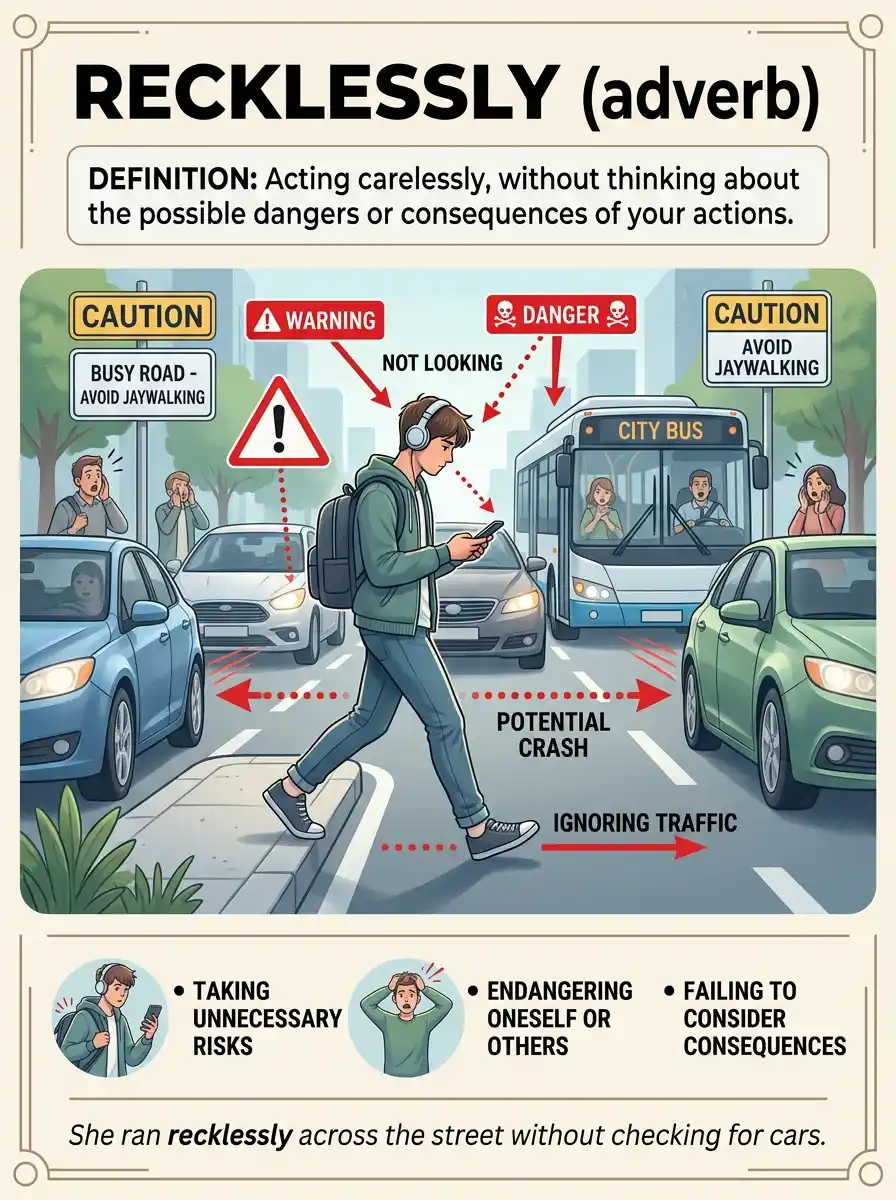
Synonyms of recklessly can instantly upgrade your everyday English writing. Imagine driving fast without looking at traffic lights. That dangerous action is acting recklessly.
You might say a teenager spent all his savings recklessly on gaming skins. This simple example shows how common this descriptive word really is.
Learning synonyms of recklessly expands your vocabulary for essays and blogs. Repeating one term makes your content boring and hard to read.
Students, bloggers, and daily speakers need varied vocabulary to convey tone accurately. Knowing synonyms of recklessly helps you express subtle shades of caution and danger.
What Does “Recklessly” Really Mean?
The word means acting without thinking about the dangerous consequences. Native speakers use it to describe careless, wild, or dangerous behavior. It carries an emotional tone of worry, disapproval, or warning.
In grammar, it is an adverb. It modifies verbs, adjectives, or other adverbs.
- Simple Definition: Doing something in a careless way that risks danger or harm.
Connotative Meaning
Connotation is the emotional feeling or cultural idea attached to a specific word (the emotional tone or cultural association a word carries beyond its dictionary definition).
- Positive tone: Boldly, daringly, fearlessly (when admiring bravery).
- Negative tone: Carelessly, foolishly, dangerously (when criticizing danger).
- Neutral tone: Unthinkingly, automatically, direct (without judgment).
Etymology
The word comes from the Old English word recceleas, meaning careless.
- Old English (450–1100): Recceleas combined recce (care) and leas (without).
- Middle English (1100–1500): It changed to reckles, meaning pay no heed.
- Modern English (1500–Present): Added the suffix “-ly” to form the adverb.
Pronunciation and Structure
- US Pronunciation: /ˈrɛk.ləs.li/
- UK Pronunciation: /ˈrɛk.lɪs.li/
- Syllables: reck-less-ly
- Affixation Pattern:
- Root: Reck (to care or heed)
- Prefix: None
- Suffix: -less (without), -ly (adverbial suffix)
Synonyms List
1. Carelessly (Adv) — US: /ˈkɛr.lɪs.li/ | UK: /ˈkeə.ləs.li/
- Meaning: Acting without giving sufficient attention or thought to safety.
- Tone/Register: Neutral, Informal
Examples:
- He carelessly dropped his laptop on the concrete floor.
- She typed her password carelessly while sitting on the bus.
2. Foolishly (Adv) — US: /ˈfuː.lɪʃ.li/ | UK: /ˈfuː.lɪʃ.li/
- Meaning: Acting in a way that lacks good judgment or sense.
- Tone/Register: Informal, Disapproving
Examples:
- Mark foolishly spent his entire paycheck on trading cards.
- They foolishly walked into the dark forest without a flashlight.
3. Rashly (Adv) — US: /ˈræʃ.li/ | UK: /ˈræʃ.li/
- Meaning: Acting too quickly without considering the bad results.
- Tone/Register: General, Everyday
Examples:
- Sarah rashly quit her job after a minor disagreement.
- Do not sign contract documents rashly without reading the details.
4. Wildly (Adv) — US: /ˈwaɪld.li/ | UK: /ˈwaɪld.li/
- Meaning: Acting without control, restraint, or reasonable limits.
- Tone/Register: Informal, Conversational
Examples:
- The dog ran wildly across the busy city street.
- Stock prices fluctuated wildly during the market crash.
5. Dangerously (Adv) — US: /ˈdeɪn.dʒɚ.əs.li/ | UK: /ˈdeɪn.dʒər.əs.li/
- Meaning: Acting in a manner likely to cause harm or injury.
- Tone/Register: Direct, Urgent
Examples:
- The speeder drifted dangerously close to the pedestrians.
- Chemicals were stored dangerously near the heat source.
6. Thoughtlessly (Adv) — US: /ˈθɑːt.ləs.li/ | UK: /ˈθɔːt.ləs.li/
- Meaning: Acting without considering the feelings or safety of others.
- Tone/Register: Everyday, Emotional
Examples:
- He thoughtlessly made a joke about her poor test score.
- She left the door open thoughtlessly in cold weather.
7. Headlong (Adv) — US: /ˈhɛd.lɑːŋ/ | UK: /ˈhɛd.lɒŋ/
- Meaning: Rushing quickly without taking time to think or look.
- Tone/Register: Literary, Dramatic
Examples:
- The young boy ran headlong into the glass door.
- They plunged headlong into a complex business project.
8. Heedlessly (Adv) — US: /ˈhiːd.ləs.li/ | UK: /ˈhiːd.ləs.li/
- Meaning: Paying no attention to warnings, advice, or hazards.
- Tone/Register: Formal, Written
Examples:
- The driver drove heedlessly past all the warning signs.
- He proceeded heedlessly despite warnings from his mentor.
9. Imprudently (Adv) — US: /ɪmˈpruː.dənt.li/ | UK: /ɪmˈpruː.dənt.li/
- Meaning: Lacking wise caution or practical judgment in action.
- Tone/Register: Formal, Academic
Examples:
- The committee imprudently ignored the budget recommendations.
- She invested imprudently in a high-risk startup scheme.
10. Incautiously (Adv) — US: /ɪnˈkɑː.ʃəs.li/ | UK: /ɪnˈkɔː.ʃəs.li/
- Meaning: Acting without taking proper precautions against risks.
- Tone/Register: Formal, Serious
Examples:
- The lab technician handled the acid incautiously.
- Travelers walked incautiously along the slippery cliff edge.
11. Madly (Adv) — US: /ˈmæd.li/ | UK: /ˈmæd.li/
- Meaning: Acting in an unpredictable, wild, or uncontrolled manner.
- Tone/Register: Informal, Expressive
Examples:
- He drove madly through the town to catch the train.
- The crowds cheered madly when the singer appeared.
12. Desperately (Adv) — US: /ˈdɛs.pɚ.ət.li/ | UK: /ˈdɛs.pər.ət.li/
- Meaning: Acting with extreme urgency regardless of risks involved.
- Tone/Register: Emotional, Dramatic
Examples:
- He reached desperately for the falling ladder.
- She searched desperately for her lost wallet in the rain.
13. Blindly (Adv) — US: /ˈblaɪnd.li/ | UK: /ˈblaɪnd.li/
- Meaning: Acting without understanding, seeing, or evaluating facts.
- Tone/Register: Critical, General
Examples:
- You should not follow online trends blindly.
- He trusted the stranger blindly and lost his money.
14. Negligently (Adv) — US: /ˈnɛɡ.lə.dʒənt.li/ | UK: /ˈneɡ.lɪ.dʒənt.li/
- Meaning: Failing to take proper care that a reasonable person would take.
- Tone/Register: Legal, Formal
Examples:
- The landlord negligently failed to fix the broken stairs.
- Equipment was left negligently unlocked overnight.
15. Inconsiderately (Adv) — US: /ˌɪn.kənˈsɪd.ɚ.ət.li/ | UK: /ˌɪn.kənˈsɪd.ər.ət.li/
- Meaning: Acting without regard for how actions affect other people.
- Tone/Register: Social, Everyday
Examples:
- He parked inconsiderately across two parking spaces.
- They played loud music inconsiderately late at night.
16. Desperado-style (Adv) — US: /ˌdɛs.pəˈrɑː.doʊ.staɪl/ | UK: /ˌdɛs.pəˈrɑː.dəʊ.staɪl/
- Meaning: Acting like a reckless outlaw who ignores all rules.
- Tone/Register: Informal, Slang
Examples:
- The racer took the turn desperado-style on two wheels.
- He ran through security desperado-style to make the flight.
17. Unadvisedly (Adv) — US: /ˌʌn.ədˈvaɪ.zɪd.li/ | UK: /ˌʌn.ədˈvaɪ.zəd.li/
- Meaning: Acting against good advice or sound judgment.
- Tone/Register: Formal, Official
Examples:
- The hiker entered the desert unadvisedly without water.
- He spoke unadvisedly to reporters before consulting his lawyer.
18. Overboldly (Adv) — US: /ˌoʊ.vɚˈboʊld.li/ | UK: /ˌəʊ.vəˈbəʊld.li/
- Meaning: Showing excessive confidence that borders on danger.
- Tone/Register: Literary, Descriptive
Examples:
- The young captain stepped overboldly into enemy territory.
- She challenged the expert overboldly during her first week.
19. Audaciously (Adv) — US: /ɑːˈdeɪ.ʃəs.li/ | UK: /ɔːˈdeɪ.ʃəs.li/
- Meaning: Taking shockingly bold risks with little fear.
- Tone/Register: Expressive, Literary
Examples:
- The thief audaciously stole the painting in broad daylight.
- She presented an audaciously creative business proposal.
20. Daringly (Adv) — US: /ˈdɛr.ɪŋ.li/ | UK: /ˈdeə.rɪŋ.li/
- Meaning: Taking risks in a brave or adventurous spirit.
- Tone/Register: Positive, Descriptive
Examples:
- The stunt driver drove daringly through the ring of fire.
- She dressed daringly for the red carpet event.
21. Foolhardily (Adv) — US: /ˌfuːlˈhɑːr.də.li/ | UK: /ˌfuːlˈhɑː.dɪ.li/
- Meaning: Taking foolish risks with little chance of success.
- Tone/Register: Formal, Critical
Examples:
- He foolhardily attempted to swim across the stormy river.
- The team spent funds foolhardily on unproven tech.
22. Indiscreetly (Adv) — US: /ˌɪn.dɪˈskriːt.li/ | UK: /ˌɪn.dɪˈskriːt.li/
- Meaning: Acting without care to keep secrets or private matters safe.
- Tone/Register: Formal, Social
Examples:
- She spoke indiscreetly about her client’s confidential data.
- The details were revealed indiscreetly in a public cafe.
23. Unwisely (Adv) — US: /ʌnˈwaɪz.li/ | UK: /ʌnˈwaɪz.li/
- Meaning: Acting in a way that lacks intelligent planning or sense.
- Tone/Register: General, Direct
Examples:
- They unwisely left their valuables on the beach towel.
- He unwisely chose to ignore his doctor’s advice.
24. Irresponsibly (Adv) — US: /ˌɪr.əˈspɑːn.sə.bli/ | UK: /ˌɪr.ɪˈspɒn.sə.bli/
- Meaning: Acting without feeling accountable for outcomes or duties.
- Tone/Register: Critical, Professional
Examples:
- The manager acted irresponsibly by skipping safety checks.
- Teenagers sometimes use social media irresponsibly.
25. Impetuously (Adv) — US: /ɪmˈpɛtʃ.u.əs.li/ | UK: /ɪmˈpetʃ.u.əs.li/
- Meaning: Acting suddenly on impulse without thinking first.
- Tone/Register: Formal, Literary
Examples:
- He impetuously bought an expensive sports car.
- She packed her bags impetuously and moved to Europe.
26. Precipitously (Adv) — US: /prəˈsɪp.ə.t̬əs.li/ | UK: /prɪˈsɪp.ɪ.təs.li/
- Meaning: Acting or rushing forward with extreme and dangerous haste.
- Tone/Register: Academic, Literary
Examples:
- The troops moved precipitously into the dangerous valley.
- The company made precipitously hasty changes to policy.
27. Hasty-headed (Adv) — US: /ˈheɪ.stiˈhɛd.ɪd.li/ | UK: /ˈheɪ.stiˈhed.ɪd.li/
- Meaning: Rushing into actions with a hot head and quick temper.
- Tone/Register: Informal, Idiomatic
Examples:
- He reacted hastily-headed during the office argument.
- She made a hasty-headed decision to sell her stocks.
28. Headstrongly (Adv) — US: /ˈhɛd.strɑːŋ.li/ | UK: /ˈhed.strɒŋ.li/
- Meaning: Stubbornly determined to act recklessly despite advice.
- Tone/Register: Descriptive, Personal
Examples:
- The toddler headstrongly ran toward the swimming pool.
- He pursued his goal headstrong without listening to experts.
29. Wildcat-style (Adv) — US: /ˈwaɪld.kæt.staɪl/ | UK: /ˈwaɪld.kæt.staɪl/
- Meaning: Operating in an unpredictable, risky, or unauthorized manner.
- Tone/Register: Informal, Business
Examples:
- They ran the project wildcat-style without corporate approvals.
- Investors put money wildcat-style into unverified crypto.
30. Unwarily (Adv) — US: /ʌnˈwɛr.əl.i/ | UK: /ʌnˈweə.rəl.i/
- Meaning: Acting without watching out for hidden dangers or traps.
- Tone/Register: Formal, Written
Examples:
- The tourists walked unwarily into the high-crime district.
- She unwarily clicked on a malicious email attachment.
31. Hot-headedly (Adv) — US: /ˌhɑːtˈhɛd.ɪd.li/ | UK: /ˌhɒtˈhed.ɪd.li/
- Meaning: Acting quickly out of sudden anger or emotional distress.
- Tone/Register: Informal, Conversational
Examples:
- He hot-headedly threw his phone against the wall.
- She resigned hot-headedly after receiving feedback.
32. Unheedfully (Adv) — US: /ʌnˈhiːd.fə.li/ | UK: /ʌnˈhiːd.fə.li/
- Meaning: Proceeding while totally ignoring rules or surroundings.
- Tone/Register: Rare, Formal
Examples:
- The cyclist rode unheedfully through red traffic lights.
- He spent money unheedfully until his bank account was empty.
33. Careeningly (Adv) — US: /kəˈriː.nɪŋ.li/ | UK: /kəˈriː.nɪŋ.li/
- Meaning: Moving dangerously out of control from side to side.
- Tone/Register: Descriptive, Literary
Examples:
- The bus moved careeningly down the icy mountain road.
- He ran careeningly through the crowded market stalls.
34. Fecklessly (Adv) — US: /ˈfɛk.ləs.li/ | UK: /ˈfek.ləs.li/
- Meaning: Acting in an irresponsible, weak, and ineffective way.
- Tone/Register: Formal, Disapproving
Examples:
- The government fecklessly managed the local water crisis.
- He spent his youth fecklessly drifting between temporary jobs.
35. Madcap-style (Adv) — US: /ˈmæd.kæp.staɪl/ | UK: /ˈmæd.kæp.staɪl/
- Meaning: Acting in an amusingly reckless and eccentric fashion.
- Tone/Register: Informal, Creative
Examples:
- They organized the charity event madcap-style in two days.
- The comedians performed madcap-style across the stage.
36. Slapdash (Adv) — US: /ˈslæp.dæʃ/ | UK: /ˈslæp.dæʃ/
- Meaning: Doing something rapidly and carelessly without attention to quality.
- Tone/Register: Informal, Common
Examples:
- He assembled the bookshelf slapdash without reading instructions.
- The report was written slapdash right before the meeting.
37. Flaky-style (Adv) — US: /ˈfleɪ.ki.staɪl/ | UK: /ˈfleɪ.ki.staɪl/
- Meaning: Acting in an unreliable, scattered, or unsafe manner.
- Tone/Register: Casual Slang
Examples:
- He handled team schedules flaky-style, missing deadlines.
- She managed her budget flaky-style without keeping receipts.
38. Brazenly (Adv) — US: /ˈbreɪ.zən.li/ | UK: /ˈbreɪ.zən.li/
- Meaning: Acting recklessly without any shame or respect for rules.
- Tone/Register: Strong, Critical
Examples:
- The suspect brazenly lied to the police officers.
- She brazenly cheated on the final exam.
39. Devil-may-care (Adv) — US: /ˌdɛv.əl.meɪˈkɛr/ | UK: /ˌdev.əl.meɪˈkeər/
- Meaning: Acting in a cheerful, relaxed, yet reckless manner.
- Tone/Register: Idiomatic, Informal
Examples:
- He smiled devil-may-care as he jumped off the cliff into the water.
- She lives in a devil-may-care style without long-term plans.
40. Unrestrainedly (Adv) — US: /ˌʌn.rɪˈstreɪ.nɪd.li/ | UK: /ˌʌn.rɪˈstreɪ.nəd.li/
- Meaning: Acting without any boundaries, control, or limits.
- Tone/Register: Formal, Descriptive
Examples:
- The kids shouted unrestrainedly in the indoor playground.
- Inflation grew unrestrainedly throughout the decade.
41. Disregardfully (Adv) — US: /ˌdɪs.rɪˈɡɑːrd.fəl.i/ | UK: /ˌdɪs.rɪˈɡɑː.fəl.i/
- Meaning: Showing a total lack of care or regard for safety regulations.
- Tone/Register: Academic, Written
Examples:
- He drove disregardfully past the pedestrians at the crosswalk.
- The company dumped waste disregardfully into the river.
42. Haphazardly (Adv) — US: /hæpˈhæz.ɚd.li/ | UK: /hæpˈhæz.əd.li/
- Meaning: Acting or placing things randomly without plan or order.
- Tone/Register: General, Descriptive
Examples:
- Books were stacked haphazardly across the office floor.
- The city was built haphazardly without central planning.
43. Off-handedly (Adv) — US: /ˌɑːfˈhæn.dɪd.li/ | UK: /ˌɒfˈhæn.dɪd.li/
- Meaning: Acting or speaking casually without serious thought or care.
- Tone/Register: Conversational
Examples:
- He offhandedly dismissed her brilliant invention idea.
- She mentioned offhandedly that she was moving to France.
44. Uncircumspectly (Adv) — US: /ˌʌn.sɚ.kəmˈspɛkt.li/ | UK: /ˌʌn.sɜː.kəmˈspekt.li/
- Meaning: Acting without caution or awareness of potential risks around you.
- Tone/Register: Formal, Academic
Examples:
- He shared company strategies uncircumspectly online.
- She acted uncircumspectly when dealing with political rivals.
45. Unguardfully (Adv) — US: /ʌnˈɡɑːrd.fəl.i/ | UK: /ʌnˈɡɑː.fəl.i/
- Meaning: Acting carelessly without defending or protecting yourself.
- Tone/Register: Literary
Examples:
- He spoke unguardedly about his personal insecurities.
- The boxer lowered his gloves unguardedly during the round.
46. Unwarily (Adv) — US: /ʌnˈwɛr.ɪ.li/ | UK: /ʌnˈweər.ɪ.li/
- Meaning: Acting without being watchful for trouble or surprises.
- Tone/Register: General, Written
Examples:
- The hiker unwarily stepped on a loose rock.
- They unwarily trusted the false claims of the salesman.
47. Harum-scarum (Adv) — US: /ˌhɛr.əmˈskɛr.əm/ | UK: /ˌhær.əmˈskeər.əm/
- Meaning: Acting in a disorganized, wild, and reckless manner.
- Tone/Register: Old-fashioned, Informal
Examples:
- The teenagers drove harum-scarum down the dirt road.
- She ran her daily errands in a harum-scarum rush.
48. Over-hastily (Adv) — US: /ˌoʊ.vɚˈheɪ.stə.li/ | UK: /ˌəʊ.vəˈheɪ.stɪ.li/
- Meaning: Acting far too quickly, leading to avoidable mistakes.
- Tone/Register: General, Practical
Examples:
- He over-hastily deleted the main database file.
- The chef over-hastily seasoned the soup with too much salt.
49. Wild-headed (Adv) — US: /ˈwaɪld.hɛd.ɪd.li/ | UK: /ˈwaɪld.hed.ɪd.li/
- Meaning: Acting driven by wild, impulsive ideas without logic.
- Tone/Register: Informal, Descriptive
Examples:
- He spent his money wild-headed on crypto investments.
- The youth rushed wild-headed into the risky adventure.
50. Thoughtlessly (Adv) — US: /ˈθɑːt.ləs.li/ | UK: /ˈθɔːt.ləs.li/
- Meaning: Acting without any conscious mental effort or consideration.
- Tone/Register: Everyday
Examples:
- She thoughtlessly tossed the paper into the wrong recycling bin.
- He clicked accept thoughtlessly on the software terms.
Synonyms by Tone
Tone controls how your audience perceives your message. Choosing the right tone prevents misunderstandings in writing.
- Positive Tone: Daringly, Audaciously. Use these when you admire someone taking brave, exciting risks.
- Neutral Tone: Unthinkingly, Haphazardly. Use these to describe messy actions without throwing severe blame.
- Negative Tone: Carelessly, Rashly, Foolishly, Negligently. Use these when criticizing dangerous or harmful behavior.
- Playful/Informal: Devil-may-care, Harum-scarum, Madcap-style. Great for fun stories and casual blog posts.
Mini Comparison: Close Alternatives
Recklessly vs. Rashly vs. Carelessly
- Meaning Difference: Recklessly implies ignoring known extreme dangers. Rashly focuses on rushing into things too quickly. Carelessly simply means not paying enough attention to small details.
- Tone Difference: Recklessly is heavy and serious. Rashly sounds impatient. Carelessly is mild and everyday.
- When to Use: Use recklessly for life-threatening or financially ruinous actions. Use rashly for hasty decisions like quitting a job. Use carelessly for small slip-ups like dropping a pen.
Context-Based Usage
- Daily Conversation: Use everyday terms like carelessly or foolishly. “He carelessly dropped his phone in the sink.”
- Writing or Blogging: Elevate your prose with daringly or haphazardly. “The author haphazardly scattered clues throughout the novel.”
- Professional or Academic: Stick to negligently, imprudently, or incautiously. “The company acted negligently regarding user privacy.”
- Creative or Informal: Use colorful adverbs like devil-may-care or harum-scarum to make fictional characters stand out.
Common Mistakes & Native Usage
Common Mistakes Learners Make
- Misusing Tone: Using recklessly when you mean bravely. Risking harm without reason is not heroic.
- Confusing Formality: Using fecklessly in casual text messages sounds overly dramatic.
- Overuse: Repeatedly using the phrase “acting recklessly” instead of varying your adverbs makes essays sound repetitive. To improve your word variety, consult an advanced vocabulary guide for better descriptive writing.
Register Notes
Native English speakers reserve formal terms like negligently for courtrooms, news, and official work reports. In casual spoken settings, short words like wildly or rashly sound far more natural.
Real-Life Mini Scenarios
- Workplace: An employee imprudently sends a private email to the entire company list without reviewing the recipients.
- Social Situations: A friend carelessly promises to meet three different people at the same time.
- Media / Pop Culture: An action hero audaciously jumps between two moving sports cars during a movie chase sequence.
- Storytelling: A young prince rashly accepts a duel without training with a sword first.
Interactive Practice Quiz
Test Your Knowledge
1. Which word is closest in meaning to “recklessly”?
A) Carefully
B) Carelessly
C) Quietly
D) Patiently
2. Which synonym of “recklessly” means acting without thinking about the consequences?
A) Thoughtlessly
B) Wisely
C) Cautiously
D) Sensibly
3. “He drove recklessly through the crowded street.” What does “recklessly” mean here?
A) Safely
B) Slowly
C) Carelessly
D) Politely
4. Which word can replace “recklessly” in the sentence: “She spent her money recklessly”?
A) Wastefully
B) Carefully
C) Sparingly
D) Wisely
5. Which of the following is a synonym for “recklessly”?
A) Rashly
B) Calmly
C) Deliberately
D) Responsibly
Part Two
6. Which word describes someone who acts recklessly because they do not consider the risks?
A) Cautiously
B) Foolishly
C) Carefully
D) Sensibly
7. Choose the best synonym for “recklessly” in this sentence: “The boy climbed the dangerous wall recklessly.”
A) Boldly
B) Carelessly
C) Gently
D) Slowly
8. Which word is closest in meaning to “recklessly”?
A) Impulsively
B) Thoughtfully
C) Patiently
D) Carefully
9. “They behaved recklessly during the experiment.” Which word can replace “recklessly”?
A) Responsibly
B) Safely
C) Rashly
D) Carefully
10. Which of the following is NOT a synonym for “recklessly”?
A) Carelessly
B) Rashly
C) Thoughtlessly
D) Cautiously
Answer Key
- B
- A
- C
- A
- A
- B
- B
- A
- C
- D
FAQs
1. What is the closest synonym of recklessly in daily conversation?
The closest everyday synonym is carelessly. While recklessly implies ignoring danger, carelessly means simply not paying attention. Both describe actions done without proper thought, making it the most natural substitute in casual conversations.
2. Can recklessly ever have a positive meaning?
The word itself is almost always negative because it involves dangerous risks. However, words like daringly or audaciously can replace it when you want to praise someone’s brave, unconventional, or exciting behavior in creative writing.
3. How does rashly differ from recklessly?
Rashly focuses mainly on speed and urgency—doing something too fast without thinking it through. Recklessly focuses on danger—doing something while completely ignoring the obvious bad consequences or physical hazards involved.
4. What is a formal academic synonym for recklessly?
In legal, medical, or academic writing, use negligently, imprudently, or incautiously. These terms clearly communicate a lack of proper care or sound judgment without sounding overly dramatic or informal.
5. Is foolhardily a common alternative to recklessly?
Foolhardily is a valid alternative, but it is less common in modern spoken English. It specifically describes taking foolish risks that have almost no chance of succeeding, whereas recklessly applies to any dangerous, uncontrolled action.
Conclusion
Expanding your vocabulary with synonyms of recklessly improves your descriptive writing instantly. Using varied words helps you convey precise emotions and maintain strong engagement across all your essays.
Swapping repetitive words gives your prose a polished, native-level feel. Readers appreciate dynamic word choices that match the exact tone of your message, whether casual or professional.
Practice using these new adverbs in your daily emails, academic papers, and casual conversations. Small vocabulary adjustments will quickly turn you into a far more confident and expressive English communicator!

Mehtab Yasir is a passionate writer and English language enthusiast dedicated to making vocabulary learning simple, practical, and enjoyable. As an author at SynonymDesk.com, she creates helpful content covering synonyms, antonyms, word meanings, vocabulary, phrases, and everyday English usage. Her goal is to provide clear and easy-to-understand information that helps students, writers, professionals, and English learners choose the right words and communicate with greater confidence. Mehtab believes that a strong vocabulary can improve both writing and communication skills. She enjoys researching new words, exploring their meanings and uses, and turning complex language concepts into useful, reader-friendly content. Through her work, she strives to make SynonymDesk.com a reliable resource for anyone looking to improve their English vocabulary and language skills.