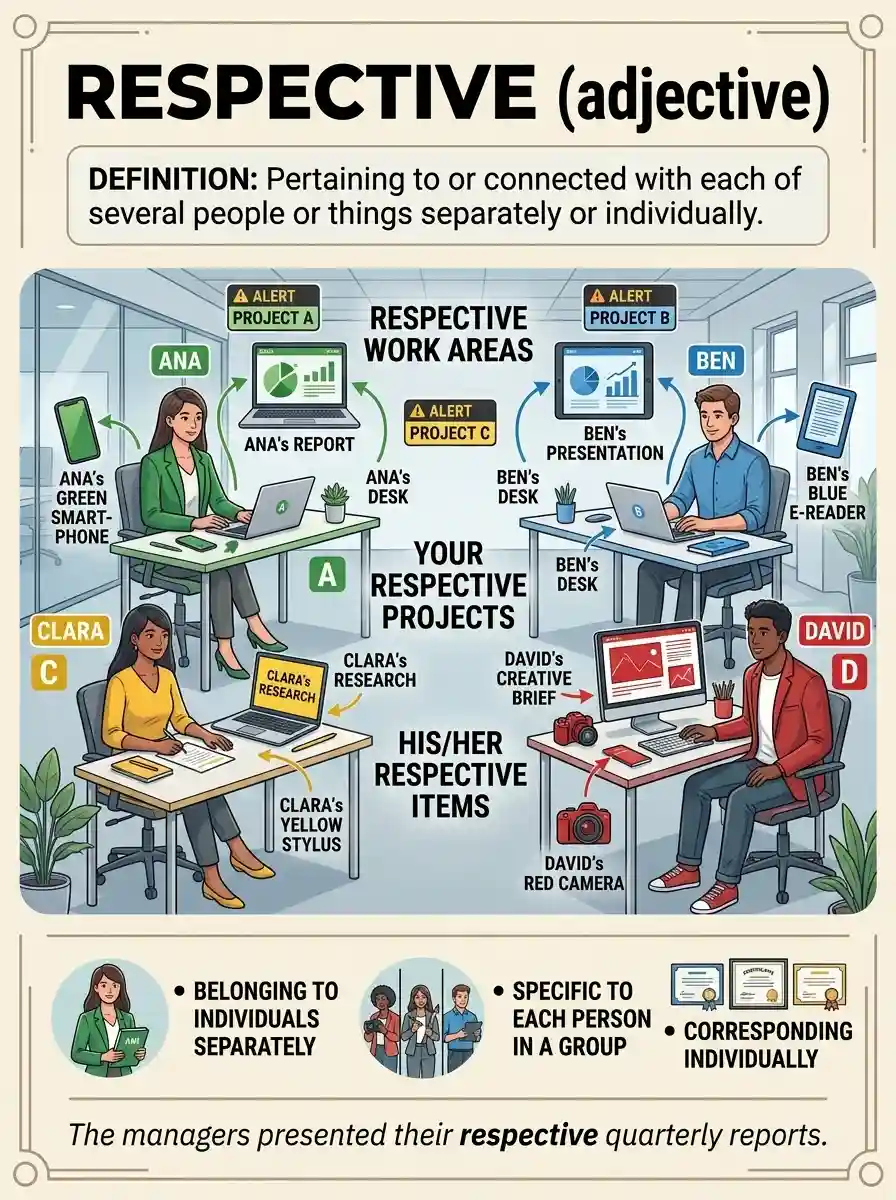
Synonyms of respective can transform your writing from repetitive to precise. Imagine writing a business report about two team leads and their duties.
You might write that Sarah and Alex went to their respective offices. Using the right alternative keeps your sentences clear and professional.
Learning synonyms of respective helps bloggers, students, and writers avoid awkward phrasing. It makes your vocabulary sound natural and polished.
This key term appears often in formal essays, corporate emails, and daily news. Mastering its variants gives you confidence in any setting.
What Does “Respective” Really Mean?
The word respective is an adjective used to relate specific items or people to another group in a direct, parallel order. It clarifies that each person or thing belongs to a matching counterpart without confusion.
- Part of Speech: Adjective
- Emotional Tone: Neutral, objective, and analytical
- Native Understanding: Native speakers use it to organize information neatly. It prevents readers from thinking items are shared or mixed.
- Common Contexts: Legal contracts, academic research papers, corporate reports, and formal instructions.
Connotative Meaning
Connotation is the emotional feeling or secondary meaning that a word carries beyond its literal definition.
- Positive tone: Professional, organized, precise, and respectful.
- Negative tone: Rigid, cold, or overly academic when used in casual speech.
- Neutral tone: Sequential, structural, and matching.
Etymology and History
- Origin: Derived from the Late Latin word respectivus, meaning “having regard to,” from the Latin respicere (“to look back at” or “regard”).
- Old English (450–1100): The term did not exist in Old English; Germanic roots served relational functions.
- Middle English (1100–1500): Entered the language through Anglo-Norman French as respectif, used mainly in legal frameworks.
- Modern English (1500–Present): Shifted into its current relational meaning during the early 17th century to streamline complex statements.
Pronunciation & Structure
- US IPA: /ɹɪˈspɛk.tɪv/
- UK IPA: /rɪˈspɛk.tɪv/
- Syllables: re-spec-tive
- Affixation Pattern:
- Root: spect (to look)
- Prefix: re- (back, again)
- Suffix: -ive (expressing tendency or function)
Synonyms List
1. Specific (Adjective) — US: /spəˈsɪf.ɪk/ | UK: /spəˈsɪf.ɪk/
- Meaning: Relating explicitly to one person, item, or category.
- Tone/Register: Neutral, Professional, Academic
- Example 1: Each department manager received a specific set of quarterly targets.
- Example 2: Please return the keys to their specific hooks after use.
2. Individual (Adjective) — US: /ˌɪn.dəˈvɪdʒ.u.əl/ | UK: /ˌɪn.dɪˈvɪdʒ.u.əl/
- Meaning: Single and separate from other members of a group.
- Tone/Register: Neutral, Business, Formal
- Example 1: The teacher handed back the tests with individual written feedback.
- Example 2: The players walked to their individual locker rooms after training.
3. Particular (Adjective) — US: /pɚˈtɪk.jə.lɚ/ | UK: /pəˈtɪk.jə.lə/
- Meaning: Single, distinct, and considered separately from others.
- Tone/Register: Neutral, Conversational
- Example 1: Every employee has a particular task assigned for the project launch.
- Example 2: She looked closely at each particular detail on the architectural plan.
4. Corresponding (Adjective) — US: /ˌkɔːr.əˈspɑːn.dɪŋ/ | UK: /ˌkɒr.ɪˈspɒn.dɪŋ/
- Meaning: Matching, equivalent, or directly related in character or position.
- Tone/Register: Formal, Academic, Technical
- Example 1: The numbers on the tickets must match the corresponding seat labels.
- Example 2: High demand brought a corresponding increase in raw material costs.
5. Relevant (Adjective) — US: /ˈrɛl.ə.vənt/ | UK: /ˈrel.ə.vənt/
- Meaning: Closely connected or appropriate to the matter at hand.
- Tone/Register: Neutral, Business
- Example 1: All drivers presented their relevant documents at the border check.
- Example 2: Place the files in their relevant color-coded folders today.
6. Relative (Adjective) — US: /ˈrɛl.ə.tɪv/ | UK: /ˈrel.ə.tɪv/
- Meaning: Considered in relation or proportion to something else.
- Tone/Register: Academic, Formal
- Example 1: The scientists assessed the relative merits of both energy theories.
- Example 2: We evaluated the relative position of each satellite in orbit.
7. Own (Adjective) — US: /oʊn/ | UK: /əʊn/
- Meaning: Belonging uniquely or exclusively to the person or thing mentioned.
- Tone/Register: General, Casual, Everyday
- Example 1: After the workshop, everyone drove back in their own cars.
- Example 2: The students expressed their own opinions during the debate.
8. Separate (Adjective) — US: /ˈsɛp.ɚ.ət/ | UK: /ˈsep.ər.ət/
- Meaning: Existing apart, distinct, or not shared with others.
- Tone/Register: General, Everyday
- Example 1: The partners agreed to open separate bank accounts for safety.
- Example 2: Guests retreated to their separate cabins as night fell.
9. Discrete (Adjective) — US: /dɪˈskriːt/ | UK: /dɪˈskriːt/
- Meaning: Individually distinct, separate, and unconnected.
- Tone/Register: Technical, Academic, Scientific
- Example 1: The software breaks complex tasks down into discrete modules.
- Example 2: Each stage of the production line forms a discrete process.
10. Distinct (Adjective) — US: /dɪˈstɪŋkt/ | UK: /dɪˈstɪŋkt/
- Meaning: Readily distinguishable as separate or different from others.
- Tone/Register: Neutral, Professional
- Example 1: The two subsidiaries maintain distinct branding identities across Europe.
- Example 2: Both brothers entered distinct career paths after university graduation.
11. Appropriate (Adjective) — US: /əˈproʊ.pri.ət/ | UK: /əˈprəʊ.pri.ət/
- Meaning: Suitable or proper for a specific situation, person, or purpose.
- Tone/Register: Formal, Professional
- Example 1: Mechanics stored the machinery parts in their appropriate bins.
- Example 2: Please direct your complaints to the appropriate department head.
12. Appurtenant (Adjective) — US: /əˈpɚ.tən.ənt/ | UK: /əˈpɜː.tɪ.nənt/
- Meaning: Belonging or pertinent to a higher primary authority or property.
- Tone/Register: Legal, Highly Formal
- Example 1: The deed listed the land and all appurtenant water rights.
- Example 2: Officers reviewed the privileges appurtenant to the diplomatic badge.
13. Applicable (Adjective) — US: /əˈplɪk.ə.bəl/ | UK: /əˈplɪk.ə.bəl/
- Meaning: Relevant or capable of being applied to a specific case.
- Tone/Register: Business, Formal, Legal
- Example 1: Applicants attached certificates to the applicable form sections.
- Example 2: Check the box that matches your applicable tax bracket.
14. Related (Adjective) — US: /rɪˈleɪ.t̬ɪd/ | UK: /rɪˈleɪ/.tɪd/
- Meaning: Connected by reason of established origin, nature, or link.
- Tone/Register: General, Casual
- Example 1: They discussed the budget issues and related payroll concerns.
- Example 2: Team members returned to their related duties after lunch.
15. Parallel (Adjective) — US: /ˈpær.ə.lel/ | UK: /ˈpær.ə.lel/
- Meaning: Occurring at the same time or corresponding in structural sequence.
- Tone/Register: Academic, Technical
- Example 1: Both committees worked on parallel schedules throughout the autumn.
- Example 2: The authors published parallel studies on urban growth trends.
16. Proper (Adjective) — US: /ˈprɑː.pɚ/ | UK: /ˈprɒp.ə/
- Meaning: Adapted or naturally suited to a designated place or purpose.
- Tone/Register: Neutral, Conversational
- Example 1: Ensure all tools are cleaned and placed in their proper slots.
- Example 2: The books were returned to their proper shelf locations.
17. Personal (Adjective) — US: /ˈpɝː.sən.əl/ | UK: /ˈpɜː.sən.əl/
- Meaning: Belonging to or affecting a particular individual person.
- Tone/Register: General, Casual
- Example 1: Employees gathered their personal items before leaving the office.
- Example 2: Every runner focused on achieving a personal best time.
18. Specialized (Adjective) — US: /ˈspɛʃ.ə.laɪzd/ | UK: /ˈspeʃ.ə.laɪzd/
- Meaning: Designed, tailored, or reserved for a distinct purpose.
- Tone/Register: Technical, Business
- Example 1: Surgeons selected their specialized instruments for the operation.
- Example 2: Technicians adjusted the specialized settings on the radar.
19. Unique (Adjective) — US: /juːˈniːk/ | UK: /juːˈniːk/
- Meaning: Belonging or connected solely to one particular entity.
- Tone/Register: Neutral, Marketing
- Example 1: Both software tools possess unique advantages for web developers.
- Example 2: Artists brought their unique perspectives to the collective project.
20. Exclusive (Adjective) — US: /ɪkˈskluː.sɪv/ | UK: /ɪkˈskluː.sɪv/
- Meaning: Restricted or limited to a specific group, person, or area.
- Tone/Register: Business, Formal
- Example 1: Directors retired to their exclusive lounge for private discussions.
- Example 2: The branches operate within their exclusive regional jurisdictions.
21. Specific-To (Adjective Phrase) — US: /spəˈsɪf.ɪk tuː/ | UK: /spəˈsɪf.ɪk tuː/
- Meaning: Restricted entirely to a designated object or group.
- Tone/Register: Academic, Professional
- Example 1: The symptoms are specific to this rare bacterial infection.
- Example 2: Regulations specific to coastal shipping were updated recently.
22. Dedicated (Adjective) — US: /ˈdɛd.ə.keɪ.t̬ɪd/ | UK: /ˈded.ɪ.keɪ.tɪd/
- Meaning: Exclusively set aside or allocated for a specified purpose.
- Tone/Register: Technical, Business
- Example 1: Server administrators logged into their dedicated control terminals.
- Example 2: The drivers pulled into the dedicated loading bays.
23. Designated (Adjective) — US: /ˈdɛz.ɪɡ.neɪ.t̬ɪd/ | UK: /ˈdez.ɪɡ.neɪ.tɪd/
- Meaning: Officially specified, assigned, or selected for a role.
- Tone/Register: Formal, Official
- Example 1: Passengers waited near their designated boarding gates patiently.
- Example 2: Staff members moved to their designated assembly points quickly.
24. Assigned (Adjective) — US: /əˈsaɪnd/ | UK: /əˈsaɪnd/
- Meaning: Designated or allocated to a specific person or duty.
- Tone/Register: Business, Professional
- Example 1: Students sat in their assigned seats before the test began.
- Example 2: Workers finished their assigned tasks well before the deadline.
25. Allocated (Adjective) — US: /ˈæl.ə.keɪ.t̬ɪd/ | UK: /ˈæl.ə.keɪ.tɪd/
- Meaning: Distributed or set apart according to a systematic plan.
- Tone/Register: Corporate, Financial
- Example 1: Teams managed their allocated budgets carefully throughout the quarter.
- Example 2: Delegates took their allocated spots around the conference table.
26. Special (Adjective) — US: /ˈspɛʃ.əl/ | UK: /ˈspeʃ.əl/
- Meaning: Single, exceptional, or reserved for a unique relationship.
- Tone/Register: Casual, General
- Example 1: Delegates received their special passes at the entry desk.
- Example 2: Cooks selected special seasonings for each signature dish.
27. Characteristic (Adjective) — US: /ˌkær.ək.təˈrɪs.tɪk/ | UK: /ˌkær.ək.təˈrɪs.tɪk/
- Meaning: Typical or indicative of a particular person, place, or thing.
- Tone/Register: Academic, Scientific
- Example 1: The animals retreated into their characteristic nesting habitats.
- Example 2: Speakers highlighted the characteristic features of modern design.
28. Express (Adjective) — US: /ɪkˈsprɛs/ | UK: /ɪkˈspres/
- Meaning: Explicitly stated, targeted, or intended for a single outcome.
- Tone/Register: Formal, Legal
- Example 1: They departed with the express purpose of settling the dispute.
- Example 2: The courier delivered packages to express destination points.
29. Idiomatic (Adjective) — US: /ˌɪd.i.əˈmæt̬.ɪk/ | UK: /ˌɪd.i.əˈmæt.ɪk/
- Meaning: Peculiar to or distinctive of a specific language style.
- Tone/Register: Academic, Literary
- Example 1: Writers translated the texts into their idiomatic mother tongues.
- Example 2: Scholars analyzed the idiomatic expressions of regional dialects.
30. Single (Adjective) — US: /ˈsɪŋ.ɡəl/ | UK: /ˈsɪŋ.ɡəl/
- Meaning: Only one, distinct from all others in a group.
- Tone/Register: General, Casual
- Example 1: The guards monitored each single entry portal during overnight hours.
- Example 2: They checked every single item off their master list.
31. Isolated (Adjective) — US: /ˈaɪ.sə.leɪ.t̬ɪd/ | UK: /ˈaɪ.sə.leɪ.tɪd/
- Meaning: Standing alone or separated from associated elements.
- Tone/Register: Neutral, Technical
- Example 1: Engineers examined the isolated failure points within the circuit.
- Example 2: Analysts studied isolated data sets to find underlying errors.
32. Singular (Adjective) — US: /ˈsɪŋ.ɡjə.lɚ/ | UK: /ˈsɪŋ.ɡjə.lə/
- Meaning: Referring to a separate, unique, or individual instance.
- Tone/Register: Academic, Formal
- Example 1: The detective focused on a singular clue left at the scene.
- Example 2: Each member fulfilled a singular role during the operation.
33. Particularized (Adjective) — US: /pɚˈtɪk.jə.lɚ.aɪzd/ | UK: /pəˈtɪk.jə.lə.raɪzd/
- Meaning: Treated, detailed, or itemized on an individual basis.
- Tone/Register: Legal, Technical
- Example 1: Attorneys filed particularized claims for each injured party.
- Example 2: The auditor presented a particularized breakdown of expenses.
34. Itemized (Adjective) — US: /ˈaɪ.t̬ə.maɪzd/ | UK: /ˈaɪ.tə.maɪzd/
- Meaning: Specified or listed individually in sequential detail.
- Tone/Register: Business, Financial
- Example 1: Clients reviewed their itemized invoices before making payments.
- Example 2: The clerk provided itemized receipts for travel reimbursements.
35. Detailed (Adjective) — US: /dɪˈteɪld/ | UK: /ˈdiː.teɪld/
- Meaning: Itemized with explicit regard to individual parts.
- Tone/Register: General, Professional
- Example 1: Officers returned to their detailed positions along the route.
- Example 2: Experts presented detailed reports on structural safety checks.
36. Divergent (Adjective) — US: /daɪˈvɝː.dʒənt/ | UK: /daɪˈvɜː.dʒənt/
- Meaning: Moving off or developing in different, distinct directions.
- Tone/Register: Academic, Scientific
- Example 1: The negotiators retreated to their divergent negotiating stances.
- Example 2: The researchers followed divergent paths after completing university.
37. Differing (Adjective) — US: /ˈdɪf.ɚ.ɪŋ/ | UK: /ˈdɪf.ər.ɪŋ/
- Meaning: Varying from one another in character or function.
- Tone/Register: Neutral, Conversational
- Example 1: Board members held differing opinions on the expansion proposal.
- Example 2: Panels presented differing solutions to the municipal council.
38. Customary (Adjective) — US: /ˈkʌs.tə.mer.i/ | UK: /ˈkʌs.tə.mər.i/
- Meaning: Commonly belonging or attributed to a specific person or group.
- Tone/Register: Formal, Cultural
- Example 1: Ambassadors assumed their customary seats for the summit photos.
- Example 2: Workers took their customary breaks at ten in the morning.
39. Expected (Adjective) — US: /ɪkˈspɛk.tɪd/ | UK: /ɪkˈspek.tɪd/
- Meaning: Anticipated as belonging or appropriate to a designated role.
- Tone/Register: Neutral, General
- Example 1: Crew members moved to their expected stations on the deck.
- Example 2: Students handed in papers at their expected submission times.
40. Reserved (Adjective) — US: /rɪˈzɝːvd/ | UK: /rɪˈzɜːvd/
- Meaning: Kept or set aside for a specific user or purpose.
- Tone/Register: Neutral, Everyday
- Example 1: Drivers parked their vehicles in reserved corporate bays.
- Example 2: VIP guests sat at reserved tables near the stage.
41. Prescribed (Adjective) — US: /prɪˈskraɪbd/ | UK: /prɪˈskraɪbd/
- Meaning: Laid down or designated as an official rule or position.
- Tone/Register: Legal, Medical, Formal
- Example 1: Doctors administered drugs according to prescribed dosage schedules.
- Example 2: Pilots maintained their prescribed flight altitudes closely.
42. Personalised (Adjective) — US: /ˈpɝː.sən.əl.aɪzd/ | UK: /ˈpɜː.sən.əl.aɪzd/
- Meaning: Made or set apart to suit a specific person’s needs.
- Tone/Register: Marketing, General
- Example 1: Clients picked up their personalised schedules at registration.
- Example 2: Athletes followed personalised training programs all winter.
43. Subjective (Adjective) — US: /səbˈdʒɛk.tɪv/ | UK: /səbˈdʒek.tɪv/
- Meaning: Existing in or belonging to an individual’s mind and perception.
- Tone/Register: Academic, Philosophical
- Example 1: Critics shared their subjective views on the modern exhibition.
- Example 2: Judges offered subjective scoring based on artistic presentation.
44. Specified (Adjective) — US: /spəˈsɪf.ɪ.keɪ.t̬ɪd/ | UK: /spəˈsɪf.ɪ.keɪ.tɪd/
- Meaning: Stated explicitly in detail within a set of requirements.
- Tone/Register: Technical, Engineering
- Example 1: Builders installed parts according to specified structural plans.
- Example 2: Engineers tested components against their specified tolerances.
45. Self (Prefix/Adjective) — US: /sɛlf/ | UK: /self/
- Meaning: Relating directly to the individual entity mentioned.
- Tone/Register: General, Casual
- Example 1: The actors retreated to their self-contained trailer units.
- Example 2: Members managed their self-directed study schedules online.
46. Private (Adjective) — US: /ˈpraɪ.vət/ | UK: /ˈpraɪ.vət/
- Meaning: Intended for or restricted to the use of a particular person.
- Tone/Register: General, Everyday
- Example 1: Executives returned to their private offices after the conference.
- Example 2: The guests kept their private opinions to themselves.
47. Tailored (Adjective) — US: /ˈteɪ.lɚd/ | UK: /ˈteɪ.ləd/
- Meaning: Adapted or made specifically for a particular need or person.
- Tone/Register: Business, Marketing
- Example 1: Consultants delivered tailored solutions to every corporate client.
- Example 2: Trainees followed tailored learning modules on the platform.
48. Distinctive (Adjective) — US: /dɪˈstɪŋk.tɪv/ | UK: /dɪˈstɪŋk.tɪv/
- Meaning: Serving to identify or set apart a specific object or person.
- Tone/Register: Formal, Creative
- Example 1: The birds flew off toward their distinctive nesting zones.
- Example 2: Brands promoted their distinctive market advantages online.
49. Appropriate-To (Adjective Phrase) — US: /əˈproʊ.pri.ət tuː/ | UK: /əˈprəʊ.pri.ət tuː/
- Meaning: Specifically suited or relevant to a given match.
- Tone/Register: Academic, Formal
- Example 1: Staff selected tools appropriate to their technical skill levels.
- Example 2: Students read texts appropriate to their research topics.
50. Respective-Like (Adjective) — US: /rɪˈspɛk.tɪv laɪk/ | UK: /rɪˈspek.tɪv laɪk/
- Meaning: Functioning in a parallel or matching ordering manner.
- Tone/Register: Rare, Informally Descriptive
- Example 1: The units advanced in respective-like formation across fields.
- Example 2: The files sat in respective-like order along the shelf.
51. Set (Adjective) — US: /sɛt/ | UK: /set/
- Meaning: Fixed or specified for a designated individual or purpose.
- Tone/Register: Casual, General
- Example 1: Drivers stayed within their set track lanes during races.
- Example 2: Workers executed their set duties without delay today.
52. Fixed (Adjective) — US: /fɪkst/ | UK: /fɪkst/
- Meaning: Permanently assigned or matched to a specific person or place.
- Tone/Register: Technical, Business
- Example 1: Technicians monitored their fixed monitoring posts overnight.
- Example 2: Tenants remained in their fixed apartment units all year.
53. Categorical (Adjective) — US: /ˌkæt̬.əˈɡɔːr.ə.kəl/ | UK: /ˌkæt.əˈɡɒr.ɪ.kəl/
- Meaning: Relating directly to specific arrangements or classes.
- Tone/Register: Academic, Formal
- Example 1: Files were archived into their categorical database folders.
- Example 2: Speakers made categorical references to past policy decisions.
54. Particularistic (Adjective) — US: /pɚˌtɪk.jə.lɚˈɪs.tɪk/ | UK: /pəˌtɪk.jə.ləˈrɪs.tɪk/
- Meaning: Focusing exclusively on individual or specific relationships.
- Tone/Register: Academic, Sociological
- Example 1: The study examined particularistic values within small towns.
- Example 2: Analysts noted particularistic approaches to customer service.
55. Self-Same (Adjective) — US: /ˈsɛlf.seɪm/ | UK: /ˈself.seɪm/
- Meaning: Being the same specific item or person.
- Tone/Register: Literary, Emphatic
- Example 1: They returned to the self-same locations they left yesterday.
- Example 2: Both authors cited the self-same historical sources in papers.
56. Exact (Adjective) — US: /ɪɡˈzækt/ | UK: /ɪɡˈzækt/
- Meaning: Completely correct and matching a specific reference.
- Tone/Register: Neutral, Precise
- Example 1: Patients took their exact prescribed dosages on schedule.
- Example 2: Workers matched parts to their exact blueprint slots.
57. Correspondingly-Matched (Adjective Phrase) — US: /ˌkɔːr.əˈspɑːn.dɪŋ.li mætʃt/ | UK: /ˌkɒr.ɪˈspɒn.dɪŋ.li mætʃt/
- Meaning: Paired directly in order according to an established pattern.
- Tone/Register: Technical, Formal
- Example 1: Players moved to correspondingly matched positions on the court.
- Example 2: Data points were placed in correspondingly matched rows.
58. Home (Adjective) — US: /hoʊm/ | UK: /həʊm/
- Meaning: Belonging to or linked with a specific native base.
- Tone/Register: Casual, Everyday
- Example 1: Teams returned to their home stadiums after the long tour.
- Example 2: Delegates flew back to their home territories for votes.
59. Native (Adjective) — US: /ˈneɪ.t̬ɪv/ | UK: /ˈneɪ.tɪv/
- Meaning: Belonging naturally to a specific origin or environment.
- Tone/Register: Neutral, Academic
- Example 1: Plants were replanted in their native soil environments.
- Example 2: Speakers returned to their native linguistic regions recently.
60. Proper-To (Adjective Phrase) — US: /ˈprɑː.pɚ tuː/ | UK: /ˈprɒp.ə tuː/
- Meaning: Belonging naturally or exclusively to a given target.
- Tone/Register: Literary, Formal
- Example 1: Rights proper to citizens were highlighted in the charter.
- Example 2: Tasks proper to senior staff were handled with care.
Synonyms by Tone
Tone plays a crucial role in clear communication. Picking the right synonym ensures your message sounds natural and matches your audience.
Positive Tone
- Dedicated
- Special
- Tailored
- Unique
Neutral Tone
- Respective
- Specific
- Individual
- Corresponding
- Separate
- Particular
Negative Tone
- Isolated
- Divergent
Playful / Informal Tone
- Own
- Home
- Set
Mini Comparison
Respective vs. Corresponding vs. Individual
| Word | Key Meaning | Best Tone | Best Use Case |
| Respective | Matches two listed groups in sequential order. | Formal / Academic | “Tom and Mary went to their respective houses.” |
| Corresponding | Focuses on equivalence or direct relationship. | Business / Technical | “Sales rose with a corresponding profit growth.” |
| Individual | Emphasizes single units separate from the group. | Neutral / General | “Every student has individual goals.” |
How “Respective” Changes by Context
Daily Conversation
In daily speech, native English speakers rarely say “respective.” Instead, they use simple possessives like “their own” or “separate.”
Saying “We drove to our respective homes” sounds overly formal. “We drove to our own homes” is much more natural.
Writing or Blogging
Bloggers and online content creators use “respective” to organize information clearly without long descriptions. It works well when listing multiple items.
For instance, “Reviewers shared their respective thoughts” avoids repeating names. It keeps paragraphs snappy.
Professional or Academic Tone
In academic papers and business reports, “respective” is vital. It creates precision in technical sentences.
Legal documents rely on it to ensure duties are linked to the correct party without ambiguity.
Creative or Informal Use
Fiction writers use alternatives like “distinct” or “separate” to build vivid imagery. “Respective” can sound too rigid in creative storytelling.
Swapping it for descriptive terms adds rhythm to narrative prose.
Common Mistakes & Native Usage
Overusing “Respective”
A common error is using “respective” when no parallel list exists. You cannot say, “John went to his respective car.”
Because John is a single person, there is no sequence to match. Use “respective” only with plural subjects matching plural objects.
Confusing “Respective” with “Respectful”
Learners often confuse these two words because they share the root word “respect.”
- Respective means relating to individual items in order.
- Respectful means showing deference or politeness.
Wrong: “They paid their respective duties to the king.”
Right: “They were respectful to the king, then returned to their respective stations.”
If you want to dive deeper into precise language, explore our [vocabulary guide] on academic tone to refine your writing skills.
Real-Life Scenarios
Workplace
During quarterly reviews, department managers report on their respective operational budgets. This ensures every manager focuses on their assigned team without overlapping responsibilities.
Social Situations
After a group dinner at a restaurant, friends split the bill based on their respective orders. Using this concept avoids confusion over who pays for what.
Media & Pop Culture
Sports broadcasters explain that after the championship match, both teams retreated to their respective locker rooms. It creates a clear image for listeners.
Storytelling
In novels, detectives analyze the respective motives of three different suspects. It keeps the plot organized and logical for readers.
Conclusion
Understanding the synonyms of respective helps you express connections clearly in any type of writing. Choosing terms like “specific,” “individual,” or “corresponding” elevates your daily communication.
Using varied vocabulary improves your blog posts, essays, and workplace conversations. It makes your writing engage readers without sounding repetitive or stale.
Try incorporating two or three of these new alternatives into your daily emails this week. Small changes in word choice quickly lead to impressive fluency gains.
Interactive Practice Quiz
Question 1: Which word best replaces “respective” in a casual conversation about personal cars?
A) Appurtenant
B) Own
C) Divergent
D) Categorical
Question 2: True or False: You can use “respective” for a single person doing one action.
A) True
B) False
Question 3: Fill in the blank: “Sarah and Mark received awards for their _____ achievements.”
A) Respectful
B) Respective
C) Respecting
D) Respectably
Question 4: What is the main difference between “respective” and “corresponding”?
A) “Respective” relates to order; “corresponding” relates to matching equivalence.
B) “Respective” is negative; “corresponding” is always positive.
C) “Corresponding” cannot be used in business writing.
D) They are identical in every context.
Question 5: Which tone category does the synonym “isolated” belong to?
A) Positive
B) Neutral
C) Negative
D) Playful
Question 6: Choose the correct academic synonym: “The scientists returned to their _____ labs.”
A) Discrete
B) Self-same
C) Home
D) Set
Question 7: Why is “John drove to his respective house” incorrect?
A) “House” is spelled wrong.
B) There is only one subject, so parallel matching is impossible.
C) “Respective” is an adverb.
D) It should use “respectful” instead.
Question 8: Which synonym fits best in a legal property contract?
A) Home
B) Appurtenant
C) Set
D) Playful
Question 9: What does connotation mean?
A) The literal dictionary definition of a word.
B) The emotional tone or secondary feeling a word carries.
C) The origin language of a word.
D) The phonetic pronunciation of a word.
Question 10: Reflection Task: Write a single sentence about two of your hobbies using the word “respective” or one of its formal synonyms correctly.
Answer Key:
1: B | 2: B | 3: B | 4: A | 5: C | 6: A | 7: B | 8: B | 9: B | 10: (Self-check: Ensures parallel plural alignment)
Frequently Asked Questions
1. What is the most common synonym of respective in business writing?
The most common business synonym for respective is “individual” or “specific.” These words clearly separate items or duties without sounding overly legal or rigid to modern readers.
2. Can I use “their own” instead of “their respective”?
Yes, “their own” is a great casual alternative. In everyday speech or informal blogging, “their own” sounds natural and avoids the formal weight of “respective.”
3. How does “respective” differ from “respectful”?
“Respective” relates items sequentially to their matching partners. “Respectful” means showing honor, politeness, or deference to someone. They share a root but have totally different meanings.
4. Is “corresponding” always interchangeable with “respective”?
Not always. “Corresponding” emphasizes a matching relationship or equivalent function between two things, whereas “respective” highlights parallel order within groups.
5. Why do search engines favor articles with semantic variations of respective?
Search engines use advanced algorithms to measure topical depth. Using semantic variations like “particular,” “discrete,” and “assigned” shows complete coverage of the topic.

Mehtab Yasir is a passionate writer and English language enthusiast dedicated to making vocabulary learning simple, practical, and enjoyable. As an author at SynonymDesk.com, she creates helpful content covering synonyms, antonyms, word meanings, vocabulary, phrases, and everyday English usage. Her goal is to provide clear and easy-to-understand information that helps students, writers, professionals, and English learners choose the right words and communicate with greater confidence. Mehtab believes that a strong vocabulary can improve both writing and communication skills. She enjoys researching new words, exploring their meanings and uses, and turning complex language concepts into useful, reader-friendly content. Through her work, she strives to make SynonymDesk.com a reliable resource for anyone looking to improve their English vocabulary and language skills.