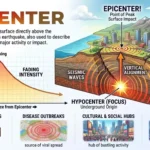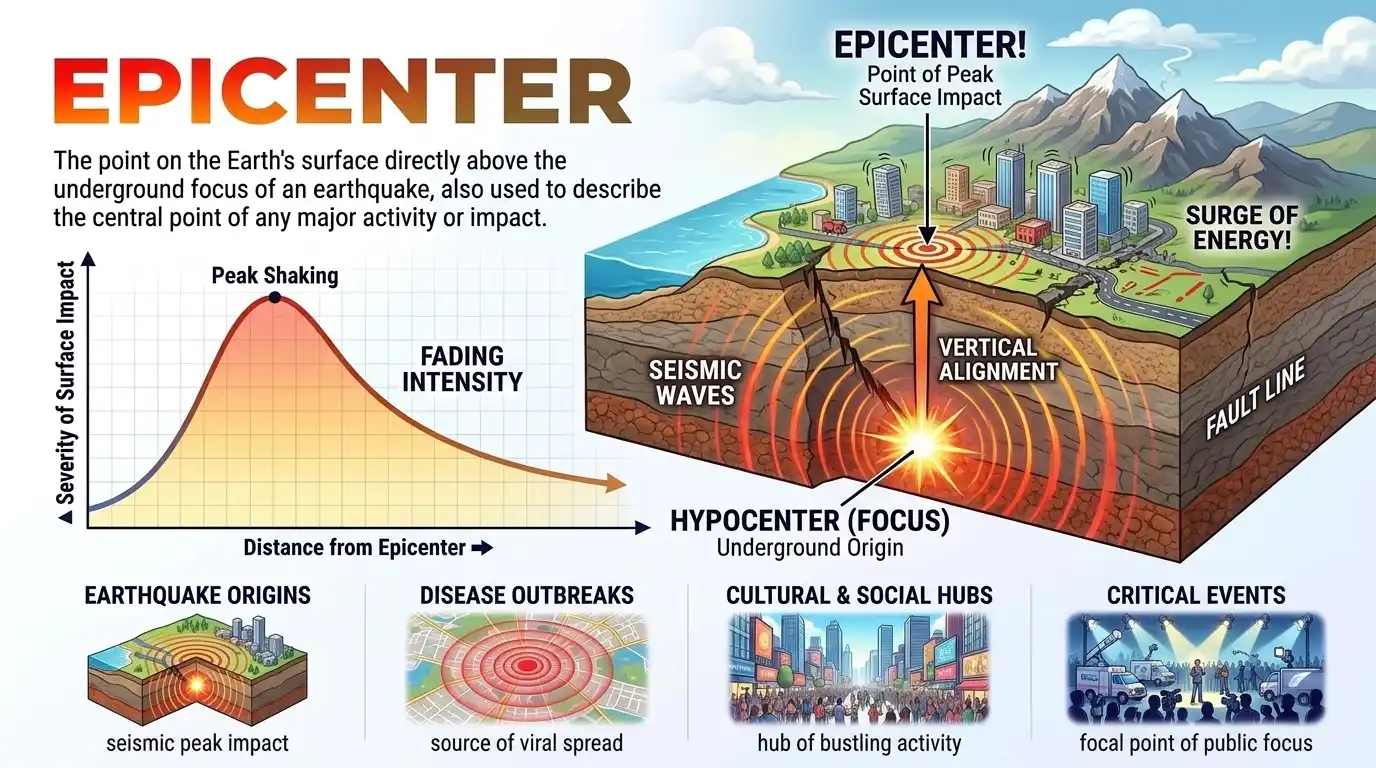
Synonyms of epicenter include center, focal point, hub, nucleus, heart, core, and central point. In earthquake science, an epicenter is the point on Earth’s surface directly above an earthquake’s origin. In everyday English, it describes the central location of important events, activity, attention, or major developments.
Imagine a city suddenly becoming the center of a global news story. Reporters arrive, cameras gather, and everyone starts talking about that location. It becomes the epicenter of attention.
The word also appears in science, politics, business, and everyday conversations. Learning synonyms of epicenter helps you describe central locations with greater accuracy.
Students, bloggers, and content writers often need alternatives to avoid repeating the same expressions. Choosing the right word also makes explanations easier to understand.
This guide explores synonyms of epicenter through meanings, pronunciation, examples, and practical comparisons. You will also discover how context changes word choice.
What Does Epicenter Really Mean?
Epicenter is a noun that identifies a central location.
It has two main meanings.
Scientific meaning: The point on Earth’s surface directly above the underground location where an earthquake begins.
Figurative meaning: The central location of important events, activities, attention, or developments.
For example:
- The earthquake’s epicenter was located near the coast.
- The university became the epicenter of student protests.
- The neighborhood is the epicenter of the city’s music scene.
Native English speakers often use epicenter figuratively to emphasize a place where something significant is happening.
However, the word has a precise scientific meaning. Not every figurative synonym can replace it in earthquake terminology.
Part of Speech: Noun
Plural Form: Epicenters (US), epicentres (UK)
British Spelling: Epicentre
Connotative Meaning of Epicenter
(Connotation is the feeling, attitude, or additional meaning a word suggests beyond its basic dictionary definition.)
The word epicenter can carry different emotional associations depending on the situation.
Positive Tone:
Epicenter can describe a place associated with creativity, innovation, or cultural development.
Example: The city became the epicenter of modern fashion.
Negative Tone:
It frequently appears in discussions about earthquakes, disease outbreaks, political unrest, and disasters.
Example: The region became the epicenter of the health crisis.
Neutral Tone:
In scientific writing, epicenter is a factual geographical term. It does not automatically express emotion.
Example: Scientists identified the earthquake’s epicenter.
Etymology of Epicenter
The word epicenter developed from Greek elements.
The prefix epi- means “upon” or “above.” The word kentron means “center” or “sharp point.”
Together, these elements help explain its scientific meaning: a point positioned directly above an earthquake’s underground origin.
The English word entered scientific vocabulary through the development of modern seismology.
Old English Period (450–1100)
The word epicenter did not exist in Old English. People described earthquakes using older vocabulary related to shaking and movement.
Middle English Period (1100–1500)
Epicenter was not yet an established English word. Scientific earthquake terminology remained relatively limited.
Modern English Period (1500–Present)
Epicenter entered English scientific usage in the nineteenth century.
It initially referred to earthquakes. Over time, writers began using it figuratively for the center of major events, activities, and developments.
Today, both meanings are widely recognized.
Pronunciation of Epicenter
American English (US): /ˈep.ɪˌsen.tɚ/
British English (UK): /ˈep.ɪˌsen.tə/
The primary stress falls on the first syllable.
Syllables
ep-i-cen-ter
Epicenter contains four syllables.
Affixation Pattern of Epicenter
- Root: Center, ultimately from Greek kentron
- Prefix: Epi- (above or upon)
- Suffix: No separate English derivational suffix
The word combines the idea of being above with the concept of a central point.
50 Synonyms of Epicenter With Meanings and Examples
Not every alternative below is interchangeable in every sentence. Some are close figurative synonyms. Others are useful context-specific substitutes for the center of activity, attention, influence, or development.
The first group contains the closest general alternatives. Later entries offer more specialized expressions.
1. Center (Noun) — US /ˈsen.tɚ/ | UK /ˈsen.tə/
Meaning: The middle or most important point of a place, event, or activity.
Tone/Register: Neutral, everyday.
Example 1: The city became the center of political discussions.
Example 2: Her office is the center of the entire operation.
2. Focal Point (Noun) — US /ˈfoʊ.kəl pɔɪnt/ | UK /ˈfəʊ.kəl pɔɪnt/
Meaning: The main location or subject receiving attention.
Tone/Register: Neutral, professional.
Example 1: The museum became the focal point of the celebration.
Example 2: Climate change was the focal point of the conference.
3. Hub (Noun) — US /hʌb/ | UK /hʌb/
Meaning: A central place where important activities or connections come together.
Tone/Register: Modern, business, informal.
Example 1: Singapore is a major aviation hub.
Example 2: The café became a hub for local artists.
4. Heart (Noun) — US /hɑːrt/ | UK /hɑːt/
Meaning: The central or most important part of a place or activity.
Tone/Register: Warm, expressive.
Example 1: The old market is the heart of the town.
Example 2: This neighborhood is the heart of the music scene.
5. Core (Noun) — US /kɔːr/ | UK /kɔː/
Meaning: The central or essential part of something.
Tone/Register: Neutral, academic.
Example 1: The research team worked at the core of the project.
Example 2: Trust sits at the core of their partnership.
6. Nucleus (Noun) — US /ˈnuː.kli.əs/ | UK /ˈnjuː.kli.əs/
Meaning: A central part around which other elements develop or gather.
Tone/Register: Formal, scientific.
Example 1: The university became the nucleus of scientific research.
Example 2: A small team formed the nucleus of the organization.
7. Central Point (Noun) — US /ˈsen.trəl pɔɪnt/ | UK /ˈsen.trəl pɔɪnt/
Meaning: The main position around which other things are arranged.
Tone/Register: Neutral, descriptive.
Example 1: The fountain marks the central point of the park.
Example 2: Education became the central point of their discussion.
8. Ground Zero (Noun) — US /ˌɡraʊnd ˈzɪr.oʊ/ | UK /ˌɡraʊnd ˈzɪə.rəʊ/
Meaning: The location of an explosion or, figuratively, the place where a major event or crisis originates.
Tone/Register: Serious, dramatic.
Example 1: The damaged district became ground zero for recovery efforts.
Example 2: The laboratory was described as ground zero for the investigation.
9. Hotspot (Noun) — US /ˈhɑːt.spɑːt/ | UK /ˈhɒt.spɒt/
Meaning: A place where a particular activity or situation is especially concentrated.
Tone/Register: Informal, media.
Example 1: The district became a hotspot for new restaurants.
Example 2: Officials identified another infection hotspot.
10. Headquarters (Noun) — US /ˈhedˌkwɔːr.tɚz/ | UK /ˌhedˈkwɔː.təz/
Meaning: The main location from which an organization directs its activities.
Tone/Register: Professional, organizational.
Example 1: The building became the campaign headquarters.
Example 2: The company moved its headquarters downtown.
11. Nerve Center (Noun) — US /ˈnɝːv ˌsen.tɚ/ | UK /ˈnɜːv ˌsen.tə/
Meaning: The central location where information and important decisions are managed.
Tone/Register: Professional, figurative.
Example 1: The control room is the airport’s nerve center.
Example 2: Their office became the nerve center of the rescue operation.
12. Activity Center (Noun) — US /ækˈtɪv.ə.ti ˌsen.tɚ/ | UK /ækˈtɪv.ə.ti ˌsen.tə/
Meaning: A location where many activities take place.
Tone/Register: Neutral, descriptive.
Example 1: The community hall became an activity center.
Example 2: The waterfront serves as the city’s activity center.
13. Central Hub (Noun) — US /ˈsen.trəl hʌb/ | UK /ˈsen.trəl hʌb/
Meaning: A main location connecting people, services, or activities.
Tone/Register: Business, modern.
Example 1: The station is the central hub of the transport network.
Example 2: Their website acts as a central hub for updates.
14. Main Center (Noun) — US /meɪn ˈsen.tɚ/ | UK /meɪn ˈsen.tə/
Meaning: The primary location of an important activity.
Tone/Register: Neutral, explanatory.
Example 1: The capital became the main center of negotiations.
Example 2: This building is the main center for community services.
15. Central Location (Noun) — US /ˈsen.trəl loʊˈkeɪ.ʃən/ | UK /ˈsen.trəl ləʊˈkeɪ.ʃən/
Meaning: A place positioned near the middle of an area or activity.
Tone/Register: Neutral, geographical.
Example 1: The organizers selected a central location for the event.
Example 2: Their office has a central location in the business district.
16. Main Point (Noun) — US /meɪn pɔɪnt/ | UK /meɪn pɔɪnt/
Meaning: The most important point within a discussion, arrangement, or situation.
Tone/Register: Neutral, conversational.
Example 1: Public safety became the main point of the meeting.
Example 2: The investigation focused on one main point.
17. Center of Attention (Noun Phrase) — US /ˈsen.tɚ əv əˈten.ʃən/ | UK /ˈsen.tə əv əˈten.ʃən/
Meaning: The person, place, or subject receiving the greatest attention.
Tone/Register: Everyday, expressive.
Example 1: The new exhibition became the center of attention.
Example 2: The small village was suddenly the center of attention.
18. Center of Activity (Noun Phrase) — US /ˈsen.tɚ əv ækˈtɪv.ə.ti/ | UK /ˈsen.tə əv ækˈtɪv.ə.ti/
Meaning: The location where most activity happens.
Tone/Register: Neutral, descriptive.
Example 1: The town square became the center of activity.
Example 2: During the festival, the harbor was the center of activity.
19. Center of Operations (Noun Phrase) — US /ˈsen.tɚ əv ˌɑː.pəˈreɪ.ʃənz/ | UK /ˈsen.tə əv ˌɒp.əˈreɪ.ʃənz/
Meaning: The main place where organized work is coordinated.
Tone/Register: Professional, formal.
Example 1: The temporary office became the center of operations.
Example 2: Emergency teams established a center of operations nearby.
20. Command Center (Noun) — US /kəˈmænd ˌsen.tɚ/ | UK /kəˈmɑːnd ˌsen.tə/
Meaning: A central location used to direct and coordinate important activities.
Tone/Register: Military, professional.
Example 1: The hospital opened a command center during the emergency.
Example 2: Managers monitored deliveries from the command center.
21. Focus (Noun) — US /ˈfoʊ.kəs/ | UK /ˈfəʊ.kəs/
Meaning: The central subject or point receiving attention.
Tone/Register: Neutral, academic.
Example 1: The coastal region became the focus of the investigation.
Example 2: Renewable energy is now the focus of their research.
22. Center Stage (Noun Phrase) — US /ˌsen.tɚ ˈsteɪdʒ/ | UK /ˌsen.tə ˈsteɪdʒ/
Meaning: The position of greatest public attention or importance.
Tone/Register: Figurative, media.
Example 1: Environmental issues took center stage at the summit.
Example 2: Local designers moved to center stage during fashion week.
23. Heartland (Noun) — US /ˈhɑːrt.lænd/ | UK /ˈhɑːt.lænd/
Meaning: A central region strongly associated with a particular activity, culture, or tradition.
Tone/Register: Cultural, geographical.
Example 1: The region is considered the heartland of traditional farming.
Example 2: Visitors explored the country’s musical heartland.
24. Seat (Noun) — US /siːt/ | UK /siːt/
Meaning: A place where an institution, authority, or important activity is based.
Tone/Register: Formal, historical.
Example 1: The city became the seat of government.
Example 2: The ancient town was once a seat of learning.
25. Power Center (Noun) — US /ˈpaʊ.ɚ ˌsen.tɚ/ | UK /ˈpaʊ.ə ˌsen.tə/
Meaning: A place where considerable political, financial, or organizational influence is concentrated.
Tone/Register: Political, professional.
Example 1: The capital remains the country’s political power center.
Example 2: The financial district developed into a major power center.
26. Center of Influence (Noun Phrase) — US /ˈsen.tɚ əv ˈɪn.flu.əns/ | UK /ˈsen.tə əv ˈɪn.flu.əns/
Meaning: A location from which significant influence spreads.
Tone/Register: Formal, analytical.
Example 1: The university became a center of influence in education.
Example 2: The organization developed into a regional center of influence.
27. Center of Gravity (Noun Phrase) — US /ˈsen.tɚ əv ˈɡræv.ə.ti/ | UK /ˈsen.tə əv ˈɡræv.ɪ.ti/
Meaning: Figuratively, the main source of importance, strength, or influence within a situation.
Tone/Register: Academic, strategic.
Example 1: The city’s economic center of gravity shifted eastward.
Example 2: Digital services became the industry’s center of gravity.
28. Crucible (Noun) — US /ˈkruː.sə.bəl/ | UK /ˈkruː.sɪ.bəl/
Meaning: A place or situation where important changes develop under intense pressure.
Tone/Register: Literary, formal.
Example 1: The city became a crucible of political change.
Example 2: The laboratory was a crucible for scientific discovery.
29. Flashpoint (Noun) — US /ˈflæʃ.pɔɪnt/ | UK /ˈflæʃ.pɔɪnt/
Meaning: A location or situation where conflict may suddenly develop.
Tone/Register: Serious, journalistic.
Example 1: The border town became a flashpoint for tensions.
Example 2: The disputed area remained a political flashpoint.
30. Trouble Spot (Noun) — US /ˈtrʌb.əl spɑːt/ | UK /ˈtrʌb.əl spɒt/
Meaning: A location where problems or disturbances are concentrated.
Tone/Register: Informal, journalistic.
Example 1: Police identified the intersection as a trouble spot.
Example 2: The damaged bridge became a trouble spot for commuters.
31. Crisis Center (Noun) — US /ˈkraɪ.sɪs ˌsen.tɚ/ | UK /ˈkraɪ.sɪs ˌsen.tə/
Meaning: A central location for managing or responding to an emergency.
Tone/Register: Professional, emergency-related.
Example 1: Volunteers gathered at the temporary crisis center.
Example 2: The hospital established a crisis center after the storm.
32. Disaster Zone (Noun) — US /dɪˈzæs.tɚ zoʊn/ | UK /dɪˈzɑː.stə zəʊn/
Meaning: An area seriously affected by a natural or human-made disaster.
Tone/Register: Serious, descriptive.
Example 1: Rescue teams entered the disaster zone at sunrise.
Example 2: Officials restricted access to the disaster zone.
33. Impact Zone (Noun) — US /ˈɪm.pækt zoʊn/ | UK /ˈɪm.pækt zəʊn/
Meaning: An area directly affected by a significant physical event or impact.
Tone/Register: Technical, descriptive.
Example 1: Engineers examined the impact zone after the collision.
Example 2: Residents were evacuated from the expected impact zone.
34. Center of Disturbance (Noun Phrase) — US /ˈsen.tɚ əv dɪˈstɝː.bəns/ | UK /ˈsen.tə əv dɪˈstɜː.bəns/
Meaning: The central location associated with disruption or unusual activity.
Tone/Register: Formal, descriptive.
Example 1: Investigators searched for the center of the disturbance.
Example 2: The crowd gathered near the center of disturbance.
35. Point of Origin (Noun Phrase) — US /pɔɪnt əv ˈɔːr.ə.dʒɪn/ | UK /pɔɪnt əv ˈɒr.ɪ.dʒɪn/
Meaning: The exact place where an event or process begins.
Tone/Register: Technical, formal.
Example 1: Firefighters identified the fire’s point of origin.
Example 2: Investigators traced the signal to its point of origin.
36. Origin (Noun) — US /ˈɔːr.ə.dʒɪn/ | UK /ˈɒr.ɪ.dʒɪn/
Meaning: The place or source where something begins.
Tone/Register: Neutral, academic.
Example 1: Scientists investigated the origin of the tremors.
Example 2: The researchers traced the outbreak to its origin.
37. Starting Point (Noun) — US /ˈstɑːr.tɪŋ pɔɪnt/ | UK /ˈstɑː.tɪŋ pɔɪnt/
Meaning: The place where an activity, movement, or process begins.
Tone/Register: Neutral, conversational.
Example 1: The library became the starting point for the campaign.
Example 2: Their small office was the starting point of the project.
38. Source (Noun) — US /sɔːrs/ | UK /sɔːs/
Meaning: The place or thing from which something originates.
Tone/Register: Neutral, scientific.
Example 1: Researchers located the source of the unusual vibrations.
Example 2: Officials investigated the source of the contamination.
39. Epicentral Area (Noun Phrase) — US /ˌep.ɪˈsen.trəl ˈer.i.ə/ | UK /ˌep.ɪˈsen.trəl ˈeə.ri.ə/
Meaning: The geographical region surrounding an earthquake’s epicenter.
Tone/Register: Scientific, technical.
Example 1: Survey teams inspected buildings in the epicentral area.
Example 2: Several roads in the epicentral area were damaged.
40. Central Area (Noun Phrase) — US /ˈsen.trəl ˈer.i.ə/ | UK /ˈsen.trəl ˈeə.ri.ə/
Meaning: The middle or main section of a geographical location.
Tone/Register: Neutral, geographical.
Example 1: Most festival activities took place in the central area.
Example 2: The central area attracted thousands of visitors.
41. Nodal Point (Noun) — US /ˈnoʊ.dəl pɔɪnt/ | UK /ˈnəʊ.dəl pɔɪnt/
Meaning: An important point where connections or activities meet.
Tone/Register: Technical, academic.
Example 1: The station became a nodal point in the railway network.
Example 2: The port serves as a nodal point for regional trade.
42. Node (Noun) — US /noʊd/ | UK /nəʊd/
Meaning: A central connection point within a network or system.
Tone/Register: Technical, digital.
Example 1: The server acts as a major node in the network.
Example 2: The city developed into an important transport node.
43. Junction (Noun) — US /ˈdʒʌŋk.ʃən/ | UK /ˈdʒʌŋk.ʃən/
Meaning: A place where routes, systems, or activities meet.
Tone/Register: Neutral, geographical.
Example 1: The railway junction became a busy commercial location.
Example 2: Several major roads meet at this junction.
44. Crossroads (Noun) — US /ˈkrɔːs.roʊdz/ | UK /ˈkrɒs.rəʊdz/
Meaning: A central meeting place of routes, cultures, or important developments.
Tone/Register: Figurative, literary.
Example 1: The city became a crossroads of international trade.
Example 2: The region has long been a cultural crossroads.
45. Meeting Point (Noun) — US /ˈmiː.tɪŋ pɔɪnt/ | UK /ˈmiː.tɪŋ pɔɪnt/
Meaning: A central location where people or activities come together.
Tone/Register: Neutral, everyday.
Example 1: The plaza became a meeting point for young artists.
Example 2: The station is a popular meeting point for travelers.
46. Gathering Place (Noun) — US /ˈɡæð.ɚ.ɪŋ pleɪs/ | UK /ˈɡæð.ər.ɪŋ pleɪs/
Meaning: A location where people regularly assemble for shared activities.
Tone/Register: Friendly, descriptive.
Example 1: The park became a gathering place for families.
Example 2: The bookstore is a favorite gathering place for readers.
47. Cultural Center (Noun) — US /ˈkʌl.tʃɚ.əl ˌsen.tɚ/ | UK /ˈkʌl.tʃər.əl ˌsen.tə/
Meaning: A place where cultural activities and creative developments are concentrated.
Tone/Register: Educational, descriptive.
Example 1: The district became a cultural center for local musicians.
Example 2: The historic building now serves as a cultural center.
48. Innovation Hub (Noun) — US /ˌɪn.əˈveɪ.ʃən hʌb/ | UK /ˌɪn.əˈveɪ.ʃən hʌb/
Meaning: A central location where new ideas and technologies are developed.
Tone/Register: Business, professional.
Example 1: The university district became an innovation hub.
Example 2: Startups gathered around the city’s new innovation hub.
49. Center of Excellence (Noun Phrase) — US /ˈsen.tɚ əv ˈek.səl.əns/ | UK /ˈsen.tə əv ˈek.səl.əns/
Meaning: A place recognized for outstanding expertise or achievement in a particular field.
Tone/Register: Academic, professional.
Example 1: The hospital became a center of excellence in medical research.
Example 2: The institute is a center of excellence for engineering.
50. Mainstay (Noun) — US /ˈmeɪn.steɪ/ | UK /ˈmeɪn.steɪ/
Meaning: The central source of support or strength within an activity or organization.
Tone/Register: Neutral, figurative.
Example 1: Tourism remains the mainstay of the local economy.
Example 2: Community support became the mainstay of the recovery effort.
Vocabulary Note: Entries such as disaster zone, mainstay, headquarters, and starting point are related expressions rather than direct replacements for epicenter. Their suitability depends on the intended meaning. In earthquake science, retain epicenter when referring to the precise surface point above the hypocenter.
Synonyms for Epicenter by Tone
Tone matters because the same central location can represent creativity, importance, danger, or disruption.
A suitable alternative helps readers understand the feeling behind your message.
Positive Tone
Use these words when discussing growth, creativity, connection, or achievement:
- Heart
- Hub
- Innovation hub
- Cultural center
- Center of excellence
- Gathering place
- Center of influence
Example: The district became an innovation hub for young entrepreneurs.
Neutral Tone
These expressions work well in factual and everyday writing:
- Center
- Central point
- Focal point
- Core
- Nucleus
- Central location
- Node
- Nodal point
- Center of activity
Example: The university became the focal point of the research project.
Negative Tone
These words suit discussions about danger, disruption, or emergencies:
- Ground zero
- Flashpoint
- Trouble spot
- Crisis center
- Disaster zone
- Center of disturbance
- Impact zone
Example: The disputed border became a flashpoint for political tensions.
Playful or Informal Tone
Epicenter does not have many exact playful alternatives.
However, words such as hub, hotspot, and heart can create a lighter feeling.
Example: The kitchen became the hotspot for everyone’s late-night conversations.
Avoid playful expressions when describing serious disasters.
Epicenter vs Close Alternatives
Although epicenter, center, focal point, and hub share related meanings, they are not always interchangeable.
| Word | Main Meaning | Tone | Best Usage |
|---|---|---|---|
| Epicenter | Central location of an earthquake or major activity | Scientific or dramatic | Earthquakes, crises, major developments |
| Center | Middle or main location | Neutral | General descriptions |
| Focal point | Main point receiving attention | Professional | Discussions, writing, presentations |
| Hub | Place connecting activities or people | Modern, positive | Business, technology, transport |
Epicenter vs Center
Epicenter often adds intensity or importance.
Center is broader and more neutral.
Compare:
“The city became the center of the discussion.”
“The city became the epicenter of the political crisis.”
The second sentence creates a stronger impression.
Epicenter vs Focal Point
A focal point attracts attention.
An epicenter identifies a central location of activity or an important event.
For example:
“The painting became the focal point of the exhibition.”
“The city became the epicenter of the cultural movement.”
Epicenter vs Hub
Hub usually emphasizes connections and ongoing activity.
Epicenter can emphasize the concentration of a major event.
For example:
“The city is a technology hub.”
“The city became the epicenter of the technology revolution.”
How Epicenter Changes by Context
Daily Conversation
In casual English, epicenter can describe the busiest or most important location in a situation.
Example: The living room became the epicenter of the birthday celebration.
However, center or hub may sound more natural in ordinary conversation.
Writing and Blogging
Writers use epicenter to emphasize the importance of a particular location.
Example: The coastal city became the epicenter of the country’s tourism revival.
Alternatives such as heart, focal point, and cultural center can help writers create variety.
Professional and Academic Writing
Academic writing requires precision.
In seismology, epicenter has a specific geographical definition. It should not be replaced casually with origin or ground zero.
In business writing, terms such as central hub, nerve center, and center of operations may communicate the intended meaning more accurately.
Creative and Informal Writing
Creative writers often use epicenter metaphorically.
Example: Her small bookstore became the epicenter of the neighborhood’s literary revival.
This expression suggests importance, energy, and concentrated activity.
Common Mistakes Learners Make
Mistake 1: Confusing Epicenter With Hypocenter
These words have different scientific meanings.
The hypocenter, also called the focus, is the underground point where an earthquake begins.
The epicenter is the point on Earth’s surface directly above it.
Mistake 2: Using Epicenter for Every Central Location
Not every middle point needs a dramatic word.
Incorrect or unnatural: “The spoon is at the epicenter of the table.”
Better: “The spoon is at the center of the table.”
Epicenter works best when the location has scientific or figurative significance.
Mistake 3: Assuming Epicenter Always Describes Something Negative
The word frequently appears in disaster reporting.
However, positive figurative uses are also possible.
Example: The city became the epicenter of artistic innovation.
Mistake 4: Treating All Related Words as Exact Synonyms
Ground zero, origin, hotspot, and epicenter express different ideas.
A location can be a hotspot without being an earthquake epicenter.
Always check the context before replacing the original word.
Mistake 5: Overusing Dramatic Language
Repeating epicenter throughout an article can make the writing feel exaggerated.
Use alternatives where appropriate.
Choose center for general descriptions, hub for connected activities, and focal point for concentrated attention.
Register Notes: Formal vs Informal English
Formal English
Epicenter, nucleus, focal point, and central point work well in formal writing when used accurately.
Scientific discussions should preserve established terminology.
Informal English
Center, heart, hub, and hotspot often sound more conversational.
Example: “That café is the heart of our neighborhood.”
Spoken English
Native speakers may use epicenter figuratively, especially when describing significant events.
However, simpler words often sound more natural in everyday speech.
Written English
Epicenter appears frequently in journalism, geography, academic explanations, and descriptive writing.
Writers should consider whether its dramatic effect is appropriate.
For further vocabulary development, explore related synonyms of focal point and centrality.
Real-Life Examples Using Epicenter
Workplace Scenario
A technology company opens a new research office.
Within months, most important projects begin there.
“The new office became the epicenter of the company’s innovation efforts.”
Social Scenario
A local community organizes a large cultural festival.
Visitors gather around the main square.
“The town square became the epicenter of the celebration.”
Media and Pop Culture Scenario
A small neighborhood suddenly attracts famous musicians and filmmakers.
“The neighborhood became the epicenter of the emerging music movement.”
Writing and Storytelling Scenario
A novelist describes a mysterious town where several unusual events occur.
“The abandoned mansion stood at the epicenter of the mystery.”
Scientific Scenario
A strong earthquake occurs beneath a coastal region.
Scientists calculate its underground origin and identify the corresponding surface location.
“The earthquake’s epicenter was located several kilometers offshore.”
Interactive Practice Quiz: Test Your Vocabulary
Choose the most suitable answer for each situation.
Part One: Meaning and Context
1. Which word identifies the point on Earth’s surface directly above an earthquake’s underground origin?
A) Hypocenter
B) Epicenter
C) Junction
D) Headquarters
2. A city becomes the main location for startup development. Which expression fits best?
A) Disaster zone
B) Trouble spot
C) Innovation hub
D) Impact zone
3. Which word best describes the main subject receiving attention during a meeting?
A) Focal point
B) Heartland
C) Junction
D) Flashpoint
4. A border region becomes the location of rising political tensions. Which word fits?
A) Gathering place
B) Cultural center
C) Mainstay
D) Flashpoint
5. Which alternative sounds most natural for the central part of a small town?
A) Ground zero
B) Heart
C) Crisis center
D) Impact zone
6. A control room manages an entire transport system. What is it?
A) Disaster zone
B) Starting point
C) Nerve center
D) Heartland
Part Two: Real-Life Word Choice
7. Which expression best describes a busy place connecting several transport routes?
A) Transport hub
B) Flashpoint
C) Trouble spot
D) Disaster zone
8. Which term describes the underground location where an earthquake begins?
A) Epicenter
B) Cultural center
C) Central area
D) Hypocenter
9. A neighborhood attracts artists, musicians, and performers. Which expression has a positive meaning?
A) Crisis center
B) Cultural center
C) Disaster zone
D) Trouble spot
10. Which word best describes a central part around which an organization develops?
A) Impact zone
B) Flashpoint
C) Nucleus
D) Junction
11. A city is the main location of a major political crisis. Which sentence sounds most expressive?
A) The city became the epicenter of the political crisis.
B) The city became a gathering place for furniture.
C) The city became a transport junction for the crisis.
D) The city became the mainstay of the earthquake.
12. Which word best describes a location where people regularly come together?
A) Hypocenter
B) Impact zone
C) Source
D) Gathering place
13. Which term best describes a place where an organization directs its main activities?
A) Crossroads
B) Headquarters
C) Disaster zone
D) Heartland
14. A fire investigator wants to identify where a fire started. Which expression is most accurate?
A) Cultural center
B) Center of excellence
C) Point of origin
D) Center of attention
15. Which expression best describes the main source of support for a local economy?
A) Mainstay
B) Flashpoint
C) Epicentral area
D) Command center
Answer Key
1-B | 2-C | 3-A | 4-D | 5-B | 6-C | 7-A | 8-D | 9-B | 10-C | 11-A | 12-D | 13-B | 14-C | 15-A
Reflection and Application Task
Write two original sentences.
In the first sentence, use epicenter to describe an important event or location.
In the second sentence, replace it with a suitable alternative from this guide.
Explain how the meaning or tone changes.
Suggested External Source:
USGS Earthquake Hazards Program — A reliable educational source for understanding earthquake terminology.
Conclusion
Understanding synonyms of epicenter helps you describe important locations with greater confidence. Every alternative adds a different shade of meaning.
Words like center, hub, nucleus, and focal point bring variety to your writing. They also make blogs, essays, and everyday explanations clearer.
Learning synonyms of epicenter strengthens your speaking and communication skills. Choosing accurate vocabulary helps readers understand your ideas.
Practice synonyms of epicenter in emails, essays, and daily conversations. Try a new expression each day and notice how naturally your vocabulary grows.
FAQs
1. What is another word for epicenter in a news headline?
The best alternative depends on the event being reported. For political unrest, flashpoint may work. For concentrated activity, center or hotspot may be suitable. Ground zero creates a stronger association with a serious event or crisis. Journalists should choose words that accurately reflect the situation rather than simply adding dramatic emphasis.
2. Can epicenter describe a person instead of a geographical location?
Epicenter usually describes a location, but figurative writing can occasionally connect it with a person who stands at the center of important events. However, expressions such as central figure, key person, or center of attention generally sound more natural. For example, “She became the central figure in the debate” is clearer than calling her an epicenter.
3. Is epicenter the same as the most damaged area of an earthquake?
No. An earthquake’s epicenter is the surface point directly above its underground origin. The location experiencing the greatest damage may be somewhere else. Building quality, soil conditions, earthquake depth, and local geography can affect the distribution of damage. Therefore, the epicenter should not automatically be used to mean the most severely damaged location.
4. What is the difference between epicenter and epicentral distance?
The epicenter identifies a specific point on Earth’s surface. Epicentral distance measures the distance between that point and another location, such as a seismic recording station. Scientists use this measurement when analyzing earthquake observations. The two terms are related, but one identifies a geographical point while the other describes a distance.
5. Can epicenter be used in business and marketing content?
Yes. In figurative business writing, epicenter can emphasize a location where important developments are concentrated. For example, “The city became the epicenter of financial innovation.” However, business hub, innovation center, or commercial center may sound more precise when describing established business activities. Choose epicenter when the stronger emphasis is justified.
6. What is the plural of epicenter in American and British English?
The American English plural is epicenters, while British English commonly uses epicentres. Both forms have the same meaning. For example, scientists may compare the epicenters of several earthquakes. When writing for an international audience, select one spelling convention and apply it consistently throughout the article.
7. Is ground zero always an appropriate replacement for epicenter?
No. Ground zero originally refers to the point on the ground directly beneath or above a nuclear explosion. It also has broader figurative uses involving major events and crises. Epicenter has a separate, precise meaning in earthquake science. Although the expressions sometimes overlap in journalism, they should not be treated as interchangeable scientific terms.
8. Which synonym of epicenter works best in creative writing?
Heart, nucleus, focal point, and crucible can work beautifully in creative writing. Each creates a different impression. Heart suggests emotional importance, while nucleus emphasizes a central element around which other things develop. Crucible suggests intense pressure and transformation. The strongest choice depends on the atmosphere, subject, and meaning you want your readers to experience.

Mehtab Yasir is a passionate writer and English language enthusiast dedicated to making vocabulary learning simple, practical, and enjoyable. As an author at SynonymDesk.com, she creates helpful content covering synonyms, antonyms, word meanings, vocabulary, phrases, and everyday English usage. Her goal is to provide clear and easy-to-understand information that helps students, writers, professionals, and English learners choose the right words and communicate with greater confidence. Mehtab believes that a strong vocabulary can improve both writing and communication skills. She enjoys researching new words, exploring their meanings and uses, and turning complex language concepts into useful, reader-friendly content. Through her work, she strives to make SynonymDesk.com a reliable resource for anyone looking to improve their English vocabulary and language skills.