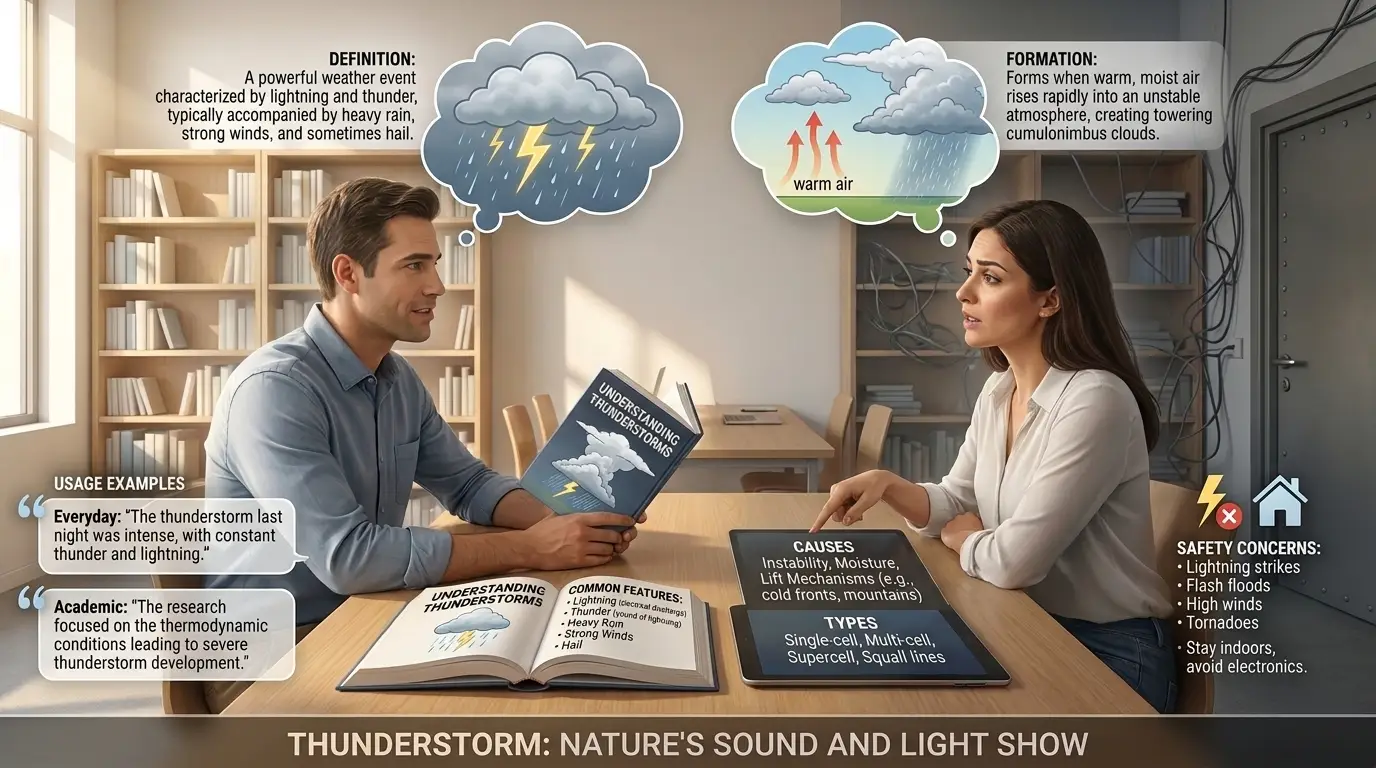
Synonyms of thunderstorm include electrical storm, lightning storm, thundershower, thunder squall, convective storm, severe thunderstorm, storm, and thunder-and-lightning storm. However, these expressions are not always exact substitutes. Some describe the same event, while others identify a specific type, feature, or intensity of thunderstorm.
Synonyms of thunderstorm become useful when you want to avoid repeating the same weather word. Imagine watching dark clouds gather while rain begins and thunder rolls across the sky.
A sudden thunderstorm can change a calm afternoon quickly. Knowing related expressions helps you describe that change with greater accuracy.
For students, synonyms of thunderstorm make essays and vocabulary exercises more varied. Bloggers and content writers can also choose words that create clearer weather descriptions.
Daily English users benefit too. Learning alternatives such as electrical storm or thundershower makes conversations and descriptions more natural.
What Does “Thunderstorm” Really Mean?
A thunderstorm is a local storm produced by a cumulonimbus cloud and accompanied by lightning and thunder. It may also bring heavy rain, strong winds, hail, and, in some situations, tornadoes.
The word is a noun.
Simple Definition
A thunderstorm is a storm with thunder and lightning, usually accompanied by rain and sometimes strong wind or hail.
Native speakers normally use thunderstorm for a particular weather event rather than for ordinary rain. The word commonly appears in weather forecasts, news reports, school science lessons, travel writing, and everyday conversation.
Emotional Tone
The word itself is generally neutral. It becomes dramatic or frightening depending on the context.
For example:
A thunderstorm is moving across the city.
This is neutral.
The violent thunderstorm shook the windows all night.
Here, words such as violent and shook create a more dramatic feeling.
Connotative Meaning
Connotation (the feeling or association a word creates beyond its basic dictionary meaning) can change how a weather expression feels.
Positive Tone
A thunderstorm may suggest excitement, beauty, freshness, or relief from hot weather.
The summer thunderstorm cooled the city.
Negative Tone
It may suggest danger, fear, destruction, or disruption.
The severe thunderstorm damaged several roofs.
Neutral Tone
It can simply identify a weather event.
A thunderstorm is expected this evening.
The National Weather Service describes a thunderstorm as a local storm produced by a cumulonimbus cloud and accompanied by lightning and thunder.
Etymology of “Thunderstorm”
The word thunderstorm is a compound formed from thunder + storm. Etymological sources date the compound to the 16th century, while the individual words are much older.
Old English: 450–1100
Thunder comes from Old English þunor, meaning thunder or thunderclap. It is related to Proto-Germanic forms and to words associated with thunder in other Germanic languages. Storm was also present in Old English as storm, meaning a tempest or violent atmospheric disturbance.
Middle English: 1100–1500
During Middle English, forms such as thonder developed from Old English þunor. The word storm also continued in related forms.
English speakers could describe violent weather using combinations involving thunder and storms before the modern compound became standardized.
Modern English: 1500–Present
The compound thunderstorm is recorded from the 1560s, originally meaning a storm accompanied by thunder and lightning. The modern spelling and usage gradually became established.
Today, thunderstorm is the standard everyday and meteorological term.
Pronunciation of “Thunderstorm”
US Pronunciation
/ˈθʌn.dɚˌstɔːrm/
UK Pronunciation
/ˈθʌn.dəˌstɔːm/
Syllables
thun-der-storm
The word has three syllables.
Affixation Pattern of “Thunderstorm”
Root
thunder + storm
Prefix
None
Suffix
None
It is best analyzed as a compound noun, not as a word created through ordinary prefixation or suffixation.
50 Synonyms and Closely Related Expressions for Thunderstorm
The 50 expressions below are therefore presented as synonyms, near-synonyms, and established weather expressions, with their differences clearly explained.
1. Electrical Storm (Noun) — US /ɪˈlɛktrɪkəl stɔːrm/ | UK /ɪˈlektrɪkəl stɔːm/
Meaning: A storm characterized especially by electrical activity, including lightning and thunder.
Tone/Register: Neutral; weather writing.
Examples:
An electrical storm crossed the region overnight.
The bright flashes made the clouds glow.
2. Lightning Storm (Noun) — US /ˈlaɪtnɪŋ stɔːrm/ | UK /ˈlaɪtnɪŋ stɔːm/
Meaning: A storm marked by frequent or noticeable lightning.
Tone/Register: Neutral; descriptive.
Examples:
A lightning storm formed over the hills.
We watched the flashes from indoors.
3. Thundershower (Noun) — US /ˈθʌndərˌʃaʊər/ | UK /ˈθʌndəˌʃaʊə/
Meaning: A rain shower accompanied by thunder and usually lightning.
Tone/Register: Neutral; weather-related.
Examples:
A brief thundershower cooled the afternoon.
The roads became wet within minutes.
4. Thunder Squall (Noun) — US /ˈθʌndər skwɔːl/ | UK /ˈθʌndə skwɒl/
Meaning: A sudden, vigorous squall associated with thunderstorm conditions.
Tone/Register: Descriptive; meteorological.
Examples:
A thunder squall swept across the coast.
Strong winds arrived before the rain.
5. Thunder-and-Lightning Storm (Noun) — US /ˈθʌndər ænd ˈlaɪtnɪŋ stɔːrm/ | UK /ˈθʌndə ænd ˈlaɪtnɪŋ stɔːm/
Meaning: A descriptive phrase for a storm producing thunder and lightning.
Tone/Register: Neutral; descriptive.
Examples:
A thunder-and-lightning storm arrived after sunset.
The sky flashed repeatedly.
6. Convective Storm (Noun) — US /kənˈvɛktɪv stɔːrm/ | UK /kənˈvektɪv stɔːm/
Meaning: A storm produced by strong upward movement of warm, moist air.
Tone/Register: Academic; meteorological.
Examples:
The forecast mentioned developing convective storms.
Warm, unstable air supported their growth.
7. Severe Thunderstorm (Noun) — US /səˈvɪr ˈθʌndərˌstɔːrm/ | UK /sɪˈvɪə ˈθʌndəˌstɔːm/
Meaning: A thunderstorm meeting specific severe-weather criteria.
Tone/Register: Formal; meteorological.
Examples:
A severe thunderstorm warning was issued.
Residents moved indoors.
The exact definition varies by weather service and jurisdiction. For example, the U.S. National Weather Service uses specific wind, hail, and tornado criteria.
8. Storm (Noun) — US /stɔːrm/ | UK /stɔːm/
Meaning: A broad term for disturbed or unpleasant atmospheric conditions.
Tone/Register: Neutral; everyday.
Examples:
The storm arrived before dinner.
Dark clouds covered the horizon.
Note: Storm is broader than thunderstorm.
9. Local Storm (Noun) — US /ˈloʊkəl stɔːrm/ | UK /ˈləʊkəl stɔːm/
Meaning: A storm affecting a relatively limited geographical area.
Tone/Register: Formal; meteorological.
Examples:
A local storm developed near the city.
Rainfall remained limited to nearby areas.
10. Severe Local Storm (Noun) — US /səˈvɪr ˈloʊkəl stɔːrm/ | UK /sɪˈvɪə ˈləʊkəl stɔːm/
Meaning: An intense localized storm capable of producing hazardous weather.
Tone/Register: Formal; meteorological.
Examples:
The forecast warned of a severe local storm.
Officials monitored the developing system.
11. Pulse Storm (Noun) — US /pʌls stɔːrm/ | UK /pʌls stɔːm/
Meaning: A short-lived thunderstorm that can briefly produce severe weather.
Tone/Register: Technical.
Examples:
A pulse storm formed during the afternoon.
It produced strong winds for a short time.
12. Pulse Severe Thunderstorm (Noun) — US /pʌls səˈvɪr ˈθʌndərˌstɔːrm/ | UK /pʌls sɪˈvɪə ˈθʌndəˌstɔːm/
Meaning: A single-cell thunderstorm with a brief period of severe weather.
Tone/Register: Technical.
Examples:
The pulse severe thunderstorm weakened quickly.
Strong gusts occurred during its peak.
13. Single-Cell Thunderstorm (Noun) — US /ˈsɪŋɡəl sɛl ˈθʌndərˌstɔːrm/ | UK /ˈsɪŋɡəl sel ˈθʌndəˌstɔːm/
Meaning: A thunderstorm organized around one main convective cell.
Tone/Register: Academic; meteorological.
Examples:
A single-cell thunderstorm developed over the valley.
It lasted less than an hour.
14. Multicell Thunderstorm (Noun) — US /ˈmʌltɪˌsɛl ˈθʌndərˌstɔːrm/ | UK /ˈmʌltɪˌsel ˈθʌndəˌstɔːm/
Meaning: A thunderstorm system made up of several convective cells.
Tone/Register: Technical.
Examples:
A multicell thunderstorm formed along the boundary.
New cells continued developing.
15. Supercell Thunderstorm (Noun) — US /ˈsuːpərˌsɛl ˈθʌndərˌstɔːrm/ | UK /ˈsuːpəˌsel ˈθʌndəˌstɔːm/
Meaning: A long-lived thunderstorm with a persistent rotating updraft.
Tone/Register: Technical.
Examples:
Meteorologists tracked a supercell thunderstorm.
Large hail was reported nearby.
16. Air-Mass Thunderstorm (Noun) — US /ˈer ˌmæs ˈθʌndərˌstɔːrm/ | UK /ˈeə ˌmæs ˈθʌndəˌstɔːm/
Meaning: A thunderstorm developing mainly within a warm, humid air mass rather than along a major front.
Tone/Register: Technical.
Examples:
An air-mass thunderstorm formed during the afternoon.
It weakened after sunset.
17. Dry Thunderstorm (Noun) — US /draɪ ˈθʌndərˌstɔːrm/ | UK /draɪ ˈθʌndəˌstɔːm/
Meaning: A thunderstorm in which little or no precipitation reaches the ground.
Tone/Register: Technical.
Examples:
A dry thunderstorm passed over the dry landscape.
Lightning remained a serious concern.
18. Nocturnal Thunderstorm (Noun) — US /nɑːkˈtɝːnəl ˈθʌndərˌstɔːrm/ | UK /nɒkˈtɜːnəl ˈθʌndəˌstɔːm/
Meaning: A thunderstorm that develops or persists during nighttime.
Tone/Register: Formal.
Examples:
A nocturnal thunderstorm woke the family.
Thunder continued until early morning.
19. Tropical Thunderstorm (Noun) — US /ˈtrɑːpɪkəl ˈθʌndərˌstɔːrm/ | UK /ˈtrɒpɪkəl ˈθʌndəˌstɔːm/
Meaning: A thunderstorm occurring in a tropical environment.
Tone/Register: Neutral; geographic.
Examples:
A tropical thunderstorm developed near the coast.
Heavy rain followed.
20. Monsoon Thunderstorm (Noun) — US /mɑːnˈsuːn ˈθʌndərˌstɔːrm/ | UK /mɒnˈsuːn ˈθʌndəˌstɔːm/
Meaning: A thunderstorm associated with monsoon-season conditions.
Tone/Register: Meteorological.
Examples:
A monsoon thunderstorm arrived in the evening.
The temperature dropped quickly.
21. Summer Thunderstorm (Noun) — US /ˈsʌmər ˈθʌndərˌstɔːrm/ | UK /ˈsʌmə ˈθʌndəˌstɔːm/
Meaning: A thunderstorm occurring during the summer season.
Tone/Register: Everyday; descriptive.
Examples:
A summer thunderstorm cooled the neighborhood.
Children watched the rain from the window.
22. Spring Thunderstorm (Noun) — US /sprɪŋ ˈθʌndərˌstɔːrm/ | UK /sprɪŋ ˈθʌndəˌstɔːm/
Meaning: A thunderstorm occurring during spring.
Tone/Register: Neutral.
Examples:
A spring thunderstorm swept through the town.
The garden received heavy rain.
23. Evening Thunderstorm (Noun) — US /ˈiːvnɪŋ ˈθʌndərˌstɔːrm/ | UK /ˈiːvnɪŋ ˈθʌndəˌstɔːm/
Meaning: A thunderstorm occurring during evening hours.
Tone/Register: Everyday.
Examples:
An evening thunderstorm interrupted our walk.
We waited indoors until it passed.
24. Afternoon Thunderstorm (Noun) — US /ˌæftərˈnuːn ˈθʌndərˌstɔːrm/ | UK /ˌɑːftəˈnuːn ˈθʌndəˌstɔːm/
Meaning: A thunderstorm developing during afternoon hours.
Tone/Register: Neutral.
Examples:
An afternoon thunderstorm formed over the city.
The temperature fell afterward.
25. Thunderstorm Cell (Noun) — US /ˈθʌndərˌstɔːrm sɛl/ | UK /ˈθʌndəˌstɔːm sel/
Meaning: An individual convective unit within a thunderstorm.
Tone/Register: Technical.
Examples:
The thunderstorm cell moved eastward.
Radar showed strong development.
26. Storm Cell (Noun) — US /ˈstɔːrm sɛl/ | UK /ˈstɔːm sel/
Meaning: A distinct organized part of a convective storm.
Tone/Register: Technical.
Examples:
A storm cell developed west of town.
It later produced heavy rain.
27. Convective Cell (Noun) — US /kənˈvɛktɪv sɛl/ | UK /kənˈvektɪv sel/
Meaning: A localized region of rising and sinking air within convection.
Tone/Register: Academic.
Examples:
A convective cell appeared on the radar.
It intensified during the afternoon.
28. Thundercloud (Noun) — US /ˈθʌndərklaʊd/ | UK /ˈθʌndəˌklaʊd/
Meaning: A cloud associated with thunder and storm development.
Tone/Register: Everyday; descriptive.
Examples:
A dark thundercloud covered the western sky.
Rain began moments later.
29. Cumulonimbus Storm (Noun) — US /ˌkjuːmjəloʊˈnɪmbəs stɔːrm/ | UK /ˌkjuːmjʊləʊˈnɪmbəs stɔːm/
Meaning: A storm associated with cumulonimbus cloud development.
Tone/Register: Academic.
Examples:
The cumulonimbus storm grew rapidly.
Its cloud tower reached high into the atmosphere.
30. Cumulonimbus Cloud (Noun) — US /ˌkjuːmjəloʊˈnɪmbəs klaʊd/ | UK /ˌkjuːmjʊləʊˈnɪmbəs klaʊd/
Meaning: A tall cloud type capable of producing thunderstorms.
Tone/Register: Scientific.
Examples:
A cumulonimbus cloud rose above the horizon.
Lightning appeared inside it.
31. Thunderburst (Noun) — US /ˈθʌndərbɝːst/ | UK /ˈθʌndəbɜːst/
Meaning: An informal or descriptive expression suggesting a sudden burst of thunderstorm activity.
Tone/Register: Literary; informal.
Examples:
A sudden thunderburst startled everyone.
Rain followed the loud flashes.
32. Thunderstorm Burst (Noun) — US /ˈθʌndərˌstɔːrm bɝːst/ | UK /ˈθʌndəˌstɔːm bɜːst/
Meaning: A brief period of intense thunderstorm activity.
Tone/Register: Descriptive.
Examples:
A thunderstorm burst crossed the area.
The rain was heavy but brief.
33. Storm Burst (Noun) — US /stɔːrm bɝːst/ | UK /stɔːm bɜːst/
Meaning: A sudden increase in storm activity.
Tone/Register: Informal; descriptive.
Examples:
A storm burst hit the neighborhood.
Heavy rain lasted only ten minutes.
34. Thunder Squall Line (Noun) — US /ˈθʌndər skwɔːl laɪn/ | UK /ˈθʌndə skwɒl laɪn/
Meaning: A line of storms containing thunderstorms and strong winds.
Tone/Register: Meteorological.
Examples:
A thunder squall line moved toward the coast.
The wind strengthened quickly.
35. Squall Line (Noun) — US /ˈskwɔːl laɪn/ | UK /ˈskwɒl laɪn/
Meaning: A line of thunderstorms or intense storms organized along a narrow zone.
Tone/Register: Technical.
Examples:
The squall line approached after sunset.
Heavy rain arrived first.
36. Thunderstorm Line (Noun) — US /ˈθʌndərˌstɔːrm laɪn/ | UK /ˈθʌndəˌstɔːm laɪn/
Meaning: A line or organized arrangement of thunderstorms.
Tone/Register: Meteorological.
Examples:
A thunderstorm line formed across the region.
Several cities experienced strong winds.
37. Thunderstorm Cluster (Noun) — US /ˈθʌndərˌstɔːrm ˈklʌstər/ | UK /ˈθʌndəˌstɔːm ˈklʌstə/
Meaning: A group of thunderstorms developing close together.
Tone/Register: Neutral; meteorological.
Examples:
A thunderstorm cluster formed over the mountains.
The storms gradually moved east.
38. Storm Cluster (Noun) — US /ˈstɔːrm ˈklʌstər/ | UK /ˈstɔːm ˈklʌstə/
Meaning: A group of storms occurring in the same general area.
Tone/Register: Neutral.
Examples:
A storm cluster appeared on the radar.
Several cells were active.
39. Thunder Event (Noun) — US /ˈθʌndər ɪˈvɛnt/ | UK /ˈθʌndə ɪˈvent/
Meaning: A descriptive expression for an event involving thunder, often within storm conditions.
Tone/Register: Formal; descriptive.
Examples:
The region experienced a major thunder event.
Lightning accompanied the activity.
40. Electrical Storm System (Noun) — US /ɪˈlɛktrɪkəl stɔːrm ˈsɪstəm/ | UK /ɪˈlektrɪkəl stɔːm ˈsɪstəm/
Meaning: A storm system notable for strong electrical activity.
Tone/Register: Formal.
Examples:
An electrical storm system moved inland.
Frequent lightning was reported.
41. Thunderstorm System (Noun) — US /ˈθʌndərˌstɔːrm ˈsɪstəm/ | UK /ˈθʌndəˌstɔːm ˈsɪstəm/
Meaning: An organized group or structure of thunderstorms.
Tone/Register: Meteorological.
Examples:
The thunderstorm system expanded overnight.
Its rain shield covered a wide area.
42. Storm Front (Noun) — US /ˈstɔːrm frʌnt/ | UK /ˈstɔːm frʌnt/
Meaning: A boundary associated with changing weather that may trigger storms.
Tone/Register: Neutral; meteorological.
Examples:
A storm front moved through the region.
Thunderstorms developed along it.
43. Weather Disturbance (Noun) — US /ˈwɛðər dɪˈstɝːbəns/ | UK /ˈweðə dɪˈstɜːbəns/
Meaning: A broad disturbance in atmospheric conditions.
Tone/Register: Formal.
Examples:
A weather disturbance developed offshore.
It later produced thunderstorms.
44. Atmospheric Disturbance (Noun) — US /ˌætməsˈfɛrɪk dɪˈstɝːbəns/ | UK /ˌætməsˈferɪk dɪˈstɜːbəns/
Meaning: A change or disruption in normal atmospheric conditions.
Tone/Register: Academic.
Examples:
An atmospheric disturbance moved across the area.
Thunderstorms formed within it.
45. Tempest (Noun) — US /ˈtɛmpəst/ | UK /ˈtempɪst/
Meaning: A violent storm, often used more broadly than thunderstorm.
Tone/Register: Literary; formal.
Examples:
The sailors faced a violent tempest.
Rain and wind battered the vessel.
46. Violent Storm (Noun) — US /ˈvaɪələnt stɔːrm/ | UK /ˈvaɪələnt stɔːm/
Meaning: A storm described as unusually intense or destructive.
Tone/Register: Dramatic; descriptive.
Examples:
A violent storm crossed the region.
Residents stayed indoors.
47. Rainstorm with Thunder (Noun) — US /ˈreɪnˌstɔːrm wɪð ˈθʌndər/ | UK /ˈreɪnˌstɔːm wɪð ˈθʌndə/
Meaning: A plain descriptive phrase for rain occurring with thunder.
Tone/Register: Everyday.
Examples:
A rainstorm with thunder arrived suddenly.
The streets flooded quickly.
48. Thunderous Storm (Noun) — US /ˈθʌndərəs stɔːrm/ | UK /ˈθʌndərəs stɔːm/
Meaning: A storm described as especially loud or dramatic.
Tone/Register: Literary; expressive.
Examples:
A thunderous storm rolled across the valley.
The windows rattled with every boom.
49. Thunderstorm Activity (Noun) — US /ˈθʌndərˌstɔːrm ækˈtɪvəti/ | UK /ˈθʌndəˌstɔːm ækˈtɪvəti/
Meaning: The occurrence or development of thunderstorms in an area.
Tone/Register: Formal; weather reporting.
Examples:
Thunderstorm activity increased after noon.
Several cells appeared on radar.
50. Thunder and Lightning (Noun Phrase) — US /ˈθʌndər ænd ˈlaɪtnɪŋ/ | UK /ˈθʌndə ænd ˈlaɪtnɪŋ/
Meaning: A familiar expression describing the two defining atmospheric features of a thunderstorm.
Tone/Register: Everyday; descriptive.
Examples:
We could hear thunder and see lightning.
The weather became unsettled quickly.
Synonyms of Thunderstorm by Tone
Positive or Pleasant
Some expressions can create a refreshing or dramatic feeling when the storm is viewed positively.
Summer Thunderstorm
This can suggest cooling rain after hot weather.
Thundershower
This often sounds lighter and less threatening than severe thunderstorm.
Thundercloud
In creative writing, it can create a beautiful or mysterious image.
Neutral
These expressions work well in ordinary conversation and informational writing.
Electrical Storm
Useful when emphasizing electrical activity.
Lightning Storm
Useful when lightning is especially noticeable.
Storm
Useful when the exact storm type is already understood.
Thunderstorm Activity
Useful in weather reports.
Convective Storm
Useful in scientific and academic contexts.
Negative or Dramatic
These expressions emphasize intensity or danger.
Severe Thunderstorm
Used when specific severe-weather criteria are met.
Violent Storm
A dramatic descriptive expression.
Tempest
A literary word suggesting powerful and turbulent weather.
Playful or Informal
English has fewer genuinely playful synonyms for thunderstorm. Writers may create imaginative descriptions, but these should not be presented as standard dictionary synonyms.
Why Tone Matters in Word Choice
Choosing a synonym is not simply about finding another word with the same dictionary meaning.
Electrical storm sounds informational.
Severe thunderstorm sounds official and specific.
Tempest sounds literary.
Thunderous storm sounds dramatic.
The right choice depends on the audience, purpose, and context.
Thunderstorm vs Close Alternatives
Thunderstorm vs Electrical Storm
A thunderstorm is the standard everyday term for a storm with thunder and lightning.
Electrical storm emphasizes the storm’s electrical activity.
Use thunderstorm in ordinary conversation. Use electrical storm when the electrical aspect is important.
Thunderstorm vs Thundershower
A thundershower usually suggests a shower of rain accompanied by thunder.
A thunderstorm is the broader standard term.
Use thundershower when you want to emphasize a brief or shower-like event.
Thunderstorm vs Storm
Storm is a broad category.
A thunderstorm is a specific type of storm involving thunder and lightning.
For precise writing, thunderstorm is usually better.
How Thunderstorm Vocabulary Changes by Context
Daily Conversation
Everyday speakers usually choose simple words.
There was a thunderstorm last night.
You can also say:
We had a huge storm last night.
If the context is obvious, storm may be enough.
Writing and Blogging
Bloggers can use descriptive expressions to prevent repetition.
Instead of writing thunderstorm repeatedly, you might use electrical storm, lightning storm, or thundershower when the meaning remains accurate.
This makes weather writing more varied without sacrificing clarity.
Professional or Academic Writing
Technical terms are more appropriate.
Words such as convective storm, single-cell thunderstorm, multicell thunderstorm, and supercell thunderstorm provide greater precision.
The National Weather Service distinguishes among several thunderstorm structures and types, including single-cell, multicell, pulse, and supercell storms.
Creative or Informal Writing
Creative writing allows more expressive language.
Words such as tempest, thunderous storm, and thundercloud can create atmosphere.
Still, writers should avoid calling every powerful storm a tempest if they simply mean a normal thunderstorm.
Common Mistakes Learners Make
Mistake 1: Treating “Storm” as an Exact Synonym
Not every storm is a thunderstorm.
A storm can be a snowstorm, sandstorm, windstorm, or thunderstorm.
Mistake 2: Calling Every Thunderstorm a Supercell
A supercell is a specific thunderstorm structure.
It should not be used as a general replacement for thunderstorm.
Mistake 3: Using “Tornado” as a Synonym
A tornado is not a synonym for thunderstorm.
A thunderstorm can produce a tornado, but the two phenomena are different.
Mistake 4: Using “Tempest” in Scientific Writing
Tempest is understandable, but it often sounds literary.
For scientific writing, thunderstorm or a specific meteorological term is usually clearer.
Mistake 5: Overusing “Severe”
Not every thunderstorm is severe.
The word severe has a technical meaning in weather reporting, so it should not be added merely to make writing sound dramatic.
Register Notes
Formal
Use:
convective storm
atmospheric disturbance
single-cell thunderstorm
supercell thunderstorm
Neutral
Use:
thunderstorm
electrical storm
lightning storm
storm
Informal
Use:
storm
thundershower
Literary
Use:
tempest
thunderous storm
Real-Life Mini Scenarios
Workplace
A weather update might say:
A severe thunderstorm is expected during the afternoon.
This is more precise than simply saying:
A bad storm is coming.
Social Situations
A friend might say:
Did you hear that thunderstorm last night?
The simple word thunderstorm sounds natural in conversation.
Media and Pop Culture
A news report might describe:
A powerful thunderstorm moved through the region.
A fictional story might use:
The tempest darkened the entire coastline.
The second version is more dramatic.
Writing and Storytelling
A writer can use:
A distant thundercloud gathered above the hills.
This creates imagery without repeatedly using thunderstorm.
How to Choose the Right Synonym
For Everyday English
Choose thunderstorm or storm.
For Weather Reports
Choose thunderstorm, severe thunderstorm, or a more specific meteorological term.
For Academic Writing
Choose convective storm, single-cell thunderstorm, or supercell thunderstorm when technically appropriate.
For Creative Writing
Choose tempest, thundercloud, or thunderous storm for atmosphere.
For Short Descriptions
Choose thundershower when the event is a brief shower accompanied by thunder.
Interactive Practice Quiz
Part One
1. Which word is the standard term for a storm with thunder and lightning?
A. Snowstorm
B. Thunderstorm
C. Dust storm
D. Fog
2. Which expression emphasizes electrical activity?
A. Electrical storm
B. Snow shower
C. Wind front
D. Heat wave
3. Which term is more technical?
A. Storm
B. Tempest
C. Convective storm
D. Rainy weather
4. Which expression usually suggests a brief rain shower with thunder?
A. Thundershower
B. Supercell
C. Tempest
D. Storm front
5. Which word is broader than “thunderstorm”?
A. Storm
B. Supercell
C. Lightning storm
D. Thundershower
6. Which term is associated with a rotating, long-lived thunderstorm?
A. Thundershower
B. Supercell
C. Rainstorm
D. Thundercloud
7. Which word sounds most literary?
A. Tempest
B. Thunderstorm
C. Electrical storm
D. Storm cell
8. A weather report needs a precise scientific term. Which is most suitable?
A. Convective storm
B. baffling storm
C. Huge weather
D. Stormy thing
9. Which expression focuses on visible flashes?
A. Lightning storm
B. Rainstorm
C. Weather disturbance
D. Tempest
10. Which term describes a thunderstorm with little or no rain reaching the ground?
A. Dry thunderstorm
B. Summer storm
C. Rainstorm
D. Snowstorm
Part Two
11. Which expression is suitable for a creative story?
A. Tempest
B. Convective cell
C. Weather disturbance
D. Storm system
12. Which term refers to a group of thunderstorms?
A. Thunderstorm cluster
B. Thunderclap
C. Thunderbolt
D. Rain shower
13. Which sentence uses “thunderstorm” naturally?
A. The thunderstorm produced lightning.
B. The thunderstorm was a sandwich.
C. I thunderstormed my homework.
D. She bought a thunderstorm.
14. Which expression should not automatically replace every “thunderstorm”?
A. Supercell
B. Electrical storm
C. Lightning storm
D. Storm
15. Which synonym-related skill helps writers avoid repetitive vocabulary?
A. Using contextually accurate alternatives
B. Replacing every word
C. Choosing the longest word
D. Ignoring meaning
Reflection Task
Write one sentence using electrical storm, thundershower, tempest, lightning storm, or convective storm. Make sure the chosen expression matches your intended meaning.
Answer Key: 1-B | 2-A | 3-C | 4-A | 5-A | 6-B | 7-A | 8-A | 9-A | 10-A | 11-A | 12-A | 13-A | 14-A | 15-A
FAQs
1. What is the closest synonym for thunderstorm in everyday English?
The closest everyday alternatives are electrical storm and lightning storm, although both emphasize particular features of the event. Thundershower can also work when the weather involves a brief rain shower with thunder. For most situations, however, thunderstorm remains the clearest and most natural choice.
2. Is “storm” a synonym for thunderstorm?
Storm is a broader term rather than a perfect synonym. A thunderstorm is one specific type of storm characterized by thunder and lightning. Other storms can include snowstorms, sandstorms, windstorms, and tropical storms. Therefore, storm can sometimes replace thunderstorm when the context is already clear.
3. What is a more formal word for thunderstorm?
In formal or scientific writing, terms such as convective storm, single-cell thunderstorm, multicell thunderstorm, or supercell thunderstorm may be appropriate. The correct choice depends on the storm’s structure and characteristics. Simply using a more complicated word does not automatically make writing more formal or accurate.
4. Can I use “tempest” instead of thunderstorm?
You can use tempest when you want to describe a violent or turbulent storm, especially in literary writing. However, it is broader and more old-fashioned in tone. It does not specifically identify thunder and lightning. For weather reports, school assignments, and everyday communication, thunderstorm is usually more precise.
5. Is a lightning storm the same as a thunderstorm?
Lightning storm is commonly used as a close synonym, especially when lightning is the main feature being emphasized. Scientifically, however, a thunderstorm involves both thunder and lightning and forms from convective activity. The expression lightning storm is therefore best treated as a descriptive alternative rather than a perfect replacement in every context.
6. What is the difference between a thundershower and a thunderstorm?
A thundershower usually emphasizes a shower of rain accompanied by thunder. A thunderstorm is the broader and standard term for a storm involving thunder and lightning. If you want to describe a short, shower-like event, thundershower can be useful. Otherwise, thunderstorm is generally the safer choice.
7. Which thunderstorm synonyms are best for academic writing?
Academic writing benefits from precise terms rather than decorative synonyms. Depending on the subject, convective storm, single-cell thunderstorm, multicell thunderstorm, supercell thunderstorm, and atmospheric disturbance may be useful. Always choose the term that accurately describes the meteorological feature being discussed.
Conclusion
Learning the synonyms of thunderstorm helps you describe weather with greater variety and precision. The key is choosing words that genuinely fit the context.
For everyday speaking, simple terms work best. For essays and blogs, carefully selected alternatives can improve flow while keeping your meaning clear.
Vocabulary becomes stronger when you understand differences in tone, register, and meaning. This skill improves writing, blogging, speaking, and everyday communication.
Practice these expressions in emails, essays, stories, and daily conversations. Choose one new synonym today and create your own sentence with it.

Mehtab Yasir is a passionate writer and English language enthusiast dedicated to making vocabulary learning simple, practical, and enjoyable. As an author at SynonymDesk.com, she creates helpful content covering synonyms, antonyms, word meanings, vocabulary, phrases, and everyday English usage. Her goal is to provide clear and easy-to-understand information that helps students, writers, professionals, and English learners choose the right words and communicate with greater confidence. Mehtab believes that a strong vocabulary can improve both writing and communication skills. She enjoys researching new words, exploring their meanings and uses, and turning complex language concepts into useful, reader-friendly content. Through her work, she strives to make SynonymDesk.com a reliable resource for anyone looking to improve their English vocabulary and language skills.