synonyms of stoicism include words such as composure, equanimity, self-control, calmness, fortitude, resilience, restraint, and self-possession. Each expresses calm strength or emotional control, but with a different shade of meaning.
Synonyms of stoicism can make your writing more precise when you describe someone who stays calm under pressure. They help you choose the exact shade of meaning.
Imagine a student receiving difficult feedback but calmly using it to improve. That response shows stoicism, but “composure” may sound more natural in everyday English.
Writers often use synonyms of stoicism to avoid repeating the same word. Students, bloggers, content writers, and daily English users can all benefit from these alternatives.
Learning synonyms of stoicism also improves speaking and writing. You can sound more natural by choosing “resilience,” “poise,” or “self-control” when the context calls for a specific meaning.
What Does “Stoicism” Really Mean?
Stoicism is the ability to remain calm, controlled, and steady when facing pain, difficulty, disappointment, or pressure.
The word can describe an attitude in everyday English. It can also refer specifically to Stoicism, the ancient Greek and Roman philosophy associated with thinkers such as Zeno, Seneca, Epictetus, and Marcus Aurelius.
In ordinary conversation, saying that someone showed stoicism usually suggests that the person did not react dramatically to a difficult situation.
For example:
She showed remarkable stoicism after receiving the disappointing news.
Here, stoicism means emotional steadiness and controlled behavior.
Part of speech: Noun
Simple definition: Stoicism is calm strength and emotional control when dealing with difficult experiences.
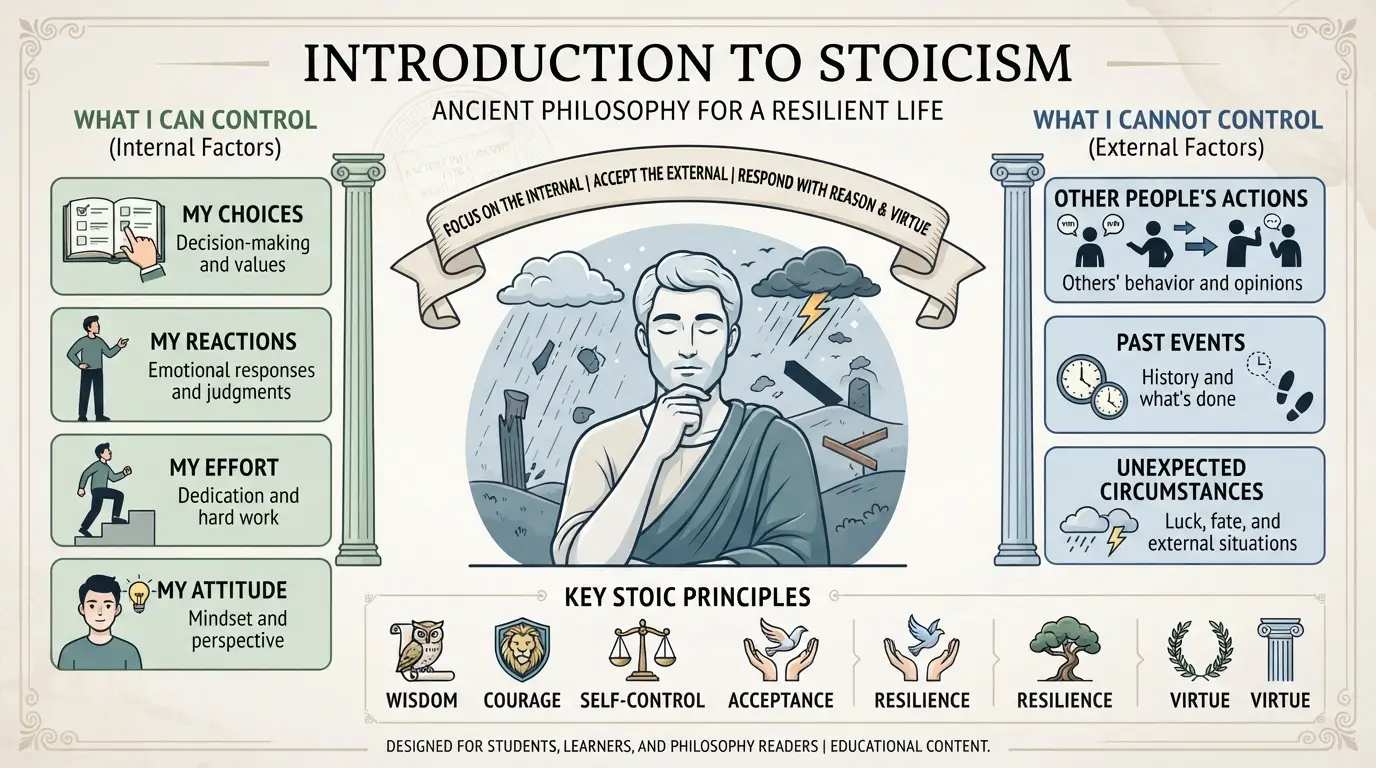
The philosophical meaning is broader. Ancient Stoicism taught that people should focus on what they can control and respond to circumstances with reason and virtue. The everyday meaning developed from this association with endurance and emotional restraint.
🧠 Connotative Meaning
Connotation (the feelings or associations that a word suggests beyond its basic dictionary meaning) can change how stoicism sounds in different situations.
Positive Tone
Stoicism can suggest courage, maturity, discipline, patience, strength, and the ability to remain calm during adversity.
Negative Tone
Sometimes stoicism can suggest emotional suppression, coldness, or refusing to express feelings when emotional expression would be healthy or appropriate.
Neutral Tone
In neutral writing, stoicism can simply describe a calm and controlled response to hardship without praising or criticizing the person.
📖 Etymology of Stoicism
The English word stoicism comes through Latin stoicus and ultimately from Greek stoikos, meaning “of a Stoic.” The word is connected with Stoa, a Greek word meaning “porch” or “portico.”
Zeno of Citium taught in the Stoa Poikile, or Painted Porch, in Athens. This location gave the philosophical school its name.
The noun stoicism entered English in the 17th century. Etymological records show its use in the 1620s for the teachings or principles of the Stoics and also for calm endurance or indifference toward pain and pleasure.
For an additional etymological reference, see Etymonline: Stoicism.
Old English: 450–1100
The modern noun stoicism was not an Old English word. However, the related name for Stoics appears in historical records as Stoices. This reflects the presence of knowledge of the philosophical school in earlier English usage.
Middle English: 1100–1500
During the Middle English period, forms such as Stoiciens were used for followers or teachers associated with Stoicism. The philosophical term gradually became part of the English intellectual vocabulary.
Modern English: 1500–Present
The modern sense expanded beyond the philosophical school. By the late 16th and early 17th centuries, stoic and stoicism could describe emotional restraint, patience, and the ability to endure pain without obvious distress.
🔊 Pronunciation
US: /ˈstoʊɪsɪzəm/
UK: /ˈstəʊɪsɪzəm/
Syllables
sto-i-cism
Affixation Pattern of Stoicism
Root: stoic
Prefix: none
Suffix: -ism, a suffix commonly used for a system, doctrine, practice, or characteristic.
The word can therefore be understood structurally as stoic + -ism.
Synonyms List
Not every word below is a perfect dictionary substitute for stoicism. Some are close synonyms, while others describe a specific part of the concept, such as emotional control, endurance, calmness, or inner strength. This distinction matters because replacing stoicism blindly can change the meaning.
1. Composure (Noun) — US: /kəmˈpoʊʒər/ | UK: /kəmˈpəʊʒə/
Meaning: Composure is the ability to stay calm and controlled, especially during stress.
Tone/Register: Neutral, professional, everyday.
Example: She maintained her composure during the difficult interview.
He lost his composure when the meeting became tense.
2. Equanimity (Noun) — US: /ˌiːkwəˈnɪməti/ | UK: /ˌekwəˈnɪməti/
Meaning: Equanimity means maintaining mental calm and balance during good or bad circumstances.
Tone/Register: Formal, academic.
Example: The manager handled the crisis with equanimity.
His equanimity impressed everyone in the room.
3. Self-Control (Noun) — US: /ˌself kənˈtroʊl/ | UK: /ˌself kənˈtrəʊl/
Meaning: Self-control is the ability to manage your emotions, impulses, or behavior.
Tone/Register: Neutral, everyday, educational.
Example: She used self-control instead of responding angrily.
Good self-control helped him finish the difficult task.
4. Calmness (Noun) — US: /ˈkɑːmnəs/ | UK: /ˈkɑːmnəs/
Meaning: Calmness is a peaceful state without excessive excitement, fear, or anger.
Tone/Register: Neutral, everyday.
Example: His calmness helped the children feel safe.
She answered the difficult question with calmness.
5. Serenity (Noun) — US: /səˈrenəti/ | UK: /səˈrenəti/
Meaning: Serenity describes a deep feeling of peace and freedom from agitation.
Tone/Register: Formal, literary, reflective.
Example: The quiet garden gave her a sense of serenity.
He spoke with surprising serenity after the setback.
6. Poise (Noun) — US: /pɔɪz/ | UK: /pɔɪz/
Meaning: Poise is confident calmness, especially in a challenging or public situation.
Tone/Register: Neutral, professional.
Example: The speaker answered every question with poise.
She showed great poise during the presentation.
7. Self-Possession (Noun) — US: /ˌself pəˈzeʃən/ | UK: /ˌself pəˈzeʃən/
Meaning: Self-possession is the ability to remain calm and in control of yourself.
Tone/Register: Formal, literary.
Example: His self-possession surprised his colleagues.
She retained her self-possession during the confrontation.
8. Fortitude (Noun) — US: /ˈfɔːrtətuːd/ | UK: /ˈfɔːtɪtjuːd/
Meaning: Fortitude is courage and mental strength when facing hardship.
Tone/Register: Formal, literary, academic.
Example: The patient showed remarkable fortitude.
Her fortitude helped her continue through the difficult period.
9. Resilience (Noun) — US: /rɪˈzɪliəns/ | UK: /rɪˈzɪliəns/
Meaning: Resilience is the ability to recover and continue after difficulty or failure.
Tone/Register: Neutral, professional, academic.
Example: His resilience helped him recover from the setback.
Children can develop resilience through challenging experiences.
10. Endurance (Noun) — US: /ɪnˈdʊrəns/ | UK: /ɪnˈdjʊərəns/
Meaning: Endurance is the ability to tolerate pain, difficulty, or prolonged effort.
Tone/Register: Neutral, formal.
Example: The long journey tested her endurance.
His endurance kept him working despite the obstacles.
11. Patience (Noun) — US: /ˈpeɪʃəns/ | UK: /ˈpeɪʃəns/
Meaning: Patience is the ability to wait or deal with difficulty without becoming annoyed.
Tone/Register: Neutral, everyday.
Example: Learning a language requires patience.
Her patience helped resolve the disagreement.
12. Restraint (Noun) — US: /rɪˈstreɪnt/ | UK: /rɪˈstreɪnt/
Meaning: Restraint means deliberately controlling your emotions, words, or actions.
Tone/Register: Neutral, formal, professional.
Example: He showed restraint during the heated discussion.
Her restraint prevented the argument from becoming worse.
13. Emotional Restraint (Noun Phrase) — US: /ɪˈmoʊʃənəl rɪˈstreɪnt/ | UK: /ɪˈməʊʃənəl rɪˈstreɪnt/
Meaning: Emotional restraint means limiting outward emotional reactions.
Tone/Register: Formal, psychological, academic.
Example: The situation required emotional restraint.
His emotional restraint was noticeable during the interview.
14. Impassivity (Noun) — US: /ɪmˌpæsˈɪvəti/ | UK: /ɪmˌpæsˈɪvəti/
Meaning: Impassivity is a lack of visible emotional reaction.
Tone/Register: Formal, literary.
Example: Her impassivity made the decision difficult to read.
He listened with complete impassivity.
15. Detachment (Noun) — US: /dɪˈtætʃmənt/ | UK: /dɪˈtætʃmənt/
Meaning: Detachment is emotional distance from a situation or personal reaction.
Tone/Register: Neutral, formal, academic.
Example: The writer examined the conflict with detachment.
Emotional detachment helped him make the decision calmly.
16. Dispassion (Noun) — US: /dɪˈspæʃən/ | UK: /dɪˈspæʃən/
Meaning: Dispassion means judging or responding without strong emotion.
Tone/Register: Formal, academic.
Example: The report analyzed the issue with dispassion.
She approached the disagreement with dispassion.
17. Sangfroid (Noun) — US: /sæŋˈfrwɑː/ | UK: /sɒŋˈfrwɑː/
Meaning: Sangfroid means remarkable calmness during a difficult or exciting situation.
Tone/Register: Formal, sophisticated.
Example: The pilot displayed impressive sangfroid.
His sangfroid helped everyone remain calm.
18. Coolness (Noun) — US: /ˈkuːlnəs/ | UK: /ˈkuːlnəs/
Meaning: Coolness can describe calm behavior when others are anxious or excited.
Tone/Register: Informal, neutral.
Example: Her coolness under pressure impressed the team.
He handled the sudden problem with coolness.
19. Collectedness (Noun) — US: /kəˈlektɪdnəs/ | UK: /kəˈlektɪdnəs/
Meaning: Collectedness means being calm, organized, and mentally controlled.
Tone/Register: Formal, less common.
Example: His collectedness helped him answer clearly.
She maintained her collectedness throughout the examination.
20. Aplomb (Noun) — US: /əˈplɑːm/ | UK: /əˈplɒm/
Meaning: Aplomb means confident and controlled behavior in a difficult situation.
Tone/Register: Formal, polished.
Example: She handled the criticism with aplomb.
He answered the unexpected question with aplomb.
21. Imperturbability (Noun) — US: /ˌɪmpərtərˈbɪləti/ | UK: /ˌɪmpəːtəˈbɪləti/
Meaning: Imperturbability is the quality of remaining calm despite disturbance.
Tone/Register: Very formal, literary.
Example: His imperturbability was remarkable during the emergency.
The leader responded with unusual imperturbability.
22. Unflappability (Noun) — US: /ˌʌnˈflæpəbɪləti/ | UK: /ˌʌnˈflæpəbɪləti/
Meaning: Unflappability is the ability to remain calm when something unexpected happens.
Tone/Register: Neutral, informal-professional.
Example: Her unflappability made her a reliable team leader.
He is known for his unflappability during busy events.
23. Self-Command (Noun) — US: /ˌself kəˈmænd/ | UK: /ˌself kəˈmɑːnd/
Meaning: Self-command means having strong control over your thoughts, emotions, and actions.
Tone/Register: Formal, literary.
Example: The situation demanded considerable self-command.
He demonstrated self-command instead of reacting impulsively.
24. Self-Mastery (Noun) — US: /ˌself ˈmæstəri/ | UK: /ˌself ˈmɑːstəri/
Meaning: Self-mastery is the ability to control your reactions and behavior through discipline.
Tone/Register: Formal, philosophical.
Example: Meditation can encourage self-mastery.
Her goal was greater self-mastery.
25. Emotional Control (Noun Phrase) — US: /ɪˈmoʊʃənəl kənˈtroʊl/ | UK: /ɪˈməʊʃənəl kənˈtrəʊl/
Meaning: Emotional control is the ability to manage emotional reactions appropriately.
Tone/Register: Neutral, educational, professional.
Example: Emotional control helped him stay focused.
The coach encouraged emotional control during the match.
26. Inner Strength (Noun Phrase) — US: /ˈɪnər streŋθ/ | UK: /ˈɪnə streŋθ/
Meaning: Inner strength describes mental or emotional strength that helps a person face adversity.
Tone/Register: Neutral, inspirational.
Example: She found inner strength after the disappointment.
His inner strength helped him remain hopeful.
27. Mental Toughness (Noun Phrase) — US: /ˈmentəl ˈtʌfnəs/ | UK: /ˈmentəl ˈtʌfnəs/
Meaning: Mental toughness is the ability to stay focused and steady under pressure.
Tone/Register: Informal, professional, sports-related.
Example: The athlete showed strong mental toughness.
Mental toughness helped her perform under pressure.
28. Hardiness (Noun) — US: /ˈhɑːrdinəs/ | UK: /ˈhɑːdinəs/
Meaning: Hardiness is the capacity to withstand difficult conditions.
Tone/Register: Formal, descriptive.
Example: The explorer’s hardiness impressed the entire group.
Years of outdoor work developed his hardiness.
29. Forbearance (Noun) — US: /fɔːrˈberəns/ | UK: /fɔːˈbeərəns/
Meaning: Forbearance means patiently controlling anger or choosing not to react harshly.
Tone/Register: Formal, literary.
Example: Her forbearance prevented a needless argument.
The teacher responded with patience and forbearance.
30. Perseverance (Noun) — US: /ˌpɜːrsəˈvɪrəns/ | UK: /ˌpɜːsɪˈvɪərəns/
Meaning: Perseverance is continued effort despite difficulty or delay.
Tone/Register: Neutral, academic, inspirational.
Example: His perseverance eventually led to success.
Learning to write well requires perseverance.
31. Grit (Noun) — US: /ɡrɪt/ | UK: /ɡrɪt/
Meaning: Grit means courage and determination to keep going through hardship.
Tone/Register: Informal, modern.
Example: She showed real grit during the competition.
Finishing the project required patience and grit.
32. Steadfastness (Noun) — US: /ˈstedfæstnəs/ | UK: /ˈstedfɑːstnəs/
Meaning: Steadfastness means remaining firm and committed despite difficulties.
Tone/Register: Formal, literary.
Example: His steadfastness inspired his colleagues.
She showed steadfastness when plans changed.
33. Constancy (Noun) — US: /ˈkɑːnstənsi/ | UK: /ˈkɒnstənsi/
Meaning: Constancy means remaining reliable, steady, or committed over time.
Tone/Register: Formal, literary.
Example: Her constancy gave the team confidence.
He valued constancy during uncertain times.
34. Resolve (Noun) — US: /rɪˈzɑːlv/ | UK: /rɪˈzɒlv/
Meaning: Resolve is firm determination to deal with a challenge or achieve a goal.
Tone/Register: Neutral, formal.
Example: She faced the problem with resolve.
His resolve never disappeared during the long project.
35. Discipline (Noun) — US: /ˈdɪsəplɪn/ | UK: /ˈdɪsəplɪn/
Meaning: Discipline is controlled behavior guided by rules, goals, or deliberate practice.
Tone/Register: Neutral, professional, academic.
Example: Daily writing requires discipline.
His discipline helped him control his reactions.
36. Moderation (Noun) — US: /ˌmɑːdəˈreɪʃən/ | UK: /ˌmɒdəˈreɪʃən/
Meaning: Moderation means avoiding extremes in behavior, emotion, or action.
Tone/Register: Formal, neutral.
Example: She responded with moderation rather than anger.
Moderation can make difficult discussions more productive.
37. Acceptance (Noun) — US: /əkˈseptəns/ | UK: /əkˈseptəns/
Meaning: Acceptance is recognizing a situation as it is rather than constantly resisting its reality.
Tone/Register: Neutral, reflective.
Example: Acceptance helped him move forward.
She reached acceptance after a long period of reflection.
38. Calm Resolve (Noun Phrase) — US: /kɑːm rɪˈzɑːlv/ | UK: /kɑːm rɪˈzɒlv/
Meaning: Calm resolve combines emotional steadiness with firm determination.
Tone/Register: Neutral, formal.
Example: She approached the challenge with calm resolve.
His calm resolve reassured the team.
39. Tranquility (Noun) — US: /træŋˈkwɪləti/ | UK: /træŋˈkwɪləti/
Meaning: Tranquility describes a peaceful and undisturbed state of mind or surroundings.
Tone/Register: Neutral, literary.
Example: The quiet room created a feeling of tranquility.
He searched for tranquility after a stressful week.
40. Stability (Noun) — US: /stəˈbɪləti/ | UK: /stəˈbɪləti/
Meaning: Stability refers to steadiness and resistance to sudden emotional or behavioral change.
Tone/Register: Neutral, professional, academic.
Example: Her emotional stability helped her manage the pressure.
The team needed stability during the transition.
Synonyms of Stoicism by Tone
Positive: Composure
Composure, equanimity, fortitude, resilience, poise, self-possession, inner strength, resolve, steadfastness, and mental toughness often carry positive associations.
They can highlight admirable qualities such as courage, maturity, confidence, or persistence.
Neutral: Calmness
Calmness, self-control, restraint, emotional control, acceptance, stability, patience, and moderation can be relatively neutral.
The surrounding sentence determines whether the quality sounds positive or simply descriptive.
Negative or Potentially Negative: Detachment
Detachment, impassivity, and emotional restraint can sound negative when they suggest excessive distance from feelings.
For example, “He showed emotional restraint” sounds different from “He seemed emotionally detached.”
Playful or Informal: Grit
Grit, coolness, and mental toughness are more conversational.
They work especially well in modern discussions about sports, work, personal challenges, and everyday resilience.
Why Tone Matters in Word Choice
Choosing a synonym is not simply about finding a word with a similar dictionary definition.
For example, fortitude emphasizes courage during hardship. Composure emphasizes calm behavior. Resilience focuses on recovery after difficulty. Self-control focuses on managing reactions.
Using the right word makes your writing more accurate and natural.
“Stoicism” vs Close Alternatives
Composure vs Stoicism
- Stoicism suggests enduring hardship with controlled emotion and can also refer to a philosophical tradition.
- Composure focuses more directly on staying calm and collected during a specific situation.
- Use stoicism when discussing endurance or a broader attitude toward hardship. Use composure when describing someone’s immediate behavior.
Stoicism vs Resilience
- Stoicism emphasizes calm acceptance and emotional control.
- Resilience emphasizes recovering, adapting, and continuing after difficulty.
- A person can be resilient without appearing emotionally restrained.
Stoicism vs Self-Control
- Stoicism can describe a general approach to adversity.
- Self-control specifically describes the ability to manage impulses, emotions, or behavior.
- A student might show self-control by not interrupting a classmate. Someone might show stoicism while calmly enduring a painful setback.
How Stoicism Changes by Context
Daily Conversation
In everyday speech, stoicism often describes someone who remains calm when life becomes difficult.
For casual conversation, simpler words such as calmness, self-control, patience, or composure may sound more natural.
Writing or Blogging
Bloggers can use stoicism when discussing emotional resilience, personal development, philosophy, or responses to adversity.
Using alternatives such as resilience, inner strength, and self-mastery can make explanations more specific.
Professional or Academic Tone
Formal writing may benefit from terms such as equanimity, fortitude, dispassion, self-command, or emotional restraint.
The best choice depends on whether the writer is emphasizing calmness, courage, objectivity, or emotional regulation.
Creative or Informal Use
Creative writing can use sangfroid, aplomb, coolness, or grit to create a stronger personality or atmosphere.
These words can make descriptions more vivid than repeatedly using stoicism.
Common Mistakes Learners Make
Mistake 1: Treating Every Synonym as Identical
Words such as resilience, composure, and fortitude overlap with stoicism, but they do not mean the same thing.
Mistake 2: Using Stoicism for Any Kind of Calmness
A person relaxing on a quiet beach is calm, but calling that experience stoicism would usually sound inappropriate.
Stoicism is more strongly associated with responding to difficulty, pressure, pain, or adversity.
Mistake 3: Confusing Stoicism With Emotional Emptiness
Stoicism does not simply mean having no emotions.
In ordinary English, it usually suggests controlled emotional expression. In its philosophical sense, Stoicism involves a broader system of ethical thought.
Mistake 4: Using Formal Synonyms in Casual Speech
Words such as equanimity, imperturbability, and forbearance are correct but can sound formal.
In everyday conversation, calmness, self-control, or composure may be more natural.
Mistake 5: Overusing Stoicism
Repeating stoicism throughout an article can make the writing feel monotonous.
Strategic use of related words can improve vocabulary variety without changing the central meaning.
Register Notes
Formal English
Use equanimity, fortitude, forbearance, dispassion, and imperturbability in formal or academic contexts.
Everyday English
Use calmness, self-control, patience, composure, and resilience for ordinary communication.
Professional English
Poise, composure, self-control, emotional control, and mental toughness can work well in workplace writing.
Literary English
Serenity, sangfroid, constancy, steadfastness, and tranquility can add a more expressive style.
For related vocabulary, an internal vocabulary article about emotional-control terms can also help readers expand their word choices.
Real-Life Mini Scenarios
Workplace Scenario
A manager discovers a serious mistake before an important deadline.
Instead of blaming someone immediately, she takes a breath, reviews the problem, and organizes the next steps. Her behavior demonstrates composure, self-control, and possibly stoicism.
Social Scenario
A friend receives disappointing news at a gathering but avoids creating a scene.
Her calm response may be described as restraint, poise, or emotional control.
Media and Pop Culture Scenario
A fictional hero remains calm while everyone around them panics.
A writer might describe the character as showing sangfroid, unflappability, or mental toughness.
Writing and Storytelling Scenario
A novelist wants to show that a character has survived years of hardship without losing determination.
Words such as fortitude, resilience, steadfastness, and inner strength may communicate that idea more precisely than simply repeating stoicism.
Practice Quiz
1. Which word best describes staying calm during a stressful interview?
A. Composure
B. Confusion
C. Excitement
D. Carelessness
2. Which synonym emphasizes recovery after hardship?
A. Resilience
B. Tranquility
C. Moderation
D. Detachment
3. Which word is most formal and academic?
A. Grit
B. Coolness
C. Equanimity
D. Calmness
4. Which term focuses on controlling impulses and reactions?
A. Self-control
B. Serenity
C. Endurance
D. Tranquility
5. Which word describes courage during severe hardship?
A. Fortitude
B. Coolness
C. Stability
D. Acceptance
6. Which word means peacefulness or a deep sense of calm?
A. Serenity
B. Resolve
C. Grit
D. Restraint
7. Which synonym best fits a confident speaker who handles difficult questions calmly?
A. Poise
B. Endurance
C. Acceptance
D. Hardiness
8. Which word emphasizes continuing despite difficulty?
A. Perseverance
B. Tranquility
C. Detachment
D. Impassivity
9. Which term can suggest emotional distance?
A. Detachment
B. Patience
C. Fortitude
D. Resolve
10. Which informal word suggests courage and determination?
A. Grit
B. Equanimity
C. Forbearance
D. Dispassion
11. Which word means deliberate control of emotions or actions?
A. Restraint
B. Serenity
C. Tranquility
D. Hardiness
12. Which word is especially suitable for a person who remains calm during an unexpected crisis?
A. Unflappability
B. Sadness
C. Hesitation
D. Anxiety
13. Which synonym emphasizes firm determination?
A. Resolve
B. Calmness
C. Detachment
D. Serenity
14. Which word describes remaining committed over time?
A. Constancy
B. Impassivity
C. Coolness
D. Acceptance
15. Which term best describes calm behavior combined with confidence?
A. Aplomb
B. Endurance
C. Moderation
D. Hardiness
Reflection Task
Write one original sentence using resilience, composure, fortitude, self-control, or equanimity. Then explain why your chosen synonym fits the situation.
Answer Key: 1-A | 2-A | 3-C | 4-A | 5-A | 6-A | 7-A | 8-A | 9-A | 10-A | 11-A | 12-A | 13-A | 14-A | 15-A
FAQs
1. What is the closest synonym for stoicism in everyday English?
Composure is one of the closest everyday alternatives when you mean remaining calm under pressure. However, it does not carry every meaning of stoicism. Stoicism can suggest enduring hardship or controlling emotional reactions as part of a broader attitude, while composure usually focuses on calm behavior in a particular situation.
2. Is resilience the same as stoicism?
Not exactly. Resilience describes the ability to recover, adapt, and continue after adversity. Stoicism emphasizes calm endurance and controlled responses to difficult circumstances. Someone can be resilient while openly expressing emotions, whereas everyday descriptions of stoicism often emphasize emotional restraint.
3. What is a formal synonym for stoicism?
Equanimity, fortitude, dispassion, and imperturbability are formal alternatives, depending on the intended meaning. Equanimity focuses on mental balance, fortitude emphasizes courage during hardship, and dispassion emphasizes freedom from strong emotional influence.
4. What is an informal synonym for stoicism?
Grit, coolness, and mental toughness can work in informal or modern contexts. Grit emphasizes determination, while coolness focuses on staying calm. Mental toughness is especially common in discussions about sports, performance, work, and challenging goals.
5. Can stoicism have a negative meaning?
Yes. In some contexts, stoicism can suggest excessive emotional suppression or an unwillingness to express feelings. The meaning depends on context. When you want to praise calm strength, words such as fortitude or composure may sound more clearly positive.
6. Is stoicism always related to the ancient philosophy?
No. Stoicism has both a philosophical and an everyday meaning. The philosophical sense refers to the ancient school of thought associated with Stoic thinkers. In ordinary modern English, stoicism often describes calm endurance or emotional restraint without referring specifically to the philosophy.
7. Which synonym of stoicism is best for academic writing?
The best choice depends on your intended meaning. Equanimity works for mental balance, fortitude for courage under hardship, dispassion for objective judgment, and self-control for regulation of emotions or behavior. Choosing the precise term is better than treating all synonyms as interchangeable.
8. How can learning synonyms of stoicism improve English?
Learning related words helps you express small differences in meaning. Instead of repeatedly writing stoicism, you can choose composure for calmness, resilience for recovery, fortitude for courage, or self-control for emotional regulation. This makes essays, blogs, emails, and conversations more precise.
Conclusion
Learning synonyms of stoicism helps you describe calmness, endurance, courage, and emotional control with greater precision. Each alternative adds a different shade to your writing.
For students and writers, words like composure, resilience, and fortitude can make essays and articles clearer. They also make everyday communication more natural.
For bloggers and content writers, varied vocabulary prevents repetition while keeping the original idea clear. Choosing the right synonym can make a sentence feel more polished.
Start practicing these words in emails, essays, stories, and daily conversations. Choose one synonym each day and create your own sentence to build stronger vocabulary.

Mehtab Yasir is a passionate writer and English language enthusiast dedicated to making vocabulary learning simple, practical, and enjoyable. As an author at SynonymDesk.com, she creates helpful content covering synonyms, antonyms, word meanings, vocabulary, phrases, and everyday English usage. Her goal is to provide clear and easy-to-understand information that helps students, writers, professionals, and English learners choose the right words and communicate with greater confidence. Mehtab believes that a strong vocabulary can improve both writing and communication skills. She enjoys researching new words, exploring their meanings and uses, and turning complex language concepts into useful, reader-friendly content. Through her work, she strives to make SynonymDesk.com a reliable resource for anyone looking to improve their English vocabulary and language skills.