Synonyms of infringed include violated, breached, transgressed, contravened, encroached, and overstepped. These words describe actions that break rules, interfere with rights, or cross established boundaries. The best alternative depends on context. For example, violated suits legal rights, while encroached describes interference with someone’s space, freedom, or authority.
Imagine a company using someone’s photograph without permission. The photographer claims that the company infringed their copyright.
A student may also infringe school rules without realizing it. Understanding synonyms of infringed helps explain such situations with greater accuracy.
The word often appears in legal reports, academic writing, and news articles. Students, bloggers, and content writers benefit from knowing its alternatives.
Learning synonyms of infringed also improves everyday English. It helps you discuss personal boundaries, workplace policies, and individual rights clearly.
What Does Infringed Really Mean?
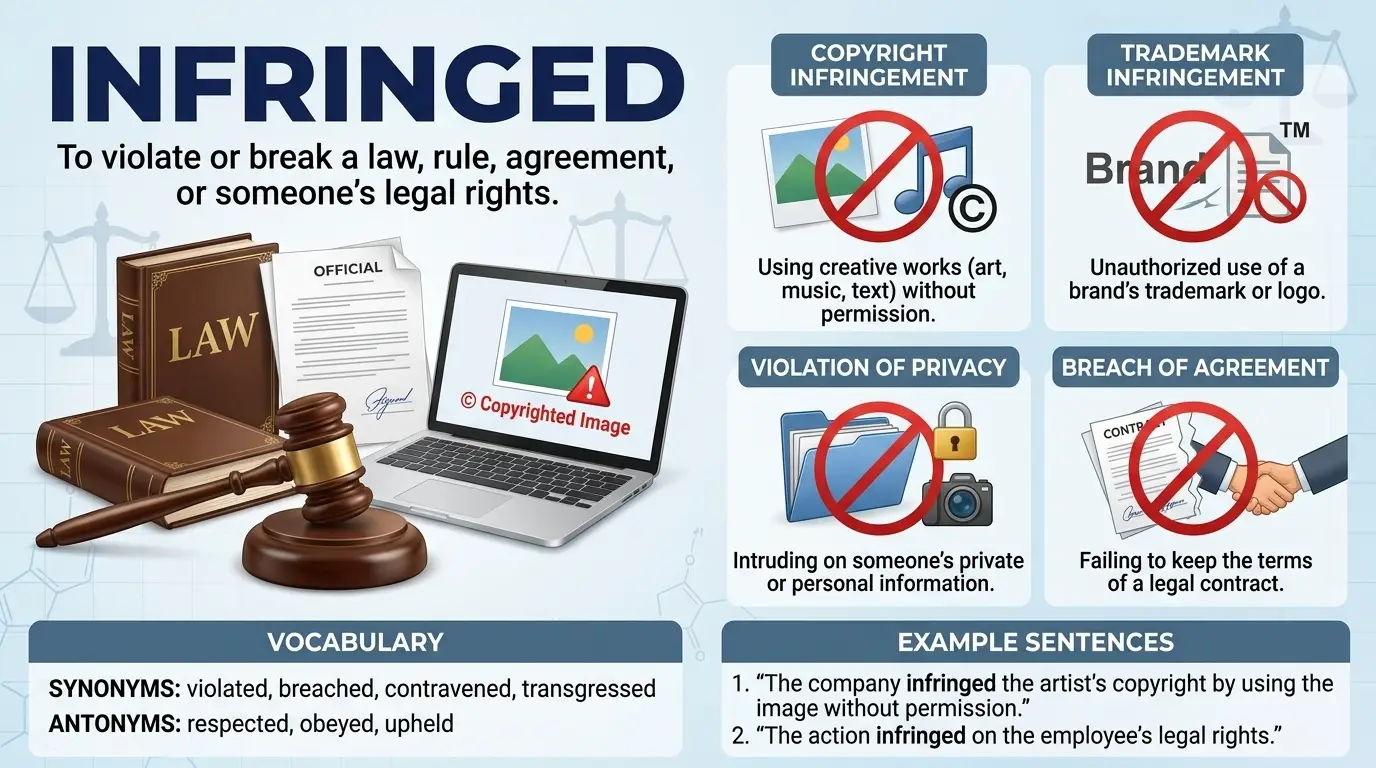
Infringed means breaking a rule, violating a right, or interfering with something that belongs to another person.
It commonly describes actions that go against laws, agreements, permissions, or established boundaries.
For example:
- The company infringed the artist’s copyright.
- The new policy infringed upon workers’ privacy.
- His actions infringed on her personal freedom.
Native English speakers usually understand infringed as a serious or formal word. It suggests that an accepted limit has been crossed.
Part of Speech
Infringed is the simple past tense and past participle of the verb infringe.
Its meaning changes slightly depending on the sentence structure.
Infringed (Verb)
To have broken a rule, violated a protected right, or interfered with an established boundary.
Example 1: The manufacturer infringed an existing patent.
Example 2: The restrictions infringed upon their freedom.
Common Grammatical Patterns
The word appears in three common structures:
- Infringed a right
- Infringed on someone’s freedom
- Infringed upon an established privilege
The first structure is especially common in legal English.
The second and third often describe interference with someone’s rights, freedom, or personal interests.
Connotative Meaning of Infringed
(Connotation is the emotional or cultural meaning a word suggests beyond its basic dictionary definition.)
The word infringed generally carries a negative meaning. However, its emotional strength depends on the situation.
Positive Tone
Infringed rarely has a positive meaning.
However, describing an infringement can support a positive goal, such as protecting someone’s rights.
Example: The court protected the inventor after the company infringed her patent.
Negative Tone
This is the most common tone.
It suggests misconduct, unauthorized interference, or disrespect for established boundaries.
Example: The organization infringed upon the privacy of its employees.
Neutral Tone
The word can sound neutral when describing an alleged or established legal issue without expressing personal judgment.
Example: The report examined whether the software infringed an existing patent.
Here, the writer presents a question rather than an emotional accusation.
Etymology of Infringed
The verb infringe comes from the Latin word infringere, meaning to break, weaken, or damage.
It combines in- with frangere, meaning to break.
The original idea of breaking something gradually developed into the modern meaning of breaking a rule or violating a right.
Old English (450–1100)
The modern word infringe was not part of ordinary Old English vocabulary.
People expressed related ideas through native words associated with breaking laws, promises, or agreements.
Middle English (1100–1500)
The term entered English during the later Middle English period through Latin and French influence.
Its early meanings involved breaking, weakening, or violating established obligations.
Modern English (1500–Present)
The word became increasingly associated with laws, rights, privileges, and formal restrictions.
Today, infringed is particularly common in intellectual property law, journalism, business policies, and academic discussions.
Pronunciation of Infringed
American English (US)
IPA: /ɪnˈfrɪndʒd/
British English (UK)
IPA: /ɪnˈfrɪndʒd/
Both varieties generally use the same pronunciation.
The main stress falls on the second syllable.
Syllables
in-fringed
Total syllables: 2
The final -ed does not create an additional syllable.
Affixation Pattern of Infringed
Root
Fring-
Historically related to the Latin verb frangere, meaning to break.
Prefix
In-
A historical Latin prefix forming part of infringere. It should not be interpreted as the ordinary negative prefix meaning not.
Suffix
-ed
A grammatical ending that forms the past tense and past participle of regular verbs.
Word Formation
Infringe + -ed = Infringed
Related forms include:
- Infringe — base verb
- Infringes — third-person singular
- Infringing — present participle
- Infringement — noun
- Infringer — noun describing someone who infringes
40 Synonyms of Infringed With Meanings and Examples
The following alternatives cover legal violations, broken agreements, unauthorized interference, and crossed boundaries.
Not every word is interchangeable in every sentence. Some describe direct violations, while others express a specific type of infringement.
Choose according to the action, object, and intended tone.
1. Violated (Verb) — US /ˈvaɪəleɪtɪd/ | UK /ˈvaɪəleɪtɪd/
Meaning: Broke a law, rule, agreement, or protected right.
Tone/Register: Formal, legal, negative.
Example 1: The employer violated several workplace safety regulations.
Example 2: Sharing those records violated the patient’s privacy.
2. Breached (Verb) — US /briːtʃt/ | UK /briːtʃt/
Meaning: Failed to respect an agreement, obligation, rule, or established boundary.
Tone/Register: Formal, business, legal.
Example 1: The supplier breached its contract with the retailer.
Example 2: The employee breached the company’s confidentiality policy.
3. Contravened (Verb) — US /ˌkɑːntrəˈviːnd/ | UK /ˌkɒntrəˈviːnd/
Meaning: Acted against a law, regulation, or official requirement.
Tone/Register: Highly formal, legal, academic.
Example 1: The decision contravened existing environmental regulations.
Example 2: Their advertising practices contravened consumer protection laws.
4. Transgressed (Verb) — US /trænzˈɡrest/ | UK /trænzˈɡrest/
Meaning: Went beyond an accepted moral, social, or legal limit.
Tone/Register: Formal, literary, negative.
Example 1: The official transgressed the ethical boundaries of his position.
Example 2: Her actions transgressed the organization’s established code.
5. Encroached (Verb) — US /ɪnˈkroʊtʃt/ | UK /ɪnˈkrəʊtʃt/
Meaning: Gradually interfered with another person’s space, rights, or freedom.
Tone/Register: Formal, descriptive.
Example 1: The construction project encroached on neighboring property.
Example 2: Extra surveillance encroached upon employees’ privacy.
6. Overstepped (Verb) — US /ˌoʊvərˈstept/ | UK /ˌəʊvəˈstept/
Meaning: Went beyond acceptable limits or personal authority.
Tone/Register: Neutral to formal, critical.
Example 1: The supervisor overstepped his authority during the meeting.
Example 2: The committee overstepped its assigned responsibilities.
7. Disobeyed (Verb) — US /ˌdɪsəˈbeɪd/ | UK /ˌdɪsəˈbeɪd/
Meaning: Failed to follow an instruction, rule, or command.
Tone/Register: Everyday, neutral to negative.
Example 1: The driver disobeyed the posted traffic instructions.
Example 2: Several participants disobeyed the event’s safety rules.
8. Defied (Verb) — US /dɪˈfaɪd/ | UK /dɪˈfaɪd/
Meaning: Openly resisted or refused to follow an authority or restriction.
Tone/Register: Strong, sometimes dramatic.
Example 1: The developer defied the city’s building restrictions.
Example 2: The protesters defied the official gathering ban.
9. Disregarded (Verb) — US /ˌdɪsrɪˈɡɑːrdɪd/ | UK /ˌdɪsrɪˈɡɑːdɪd/
Meaning: Ignored a rule, right, instruction, or established expectation.
Tone/Register: Neutral, professional.
Example 1: The manager disregarded the employee’s contractual rights.
Example 2: The publisher disregarded the photographer’s licensing conditions.
10. Flouted (Verb) — US /ˈflaʊtɪd/ | UK /ˈflaʊtɪd/
Meaning: Openly or deliberately ignored a rule or accepted standard.
Tone/Register: Formal, strongly negative.
Example 1: The factory flouted important environmental restrictions.
Example 2: The contractor repeatedly flouted workplace safety requirements.
11. Trespassed (Verb) — US /ˈtrespæst/ | UK /ˈtrespɑːst/
Meaning: Entered property without permission or interfered with another person’s protected space.
Tone/Register: Legal, everyday.
Example 1: The visitors trespassed on privately owned farmland.
Example 2: The hikers accidentally trespassed beyond the marked boundary.
12. Intruded (Verb) — US /ɪnˈtruːdɪd/ | UK /ɪnˈtruːdɪd/
Meaning: Entered or interfered with someone’s space, privacy, or affairs without being welcome.
Tone/Register: Everyday, descriptive.
Example 1: The reporter intruded on the family’s private gathering.
Example 2: Unexpected questions intruded upon her personal life.
13. Invaded (Verb) — US /ɪnˈveɪdɪd/ | UK /ɪnˈveɪdɪd/
Meaning: Entered or interfered with someone’s territory, privacy, or protected space.
Tone/Register: Strong, negative.
Example 1: The unauthorized recording invaded their privacy.
Example 2: The group invaded an area reserved for residents.
14. Exceeded (Verb) — US /ɪkˈsiːdɪd/ | UK /ɪkˈsiːdɪd/
Meaning: Went beyond an established limit, permission, or level of authority.
Tone/Register: Neutral, professional.
Example 1: The officer exceeded the authority granted by the policy.
Example 2: The company exceeded its permitted data collection limits.
15. Disrupted (Verb) — US /dɪsˈrʌptɪd/ | UK /dɪsˈrʌptɪd/
Meaning: Interrupted an activity or interfered with its normal operation.
Tone/Register: Neutral, professional.
Example 1: The unauthorized protest disrupted the scheduled proceedings.
Example 2: Repeated interruptions disrupted the residents’ peaceful enjoyment of their homes.
Usage note: Disrupted emphasizes the effect of interference rather than a legal violation itself.
16. Impinged (Verb) — US /ɪmˈpɪndʒd/ | UK /ɪmˈpɪndʒd/
Meaning: Had an unwanted effect on someone’s rights, freedom, or interests.
Tone/Register: Formal, academic.
Example 1: The restrictions impinged on individual freedom.
Example 2: The proposed changes impinged upon existing property rights.
17. Usurped (Verb) — US /juːˈsɜːrpt/ | UK /juːˈzɜːpt/
Meaning: Took authority, power, or a position without having a legitimate right to it.
Tone/Register: Formal, political, legal.
Example 1: The administrator usurped powers reserved for the board.
Example 2: The temporary leader usurped the director’s authority.
18. Misappropriated (Verb) — US /ˌmɪsəˈproʊprieɪtɪd/ | UK /ˌmɪsəˈprəʊprieɪtɪd/
Meaning: Used another person’s money, property, or resources without proper authorization.
Tone/Register: Formal, financial, legal.
Example 1: The accountant misappropriated funds from the charity.
Example 2: The employee misappropriated confidential company resources.
19. Pirated (Verb) — US /ˈpaɪrətɪd/ | UK /ˈpaɪrətɪd/
Meaning: Copied or distributed protected creative material without authorization.
Tone/Register: Digital, legal, everyday.
Example 1: The website pirated several independent films.
Example 2: Someone pirated the musician’s latest album.
20. Plagiarized (Verb) — US /ˈpleɪdʒəraɪzd/ | UK /ˈpleɪdʒəraɪzd/
Meaning: Presented another person’s words or ideas as one’s own without proper acknowledgment.
Tone/Register: Academic, professional.
Example 1: The student plagiarized sections of a published essay.
Example 2: The blogger plagiarized another writer’s original research.
Usage note: Plagiarism and copyright infringement can overlap, but they are not identical.
21. Counterfeited (Verb) — US /ˈkaʊntərfɪtɪd/ | UK /ˈkaʊntəfɪtɪd/
Meaning: Illegitimately imitated something genuine, often violating protected commercial rights.
Tone/Register: Legal, commercial.
Example 1: The manufacturer counterfeited a registered luxury brand’s products.
Example 2: Investigators discovered that the workshop counterfeited official labels.
22. Appropriated (Verb) — US /əˈproʊprieɪtɪd/ | UK /əˈprəʊprieɪtɪd/
Meaning: Took or used something for one’s own purposes, sometimes without permission.
Tone/Register: Formal, academic.
Example 1: The agency improperly appropriated land belonging to residents.
Example 2: The designer appropriated another artist’s protected artwork without consent.
23. Exploited (Verb) — US /ɪkˈsplɔɪtɪd/ | UK /ɪkˈsplɔɪtɪd/
Meaning: Used another person’s rights, work, or resources unfairly for personal benefit.
Tone/Register: Professional, negative.
Example 1: The company exploited the author’s work without authorization.
Example 2: The organization exploited workers despite established labor protections.
24. Undermined (Verb) — US /ˌʌndərˈmaɪnd/ | UK /ˌʌndəˈmaɪnd/
Meaning: Weakened someone’s rights, authority, or established position.
Tone/Register: Formal, professional.
Example 1: The policy undermined protections for temporary employees.
Example 2: Unauthorized decisions undermined the committee’s authority.
25. Compromised (Verb) — US /ˈkɑːmprəmaɪzd/ | UK /ˈkɒmprəmaɪzd/
Meaning: Put something valuable, protected, or confidential at risk.
Tone/Register: Business, technical.
Example 1: The security failure compromised customers’ private information.
Example 2: Unauthorized access compromised the integrity of the records.
26. Interfered (Verb) — US /ˌɪntərˈfɪrd/ | UK /ˌɪntəˈfɪəd/
Meaning: Unnecessarily or improperly became involved in another person’s rights, activities, or affairs.
Tone/Register: Neutral, everyday.
Example 1: The new restrictions interfered with residents’ property rights.
Example 2: Management interfered with the employees’ lawful activities.
27. Obstructed (Verb) — US /əbˈstrʌktɪd/ | UK /əbˈstrʌktɪd/
Meaning: Blocked or prevented the proper exercise of a right or permitted activity.
Tone/Register: Formal, legal.
Example 1: The security team obstructed lawful access to the building.
Example 2: The restrictions obstructed citizens’ ability to exercise their rights.
28. Restricted (Verb) — US /rɪˈstrɪktɪd/ | UK /rɪˈstrɪktɪd/
Meaning: Placed limits on someone’s actions, freedom, or permitted activities.
Tone/Register: Neutral, administrative.
Example 1: The policy improperly restricted employees’ freedom of expression.
Example 2: The regulations restricted access to public information.
29. Curtailed (Verb) — US /kɜːrˈteɪld/ | UK /kɜːˈteɪld/
Meaning: Reduced or limited an existing right, freedom, or opportunity.
Tone/Register: Formal, journalistic.
Example 1: The emergency order curtailed certain civil liberties.
Example 2: The new rules curtailed workers’ existing privileges.
30. Trampled (Verb) — US /ˈtræmpəld/ | UK /ˈtræmpəld/
Meaning: Treated someone’s rights or freedoms with serious disregard.
Tone/Register: Strong, emotional, figurative.
Example 1: The authorities trampled on the residents’ basic rights.
Example 2: The decision trampled upon established democratic freedoms.
31. Disrespected (Verb) — US /ˌdɪsrɪˈspektɪd/ | UK /ˌdɪsrɪˈspektɪd/
Meaning: Failed to show proper regard for another person’s boundaries, rights, or wishes.
Tone/Register: Everyday, negative.
Example 1: The visitor disrespected the family’s request for privacy.
Example 2: His behavior disrespected her clearly stated boundaries.
32. Crossed (Verb) — US /krɔːst/ | UK /krɒst/
Meaning: Went beyond a permitted, expected, or acceptable boundary.
Tone/Register: Everyday, informal.
Example 1: The interviewer crossed a professional boundary.
Example 2: The developer crossed the legally defined property line.
33. Encumbered (Verb) — US /ɪnˈkʌmbərd/ | UK /ɪnˈkʌmbəd/
Meaning: Burdened property, rights, or activities with restrictions or obligations.
Tone/Register: Formal, legal.
Example 1: The unauthorized claim encumbered the owner’s property rights.
Example 2: Additional obligations encumbered the tenant’s existing privileges.
Usage note: Encumbered describes a burden or restriction. It does not automatically establish an infringement.
34. Impaired (Verb) — US /ɪmˈperd/ | UK /ɪmˈpeəd/
Meaning: Weakened the proper use or enjoyment of a right, ability, or protected interest.
Tone/Register: Formal, legal, academic.
Example 1: The policy impaired the residents’ ability to access their homes.
Example 2: Unauthorized changes impaired the owner’s property rights.
35. Jeopardized (Verb) — US /ˈdʒepərdaɪzd/ | UK /ˈdʒepədaɪzd/
Meaning: Put someone’s rights, interests, or protected position in danger.
Tone/Register: Professional, serious.
Example 1: The unauthorized disclosure jeopardized the witness’s privacy.
Example 2: The company’s conduct jeopardized its customers’ legal protections.
36. Displaced (Verb) — US /dɪˈspleɪst/ | UK /dɪˈspleɪst/
Meaning: Removed someone from an established position, place, or entitlement.
Tone/Register: Formal, descriptive.
Example 1: The unlawful development displaced several property owners.
Example 2: The new arrangement improperly displaced existing contractual rights.
37. Abrogated (Verb) — US /ˈæbrəɡeɪtɪd/ | UK /ˈæbrəɡeɪtɪd/
Meaning: Formally abolished or ended an established law, agreement, or right.
Tone/Register: Highly formal, legal.
Example 1: The decree abrogated several existing legal protections.
Example 2: The administration unlawfully abrogated the workers’ contractual rights.
38. Circumvented (Verb) — US /ˌsɜːrkəmˈventɪd/ | UK /ˌsɜːkəmˈventɪd/
Meaning: Avoided a rule, restriction, or requirement through an indirect method.
Tone/Register: Formal, business, legal.
Example 1: The business circumvented the licensing requirements.
Example 2: The developer circumvented restrictions on protected software.
39. Infracted (Verb) — US /ɪnˈfræktɪd/ | UK /ɪnˈfræktɪd/
Meaning: Broke a rule or committed an infraction.
Tone/Register: Rare, formal, specialized.
Example 1: The participant was reported to have infracted the competition rules.
Example 2: The official stated that the athlete had infracted a specific regulation.
Usage note: This verb is uncommon in modern English. Native speakers usually prefer violated, breached, or broke.
40. Broken (Verb: Past Participle) — US /ˈbroʊkən/ | UK /ˈbrəʊkən/
Meaning: Failed to obey or respect a rule, law, promise, or agreement.
Tone/Register: Everyday, neutral.
Example 1: The organization had broken several important regulations.
Example 2: The agreement was broken when confidential information was shared.
Usage note: Broken is the past participle of break. Use broke when a simple past-tense replacement is required.
Synonyms for Infringed by Tone
Tone matters because two words can describe similar actions while creating different impressions.
Legal documents usually require precise language. Everyday conversations often benefit from simpler alternatives.
Positive or Rights-Protective Context
The act of infringement is generally negative. However, these words can appear in discussions about protecting rights:
- Restricted
- Curtailed
- Impaired
- Interfered
Example: The court examined whether the policy improperly restricted freedom of expression.
These alternatives help describe the issue without assuming the final legal outcome.
Neutral Tone
These alternatives work well in factual reports and professional explanations:
- Exceeded
- Crossed
- Disrupted
- Encumbered
- Displaced
- Compromised
They can describe an effect without automatically suggesting deliberate wrongdoing.
Negative Tone
Use these words when the context clearly involves misconduct or unauthorized action:
- Violated
- Breached
- Contravened
- Transgressed
- Encroached
- Overstepped
- Defied
- Disregarded
- Flouted
- Trespassed
- Intruded
- Invaded
- Impinged
- Usurped
- Misappropriated
- Pirated
- Plagiarized
- Counterfeited
- Appropriated
- Exploited
- Undermined
- Obstructed
- Trampled
- Jeopardized
- Abrogated
- Circumvented
The exact strength depends on the surrounding sentence.
Playful or Informal Tone
Infringement is usually a serious subject. Still, informal expressions can make everyday discussions sound natural.
Suitable alternatives include:
- Crossed
- Broken
- Disrespected
- Overstepped
Example: You really crossed the line by reading my messages!
This wording sounds more conversational than a formal statement about privacy infringement.
Infringed vs Close Alternatives
Three especially useful alternatives are violated, breached, and encroached.
Although they share a central idea, their meanings are not identical.
| Word | Main Difference | Tone | Best Context |
|---|---|---|---|
| Infringed | Interfered with a right or broke a protected restriction | Formal | Copyright, patents, legal rights |
| Violated | Broke a law, rule, right, or principle | Strong | Privacy, regulations, human rights |
| Breached | Failed to follow an agreement or obligation | Professional | Contracts, policies, confidentiality |
| Encroached | Gradually interfered with another person’s space or freedom | Descriptive | Property, authority, personal boundaries |
Infringed vs Violated
Infringed is particularly suitable when discussing protected rights.
Violated has a broader meaning and often sounds more forceful.
Compare:
The company infringed the photographer’s copyright.
The company violated the photographer’s legal rights.
Both sentences work, but the first identifies the specific type of legal issue more precisely.
Infringed vs Breached
Use breached when someone fails to meet an agreement or obligation.
Use infringed when someone interferes with a protected right.
Compare:
The supplier breached its contract.
The supplier infringed a competitor’s trademark rights.
Infringed vs Encroached
Encroached often suggests gradual interference.
Infringed can describe a single unauthorized action.
Compare:
The building encroached on neighboring land.
The manufacturer infringed an existing patent.
How Infringed Changes by Context
The meaning of infringed becomes clearer when you consider where it appears.
Different settings require different levels of formality and precision.
Daily Conversation
People rarely use infringed in casual speech unless they are discussing a serious issue.
They usually prefer simpler alternatives.
Formal: You infringed upon my personal privacy.
Natural: You crossed a personal boundary.
Writing or Blogging
Bloggers often discuss digital rights, online privacy, and unauthorized content use.
Useful alternatives include violated, pirated, plagiarized, and misappropriated.
Example: The website infringed the creator’s copyright by reproducing protected material without permission.
The precise word depends on what happened.
Professional or Academic Writing
Formal writing benefits from accurate distinctions.
A researcher may discuss infringed rights, breached agreements, or contravened regulations.
Example: The investigation examined whether the proposed restrictions infringed upon established constitutional protections.
Avoid replacing technical legal language merely to create variety.
Creative or Informal Writing
Creative writing allows more emotional alternatives.
Words such as invaded, trampled, and overstepped can strengthen a scene.
Example: He had invaded her peaceful world without asking permission.
Here, invaded creates a stronger emotional image than infringed.
Common Mistakes Learners Make
Mistake 1: Using Infringed for Every Broken Rule
Not every rule-breaking situation requires infringed.
Less natural: She infringed the classroom instruction.
Better: She disobeyed the classroom instruction.
Use infringed when discussing rights, laws, or protected boundaries.
Mistake 2: Confusing Infringed With Inflicted
These words sound somewhat similar but have different meanings.
Infringed means violated or interfered with something protected.
Inflicted means caused something unpleasant to happen.
Correct: The company infringed the inventor’s patent.
Correct: The accident inflicted serious damage.
Mistake 3: Confusing Infringed With Infringement
Infringed is a verb form.
Infringement is a noun.
Correct: The business infringed the registered trademark.
Correct: The business faced an infringement claim.
Mistake 4: Using Encroached Without the Correct Preposition
Encroached usually requires on or upon when describing interference.
Incorrect: The construction encroached their land.
Correct: The construction encroached on their land.
Mistake 5: Treating Every Synonym as Interchangeable
A company can breach a contract and infringe a patent.
However, pirated is not a natural replacement for every type of infringement.
Always consider the object of the verb.
Native Usage and Register Notes
Formal English
Common formal choices include:
- Infringed
- Contravened
- Breached
- Impinged
- Transgressed
These words frequently appear in professional, legal, and academic writing.
Informal English
Everyday speakers usually prefer:
- Broke
- Crossed
- Disrespected
- Overstepped
For example, someone might say, “You crossed the line,” rather than “You infringed upon my rights.”
Spoken vs Written English
In spoken English, violated is usually easier to understand than contravened.
Written legal English often favors infringed because it can identify interference with a specific protected right.
Writers interested in related vocabulary can also explore synonyms of intruding to understand the difference between unwanted entry and the violation of established rights.
Real-Life Examples Using Infringed
Workplace Scenario
A manager shares confidential employee information without permission.
Sentence: The manager infringed upon the employee’s privacy by sharing personal records.
Alternative: The manager violated the employee’s privacy.
Social Situation
Someone reads a friend’s private messages without asking.
Sentence: His behavior infringed upon her personal privacy.
Alternative: He crossed an important personal boundary.
Media and Pop Culture
A content creator uploads a protected film without authorization.
Sentence: The creator infringed the studio’s copyright.
Alternative: The creator pirated the film.
Writing and Storytelling
A character gradually influences another person’s decisions.
Sentence: His growing influence infringed upon her independence.
Alternative: His controlling behavior encroached on her personal freedom.
Interactive Practice Quiz
Choose the most suitable answer for each situation.
Part One: Meaning and Word Choice
1. A company uses a protected logo without authorization. Which word best describes the action?
A) Celebrated
B) Infringed
C) Improved
D) Supported
2. An employee fails to follow a confidentiality agreement. Which alternative fits best?
A) Breached
B) Encouraged
C) Protected
D) Created
3. A manager gradually interferes with another department’s responsibilities. Which word is most suitable?
A) Pirated
B) Praised
C) Encroached
D) Restored
4. A business openly ignores environmental regulations. Which word expresses deliberate disregard?
A) Followed
B) Appreciated
C) Accepted
D) Flouted
5. A supervisor acts beyond the limits of their authority. Which word fits?
A) Respected
B) Overstepped
C) Improved
D) Assisted
6. Someone copies an author’s essay and presents it as original work. Which word applies?
A) Plagiarized
B) Protected
C) Published
D) Reviewed
Part Two: Tone and Context
7. Which word is especially suitable for breaking a contractual obligation?
A) Invaded
B) Praised
C) Breached
D) Celebrated
8. Which alternative suggests gradual interference with personal freedom?
A) Encroached
B) Completed
C) Protected
D) Explained
9. Which word describes taking another person’s authority without a legitimate right?
A) Assisted
B) Encouraged
C) Supported
D) Usurped
10. Which sentence uses infringed correctly?
A) She infringed her breakfast.
B) The manufacturer infringed an existing patent.
C) He infringed a beautiful painting.
D) They infringed the sunny weather.
11. Which word is most suitable for entering private property without permission?
A) Improved
B) Protected
C) Trespassed
D) Encouraged
12. A government measure weakens an existing legal protection. Which word emphasizes weakening?
A) Undermined
B) Celebrated
C) Created
D) Praised
13. Which alternative is most natural in casual conversation about personal boundaries?
A) Contravened
B) Abrogated
C) Misappropriated
D) Crossed
14. Which word means avoiding a restriction through an indirect method?
A) Respected
B) Circumvented
C) Supported
D) Strengthened
15. Which word best describes unauthorized copying and distribution of protected films?
A) Protected
B) Improved
C) Pirated
D) Explained
Answer Key
1-B | 2-A | 3-C | 4-D | 5-B | 6-A | 7-C | 8-A | 9-D | 10-B | 11-C | 12-A | 13-D | 14-B | 15-C
Reflection and Application Task
Write one original sentence using any synonym from this article.
Choose a workplace, educational, social, or legal situation.
Then explain why your chosen word fits better than infringed.
This small exercise will help you develop stronger judgment about vocabulary.
Suggested External Reference
For additional vocabulary verification, consult the Cambridge Dictionary.
It provides definitions, British and American pronunciation, grammatical information, and authentic usage examples.
Reference: https://dictionary.cambridge.org/dictionary/english/infringe
This resource can help readers distinguish infringe, infringement, and related vocabulary in formal English.
Conclusion
Learning synonyms of infringed helps you describe broken rules, crossed boundaries, and violated rights with confidence. Every alternative adds a useful shade of meaning.
Strong vocabulary makes essays, blogging, and professional writing more precise. Choosing the right expression also helps readers understand your intended message.
These words can improve everyday speaking and communication. They help you explain difficult situations without sounding repetitive, confusing, or overly formal.
Keep practicing synonyms of infringed in emails, essays, and daily conversations. Try one new expression each day and notice how naturally your vocabulary grows.
FAQs
1. What is another word for infringed in a copyright dispute?
Violated is one of the closest alternatives to infringed in a copyright dispute. However, copied without permission may be clearer for general readers.
The word pirated is appropriate when someone unlawfully copies or distributes protected creative material. Use plagiarized only when the situation involves presenting someone else’s work or ideas as one’s own.
2. Can infringed be used when no physical damage has occurred?
Yes. Infringement does not require physical damage. It commonly involves interference with intangible rights, such as copyright, privacy, patents, or freedom of expression.
For example, unauthorized reproduction of protected software may constitute copyright infringement even when the original software remains unchanged. The issue concerns the protected right rather than physical destruction.
3. What is the difference between infringed and alleged infringement?
Infringed can describe a completed violation. Alleged infringement refers to a claim that has not necessarily been established.
This distinction matters in journalism and legal reporting. If a dispute remains unresolved, saying that a company allegedly infringed a patent is more careful than presenting the accusation as a confirmed legal finding.
4. Is infringed suitable for describing someone’s emotional boundaries?
Yes, although it usually sounds formal in personal conversations.
You might write, “His constant interference infringed upon her personal freedom.” However, everyday speakers would probably say, “He crossed her boundaries.”
The second expression sounds more natural when discussing friendships, family relationships, or uncomfortable social situations.
5. What is the best synonym for infringed in academic writing?
The strongest choice depends on the subject.
Use contravened for regulations, breached for agreements, violated for rights, and impinged upon for unwanted interference.
Academic writers should prioritize precision over variety. Replacing every occurrence of infringed with a different word can accidentally change the meaning of an argument.
6. Can a person accidentally infringe someone’s rights?
Yes. An infringement may occur without deliberate wrongdoing, depending on the applicable law and circumstances.
For example, someone might reproduce copyrighted material without realizing that permission is required. Lack of awareness does not automatically eliminate legal responsibility.
Words such as flouted and defied suggest deliberate resistance, so they are unsuitable when the action was genuinely accidental.
7. Should I write infringed on or infringed upon?
Both expressions are grammatically acceptable.
Infringed on is common in modern English, while infringed upon can sound slightly more formal.
For example, “The restrictions infringed on their freedom” and “The restrictions infringed upon their freedom” are both natural.
In legal contexts, the verb can also take a direct object, as in “The company infringed the patent.”
8. What is the opposite of infringed when discussing legal rights?
Suitable opposites include respected, upheld, protected, and honored.
The best choice depends on the sentence. A company may respect intellectual property rights, while a court may uphold constitutional protections.
For example, instead of saying that an organization infringed employee rights, you could say that it respected and protected those rights.

Mehtab Yasir is a passionate writer and English language enthusiast dedicated to making vocabulary learning simple, practical, and enjoyable. As an author at SynonymDesk.com, she creates helpful content covering synonyms, antonyms, word meanings, vocabulary, phrases, and everyday English usage. Her goal is to provide clear and easy-to-understand information that helps students, writers, professionals, and English learners choose the right words and communicate with greater confidence. Mehtab believes that a strong vocabulary can improve both writing and communication skills. She enjoys researching new words, exploring their meanings and uses, and turning complex language concepts into useful, reader-friendly content. Through her work, she strives to make SynonymDesk.com a reliable resource for anyone looking to improve their English vocabulary and language skills.