Synonyms of quashed include suppressed, crushed, defeated, overturned, annulled, nullified, revoked, dismissed, silenced, quelled, and thwarted. The best synonym depends on whether something was stopped, defeated, rejected, or legally canceled.
Synonyms of quashed become useful when a writer wants to avoid repeating the same word. Imagine a court quashing a decision or a manager quashing a harmful rumor.
Learning synonyms of quashed helps students choose precise words. Bloggers and content writers can also make explanations more natural and varied.
The word is common in legal, political, social, and everyday English. Knowing its alternatives helps daily speakers express ideas with greater confidence.
For students, writers, and English learners, synonyms of quashed offer useful choices for essays, articles, reports, conversations, and professional communication.
What Does “Quashed” Really Mean?
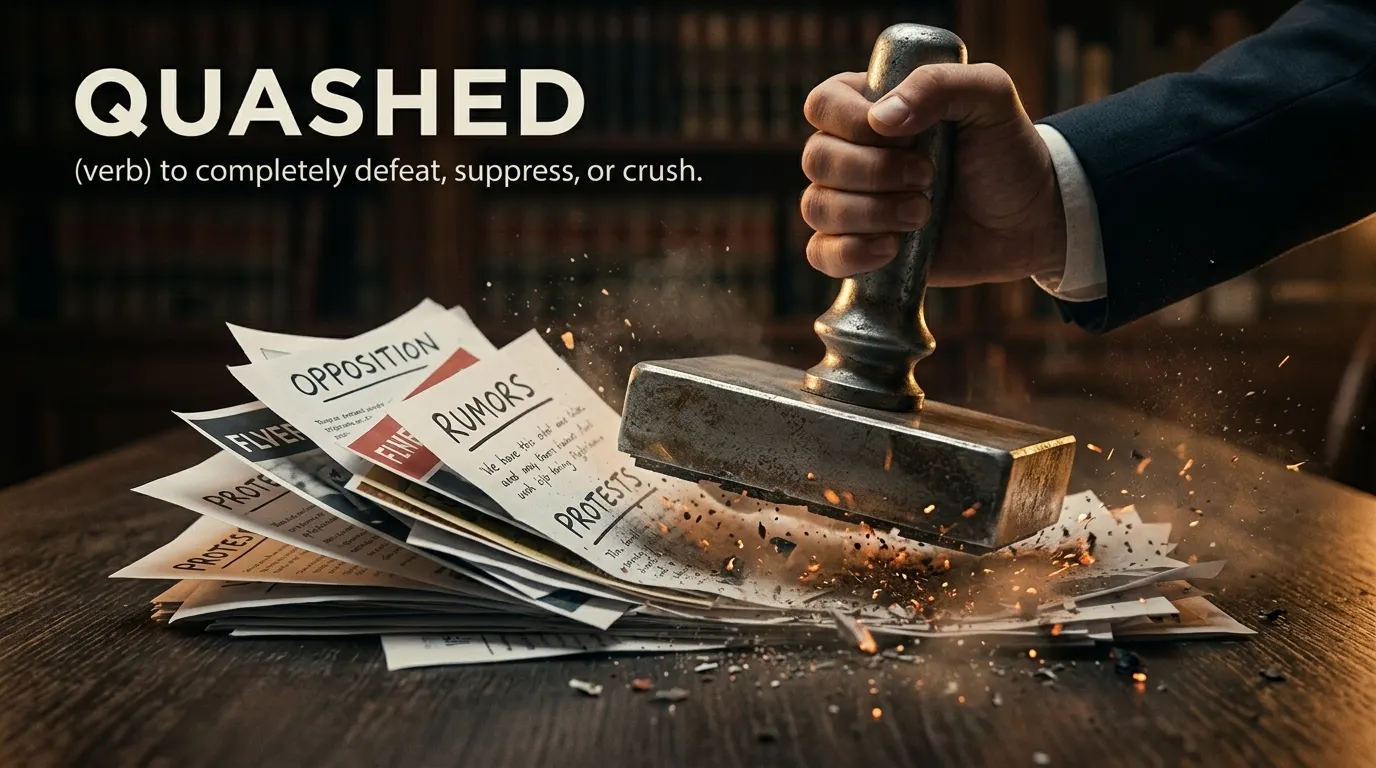
Quashed is the past tense and past participle of quash. It generally means to stop, defeat, suppress, cancel, or officially reject something.
In simple English, if something is quashed, it is brought to an end or made ineffective.
The exact meaning depends on context. A court can quash a conviction. A government can quash a rebellion. A person can quash a rumor. A team can quash an opponent’s hopes.
Native speakers often associate quash with decisive action. It suggests that something was stopped firmly rather than merely delayed.
The word is especially common in legal, political, journalistic, and formal writing.
Part of Speech: Verb, used here as the past tense and past participle of quash.
Simple definition: To stop, suppress, defeat, or officially cancel something.
Connotative Meaning
Connotation (the feeling or association a word carries beyond its basic dictionary meaning) can change how a sentence sounds.
Positive Tone
When quashed describes a harmful plan, rumor, threat, or conflict, it can have a positive effect.
The false rumor was quickly quashed.
Negative Tone
When it describes protest, criticism, freedom, or opposition, quashed can suggest harsh control.
The authorities quashed the peaceful protest.
Neutral Tone
In legal writing, quashed can be relatively neutral.
The appeal court quashed the earlier ruling.
Etymology of “Quashed”
The verb quash entered English through Anglo-French and Old French forms related to the idea of crushing, breaking, or suppressing. It is ultimately connected with Latin quatere, meaning “to shake.”
Over time, the physical idea of crushing developed into figurative meanings such as suppressing opposition, stopping an activity, and defeating an argument.
Old English: 450–1100
The modern word quash was not a standard Old English verb in its present form. Its later French influence had not yet entered English vocabulary. Old English used native Germanic words for ideas such as crushing, breaking, and defeating.
Middle English: 1100–1500
During Middle English, French vocabulary strongly influenced English after the Norman Conquest. Forms related to quash entered English and developed meanings connected with crushing, breaking, and suppressing.
Modern English: 1500–Present
In Modern English, quash expanded into several important senses. It can describe physically crushing something, suppressing opposition, defeating an idea, or officially setting aside a legal decision.
Pronunciation
US: /kwɑːʃt/
UK: /kwɒʃt/
Syllables
quashed
It is a one-syllable word.
Affixation Pattern of “Quashed”
Root: quash
Prefix: none
Suffix: -ed, marking the past tense and past participle
Synonyms List
The following alternatives are numbered for easy reference. Each one has a specific shade of meaning, so they should not be treated as perfectly interchangeable in every sentence.
1. Suppressed (verb) — US /səˈprest/ — UK /səˈprest/
Meaning: To stop something from developing, spreading, or being expressed.
Tone/Register: Formal, political, academic
Example:
The authorities suppressed the violent uprising.
The report suppressed important information.
2. Crushed (verb) — US /krʌʃt/ — UK /krʌʃt/
Meaning: To defeat something or someone completely.
Tone/Register: Strong, everyday
Example:
The new evidence crushed his argument.
The team crushed its strongest rival.
3. Defeated (verb) — US /dɪˈfiːtɪd/ — UK /dɪˈfiːtɪd/
Meaning: To successfully overcome an opponent, plan, or attempt.
Tone/Register: Neutral
Example:
The players defeated their opponents.
Her evidence defeated the proposed claim.
4. Overturned (verb) — US /ˌoʊvərˈtɜːrnd/ — UK /ˌəʊvəˈtɜːnd/
Meaning: To officially reverse a previous decision, judgment, or ruling.
Tone/Register: Legal, formal
Example:
The higher court overturned the conviction.
The board overturned the earlier decision.
5. Annulled (verb) — US /əˈnʌld/ — UK /əˈnʌld/
Meaning: To officially declare something legally invalid.
Tone/Register: Formal, legal
Example:
The court annulled the agreement.
The marriage was later annulled.
6. Nullified (verb) — US /ˈnʌləˌfaɪd/ — UK /ˈnʌlɪfaɪd/
Meaning: To make something legally or practically ineffective.
Tone/Register: Formal, academic
Example:
The new rule nullified the previous restriction.
The error nullified the agreement.
7. Revoked (verb) — US /rɪˈvoʊkt/ — UK /rɪˈvəʊkt/
Meaning: To officially withdraw permission, authority, or a decision.
Tone/Register: Formal, administrative
Example:
The agency revoked his license.
The permit was revoked after an inspection.
8. Dismissed (verb) — US /dɪˈmɪst/ — UK /dɪˈmɪst/
Meaning: To reject, remove, or decide that something should not continue.
Tone/Register: Neutral to formal
Example:
The judge dismissed the case.
She dismissed the complaint as unfounded.
9. Silenced (verb) — US /ˈsaɪlənd/ — UK /ˈsaɪlənd/
Meaning: To stop someone or something from speaking, expressing an opinion, or being heard.
Tone/Register: Neutral, sometimes critical
Example:
The new policy silenced several critics.
She refused to let fear silence her voice.
10. Quelled (verb) — US /kweld/ — UK /kweld/
Meaning: To bring a disturbance, protest, fear, or conflict under control.
Tone/Register: Formal
Example:
The police quelled the disturbance.
The announcement quelled public fears.
11. Subdued (verb) — US /səˈduːd/ — UK /səˈdjuːd/
Meaning: To bring something or someone under control.
Tone/Register: Formal
Example:
Security officers subdued the attacker.
The response quickly subdued the growing tension.
12. Thwarted (verb) — US /θwɔːrtɪd/ — UK /θwɔːtɪd/
Meaning: To prevent someone from achieving a plan or goal.
Tone/Register: Formal, literary
Example:
The police thwarted the robbery.
Bad weather thwarted our travel plans.
13. Stopped (verb) — US /stɑːpt/ — UK /stɒpt/
Meaning: To bring an activity or process to an end.
Tone/Register: Everyday
Example:
The manager stopped the argument.
Heavy rain stopped the outdoor event.
14. Halted (verb) — US /ˈhɔːltɪd/ — UK /ˈhɔːltɪd/
Meaning: To make something stop, often suddenly.
Tone/Register: Formal, business
Example:
The company halted production.
The project was halted after the inspection.
15. Prevented (verb) — US /prɪˈventɪd/ — UK /prɪˈventɪd/
Meaning: To stop something from happening.
Tone/Register: Neutral
Example:
The warning prevented a serious accident.
Quick action prevented the problem from spreading.
16. Blocked (verb) — US /blɑːkt/ — UK /blɒkt/
Meaning: To stop movement, progress, access, or development.
Tone/Register: Everyday, business
Example:
The proposal was blocked by the committee.
A technical issue blocked the payment.
17. Abolished (verb) — US /əˈbɑːlɪʃt/ — UK /əˈbɒlɪʃt/
Meaning: To officially end a system, practice, or institution.
Tone/Register: Formal, political
Example:
The government abolished the outdated law.
The policy was abolished after years of criticism.
18. Rescinded (verb) — US /rɪˈsɪndɪd/ — UK /rɪˈsɪndɪd/
Meaning: To officially cancel or withdraw a decision, offer, or agreement.
Tone/Register: Formal, legal, business
Example:
The company rescinded the offer.
The organization rescinded its earlier statement.
19. Invalidated (verb) — US /ɪnˈvæləˌdeɪtɪd/ — UK /ɪnˈvælɪdeɪtɪd/
Meaning: To make something no longer legally or logically acceptable.
Tone/Register: Academic, formal
Example:
The missing evidence invalidated the conclusion.
The court invalidated the regulation.
20. Reversed (verb) — US /rɪˈvɜːrst/ — UK /rɪˈvɜːst/
Meaning: To change an earlier decision, judgment, or policy to its opposite.
Tone/Register: Formal, legal
Example:
The appeal court reversed the ruling.
The company reversed its earlier decision.
21. Overruled (verb) — US /ˌoʊvərˈruːld/ — UK /ˌəʊvəˈruːld/
Meaning: To reject or officially change a previous decision or objection.
Tone/Register: Legal, formal
Example:
The judge overruled the objection.
The higher court overruled the earlier judgment.
22. Struck down (phrasal verb) — US /strʌk daʊn/ — UK /strʌk daʊn/
Meaning: To officially declare a law or rule invalid.
Tone/Register: Legal, journalistic
Example:
The court struck down the regulation.
Judges struck down the controversial law.
23. Canceled (verb) — US /ˈkænsəld/ — UK /ˈkænsəld/
Meaning: To decide that something planned or arranged will not happen.
Tone/Register: Everyday
Example:
They canceled the meeting.
The event was canceled because of the storm.
24. Terminated (verb) — US /ˈtɜːrməˌneɪtɪd/ — UK /ˈtɜːmɪneɪtɪd/
Meaning: To formally bring something to an end.
Tone/Register: Formal, business
Example:
The contract was terminated early.
The company terminated the agreement.
25. Extinguished (verb) — US /ɪkˈstɪŋɡwɪʃt/ — UK /ɪkˈstɪŋɡwɪʃt/
Meaning: To completely end something such as a hope, right, or possibility.
Tone/Register: Formal, literary
Example:
The defeat extinguished their hopes.
The ruling extinguished the remaining claim.
26. Eradicated (verb) — US /ɪˈrædəˌkeɪtɪd/ — UK /ɪˈrædɪkeɪtɪd/
Meaning: To completely remove something harmful.
Tone/Register: Formal, academic
Example:
The campaign helped eradicate the disease.
The program targeted corruption to eradicate it.
27. Eliminated (verb) — US /ɪˈlɪməˌneɪtɪd/ — UK /ɪˈlɪmɪneɪtɪd/
Meaning: To remove or defeat something completely.
Tone/Register: Neutral, professional
Example:
The update eliminated several errors.
The team eliminated its rivals from the tournament.
28. Suppressed (verb) — US /səˈprest/ — UK /səˈprest/
Meaning: To prevent information, feelings, activity, or opposition from being openly expressed.
Tone/Register: Formal
Example:
She suppressed her anger during the meeting.
The regime suppressed independent reporting.
29. Squelched (verb) — US /skweltʃt/ — UK /skweltʃt/
Meaning: To stop something quickly, especially a rumor, protest, or attempt.
Tone/Register: Informal, journalistic
Example:
The spokesperson squelched the rumor.
The announcement squelched speculation about delays.
30. Crushed out (phrasal verb) — US /krʌʃt aʊt/ — UK /krʌʃt aʊt/
Meaning: To completely suppress or remove something.
Tone/Register: Informal
Example:
The new rules crushed out the old practice.
The victory crushed out any remaining doubt.
31. Subjugated (verb) — US /ˈsʌbdʒəˌɡeɪtɪd/ — UK /ˈsʌbdʒʊɡeɪtɪd/
Meaning: To bring people or a group under control by force.
Tone/Register: Formal, historical
Example:
The empire subjugated neighboring regions.
The population resisted being subjugated.
32. Conquered (verb) — US /ˈkɑːŋkərd/ — UK /ˈkɒŋkəd/
Meaning: To defeat and gain control over an opponent or territory.
Tone/Register: Historical, formal
Example:
The army conquered the region.
She conquered her fear of public speaking.
33. Overpowered (verb) — US /ˌoʊvərˈpaʊərd/ — UK /ˌəʊvəˈpaʊəd/
Meaning: To defeat someone or something through greater strength or force.
Tone/Register: Neutral
Example:
The larger team overpowered its opponent.
The firefighters overpowered the flames.
34. Neutralized (verb) — US /ˈnuːtrəˌlaɪzd/ — UK /ˈnjuːtrəlaɪzd/
Meaning: To make a threat or harmful force ineffective.
Tone/Register: Formal, technical
Example:
The security team neutralized the threat.
The treatment neutralized the harmful chemical.
35. Defused (verb) — US /diːˈfjuːzd/ — UK /diːˈfjuːzd/
Meaning: To reduce tension or prevent a situation from becoming worse.
Tone/Register: Everyday, professional
Example:
The manager defused the argument.
Her calm response defused the tension.
36. Deterred (verb) — US /dɪˈtɜːrd/ — UK /dɪˈtɜːd/
Meaning: To discourage someone from taking a particular action.
Tone/Register: Formal
Example:
The fine deterred further violations.
The warning deterred him from repeating the mistake.
37. Discouraged (verb) — US /dɪˈskɜːrɪdʒd/ — UK /dɪˈskʌrɪdʒd/
Meaning: To make someone less willing to continue an action.
Tone/Register: Neutral
Example:
The setback discouraged the team.
The criticism discouraged her from applying again.
38. Disproved (verb) — US /ˌdɪsˈpruːvd/ — UK /ˌdɪsˈpruːvd/
Meaning: To show that an idea, claim, or belief is not true.
Tone/Register: Academic, formal
Example:
The experiment disproved the theory.
New evidence disproved the original claim.
39. Refuted (verb) — US /rɪˈfjuːtɪd/ — UK /rɪˈfjuːtɪd/
Meaning: To prove that an argument or statement is wrong.
Tone/Register: Academic, formal
Example:
The researcher refuted the claim.
Her evidence refuted the accusation.
40. Rejected (verb) — US /rɪˈdʒektɪd/ — UK /rɪˈdʒektɪd/
Meaning: To refuse to accept an idea, request, proposal, or claim.
Tone/Register: Neutral
Example:
The committee rejected the proposal.
The editor rejected the first draft.
41. Denied (verb) — US /dɪˈnaɪd/ — UK /dɪˈnaɪd/
Meaning: To refuse to grant or accept something.
Tone/Register: Neutral, formal
Example:
The court denied the request.
The company denied the allegation.
42. Disallowed (verb) — US /ˌdɪsəˈlaʊd/ — UK /ˌdɪsəˈlaʊd/
Meaning: To officially say that something is not permitted.
Tone/Register: Formal, rules-based
Example:
The referee disallowed the goal.
The judge disallowed the evidence.
43. Barred (verb) — US /bɑːrd/ — UK /bɑːd/
Meaning: To officially prevent someone from entering, participating, or doing something.
Tone/Register: Formal
Example:
The player was barred from the competition.
The rule barred employees from sharing private data.
44. Prohibited (verb) — US /proʊˈhɪbɪtɪd/ — UK /prəˈhɪbɪtɪd/
Meaning: To officially forbid something.
Tone/Register: Formal, legal
Example:
The law prohibited the practice.
The policy prohibits unauthorized access.
45. Banned (verb) — US /bænd/ — UK /bænd/
Meaning: To officially prevent something from being used, done, or allowed.
Tone/Register: Neutral
Example:
The school banned the unsafe device.
The platform banned the account.
46. Curbbed (verb) — US /kɜːrbd/ — UK /kɜːbd/
Meaning: To control or reduce something undesirable.
Tone/Register: Business, formal
Example:
The new rule curbed excessive spending.
The campaign curbed unnecessary waste.
47. Contained (verb) — US /kənˈteɪnd/ — UK /kənˈteɪnd/
Meaning: To prevent a problem or situation from spreading.
Tone/Register: Professional, neutral
Example:
Doctors contained the outbreak quickly.
The team contained the damage.
48. Arrested (verb) — US /əˈrestɪd/ — UK /əˈrestɪd/
Meaning: To stop a process or development, especially suddenly.
Tone/Register: Formal
Example:
The policy arrested the decline.
The intervention arrested further damage.
49. Stifled (verb) — US /ˈstaɪfəld/ — UK /ˈstaɪfəld/
Meaning: To prevent something from developing, being expressed, or becoming successful.
Tone/Register: Formal, expressive
Example:
Fear stifled her creativity.
The policy stifled public discussion.
50. Suppressed completely (verb phrase) — US /səˈprest kəmˈpliːtli/ — UK /səˈprest kəmˈpliːtli/
Meaning: To stop something so thoroughly that little or none of it remains active.
Tone/Register: Formal, emphatic
Example:
The emergency team suppressed the fire completely.
The campaign suppressed the rumor completely.
Synonyms of Quashed by Tone
Tone matters because two words can have similar dictionary meanings but create very different impressions.
Positive or Protective
Prevented, quelled, defused, contained, curbed, eliminated
These choices work well when something harmful was stopped.
Neutral
Stopped, halted, rejected, dismissed, defeated, canceled, blocked
These words are useful when you want a straightforward description without strong emotion.
Negative or Forceful
Crushed, silenced, suppressed, subjugated, overpowered, stifled
These words can suggest pressure, force, restriction, or loss of freedom.
Legal or Official
Overturned, annulled, nullified, revoked, rescinded, invalidated, reversed, overruled, struck down
These are especially useful when discussing courts, laws, contracts, decisions, or official actions.
Informal or Conversational
Stopped, squelched, crushed, blocked, canceled
These sound more natural in everyday conversation than highly technical legal terms.
“Quashed” vs Close Alternatives
Quashed vs Suppressed
The Quashed often suggests decisive stopping or defeating. Suppressed focuses more on preventing something from being expressed, spreading, or continuing.
Use quashed for a rebellion, ruling, plan, or rumor. Use suppressed for information, speech, emotions, or opposition.
Quashed vs Overturned
Overturned is especially appropriate for decisions, judgments, and rulings. Quashed can also be legal, but it has a broader sense of stopping or defeating something.
The court overturned the ruling sounds specifically legal. The authorities quashed the uprising does not.
Quashed vs Dismissed
Dismissed often means rejecting a case, claim, complaint, or idea. Quashed usually implies that something was decisively stopped, canceled, or invalidated.
The two can overlap in legal contexts, but they should not automatically replace one another.
How “Quashed” Changes by Context
Daily Conversation
In casual speech, people often prefer simpler alternatives such as stopped, canceled, defeated, or blocked.
Instead of saying, “The plan was quashed,” a speaker might say, “The plan was stopped.”
Writing or Blogging
Quashed can make writing more precise and energetic. It works well in news articles, opinion pieces, educational content, and historical writing.
For variety, writers can alternate it with suppressed, thwarted, halted, or defeated when the meaning remains accurate.
Professional or Academic English
Formal alternatives such as nullified, invalidated, overturned, and refuted may be more precise in professional or academic contexts.
The correct choice depends on what was actually stopped or changed.
Creative or Informal English
Creative writers may choose crushed, silenced, stifled, or extinguished to create stronger imagery.
These choices can make a sentence feel more emotional without changing its central idea.
Common Mistakes Learners Make
Mistake 1: Using “Quashed” for Every Type of Cancellation
Quashed is not always the natural substitute for canceled. A canceled birthday party is usually not described as “quashed.”
Mistake 2: Confusing “Quashed” With “Refuted”
To refute something means to prove an argument or claim wrong. To quash something means to stop, suppress, defeat, or invalidate it.
Mistake 3: Using Legal Synonyms in Casual Speech
Words such as annulled, rescinded, and invalidated can sound unnecessarily formal in everyday conversation.
Mistake 4: Ignoring the Object
Native speakers choose the synonym based on what is being stopped.
A court overturns a ruling.
A government quells unrest.
A person dismisses an idea.
Evidence refutes a claim.
Native Usage Tip
Think about the object first. Ask: Is it a law, argument, rumor, protest, plan, threat, decision, or physical force? Then select the synonym that naturally belongs with that object.
Register Notes
Formal: annulled, nullified, rescinded, invalidated, overturned, overruled
Neutral: stopped, rejected, defeated, dismissed, blocked, prevented
Informal: squelched, crushed, stopped, blocked
Strong or expressive: crushed, silenced, stifled, extinguished
For related vocabulary, an internal article on synonyms of suppressed can help readers compare closely related expressions.
Real-Life Mini Scenarios
Workplace
A manager may quash a false rumor about layoffs. In a softer workplace context, dismissed or corrected may sound more natural.
Social Situations
Someone might quash an argument before it becomes serious. In everyday speech, defused is often the friendlier choice.
Media and Pop Culture
News reports may say that authorities quashed a protest or thwarted a planned attack. The vocabulary often reflects the seriousness of the event.
Writing and Storytelling
A novelist might write that a character’s hopes were crushed or extinguished. These choices create a stronger emotional effect than the neutral word stopped.
Practice Quiz
1. The court ______ the earlier conviction after reviewing new evidence.
A. crushed
B. overturned
C. squelched
D. curbed
2. The spokesperson quickly ______ the false rumor.
A. annulled
B. revoked
C. squelched
D. conquered
3. The experiment ______ the scientist’s original claim.
A. refuted
B. halted
C. barred
D. canceled
4. The government used new measures to ______ public unrest.
A. quelled
B. contained
C. quell
D. reversed
5. The company ______ the job offer after discovering false information.
A. rescinded
B. crushed
C. subdued
D. stifled
6. The referee ______ the goal because of a foul.
A. abolished
B. disallowed
C. eradicated
D. extinguished
7. The warning ______ the driver from speeding again.
A. deterred
B. annulled
C. overturned
D. rejected
8. The new policy ______ unnecessary spending.
A. curbed
B. conquered
C. refuted
D. silenced
9. The higher court ______ the lower court’s ruling.
A. dismissed
B. reversed
C. discouraged
D. contained
10. Fear ______ her ability to speak confidently.
A. stifled
B. revoked
C. annulled
D. disallowed
Part Two
11. The committee ______ the proposal after a long discussion.
A. rejected
B. extinguished
C. neutralized
D. subjugated
12. The security team ______ the threat before anyone was injured.
A. neutralized
B. rescinded
C. refuted
D. dismissed
13. The judge ______ the evidence because it was obtained improperly.
A. disallowed
B. conquered
C. curbed
D. discouraged
14. The campaign helped ______ the spread of the harmful practice.
A. eradicate
B. overturn
C. reverse
D. dismiss
15. The manager ______ the heated disagreement before it became serious.
A. defused
B. annulled
C. revoked
D. disproved
Reflection Task: Write one sentence using quashed, then rewrite it using a synonym that gives the sentence a different tone.
Answer Key: 1-B, 2-C, 3-A, 4-C, 5-A, 6-B, 7-A, 8-A, 9-B, 10-A, 11-A, 12-A, 13-A, 14-A, 15-A
Frequently Asked Questions
1. What is the best synonym for quashed in legal English?
The best synonym depends on the legal action involved. Overturned, annulled, nullified, invalidated, reversed, and overruled are strong choices. For example, a court may overturn a conviction or invalidate a regulation. Quashed itself is also a recognized legal term for setting aside or rendering a legal decision ineffective.
2. What is a simple synonym for quashed?
Stopped is one of the simplest alternatives to quashed. Other easy choices include ended, defeated, blocked, canceled, and prevented. However, the best option depends on the sentence. “The plan was stopped” is simple and natural, while “The ruling was overturned” is more precise for legal writing.
3. Is quashed positive or negative?
Quashed is not automatically positive or negative. Its tone depends on what was stopped. Quashing a dangerous threat can sound positive, while quashing peaceful criticism can sound negative. In legal contexts, the word may be largely neutral because it simply describes an official action.
4. What is the difference between quashed and suppressed?
Quashed generally emphasizes stopping, defeating, or invalidating something. Suppressed focuses more strongly on preventing something from being expressed, revealed, or spread. For example, a court may quash a legal decision, while authorities may suppress information or opposition. The two words overlap but are not identical.
5. Can quashed be used for an argument?
Yes, but the meaning matters. Saying an argument was quashed suggests that it was decisively stopped or defeated. If you specifically mean that evidence demonstrated the argument was false, refuted is usually more precise. “The evidence refuted his argument” is clearer than using quashed when proof is the main idea.
6. Is quashed a formal word?
Quashed is more common in formal writing than casual conversation. It frequently appears in legal reporting, politics, journalism, and serious commentary. In ordinary conversation, speakers may prefer simpler words such as stopped, canceled, defeated, or blocked. Using the simpler alternative can make casual English sound more natural.
7. What is the difference between quashed and canceled?
Canceled usually means that an event, plan, appointment, or arrangement will not happen. Quashed is stronger and often suggests that an idea, plan, opposition, legal decision, or movement was decisively stopped. Therefore, “The meeting was canceled” sounds natural, while “The rebellion was quashed” is much more appropriate.
Final Thoughts
Learning synonyms of quashed gives you more control over your writing. You can choose a word that sounds neutral, formal, powerful, legal, or emotional.
Strong vocabulary also makes blogging and academic writing clearer. Instead of repeating quashed, you can select overturned, suppressed, or thwarted when the context supports it.
These choices can improve speaking, essays, emails, articles, and everyday communication. The key is not to memorize every word blindly, but to understand its exact shade.
Keep practicing by creating your own examples. Use these words in short emails, essays, and daily conversations, and let context guide your choice.

Mehtab Yasir is a passionate writer and English language enthusiast dedicated to making vocabulary learning simple, practical, and enjoyable. As an author at SynonymDesk.com, she creates helpful content covering synonyms, antonyms, word meanings, vocabulary, phrases, and everyday English usage. Her goal is to provide clear and easy-to-understand information that helps students, writers, professionals, and English learners choose the right words and communicate with greater confidence. Mehtab believes that a strong vocabulary can improve both writing and communication skills. She enjoys researching new words, exploring their meanings and uses, and turning complex language concepts into useful, reader-friendly content. Through her work, she strives to make SynonymDesk.com a reliable resource for anyone looking to improve their English vocabulary and language skills.