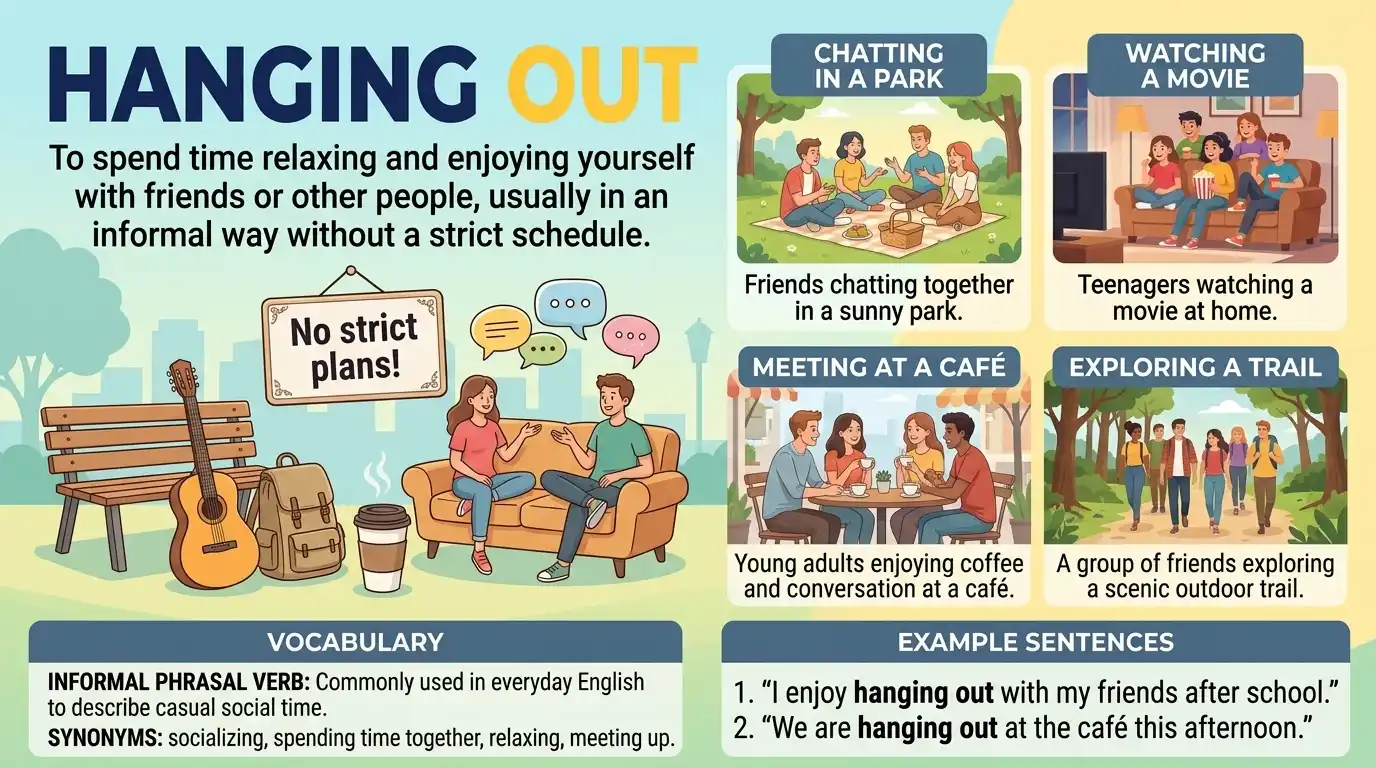
Synonyms of hanging out include spending time together, socializing, chilling, relaxing, meeting up, catching up, and getting together. These expressions describe casual activities with friends, family, or other people. The best alternative depends on the situation, relationship, and tone. Some suggest relaxation, while others emphasize conversation, friendship, or shared experiences.
Picture a Friday evening. Your friends invite you for coffee, but nobody has a fixed plan. You simply want to enjoy each other’s company.
The phrase hanging out appears frequently in everyday English. People use it when discussing friendships, weekend plans, relationships, and casual social activities.
Learning synonyms of hanging out helps students, bloggers, and content writers express social experiences naturally. It also makes everyday conversations more interesting.
A simple vocabulary change can transform your message. Instead of repeating hanging out, you can choose expressions that capture relaxation, friendship, or connection.
What Does Hanging Out Really Mean?
Hanging out means spending time somewhere or with someone in a relaxed, informal way, usually without a strict schedule or specific purpose.
It commonly describes activities such as meeting friends, visiting familiar places, chatting, playing games, or enjoying free time.
For example:
- We are hanging out at Sarah’s house tonight.
- I love hanging out with my childhood friends.
The expression often suggests comfort, freedom, and enjoyment.
Native English speakers commonly use it when discussing social plans. However, its meaning can change slightly depending on the context.
Someone hanging out at a café may simply be relaxing there. Two friends hanging out together are spending casual time in each other’s company.
Part of Speech
Hanging out is a phrasal verb in its present participle or gerund form.
Its base form is hang out.
It combines the verb hang with the particle out.
Examples:
- Present: I hang out with my classmates.
- Present continuous: We are hanging out.
- Past: They hung out yesterday.
- Future: We will hang out tomorrow.
The expression can also function as a gerund.
Example: Hanging out with friends makes weekends enjoyable.
Connotative Meaning of Hanging Out
(Connotation is the emotional feeling or association a word carries beyond its basic dictionary meaning.)
Positive Tone
Hanging out often suggests friendship, comfort, belonging, and relaxation.
Example: Hanging out with my cousins always makes me happy.
Negative Tone
In certain situations, it may suggest wasting time, avoiding responsibilities, or remaining somewhere without a clear purpose.
Example: He keeps hanging out instead of finishing his assignments.
Neutral Tone
Sometimes, it simply describes spending time at a particular location.
Example: Several students were hanging out near the library.
The surrounding sentence determines the emotional meaning.
Etymology of Hanging Out
The phrase combines two English elements: hanging and out.
The verb hang has Germanic roots. It is connected to Old English forms such as hangian, meaning to hang or remain suspended.
The particle out comes from Old English ūt, meaning outside or outward.
The modern social meaning developed much later.
Old English Period (450–1100)
Old English contained the linguistic ancestors of both hang and out.
However, the modern social expression hang out did not exist with today’s meaning.
Middle English Period (1100–1500)
The verb hang continued developing through Middle English.
It retained meanings connected with suspension, attachment, and remaining in a position.
Modern English Period (1500–Present)
The expression hang out developed several meanings over time.
Its informal social meaning became established in modern English, particularly in American usage.
Today, it commonly describes relaxed social interaction without a formal arrangement.
Pronunciation of Hanging Out
American English (US)
IPA: /ˈhæŋɪŋ aʊt/
British English (UK)
IPA: /ˈhæŋɪŋ aʊt/
Both varieties use essentially the same pronunciation.
In natural speech, the words often flow together.
Syllable Breakdown
hang-ing-out
Total: Three syllables.
Affixation Pattern
Root: Hang
Prefix: None
Suffix: -ing
Particle: Out
The suffix -ing creates the present participle or gerund form of the phrasal verb hang out.
Synonyms List
The following alternatives cover casual socializing, spending leisure time together, and closely related activities.
Some expressions describe the general act of hanging out. Others describe a particular type of social interaction.
Choose the alternative that matches your intended meaning.
1. Socializing (Verb) — US /ˈsoʊʃəlaɪzɪŋ/ | UK /ˈsəʊʃəlaɪzɪŋ/
Meaning: Spending time with people through conversation or shared activities.
Tone/Register: Neutral, social, everyday.
Example 1: Emma enjoys socializing with her neighbors.
Example 2: We spent Saturday socializing at the community event.
2. Chilling (Verb) — US /ˈtʃɪlɪŋ/ | UK /ˈtʃɪlɪŋ/
Meaning: Relaxing without pressure, often alone or with friends.
Tone/Register: Very informal, friendly.
Example 1: We’re chilling at home tonight.
Example 2: Jake spent the afternoon chilling with his roommates.
3. Relaxing (Verb) — US /rɪˈlæksɪŋ/ | UK /rɪˈlæksɪŋ/
Meaning: Spending time comfortably without stress or demanding activities.
Tone/Register: Neutral, everyday.
Example 1: We’re relaxing by the pool.
Example 2: The family enjoyed relaxing together after dinner.
4. Meeting Up (Phrasal Verb) — US /ˈmiːtɪŋ ʌp/ | UK /ˈmiːtɪŋ ʌp/
Meaning: Getting together with someone at an arranged place or time.
Tone/Register: Neutral, conversational.
Example 1: I’m meeting up with Olivia after class.
Example 2: We’re meeting up downtown this evening.
5. Catching Up (Phrasal Verb) — US /ˈkætʃɪŋ ʌp/ | UK /ˈkætʃɪŋ ʌp/
Meaning: Talking with someone to share recent news and personal experiences.
Tone/Register: Friendly, conversational.
Example 1: We’re catching up over coffee.
Example 2: Mia spent Sunday catching up with her old roommate.
6. Getting Together (Phrasal Verb) — US /ˈɡɛtɪŋ təˈɡɛðər/ | UK /ˈɡetɪŋ təˈɡeðə/
Meaning: Meeting other people for a shared activity or social occasion.
Tone/Register: Neutral, friendly.
Example 1: We’re getting together this weekend.
Example 2: The cousins enjoy getting together during holidays.
7. Spending Time Together (Verb Phrase) — US /ˈspɛndɪŋ taɪm təˈɡɛðər/ | UK /ˈspendɪŋ taɪm təˈɡeðə/
Meaning: Sharing time with another person through activities or companionship.
Tone/Register: Neutral, warm.
Example 1: We love spending time together after school.
Example 2: The grandparents enjoy spending time together in their garden.
8. Mingling (Verb) — US /ˈmɪŋɡəlɪŋ/ | UK /ˈmɪŋɡəlɪŋ/
Meaning: Moving among people and talking with different individuals.
Tone/Register: Neutral, social, occasionally formal.
Example 1: Guests were mingling near the entrance.
Example 2: Hannah enjoyed mingling with the other students.
9. Lounging (Verb) — US /ˈlaʊndʒɪŋ/ | UK /ˈlaʊndʒɪŋ/
Meaning: Sitting or lying comfortably while enjoying free time.
Tone/Register: Casual, descriptive.
Example 1: We’re lounging on the balcony.
Example 2: The roommates spent Sunday lounging around the apartment.
10. Unwinding (Verb) — US /ʌnˈwaɪndɪŋ/ | UK /ʌnˈwaɪndɪŋ/
Meaning: Relaxing after work, stress, or demanding activities.
Tone/Register: Neutral, positive.
Example 1: We’re unwinding after a busy week.
Example 2: Daniel enjoys unwinding with friends on Fridays.
11. Kicking Back (Phrasal Verb) — US /ˈkɪkɪŋ bæk/ | UK /ˈkɪkɪŋ bæk/
Meaning: Resting comfortably without worrying about responsibilities.
Tone/Register: Informal, relaxed.
Example 1: We’re kicking back in the backyard.
Example 2: Everyone was kicking back after the barbecue.
12. Spending Time With Friends (Verb Phrase) — US /ˈspɛndɪŋ taɪm wɪð frɛndz/ | UK /ˈspendɪŋ taɪm wɪð frendz/
Meaning: Enjoying activities or companionship with friends.
Tone/Register: Neutral, everyday.
Example 1: I enjoy spending time with friends during summer.
Example 2: She’s spending time with friends after her exams.
13. Chatting (Verb) — US /ˈtʃætɪŋ/ | UK /ˈtʃætɪŋ/
Meaning: Having a relaxed and friendly conversation.
Tone/Register: Neutral, informal.
Example 1: We were chatting outside the bookstore.
Example 2: The neighbors spent an hour chatting in the garden.
14. Conversing (Verb) — US /kənˈvɜːrsɪŋ/ | UK /kənˈvɜːsɪŋ/
Meaning: Talking with another person through an exchange of ideas.
Tone/Register: Formal, literary, academic.
Example 1: The guests were conversing in the lounge.
Example 2: Two professors spent the evening conversing over dinner.
15. Gathering (Verb) — US /ˈɡæðərɪŋ/ | UK /ˈɡæðərɪŋ/
Meaning: Coming together in one place as a group.
Tone/Register: Neutral.
Example 1: Friends were gathering near the beach.
Example 2: The students started gathering outside the café.
16. Congregating (Verb) — US /ˈkɑːŋɡrɪɡeɪtɪŋ/ | UK /ˈkɒŋɡrɪɡeɪtɪŋ/
Meaning: Coming together in a particular location, usually as a group.
Tone/Register: Formal, descriptive.
Example 1: Teenagers were congregating near the basketball court.
Example 2: Visitors began congregating outside the museum.
17. Hobnobbing (Verb) — US /ˈhɑːbnɑːbɪŋ/ | UK /ˈhɒbnɒbɪŋ/
Meaning: Socializing with people, especially those considered influential or important.
Tone/Register: Informal, sometimes humorous.
Example 1: He spent the evening hobnobbing with local celebrities.
Example 2: The journalist enjoyed hobnobbing with famous authors.
18. Fraternizing (Verb) — US /ˈfrætərnaɪzɪŋ/ | UK /ˈfrætənaɪzɪŋ/
Meaning: Associating socially with people, sometimes across expected social or professional boundaries.
Tone/Register: Formal, occasionally disapproving.
Example 1: The employees were fraternizing after work.
Example 2: The manager discouraged fraternizing during working hours.
19. Mixing (Verb) — US /ˈmɪksɪŋ/ | UK /ˈmɪksɪŋ/
Meaning: Spending time socially with different people.
Tone/Register: Neutral, conversational.
Example 1: She’s mixing with new classmates.
Example 2: The volunteers enjoyed mixing with local residents.
20. Associating (Verb) — US /əˈsoʊsieɪtɪŋ/ | UK /əˈsəʊsieɪtɪŋ/
Meaning: Spending time with particular people or maintaining social connections.
Tone/Register: Neutral, slightly formal.
Example 1: He’s been associating with a new group of friends.
Example 2: Parents noticed their daughter associating with older students.
21. Palling Around (Phrasal Verb) — US /ˈpælɪŋ əˈraʊnd/ | UK /ˈpælɪŋ əˈraʊnd/
Meaning: Spending casual, friendly time with someone.
Tone/Register: Informal, playful.
Example 1: Ben enjoys palling around with his cousins.
Example 2: The boys spent Saturday palling around at the park.
22. Bumming Around (Phrasal Verb) — US /ˈbʌmɪŋ əˈraʊnd/ | UK /ˈbʌmɪŋ əˈraʊnd/
Meaning: Spending time casually without a definite plan or productive activity.
Tone/Register: Very informal, sometimes negative.
Example 1: We spent the afternoon bumming around town.
Example 2: They were bumming around during their summer break.
23. Loitering (Verb) — US /ˈlɔɪtərɪŋ/ | UK /ˈlɔɪtərɪŋ/
Meaning: Remaining somewhere without an obvious purpose, sometimes where it is unwelcome.
Tone/Register: Neutral to negative, official.
Example 1: Several teenagers were loitering outside the shop.
Example 2: The guard asked the group to stop loitering near the entrance.
24. Lazing Around (Phrasal Verb) — US /ˈleɪzɪŋ əˈraʊnd/ | UK /ˈleɪzɪŋ əˈraʊnd/
Meaning: Spending time resting or doing very little.
Tone/Register: Informal, relaxed.
Example 1: We’re lazing around at home today.
Example 2: The siblings spent their holiday lazing around the beach house.
25. Passing the Time (Verb Phrase) — US /ˈpæsɪŋ ðə taɪm/ | UK /ˈpɑːsɪŋ ðə taɪm/
Meaning: Doing something casual while waiting or enjoying free time.
Tone/Register: Neutral.
Example 1: We were passing the time at the station.
Example 2: The friends passed the time by sharing funny stories.
26. Having a Good Time (Verb Phrase) — US /ˈhævɪŋ ə ɡʊd taɪm/ | UK /ˈhævɪŋ ə ɡʊd taɪm/
Meaning: Enjoying an activity or social experience.
Tone/Register: Positive, conversational.
Example 1: Everyone was having a good time at the picnic.
Example 2: We’re having a good time with our neighbors.
27. Enjoying Each Other’s Company (Verb Phrase) — US /ɛnˈdʒɔɪɪŋ iːtʃ ˈʌðərz ˈkʌmpəni/ | UK /ɪnˈdʒɔɪɪŋ iːtʃ ˈʌðəz ˈkʌmpəni/
Meaning: Feeling happy and comfortable while spending time together.
Tone/Register: Warm, positive.
Example 1: The couple spent the evening enjoying each other’s company.
Example 2: We sat quietly, enjoying each other’s company.
28. Keeping Company (Verb Phrase) — US /ˈkiːpɪŋ ˈkʌmpəni/ | UK /ˈkiːpɪŋ ˈkʌmpəni/
Meaning: Spending time with someone to provide companionship.
Tone/Register: Neutral, slightly traditional.
Example 1: Maya was keeping her grandmother company.
Example 2: The brothers kept each other company during the trip.
29. Having a Get-Together (Verb Phrase) — US /ˈhævɪŋ ə ˈɡɛt təˌɡɛðər/ | UK /ˈhævɪŋ ə ˈɡet təˌɡeðə/
Meaning: Organizing or enjoying a casual social gathering.
Tone/Register: Friendly, conversational.
Example 1: We’re having a get-together on Sunday.
Example 2: Our neighbors are having a small get-together tonight.
30. Going Out (Phrasal Verb) — US /ˈɡoʊɪŋ aʊt/ | UK /ˈɡəʊɪŋ aʊt/
Meaning: Leaving home to enjoy social activities or entertainment.
Tone/Register: Informal, everyday.
Example 1: We’re going out with friends tonight.
Example 2: Lily enjoys going out on Saturday evenings.
31. Stepping Out (Phrasal Verb) — US /ˈstɛpɪŋ aʊt/ | UK /ˈstepɪŋ aʊt/
Meaning: Leaving a place, sometimes to enjoy a short outing.
Tone/Register: Neutral, conversational.
Example 1: We’re stepping out for coffee.
Example 2: The roommates stepped out for a quick walk.
32. Roaming Around (Phrasal Verb) — US /ˈroʊmɪŋ əˈraʊnd/ | UK /ˈrəʊmɪŋ əˈraʊnd/
Meaning: Moving casually from place to place without a fixed destination.
Tone/Register: Informal, descriptive.
Example 1: We spent the evening roaming around the city.
Example 2: The friends enjoyed roaming around the old market.
33. Wandering Around (Phrasal Verb) — US /ˈwɑːndərɪŋ əˈraʊnd/ | UK /ˈwɒndərɪŋ əˈraʊnd/
Meaning: Walking casually through an area without following a strict route.
Tone/Register: Neutral, descriptive.
Example 1: We were wandering around the shopping district.
Example 2: The classmates spent an hour wandering around campus.
34. Strolling (Verb) — US /ˈstroʊlɪŋ/ | UK /ˈstrəʊlɪŋ/
Meaning: Walking slowly and comfortably for enjoyment.
Tone/Register: Neutral, pleasant.
Example 1: We’re strolling through the park.
Example 2: The friends spent sunset strolling along the beach.
35. Ambling (Verb) — US /ˈæmblɪŋ/ | UK /ˈæmblɪŋ/
Meaning: Walking at an easy, unhurried pace.
Tone/Register: Descriptive, slightly literary.
Example 1: We were ambling through the neighborhood.
Example 2: The group enjoyed ambling along the riverside.
36. Cruising Around (Phrasal Verb) — US /ˈkruːzɪŋ əˈraʊnd/ | UK /ˈkruːzɪŋ əˈraʊnd/
Meaning: Moving casually around an area, often by car, for enjoyment.
Tone/Register: Informal.
Example 1: We spent Friday night cruising around town.
Example 2: The friends were cruising around after dinner.
37. Messing Around (Phrasal Verb) — US /ˈmɛsɪŋ əˈraʊnd/ | UK /ˈmesɪŋ əˈraʊnd/
Meaning: Spending time doing playful or unstructured activities.
Tone/Register: Informal, playful, sometimes negative.
Example 1: The kids were messing around in the backyard.
Example 2: We spent the afternoon messing around with old board games.
38. Fooling Around (Phrasal Verb) — US /ˈfuːlɪŋ əˈraʊnd/ | UK /ˈfuːlɪŋ əˈraʊnd/
Meaning: Behaving playfully or spending time doing silly activities.
Tone/Register: Informal, sometimes disapproving.
Example 1: The classmates were fooling around after lunch.
Example 2: Stop fooling around and help us clean up.
Usage note: This expression can also carry romantic or sexual meanings in certain contexts.
39. Kicking It (Verb Phrase) — US /ˈkɪkɪŋ ɪt/ | UK /ˈkɪkɪŋ ɪt/
Meaning: Spending relaxed time with friends.
Tone/Register: American slang, very informal.
Example 1: We’re kicking it at Marcus’s place.
Example 2: The guys spent Sunday kicking it by the lake.
40. Chilling Out (Phrasal Verb) — US /ˈtʃɪlɪŋ aʊt/ | UK /ˈtʃɪlɪŋ aʊt/
Meaning: Relaxing and enjoying a calm, pressure-free atmosphere.
Tone/Register: Informal, friendly.
Example 1: We’re chilling out after the concert.
Example 2: Everyone was chilling out in the living room.
41. Having a Laugh (Verb Phrase) — US /ˈhævɪŋ ə læf/ | UK /ˈhævɪŋ ə lɑːf/
Meaning: Enjoying a fun, humorous time with other people.
Tone/Register: Informal, especially natural in British English.
Example 1: We’re laughing with our old school friends.
Example 2: The colleagues were laughing during their break.
42. Shooting the Breeze (Idiom) — US /ˈʃuːtɪŋ ðə briːz/ | UK /ˈʃuːtɪŋ ðə briːz/
Meaning: Having a relaxed conversation about ordinary or unimportant subjects.
Tone/Register: Informal, idiomatic.
Example 1: We spent an hour shooting the breeze outside.
Example 2: The neighbors were shooting the breeze over tea.
43. Chewing the Fat (Idiom) — US /ˈtʃuːɪŋ ðə fæt/ | UK /ˈtʃuːɪŋ ðə fæt/
Meaning: Talking casually with someone for an extended period.
Tone/Register: Informal, idiomatic.
Example 1: We spent Saturday morning chewing the fat.
Example 2: The old friends enjoyed chewing the fat at the café.
44. Spending Quality Time (Verb Phrase) — US /ˈspɛndɪŋ ˈkwɑːləti taɪm/ | UK /ˈspendɪŋ ˈkwɒləti taɪm/
Meaning: Sharing meaningful time that strengthens a personal relationship.
Tone/Register: Positive, warm.
Example 1: We’re spending quality time with our children.
Example 2: Nina enjoys spending quality time with her sister.
45. Batching (Verb) — US /ˈbætʃɪŋ/ | UK /ˈbætʃɪŋ/
Meaning: Spending time together socially, especially in some regional varieties of English.
Tone/Register: Regional, informal; not a standard general synonym.
Example 1: The friends were batching together over the weekend.
Example 2: They spent the afternoon batching at a friend’s house.
Usage note: This is a regional and less reliable alternative. In international English, hanging out, socializing, or getting together will usually sound more natural. In other contexts, batching commonly means grouping tasks or items.
Synonyms for Hanging Out by Tone
The emotional tone of a synonym affects how readers understand a situation.
Some alternatives communicate friendship and comfort. Others suggest inactivity, playfulness, or unwanted behavior.
Positive Synonyms
- Socializing
- Catching up
- Spending quality time
- Enjoying each other’s company
- Getting together
- Having a good time
- Keeping company
These expressions emphasize friendship, happiness, and connection.
Neutral Synonyms
- Meeting up
- Gathering
- Mixing
- Chatting
- Spending time together
- Going out
- Wandering around
- Strolling
Use these expressions when describing activities without adding a strong emotional judgment.
Negative Synonyms
- Loitering
- Bumming around
- Fraternizing
- Fooling around
These expressions can suggest unwanted behavior, wasted time, or questionable social interaction.
However, their meanings depend on context.
Playful and Informal Synonyms
- Chilling
- Kicking it
- Palling around
- Kicking back
- Messing around
- Shooting the breeze
- Chewing the fat
- Having a laugh
These expressions work especially well in relaxed conversations and informal storytelling.
Hanging Out vs Close Alternatives
Although several expressions share similar meanings, they are not always interchangeable.
| Expression | Main Meaning | Tone | Best Context |
|---|---|---|---|
| Hanging out | Spending casual time together | Informal | Friends and everyday plans |
| Socializing | Interacting with other people | Neutral | Parties and social events |
| Chilling | Relaxing without pressure | Very informal | Relaxed weekends |
| Catching up | Sharing recent personal news | Friendly | Reconnecting with someone |
Hanging Out vs Socializing
Hanging out usually suggests casual time with familiar people.
Socializing places greater emphasis on interacting with others.
For example:
We’re hanging out at Ryan’s house.
She’s socializing with guests at the reception.
The second sentence suggests interaction with several people rather than simply relaxing with close friends.
Hanging Out vs Chilling
Hanging out often involves companionship.
Chilling emphasizes relaxation and may describe time spent alone.
For example:
I’m hanging out with my classmates.
I’m chilling at home tonight.
The first sentence highlights a social relationship. The second focuses on a relaxed state.
Hanging Out vs Catching Up
Catching up suggests that people have news to share.
Hanging out does not require a specific conversational purpose.
For example:
We’re hanging out after school.
We’re catching up after six months apart.
Choose catching up when reconnecting is the main purpose.
How Hanging Out Changes by Context
Daily Conversation
In casual speech, hanging out is a natural expression for informal social plans.
Example: Are you hanging out with us tonight?
You can replace it with meeting up, chilling, or getting together.
Writing and Blogging
Bloggers often describe friendships, travel experiences, and leisure activities.
Repeating hanging out can make descriptions feel limited.
Instead, use expressions that reflect the actual activity.
Example: We spent the afternoon exploring local shops and catching up over coffee.
This sentence creates a clearer picture for readers.
Professional or Academic Tone
Hanging out may sound too casual in formal reports or academic discussions.
More suitable alternatives include socializing, interacting, gathering, and spending time together.
Informal: Students were hanging out after class.
Formal: Students were socializing after the lecture.
The second sentence sounds more appropriate in academic writing.
Creative and Informal Use
Creative writing benefits from expressions that reveal personality and atmosphere.
Example: The teenagers were kicking back beneath the old oak tree.
This creates a different impression from:
The teenagers were loitering outside the abandoned building.
The first suggests relaxation. The second may create suspicion or tension.
Common Mistakes Learners Make
Understanding the meaning of hanging out is useful. Knowing its grammatical patterns is equally important.
Mistake 1: Using the Wrong Past Tense
Incorrect: We hanged out yesterday.
Correct: We hung out yesterday.
The ordinary past tense of hang out is hung out.
Mistake 2: Confusing Hanging Out With Dating
Hanging out does not automatically mean dating.
Example: I’m hanging out with Alex tonight.
This sentence could describe friendship, a casual meeting, or a romantic situation.
Context determines the intended meaning.
Mistake 3: Using Informal Slang in Academic Writing
Less suitable: The researchers were kicking it after the conference.
Better: The researchers were socializing after the conference.
Choose vocabulary that matches the audience.
Mistake 4: Confusing Loitering With Relaxing
Loitering may suggest remaining somewhere without permission or an accepted purpose.
It is not always a friendly replacement for hanging out.
Mistake 5: Overusing the Same Expression
Repeating hanging out in every sentence can weaken descriptive writing.
Instead, identify the specific activity.
Were people talking, relaxing, walking, or reconnecting?
Choose a word that communicates that action.
Native English Usage and Register Notes
Informal Spoken English
Native speakers frequently use:
- Wanna hang out?
- We’re just chilling.
- Let’s meet up later.
- We should catch up sometime.
These expressions sound natural in friendly conversations.
Formal Written English
In professional communication, prefer expressions such as:
- Socializing with colleagues
- Interacting with classmates
- Attending an informal gathering
- Spending time with team members
American and British Usage
Hanging out is widely understood in both American and British English.
Kicking it is especially associated with informal American speech.
Laughing is particularly familiar in British conversational English.
Catching up and meeting up work naturally in both varieties.
For related vocabulary, explore synonyms of belongingness to understand expressions connected with friendship, acceptance, and social relationships.
Real-Life Examples Using Hanging Out
Workplace Scenario
A group of coworkers meets at a nearby café after finishing a demanding project.
Casual: We’re hanging out after work.
Alternative: We’re unwinding together after a busy week.
The alternative highlights relaxation after stress.
Social Scenario
Two childhood friends meet after several years.
Casual: We’re hanging out this afternoon.
Alternative: We’re catching up over lunch.
The second sentence communicates the purpose more clearly.
Media and Pop Culture Scenario
A television series shows teenagers spending their weekends at a familiar diner.
Casual: The characters are always hanging out at the diner.
Alternative: The characters enjoy chilling at their favorite diner.
The alternative creates a relaxed, youthful atmosphere.
Storytelling Scenario
A writer describes two friends walking through a quiet neighborhood.
Basic: They were hanging out together.
Descriptive: They were strolling through the empty streets, sharing stories.
The second version gives readers a stronger visual impression.
Interactive Practice Quiz
Choose the most suitable answer for each situation.
Part One: Meaning and Everyday Usage
1. Two friends meet after five years to share personal news. Which expression fits best?
A) Loitering
B) Catching up
C) Congregating
D) Roaming around
2. You are relaxing at home without any plans. What sounds most natural?
A) Chilling
B) Fraternizing
C) Mingling
D) Conversing
3. Several guests are talking with different people at a wedding. They are:
A) Lazing around
B) Loitering
C) Mingling
D) Ambling
4. Your classmates arrange to see each other after school. They are:
A) Meeting up
B) Loitering
C) Fooling around
D) Wandering around
5. A family spends meaningful time together during a holiday. Which phrase is best?
A) Bumming around
B) Spending quality time
C) Congregating
D) Messing around
6. Friends are having a relaxed conversation about ordinary topics. They are:
A) Shooting the breeze
B) Loitering
C) Cruising around
D) Fraternizing
Part Two: Tone and Context
7. Which expression sounds most suitable in a formal workplace report?
A) Kicking it
B) Chilling out
C) Socializing
D) Palling around
8. Teenagers remain outside a closed shop without an obvious purpose. Which word may suggest disapproval?
A) Catching up
B) Loitering
C) Unwinding
D) Enjoying each other’s company
9. Which expression strongly emphasizes relaxing after stress?
A) Congregating
B) Associating
C) Unwinding
D) Gathering
10. Which expression is particularly associated with informal American slang?
A) Kicking it
B) Conversing
C) Congregating
D) Gathering
11. Two friends enjoy walking slowly through a beautiful park. They are:
A) Fraternizing
B) Strolling
C) Loitering
D) Mingling
12. Which sentence uses the correct past tense of hang out?
A) We hanged out yesterday.
B) We hanging out yesterday.
C) We hung out yesterday.
D) We hang out yesterday.
13. Which expression suggests spending time playfully without a serious purpose?
A) Messing around
B) Spending quality time
C) Conversing
D) Socializing
14. You want to describe people interacting at a networking event. Which word fits best?
A) Lazing around
B) Mingling
C) Kicking back
D) Bumming around
15. Which expression best describes enjoying someone’s companionship?
A) Loitering
B) Roaming around
C) Enjoying each other’s company
D) Passing the time
Answer Key
1-B | 2-A | 3-C | 4-A | 5-B | 6-A | 7-C | 8-B | 9-C | 10-A | 11-B | 12-C | 13-A | 14-B | 15-C
Reflection and Application Task
Think about the last time you spent an enjoyable afternoon with friends or family.
Write one sentence describing that experience without using the phrase hanging out.
Choose a synonym that communicates the activity and emotional tone accurately.
Suggested External Reference
Cambridge Dictionary: Hang out – Meaning and Usage
This authoritative dictionary provides definitions, pronunciation guidance, grammatical information, and authentic usage examples.
Conclusion
Learning synonyms of hanging out makes everyday English more expressive. Each alternative helps you describe friendship, relaxation, and shared experiences clearly.
The right expression can bring warmth to a conversation or add personality to a story. Small vocabulary changes make speaking and communication more natural.
Using synonyms of hanging out also improves essays, blogging, and creative writing. Your sentences become more precise, engaging, and enjoyable to read.
Practice synonyms of hanging out in emails, essays, and daily conversations. Try one new expression each day and enjoy building a stronger English vocabulary.
Frequently Asked Questions About Hanging Out
1. What is a better way to say hanging out with friends in a text message?
You can say chilling with friends, meeting up with friends, catching up, or spending time together. The best choice depends on your plans.
For example, “Just chilling with friends” sounds relaxed and natural in a casual message. “Catching up with friends” works better when you have not seen them recently.
2. Can hanging out mean spending time alone?
Yes. Although hanging out commonly describes spending time with other people, it can also describe relaxing alone at a particular location.
For example, “I’m just hanging out at home” does not necessarily involve anyone else. The expression emphasizes casual, unstructured time rather than a specific social activity.
3. What does it mean when someone asks, “Do you want to hang out sometime?”
This question usually means the person wants to spend casual time with you in the future.
It might involve coffee, walking, watching a movie, or another relaxed activity. The invitation does not automatically suggest romantic interest. Consider your relationship and the surrounding conversation before interpreting its meaning.
4. What are some short slang alternatives to hanging out?
Common slang alternatives include chilling, kicking it, kicking back, and chilling out.
For example, “We’re kicking it at home” means spending relaxed time together. These expressions are suitable for friendly messages and informal speech. Avoid using them in academic assignments or professional documents where neutral vocabulary is expected.
5. Is hanging out the same as spending quality time?
Not exactly. Hanging out describes casual time spent somewhere or with someone. Spending quality time emphasizes meaningful attention and emotional connection.
Two friends may hang out while watching television. Parents spending quality time with their children usually focus on shared activities that strengthen their relationship. The expressions overlap, but their emotional emphasis differs.
6. What can I say instead of “Let’s hang out” when inviting someone politely?
You can say, “Would you like to meet up sometime?” or “Would you be interested in getting together this weekend?”
These expressions sound friendly without being overly casual. For a professional acquaintance, try “Would you like to meet for coffee?” A specific invitation often makes your intention clearer.
7. What is the difference between hang out and hang around?
Hang out commonly describes spending casual time somewhere or with someone for enjoyment.
Hang around often means remaining in a place, sometimes while waiting for something.
For example, “We hung out at the café” suggests a relaxed visit. “We hung around after the meeting” suggests staying there rather than leaving immediately.
8. Can I use hanging out in an IELTS speaking test?
Yes. Hanging out is a natural expression for IELTS Speaking, especially when discussing hobbies, friends, or free-time activities.
For example, “I usually hang out with my classmates on weekends” sounds conversational and appropriate.
However, use more formal alternatives in IELTS Academic Writing when needed. Expressions such as social interaction and spending leisure time together may better suit formal discussions.

Mehtab Yasir is a passionate writer and English language enthusiast dedicated to making vocabulary learning simple, practical, and enjoyable. As an author at SynonymDesk.com, she creates helpful content covering synonyms, antonyms, word meanings, vocabulary, phrases, and everyday English usage. Her goal is to provide clear and easy-to-understand information that helps students, writers, professionals, and English learners choose the right words and communicate with greater confidence. Mehtab believes that a strong vocabulary can improve both writing and communication skills. She enjoys researching new words, exploring their meanings and uses, and turning complex language concepts into useful, reader-friendly content. Through her work, she strives to make SynonymDesk.com a reliable resource for anyone looking to improve their English vocabulary and language skills.