Imagine moving to a brand-new country where every street sign, cafe menu, and spoken phrase feels totally unfamiliar. When you arrive as a stranger in a bustling city, finding the exact right word to describe yourself or someone from another land matters. Using precise vocabulary helps you connect better with locals and express your thoughts clearly.
A synonym for foreigner is a handy phrase many English learners search for when they want to expand their vocabulary beyond basic terms. A rich vocabulary transforms your writing from flat to vibrant. Instead of repeating the same basic noun, you can choose words that reflect specific legal statuses, cultural backgrounds, or friendly tones.
This powerful term appears everywhere in modern media, immigration reports, travel vlogs, and everyday casual conversations. Knowing various alternatives helps students write better essays, bloggers craft engaging posts, and daily English users sound much more natural and articulate in chat rooms or face-to-face chats.
What Does “Foreigner” Really Mean?
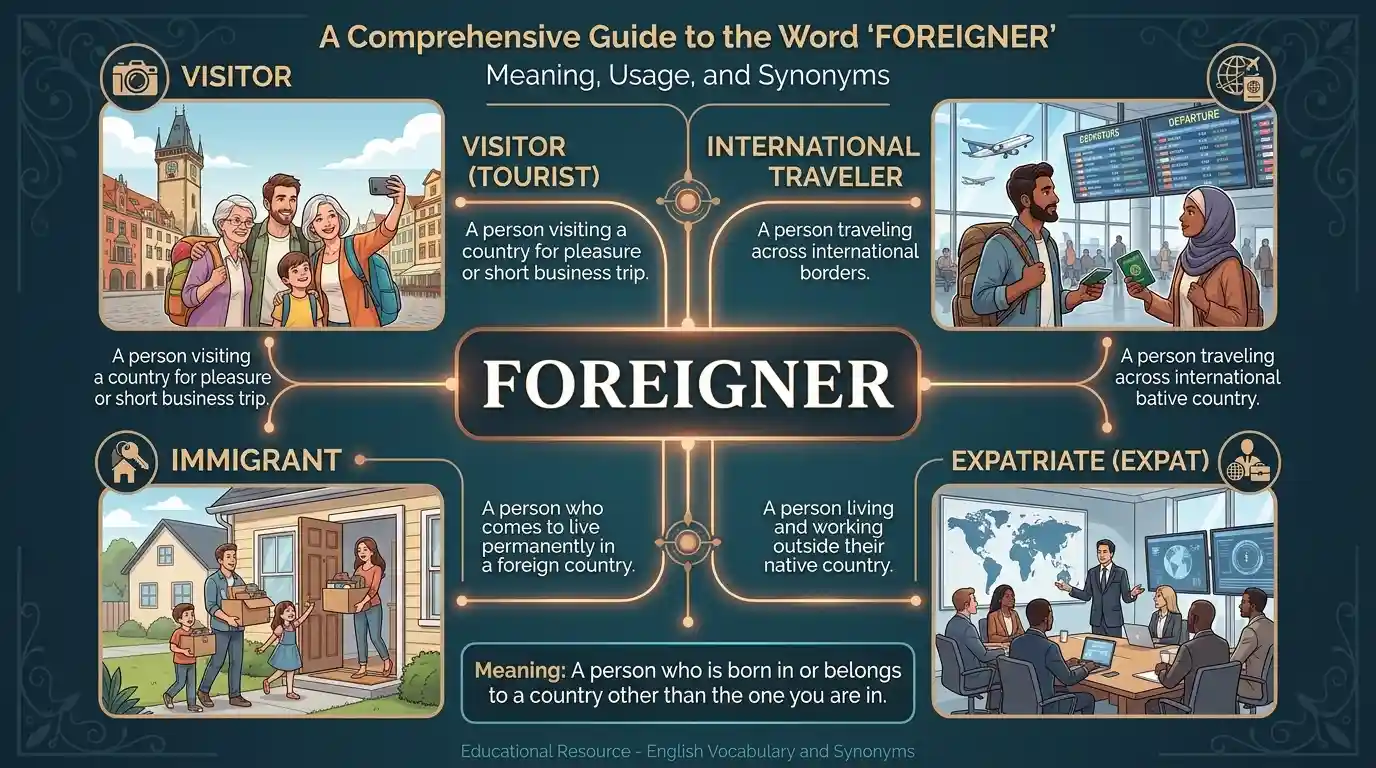
A foreigner is simply a person who belongs to a country other than the one where they currently are. Native speakers understand it as a descriptive noun, though its emotional tone can sometimes lean slightly detached depending on context. It often appears in legal documents, travel discussions, and global news updates.
Connotative Meaning
The emotional tone of a word (connotation) shapes how people feel when they hear it.
- Positive tone: Welcoming, global-minded, and culturally curious.
- Negative tone: Outcast, alien, or unwelcomed outsider.
- Neutral tone: Objective, factual, and descriptive traveler or visitor.
Etymology
The term originates from the Old French word forein, meaning “outward” or “outside,” combined with Latin roots.
- Old English (450–1100): Early Germanic roots focused on outsider statuses called eltheodig.
- Middle English (1100–1500): The Norman influence introduced forein to describe external lands.
- Modern English (1500–Present): It stabilized into the standard modern spelling and use we recognize today.
Word Anatomy
- Part of Speech: Noun
- Syllables: for-eign-er
- Root: foreign
- Prefix: None
- Suffix: -er (denoting a person connected with a place or action)
Comprehensive List of Synonyms
1. Alien (Noun)
- Meaning: A person who is not a citizen of the country in which they live.
- Tone/Register: Legal / Formal
- The government updated the visa policies for resident aliens this year.
- She holds alien status while completing her studies abroad.
2. Outsider (Noun)
- Meaning: A person who does not belong to a particular group, community, or society.
- Tone/Register: Casual / Literary
- He always felt like an outsider during his first few weeks in town.
- Joining a new sports team can make anyone feel like an outsider at first.
3. Non-national (Noun)
- Meaning: Someone who does not hold citizenship in the nation where they reside.
- Tone/Register: Official / Administrative
- The museum offers special ticket discounts for residents and non-nationals.
- Non-nationals must register their current residential address at City Hall.
4. Immigrant (Noun)
- Meaning: A person who comes to live permanently in a foreign country.
- Tone/Register: Standard / Sociological
- Her grandparents were immigrants who started a bakery in downtown Chicago.
- Many immigrants work hard to build a stable life for their families.
5. Expatriate (Noun)
- Meaning: A person living outside their native country, often for professional work.
- Tone/Register: Professional / Business
- The company relocated several senior engineers as expatriates to Tokyo.
- Expatriates often gather at local cafes to share experiences of home.
6. Outlander (Noun)
- Meaning: A native or resident of a foreign country or different region.
- Tone/Register: Literary / Archaic
- The villagers viewed the traveler as an outlander from the distant mountains.
- Fantasy novels frequently feature mysterious outlanders seeking shelter.
7. Newcomer (Noun)
- Meaning: A person who has recently arrived in a place or joined a group.
- Tone/Register: Friendly / Everyday
- The neighborhood association organized a welcome party for every newcomer.
- Being a newcomer in the office can feel intimidating on day one.
8. Visitor (Noun)
- Meaning: Someone who is visiting a person or place temporarily.
- Tone/Register: Polite / Casual
- The art gallery welcomed thousands of international visitors this summer.
- Hotel staff greeted each visitor with a warm smile and a refreshing drink.
9. Tourist (Noun)
- Meaning: A person who is visiting a place for pleasure and sightseeing.
- Tone/Register: Casual / Everyday
- Tourists crowded around the historic monument to take souvenir photos.
- She bought a paper map so she wouldn’t look like a lost tourist.
10. Traveler (Noun)
- Meaning: A person who is traveling or who often travels to distant places.
- Tone/Register: Descriptive / Neutral
- Experienced travelers always keep an extra copy of their passport handy.
- The lonely traveler stopped at the inn to rest his tired horses.
11. Migrant (Noun)
- Meaning: A worker who moves from one region or country to another, often seasonally.
- Tone/Register: Economic / Sociological
- Agricultural migrant workers help harvest crops during peak autumn months.
- The city council provides support services for newly arrived migrants.
12. Non-citizen (Noun)
- Meaning: A person who lacks citizenship rights in a given state.
- Tone/Register: Legal / Bureaucratic
- Voting in federal elections is restricted to citizens, excluding non-citizens.
- Non-citizens need proper documentation to open a local bank account.
13. Off-comer (Noun)
- Meaning: A person who comes from another district or country.
- Tone/Register: Regional / Informal
- The tight-knit village took time to trust the friendly off-comer.
- Old farmers referred to anyone born outside the county as an off-comer.
14. Out-of-towner (Noun)
- Meaning: A visitor or traveler from a different city or town.
- Tone/Register: Casual / Spoken
- The busy downtown restaurant was packed with locals and out-of-towners.
- Ask that out-of-towner if he needs directions to the subway station.
15. Globe-trotter (Noun)
- Meaning: A person who regularly travels all over the world.
- Tone/Register: Informal / Enthusiastic
- My adventurous aunt is a true globetrotter with stamps from fifty countries.
- The famous chef lives like a globetrotter, exploring unfamiliar food markets.
16. Wanderer (Noun)
- Meaning: A person who travels aimlessly or from place to place.
- Tone/Register: Poetic / Literary
- The tired wanderer sought shelter beneath the branches of an oak tree.
- Songs about lonely wanderers always capture a sense of deep freedom.
17. Wayfarer (Noun)
- Meaning: A person who travels on foot across long distances.
- Tone/Register: Literary / Classic
- Ancient legends tell of kind innkeepers who fed every hungry wayfarer.
- A lone wayfarer walked down the dusty path as the sun set.
18. Pilgrim (Noun)
- Meaning: A person who journeys to a sacred place for religious reasons.
- Tone/Register: Formal / Historical
- Devoted pilgrims walked along the ancient trail toward the mountain shrine.
- Every year, thousands of pilgrims gather in the holy city.
19. Voyager (Noun)
- Meaning: A person who goes on a long journey, especially by sea or space.
- Tone/Register: Adventurous / Epic
- Brave voyagers set sail across the uncharted ocean in search of new lands.
- The science museum celebrated the historic launch of deep-space voyagers.
20. Expeditionary (Noun / Adjective)
- Meaning: A member of an organized journey undertaken for a specific purpose.
- Tone/Register: Scientific / Official
- The expeditionary team packed heavy winter gear for the Arctic tundra.
- Researchers joined the expeditionary group to study rare mountain plants.
21. Transient (Noun)
- Meaning: A person who stays or works in a place only for a short time.
- Tone/Register: Formal / Clinical
- The coastal motel mostly caters to short-term transients and weekend fishers.
- Local shelters offer temporary beds for transients during freezing winter nights.
22. Sojourner (Noun)
- Meaning: A person who stays in a place temporarily as a resident.
- Tone/Register: Literary / Formal
- He viewed himself merely as a temporary sojourner in the quiet European village.
- The poet spent a peaceful year as a sojourner by the Mediterranean coast.
23. Nomad (Noun)
- Meaning: A member of a community that moves from place to place instead of settling.
- Tone/Register: Historical / Cultural
- Desert nomads navigate vast dunes using the position of the stars.
- Modern digital nomads work remotely while traveling across different continents.
24. Drifter (Noun)
- Meaning: A person who continually moves from place to place without any fixed home.
- Tone/Register: Informal / Gritty
- The quiet town was surprised when a mysterious drifter rented the old cabin.
- He lived the life of a carefree drifter, packing light and moving often.
25. Refugee (Noun)
- Meaning: A person forced to leave their country to escape war, persecution, or disaster.
- Tone/Register: Humanitarian / Serious
- The charitable organization provides immediate food and medical care to refugees.
- Many refugees hope to rebuild their shattered careers in peaceful nations.
26. Asylee (Noun)
- Meaning: A person who has political refugee status granted by a host government.
- Tone/Register: Legal / Administrative
- The approved asylee started attending English evening classes on Tuesday.
- Legal aid clinics help every qualified asylee navigate immigration paperwork.
27. Exilic (Noun reference)
- Meaning: A person living away from their native country due to expulsion or banishment.
- Tone/Register: Academic / Literary
- The famous writer spent his exilic years composing memoirs about his homeland.
- Exilic communities kept their traditional music alive through local festivals.
28. Displaced person (Noun phrase)
- Meaning: Someone forced to leave their home region due to conflict or upheaval.
- Tone/Register: Formal / Humanitarian
- Relief agencies distributed blankets to every displaced person in the camp.
- Rebuilding infrastructure helps return a displaced person to normal life.
29. Extraterritorial (Noun reference)
- Meaning: Situated outside the legal jurisdiction of the local country.
- Tone/Register: Legal / Diplomatic
- Embassy grounds often hold extraterritorial status under international law.
- Diplomatic staff work within extraterritorial zones during international postings.
30. External resident (Noun phrase)
- Meaning: A person residing outside their country of origin.
- Tone/Register: Bureaucratic / Formal
- Tax laws apply differently to internal citizens and external residents.
- The consulate assists any external resident needing passport renewals.
31. Global citizen (Noun phrase)
- Meaning: Someone who identifies with being part of the worldwide community.
- Tone/Register: Modern / Inspiring
- She considers herself a true global citizen with friends across five continents.
- Modern schools encourage students to act responsibly as global citizens.
32. Cosmopolitan (Noun)
- Meaning: A person familiar with and at ease in many different countries and cultures.
- Tone/Register: Sophisticated / Cultural
- The art curator is a true cosmopolitan who speaks four languages fluently.
- Big cities attract worldly cosmopolitans who love diverse culinary scenes.
33. World traveler (Noun phrase)
- Meaning: Someone who has visited numerous countries across the globe.
- Tone/Register: Casual / Enthusiastic
- The seasoned world traveler shared packing tips on his popular blog.
- Becoming a world traveler requires patience, curiosity, and adaptability.
34. Jet-setter (Noun)
- Meaning: A wealthy person who frequently travels internationally for luxury or business.
- Tone/Register: Informal / Glamorous
- Fashion designers and wealthy jet-setters filled the front rows of the show.
- He lived the fast-paced lifestyle of an international jet-setter.
35. Backpacker (Noun)
- Meaning: A traveler carrying belongings in a backpack, often on a budget.
- Tone/Register: Casual / Youthful
- Budget backpackers often stay in shared hostels to save money.
- She met wonderful friends while working as a backpacker in New Zealand.
36. Interloper (Noun)
- Meaning: A person who becomes involved in a place or situation where they are not wanted.
- Tone/Register: Literary / Formal
- The guard questioned the stranger to ensure he wasn’t an unauthorized interloper.
- He felt like an unwelcome interloper in the private family meeting.
37. Incomer (Noun)
- Meaning: A person who moves to a new town, region, or organization.
- Tone/Register: Regional / British
- Local shop owners welcomed every new incomer to the coastal village.
- Some traditional villagers were skeptical of wealthy southern incomers.
38. Foreign-born resident (Noun phrase)
- Meaning: A person living in a country where they were not born.
- Tone/Register: Demographic / Statistical
- Census reports track the growing percentage of foreign-born residents.
- Foreign-born residents contribute greatly to local small business growth.
39. Non-native (Noun)
- Meaning: A plant, animal, or person not originally from or native to a place.
- Tone/Register: Scientific / General
- English teachers help non-natives master difficult pronunciation rules.
- The botanist studied how non-native shrubs adapted to the regional soil.
40. Overseas worker (Noun phrase)
- Meaning: Someone employed outside their home nation.
- Tone/Register: Economic / Practical
- Remittances sent home by overseas workers support many rural families.
- The government offers safety seminars for departing overseas workers.
41. Overseas student (Noun phrase)
- Meaning: A pupil pursuing education in a country other than their own.
- Tone/Register: Academic / Educational
- University dormitories hosted a welcome mixer for incoming overseas students.
- Tuition fees for overseas students often differ from domestic rates.
42. Overseas visitor (Noun phrase)
- Meaning: A traveler arriving from another country across the sea.
- Tone/Register: Tourism / Polite
- The tourism board launched a new campaign targeting overseas visitors.
- Duty-free shops at the airport cater primarily to departing overseas visitors.
43. External visitor (Noun phrase)
- Meaning: A visitor arriving from outside an organization or country.
- Tone/Register: Corporate / Official
- External visitors must wear identification badges while inside the laboratory.
- Security guards escorted the group of external visitors to the conference room.
44. Out-of-state visitor (Noun phrase)
- Meaning: A traveler visiting from a different state within the same country.
- Tone/Register: Regional / Domestic
- National parks see a surge of out-of-state visitors during autumn foliage.
- Toll booths accept electronic passes for local and out-of-state visitors.
45. Regional outsider (Noun phrase)
- Meaning: Someone from a different geographical region within the same land.
- Tone/Register: Descriptive / Cultural
- Even within the same country, regional outsiders can struggle with local dialects.
- The small mountain town rarely saw regional outsiders passing through.
46. Cross-border commuter (Noun phrase)
- Meaning: Someone who regularly travels across an international border for work.
- Tone/Register: Economic / Administrative
- Thousands of cross-border commuters cross the bridge every morning at dawn.
- Border patrol agents checked passport cards for the daily cross-border commuters.
47. Transnational worker (Noun phrase)
- Meaning: An employee operating across multiple national boundaries.
- Tone/Register: Corporate / Modern
- Transnational workers enjoy flexible schedules and remote collaboration tools.
- Multinational corporations rely heavily on transnational workers to bridge offices.
48. Border-crosser (Noun phrase)
- Meaning: A person who crosses a national border legally or physically.
- Tone/Register: Factual / Descriptive
- Every legal border-crosser must declare agricultural items at customs.
- The highway camera monitored traffic flow for every registered border-crosser.
49. External traveler (Noun phrase)
- Meaning: A traveler entering a system or territory from outside.
- Tone/Register: Technical / Formal
- Public transit systems track ticket sales for internal and external travelers.
- The travel app provides real-time currency conversion for external travelers.
50. Global nomad (Noun phrase)
- Meaning: Someone who continuously travels the world without a single permanent home.
- Tone/Register: Modern / Casual
- The freelance programmer lived the dream of a true global nomad in Bali.
- Global nomads often rely on co-working spaces and international data plans.
51. External guest (Noun phrase)
- Meaning: A guest invited from outside a specific community or institution.
- Tone/Register: Formal / Polite
- The university dean delivered a keynote speech welcoming all external guests.
- Receptionists handed parking permits to each arriving external guest.
52. Foreign national (Noun phrase)
- Meaning: A person who holds citizenship in a foreign country.
- Tone/Register: Legal / Official
- Consular services offer assistance to any stranded foreign national.
- The suspect was identified as a foreign national living temporarily downtown.
53. Un-enrolled newcomer (Noun phrase)
- Meaning: A newly arrived person not yet registered in local systems.
- Tone/Register: Administrative / Descriptive
- Community centers guide every unenrolled newcomer in the ward.
- Registration desks help connect unenrolled newcomers with local healthcare.
54. Transient worker (Noun phrase)
- Meaning: A laborer who moves between temporary jobs in different areas.
- Tone/Register: Economic / Labor
- Fruit orchards hire transient worker crews during the summer picking season.
- Local housing boards discuss affordable options for seasonal transient workers.
55. Distant traveler (Noun phrase)
- Meaning: A person journeying from far away places.
- Tone/Register: Literary / Descriptive
- The ancient tavern welcomed any tired, distant traveler with warm stew.
- Postcards arrived from a distant traveler exploring the Himalayan peaks.
56. Remote wanderer (Noun phrase)
- Meaning: Someone traveling through isolated or far-flung regions.
- Tone/Register: Poetic / Adventurous
- Satellite beacons help keep remote wanderers safe in uncharted wilderness.
- Stories of the bold remote wanderer inspired young readers everywhere.
57. Continental visitor (Noun phrase)
- Meaning: A traveler arriving from a neighboring continent or mainland.
- Tone/Register: Travel / Geographic
- Ferries brought hundreds of continental visitors across the narrow channel.
- Hotels prepped multilingual brochures for the upcoming wave of continental visitors.
58. Oceanic traveler (Noun phrase)
- Meaning: A person crossing large oceans by ship or flight.
- Tone/Register: Maritime / Epic
- Early oceanic travelers navigated by observing cloud formations and seabirds.
- Modern cruise liners pamper every oceanic traveler with luxury amenities.
59. Frontier crosser (Noun phrase)
- Meaning: Someone passing across an unsettled or remote boundary line.
- Tone/Register: Historical / Adventure
- Brave frontier crossers mapped unknown territories in the western wilderness.
- Guard posts monitored trade between frontier crossers and local merchants.
60. Wandering soul (Noun phrase)
- Meaning: A poetic descriptor for someone traveling without fixed roots.
- Tone/Register: Expressive / Literary
- The cozy coffee shop became a haven for every wandering soul in the city.
- Her acoustic guitar songs captured the lonely heart of a wandering soul.
Synonyms for “Foreigner” by Tone
Choosing the right word depends entirely on your context and emotional tone. Grouping these options prevents accidental miscommunication:
- Positive Tone: Global citizen, Cosmopolitan, Globe-trotter, World traveler.
- Neutral Tone: Visitor, Non-national, Traveler, Expatriate, Newcomer.
- Negative Tone: Alien, Interloper, Outsider.
- Playful or Informal Tone: Out-of-towner, Backpacker, Jet-setter.
Tone matters because words carry invisible weight. Calling someone an “alien” sounds formal or harsh, whereas calling them a “visitor” or “newcomer” creates immediate warmth and hospitality.
Mini Comparison: Foreigner vs Expatriate vs Immigrant
Understanding subtle distinctions prevents awkward phrasing in professional or casual writing:
- Foreigner: A broad, general term for anyone from another country. It can sometimes feel slightly distant or clinical in modern conversation.
- Expatriate: Specifically refers to a professional or skilled worker living abroad temporarily, often associated with corporate relocations or lifestyle moves.
- Immigrant: Describes someone who settles in a new nation permanently with the intention of making it their long-term home.
Use “immigrant” for permanent settlement stories, “expatriate” for corporate work placements, and “visitor” for casual tourism.
Context-Based Usage
Adapting your vocabulary to your setting ensures your message lands effectively:
- Daily Conversation: Use warm, friendly terms like newcomer, visitor, or out-of-towner when chatting with friends or neighbors.
- Writing or Blogging: Opt for engaging nouns like globe-trotter or world traveler to paint a vivid mental picture for readers.
- Professional or Academic Tone: Stick to precise administrative terms like non-national, foreign national, or expatriate in formal reports.
Common Mistakes and Native Usage
Learners often misuse these terms by mixing up legal status with casual descriptions. Calling a friendly tourist an “alien” sounds overly legalistic and cold. Similarly, overusing “outsider” can unintentionally make people sound unwelcome.
In spoken English, native speakers prefer conversational alternatives like “out-of-towner” or “newcomer” over rigid dictionary words during casual small talk.
Conclusion
Mastering a variety of terms for our main focus keyword elevates your writing, speaking, and everyday communication skills remarkably. Exploring diverse vocabulary allows you to express exact shades of meaning with confidence and style.
We encourage you to practice these fantastic synonyms in your upcoming emails, essays, and daily conversations. Try swapping out basic words today. For further reading, explore this synonym of foreigner to boost your English fluency even further!
Interactive Practice Quiz
1. Which term best describes a corporate worker temporarily relocated to an overseas branch?
- A) Alien
- B) Expatriate
- C) Drifter
- D) Tourist
2. What is the most welcoming, casual word for someone who just moved into your apartment building?
- A) Interloper
- B) Outsider
- C) Newcomer
- D) Non-national
3. Which word carries a strict legal or administrative tone in government documents?
- A) Globe-trotter
- B) Backpacker
- C) Alien
- D) Wanderer
4. If someone travels purely for pleasure and sightseeing for one week, what are they called?
- A) Immigrant
- B) Tourist
- C) Expatriate
- D) Asylee
5. Which term describes a person forced to flee their home country due to war?
- A) Refugee
- B) Jet-setter
- C) Out-of-towner
- D) Off-comer
6. What do you call someone who travels the world continuously without a permanent home?
- A) Global nomad
- B) Commuter
- C) Visitor
- D) Non-citizen
7. Which phrase fits best in a formal academic research paper about regional demographics?
- A) Foreign-born resident
- B) Wandering soul
- C) Backpacker buddy
- D) Holiday maker
8. What is the literary term for someone journeying on foot across long distances?
- A) Tourist
- B) Wayfarer
- C) Commuter
- D) Shopper
9. Which word describes someone who crosses an international boundary daily for work?
- A) Pilgrim
- B) Cross-border commuter
- C) Outlander
- D) Voyager
10. Which option represents a positive, sophisticated term for someone at ease across cultures?
- A) Cosmopolitan
- B) Outsider
- C) Intruder
- D) Transient
Reflection Task: Write one short, original sentence using the word “expatriate” to describe a friend working in Paris.
Answer Key: 1: B | 2: C | 3: C | 4: B | 5: A | 6: A | 7: A | 8: B | 9: B | 10: A
FAQs
1. Is “alien” still an acceptable modern word in English?
Yes, “alien” remains a valid legal term in official government and immigration statutes. However, in everyday social conversation, it can sound overly clinical or harsh. Most speakers prefer terms like non-national, newcomer, or foreign resident for polite daily interactions.
2. What is the difference between an immigrant and an expatriate?
An immigrant moves to a new country with the intention of settling down permanently and seeking citizenship. An expatriate usually lives abroad temporarily for employment or lifestyle reasons, often intending to return to their home country eventually.
3. How can I sound more natural when talking about visitors?
Instead of repeating formal textbook words, use expressions that fit the context. Say “out-of-towner” for someone visiting from another city, “newcomer” for recent arrivals in your neighborhood, or “traveler” for people journeying from afar.
4. Are there positive alternatives to describe someone from another country?
Absolutely. Words like cosmopolitan, global citizen, globe-trotter, and world traveler celebrate cultural curiosity, international experience, and a welcoming global mindset without any negative baggage.
5. When should I use legal terms instead of casual synonyms?
Use legal and administrative terms like foreign national or non-citizen when writing formal essays, legal documents, business contracts, or government reports where precision and accuracy matter most.

Mehtab Yasir is a passionate writer and English language enthusiast dedicated to making vocabulary learning simple, practical, and enjoyable. As an author at SynonymDesk.com, she creates helpful content covering synonyms, antonyms, word meanings, vocabulary, phrases, and everyday English usage. Her goal is to provide clear and easy-to-understand information that helps students, writers, professionals, and English learners choose the right words and communicate with greater confidence. Mehtab believes that a strong vocabulary can improve both writing and communication skills. She enjoys researching new words, exploring their meanings and uses, and turning complex language concepts into useful, reader-friendly content. Through her work, she strives to make SynonymDesk.com a reliable resource for anyone looking to improve their English vocabulary and language skills.