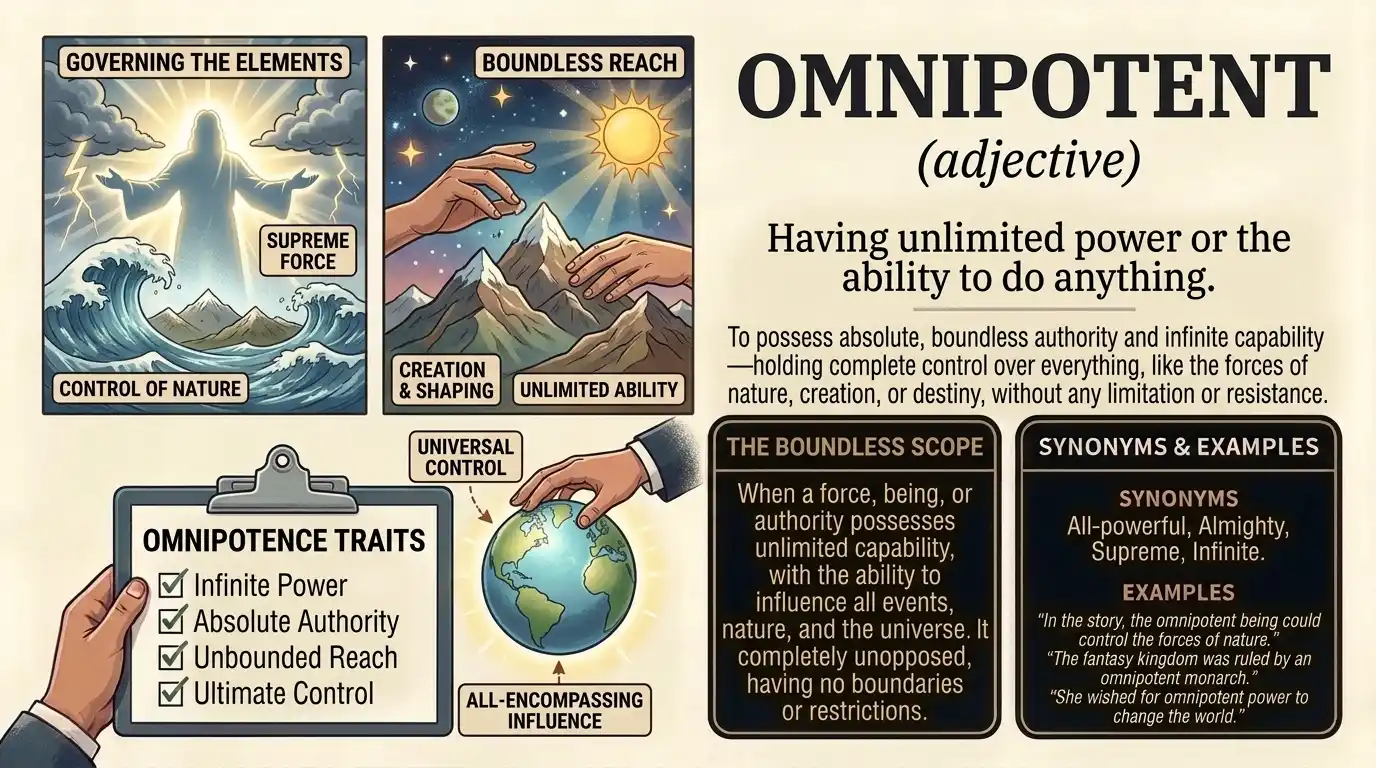
Synonyms of omnipotent include all-powerful, almighty, supreme, unlimited, and invincible. Omnipotent describes someone or something believed to possess unlimited power or authority. It commonly appears in religious, literary, and philosophical writing. The best alternative depends on whether you mean absolute power, exceptional influence, physical strength, or complete control.
Imagine a fictional ruler who controls every decision in a kingdom. People might describe that ruler as omnipotent because nobody can challenge their authority.
Learning synonyms of omnipotent helps you describe power more precisely. Some alternatives sound respectful, while others suggest excessive control or dominance.
The word often appears in books, religious discussions, political commentary, and storytelling. It adds depth when ordinary words like “powerful” fall short.
For students, bloggers, writers, and everyday English users, understanding synonyms of omnipotent improves vocabulary and makes communication more expressive.
What Does Omnipotent Really Mean?
Omnipotent is an adjective that describes someone or something possessing unlimited power or the ability to do anything.
In its strict meaning, omnipotence refers to absolute power without external limitations. The term is especially common in theology, where it describes the unlimited power of God.
In everyday English, people sometimes use omnipotent figuratively. They may describe an influential leader, wealthy organization, or fictional superhero as omnipotent.
However, ordinary human authority is rarely unlimited. This distinction matters when selecting an accurate synonym.
Simple Definition
Having unlimited power or the ability to accomplish anything.
Part of Speech
Adjective.
Example 1: Religious Context
Many believers describe God as omnipotent.
Example 2: Figurative Context
The fictional emperor appeared omnipotent to his frightened citizens.
Connotative Meaning of Omnipotent
(Connotation is the emotional or cultural meaning a word suggests beyond its basic dictionary definition.)
Positive Tone
Omnipotent can express admiration, greatness, divine strength, and complete capability.
Example: The community believed in an omnipotent and compassionate creator.
Negative Tone
The word can suggest excessive control, unchecked authority, or an intimidating concentration of power.
Example: The dictator wanted everyone to consider him omnipotent.
Neutral Tone
In academic and philosophical discussions, omnipotent describes a theoretical quality without necessarily expressing approval or criticism.
Example: The philosopher examined whether an omnipotent being could face logical limitations.
Etymology of Omnipotent
The word omnipotent comes from the Latin omnipotens, meaning all-powerful.
It combines two Latin elements:
- Omnis: All or every.
- Potens: Powerful or able.
Together, these elements express the idea of possessing all power.
Old English Period (450–1100)
The modern English word omnipotent did not yet exist as an established English adjective.
Old English religious vocabulary used native expressions to communicate ideas of divine power. Words related to almighty served a similar purpose.
Middle English Period (1100–1500)
The term entered English through Latin and French religious traditions during the Middle English period.
Christian texts helped establish its association with God’s unlimited power.
Modern English Period (1500–Present)
Omnipotent became increasingly familiar in theology, philosophy, literature, and formal writing.
Today, it also appears figuratively in discussions about powerful leaders, technology, institutions, and fictional characters.
Pronunciation of Omnipotent
American English (US)
IPA: /ɑːmˈnɪpətənt/
British English (UK)
IPA: /ɒmˈnɪpətənt/
The main stress falls on the second syllable.
Syllables
om-NIP-o-tent
Total syllables: Four.
Affixation Pattern of Omnipotent
Root
The Latin element potent-, meaning powerful or capable.
Prefix
Omni-: All or every.
Suffix
The final -ent is inherited from the Latin adjective form and is associated with the meaning of possessing a quality.
Related Word Forms
- Omnipotence — Noun.
- Omnipotently — Adverb.
- Potent — Adjective.
- Potency — Noun.
Synonyms List
The following collection includes 50 synonyms and context-specific alternatives for omnipotent.
1. All-Powerful (Adjective) — US /ˌɔːl ˈpaʊərfəl/ | UK /ˌɔːl ˈpaʊəfəl/
Meaning: Possessing complete or unlimited power.
Tone/Register: Formal, religious, literary.
Example 1: The villagers believed in an all-powerful creator.
Example 2: The novel features an all-powerful supernatural being.
2. Almighty (Adjective) — US /ɔːlˈmaɪti/ | UK /ɔːlˈmaɪti/
Meaning: Having unlimited power, especially in a divine or religious sense.
Tone/Register: Religious, formal, reverential.
Example 1: They prayed to Almighty God for guidance.
Example 2: The ancient text describes an almighty creator.
3. Supreme (Adjective) — US /suːˈpriːm/ | UK /suːˈpriːm/
Meaning: Holding the highest position, authority, or degree of power.
Tone/Register: Formal, political, academic.
Example 1: The supreme commander approved the mission.
Example 2: The council exercised supreme authority over the region.
4. Unlimited (Adjective) — US /ʌnˈlɪmɪtɪd/ | UK /ʌnˈlɪmɪtɪd/
Meaning: Having no fixed boundaries or restrictions.
Tone/Register: Neutral, formal.
Example 1: The magical object granted its owner seemingly unlimited power.
Example 2: No leader should expect unlimited authority.
5. Unrestricted (Adjective) — US /ˌʌnrɪˈstrɪktɪd/ | UK /ˌʌnrɪˈstrɪktɪd/
Meaning: Not controlled or limited by imposed rules.
Tone/Register: Formal, professional.
Example 1: The director demanded unrestricted control over the project.
Example 2: The agreement gave the committee unrestricted access.
6. Boundless (Adjective) — US /ˈbaʊndləs/ | UK /ˈbaʊndləs/
Meaning: Appearing to have no limits in size, strength, or extent.
Tone/Register: Literary, positive.
Example 1: The character possessed boundless magical energy.
Example 2: Her boundless determination impressed the entire team.
7. Limitless (Adjective) — US /ˈlɪmɪtləs/ | UK /ˈlɪmɪtləs/
Meaning: Having no apparent limits or boundaries.
Tone/Register: Neutral, inspirational.
Example 1: The fantasy hero discovered his seemingly limitless abilities.
Example 2: The artist imagined a world of limitless possibilities.
8. Infinite (Adjective) — US /ˈɪnfɪnət/ | UK /ˈɪnfɪnət/
Meaning: Having no measurable end or limit.
Tone/Register: Academic, philosophical, literary.
Example 1: The philosopher discussed the idea of infinite divine power.
Example 2: The story describes a mysterious source of infinite energy.
9. Absolute (Adjective) — US /ˈæbsəluːt/ | UK /ˈæbsəluːt/
Meaning: Complete and not subject to outside restrictions.
Tone/Register: Formal, political, philosophical.
Example 1: The monarch exercised absolute authority.
Example 2: Absolute power can weaken public accountability.
10. Invincible (Adjective) — US /ɪnˈvɪnsəbəl/ | UK /ɪnˈvɪnsəbəl/
Meaning: Impossible to defeat or overcome.
Tone/Register: Neutral, dramatic.
Example 1: The champion seemed invincible throughout the tournament.
Example 2: The superhero believed his protective armor made him invincible.
11. Unconquerable (Adjective) — US /ʌnˈkɑːŋkərəbəl/ | UK /ʌnˈkɒŋkərəbəl/
Meaning: Impossible or extremely difficult to defeat.
Tone/Register: Literary, inspirational.
Example 1: The warrior displayed an unconquerable spirit.
Example 2: The novel celebrates an unconquerable kingdom.
12. Unassailable (Adjective) — US /ˌʌnəˈseɪləbəl/ | UK /ˌʌnəˈseɪləbəl/
Meaning: So secure or strong that it cannot easily be attacked or challenged.
Tone/Register: Formal, academic.
Example 1: The leader maintained an unassailable political position.
Example 2: Her argument appeared unassailable during the debate.
13. Unchallengeable (Adjective) — US /ʌnˈtʃælɪndʒəbəl/ | UK /ʌnˈtʃælɪndʒəbəl/
Meaning: Not open to successful opposition or questioning.
Tone/Register: Formal, authoritative.
Example 1: The king claimed unchallengeable authority.
Example 2: The committee rejected the idea of an unchallengeable leader.
14. Unbeatable (Adjective) — US /ʌnˈbiːtəbəl/ | UK /ʌnˈbiːtəbəl/
Meaning: Too strong or skilled to be defeated.
Tone/Register: Neutral, conversational.
Example 1: Their football team looked unbeatable this season.
Example 2: The final opponent appeared almost unbeatable.
15. Indomitable (Adjective) — US /ɪnˈdɑːmɪtəbəl/ | UK /ɪnˈdɒmɪtəbəl/
Meaning: Showing strength or determination that cannot easily be subdued.
Tone/Register: Literary, positive.
Example 1: Her indomitable courage inspired the rescue team.
Example 2: The explorer maintained an indomitable spirit.
16. Dominant (Adjective) — US /ˈdɑːmɪnənt/ | UK /ˈdɒmɪnənt/
Meaning: Exercising greater power, influence, or control than others.
Tone/Register: Neutral, business, academic.
Example 1: The company became a dominant force in the industry.
Example 2: The dominant team controlled the entire match.
17. Predominant (Adjective) — US /prɪˈdɑːmɪnənt/ | UK /prɪˈdɒmɪnənt/
Meaning: Having the greatest influence or importance within a particular setting.
Tone/Register: Academic, formal.
Example 1: One organization held a predominant position in the market.
Example 2: The predominant political group shaped national policy.
18. Sovereign (Adjective) — US /ˈsɑːvrən/ | UK /ˈsɒvrɪn/
Meaning: Possessing independent and supreme governing authority.
Tone/Register: Political, legal, formal.
Example 1: The nation defended its sovereign rights.
Example 2: The queen exercised sovereign authority within the kingdom.
19. Paramount (Adjective) — US /ˈpærəmaʊnt/ | UK /ˈpærəmaʊnt/
Meaning: Greater in importance or authority than everything else in a particular situation.
Tone/Register: Formal, professional.
Example 1: Public safety remained the paramount concern.
Example 2: The general held paramount authority during the emergency.
20. Preeminent (Adjective) — US /priˈemɪnənt/ | UK /priˈemɪnənt/
Meaning: Superior to others in achievement, status, or importance.
Tone/Register: Academic, formal.
Example 1: She became the preeminent researcher in her field.
Example 2: The institution gained a preeminent position in education.
21. Overpowering (Adjective) — US /ˌoʊvərˈpaʊərɪŋ/ | UK /ˌəʊvəˈpaʊərɪŋ/
Meaning: So strong that resistance becomes difficult.
Tone/Register: Descriptive, literary.
Example 1: The creature displayed overpowering strength.
Example 2: An overpowering force pushed the defenders backward.
22. Overwhelming (Adjective) — US /ˌoʊvərˈwelmɪŋ/ | UK /ˌəʊvəˈwelmɪŋ/
Meaning: Extremely powerful in effect, amount, or intensity.
Tone/Register: Neutral, descriptive.
Example 1: The army faced overwhelming opposition.
Example 2: The proposal received overwhelming public support.
23. Mighty (Adjective) — US /ˈmaɪti/ | UK /ˈmaɪti/
Meaning: Possessing impressive strength, influence, or power.
Tone/Register: Literary, conversational.
Example 1: A mighty warrior protected the ancient city.
Example 2: The mighty empire controlled several trading routes.
24. Powerful (Adjective) — US /ˈpaʊərfəl/ | UK /ˈpaʊəfəl/
Meaning: Having considerable strength, authority, or influence.
Tone/Register: Neutral, everyday English.
Example 1: She became a powerful voice in the organization.
Example 2: The machine uses a powerful engine.
25. Potent (Adjective) — US /ˈpoʊtənt/ | UK /ˈpəʊtənt/
Meaning: Having strong power or the ability to produce a significant effect.
Tone/Register: Formal, academic.
Example 1: His speech delivered a potent political message.
Example 2: The new policy became a potent symbol of reform.
26. Formidable (Adjective) — US /ˈfɔːrmɪdəbəl/ | UK /ˈfɔːmɪdəbəl/
Meaning: Inspiring respect or fear because of exceptional strength or ability.
Tone/Register: Formal, descriptive.
Example 1: The lawyer proved to be a formidable opponent.
Example 2: Their company faced formidable competition.
27. Commanding (Adjective) — US /kəˈmændɪŋ/ | UK /kəˈmɑːndɪŋ/
Meaning: Having a strong presence or position that inspires authority.
Tone/Register: Professional, formal.
Example 1: The manager maintained a commanding presence during the meeting.
Example 2: The fortress occupied a commanding position above the valley.
28. Authoritative (Adjective) — US /əˈθɔːrəteɪtɪv/ | UK /ɔːˈθɒrətətɪv/
Meaning: Showing recognized authority, confidence, or reliable knowledge.
Tone/Register: Academic, professional.
Example 1: The professor delivered an authoritative explanation.
Example 2: Her authoritative manner reassured the audience.
29. Masterful (Adjective) — US /ˈmæstərfəl/ | UK /ˈmɑːstəfəl/
Meaning: Demonstrating exceptional skill or confident control.
Tone/Register: Positive, professional.
Example 1: The director gave a masterful performance.
Example 2: Her masterful handling of the crisis impressed everyone.
30. Unrivaled (Adjective) — US /ʌnˈraɪvəld/ | UK /ʌnˈraɪvəld/
Meaning: Having no equal in a particular quality or achievement.
Tone/Register: Formal, positive.
Example 1: The athlete displayed unrivaled speed.
Example 2: His knowledge of ancient history was unrivaled.
31. Matchless (Adjective) — US /ˈmætʃləs/ | UK /ˈmætʃləs/
Meaning: So exceptional that nothing else compares favorably.
Tone/Register: Literary, positive.
Example 1: The singer impressed audiences with her matchless talent.
Example 2: The legendary sword possessed matchless strength.
32. Peerless (Adjective) — US /ˈpɪrləs/ | UK /ˈpɪələs/
Meaning: Without an equal in excellence, importance, or ability.
Tone/Register: Literary, formal.
Example 1: The architect earned praise for her peerless creativity.
Example 2: The mythical guardian possessed peerless fighting skills.
33. Incomparable (Adjective) — US /ɪnˈkɑːmpərəbəl/ | UK /ɪnˈkɒmpərəbəl/
Meaning: So exceptional that meaningful comparison becomes difficult.
Tone/Register: Formal, expressive.
Example 1: The artist demonstrated incomparable imagination.
Example 2: The ancient ruler was praised for his incomparable wisdom.
34. Unequaled (Adjective) — US /ʌnˈiːkwəld/ | UK /ʌnˈiːkwəld/
Meaning: Not matched by anyone or anything in a particular quality.
Tone/Register: Formal, positive.
Example 1: The engineer showed unequaled technical expertise.
Example 2: The warrior possessed unequaled combat skills.
35. Unparalleled (Adjective) — US /ʌnˈpærəleld/ | UK /ʌnˈpærəleld/
Meaning: Greater or more remarkable than comparable examples.
Tone/Register: Formal, academic.
Example 1: The discovery represented unparalleled scientific progress.
Example 2: The organization gained unparalleled influence in the region.
36. Transcendent (Adjective) — US /trænˈsendənt/ | UK /trænˈsendənt/
Meaning: Existing beyond ordinary limits or surpassing normal experience.
Tone/Register: Philosophical, spiritual, literary.
Example 1: The poem explores the idea of transcendent divine power.
Example 2: The musician created an almost transcendent experience.
37. Superhuman (Adjective) — US /ˌsuːpərˈhjuːmən/ | UK /ˌsuːpəˈhjuːmən/
Meaning: Having abilities beyond normal human capacity.
Tone/Register: Fictional, descriptive.
Example 1: The superhero demonstrated superhuman strength.
Example 2: The rescue required an almost superhuman effort.
38. Godlike (Adjective) — US /ˈɡɑːdlaɪk/ | UK /ˈɡɒdlaɪk/
Meaning: Resembling a god in power, greatness, or other qualities.
Tone/Register: Literary, spiritual.
Example 1: The character possessed godlike abilities.
Example 2: The ancient legend describes a godlike ruler.
39. Divine (Adjective) — US /dɪˈvaɪn/ | UK /dɪˈvaɪn/
Meaning: Relating to a god or possessing qualities associated with divinity.
Tone/Register: Religious, literary.
Example 1: The temple represented divine authority.
Example 2: The villagers believed the mysterious light came from divine power.
40. Omniscient (Adjective) — US /ɑːmˈnɪʃənt/ | UK /ɒmˈnɪsiənt/
Meaning: Knowing everything rather than possessing unlimited power.
Tone/Register: Religious, academic, literary.
Example 1: The novel uses an omniscient narrator.
Example 2: The philosopher discussed the concept of an omniscient creator.
Usage Note: Omniscient is a related theological term, not a direct synonym for omnipotent.
41. Omnipresent (Adjective) — US /ˌɑːmnɪˈprezənt/ | UK /ˌɒmnɪˈprezənt/
Meaning: Existing or appearing everywhere at the same time.
Tone/Register: Religious, formal.
Example 1: The text describes God as omnipresent.
Example 2: Digital advertising feels almost omnipresent today.
Usage Note: This word describes presence, not power. It belongs to the same conceptual family as omnipotent.
42. Irresistible (Adjective) — US /ˌɪrɪˈzɪstəbəl/ | UK /ˌɪrɪˈzɪstəbəl/
Meaning: Too strong or compelling to oppose successfully.
Tone/Register: Neutral, expressive.
Example 1: The army advanced with seemingly irresistible force.
Example 2: The campaign generated an irresistible wave of support.
43. Unstoppable (Adjective) — US /ʌnˈstɑːpəbəl/ | UK /ʌnˈstɒpəbəl/
Meaning: Impossible or extremely difficult to prevent from continuing.
Tone/Register: Conversational, motivational.
Example 1: The runner looked unstoppable during the final lap.
Example 2: Their campaign gained unstoppable momentum.
44. Unyielding (Adjective) — US /ʌnˈjiːldɪŋ/ | UK /ʌnˈjiːldɪŋ/
Meaning: Refusing to surrender, weaken, or change under pressure.
Tone/Register: Formal, descriptive.
Example 1: The commander remained unyielding during negotiations.
Example 2: Her unyielding determination helped the team succeed.
45. Imperious (Adjective) — US /ɪmˈpɪriəs/ | UK /ɪmˈpɪəriəs/
Meaning: Behaving as though one possesses unquestionable authority.
Tone/Register: Formal, usually negative.
Example 1: The supervisor spoke in an imperious voice.
Example 2: His imperious attitude upset the employees.
46. Autocratic (Adjective) — US /ˌɔːtəˈkrætɪk/ | UK /ˌɔːtəˈkrætɪk/
Meaning: Exercising power through personal control with little outside participation.
Tone/Register: Political, formal, negative.
Example 1: The autocratic ruler rejected public criticism.
Example 2: Employees complained about the director’s autocratic leadership.
47. Despotic (Adjective) — US /dɪˈspɑːtɪk/ | UK /dɪˈspɒtɪk/
Meaning: Exercising absolute authority oppressively or cruelly.
Tone/Register: Political, strongly negative.
Example 1: Citizens protested against the despotic regime.
Example 2: The novel portrays a despotic emperor.
48. Tyrannical (Adjective) — US /tɪˈrænɪkəl/ | UK /tɪˈrænɪkəl/
Meaning: Using power in a cruel, unfair, or oppressive way.
Tone/Register: Formal, negative.
Example 1: The workers opposed the tyrannical factory owner.
Example 2: The fictional kingdom suffered under tyrannical rule.
49. Overlordly (Adjective) — US /ˈoʊvərlɔːrdli/ | UK /ˈəʊvəlɔːdli/
Meaning: Resembling the commanding or dominating behavior of an overlord.
Tone/Register: Rare, literary.
Example 1: The character adopted an overlordly manner.
Example 2: His overlordly attitude created tension among the nobles.
Usage Note: This is an uncommon descriptive alternative. Dominating or imperious will sound more natural in most modern writing.
50. All-Controlling (Adjective) — US /ˌɔːl kənˈtroʊlɪŋ/ | UK /ˌɔːl kənˈtrəʊlɪŋ/
Meaning: Exercising control over every aspect of a particular situation.
Tone/Register: Descriptive, often negative.
Example 1: The fictional government operated through an all-controlling surveillance system.
Example 2: The story features an all-controlling artificial intelligence.
Usage Note: This expression emphasizes complete control within a defined setting. It does not necessarily imply unlimited power.
Synonyms for Omnipotent by Tone
The emotional tone of a synonym influences how readers interpret power.
A word like almighty can communicate respect. Despotic, however, suggests cruelty and oppression.
Choosing the correct tone prevents accidental exaggeration and helps your message sound natural.
Positive Synonyms
All-powerful, almighty, mighty, indomitable, formidable, peerless, matchless, unrivaled, and unparalleled.
These words can express admiration, exceptional ability, or impressive strength.
Neutral Synonyms
Supreme, unlimited, unrestricted, boundless, limitless, infinite, absolute, sovereign, powerful, potent, and predominant.
These alternatives focus mainly on the degree or scope of power.
Negative Synonyms
Imperious, autocratic, despotic, tyrannical, overpowering, and all-controlling.
These expressions can suggest excessive authority, intimidation, or oppressive behavior.
Playful and Informal Alternatives
Unstoppable, unbeatable, superhuman, and invincible.
These words often appear in sports discussions, entertainment, friendly compliments, and casual conversations.
For example:
“After winning five games, our team feels unstoppable!”
The speaker expresses excitement rather than claiming the team possesses unlimited power.
Omnipotent vs Close Alternatives
Three alternatives deserve special attention because they describe different kinds of exceptional power.
| Word | Main Meaning | Tone | Best Context |
|---|---|---|---|
| Omnipotent | Having unlimited power | Formal, theological | Divine or absolute power |
| Almighty | Possessing unlimited power, especially divine power | Religious, reverential | Religious discussions |
| Supreme | Holding the highest rank or authority | Formal, neutral | Leadership and institutions |
| Invincible | Impossible to defeat | Dramatic, motivational | Sports, fiction, competition |
Omnipotent vs Almighty
These words are especially close in religious writing.
Omnipotent emphasizes unlimited ability. Almighty commonly refers to God and often carries a reverential tone.
Example: The theologian discussed the omnipotent nature of God.
Omnipotent vs Supreme
Supreme describes the highest authority within a particular hierarchy.
A supreme commander may outrank everyone in an organization. That commander is not necessarily omnipotent.
Use supreme when discussing rank or leadership.
Omnipotent vs Invincible
Invincible describes someone who cannot be defeated.
Omnipotent describes someone with unlimited power.
A fictional warrior may be invincible in battle without having the ability to control time, create worlds, or perform every possible action.
How Omnipotent Changes by Context
The meaning and emotional impact of omnipotent depend heavily on the surrounding sentence.
Daily Conversation
In ordinary speech, omnipotent usually sounds dramatic or humorous.
Example: “My younger brother thinks he is omnipotent whenever he wins a video game.”
Here, the speaker exaggerates the brother’s confidence.
Writing and Blogging
Bloggers may use omnipotent to describe extreme influence, authority, or control.
Example: “The novel questions whether an omnipotent ruler could remain compassionate.”
This wording encourages readers to consider the relationship between power and responsibility.
Professional and Academic Writing
Academic writers commonly encounter omnipotent in theology, philosophy, literature, and political theory.
Example: “The research examines different philosophical interpretations of omnipotence.”
In ordinary business communication, powerful, dominant, or influential will usually sound more precise.
Creative and Informal Writing
Fantasy and science fiction frequently explore characters with seemingly unlimited abilities.
Example: “The omnipotent guardian could reshape reality with a single thought.”
Creative writing allows stronger exaggeration than professional communication.
Common Mistakes Learners Make
Mistake 1: Treating Powerful and Omnipotent as Identical
A powerful individual has considerable influence.
An omnipotent being possesses unlimited power.
Avoid using omnipotent when you only mean influential or successful.
Mistake 2: Confusing Omnipotent With Omniscient
Omnipotent means all-powerful.
Omniscient means all-knowing.
A person who understands everything is not automatically capable of doing everything.
Mistake 3: Confusing Omnipotent With Omnipresent
Omnipresent describes something existing everywhere.
Omnipotent describes unlimited power.
These concepts sometimes appear together in theology, but they express different qualities.
Mistake 4: Ignoring Negative Connotations
Calling a manager omnipotent may sound sarcastic.
It can suggest that the manager behaves as though nobody should question their decisions.
Choose authoritative or influential when you intend a professional compliment.
Mistake 5: Overusing Dramatic Vocabulary
Repeating omnipotent throughout an essay can make the writing feel exaggerated.
Use it when unlimited power is genuinely relevant.
Choose supreme, powerful, dominant, or influential when those words express your meaning more accurately.
Native English Usage and Register Notes
Formal English
Omnipotent fits naturally into religious studies, philosophy, literary criticism, and formal discussions of absolute power.
Informal English
Native speakers usually prefer powerful, unstoppable, unbeatable, or incredibly strong during casual conversation.
Spoken English
Omnipotent is less common in ordinary speech. When used conversationally, it may communicate humor, criticism, or deliberate exaggeration.
Written English
The adjective is particularly effective in descriptive writing, theological discussion, and fantasy literature.
Writers who want to explore related vocabulary can also read an article about synonyms of powerful.
Real-Life Examples Using Omnipotent
Workplace Scenario
A new employee notices that every major decision requires the director’s approval.
A colleague jokes, “Our director seems omnipotent around here.”
The statement humorously suggests excessive workplace control.
Social Situation
A child wins several board games and begins boasting about being unbeatable.
His sister laughs and says, “You are not omnipotent just because you won three games!”
The word adds playful exaggeration.
Media and Pop Culture
A fantasy series introduces a mysterious character capable of changing reality.
Fans debate whether the character is genuinely omnipotent or simply possesses extraordinary abilities.
Storytelling Scenario
An author creates a ruler who can command storms, alter memories, and control time.
Describing the ruler as omnipotent establishes a sense of immense supernatural power.
However, revealing that the ruler has limitations can create an interesting conflict.
Suggested External Reference
Merriam-Webster Dictionary: https://www.merriam-webster.com/dictionary/omnipotent
This established dictionary is a useful external reference for checking the definition, pronunciation, grammatical usage, and related vocabulary of omnipotent.
Practice Quiz
Choose the most suitable answer for each situation.
Part One: Meaning and Word Choice
1. Which word best describes a being with unlimited power?
A) Ordinary
B) Omnipotent
C) Vulnerable
D) Limited
2. A football team has won every match this season. Which conversational word fits best?
A) Omniscient
B) Despotic
C) Unbeatable
D) Sovereign
3. Which word describes a ruler who exercises cruel and oppressive authority?
A) Despotic
B) Matchless
C) Divine
D) Boundless
4. A researcher is recognized as the leading expert in her field. Which word fits best?
A) Tyrannical
B) Unrestricted
C) Overpowering
D) Preeminent
5. Which adjective best describes a person who cannot be defeated?
A) Omnipresent
B) Invincible
C) Authoritative
D) Infinite
6. A religious text describes God’s unlimited power. Which alternative sounds most natural?
A) Almighty
B) Dominant
C) Commanding
D) Unyielding
7. A company controls most of its industry. Which word best describes its position?
A) Divine
B) Indomitable
C) Dominant
D) Omniscient
Part Two: Tone and Real-Life Context
8. Your friend keeps winning video games. Which word offers a playful compliment?
A) Despotic
B) Autocratic
C) Imperious
D) Unstoppable
9. A philosopher describes a being that knows everything. Which word is correct?
A) Omniscient
B) Omnipotent
C) Invincible
D) Unrestricted
10. A manager refuses to let employees participate in decisions. Which adjective fits?
A) Peerless
B) Divine
C) Autocratic
D) Boundless
11. A writer describes a character whose abilities exceed normal human limits. Which word fits?
A) Paramount
B) Superhuman
C) Sovereign
D) Predominant
12. Which adjective describes authority that is complete and unrestricted?
A) Matchless
B) Potent
C) Formidable
D) Absolute
13. A person remains determined despite repeated difficulties. Which word fits best?
A) Indomitable
B) Omnipresent
C) Tyrannical
D) Infinite
14. Which word describes something existing everywhere?
A) Omnipotent
B) Invincible
C) Omnipresent
D) Unassailable
15. A fictional emperor possesses the highest governing authority in his kingdom. Which word best describes his position?
A) Unbeatable
B) Sovereign
C) Irresistible
D) Masterful
Answer Key
1-B | 2-C | 3-A | 4-D | 5-B | 6-A | 7-C | 8-D | 9-A | 10-C | 11-B | 12-D | 13-A | 14-C | 15-B
Reflection and Application Task
Write two original sentences using different synonyms of omnipotent.
Make one sentence positive and the other negative.
Then explain how your chosen words change the emotional tone of each sentence.
FAQs
1. Can omnipotent describe an ordinary human being?
Yes, but usually in a figurative or exaggerated sense. Strictly speaking, omnipotent describes unlimited power, which ordinary humans do not possess. A writer might call a wealthy executive omnipotent to emphasize exceptional influence. However, powerful, dominant, or influential is generally more accurate when describing real people.
2. What is the difference between omnipotent and omnipotence?
Omnipotent is an adjective, while omnipotence is a noun. Omnipotent describes a being that possesses unlimited power. Omnipotence names the quality or state of possessing that power. For example, “The story features an omnipotent creator” uses the adjective. “The philosopher questioned the nature of omnipotence” uses the noun.
3. Is omnipotent always associated with religion?
No. Although omnipotent has strong religious associations, it also appears in philosophy, fiction, political commentary, and everyday exaggeration. Writers may use it to describe supernatural characters or seemingly unstoppable institutions. The context determines whether the word communicates literal divine power or a figurative impression of unlimited control.
4. What is a simpler word for omnipotent in everyday English?
All-powerful is the closest straightforward alternative. However, powerful may sound more natural when unlimited ability is not intended. For example, “a powerful leader” describes someone with considerable influence. “An all-powerful being” suggests a much greater degree of authority or ability. Choose according to the actual meaning.
5. Can omnipotent have a negative meaning?
Yes. Although the word is often respectful in religious writing, it can sound critical when applied to human behavior. Calling a manager omnipotent may suggest that the person acts as though nobody can question their authority. The negative meaning comes from the surrounding context rather than the adjective alone.
6. What is the opposite of omnipotent?
Common antonyms include powerless, weak, helpless, limited, and impotent. Powerless is often the clearest general opposite. However, the best choice depends on context. A powerless individual lacks control, while a limited being possesses abilities that cannot accomplish everything. These distinctions matter in philosophical and descriptive writing.
7. Is omnipotent suitable for academic essays?
Yes, especially in essays about theology, philosophy, literature, and concepts of absolute authority. Academic writers should define the intended meaning and avoid unsupported exaggeration. When discussing ordinary political or organizational influence, alternatives such as dominant, authoritative, or supreme may provide greater precision and make the argument easier to understand.
8. Can a fictional character be described as omnipotent?
Yes. Fantasy and science fiction frequently introduce characters with seemingly unlimited abilities. However, a character who can only control certain elements or perform specific supernatural actions is not strictly omnipotent. Writers should consider whether the character possesses unlimited power or merely extraordinary abilities within the fictional world.
Conclusion
Exploring synonyms of omnipotent reveals how English expresses strength, authority, and greatness. Every alternative offers a different shade of meaning and emotion.
Choosing accurate vocabulary makes your writing clearer and your blogging more engaging. It also helps you express ideas confidently without unnecessary exaggeration.
Understanding synonyms of omnipotent improves speaking and everyday communication. The right word can express admiration, describe authority, or highlight excessive control.
Keep practicing synonyms of omnipotent in emails, essays, and daily conversations. Try one new expression each day and enjoy watching your vocabulary grow.

Mehtab Yasir is a passionate writer and English language enthusiast dedicated to making vocabulary learning simple, practical, and enjoyable. As an author at SynonymDesk.com, she creates helpful content covering synonyms, antonyms, word meanings, vocabulary, phrases, and everyday English usage. Her goal is to provide clear and easy-to-understand information that helps students, writers, professionals, and English learners choose the right words and communicate with greater confidence. Mehtab believes that a strong vocabulary can improve both writing and communication skills. She enjoys researching new words, exploring their meanings and uses, and turning complex language concepts into useful, reader-friendly content. Through her work, she strives to make SynonymDesk.com a reliable resource for anyone looking to improve their English vocabulary and language skills.