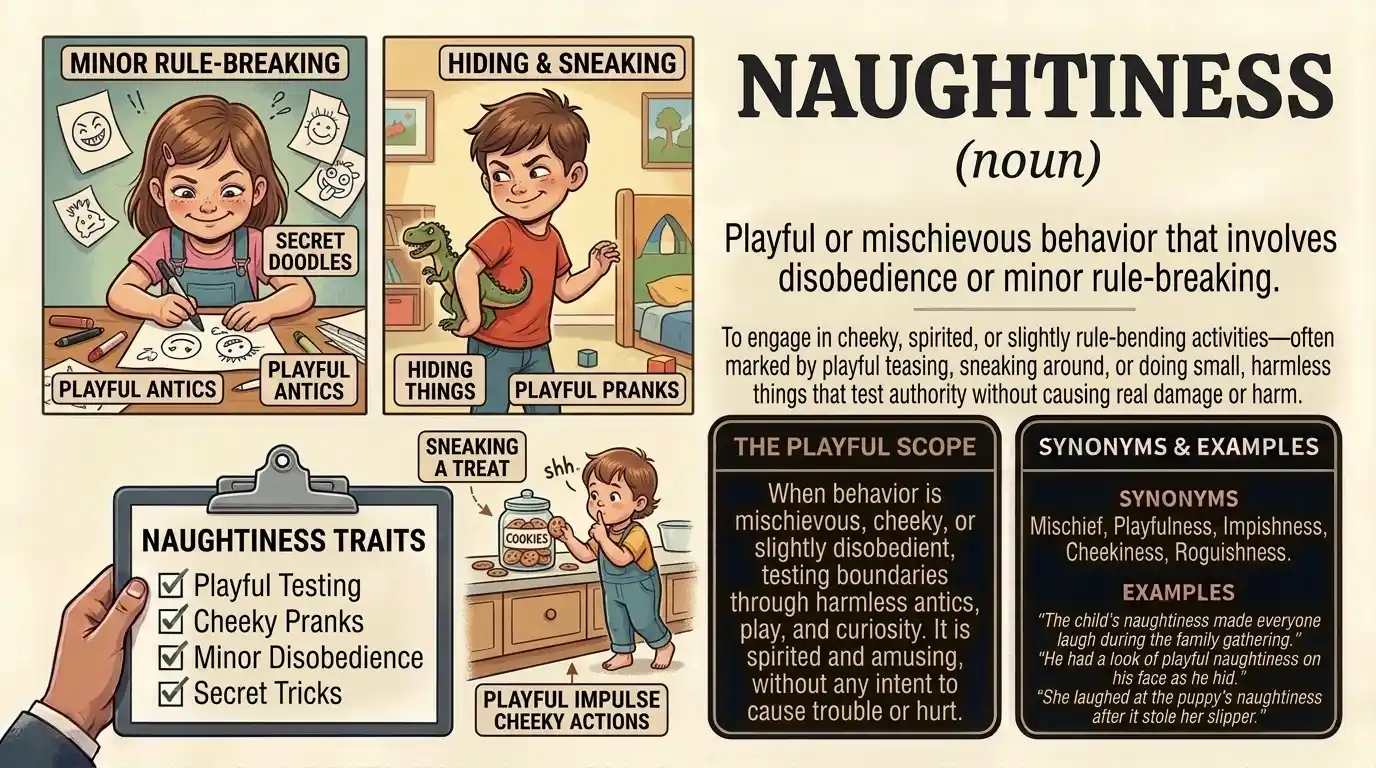
Synonyms of naughtiness include mischief, mischievousness, playfulness, cheekiness, impishness, disobedience, and unruliness. These words describe behavior that breaks rules, causes minor trouble, or shows a playful disregard for expectations. Some suggest harmless fun, while others describe deliberate misconduct. Choosing the right alternative depends on the situation, intention, and emotional tone.
Imagine a child hiding a sibling’s shoes and laughing at the confusion. That little act of naughtiness may be annoying, but it can also seem funny and innocent.
Learning synonyms of naughtiness helps you describe different types of behavior. You can distinguish harmless jokes from actions that show genuine disrespect.
Naughtiness appears in everyday conversations, parenting discussions, stories, and educational writing. Its meaning often changes with the speaker’s attitude.
Students, bloggers, content writers, and daily English users can benefit from these expressions. A richer vocabulary makes descriptions more natural and precise.
What Does Naughtiness Really Mean?
Naughtiness is a noun that describes behavior that is mischievous, disobedient, improper, or slightly troublesome.
It often refers to someone who breaks small rules or behaves in a playful but unacceptable way.
For example:
- The child’s naughtiness made everyone laugh.
- Her naughtiness sometimes tested her teacher’s patience.
Native English speakers often associate this word with children, harmless tricks, and playful misbehavior.
However, its meaning is not always innocent. Depending on the situation, naughtiness can suggest deliberate rule-breaking or mildly inappropriate adult behavior.
Part of Speech
Naughtiness (Noun): The quality or state of behaving in a naughty, mischievous, or disobedient manner.
Related forms:
- Naughty: Adjective
- Naughtily: Adverb
- Naughtiness: Noun
Example:
The puppy’s naughtiness became obvious when we found our missing slippers.
Connotative Meaning of Naughtiness
(Connotation is the emotional or cultural meaning a word suggests beyond its basic dictionary definition.)
Positive Tone
Naughtiness can suggest humor, innocence, curiosity, and playful energy.
Example: The toddler’s naughtiness brought smiles to the entire family.
Negative Tone
It may describe disobedience, disrespect, troublesome behavior, or intentional rule-breaking.
Example: His repeated naughtiness disrupted the classroom.
Neutral Tone
Sometimes, the word simply identifies behavior without strongly praising or criticizing it.
Example: The researcher observed different patterns of naughtiness among young children.
Important: The emotional meaning depends on the speaker, setting, and seriousness of the action.
Etymology of Naughtiness
The word naughtiness developed from the adjective naughty, which is historically connected to naught.
Naught comes from Old English nāwiht, meaning nothing or not anything.
Over time, naughty developed from meanings associated with having nothing or being of little worth into meanings connected with improper or disobedient behavior.
Old English (450–1100)
The linguistic ancestor nāwiht meant nothing. The modern noun naughtiness did not yet exist.
Middle English (1100–1500)
The adjective naughty developed from naught. Its earlier meanings included needy, worthless, and morally bad.
Modern English (1500–Present)
The meaning gradually shifted toward improper behavior and disobedience.
Today, naughtiness commonly describes playful mischief, particularly among children.
Pronunciation of Naughtiness
American English (US)
IPA: /ˈnɔː.ti.nəs/
British English (UK)
IPA: /ˈnɔː.ti.nəs/
The pronunciation may vary slightly by regional accent.
Syllables
naugh-ti-ness
Total syllables: 3
The primary stress falls on the first syllable.
Affixation Pattern of Naughtiness
Root/Base: Naughty
Prefix: None
Suffix: -ness
Formation: Naughty + -ness → Naughtiness
The suffix -ness changes an adjective into a noun describing a quality or condition.
40 Synonyms of Naughtiness With Meanings and Examples
Not every synonym of naughtiness has exactly the same emotional strength.
Some describe innocent amusement. Others suggest deliberate disobedience, social impropriety, or serious misconduct.
The following 40 words include close synonyms and context-dependent alternatives. Each entry explains its particular meaning and appropriate usage.
1. Mischief (Noun) — US /ˈmɪs.tʃɪf/ | UK /ˈmɪs.tʃɪf/
Meaning: Playful behavior that causes minor trouble, annoyance, or harmless disruption.
Tone/Register: Informal, playful, everyday English.
Example 1: The twins were always getting into mischief after school.
Example 2: I could see mischief in his smile before he opened the box.
2. Mischievousness (Noun) — US /ˈmɪs.tʃə.vəs.nəs/ | UK /ˈmɪs.tʃɪ.vəs.nəs/
Meaning: The quality of enjoying playful tricks or causing small amounts of trouble.
Tone/Register: Neutral, descriptive, conversational.
Example 1: Her mischievousness made family gatherings entertaining.
Example 2: The kitten’s mischievousness kept everyone busy.
3. Playfulness (Noun) — US /ˈpleɪ.fəl.nəs/ | UK /ˈpleɪ.fəl.nəs/
Meaning: A cheerful tendency to behave in an amusing or lighthearted way.
Tone/Register: Positive, friendly, informal.
Example 1: His playfulness helped the children feel comfortable.
Example 2: A little playfulness made the long journey enjoyable.
4. Cheekiness (Noun) — US /ˈtʃiː.ki.nəs/ | UK /ˈtʃiː.ki.nəs/
Meaning: Amusingly bold behavior that shows mild disrespect or a willingness to challenge expectations.
Tone/Register: Informal, especially common in British English.
Example 1: The boy’s cheekiness made his grandmother laugh.
Example 2: Her cheekiness surprised the interviewer.
5. Impishness (Noun) — US /ˈɪm.pɪʃ.nəs/ | UK /ˈɪm.pɪʃ.nəs/
Meaning: A lively tendency to play clever, amusing, or slightly troublesome tricks.
Tone/Register: Playful, literary, descriptive.
Example 1: There was a hint of impishness in her expression.
Example 2: His impishness often led to unexpected practical jokes.
6. Disobedience (Noun) — US /ˌdɪs.əˈbiː.di.əns/ | UK /ˌdɪs.əˈbiː.di.əns/
Meaning: The act of refusing or failing to follow rules, instructions, or authority.
Tone/Register: Neutral to negative, formal, educational.
Example 1: The teacher addressed the student’s repeated disobedience.
Example 2: His disobedience resulted in losing his weekend privileges.
7. Unruliness (Noun) — US /ʌnˈruː.li.nəs/ | UK /ʌnˈruː.li.nəs/
Meaning: Behavior that is difficult to control because someone refuses to follow expected rules.
Tone/Register: Negative, descriptive, formal.
Example 1: The crowd’s unruliness delayed the performance.
Example 2: Classroom unruliness made the lesson difficult to complete.
8. Rascality (Noun) — US /ræˈskæl.ə.ti/ | UK /rɑːˈskæl.ə.ti/
Meaning: Mischievous or dishonest behavior associated with a playful or troublesome rascal.
Tone/Register: Literary, humorous, sometimes negative.
Example 1: His childhood rascality became a favorite family story.
Example 2: The character’s rascality added humor to the novel.
9. Prankishness (Noun) — US /ˈpræŋ.kɪʃ.nəs/ | UK /ˈpræŋ.kɪʃ.nəs/
Meaning: A tendency to play tricks or practical jokes on other people.
Tone/Register: Informal, descriptive, relatively uncommon.
Example 1: Their prankishness became obvious during the school trip.
Example 2: His prankishness sometimes annoyed his older sister.
10. Waywardness (Noun) — US /ˈweɪ.wɚd.nəs/ | UK /ˈweɪ.wəd.nəs/
Meaning: A tendency to behave unpredictably or resist guidance and accepted expectations.
Tone/Register: Literary, formal, mildly negative.
Example 1: The teenager’s waywardness worried his parents.
Example 2: Her youthful waywardness shaped the story’s central conflict.
11. Rebelliousness (Noun) — US /rɪˈbel.jəs.nəs/ | UK /rɪˈbel.i.əs.nəs/
Meaning: A strong tendency to resist rules, authority, or established expectations.
Tone/Register: Neutral to negative, descriptive.
Example 1: His rebelliousness became more noticeable during adolescence.
Example 2: The character’s rebelliousness challenged traditional family values.
12. Defiance (Noun) — US /dɪˈfaɪ.əns/ | UK /dɪˈfaɪ.əns/
Meaning: Open resistance to instructions, authority, or established rules.
Tone/Register: Serious, formal, sometimes negative.
Example 1: The student’s defiance surprised the principal.
Example 2: She crossed her arms in quiet defiance.
13. Insolence (Noun) — US /ˈɪn.sə.ləns/ | UK /ˈɪn.səl.əns/
Meaning: Rude or disrespectful behavior toward someone who expects courtesy.
Tone/Register: Formal, negative.
Example 1: The manager refused to tolerate his insolence.
Example 2: Her insolence shocked the visiting guests.
14. Impertinence (Noun) — US /ɪmˈpɝː.tən.əns/ | UK /ɪmˈpɜː.tɪ.nəns/
Meaning: Bold or inappropriate behavior that shows insufficient respect.
Tone/Register: Formal, literary, negative.
Example 1: The guest apologized for his unexpected impertinence.
Example 2: Her impertinence irritated the strict instructor.
15. Impudence (Noun) — US /ˈɪm.pjə.dəns/ | UK /ˈɪm.pjə.dəns/
Meaning: Shamelessly bold behavior that ignores normal standards of respect.
Tone/Register: Formal, disapproving.
Example 1: His impudence left the committee speechless.
Example 2: The child showed surprising impudence when questioned.
16. Disrespect (Noun) — US /ˌdɪs.rɪˈspekt/ | UK /ˌdɪs.rɪˈspekt/
Meaning: Behavior that shows a lack of proper regard for another person or their authority.
Tone/Register: Neutral to negative, widely used.
Example 1: The coach addressed the team’s disrespect after practice.
Example 2: Interrupting every speaker showed clear disrespect.
17. Irreverence (Noun) — US /ɪˈrev.ɚ.əns/ | UK /ɪˈrev.ər.əns/
Meaning: A lack of expected seriousness or respect toward important people, beliefs, or traditions.
Tone/Register: Literary, intellectual, sometimes humorous.
Example 1: The comedian’s irreverence delighted the younger audience.
Example 2: His irreverence made the formal ceremony feel surprisingly relaxed.
18. Friskiness (Noun) — US /ˈfrɪs.ki.nəs/ | UK /ˈfrɪs.ki.nəs/
Meaning: Lively and playful behavior that may involve harmless excitement or mischief.
Tone/Register: Positive, informal, descriptive.
Example 1: The puppy’s friskiness filled the garden with energy.
Example 2: Her sudden friskiness surprised everyone at the picnic.
19. Tomfoolery (Noun) — US /tɑːmˈfuː.lɚ.i/ | UK /tɒmˈfuː.lər.i/
Meaning: Silly or foolish behavior that may cause amusement or minor trouble.
Tone/Register: Informal, humorous.
Example 1: The teacher asked the boys to stop their tomfoolery.
Example 2: Their holiday tomfoolery kept the whole family laughing.
20. Shenanigans (Plural Noun) — US /ʃəˈnæn.ɪ.ɡənz/ | UK /ʃɪˈnæn.ɪ.ɡənz/
Meaning: Playful tricks, mischievous activities, or questionable behavior.
Tone/Register: Informal, humorous, sometimes suspicious.
Example 1: The cousins were planning shenanigans for the reunion.
Example 2: Everyone suspected shenanigans when the birthday cake disappeared.
21. Horseplay (Noun) — US /ˈhɔːrs.pleɪ/ | UK /ˈhɔːs.pleɪ/
Meaning: Rough or noisy physical play that can become disruptive or unsafe.
Tone/Register: Informal, mildly negative.
Example 1: The coach warned the players against horseplay.
Example 2: Their horseplay knocked over a chair.
22. Foolishness (Noun) — US /ˈfuː.lɪʃ.nəs/ | UK /ˈfuː.lɪʃ.nəs/
Meaning: Behavior that shows poor judgment or a lack of sensible thinking.
Tone/Register: Neutral to negative, conversational.
Example 1: Their foolishness turned a simple task into a disaster.
Example 2: She regretted the foolishness of her childhood decisions.
23. Silliness (Noun) — US /ˈsɪ.li.nəs/ | UK /ˈsɪ.li.nəs/
Meaning: Lighthearted or foolish behavior that is often amusing rather than harmful.
Tone/Register: Informal, playful.
Example 1: A little silliness made the birthday party more enjoyable.
Example 2: His silliness helped everyone relax before the presentation.
24. Antics (Plural Noun) — US /ˈæn.tɪks/ | UK /ˈæn.tɪks/
Meaning: Funny, unusual, or mischievous actions that attract attention.
Tone/Register: Informal, humorous.
Example 1: The puppy’s antics entertained the entire neighborhood.
Example 2: Their backstage antics became popular on social media.
25. Trickery (Noun) — US /ˈtrɪk.ɚ.i/ | UK /ˈtrɪk.ər.i/
Meaning: The use of tricks or deception to mislead someone.
Tone/Register: Negative, descriptive.
Example 1: The magician’s playful trickery amazed the children.
Example 2: The investigation revealed deliberate trickery.
26. Trickishness (Noun) — US /ˈtrɪk.ɪʃ.nəs/ | UK /ˈtrɪk.ɪʃ.nəs/
Meaning: A tendency toward tricks, deception, or mischievous conduct.
Tone/Register: Rare, literary, descriptive.
Example 1: The fox’s trickishness became a recurring theme in the tale.
Example 2: His trickishness made the other characters cautious.
27. Puckishness (Noun) — US /ˈpʌk.ɪʃ.nəs/ | UK /ˈpʌk.ɪʃ.nəs/
Meaning: A playful and slightly wicked sense of humor expressed through mischievous behavior.
Tone/Register: Literary, humorous, expressive.
Example 1: Her puckishness made every conversation unpredictable.
Example 2: The actor brought a charming puckishness to the role.
28. Saucy Behavior (Noun Phrase) — US /ˈsɑː.si bɪˈheɪ.vjɚ/ | UK /ˈsɔː.si bɪˈheɪ.vjə/
Meaning: Bold, cheeky, or mildly disrespectful conduct that can seem amusing.
Tone/Register: Informal, somewhat old-fashioned.
Example 1: The child’s saucy behavior surprised his older aunt.
Example 2: Her saucy behavior brought laughter to the dinner table.
29. High Spirits (Plural Noun Phrase) — US /ˌhaɪ ˈspɪr.ɪts/ | UK /ˌhaɪ ˈspɪr.ɪts/
Meaning: A cheerful and energetic mood that may lead to lively or mischievous actions.
Tone/Register: Positive, conversational.
Example 1: The children were in high spirits after their exams.
Example 2: Their high spirits made the celebration especially lively.
30. Devilment (Noun) — US /ˈdev.əl.mənt/ | UK /ˈdev.əl.mənt/
Meaning: Mischievous behavior that involves causing playful trouble or annoyance.
Tone/Register: Informal, literary, sometimes regional.
Example 1: There was pure devilment in the little boy’s grin.
Example 2: The brothers spent the afternoon planning harmless devilment.
31. Ro guishness (Noun) — US /ˈroʊ.ɡɪʃ.nəs/ | UK /ˈrəʊ.ɡɪʃ.nəs/
Meaning: Charming but slightly dishonest or mischievous behavior.
Tone/Register: Literary, playful, descriptive.
Example 1: His roguishness made the fictional character memorable.
Example 2: A touch of roguishness appeared in her playful smile.
32. Misbehavior (Noun) — US /ˌmɪs.bɪˈheɪ.vjɚ/ | UK /ˌmɪs.bɪˈheɪ.vjə/
Meaning: Conduct that fails to meet expected rules or standards of behavior.
Tone/Register: Neutral, educational, everyday English.
Example 1: The teacher discussed the student’s misbehavior with his parents.
Example 2: Repeated misbehavior disrupted the school assembly.
33. Misconduct (Noun) — US /ˌmɪsˈkɑːn.dʌkt/ | UK /ˌmɪsˈkɒn.dʌkt/
Meaning: Improper behavior that violates accepted rules or professional standards.
Tone/Register: Formal, professional, negative.
Example 1: The employee faced an investigation for workplace misconduct.
Example 2: The university introduced new policies to address student misconduct.
34. Impropriety (Noun) — US /ˌɪm.prəˈpraɪ.ə.ti/ | UK /ˌɪm.prəˈpraɪ.ə.ti/
Meaning: Behavior that violates accepted standards of politeness, morality, or social conduct.
Tone/Register: Formal, academic, professional.
Example 1: The committee expressed concern about his impropriety.
Example 2: Her comment was criticized as an act of social impropriety.
35. Indiscipline (Noun) — US /ɪnˈdɪs.ə.plɪn/ | UK /ɪnˈdɪs.ɪ.plɪn/
Meaning: A lack of self-control or unwillingness to follow established rules.
Tone/Register: Formal, educational, professional.
Example 1: The principal introduced measures to reduce classroom indiscipline.
Example 2: Team indiscipline affected their performance throughout the season.
36. Rowdiness (Noun) — US /ˈraʊ.di.nəs/ | UK /ˈraʊ.di.nəs/
Meaning: Loud, disorderly, or uncontrolled behavior that disturbs other people.
Tone/Register: Negative, conversational.
Example 1: The passengers complained about the group’s rowdiness.
Example 2: Their rowdiness interrupted the peaceful neighborhood gathering.
37. Disorderliness (Noun) — US /dɪsˈɔːr.dɚ.li.nəs/ | UK /dɪsˈɔː.də.li.nəs/
Meaning: A lack of order or control in behavior or activities.
Tone/Register: Formal, descriptive.
Example 1: The supervisor noticed increasing disorderliness during the event.
Example 2: Classroom disorderliness made concentration difficult.
38. Bad Behavior (Noun Phrase) — US /ˌbæd bɪˈheɪ.vjɚ/ | UK /ˌbæd bɪˈheɪ.vjə/
Meaning: Actions that do not meet accepted standards of proper conduct.
Tone/Register: Neutral, everyday English.
Example 1: The parents explained why the bad behavior was unacceptable.
Example 2: The school introduced clear rules to discourage bad behavior.
39. Rule-Breaking (Noun) — US /ˈruːl ˌbreɪ.kɪŋ/ | UK /ˈruːl ˌbreɪ.kɪŋ/
Meaning: The act or habit of ignoring established rules or instructions.
Tone/Register: Neutral to negative, educational, professional.
Example 1: Repeated rule-breaking led to stricter classroom supervision.
Example 2: The manager addressed the team’s rule-breaking immediately.
40. Delinquency (Noun) — US /dɪˈlɪŋ.kwən.si/ | UK /dɪˈlɪŋ.kwən.si/
Meaning: Wrongful or unlawful behavior, especially among young people.
Tone/Register: Formal, legal, academic, strongly negative.
Example 1: The community developed programs to prevent juvenile delinquency.
Example 2: Researchers examined the causes of adolescent delinquency.
Usage Note: Delinquency is much stronger than ordinary naughtiness. It should not describe harmless childhood jokes.
Synonyms for Naughtiness by Tone
Choosing a synonym becomes easier when you understand the feeling it communicates.
A playful word can make behavior sound charming. A stronger expression can make the same action appear disrespectful or unacceptable.
Positive Tone
These words emphasize lively energy, humor, or innocent amusement.
- Playfulness
- Friskiness
- High spirits
- Impishness
- Puckishness
Example: The puppy’s playfulness brightened everyone’s afternoon.
Neutral Tone
These expressions can describe troublesome behavior without necessarily suggesting serious wrongdoing.
- Mischief
- Mischievousness
- Misbehavior
- Antics
- Waywardness
- Rascality
Example: The teacher noticed a pattern of minor misbehavior.
Negative Tone
These alternatives communicate disapproval, intentional rule-breaking, or unacceptable conduct.
- Disobedience
- Insolence
- Impudence
- Misconduct
- Delinquency
- Indiscipline
- Defiance
- Impropriety
Example: The employee received a warning for repeated misconduct.
Playful and Informal Tone
These words work well in friendly conversations, humorous writing, and lighthearted storytelling.
- Cheekiness
- Shenanigans
- Tomfoolery
- Devilment
- Silliness
- Horseplay
- Prankishness
Example: The cousins’ shenanigans made the family reunion unforgettable.
Why Does Tone Matter?
Imagine someone hiding a friend’s birthday gift as a surprise.
Calling this action mischief suggests playful fun.
Calling it misconduct would sound unnecessarily serious.
A good synonym should communicate both the action and the speaker’s attitude toward it.
Naughtiness vs. Close Alternatives
Three particularly useful alternatives are mischief, cheekiness, and disobedience.
Although their meanings overlap, they describe different aspects of behavior.
| Word | Main Meaning | Tone | Best Use |
|---|---|---|---|
| Naughtiness | Playful or improper behavior | Mild, flexible | General descriptions |
| Mischief | Small tricks that cause trouble | Playful | Harmless pranks |
| Cheekiness | Bold or mildly disrespectful behavior | Informal | Witty remarks |
| Disobedience | Failure to follow instructions | Serious | Rules and authority |
Naughtiness vs. Mischief
Naughtiness is a broader description of behavior that breaks expectations.
Mischief usually emphasizes playful tricks or small acts that cause trouble.
Example: The children’s mischief included hiding their father’s slippers.
Naughtiness vs. Cheekiness
Cheekiness often appears in speech, facial expressions, and bold remarks.
Naughtiness can involve both words and actions.
Example: Her cheekiness showed when she jokingly corrected her grandfather.
Naughtiness vs. Disobedience
Disobedience focuses on refusing to follow instructions.
Naughtiness may be playful and does not always involve deliberately ignoring a direct command.
Example: The student’s disobedience continued after several warnings.
How Naughtiness Changes by Context
The meaning of naughtiness depends heavily on where and how it appears.
Understanding context helps learners avoid awkward or overly strong vocabulary.
Daily Conversation
In everyday English, naughtiness often describes children, pets, and playful family behavior.
People may use the word affectionately.
Example: Our dog’s naughtiness started when he discovered the laundry basket.
Natural alternatives include mischief, cheekiness, and antics.
Writing and Blogging
Bloggers often need descriptive vocabulary that creates a clear emotional picture.
For a lighthearted parenting article, mischievousness may sound more natural than misconduct.
Example: Her playful antics made the family vacation memorable.
Using precise alternatives also improves readability and prevents unnecessary repetition.
Professional and Academic Writing
Formal communication requires careful word selection.
Words such as misconduct, indiscipline, and rule-breaking are more suitable when discussing violations of established standards.
However, these expressions should only be used when their stronger meanings fit the situation.
Example: The report examined repeated classroom misbehavior.
Creative and Informal Writing
Storytelling allows greater flexibility.
Words such as impishness, devilment, and puckishness can make a character feel lively and memorable.
Example: A mischievous smile revealed the young wizard’s playful intentions.
The right expression helps readers imagine both personality and behavior.
Common Mistakes Learners Make
Mistake 1: Treating Every Synonym as Interchangeable
Not all alternatives have equal emotional strength.
Mischief may describe a harmless joke, while delinquency can refer to serious unlawful behavior.
Choose words according to the seriousness of the action.
Mistake 2: Using Naughtiness for Every Kind of Bad Behavior
Naughtiness is generally too mild for serious wrongdoing.
For example, describing major workplace fraud as naughtiness would minimize the seriousness of the situation.
Misconduct or dishonesty would be more appropriate.
Mistake 3: Confusing Playfulness With Disobedience
Playfulness does not automatically mean someone is behaving badly.
A child laughing during a game may simply be playful.
A child deliberately ignoring a teacher’s instructions may be disobedient.
Mistake 4: Using Uncommon Words in Casual Speech
Words such as puckishness, trickishness, and impertinence are understandable, but they are less common in ordinary conversation.
Mischief, cheekiness, and bad behavior are usually more natural in everyday situations.
Mistake 5: Confusing Naughty and Naughtiness
Naughty is an adjective.
Naughtiness is a noun.
Incorrect: The child’s naughty made everyone laugh.
Correct: The child’s naughtiness made everyone laugh.
Also correct: The naughty child made everyone laugh.
Native Usage and Register Notes
Formal English
Use expressions such as misconduct, impropriety, indiscipline, and disobedience when the situation requires a serious tone.
These words are especially useful in reports, policies, and academic discussions.
Informal English
Mischief, cheekiness, shenanigans, and antics are common choices for relaxed conversations.
They sound natural when describing amusing behavior among friends and family.
Spoken English
Native speakers frequently use simple expressions such as:
- Getting into mischief
- Being naughty
- Acting cheeky
- Messing around
- Getting up to something
Example: What have you two been getting up to?
This question can playfully suggest that someone has been behaving mischievously.
Written English
Written descriptions often benefit from more precise nouns.
For example, impishness creates a different impression from defiance.
The first suggests playful trouble. The second emphasizes resistance.
For related vocabulary, readers can also explore an internal article about synonyms of mischievous.
Real-Life Examples Using Naughtiness
Workplace Scenario
An employee repeatedly ignores office rules and disrupts meetings.
Suitable word: Misconduct
Example: The supervisor addressed the employee’s repeated misconduct.
Social Scenario
A friend secretly switches two birthday cards as a harmless joke.
Suitable word: Mischief
Example: Everyone laughed when they discovered his little act of mischief.
Media and Pop Culture Scenario
A fictional character constantly plays clever tricks on others.
Suitable word: Impishness
Example: The character’s impishness made the comedy more entertaining.
Writing and Storytelling Scenario
A young adventurer refuses to follow the village’s traditional expectations.
Suitable word: Waywardness
Example: Her waywardness eventually led her beyond the village walls.
Interactive Practice Quiz
Choose the most suitable answer for each situation. Focus on meaning, emotional tone, and natural usage.
Part One: Meaning and Tone
1. A child hides his father’s keys as a harmless joke. Which word fits best?
A) Delinquency
B) Mischief
C) Misconduct
D) Impropriety
2. A student repeatedly refuses to follow classroom instructions. This behavior shows:
A) Playfulness
B) Friskiness
C) Disobedience
D) High spirits
3. A puppy runs around the garden with cheerful energy. Which word is most suitable?
A) Insolence
B) Defiance
C) Impropriety
D) Friskiness
4. A young girl makes a bold but amusing remark to her uncle. Her behavior shows:
A) Cheekiness
B) Delinquency
C) Indiscipline
D) Disorderliness
5. A professional report describes an employee’s repeated violation of company policies. Which word fits best?
A) Tomfoolery
B) Impishness
C) Mischief
D) Misconduct
6. A group of friends enjoys silly jokes during a holiday. Which expression sounds most natural?
A) Insolence
B) Shenanigans
C) Delinquency
D) Impropriety
Part Two: Real-Life Application
7. A teenager openly challenges every instruction from his parents. Which word best describes his attitude?
A) Silliness
B) Friskiness
C) Defiance
D) Playfulness
8. A comedian makes humorous remarks about respected traditions. Which word fits best?
A) Irreverence
B) Disobedience
C) Disorderliness
D) Indiscipline
9. Two children push each other playfully and accidentally knock over a chair. This is an example of:
A) Impropriety
B) Puckishness
C) Delinquency
D) Horseplay
10. A fictional character enjoys clever, slightly wicked jokes. Which word creates the best literary effect?
A) Misconduct
B) Puckishness
C) Indiscipline
D) Disrespect
11. A teacher wants a neutral word for behavior that breaks classroom expectations. Which choice is best?
A) Friskiness
B) High spirits
C) Misbehavior
D) Devilment
12. A crowd becomes loud and difficult to control during a public event. Which word fits best?
A) Rowdiness
B) Impishness
C) Cheekiness
D) Playfulness
13. A young person becomes involved in repeated unlawful activity. Which term is most appropriate?
A) Silliness
B) Mischief
C) Antics
D) Delinquency
14. A novelist describes a character who is charming but slightly dishonest. Which word fits best?
A) Indiscipline
B) Roguishness
C) Disobedience
D) Disorderliness
15. Someone speaks rudely to a supervisor without showing proper respect. Which word best describes this conduct?
A) High spirits
B) Friskiness
C) Insolence
D) Playfulness
Answer Key
1-B | 2-C | 3-D | 4-A | 5-D | 6-B | 7-C | 8-A | 9-D | 10-B | 11-C | 12-A | 13-D | 14-B | 15-C
Reflection and Application Task
Think about a funny or mischievous situation you have experienced.
Write one original sentence using any synonym from this article.
Then replace that synonym with another suitable word.
Ask yourself: Does the emotional tone change? Does the new expression make the behavior sound more serious or more playful?
This exercise helps build natural vocabulary awareness.
Recommended External Reference
For additional vocabulary verification, pronunciation guidance, and grammatical usage, consult the Cambridge Dictionary.
Suggested external link:
Cambridge Dictionary – Naughtiness
It provides a reliable reference for learners who want to explore standard English definitions and usage.
Conclusion
Learning synonyms of naughtiness helps you describe playful tricks, disobedience, and troublesome actions with greater accuracy and emotional understanding.
The right vocabulary improves essays, blogging, storytelling, and everyday speaking. It also helps readers understand whether an action is harmless or serious.
Exploring synonyms of naughtiness makes communication more expressive. Small differences in meaning can change how people understand your words and intentions.
Keep practicing synonyms of naughtiness in emails, essays, and daily conversations. Try one new expression each day and gradually build your confidence.
FAQs
1. What is a simple synonym for naughtiness that children can easily understand?
Mischief is one of the easiest alternatives for children to understand. It describes playful actions that cause minor trouble. Bad behavior is another simple expression, although it sounds more negative. Teachers and parents can use mischief when discussing harmless tricks and misbehavior when explaining actions that break classroom or household rules.
2. What is the difference between naughtiness and wickedness?
Naughtiness usually refers to playful, mildly improper, or disobedient behavior. Wickedness suggests serious moral wrongdoing or cruelty. For example, hiding someone’s pencil may be described as naughtiness. Deliberately causing severe harm would require a much stronger word. The two expressions should not be treated as direct substitutes.
3. Can naughtiness describe adults, or is it only used for children?
Naughtiness can describe adults as well as children. When applied to adults, it may suggest cheeky humor, playful rule-breaking, or mildly suggestive behavior. The meaning depends on context. For example, a friend’s harmless practical joke may be called naughtiness, while serious professional violations require more precise language.
4. What is a polite alternative to saying someone is naughty?
Playful, spirited, energetic, and mischievous can sound gentler than naughty, depending on the situation. For example, describing a child as spirited may highlight enthusiasm rather than criticize behavior. However, polite wording should remain accurate. If someone deliberately ignores important instructions, it may be necessary to describe the behavior more directly.
5. Is naughtiness a countable or uncountable noun?
Naughtiness is normally an uncountable noun. It describes a quality or general pattern of behavior rather than individual actions. Native speakers commonly say “a little naughtiness” or “some naughtiness.” They do not usually say “three naughtinesses.” To describe separate incidents, use expressions such as three naughty acts or several examples of misbehavior.
6. What does naughtiness mean when used in a humorous or romantic conversation?
In humorous or romantic contexts, naughtiness can suggest teasing, flirtation, cheeky remarks, or mildly suggestive behavior. It does not necessarily imply actual wrongdoing. Tone, relationship, and context determine the intended meaning. Because the word can carry different implications, it is important to consider the audience before using it.
7. Which alternatives to naughtiness work best in children’s stories?
Mischief, impishness, antics, and playfulness are excellent choices for children’s stories. These words create lively descriptions without making young characters seem seriously troublesome. Mischief works well for harmless tricks, while impishness can describe a clever, playful personality. Antics is especially useful when describing a series of amusing actions.
8. How can ESL learners remember the difference between mischief and misconduct?
A simple memory technique is to associate mischief with playful trouble and misconduct with improper behavior that breaks important rules. Imagine a child hiding a toy for fun. That is mischief. Now imagine an employee deliberately violating workplace policies. That is misconduct. Connecting each word with a familiar situation makes the difference easier to remember.

Mehtab Yasir is a passionate writer and English language enthusiast dedicated to making vocabulary learning simple, practical, and enjoyable. As an author at SynonymDesk.com, she creates helpful content covering synonyms, antonyms, word meanings, vocabulary, phrases, and everyday English usage. Her goal is to provide clear and easy-to-understand information that helps students, writers, professionals, and English learners choose the right words and communicate with greater confidence. Mehtab believes that a strong vocabulary can improve both writing and communication skills. She enjoys researching new words, exploring their meanings and uses, and turning complex language concepts into useful, reader-friendly content. Through her work, she strives to make SynonymDesk.com a reliable resource for anyone looking to improve their English vocabulary and language skills.