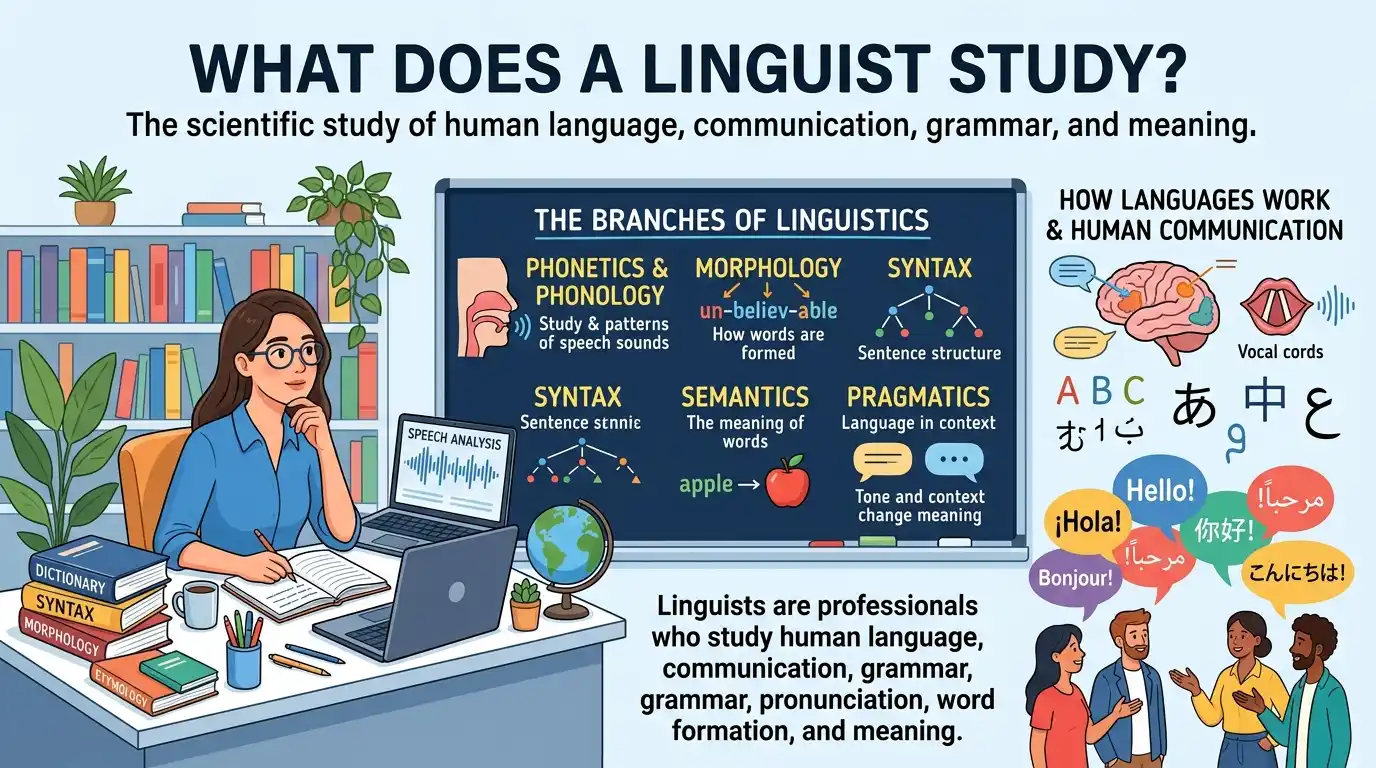
Synonyms of linguist include language specialist, philologist, linguistic scholar, language researcher, and grammarian. A linguist is someone who studies language scientifically or has specialized knowledge of languages. The best alternative depends on whether you mean a language researcher, a multilingual speaker, a translator, or an expert in a particular area of language.
Imagine meeting someone who studies how people speak. You might call them a linguist, but another word could describe their expertise more precisely.
Learning synonyms of linguist helps you describe language professionals clearly. It also makes your vocabulary richer and improves everyday communication.
Students, bloggers, and content writers often need accurate terms for language experts. Choosing the right word makes academic and creative writing clearer.
Exploring synonyms of linguist also reveals how language connects people, cultures, and ideas. Small differences in meaning can change an entire sentence.
What Does Linguist Really Mean?
A linguist is a person who studies language, its structure, development, meaning, or use. The term can also describe someone skilled in several languages.
In modern academic English, linguist most commonly refers to a specialist in linguistics, the scientific study of human language.
Linguists explore how people produce sounds, form words, build sentences, express meanings, and communicate across communities.
For example:
- A linguist studies how children learn their first language.
- The university hired a linguist to research regional accents.
The word is a countable noun. Its plural form is linguists.
Native speakers generally understand it as a professional or academic term. However, everyday speakers sometimes use it to describe someone who knows several languages.
Connotative Meaning
(Connotation is the emotional, cultural, or social meaning a word suggests beyond its basic dictionary definition.)
Positive Tone
Linguist can suggest intelligence, education, curiosity, and expertise.
Example: The talented linguist helped preserve an endangered language.
Negative Tone
The word has no inherently negative meaning. A negative impression usually comes from the surrounding sentence.
Example: The arrogant linguist dismissed everyone else’s suggestions.
Neutral Tone
In academic and professional contexts, linguist simply identifies a person’s field of expertise.
Example: The linguist presented her research at the conference.
Etymology of Linguist
The word linguist has roots in Latin.
It comes from the Latin word lingua, meaning tongue or language. The term entered English through linguistic forms associated with language knowledge.
Its history reflects humanity’s growing interest in studying communication.
Old English (450–1100)
The modern word linguist did not exist in Old English.
People used native vocabulary associated with speech, tongues, and language. The Old English word tunge could refer to both the physical tongue and language.
Middle English (1100–1500)
French and Latin strongly influenced English during this period.
Language-related vocabulary expanded through education, religion, and scholarly writing. However, linguist had not yet become an established English term.
Modern English (1500–Present)
Linguist entered English in the late sixteenth century, initially describing someone skilled in languages.
Its academic meaning developed as the systematic study of language became more established.
Today, it commonly refers to a researcher or specialist in linguistics.
Pronunciation of Linguist
American English (US)
IPA: /ˈlɪŋ.ɡwɪst/
British English (UK)
IPA: /ˈlɪŋ.ɡwɪst/
Both varieties use essentially the same pronunciation.
The first syllable receives the primary stress.
Syllables
lin-guist
Total syllables: 2
Pronunciation tip: Say LING-gwist. Keep the first syllable stronger than the second.
Affixation Pattern of Linguist
Root: Lingu-, derived from Latin lingua (language or tongue).
Prefix: None.
Suffix: -ist, indicating a person associated with a field, activity, or specialized practice.
Related word forms include:
Linguistics
The scientific study of language.
Linguistic
An adjective relating to language or linguistics.
Linguistically
An adverb describing something from the perspective of language.
Multilingual
An adjective describing someone or something that uses several languages.
Synonyms List
1. Language Specialist (Noun Phrase) — US /ˈlæŋ.ɡwɪdʒ ˈspeʃ.əl.ɪst/ | UK /ˈlæŋ.ɡwɪdʒ ˈspeʃ.əl.ɪst/
Meaning: A professional with specialized knowledge of language or a particular language-related field.
Tone/Register: Professional, neutral.
Example 1: The company hired a language specialist for its international project.
Example 2: Our language specialist reviewed the training materials.
2. Language Expert (Noun Phrase) — US /ˈlæŋ.ɡwɪdʒ ˈek.spɝːt/ | UK /ˈlæŋ.ɡwɪdʒ ˈek.spɜːt/
Meaning: Someone with advanced knowledge of one or more languages.
Tone/Register: Neutral, professional.
Example 1: A language expert explained the unusual expression.
Example 2: The museum invited a language expert to examine the inscription.
3. Philologist (Noun) — US /fɪˈlɑː.lə.dʒɪst/ | UK /fɪˈlɒl.ə.dʒɪst/
Meaning: A scholar who studies languages through historical texts and their development.
Tone/Register: Formal, academic.
Example 1: The philologist examined a collection of medieval manuscripts.
Example 2: Her research explores how ancient words changed over time.
4. Linguistic Scholar (Noun Phrase) — US /lɪŋˈɡwɪs.tɪk ˈskɑː.lɚ/ | UK /lɪŋˈɡwɪs.tɪk ˈskɒl.ə/
Meaning: An academic who studies language and contributes to linguistic knowledge.
Tone/Register: Academic, formal.
Example 1: The linguistic scholar published a study on sentence structure.
Example 2: Several scholars attended the international language conference.
5. Language Researcher (Noun Phrase) — US /ˈlæŋ.ɡwɪdʒ rɪˈsɝː.tʃɚ/ | UK /ˈlæŋ.ɡwɪdʒ rɪˈsɜː.tʃə/
Meaning: A person who investigates language through observation, analysis, and research.
Tone/Register: Academic, professional.
Example 1: The language researcher interviewed bilingual families.
Example 2: She collected speech samples from several communities.
6. Grammarian (Noun) — US /ɡrəˈmer.i.ən/ | UK /ɡrəˈmeə.ri.ən/
Meaning: A specialist who studies or describes the rules and structures of grammar.
Tone/Register: Formal, educational.
Example 1: The grammarian explained why the sentence sounded unnatural.
Example 2: A respected grammarian contributed to the reference book.
7. Language Scholar (Noun Phrase) — US /ˈlæŋ.ɡwɪdʒ ˈskɑː.lɚ/ | UK /ˈlæŋ.ɡwɪdʒ ˈskɒl.ə/
Meaning: Someone who studies languages through advanced academic work.
Tone/Register: Academic, respectful.
Example 1: The language scholar explored the history of English.
Example 2: Her university recognized her contributions to language studies.
8. Linguistics Researcher (Noun Phrase) — US /lɪŋˈɡwɪs.tɪks rɪˈsɝː.tʃɚ/ | UK /lɪŋˈɡwɪs.tɪks rɪˈsɜː.tʃə/
Meaning: A researcher who investigates scientific questions about human language.
Tone/Register: Academic, technical.
Example 1: The linguistics researcher studied how people recognize spoken words.
Example 2: His latest project focuses on bilingual communication.
9. Language Scientist (Noun Phrase) — US /ˈlæŋ.ɡwɪdʒ ˈsaɪ.ən.tɪst/ | UK /ˈlæŋ.ɡwɪdʒ ˈsaɪ.ən.tɪst/
Meaning: A scientist who studies language using systematic research methods.
Tone/Register: Academic, descriptive.
Example 1: The language scientist investigated how infants recognize speech.
Example 2: Her experiments revealed interesting patterns in pronunciation.
10. Linguistic Analyst (Noun Phrase) — US /lɪŋˈɡwɪs.tɪk ˈæn.ə.lɪst/ | UK /lɪŋˈɡwɪs.tɪk ˈæn.ə.lɪst/
Meaning: A specialist who examines language data, patterns, or structures.
Tone/Register: Technical, professional.
Example 1: The linguistic analyst reviewed hundreds of recorded conversations.
Example 2: The research team needed someone to analyze regional speech patterns.
11. Phonetician (Noun) — US /ˌfoʊ.nəˈtɪʃ.ən/ | UK /ˌfəʊ.nəˈtɪʃ.ən/
Meaning: A specialist who studies the physical production and perception of speech sounds.
Tone/Register: Scientific, academic.
Example 1: The phonetician recorded different vowel sounds.
Example 2: She examined how speakers pronounce difficult consonants.
12. Phonologist (Noun) — US /fəˈnɑː.lə.dʒɪst/ | UK /fəˈnɒl.ə.dʒɪst/
Meaning: A linguist who studies how sounds function within language systems.
Tone/Register: Academic, technical.
Example 1: The phonologist compared sound patterns across several languages.
Example 2: His research explains why certain sound combinations are uncommon.
13. Morphologist (Noun) — US /mɔːrˈfɑː.lə.dʒɪst/ | UK /mɔːˈfɒl.ə.dʒɪst/
Meaning: In linguistics, a specialist who studies the structure and formation of words.
Tone/Register: Technical, academic.
Example 1: The morphologist examined how English prefixes change meaning.
Example 2: She studied word endings in Turkish.
14. Syntactician (Noun) — US /ˌsɪn.tækˈtɪʃ.ən/ | UK /ˌsɪn.tækˈtɪʃ.ən/
Meaning: A linguist who studies sentence structure and grammatical relationships.
Tone/Register: Academic, specialized.
Example 1: The syntactician investigated English question formation.
Example 2: His research compares sentence patterns in different languages.
15. Semanticist (Noun) — US /sɪˈmæn.tɪ.sɪst/ | UK /sɪˈmæn.tɪ.sɪst/
Meaning: A specialist who studies meaning in words, phrases, and sentences.
Tone/Register: Academic, technical.
Example 1: The semanticist explained why one word has several meanings.
Example 2: Her research examines how context affects interpretation.
16. Pragmaticist (Noun) — US /præɡˈmæt.ɪ.sɪst/ | UK /præɡˈmæt.ɪ.sɪst/
Meaning: A researcher who studies how speakers communicate meaning through context and intention.
Tone/Register: Academic, specialized.
Example 1: The pragmaticist analyzed how people make polite requests.
Example 2: She studied indirect meanings in workplace conversations.
17. Sociolinguist (Noun) — US /ˌsoʊ.si.oʊˈlɪŋ.ɡwɪst/ | UK /ˌsəʊ.si.əʊˈlɪŋ.ɡwɪst/
Meaning: A linguist who studies the relationship between language and society.
Tone/Register: Academic, professional.
Example 1: The sociolinguist explored how teenagers use slang.
Example 2: Her research examined language differences across social groups.
18. Psycholinguist (Noun) — US /ˌsaɪ.koʊˈlɪŋ.ɡwɪst/ | UK /ˌsaɪ.kəʊˈlɪŋ.ɡwɪst/
Meaning: A researcher who studies how the human mind understands, produces, and learns language.
Tone/Register: Scientific, academic.
Example 1: The psycholinguist studied how children recognize familiar words.
Example 2: His experiment measured how quickly adults process sentences.
19. Neurolinguist (Noun) — US /ˌnʊr.oʊˈlɪŋ.ɡwɪst/ | UK /ˌnjʊə.rəʊˈlɪŋ.ɡwɪst/
Meaning: A specialist who studies the relationship between language and the brain.
Tone/Register: Scientific, technical.
Example 1: The neurolinguist investigated how brain injuries affect speech.
Example 2: Her team studied language processing through brain imaging.
20. Computational Linguist (Noun Phrase) — US /ˌkɑːm.pjəˈteɪ.ʃən.əl ˈlɪŋ.ɡwɪst/ | UK /ˌkɒm.pjʊˈteɪ.ʃən.əl ˈlɪŋ.ɡwɪst/
Meaning: A specialist who uses computational methods to analyze or model human language.
Tone/Register: Technical, professional.
Example 1: The computational linguist developed a system for recognizing speech.
Example 2: She works on improving multilingual language technology.
21. Historical Linguist (Noun Phrase) — US /hɪˈstɔːr.ɪ.kəl ˈlɪŋ.ɡwɪst/ | UK /hɪˈstɒr.ɪ.kəl ˈlɪŋ.ɡwɪst/
Meaning: A linguist who studies how languages change over time.
Tone/Register: Academic, formal.
Example 1: The historical linguist traced the origins of several English words.
Example 2: His research explored changes in ancient pronunciation.
22. Comparative Linguist (Noun Phrase) — US /kəmˈper.ə.tɪv ˈlɪŋ.ɡwɪst/ | UK /kəmˈpær.ə.tɪv ˈlɪŋ.ɡwɪst/
Meaning: A specialist who compares languages to identify historical relationships and shared features.
Tone/Register: Academic, formal.
Example 1: The comparative linguist examined similarities between related languages.
Example 2: She identified several shared grammatical patterns.
23. Applied Linguist (Noun Phrase) — US /əˈplaɪd ˈlɪŋ.ɡwɪst/ | UK /əˈplaɪd ˈlɪŋ.ɡwɪst/
Meaning: A specialist who applies language research to practical problems.
Tone/Register: Professional, academic.
Example 1: The applied linguist helped improve the school’s language curriculum.
Example 2: Her work focuses on effective second-language teaching.
24. Corpus Linguist (Noun Phrase) — US /ˈkɔːr.pəs ˈlɪŋ.ɡwɪst/ | UK /ˈkɔː.pəs ˈlɪŋ.ɡwɪst/
Meaning: A researcher who studies language through large collections of authentic texts or recordings.
Tone/Register: Academic, technical.
Example 1: The corpus linguist analyzed thousands of online articles.
Example 2: His findings showed how word usage changes across generations.
25. Field Linguist (Noun Phrase) — US /fiːld ˈlɪŋ.ɡwɪst/ | UK /fiːld ˈlɪŋ.ɡwɪst/
Meaning: A linguist who gathers language information directly from speakers and communities.
Tone/Register: Academic, professional.
Example 1: The field linguist recorded stories from local speakers.
Example 2: She spent several months documenting an endangered language.
26. Descriptive Linguist (Noun Phrase) — US /dɪˈskrɪp.tɪv ˈlɪŋ.ɡwɪst/ | UK /dɪˈskrɪp.tɪv ˈlɪŋ.ɡwɪst/
Meaning: A specialist who documents how people actually use language.
Tone/Register: Academic, neutral.
Example 1: The descriptive linguist examined everyday speech patterns.
Example 2: He recorded regional expressions without judging them as incorrect.
27. Dialectologist (Noun) — US /ˌdaɪ.ə.lekˈtɑː.lə.dʒɪst/ | UK /ˌdaɪ.ə.lekˈtɒl.ə.dʒɪst/
Meaning: A specialist who studies regional and social varieties of language.
Tone/Register: Academic, technical.
Example 1: The dialectologist documented speech differences across the region.
Example 2: Her research focused on rural English dialects.
28. Etymologist (Noun) — US /ˌet.əˈmɑː.lə.dʒɪst/ | UK /ˌet.ɪˈmɒl.ə.dʒɪst/
Meaning: A scholar who investigates the origins and historical development of words.
Tone/Register: Academic, formal.
Example 1: The etymologist explained the Latin origin of the expression.
Example 2: She traced the word through several centuries of written records.
29. Lexicologist (Noun) — US /ˌlek.sɪˈkɑː.lə.dʒɪst/ | UK /ˌlek.sɪˈkɒl.ə.dʒɪst/
Meaning: A specialist who studies vocabulary and the relationships between words.
Tone/Register: Academic, technical.
Example 1: The lexicologist researched changes in modern English vocabulary.
Example 2: His study explored how new expressions enter everyday speech.
30. Discourse Analyst (Noun Phrase) — US /ˈdɪs.kɔːrs ˈæn.ə.lɪst/ | UK /ˈdɪs.kɔːs ˈæn.ə.lɪst/
Meaning: A researcher who examines language use across conversations, texts, and social situations.
Tone/Register: Academic, professional.
Example 1: The discourse analyst studied communication during job interviews.
Example 2: She examined how political speeches influence public discussion.
Related Language Professionals and Specialists
The following expressions are useful alternatives when describing someone who works professionally with languages.
They are not universal substitutes for linguist. Their meanings depend on the person’s responsibilities.
31. Lexicographer (Noun) — US /ˌlek.sɪˈkɑː.ɡrə.fɚ/ | UK /ˌlek.sɪˈkɒɡ.rə.fə/
Meaning: A professional who writes, edits, or compiles dictionaries.
Tone/Register: Professional, academic.
Example 1: The lexicographer added several modern expressions to the dictionary.
Example 2: Her team researched how people use the word online.
32. Translator (Noun) — US /trænzˈleɪ.tɚ/ | UK /trænzˈleɪ.tə/
Meaning: A professional who converts written material from one language into another.
Tone/Register: Professional, neutral.
Example 1: The translator prepared an English version of the novel.
Example 2: She specializes in translating legal documents.
33. Interpreter (Noun) — US /ɪnˈtɝː.prə.tɚ/ | UK /ɪnˈtɜː.prɪ.tə/
Meaning: A professional who conveys spoken or signed communication between languages.
Tone/Register: Professional, neutral.
Example 1: The interpreter helped both speakers understand each other.
Example 2: He interpreted the presentation during the international meeting.
34. Language Consultant (Noun Phrase) — US /ˈlæŋ.ɡwɪdʒ kənˈsʌl.tənt/ | UK /ˈlæŋ.ɡwɪdʒ kənˈsʌl.tənt/
Meaning: A professional who advises organizations or individuals on language-related matters.
Tone/Register: Business, professional.
Example 1: The language consultant reviewed the company’s global communication strategy.
Example 2: She helped the team adapt its message for international readers.
35. Language Educator (Noun Phrase) — US /ˈlæŋ.ɡwɪdʒ ˈedʒ.ə.keɪ.tɚ/ | UK /ˈlæŋ.ɡwɪdʒ ˈedʒ.u.keɪ.tə/
Meaning: A professional who teaches languages and develops language-learning skills.
Tone/Register: Educational, professional.
Example 1: The language educator introduced a new speaking activity.
Example 2: Her lessons encourage students to communicate confidently.
36. Language Instructor (Noun Phrase) — US /ˈlæŋ.ɡwɪdʒ ɪnˈstrʌk.tɚ/ | UK /ˈlæŋ.ɡwɪdʒ ɪnˈstrʌk.tə/
Meaning: Someone who provides structured teaching in a particular language.
Tone/Register: Educational, neutral.
Example 1: The language instructor taught beginners basic Spanish.
Example 2: He prepared pronunciation exercises for his class.
37. Language Trainer (Noun Phrase) — US /ˈlæŋ.ɡwɪdʒ ˈtreɪ.nɚ/ | UK /ˈlæŋ.ɡwɪdʒ ˈtreɪ.nə/
Meaning: A professional who helps learners develop practical language skills.
Tone/Register: Professional, educational.
Example 1: The language trainer helped employees improve their spoken English.
Example 2: She designed lessons around everyday workplace situations.
38. Language Coach (Noun Phrase) — US /ˈlæŋ.ɡwɪdʒ koʊtʃ/ | UK /ˈlæŋ.ɡwɪdʒ kəʊtʃ/
Meaning: Someone who gives personalized guidance to improve language performance.
Tone/Register: Friendly, professional.
Example 1: The language coach helped him prepare for his interview.
Example 2: She gave practical feedback on his speaking habits.
39. Terminologist (Noun) — US /ˌtɝː.məˈnɑː.lə.dʒɪst/ | UK /ˌtɜː.mɪˈnɒl.ə.dʒɪst/
Meaning: A specialist who studies and manages technical vocabulary within particular fields.
Tone/Register: Technical, professional.
Example 1: The terminologist reviewed medical terms for consistency.
Example 2: She created a vocabulary guide for the engineering team.
40. Language Documentarian (Noun Phrase) — US /ˈlæŋ.ɡwɪdʒ ˌdɑː.kjə.menˈter.i.ən/ | UK /ˈlæŋ.ɡwɪdʒ ˌdɒk.jə.menˈteə.ri.ən/
Meaning: A specialist who records and preserves information about languages, especially underdocumented ones.
Tone/Register: Academic, descriptive.
Example 1: The language documentarian recorded traditional songs and stories.
Example 2: Her project preserved valuable knowledge from older speakers.
Related Terms for People Skilled in Languages
These expressions describe language ability rather than scientific expertise.
Use them when the context focuses on speaking, reading, or understanding multiple languages.
41. Polyglot (Noun) — US /ˈpɑː.li.ɡlɑːt/ | UK /ˈpɒl.i.ɡlɒt/
Meaning: A person who knows or speaks several languages.
Tone/Register: Positive, neutral.
Example 1: The polyglot switched comfortably between French and English.
Example 2: She enjoys learning languages during her travels.
42. Multilingual Speaker (Noun Phrase) — US /ˌmʌl.tiˈlɪŋ.ɡwəl ˈspiː.kɚ/ | UK /ˌmʌl.tiˈlɪŋ.ɡwəl ˈspiː.kə/
Meaning: Someone who can communicate in several languages.
Tone/Register: Neutral, descriptive.
Example 1: The multilingual speaker welcomed visitors from different countries.
Example 2: She uses three languages at home and work.
43. Bilingual Speaker (Noun Phrase) — US /baɪˈlɪŋ.ɡwəl ˈspiː.kɚ/ | UK /baɪˈlɪŋ.ɡwəl ˈspiː.kə/
Meaning: A person who communicates in two languages.
Tone/Register: Neutral, everyday.
Example 1: The bilingual speaker answered questions in Urdu and English.
Example 2: He grew up using two languages with his family.
44. Language Enthusiast (Noun Phrase) — US /ˈlæŋ.ɡwɪdʒ ɪnˈθuː.zi.æst/ | UK /ˈlæŋ.ɡwɪdʒ ɪnˈθjuː.zi.æst/
Meaning: Someone who has a strong personal interest in learning about languages.
Tone/Register: Positive, informal.
Example 1: The language enthusiast practices Japanese every evening.
Example 2: She enjoys discovering expressions from different cultures.
45. Language Aficionado (Noun Phrase) — US /ˈlæŋ.ɡwɪdʒ əˌfɪʃ.i.əˈnɑː.doʊ/ | UK /ˈlæŋ.ɡwɪdʒ əˌfɪʃ.i.əˈnɑː.dəʊ/
Meaning: A person with an enthusiastic and knowledgeable interest in languages.
Tone/Register: Expressive, informal.
Example 1: The language aficionado collects books about unusual dialects.
Example 2: He loves discussing interesting expressions with friends.
46. Language Savant (Noun Phrase) — US /ˈlæŋ.ɡwɪdʒ sæˈvɑːnt/ | UK /ˈlæŋ.ɡwɪdʒ ˈsæv.ənt/
Meaning: Someone with exceptional language-related knowledge or ability.
Tone/Register: Expressive, admiring.
Example 1: Her remarkable memory made people describe her as a language savant.
Example 2: The young language savant could recognize several unfamiliar languages.
47. Linguaphile (Noun) — US /ˈlɪŋ.ɡwə.faɪl/ | UK /ˈlɪŋ.ɡwə.faɪl/
Meaning: A person who loves languages and enjoys learning about them.
Tone/Register: Informal, positive, relatively uncommon.
Example 1: As a linguaphile, she enjoys comparing expressions across cultures.
Example 2: His interest in ancient writing systems began at school.
48. Language Learner (Noun Phrase) — US /ˈlæŋ.ɡwɪdʒ ˈlɝː.nɚ/ | UK /ˈlæŋ.ɡwɪdʒ ˈlɜː.nə/
Meaning: Someone who is actively studying a language.
Tone/Register: Neutral, educational.
Example 1: The language learner practiced new vocabulary before breakfast.
Example 2: She improved her pronunciation through regular conversations.
49. Language Practitioner (Noun Phrase) — US /ˈlæŋ.ɡwɪdʒ prækˈtɪʃ.ən.ɚ/ | UK /ˈlæŋ.ɡwɪdʒ prækˈtɪʃ.ən.ə/
Meaning: A professional who applies language-related knowledge in practical work.
Tone/Register: Professional, descriptive.
Example 1: The language practitioner developed communication resources for schools.
Example 2: Her work connects language research with classroom activities.
50. Multilingual (Noun) — US /ˌmʌl.tiˈlɪŋ.ɡwɪst/ | UK /ˌmʌl.tiˈlɪŋ.ɡwɪst/
Meaning: A relatively uncommon term for someone knowledgeable or skilled in several languages.
Tone/Register: Descriptive, uncommon.
Example 1: The multilingual demonstrated impressive knowledge of European languages.
Example 2: Her multilingual abilities made her valuable to the international team.
Usage note: Polyglot or multilingual speaker is usually more natural in everyday English.
Synonyms for Linguist by Tone
Tone helps readers understand how you view a person’s abilities, knowledge, or profession.
Most alternatives for linguist are neutral or positive. Negative meanings usually come from surrounding words rather than the professional title itself.
Positive Tone
These expressions can highlight expertise, dedication, or admiration:
- Language expert
- Linguistic scholar
- Polyglot
- Language savant
- Language enthusiast
- Language aficionado
- Linguaphile
Example: The respected linguistic scholar inspired students to explore endangered languages.
Neutral Tone
These alternatives identify a person’s work without expressing strong feelings:
- Language specialist
- Language researcher
- Grammarian
- Phonetician
- Sociolinguist
- Translator
- Interpreter
- Language instructor
- Language consultant
- Applied linguist
Example: The language researcher collected information about local pronunciation.
Negative Tone
There are no standard inherently negative synonyms for linguist in this collection.
A professional title can develop a negative tone when paired with critical descriptions.
For example, arrogant grammarian suggests someone who acts superior about grammar.
Likewise, pedantic language expert suggests someone who focuses excessively on small language details.
Neither phrase means that all grammarians or language experts behave this way.
Playful or Informal Tone
These expressions work better in friendly conversations:
- Language enthusiast
- Linguaphile
- Language aficionado
- Polyglot
- Language lover (an informal descriptive alternative)
Example: My friend is a real language enthusiast. She studies a new language whenever she travels.
Linguist vs Close Alternatives
Three particularly useful comparisons are linguist, philologist, and polyglot.
Although these words share a connection with language, they describe different abilities or interests.
| Word | Main meaning | Tone | Best context |
|---|---|---|---|
| Linguist | Studies language scientifically | Academic, neutral | Language research |
| Philologist | Studies language through historical texts | Scholarly, formal | Historical language studies |
| Polyglot | Knows or speaks several languages | Positive, neutral | Multilingual ability |
Linguist vs Philologist
A linguist may study pronunciation, grammar, meaning, or communication.
A philologist focuses more specifically on language history and written texts.
Use philologist when discussing ancient manuscripts, historical literature, or textual traditions.
Linguist vs Polyglot
A linguist studies how language works.
A polyglot knows several languages.
A person can be both, but one qualification does not automatically imply the other.
For example, someone might study English sentence structure professionally while speaking only English fluently.
Another person might speak five languages without having formal training in linguistics.
Linguist vs Language Specialist
Linguist is more precise when describing someone trained in linguistics.
Language specialist is broader. It may describe someone working in translation, language education, editing, or communication.
Use the broader expression when the person’s exact specialization is unknown.
How Linguist Changes by Context
The meaning of linguist becomes clearer when we consider where and why it appears.
Daily Conversation
In everyday speech, people sometimes use linguist for someone who knows several languages.
Example: My cousin is a talented linguist who speaks four languages.
However, a polyglot or multilingual speaker may communicate this meaning more precisely.
Writing or Blogging
Bloggers often use the term when discussing vocabulary, grammar, pronunciation, or language learning.
Example: A linguist explains why English spelling can feel confusing.
For educational articles, choose specific titles whenever possible. For instance, a lexicographer has a different professional role than a phonetician.
Professional or Academic Tone
Academic writing usually treats a linguist as someone who studies language scientifically.
Example: The linguist presented new findings about bilingual speech development.
Specialist titles such as sociolinguist and psycholinguist provide additional precision.
Creative or Informal Use
Creative writing allows more expressive descriptions.
Example: She was a curious linguaphile who loved collecting forgotten expressions.
Words such as polyglot and language aficionado can make character descriptions more engaging.
However, they should match the character’s actual abilities and interests.
Common Mistakes Learners Make
Choosing synonyms requires more than finding words with similar dictionary definitions.
The following mistakes are especially common when discussing language-related professions.
Mistake 1: Assuming Every Linguist Speaks Many Languages
A linguist does not need to speak several languages fluently.
Linguistics involves studying how language works. Multilingual ability is a separate skill.
Better usage: She is a linguist who researches English pronunciation.
Mistake 2: Using Translator and Interpreter Interchangeably
A translator usually works with written language.
An interpreter works with spoken or signed communication.
Better usage: The interpreter helped during the live conference.
Mistake 3: Calling Every Language Teacher a Linguist
A language teacher may have linguistic training, but teaching a language does not automatically make someone a linguistics researcher.
Better usage: The language instructor helped students improve their speaking skills.
Mistake 4: Confusing Philologist With Polyglot
A philologist studies language through historical texts.
A polyglot knows several languages.
These words should not replace each other without considering the intended meaning.
Mistake 5: Overusing Academic Vocabulary
Technical terms can make simple sentences unnecessarily difficult.
For general readers, a language expert may communicate more effectively than a computational linguist when the precise specialty is irrelevant.
Choose accuracy first. Use advanced vocabulary only when it improves understanding.
Native Usage and Register Notes
Native speakers often choose language-related titles according to the setting.
Formal English
Academic writing commonly uses linguist, philologist, language researcher, and specific professional titles.
Example: The historical linguist examined changes in Germanic languages.
Informal English
Everyday speakers often prefer simple expressions such as language expert or someone who speaks several languages.
Example: My sister is great with languages.
Spoken English
Short, familiar descriptions usually sound more natural during conversation.
Example: He’s a linguist at the local university.
Written English
Professional documents benefit from precise job titles.
Example: The organization appointed a computational linguist to its research department.
For related vocabulary practice, explore the differences between synonyms of communication and expressions describing language expertise.
Real-Life Examples Using Linguist
Understanding a word becomes easier when you see it in familiar situations.
Workplace Scenario
A company needs help adapting its communication for international employees.
Sentence: The company consulted a language specialist before updating its training materials.
Social Situation
Someone introduces a friend who speaks several languages.
Sentence: My friend is a polyglot who enjoys learning about different cultures.
Media and Pop Culture
A documentary explores how ancient languages developed.
Sentence: A historical linguist explained the origins of several familiar words.
Writing and Storytelling
A novelist creates a character who studies old manuscripts.
Sentence: The philologist spent years uncovering the secrets of forgotten texts.
University Scenario
A student wants to understand how language affects social identity.
Sentence: The sociolinguist helped her develop a research question about regional accents.
Interactive Practice Quiz
Choose the most suitable answer for each situation.
These questions focus on meaning, tone, professional roles, and everyday word choice.
Part One: Choose the Correct Alternative
1. A researcher studies how children understand spoken words. Which title fits best?
A) Translator B) Psycholinguist C) Lexicographer D) Interpreter
2. Someone studies ancient manuscripts and the historical development of language. What are they?
A) Language coach B) Interpreter C) Philologist D) Bilingual speaker
3. Your friend speaks six languages fluently. Which word describes this ability?
A) Grammarian B) Polyglot C) Semanticist D) Phonetician
4. A professional converts an English document into Spanish. Which title is correct?
A) Translator B) Interpreter C) Phonologist D) Sociolinguist
5. A researcher studies the relationship between language and society. What is their specialization?
A) Morphology B) Phonetics C) Sociolinguistics D) Lexicography
6. Someone studies the physical production of speech sounds. Which title is most accurate?
A) Phonetician B) Language trainer C) Philologist D) Translator
7. A professional develops dictionary entries and researches word definitions. What are they?
A) Polyglot B) Lexicographer C) Interpreter D) Language coach
Part Two: Real-Life Usage and Tone
8. Which expression sounds most natural for someone who simply loves learning languages?
A) Syntactician B) Neurolinguist C) Language enthusiast D) Discourse analyst
9. A scientist studies how the brain processes language. Which title fits best?
A) Neurolinguist B) Translator C) Grammarian D) Language instructor
10. Which sentence uses linguist most accurately in an academic context?
A) The linguist repaired the computer. B) The linguist studied patterns in human speech. C) The linguist prepared the restaurant menu. D) The linguist painted the classroom.
11. A professional helps people communicate during a live international meeting. What is their role?
A) Lexicologist B) Interpreter C) Etymologist D) Morphologist
12. Which term describes someone who investigates the origins of words?
A) Etymologist B) Language trainer C) Bilingual speaker D) Phonetician
13. A company needs advice about multilingual communication. Which professional title is appropriate?
A) Language consultant B) Historical linguist C) Dialectologist D) Phonologist
14. Which expression best describes a researcher who analyzes large collections of authentic language data?
A) Language enthusiast B) Corpus linguist C) Interpreter D) Language coach
15. Which statement correctly explains the difference between a linguist and a polyglot?
A) Both words always mean the same thing. B) A linguist must speak at least five languages. C) A polyglot only studies historical manuscripts. D) A linguist studies language, while a polyglot knows several languages.
Answer Key
1-B | 2-C | 3-B | 4-A | 5-C | 6-A | 7-B | 8-C | 9-A | 10-B | 11-B | 12-A | 13-A | 14-B | 15-D
Reflection and Application Task
Write one sentence about a person who works with languages.
Choose one suitable expression from the article, such as philologist, polyglot, or language specialist.
Then explain why your chosen word fits the person’s abilities or professional role.
Suggested External Reference
For further reading and authoritative information about the scientific study of language, visit the Linguistic Society of America (LSA).
Conclusion
Exploring synonyms of linguist reveals the fascinating world of language expertise. Each alternative offers a different way to describe knowledge and skill.
Understanding these differences makes your writing and blogging more accurate. It also helps you communicate ideas more confidently and clearly.
The right synonyms for linguist can enrich your speaking and storytelling. Learning their meanings helps you appreciate the people who study and preserve languages.
Keep practicing synonyms of linguist in emails, essays, and daily conversations. Every new word you use brings you closer to clearer and more expressive English.
Frequently Asked Questions About Linguists
1. Can someone become a linguist without speaking several foreign languages?
Yes. A linguist can specialize in studying a single language or a particular aspect of human communication. Linguistics focuses on understanding how languages function rather than simply achieving fluency in many languages.
Knowledge of additional languages can support research, but multilingual ability is not a universal requirement for becoming a linguist.
2. What qualifications does someone usually need to become a professional linguist?
Many professional linguists study linguistics or a closely related subject at university. Their education may include phonetics, grammar, semantics, language acquisition, and research methods.
Advanced research positions often require postgraduate qualifications. However, specific requirements depend on the institution, country, and professional specialization. Practical research experience can also be valuable.
3. Is a linguist the same as an English language expert?
Not necessarily. A linguist studies language as a broader human system, while an English language expert may specialize in English grammar, vocabulary, teaching, or communication.
Some professionals qualify as both. However, linguistic research can involve any language, including signed languages and languages with limited written records.
4. What do you call a person who studies endangered languages?
A person who studies endangered languages may be called a field linguist, documentary linguist, or language documentation specialist.
Their work often involves recording speech, describing grammar, collecting vocabulary, and collaborating with language communities. These activities can help preserve valuable linguistic knowledge for future generations and support community-led language revitalization.
5. Can linguists work in artificial intelligence and technology?
Yes. Computational linguists frequently contribute to artificial intelligence, speech recognition, language modeling, and natural language processing.
They combine knowledge of human language with computational methods. Their research can help improve how computer systems analyze written text, recognize speech, and process communication across different languages.
6. What is the difference between a linguist and a speech-language pathologist?
A linguist studies language structure, meaning, development, or use. A speech-language pathologist is a healthcare professional who assesses and treats communication and swallowing disorders.
Their fields sometimes overlap, particularly in language development and speech research. However, speech-language pathology requires specific clinical training and professional qualifications.
7. Is linguist a suitable word to use on a professional résumé?
Yes, provided it accurately reflects your education, professional experience, or responsibilities.
For greater clarity, include your specialization. For example, computational linguist, linguistics researcher, or applied linguist communicates more specific expertise.
If your main qualification is multilingual ability rather than linguistic research, describing yourself as multilingual or listing your language proficiency may be more appropriate.
8. What is the feminine form of linguist in modern English?
The word linguist is gender-neutral in modern English. It can describe a woman, man, or person of any gender without changing its form.
For example, both “She is a respected linguist” and “He is a respected linguist” are grammatically correct. There is no need to create a separate feminine occupational title.

Mehtab Yasir is a passionate writer and English language enthusiast dedicated to making vocabulary learning simple, practical, and enjoyable. As an author at SynonymDesk.com, she creates helpful content covering synonyms, antonyms, word meanings, vocabulary, phrases, and everyday English usage. Her goal is to provide clear and easy-to-understand information that helps students, writers, professionals, and English learners choose the right words and communicate with greater confidence. Mehtab believes that a strong vocabulary can improve both writing and communication skills. She enjoys researching new words, exploring their meanings and uses, and turning complex language concepts into useful, reader-friendly content. Through her work, she strives to make SynonymDesk.com a reliable resource for anyone looking to improve their English vocabulary and language skills.