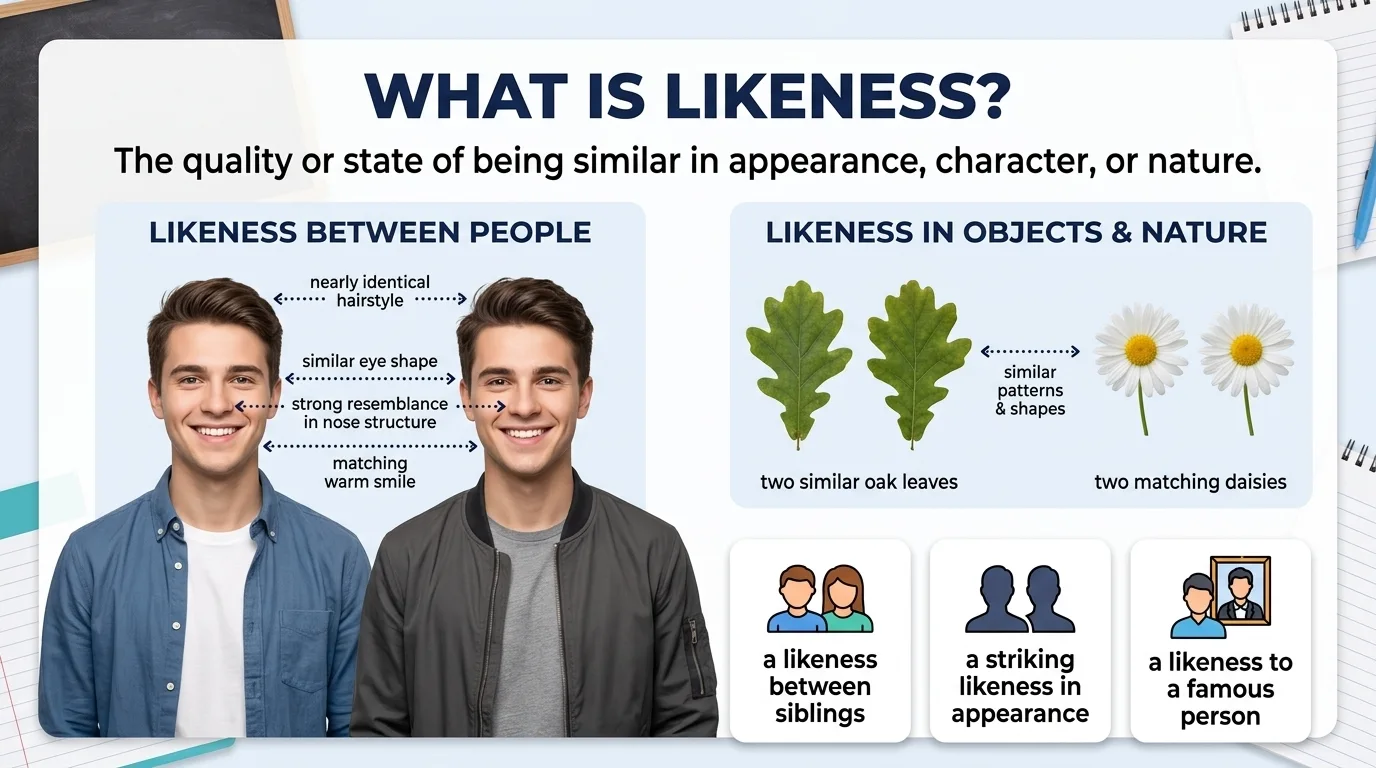
Synonyms of likeness include similarity, resemblance, correspondence, affinity, and equivalence. These words describe how two people, objects, ideas, or situations share common features. Likeness can also refer to a person’s visual representation, such as a portrait or photograph. The best alternative depends on whether you mean shared qualities, appearance, or representation.
Imagine seeing two siblings who look almost identical. You might notice their likeness immediately, even before learning they belong to the same family.
Understanding synonyms of likeness helps you describe connections more accurately. Each alternative adds a slightly different meaning to your sentences.
The word appears in everyday conversations, academic discussions, art, and creative writing. It helps people explain similarities without using the same expression repeatedly.
Students, bloggers, content writers, and daily English users can benefit from learning synonyms of likeness. Better word choices make communication clearer and more engaging.
What Does “Likeness” Really Mean?
Likeness is a noun that describes similarity between two or more things. It can also mean an image or representation of someone’s appearance.
In simple English, likeness means looking alike, sharing similar qualities, or showing what someone looks like.
For example:
- There is a strong likeness between the two sisters.
- The artist painted a beautiful likeness of her grandmother.
The first sentence describes resemblance between people. The second refers to an artistic representation.
Native English speakers commonly use likeness when discussing family features, physical appearance, artistic portraits, and shared characteristics.
The word usually carries a neutral tone. However, its emotional meaning changes with the situation.
Part of Speech
Noun: Likeness
Plural: Likenesses
Simple definition: The quality of being similar or a picture that represents someone’s appearance.
Example: Everyone noticed the remarkable likeness between the twins.
Connotative Meaning of Likeness
(Connotation is the emotional or cultural meaning a word suggests beyond its basic dictionary definition.)
Positive Tone
Likeness can express admiration, affection, or a meaningful connection.
Example: Her likeness to her late mother brought back beautiful memories.
Negative Tone
It may suggest an unwanted resemblance or association.
Example: The character’s likeness to the notorious criminal disturbed the audience.
Neutral Tone
In ordinary descriptions, likeness simply identifies shared characteristics.
Example: Researchers noticed a likeness between the two designs.
The word itself is not inherently positive or negative. Context determines its emotional effect.
Etymology and History of Likeness
The word likeness developed from Old English forms associated with similarity, appearance, and resemblance.
Its historical development reflects how English speakers have described shared qualities and visual representations over time.
Old English (450–1100)
Old English contained the word gelīcnes, meaning resemblance, appearance, form, or image.
It developed from gelīc, meaning alike or similar, combined with the noun-forming suffix -nes.
Middle English (1100–1500)
During the Middle English period, forms such as liknesse became established.
The word described resemblance, outward appearance, and representations of people or objects.
Modern English (1500–Present)
Modern English retained likeness as a noun.
Today, it appears in discussions about family resemblance, visual art, photography, identity, and comparisons.
It also has a specialized legal and commercial use when referring to a person’s recognizable image.
Pronunciation of Likeness
American English (US)
IPA: /ˈlaɪk.nəs/
British English (UK)
IPA: /ˈlaɪk.nəs/
Both varieties generally use the same pronunciation.
The first syllable receives the main stress.
Syllables
like-ness
Total syllables: 2
Affixation Pattern of Likeness
Root: Like
Prefix: None in the modern word.
Suffix: -ness
Formation: Like + ness → Likeness
The suffix -ness changes an adjective into a noun that describes a quality or state.
Synonyms List
The following 40 alternatives cover the main senses of likeness.
1. Similarity (Noun) — US /ˌsɪməˈlærəti/ | UK /ˌsɪmɪˈlærəti/
Meaning: The quality of sharing features or characteristics with something else.
Tone/Register: Neutral, academic, everyday.
Example 1: There is a clear similarity between their writing styles.
Example 2: I noticed several similarities between the two proposals.
2. Resemblance (Noun) — US /rɪˈzɛmbləns/ | UK /rɪˈzembləns/
Meaning: A noticeable similarity in appearance or characteristics.
Tone/Register: Neutral, descriptive.
Example 1: The baby’s resemblance to her father is remarkable.
Example 2: This building bears a striking resemblance to an old castle.
3. Correspondence (Noun) — US /ˌkɔrəˈspɑndəns/ | UK /ˌkɒrɪˈspɒndəns/
Meaning: A close agreement or matching relationship between different things.
Tone/Register: Formal, academic.
Example 1: Researchers found a correspondence between the two results.
Example 2: There is little correspondence between his promises and actions.
4. Affinity (Noun) — US /əˈfɪnəti/ | UK /əˈfɪnəti/
Meaning: A natural similarity or connection between people, ideas, or things.
Tone/Register: Formal, positive.
Example 1: The two artists share an affinity in their creative styles.
Example 2: Their musical tastes show a surprising affinity.
5. Equivalence (Noun) — US /ɪˈkwɪvələns/ | UK /ɪˈkwɪvələns/
Meaning: The state of being equal or comparable in meaning, value, or function.
Tone/Register: Academic, technical.
Example 1: The teacher explained the equivalence of the two expressions.
Example 2: Both qualifications have professional equivalence.
6. Comparability (Noun) — US /ˌkɑmpərəˈbɪləti/ | UK /ˌkɒmpərəˈbɪləti/
Meaning: The quality of being similar enough to allow a meaningful comparison.
Tone/Register: Formal, analytical.
Example 1: The studies have limited comparability.
Example 2: Differences in sample size affect the comparability of the results.
7. Parallel (Noun) — US /ˈpærəlel/ | UK /ˈpærəlel/
Meaning: A noticeable similarity between two situations, events, or ideas.
Tone/Register: Neutral, literary, academic.
Example 1: The writer draws a parallel between childhood and adulthood.
Example 2: I can see a parallel between their experiences.
8. Analogy (Noun) — US /əˈnælədʒi/ | UK /əˈnælədʒi/
Meaning: A comparison that highlights similarities between otherwise different things.
Tone/Register: Academic, explanatory.
Example 1: The professor used an analogy to explain the difficult concept.
Example 2: Her analogy made the technical process easier to understand.
9. Alikeness (Noun) — US /əˈlaɪknəs/ | UK /əˈlaɪknəs/
Meaning: The state of being alike in appearance, nature, or qualities.
Tone/Register: Uncommon, descriptive.
Example 1: The alikeness of their voices surprised everyone.
Example 2: Their facial alikeness became clearer in the photographs.
10. Sameness (Noun) — US /ˈseɪmnəs/ | UK /ˈseɪmnəs/
Meaning: The quality of being identical or having very little noticeable difference.
Tone/Register: Neutral, everyday.
Example 1: The sameness of the two designs confused customers.
Example 2: She wanted more variety instead of constant sameness.
11. Identity (Noun) — US /aɪˈdɛntəti/ | UK /aɪˈdentɪti/
Meaning: Exact sameness between things in a particular respect.
Tone/Register: Formal, philosophical, technical.
Example 1: The scientist confirmed the identity of the two chemical samples.
Example 2: The patterns showed an identity of structure.
Usage note: Identity is a stronger term than likeness when it means exact sameness.
12. Uniformity (Noun) — US /ˌjunəˈfɔrməti/ | UK /ˌjuːnɪˈfɔːmɪti/
Meaning: The quality of remaining consistent or similar throughout.
Tone/Register: Formal, professional.
Example 1: The company maintains uniformity across its product designs.
Example 2: Uniformity in formatting makes the report easier to read.
13. Homogeneity (Noun) — US /ˌhoʊmədʒəˈniəti/ | UK /ˌhɒmədʒɪˈneɪəti/
Meaning: The quality of having similar characteristics throughout a group or substance.
Tone/Register: Scientific, academic.
Example 1: The researchers examined the homogeneity of the sample.
Example 2: Cultural homogeneity was a central topic in the discussion.
14. Congruence (Noun) — US /ˈkɑŋɡruəns/ | UK /ˈkɒŋɡruəns/
Meaning: Close agreement or harmony between two things.
Tone/Register: Formal, mathematical, academic.
Example 1: There is strong congruence between her values and behavior.
Example 2: The study explored congruence between personal goals and career choices.
15. Congruity (Noun) — US /kənˈɡruəti/ | UK /kənˈɡruːɪti/
Meaning: The quality of agreeing or fitting together appropriately.
Tone/Register: Formal, literary.
Example 1: The designer maintained congruity between the furniture and decor.
Example 2: The speech showed congruity between its message and tone.
16. Agreement (Noun) — US /əˈɡrimənt/ | UK /əˈɡriːmənt/
Meaning: A state in which facts, descriptions, or characteristics match.
Tone/Register: Neutral, professional.
Example 1: The two reports are in agreement about the findings.
Example 2: There was close agreement between the survey results.
17. Accordance (Noun) — US /əˈkɔrdəns/ | UK /əˈkɔːdəns/
Meaning: The state of being consistent or in agreement with something.
Tone/Register: Formal, professional.
Example 1: The changes were made in accordance with company policy.
Example 2: The decision was in accordance with the stated principles.
18. Conformity (Noun) — US /kənˈfɔrməti/ | UK /kənˈfɔːmɪti/
Meaning: Similarity created by following the same pattern, rules, or standards.
Tone/Register: Formal, social, professional.
Example 1: The products showed conformity to the approved design.
Example 2: The school encouraged conformity in classroom behavior.
19. Harmony (Noun) — US /ˈhɑrməni/ | UK /ˈhɑːməni/
Meaning: A pleasing agreement or compatibility between different elements.
Tone/Register: Positive, literary, everyday.
Example 1: The colors create harmony throughout the room.
Example 2: Their ideas work together in perfect harmony.
20. Compatibility (Noun) — US /kəmˌpætəˈbɪləti/ | UK /kəmˌpætəˈbɪləti/
Meaning: The quality of having characteristics that allow things to work well together.
Tone/Register: Neutral, technical, professional.
Example 1: Their compatibility made teamwork easier.
Example 2: The engineer checked compatibility between the two systems.
21. Commonality (Noun) — US /ˌkɑməˈnæləti/ | UK /ˌkɒməˈnæləti/
Meaning: A characteristic or quality shared by different people or things.
Tone/Register: Neutral, academic.
Example 1: The interviews revealed a commonality in their experiences.
Example 2: Both communities share a commonality of purpose.
22. Kinship (Noun) — US /ˈkɪnʃɪp/ | UK /ˈkɪnʃɪp/
Meaning: A close connection based on shared qualities, origins, or relationships.
Tone/Register: Positive, literary.
Example 1: She felt a sense of kinship with the other volunteers.
Example 2: The two traditions show a cultural kinship.
23. Relatedness (Noun) — US /rɪˈleɪtɪdnəs/ | UK /rɪˈleɪtɪdnəs/
Meaning: The degree to which two things share a connection or similar characteristics.
Tone/Register: Academic, neutral.
Example 1: The study measured the relatedness of the two languages.
Example 2: Their shared history explains their cultural relatedness.
24. Closeness (Noun) — US /ˈkloʊsnəs/ | UK /ˈkləʊsnəs/
Meaning: A high degree of similarity, connection, or proximity.
Tone/Register: Neutral, emotional.
Example 1: The closeness of their opinions surprised the interviewer.
Example 2: Their emotional closeness grew over time.
25. Approximation (Noun) — US /əˌprɑksəˈmeɪʃən/ | UK /əˌprɒksɪˈmeɪʃən/
Meaning: Something that comes close to another thing without matching it exactly.
Tone/Register: Academic, technical.
Example 1: The sketch was a reasonable approximation of her face.
Example 2: This model provides an approximation of the original design.
26. Nearness (Noun) — US /ˈnɪrnəs/ | UK /ˈnɪənəs/
Meaning: The state of being close in distance, degree, or quality.
Tone/Register: Neutral, descriptive.
Example 1: The nearness of their test scores was unexpected.
Example 2: Their nearness in age helped them develop similar interests.
27. Semblance (Noun) — US /ˈsɛmbləns/ | UK /ˈsembləns/
Meaning: An outward appearance or impression of something, sometimes without complete reality.
Tone/Register: Literary, formal.
Example 1: She tried to maintain a semblance of normality.
Example 2: The damaged building still retained some semblance of its original beauty.
28. Image (Noun) — US /ˈɪmɪdʒ/ | UK /ˈɪmɪdʒ/
Meaning: A visual representation of a person, object, or scene.
Tone/Register: Neutral, everyday.
Example 1: The museum displayed an image of the former queen.
Example 2: His image appeared on the event poster.
29. Portrait (Noun) — US /ˈpɔrtrət/ | UK /ˈpɔːtrət/
Meaning: A painting, photograph, or drawing that represents a person.
Tone/Register: Artistic, neutral.
Example 1: The artist completed a portrait of her grandfather.
Example 2: A large family portrait hangs above the fireplace.
30. Representation (Noun) — US /ˌrɛprɪzɛnˈteɪʃən/ | UK /ˌreprɪzenˈteɪʃən/
Meaning: An image or depiction that shows what someone or something is like.
Tone/Register: Formal, artistic, academic.
Example 1: The sculpture is a representation of a historical leader.
Example 2: The illustration offers a detailed representation of village life.
31. Depiction (Noun) — US /dɪˈpɪkʃən/ | UK /dɪˈpɪkʃən/
Meaning: The act or result of showing someone or something through art, words, or images.
Tone/Register: Artistic, literary.
Example 1: The film offers a realistic depiction of city life.
Example 2: Her depiction of the main character felt authentic.
32. Portrayal (Noun) — US /pɔrˈtreɪəl/ | UK /pɔːˈtreɪəl/
Meaning: A particular way of representing a person or character.
Tone/Register: Artistic, media, literary.
Example 1: The actor’s portrayal of the scientist received praise.
Example 2: The novel presents a thoughtful portrayal of motherhood.
33. Picture (Noun) — US /ˈpɪktʃər/ | UK /ˈpɪktʃə/
Meaning: A visual representation created through photography, painting, or drawing.
Tone/Register: Informal, everyday.
Example 1: She showed me a picture of her childhood home.
Example 2: The picture captured his familiar smile.
34. Photograph (Noun) — US /ˈfoʊtəɡræf/ | UK /ˈfəʊtəɡrɑːf/
Meaning: An image of someone or something captured using a camera.
Tone/Register: Neutral, everyday.
Example 1: The photograph showed her father as a young man.
Example 2: They displayed an old photograph at the reunion.
35. Sketch (Noun) — US /skɛtʃ/ | UK /sketʃ/
Meaning: A simple drawing that captures the main appearance of a subject.
Tone/Register: Artistic, everyday.
Example 1: The witness helped the police create a sketch of the suspect.
Example 2: He made a quick sketch of his daughter.
36. Illustration (Noun) — US /ˌɪləˈstreɪʃən/ | UK /ˌɪləˈstreɪʃən/
Meaning: A drawing or image used to represent or explain something.
Tone/Register: Educational, artistic.
Example 1: The book contains an illustration of the famous explorer.
Example 2: Her illustration captured the character’s cheerful expression.
37. Effigy (Noun) — US /ˈɛfədʒi/ | UK /ˈefɪdʒi/
Meaning: A model or figure made to represent a particular person.
Tone/Register: Formal, historical, sometimes negative.
Example 1: The museum displayed a medieval effigy of a knight.
Example 2: Protesters carried an effigy of the unpopular ruler.
38. Simulacrum (Noun) — US /ˌsɪmjəˈleɪkrəm/ | UK /ˌsɪmjʊˈleɪkrəm/
Meaning: An image or imitation that resembles a person or thing.
Tone/Register: Literary, philosophical, academic.
Example 1: The exhibition featured a digital simulacrum of the ancient statue.
Example 2: The virtual character was a convincing simulacrum of its creator.
39. Double (Noun) — US /ˈdʌbəl/ | UK /ˈdʌbəl/
Meaning: A person or thing that closely resembles another.
Tone/Register: Informal, everyday.
Example 1: Everyone says he is his father’s double.
Example 2: The actor’s double appeared in the difficult scene.
40. Lookalike (Noun) — US /ˈlʊkəlaɪk/ | UK /ˈlʊkəlaɪk/
Meaning: A person who looks remarkably similar to someone else.
Tone/Register: Informal, conversational.
Example 1: We spotted a celebrity lookalike at the shopping mall.
Example 2: Her sister is almost her exact lookalike.
Synonyms for Likeness by Tone
Tone matters because words communicate more than their dictionary meanings.
A positive alternative may suggest warmth or connection. A neutral term simply describes shared features. A negative expression can suggest an unwanted or misleading resemblance.
Choosing the right tone helps readers understand your intended message.
Positive Synonyms
- Affinity
- Harmony
- Kinship
- Compatibility
- Closeness
- Congruence
These words often suggest connection, agreement, or shared qualities.
Neutral Synonyms
- Similarity
- Resemblance
- Correspondence
- Equivalence
- Comparability
- Parallel
- Analogy
- Alikeness
- Sameness
- Identity
- Uniformity
- Homogeneity
- Congruity
- Agreement
- Accordance
- Commonality
- Relatedness
- Approximation
- Nearness
- Image
- Portrait
- Representation
- Depiction
- Portrayal
- Picture
- Photograph
- Sketch
- Illustration
These alternatives describe similarities or representations without necessarily expressing emotion.
Potentially Negative Synonyms
- Conformity
- Semblance
- Effigy
- Simulacrum
These words can carry negative associations in certain contexts.
For example, semblance may suggest that something only appears genuine.
Playful or Informal Synonyms
- Double
- Lookalike
These alternatives work well in friendly conversations about people who look remarkably similar.
Likeness vs Close Alternatives
Although likeness, similarity, resemblance, and equivalence share related meanings, they are not always interchangeable.
The following comparison explains their differences.
| Word | Meaning Difference | Tone | Best Usage |
|---|---|---|---|
| Likeness | Shared features or a visual representation | Neutral, descriptive | Appearance, portraits, general comparison |
| Similarity | Shared characteristics | Neutral | General comparisons |
| Resemblance | Noticeable likeness, especially in appearance | Neutral, descriptive | People, faces, objects |
| Equivalence | Equality in value, meaning, or function | Formal, academic | Mathematics, research, professional writing |
Likeness vs Similarity
Similarity is the broadest alternative.
It works when comparing ideas, habits, designs, or experiences.
Likeness is especially natural when describing appearance or a visual representation.
Example: The two paintings share several similarities.
Likeness vs Resemblance
Resemblance emphasizes how closely one person or object looks or seems like another.
Likeness can express the same idea. However, it can also refer to a portrait or image.
Example: His resemblance to his grandfather is unmistakable.
Likeness vs Equivalence
Equivalence expresses equality in a particular respect.
Two things can have a likeness without being equivalent.
Example: The two certificates have equivalent academic value.
Use equivalence when equality matters more than general resemblance.
How Likeness Changes by Context
The meaning of likeness depends on the subject being discussed.
Understanding these differences helps you select natural alternatives for different audiences.
Daily Conversation
People commonly use likeness to describe family members or physical appearance.
Example: There is such a strong likeness between you and your brother!
In casual speech, lookalike and resemblance are also useful.
Writing and Blogging
Bloggers use likeness to compare designs, personalities, cultural ideas, and visual details.
Example: The new design has a noticeable likeness to traditional architecture.
For broader comparisons, similarity may sound more natural.
Professional or Academic Writing
Formal writing often requires precise terms such as correspondence, congruence, equivalence, and comparability.
Example: The research identified a correspondence between the two datasets.
These words explain specific relationships rather than vague similarities.
Creative and Informal Writing
Creative writers use likeness to build imagery, describe characters, and establish emotional connections.
Example: Her face carried an extraordinary likeness to the woman in the faded photograph.
Words such as semblance, portrait, and double can create different literary effects.
Common Mistakes Learners Make
Even familiar words can become confusing when their meanings overlap.
The following mistakes are especially common among English learners.
Mistake 1: Treating Similarity and Identity as Exact Synonyms
Similarity means sharing certain features.
Identity, when used to mean sameness, suggests an exact match in a particular respect.
Incorrect: The two products have complete identity because their colors are similar.
Better: The two products share a similarity in color.
Mistake 2: Using Likeness for Every Kind of Relationship
Likeness does not automatically mean friendship, agreement, or emotional closeness.
Incorrect: Their likeness became stronger after spending time together.
Better: Their friendship became stronger after spending time together.
Mistake 3: Confusing Resemblance With Representation
A resemblance describes similarity.
A representation is something that depicts another person or object.
Example: The portrait is a representation of the queen.
Example: The actress bears a resemblance to the queen.
Mistake 4: Using Technical Synonyms in Casual Speech
Words such as homogeneity and congruence may sound unnatural in ordinary conversation.
Instead of saying:
“The homogeneity of our clothing is noticeable.”
Say:
“Our clothes look almost identical.”
Mistake 5: Overusing Likeness
Repeating the same noun can make writing feel mechanical.
Use similarity for general comparisons, resemblance for appearance, and correspondence for matching relationships.
However, avoid replacing words merely to create variety. Accuracy matters more than using unusual vocabulary.
Native Usage and Register Notes
Native English speakers select alternatives based on context, audience, and purpose.
Formal English
Correspondence, equivalence, congruence, and comparability commonly appear in academic or professional discussions.
Informal English
Similarity, resemblance, double, and lookalike are easier to use in ordinary conversations.
Spoken English
People often prefer simple phrases such as “looks like,” “looks alike,” or “has the same features.”
Written English
Likeness is particularly useful in descriptive writing, art criticism, biographies, and discussions of visual identity.
For additional vocabulary practice, explore related words in an article about synonyms of similarity.
Real-Life Examples Using Likeness
These short scenarios show how the word works in practical communication.
Workplace Scenario
Two companies introduce products with almost identical packaging.
Sentence: The manager noticed a striking likeness between the competing designs.
Social Situation
A woman meets her friend’s younger sister for the first time.
Sentence: The family likeness was obvious from their smiles.
Media and Pop Culture
An actor plays a famous historical personality.
Sentence: The actor’s likeness to the historical figure impressed viewers.
Writing and Storytelling
A novelist describes a character who discovers an old family painting.
Sentence: The portrait held an unsettling likeness to the young woman standing before it.
Art and Photography
A photographer captures an older musician’s expression.
Sentence: The photograph preserves a beautiful likeness of the musician.
Interactive Practice Quiz
Choose the most suitable answer for each situation.
Part One: Meaning and Context
1. Two sisters have almost identical facial features. Which word best describes their shared appearance?
A) Conflict
B) Resemblance
C) Distance
D) Opposition
2. A researcher discovers that two studies produced matching findings. Which word fits best?
A) Disagreement
B) Isolation
C) Correspondence
D) Difference
3. An artist paints someone’s face. What is the finished painting called?
A) Portrait
B) Argument
C) Comparison
D) Pattern
4. Two employees have similar interests and naturally connect. Which word fits best?
A) Division
B) Resistance
C) Contrast
D) Affinity
5. A student wants to describe shared characteristics between two poems. Which word is most suitable?
A) Similarity
B) Separation
C) Opposition
D) Confusion
6. Two qualifications carry the same recognized value. Which term is most accurate?
A) Resemblance
B) Equivalence
C) Portrait
D) Sketch
Part Two: Tone and Real-Life Usage
7. Someone looks almost exactly like a famous singer. What informal noun describes this person?
A) Researcher
B) Stranger
C) Lookalike
D) Opponent
8. A writer compares two historical events to highlight their shared features. Which word works best?
A) Contrast
B) Dispute
C) Separation
D) Parallel
9. A designer wants every page to follow the same visual style. Which word describes this consistency?
A) Confusion
B) Uniformity
C) Variety
D) Disorder
10. A witness helps an artist draw a suspect’s face. What is the drawing called?
A) Sketch
B) Agreement
C) Affinity
D) Equivalence
11. A character tries to maintain the appearance of happiness despite feeling sad. Which expression is most natural?
A) An identity of happiness
B) A photograph of happiness
C) A semblance of happiness
D) A correspondence of happiness
12. Two software systems can work successfully together. Which word describes this quality?
A) Opposition
B) Compatibility
C) Distance
D) Isolation
13. An author describes a strong connection between two communities with shared traditions. Which word adds a warm tone?
A) Difference
B) Disagreement
C) Separation
D) Kinship
14. A filmmaker presents a particular interpretation of a historical character. Which word fits best?
A) Portrayal
B) Sameness
C) Nearness
D) Comparability
15. A scientist needs a word describing a sample with similar characteristics throughout. Which term is most precise?
A) Diversity
B) Resemblance
C) Homogeneity
D) Conflict
Answer Key
1-B | 2-C | 3-A | 4-D | 5-A | 6-B | 7-C | 8-D | 9-B | 10-A | 11-C | 12-B | 13-D | 14-A | 15-C
Reflection and Application Task
Think of two people, places, or objects that share noticeable characteristics.
Write one original sentence using any synonym from this article.
Then replace your chosen word with another alternative. Notice whether the meaning or emotional tone changes.
Example: The two houses share a remarkable similarity in design.
Alternative: The two houses show a remarkable resemblance in their exterior features.
Suggested External Reference
For additional vocabulary verification, pronunciation guidance, and established usage examples, consult the Cambridge Dictionary:
This dictionary provides a reliable reference for understanding the noun likeness and its usage in modern English.
Conclusion
Understanding synonyms of likeness helps you describe shared qualities with greater confidence. Every alternative adds a useful shade of meaning to your vocabulary.
The right word can make writing, blogging, and speaking more expressive. It also helps readers recognize whether you mean appearance, connection, or exact agreement.
Learning synonyms of likeness improves communication beyond the classroom. These expressions make descriptions clearer and help everyday conversations sound natural.
Practice synonyms of likeness in emails, essays, and daily conversations. Try one new expression each day and gradually build a richer, more confident vocabulary.
FAQs
1. What is the best synonym for likeness when describing family members?
Resemblance is usually the most natural alternative when discussing similar facial features among relatives. You can describe a strong resemblance between siblings, parents, or grandparents. The expression family resemblance is particularly common. Similarity also works, but resemblance emphasizes recognizable physical characteristics rather than general qualities.
2. Can likeness refer to someone’s voice rather than physical appearance?
Yes. Likeness can describe similarities in sound, speech patterns, or vocal characteristics. For example, two siblings may have a remarkable likeness in their voices. However, similarity and resemblance are often more natural in this context. You might say, “There is a striking similarity between their voices.”
3. What does someone’s name, image, and likeness mean?
The expression name, image, and likeness, often shortened to NIL, refers to aspects of a person’s recognizable identity. It commonly appears in discussions about publicity rights, advertising, and sports. In this context, likeness means a recognizable representation of someone, such as their face, photograph, or other identifying visual features.
4. Is likeness a countable or uncountable noun?
Likeness can be both countable and uncountable, depending on its meaning. When describing general similarity, it often functions as an uncountable noun. When referring to portraits or representations, it can be countable. For example, an art gallery may display several likenesses of the same historical figure.
5. What is the difference between a striking likeness and a passing resemblance?
A striking likeness describes an unusually strong or immediately noticeable similarity. A passing resemblance suggests a weaker similarity that may only be apparent at first glance. For example, identical twins might share a striking likeness, while two unrelated people with similar hairstyles may have only a passing resemblance.
6. Can likeness describe similarities between abstract ideas?
Yes. Likeness can describe shared features between abstract concepts, theories, beliefs, or experiences. However, similarity, parallel, and correspondence are often more natural choices in analytical writing. For example, an academic writer might discuss parallels between two philosophical theories rather than repeatedly describing their likeness.
7. What adjectives commonly appear before the noun likeness?
Common adjective combinations include striking likeness, remarkable likeness, close likeness, strong likeness, and uncanny likeness. These expressions communicate different degrees of resemblance. Striking and remarkable emphasize noticeable similarity, while uncanny suggests a resemblance that feels surprisingly exact or slightly unsettling.
8. Is likeness the same as imitation?
No. Likeness describes similarity or a visual representation, while imitation involves copying someone’s appearance, actions, style, or behavior. Two people may naturally share a likeness without either person copying the other. An imitation, however, usually involves an intentional attempt to reproduce particular characteristics.

Mehtab Yasir is a passionate writer and English language enthusiast dedicated to making vocabulary learning simple, practical, and enjoyable. As an author at SynonymDesk.com, she creates helpful content covering synonyms, antonyms, word meanings, vocabulary, phrases, and everyday English usage. Her goal is to provide clear and easy-to-understand information that helps students, writers, professionals, and English learners choose the right words and communicate with greater confidence. Mehtab believes that a strong vocabulary can improve both writing and communication skills. She enjoys researching new words, exploring their meanings and uses, and turning complex language concepts into useful, reader-friendly content. Through her work, she strives to make SynonymDesk.com a reliable resource for anyone looking to improve their English vocabulary and language skills.