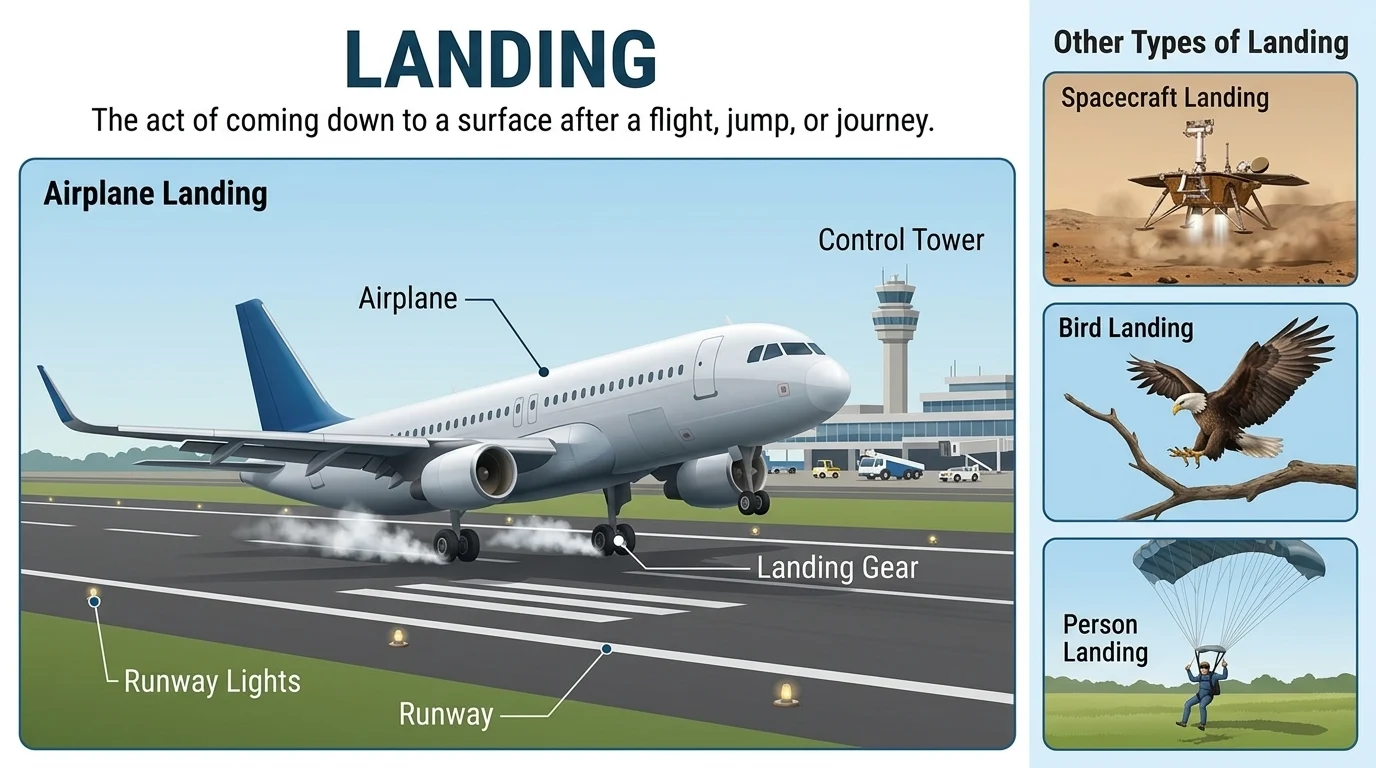
Synonyms of landing include arrival, touchdown, descent, alighting, docking, disembarkation, and landfall. The best alternative depends on the situation. Touchdown describes an aircraft reaching the ground, while docking refers to a vessel reaching a berth. Landing can also describe reaching a place, securing a job, or successfully achieving something.
Picture yourself sitting beside an airplane window. The wheels touch the runway, and everyone relaxes. That final moment is called a landing.
But landing is not limited to airplanes. A boat reaches a harbor, a worker gets a dream job, and a gymnast finishes a jump. Each situation needs different vocabulary.
Learning synonyms of landing helps students, bloggers, and content writers describe movement and achievement with greater accuracy. It also makes everyday English more expressive.
Since landing appears in travel, sports, business, and daily conversations, understanding synonyms of landing helps you choose words that match your exact meaning.
What Does Landing Really Mean?
- Landing means reaching the ground, arriving at a destination, or successfully obtaining something. Its exact meaning changes according to context.
- In aviation, landing happens when an aircraft returns to the ground after flying.
- In travel, the word may describe someone getting off a vehicle or a boat reaching land.
- In professional English, landing can mean successfully securing a job, client, contract, or opportunity.
- In sports, it may describe how an athlete returns to the ground after jumping.
- Part of Speech: Landing functions mainly as a noun. It is also the present participle and gerund form of the verb land.
Simple definition: The act of arriving, coming down, reaching a surface, or successfully getting something.
Examples:
- The pilot made a smooth landing.
- Landing a new client helped our small business grow.
Native English speakers understand landing as a flexible word. Its meaning depends on what is arriving, where it arrives, and what the speaker wants to emphasize.
Connotative Meaning of Landing
(Connotation is the emotional or cultural feeling associated with a word beyond its basic dictionary meaning.)
Landing generally has a neutral meaning. However, its emotional tone changes with the situation.
Positive Tone
Landing can suggest success, safety, relief, or achievement.
Example: Her successful landing earned loud applause.
Negative Tone
Landing may suggest danger, difficulty, or an unexpected outcome.
Example: The aircraft made a rough landing during the storm.
Neutral Tone
In technical or factual descriptions, landing simply identifies an action.
Example: The landing occurred at 8:45 a.m.
Understanding these differences helps writers avoid using emotionally inappropriate alternatives.
Etymology and History of Landing
The word landing comes from the English verb land, which has Germanic roots.
Its history reflects how English speakers gradually expanded a physical action into several figurative meanings.
Old English (450–1100)
The noun land comes from Old English land, meaning ground, territory, or a defined area of earth.
The verb landian referred to reaching land or bringing something ashore.
Middle English (1100–1500)
During Middle English, forms of landen continued to describe reaching land.
The noun landing developed from the verb through the addition of -ing.
Its meanings included arriving on land and places associated with going ashore.
Modern English (1500–Present)
The meaning expanded alongside developments in transportation, exploration, and aviation.
Landing became common in descriptions of aircraft, spacecraft, sports, and professional achievements.
Today, phrases such as landing a job and landing a major deal demonstrate its figurative development.
Pronunciation of Landing (US & UK)
Landing has the same standard IPA transcription in American and British English.
- US: /ˈlæn.dɪŋ/
- UK: /ˈlæn.dɪŋ/
The first syllable receives the main stress.
Syllables
land-ing
Total syllables: 2
Affixation Pattern of Landing
- Root: land
- Prefix: None
- Suffix: -ing
- Word formation: land + ing = landing
The suffix -ing allows the verb to function as a present participle, gerund, or action noun.
Synonyms List
Landing has several distinct meanings. For this reason, its alternatives are grouped by context rather than presented as universally interchangeable words.
Aviation and Aircraft Landing Synonyms
These alternatives describe an aircraft reaching the ground, descending, or completing a flight.
1. Touchdown (Noun) — US /ˈtʌtʃ.daʊn/ | UK /ˈtʌtʃ.daʊn/
Meaning: The moment an aircraft’s wheels or landing gear make contact with the ground.
Tone/Register: Neutral, Aviation, Professional
Example 1: The passengers cheered after a gentle touchdown.
Example 2: The pilot prepared the aircraft for touchdown.
2. Descent (Noun) — US /dɪˈsent/ | UK /dɪˈsent/
Meaning: The movement from a higher position toward a lower one before landing.
Tone/Register: Neutral, Technical
Example 1: The airplane began its descent over the mountains.
Example 2: Our descent took longer because of heavy traffic.
3. Arrival (Noun) — US /əˈraɪ.vəl/ | UK /əˈraɪ.vəl/
Meaning: The act of reaching a destination after traveling.
Tone/Register: Neutral, General
Example 1: Our arrival at the airport was slightly delayed.
Example 2: Everyone waited for the arrival of the rescue helicopter.
4. Alighting (Noun) — US /əˈlaɪ.tɪŋ/ | UK /əˈlaɪ.tɪŋ/
Meaning: The act of coming down onto a surface or getting off a vehicle.
Tone/Register: Formal, Literary
Example 1: The bird’s gentle alighting barely moved the branch.
Example 2: Alighting from the train, she noticed the cold air.
5. Setting Down (Noun Phrase) — US /ˈset.ɪŋ daʊn/ | UK /ˈset.ɪŋ daʊn/
Meaning: The action of placing something onto a surface, including bringing an aircraft down.
Tone/Register: Neutral, Descriptive
Example 1: The pilot’s careful setting down impressed the instructor.
Example 2: The helicopter’s setting down raised a cloud of dust.
6. Grounding (Noun) — US /ˈɡraʊn.dɪŋ/ | UK /ˈɡraʊn.dɪŋ/
Meaning: The act of bringing or keeping an aircraft on the ground, often for safety or operational reasons.
Tone/Register: Technical, Aviation
Example 1: The grounding of several aircraft disrupted the schedule.
Example 2: Engineers recommended grounding the plane for inspection.
7. Emergency Landing (Noun Phrase) — US /ɪˈmɝː.dʒən.si ˈlæn.dɪŋ/ | UK /ɪˈmɜː.dʒən.si ˈlæn.dɪŋ/
Meaning: An unscheduled landing made because of an urgent safety concern.
Tone/Register: Technical, Serious
Example 1: The crew performed an emergency landing after detecting smoke.
Example 2: Everyone remained calm during the emergency landing.
8. Forced Landing (Noun Phrase) — US /fɔːrst ˈlæn.dɪŋ/ | UK /fɔːst ˈlæn.dɪŋ/
Meaning: A landing made necessary by circumstances that prevent normal flight from continuing.
Tone/Register: Technical, Aviation
Example 1: Engine trouble caused a forced landing in an open field.
Example 2: The instructor explained the correct forced landing procedure.
9. Splashdown (Noun) — US /ˈsplæʃ.daʊn/ | UK /ˈsplæʃ.daʊn/
Meaning: The landing of a spacecraft or similar vehicle on water.
Tone/Register: Technical, Space Exploration
Example 1: The capsule completed a safe splashdown in the ocean.
Example 2: Millions watched the spacecraft’s splashdown live.
10. Soft Landing (Noun Phrase) — US /sɔːft ˈlæn.dɪŋ/ | UK /sɒft ˈlæn.dɪŋ/
Meaning: A gentle landing that avoids significant impact or damage.
Tone/Register: Neutral, Technical
Example 1: The lunar probe achieved a soft landing.
Example 2: The crew celebrated the spacecraft’s soft landing.
Travel, Sea, and Arrival Synonyms
These words describe reaching land, entering a destination, or leaving transportation after a journey.
11. Docking (Noun) — US /ˈdɑː.kɪŋ/ | UK /ˈdɒk.ɪŋ/
Meaning: The act of bringing a vessel into a dock or designated berth.
Tone/Register: Neutral, Maritime
Example 1: The ferry completed its docking before sunset.
Example 2: Strong winds made docking difficult for the captain.
12. Berthing (Noun) — US /ˈbɝː.θɪŋ/ | UK /ˈbɜː.θɪŋ/
Meaning: The process of positioning a vessel at its assigned place in a harbor.
Tone/Register: Technical, Maritime
Example 1: The ship’s berthing took nearly thirty minutes.
Example 2: Harbor workers assisted with the vessel’s berthing.
13. Disembarkation (Noun) — US /ˌdɪs.em.bɑːrˈkeɪ.ʃən/ | UK /ˌdɪs.em.bɑːˈkeɪ.ʃən/
Meaning: The process of leaving a ship, aircraft, or other means of transportation.
Tone/Register: Formal, Travel
Example 1: Disembarkation began once the aircraft reached the gate.
Example 2: Passengers received instructions before disembarkation.
14. Debarkation (Noun) — US /ˌdiː.bɑːrˈkeɪ.ʃən/ | UK /ˌdiː.bɑːˈkeɪ.ʃən/
Meaning: The act of getting off a ship or aircraft after a journey.
Tone/Register: Formal, Maritime
Example 1: The crew supervised debarkation at the port.
Example 2: Heavy rain delayed the passengers’ debarkation.
15. Landfall (Noun) — US /ˈlænd.fɑːl/ | UK /ˈlænd.fɔːl/
Meaning: The first sighting or reaching of land after traveling by sea or air.
Tone/Register: Maritime, Literary
Example 1: The sailors celebrated their first landfall in weeks.
Example 2: The expedition made landfall near a quiet island.
16. Coming Ashore (Verb Phrase) — US /ˈkʌm.ɪŋ əˈʃɔːr/ | UK /ˈkʌm.ɪŋ əˈʃɔː/
Meaning: Moving from water or a vessel onto dry land.
Tone/Register: Neutral, Conversational
Example 1: The fishermen were coming ashore before the storm.
Example 2: Tourists enjoyed coming ashore at the small village.
17. Reaching Land (Verb Phrase) — US /ˈriː.tʃɪŋ lænd/ | UK /ˈriː.tʃɪŋ lænd/
Meaning: Successfully arriving at dry ground after traveling over water.
Tone/Register: Neutral, Descriptive
Example 1: Reaching land brought relief to the exhausted swimmers.
Example 2: The rescue team celebrated reaching land safely.
18. Mooring (Noun) — US /ˈmʊr.ɪŋ/ | UK /ˈmɔː.rɪŋ/
Meaning: The act of securing a boat or ship in position using ropes, anchors, or similar equipment.
Tone/Register: Technical, Maritime
Example 1: The crew finished mooring the boat before dinner.
Example 2: Careful mooring kept the yacht secure overnight.
19. Port Arrival (Noun Phrase) — US /pɔːrt əˈraɪ.vəl/ | UK /pɔːt əˈraɪ.vəl/
Meaning: The arrival of a ship or vessel at a port.
Tone/Register: Formal, Logistics
Example 1: The cargo ship’s port arrival was scheduled for Monday.
Example 2: Officials confirmed the vessel’s port arrival that morning.
20. Making Port (Verb Phrase) — US /ˈmeɪ.kɪŋ pɔːrt/ | UK /ˈmeɪ.kɪŋ pɔːt/
Meaning: Successfully reaching a port after traveling by sea.
Tone/Register: Maritime, Descriptive
Example 1: The fishing boat was making port after a long trip.
Example 2: Making port before nightfall was the captain’s priority.
Movement and Physical Contact Synonyms
Landing also describes reaching a surface after jumping, falling, or moving through the air.
21. Coming Down (Verb Phrase) — US /ˈkʌm.ɪŋ daʊn/ | UK /ˈkʌm.ɪŋ daʊn/
Meaning: Moving downward until reaching a lower position or surface.
Tone/Register: Informal, General
Example 1: The balloon was coming down near the park.
Example 2: We watched the parachutist coming down slowly.
22. Settling (Noun) — US /ˈset.əl.ɪŋ/ | UK /ˈset.əl.ɪŋ/
Meaning: The process of gradually coming to rest on a surface or in a position.
Tone/Register: Neutral, Descriptive
Example 1: The settling of snow covered the garden.
Example 2: The feather’s gentle settling caught her attention.
23. Dropping (Noun) — US /ˈdrɑː.pɪŋ/ | UK /ˈdrɒp.ɪŋ/
Meaning: The act of moving or falling from a higher position to a lower one.
Tone/Register: Neutral, General
Example 1: The sudden dropping of the package surprised everyone.
Example 2: Dropping onto the mat was part of the exercise.
24. Falling (Noun) — US /ˈfɑː.lɪŋ/ | UK /ˈfɔː.lɪŋ/
Meaning: The action of moving downward, usually under the influence of gravity.
Tone/Register: Neutral, General
Example 1: Falling onto the soft grass prevented serious injury.
Example 2: The instructor explained how to control falling during practice.
25. Ground Contact (Noun Phrase) — US /ɡraʊnd ˈkɑːn.tækt/ | UK /ɡraʊnd ˈkɒn.tækt/
Meaning: The moment a person or object makes physical contact with the ground.
Tone/Register: Technical, Sports
Example 1: The coach studied the runner’s ground contact.
Example 2: Proper ground contact helps athletes maintain balance.
26. Impact (Noun) — US /ˈɪm.pækt/ | UK /ˈɪm.pækt/
Meaning: The forceful contact between an object and a surface.
Tone/Register: Neutral, Technical
Example 1: The athlete bent her knees to reduce the impact.
Example 2: The package survived the impact without damage.
27. Contact (Noun) — US /ˈkɑːn.tækt/ | UK /ˈkɒn.tækt/
Meaning: The state or moment of touching a surface.
Tone/Register: Neutral, Technical
Example 1: The ball made contact with the court.
Example 2: The gymnast maintained control after contact with the mat.
28. Planting (Noun) — US /ˈplæn.tɪŋ/ | UK /ˈplɑːn.tɪŋ/
Meaning: The deliberate placement of a foot or another object firmly onto a surface.
Tone/Register: Sports, Descriptive
Example 1: Proper foot planting helped the player maintain balance.
Example 2: The dancer practiced planting her feet after each jump.
29. Touching Down (Verb Phrase) — US /ˈtʌtʃ.ɪŋ daʊn/ | UK /ˈtʌtʃ.ɪŋ daʊn/
Meaning: Making contact with the ground after moving through the air.
Tone/Register: Neutral, Aviation
Example 1: The helicopter was touching down beside the hospital.
Example 2: Touching down smoothly required careful control.
30. Coming to Rest (Verb Phrase) — US /ˈkʌm.ɪŋ tə rest/ | UK /ˈkʌm.ɪŋ tə rest/
Meaning: Stopping movement and reaching a stable final position.
Tone/Register: Neutral, Descriptive
Example 1: The ball came to rest near the fence.
Example 2: The glider was coming to rest at the end of the runway.
Achievement and Figurative Landing Synonyms
In everyday English, landing often means successfully obtaining something valuable.
These alternatives work particularly well in professional, academic, and conversational writing.
31. Securing (Verb) — US /sɪˈkjʊr.ɪŋ/ | UK /sɪˈkjʊə.rɪŋ/
Meaning: Successfully obtaining something important through effort or planning.
Tone/Register: Professional, Formal
Example 1: She succeeded in securing a position at the university.
Example 2: Securing the contract took several months.
32. Obtaining (Verb) — US /əbˈteɪ.nɪŋ/ | UK /əbˈteɪ.nɪŋ/
Meaning: Getting something through a particular process or action.
Tone/Register: Formal, Academic
Example 1: Obtaining permission required an official application.
Example 2: He focused on obtaining the necessary documents.
33. Acquiring (Verb) — US /əˈkwaɪr.ɪŋ/ | UK /əˈkwaɪə.rɪŋ/
Meaning: Gaining possession of something or developing a useful ability.
Tone/Register: Formal, Business
Example 1: Acquiring new clients helped the company expand.
Example 2: She spent years acquiring valuable experience.
34. Gaining (Verb) — US /ˈɡeɪ.nɪŋ/ | UK /ˈɡeɪ.nɪŋ/
Meaning: Successfully receiving or developing something beneficial.
Tone/Register: Neutral, General
Example 1: Gaining her manager’s trust took patience.
Example 2: The campaign focused on gaining public support.
35. Winning (Verb) — US /ˈwɪn.ɪŋ/ | UK /ˈwɪn.ɪŋ/
Meaning: Achieving success through competition, effort, or persuasion.
Tone/Register: Positive, General
Example 1: Winning the scholarship changed his future.
Example 2: The agency celebrated winning a major contract.
36. Earning (Verb) — US /ˈɝː.nɪŋ/ | UK /ˈɜː.nɪŋ/
Meaning: Receiving something as a result of effort, achievement, or deserving behavior.
Tone/Register: Positive, Professional
Example 1: Earning a promotion made her proud.
Example 2: He focused on earning the team’s respect.
37. Attaining (Verb) — US /əˈteɪ.nɪŋ/ | UK /əˈteɪ.nɪŋ/
Meaning: Successfully reaching a goal, level, or desired result.
Tone/Register: Formal, Academic
Example 1: Attaining her career goals required dedication.
Example 2: The athlete worked toward attaining a higher ranking.
38. Achieving (Verb) — US /əˈtʃiː.vɪŋ/ | UK /əˈtʃiː.vɪŋ/
Meaning: Accomplishing something through effort.
Tone/Register: Positive, General
Example 1: Achieving the sales target boosted everyone’s confidence.
Example 2: She dreamed of achieving international recognition.
39. Clinching (Verb) — US /ˈklɪn.tʃɪŋ/ | UK /ˈklɪn.tʃɪŋ/
Meaning: Successfully securing a victory, agreement, or opportunity.
Tone/Register: Informal, Sports, Business
Example 1: The final interview helped him clinch the position.
Example 2: Their presentation was crucial in clinching the deal.
40. Nabbing (Verb) — US /ˈnæb.ɪŋ/ | UK /ˈnæb.ɪŋ/
Meaning: Getting something desirable, often quickly or unexpectedly.
Tone/Register: Informal, Conversational
Example 1: She ended up nabbing the last available ticket.
Example 2: Nabbing that internship was an exciting surprise.
41. Bagging (Verb) — US /ˈbæɡ.ɪŋ/ | UK /ˈbæɡ.ɪŋ/
Meaning: Successfully getting something wanted, especially an opportunity or achievement.
Tone/Register: Informal, Conversational
Example 1: He celebrated bagging his dream job.
Example 2: The singer was thrilled about bagging another award.
42. Scoring (Verb) — US /ˈskɔːr.ɪŋ/ | UK /ˈskɔː.rɪŋ/
Meaning: Successfully obtaining something desirable or impressive.
Tone/Register: Informal, Playful
Example 1: Scoring free concert tickets made their weekend.
Example 2: She was excited about scoring an interview with the director.
43. Capturing (Verb) — US /ˈkæp.tʃɚ.ɪŋ/ | UK /ˈkæp.tʃər.ɪŋ/
Meaning: Successfully gaining control of something or attracting attention and interest.
Tone/Register: Professional, Descriptive
Example 1: The campaign succeeded in capturing a new audience.
Example 2: Capturing the market’s attention required a fresh idea.
44. Getting (Verb) — US /ˈɡet.ɪŋ/ | UK /ˈɡet.ɪŋ/
Meaning: Receiving, obtaining, or successfully acquiring something.
Tone/Register: Neutral, Everyday English
Example 1: Getting a new job gave him fresh motivation.
Example 2: She was happy about getting an invitation to the event.
45. Locking Down (Phrasal Verb) — US /ˈlɑː.kɪŋ daʊn/ | UK /ˈlɒk.ɪŋ daʊn/
Meaning: Firmly securing an agreement, opportunity, or arrangement.
Tone/Register: Informal, Business
Example 1: The team focused on locking down the final agreement.
Example 2: Locking down a reliable supplier improved production.
Synonyms for Landing by Tone
Tone affects how readers interpret your message. Some alternatives communicate excitement, while others describe an event without emotion.
Choosing the correct tone makes writing sound natural and appropriate.
Positive Synonyms
These alternatives often communicate success, relief, or achievement.
- Touchdown
- Soft landing
- Securing
- Winning
- Earning
- Attaining
- Achieving
- Clinching
Example: Securing the internship was an important milestone.
Neutral Synonyms
These words provide factual descriptions without adding strong emotions.
- Arrival
- Descent
- Alighting
- Docking
- Berthing
- Disembarkation
- Reaching land
- Ground contact
- Obtaining
- Getting
Example: The vessel’s arrival was confirmed at noon.
Negative or Serious Alternatives
These expressions may suggest danger, difficulty, or unexpected circumstances.
- Forced landing
- Emergency landing
- Impact
- Falling
- Dropping
- Grounding
These words are not inherently negative in every context. Their emotional effect depends on the surrounding sentence.
Example: The unexpected forced landing worried several passengers.
Playful and Informal Synonyms
These alternatives make conversations sound relaxed and energetic.
- Bagging
- Nabbing
- Scoring
- Locking down
- Getting
- Coming down
Example: She couldn’t believe she had scored her dream internship.
Landing vs Close Alternatives
Landing, touchdown, arrival, and descent are closely connected. However, they describe different parts of an event.
| Word | Meaning Difference | Tone | Best Usage |
|---|---|---|---|
| Landing | The overall act of reaching a surface | Neutral | Aircraft, sports, general descriptions |
| Touchdown | The exact moment of ground contact | Technical, neutral | Aviation |
| Arrival | Reaching a destination | General | Travel, transportation |
| Descent | Moving downward before landing | Technical | Aviation, movement |
Landing vs Touchdown
Landing refers to the broader process or event.
Touchdown identifies the moment the aircraft first contacts the runway.
Example: The landing was smooth, and touchdown occurred exactly on schedule.
Landing vs Arrival
Arrival emphasizes reaching a destination.
Landing focuses on reaching a surface, especially after movement through the air.
Example: Our flight’s arrival was delayed by twenty minutes.
Landing vs Descent
Descent describes downward movement.
Landing describes reaching the surface.
Example: The pilot started the descent long before the actual landing.
How Landing Changes by Context
The word landing appears in several areas of modern English. Understanding these contexts helps you choose accurate alternatives.
Daily Conversation
People often use landing to describe successful achievements.
Example: My brother finally landed a better job.
In casual speech, got or bagged may replace landed.
Writing and Blogging
Travel bloggers frequently use landing when describing flights or arriving at new destinations.
Example: After landing in Rome, we headed straight to our hotel.
Arrival or touchdown may provide variety, depending on the intended meaning.
Professional and Academic English
Business writers often use landing to describe obtaining contracts, customers, or opportunities.
Example: The company landed three major clients this month.
Secured sounds more formal and precise in this situation.
Academic writing generally favors specific expressions such as obtaining, attaining, or achieving.
Creative and Informal Writing
Creative writers use landing to describe movement, emotion, or unexpected success.
Example: The tiny bird landed beside her coffee cup.
Alighted creates a more literary effect.
Common Mistakes Learners Make
Even advanced English learners sometimes confuse landing with related words.
These mistakes usually happen because several alternatives describe different stages of the same event.
Mistake 1: Using Descent as an Exact Replacement
Incorrect: The airplane completed its descent when the wheels touched the runway.
Better: The airplane completed its landing when the wheels touched the runway.
Descent refers to downward movement. Landing refers to reaching the surface.
Mistake 2: Confusing Docking With Landing
Incorrect: The passenger airplane completed its docking on the runway.
Correct: The passenger airplane completed its landing on the runway.
Docking normally describes bringing a vessel to a berth. It may also describe connecting spacecraft or other vehicles.
Mistake 3: Using Informal Words in Formal Writing
Less suitable: The researcher bagged a prestigious academic grant.
Better: The researcher secured a prestigious academic grant.
Bagged is natural in casual conversation. Secured is more appropriate in formal academic writing.
Mistake 4: Confusing Landing With Landfall
Landfall is commonly used when ships reach or first sight land. It also describes storms moving from water onto land.
It does not normally replace landing in ordinary airport announcements.
Mistake 5: Overusing Landing
Repeating landing in every sentence makes writing less engaging.
Instead, select a contextually accurate alternative.
Repetitive: The landing was safe. Everyone enjoyed the landing.
Improved: The landing was safe. Everyone appreciated the pilot’s smooth touchdown.
Native Usage and Register Notes
Native speakers frequently use landing in both literal and figurative expressions.
The most natural alternative depends on the situation and the level of formality.
Formal English
Prefer securing, obtaining, attaining, disembarkation, or arrival when the context supports them.
Informal English
Getting, bagging, scoring, and nabbing work naturally in friendly conversations about achievements.
Spoken English
Speakers commonly say:
- We just landed.
- She landed a great job.
- The plane touched down safely.
Written English
Technical reports and professional documents benefit from more specific terminology.
For example, an aviation report may distinguish descent, touchdown, and landing rollout rather than treating them as identical events.
Readers interested in more achievement-related vocabulary can also explore synonyms of success to understand how English describes positive outcomes.
Real-Life Examples Using Landing
The following situations demonstrate how landing and its alternatives work in modern communication.
Workplace Scenario
A designer attends several interviews and receives an offer from a respected company.
Natural sentence: She finally landed the position she wanted.
Alternative: She successfully secured her preferred position.
Social Situation
Two friends return home after an international flight.
Natural sentence: We landed safely despite the strong winds.
Alternative: Our aircraft completed a safe touchdown.
Media and Pop Culture
An actor receives a major role in a television series.
Natural sentence: The young actor landed a leading role.
Alternative: The young actor secured a leading role.
Writing and Storytelling
A butterfly moves through a garden and rests on a flower.
Natural sentence: The butterfly landed on a yellow rose.
Alternative: The butterfly gently alighted on a yellow rose.
Suggested External Reference
For additional linguistic verification, readers can consult the Cambridge Dictionary – Landing.
It provides dictionary definitions, pronunciation guidance, grammatical information, and examples that help learners understand how the word functions in standard English.
Practice Quiz
Choose the most suitable answer for each situation. These questions focus on meaning, tone, and natural English usage.
Part One: Meaning and Context
1. The airplane’s wheels have just touched the runway. Which word describes this exact moment?
A) Departure B) Touchdown C) Disembarkation D) Mooring
2. A company successfully gets an important business contract. Which formal word fits best?
A) Dropping B) Falling C) Securing D) Alighting
3. A ship reaches land after several weeks at sea. Which word is most suitable?
A) Landfall B) Grounding C) Impact D) Descent
4. An aircraft starts moving downward toward an airport. What is this movement called?
A) Berthing B) Scoring C) Docking D) Descent
5. A spacecraft returns to Earth and lands in the ocean. Which term describes this event?
A) Ground contact B) Splashdown C) Mooring D) Disembarkation
6. Passengers begin leaving a cruise ship. Which formal noun describes this process?
A) Touchdown B) Attainment C) Disembarkation D) Impact
Part Two: Tone and Real-Life Usage
7. Your friend gets a fantastic internship. Which informal sentence sounds natural?
A) She scored an amazing internship. B) She docked an amazing internship. C) She descended an amazing internship. D) She moored an amazing internship.
8. An academic report describes successfully reaching a research objective. Which word is most suitable?
A) Nabbing B) Bagging C) Dropping D) Attaining
9. A helicopter must land immediately because of an urgent mechanical problem. Which expression fits?
A) Port arrival B) Emergency landing C) Berthing D) Acquiring
10. A small bird gently reaches a tree branch. Which literary word works best?
A) Grounding B) Clinching C) Alighting D) Docking
11. A team wins an important agreement after weeks of negotiation. Which expression fits naturally?
A) Clinching the deal B) Splashing down the deal C) Mooring the deal D) Descending the deal
12. A pilot brings an aircraft down gently without significant impact. Which phrase is most suitable?
A) Forced landing B) Hard impact C) Port arrival D) Soft landing
13. A boat is being positioned at its assigned place in a harbor. Which technical word describes this?
A) Touchdown B) Berthing C) Attaining D) Scoring
14. A person successfully receives a promotion after years of effort. Which word emphasizes deserving the reward?
A) Falling B) Docking C) Earning D) Dropping
15. A gymnast reaches the mat after a jump. Which phrase precisely describes the moment of touching the surface?
A) Ground contact B) Landfall C) Port arrival D) Disembarkation
Answer Key
1-B | 2-C | 3-A | 4-D | 5-B | 6-C | 7-A | 8-D | 9-B | 10-C | 11-A | 12-D | 13-B | 14-C | 15-A
Reflection and Application Task
Write three original sentences using different alternatives to landing.
Try describing an aircraft, a professional achievement, and a person or object reaching a surface.
Check whether each word matches the situation and emotional tone.
Conclusion
Understanding synonyms of landing helps you describe travel, movement, and achievement with greater confidence. Every alternative brings a slightly different meaning.
Choosing accurate vocabulary improves writing and blogging. It also helps readers understand whether you mean arrival, physical contact, or success.
These expressions make everyday speaking and communication more natural. Small vocabulary improvements can make your stories, descriptions, and ideas much clearer.
Practice synonyms of landing in emails, essays, and daily conversations. Try one new expression each day, and notice how naturally your English begins to grow.
FAQs
1. What is another word for landing on a website?
In digital marketing, a landing page is a webpage that visitors reach after clicking a link, advertisement, or search result. Possible related terms include destination page, entry page, and campaign page.
However, these terms are not always interchangeable. A landing page often has a specific purpose, such as encouraging visitors to complete an action. A homepage may serve a much broader purpose.
2. What is another word for a landing between two flights of stairs?
A staircase landing is a flat platform between flights of stairs or at the top or bottom of a staircase.
The closest alternatives include stair landing, intermediate landing, and stair platform. Platform may work in general descriptions, but landing remains the standard architectural term. Avoid replacing it with arrival or touchdown, as those words describe completely different meanings.
3. Can touchdown replace landing in every aviation sentence?
No. Touchdown describes the precise moment an aircraft makes contact with the runway. Landing can refer to the broader event, including the approach, touchdown, and subsequent deceleration.
For example, The plane made a safe landing sounds natural. However, touchdown is more precise when discussing the exact moment the wheels meet the runway.
4. What are the best alternatives to landing a job on a resume?
Secured, obtained, and earned are useful alternatives, depending on the intended meaning.
For example, Secured a competitive research internship sounds more professional than Landed a cool internship. However, resumes usually emphasize responsibilities and measurable achievements rather than simply obtaining a position. Choose language that accurately reflects your contribution and professional experience.
5. What is the difference between landing and disembarking?
Landing describes an aircraft reaching the ground or another suitable surface. Disembarking describes passengers leaving a vehicle after reaching their destination.
These actions occur at different stages of a journey. An aircraft may land at 9:00 a.m., but passengers might not begin disembarking until several minutes later. The words should not be treated as direct synonyms in travel instructions.
6. Which word describes a storm landing on a coastline?
Landfall is the standard term used when a tropical cyclone moves from water onto land. Weather reports commonly use the expression making landfall.
For example, a hurricane may make landfall along a coastal region. This terminology is more precise than saying the hurricane landed. It identifies an important event in the storm’s movement and development.
7. Is landing always a noun in English grammar?
No. Landing can function as a noun, a gerund, or a present participle.
In The landing was smooth, it functions as a noun. In Landing safely requires skill, it functions as a gerund. Its grammatical role depends on how it appears in the sentence.
8. What is a better word for landing a major opportunity unexpectedly?
Nabbing, scoring, and bagging are natural informal alternatives when someone gets a desirable opportunity unexpectedly.
For example, She scored a last-minute interview with the director sounds conversational and enthusiastic. For formal writing, secured or obtained is usually more suitable. The choice depends on whether you want to emphasize excitement, surprise, or professional achievement.

Mehtab Yasir is a passionate writer and English language enthusiast dedicated to making vocabulary learning simple, practical, and enjoyable. As an author at SynonymDesk.com, she creates helpful content covering synonyms, antonyms, word meanings, vocabulary, phrases, and everyday English usage. Her goal is to provide clear and easy-to-understand information that helps students, writers, professionals, and English learners choose the right words and communicate with greater confidence. Mehtab believes that a strong vocabulary can improve both writing and communication skills. She enjoys researching new words, exploring their meanings and uses, and turning complex language concepts into useful, reader-friendly content. Through her work, she strives to make SynonymDesk.com a reliable resource for anyone looking to improve their English vocabulary and language skills.