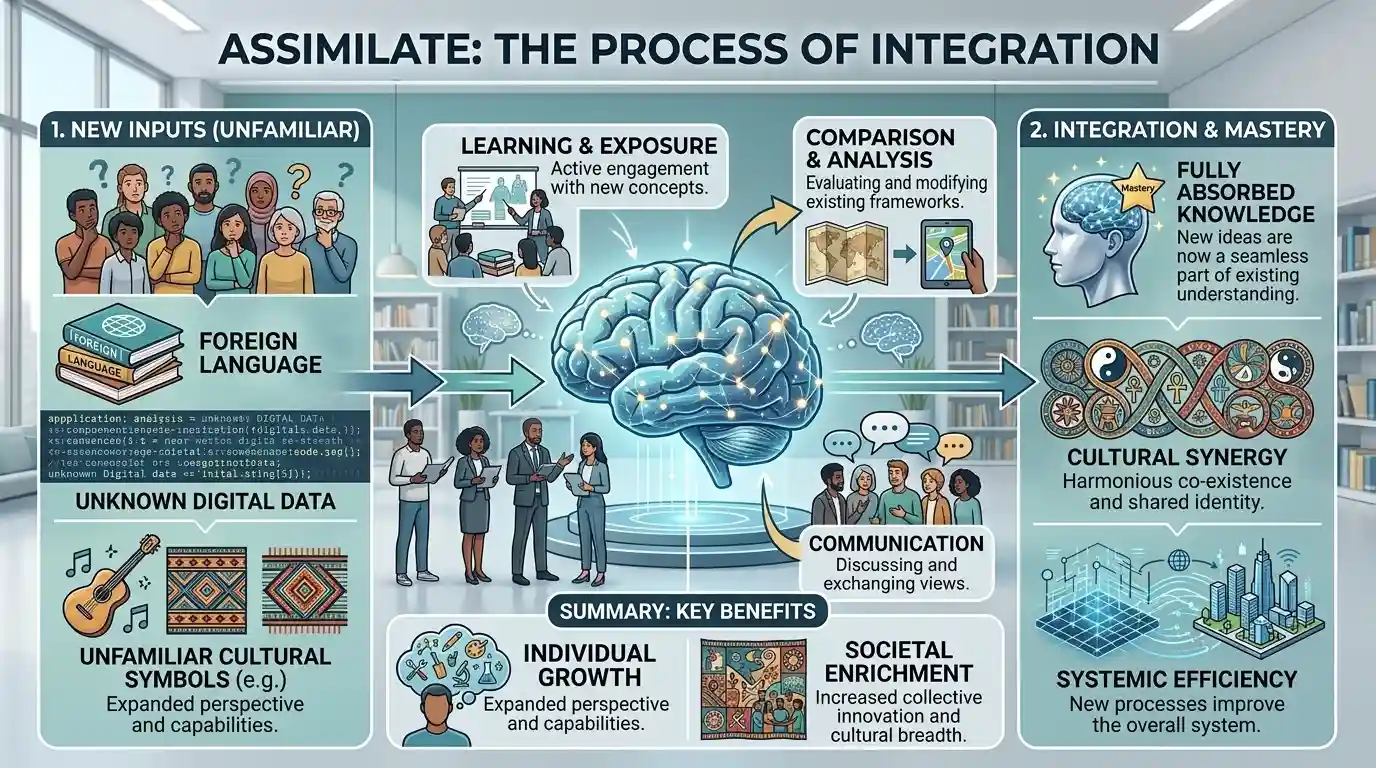
A synonym of assimilate is a word or phrase that expresses the idea of taking in, understanding, absorbing, or becoming part of something. Depending on context, useful alternatives include absorb, integrate, incorporate, internalize, adapt, comprehend, and blend in.
The synonym of assimilate becomes useful when a student learns a new idea and makes it part of their knowledge.
Imagine joining a new workplace and slowly learning its rules, habits, and culture. You are beginning to assimilate.
The word is common in education, science, culture, language, and everyday communication. Learning its synonyms makes your English more flexible.
For students and writers, knowing a synonym of assimilate helps avoid repetition. It also makes essays, blogs, and explanations more precise.
Daily English users can choose words such as absorb or adapt when the exact shade of meaning matters.
What Does “Assimilate” Really Mean?
Assimilate is mainly a verb. It means to take in something and make it part of your knowledge, understanding, system, or experience.
It can also mean becoming similar to or integrated into a group, culture, language, or social environment.
In simple English, assimilate means to take something in and make it part of yourself or a larger whole.
For example:
She quickly assimilated the new information.
This means she understood and absorbed the information.
Another example is:
The family gradually assimilated into the local community.
Here, assimilated means they became integrated into the community.
Native speakers understand the word according to context. In academic writing, it often relates to absorbing information. In biology and physiology, it can describe how the body absorbs and uses nutrients.
Connotative Meaning
Connotation (the feeling, attitude, or association connected with a word beyond its basic dictionary meaning) can change how assimilate sounds.
Positive Tone
Assimilate can sound positive when it describes learning, adapting, or becoming comfortable in a new environment.
Example:
The new employee quickly assimilated into the team.
Negative Tone
In cultural or social discussions, assimilate can sometimes suggest losing distinctive traditions or identity under pressure.
Example:
The community resisted pressure to assimilate completely.
Neutral Tone
In education, science, and general learning, the word is often neutral.
Example:
Students need time to assimilate complex information.
Etymology of Assimilate
The English verb assimilate entered English in the early 15th century. It came through Latin assimilare and is connected with the idea of making something similar. The Latin forms are related to similis, meaning “like” or “resembling.” The early English sense included absorbing something into the body. Later meanings developed around becoming alike, being incorporated, and bringing things into agreement.
The word developed several specialized meanings over time. The sense of “make alike” and the intransitive sense of “become incorporated” appeared in the 17th century. A linguistic sense involving agreement in speech was recorded in the 19th century.
Old English: 450–1100
The modern word assimilate was not an Old English word. Its direct history belongs mainly to Latin and later French and English vocabulary.
However, Old English already had many native words expressing ideas such as learning, taking in knowledge, joining, and becoming accustomed to something.
Middle English: 1100–1500
The word entered English during the early part of this broader period through learned vocabulary influenced by Latin and French.
Its early use was especially connected with physiology and the process of absorbing material into the body.
Modern English: 1500–Present
During Modern English, assimilate expanded beyond physical processes. It developed meanings involving similarity, incorporation, learning, language, culture, and social integration.
Today, it remains useful across academic, professional, scientific, and everyday contexts.
Pronunciation
Pronunciation is omitted as requested.
Syllables
as-sim-i-late
Affixation Pattern of Assimilate
Root: simil / simul, associated with the idea of being like or similar
Prefix: ad- in the historical Latin formation, with assimilation of sounds
Suffix: -ate, forming a verb in English
The historical structure is connected with Latin assimilare, related to making something similar.
40 Synonyms of Assimilate
The best synonym depends on what is being assimilated. Information may be absorbed or internalized, while a person may adapt, integrate, or blend in. The following words cover the most useful shades.
1. Absorb (Verb)
Meaning: To take in information, knowledge, ideas, or experiences and understand them.
Tone/Register: Neutral, academic, everyday.
Example:
She absorbed the lesson quickly.
He absorbed every detail of the training session.
Best use: Use absorb when the focus is on taking information or experience into the mind.
2. Integrate (Verb)
Meaning: To combine something or someone with an existing system, group, or environment.
Tone/Register: Neutral, formal, academic.
Example:
The new students integrated well into the class.
The company integrated the new software into its system.
Best use: Integrate emphasizes becoming part of an established whole.
3. Incorporate (Verb)
Meaning: To include something as a part of a larger whole.
Tone/Register: Formal, academic, professional.
Example:
The teacher incorporated new examples into the lesson.
The report incorporates several recent findings.
Best use: Choose incorporate when something is deliberately added to an existing structure.
4. Internalize (Verb)
Meaning: To absorb an idea, belief, rule, or lesson so deeply that it becomes part of your thinking.
Tone/Register: Academic, psychological, formal.
Example:
Children gradually internalize social rules.
She internalized the advice after years of practice.
Best use: Internalize is especially useful for beliefs, values, lessons, and ideas.
5. Take In (Phrasal Verb)
Meaning: To receive and understand information or experience.
Tone/Register: Informal, conversational.
Example:
I need a minute to take in all this information.
He sat quietly and took in the instructions.
Best use: This is a natural everyday alternative.
6. Digest (Verb)
Meaning: To think about and understand difficult information gradually.
Tone/Register: Neutral, figurative, academic.
Example:
Give the students time to digest the new material.
I am still digesting what the speaker said.
Best use: Digest suggests careful mental processing.
7. Comprehend (Verb)
Meaning: To understand something fully or clearly.
Tone/Register: Formal, academic.
Example:
The student finally comprehended the difficult concept.
Readers must comprehend the main argument first.
Best use: Use it when understanding itself is the main idea.
8. Understand (Verb)
Meaning: To know the meaning or significance of something.
Tone/Register: Neutral, everyday.
Example:
She understood the instructions immediately.
I understand why the rule matters.
Best use: Understand is the simplest and most natural everyday alternative.
9. Learn (Verb)
Meaning: To gain knowledge or skill through study, experience, or teaching.
Tone/Register: Neutral, everyday, academic.
Example:
He learned the new procedure quickly.
Students learn better through practical examples.
Best use: Choose learn when the focus is acquiring knowledge or skill.
10. Master (Verb)
Meaning: To learn something thoroughly and become highly skilled at it.
Tone/Register: Neutral, academic, professional.
Example:
She mastered the new writing technique.
He mastered the language after years of study.
Best use: Master is stronger than assimilate because it suggests a high level of competence.
11. Acquire (Verb)
Meaning: To gain knowledge, skills, habits, or information over time.
Tone/Register: Formal, academic, professional.
Example:
Students acquire vocabulary through repeated exposure.
She acquired valuable communication skills.
Best use: Use acquire for gradual development or gaining something.
12. Grasp (Verb)
Meaning: To understand an idea or concept clearly.
Tone/Register: Neutral, conversational, academic.
Example:
He quickly grasped the main idea.
It took me a while to grasp the theory.
Best use: Grasp often describes successfully understanding something difficult.
13. Comprehend Fully (Verb Phrase)
Meaning: To understand something completely rather than only recognizing part of it.
Tone/Register: Formal, academic.
Example:
The researchers comprehended the implications of the results.
Students must comprehend the entire passage.
Best use: This phrase is useful when emphasizing complete understanding.
14. Absorb Knowledge (Verb Phrase)
Meaning: To take in knowledge naturally through exposure, study, or experience.
Tone/Register: Neutral, educational.
Example:
Young learners absorb knowledge through conversation.
She absorbed knowledge from every training session.
Best use: It emphasizes the learning process.
15. Take On (Phrasal Verb)
Meaning: To accept and adopt a role, responsibility, quality, or characteristic.
Tone/Register: Informal, neutral.
Example:
The new manager took on the team’s working style.
He took on more responsibility after the promotion.
Best use: Use it when someone adopts a role, responsibility, or characteristic.
16. Adopt (Verb)
Meaning: To begin using or accepting an idea, behavior, method, or practice.
Tone/Register: Neutral, formal, professional.
Example:
The school adopted a new teaching method.
She adopted several useful study habits.
Best use: Adopt emphasizes deliberate acceptance.
17. Adapt (Verb)
Meaning: To change behavior or habits so that you can function effectively in a new situation.
Tone/Register: Neutral, academic, everyday.
Example:
She adapted quickly to her new school.
It took him several weeks to adapt to the schedule.
Best use: Adapt focuses on adjusting rather than simply understanding.
18. Acclimate (Verb)
Meaning: To become accustomed to a new environment or situation.
Tone/Register: Neutral, formal.
Example:
It took the students time to acclimate to the new campus.
Workers gradually acclimated to the different schedule.
Best use: Common when discussing adjustment to new surroundings or conditions.
19. Adjust (Verb)
Meaning: To change your behavior, expectations, or approach to suit a new situation.
Tone/Register: Neutral, everyday.
Example:
She adjusted to her new routine quickly.
He adjusted his communication style for the audience.
Best use: Adjust is broader and more common than assimilate.
20. Conform (Verb)
Meaning: To behave according to accepted rules, standards, or expectations.
Tone/Register: Formal, neutral, sometimes negative.
Example:
The design must conform to safety standards.
He refused to conform to every social expectation.
Best use: It can overlap with assimilation but often suggests following an external standard.
21. Blend In (Phrasal Verb)
Meaning: To appear naturally similar to the people or surroundings around you.
Tone/Register: Informal, conversational.
Example:
She dressed casually to blend in with the crowd.
The new student soon learned how to blend in.
Best use: Common in social situations.
22. Fit In (Phrasal Verb)
Meaning: To become comfortable or accepted within a group or environment.
Tone/Register: Informal, conversational.
Example:
He worried that he would not fit in.
After a few weeks, she felt she belonged and fit in.
Best use: Fit in is more conversational than assimilate.
23. Merge (Verb)
Meaning: To combine two or more things into one larger whole.
Tone/Register: Neutral, business, formal.
Example:
The two departments merged last year.
The colors merge smoothly in the final design.
Best use: Use merge when separate things become one.
24. Blend (Verb)
Meaning: To mix or combine so that separate elements work naturally together.
Tone/Register: Neutral, descriptive.
Example:
The writer blended humor with serious ideas.
The new design blends traditional and modern features.
Best use: Blend often suggests a smooth combination.
25. Unite (Verb)
Meaning: To bring people or things together as one group or whole.
Tone/Register: Formal, neutral.
Example:
The project united students from different departments.
The event united people around a shared goal.
Best use: More focused on bringing together than mentally absorbing.
26. Combine (Verb)
Meaning: To join separate elements so they work or exist together.
Tone/Register: Neutral, academic, professional.
Example:
The course combines theory with practical work.
She combined several ideas into one proposal.
Best use: Appropriate when separate elements are brought together.
27. Embrace (Verb)
Meaning: To willingly accept an idea, change, culture, or practice.
Tone/Register: Positive, expressive, professional.
Example:
The team embraced the new approach.
She embraced the opportunity to learn another language.
Best use: Embrace carries a warmer and more willing tone.
28. Accept (Verb)
Meaning: To receive or recognize something as valid, suitable, or true.
Tone/Register: Neutral, everyday.
Example:
He accepted the new rules without complaint.
She gradually accepted the changes around her.
Best use: It emphasizes willingness to recognize or receive something.
29. Absorb Into (Verb Phrase)
Meaning: To make something become part of a larger system, group, or structure.
Tone/Register: Formal, neutral.
Example:
The larger organization absorbed the smaller department.
The body absorbs nutrients into the bloodstream.
Best use: This phrase can be especially precise for physical or organizational contexts.
30. Assimilate Into (Verb Phrase)
Meaning: To become integrated into a group, culture, system, or environment.
Tone/Register: Formal, academic.
Example:
The newcomers gradually assimilated into the community.
The students assimilated into their new school environment.
Best use: This phrase directly expresses social or cultural integration.
31. Internalize Fully (Verb Phrase)
Meaning: To absorb an idea or principle so deeply that it influences future behavior.
Tone/Register: Academic, psychological.
Example:
The trainees internalized the safety principles.
She fully internalized the lessons from the experience.
Best use: Useful when learning changes future thinking or behavior.
32. Familiarize Yourself With (Verb Phrase)
Meaning: To learn enough about something to become comfortable or knowledgeable about it.
Tone/Register: Formal, professional.
Example:
Please familiarize yourself with the new policy.
Students should familiarize themselves with the assignment guidelines.
Best use: Ideal for instructions, workplaces, and academic settings.
33. Get Used To (Phrase)
Meaning: To become accustomed to something through repeated experience.
Tone/Register: Informal, everyday.
Example:
I am still getting used to my new schedule.
She quickly got used to speaking in public.
Best use: A highly natural everyday alternative to formal language.
34. Become Accustomed To (Phrase)
Meaning: To gradually become comfortable with something unfamiliar.
Tone/Register: Formal, neutral.
Example:
He became accustomed to the busy city life.
She became accustomed to the new academic routine.
Best use: More formal than get used to.
35. Learn the Ropes (Idiom)
Meaning: To learn how a particular job, activity, or environment works.
Tone/Register: Informal, conversational.
Example:
The intern is still learning the ropes.
It took her a month to learn the ropes.
Best use: This is useful when discussing practical adjustment rather than deep understanding.
36. Take Up (Phrasal Verb)
Meaning: To begin adopting or engaging in an activity, practice, or habit.
Tone/Register: Neutral, conversational.
Example:
She took up a new study routine.
He took up the team’s preferred communication style.
Best use: Use it when someone begins a practice or activity.
37. Integrate With (Verb Phrase)
Meaning: To become connected with and function effectively alongside another group or system.
Tone/Register: Formal, professional.
Example:
The new employee integrated with the team quickly.
The program integrates with existing classroom systems.
Best use: Helpful for people, systems, technology, and organizations.
38. Accommodate (Verb)
Meaning: To adjust or make room for something or someone within an existing situation.
Tone/Register: Formal, professional.
Example:
The course accommodates different learning styles.
The schedule was adjusted to accommodate new students.
Best use: Accommodate focuses on making room or adjusting for something.
39. Assimilate Knowledge (Verb Phrase)
Meaning: To absorb and understand information until it becomes part of your existing knowledge.
Tone/Register: Academic, educational.
Example:
Students need quiet time to assimilate knowledge.
Practice helps learners assimilate new vocabulary.
Best use: Especially useful in educational writing.
40. Incorporate Into (Verb Phrase)
Meaning: To make something an established part of a larger system, plan, or structure.
Tone/Register: Formal, academic, professional.
Example:
The editor incorporated the feedback into the article.
The teacher incorporated real-life examples into the lesson.
Best use: Best when something is intentionally added to an existing whole.
Synonyms of Assimilate by Tone
Positive Synonyms
Words such as embrace, integrate, adapt, absorb, internalize, and blend can have positive or constructive associations.
They work well when describing successful learning, cooperation, adjustment, or personal growth.
Neutral Synonyms
Understand, learn, acquire, accept, adjust, incorporate, combine, and comprehend are generally neutral.
They are suitable for educational, professional, and everyday contexts.
Negative or Potentially Negative Synonyms
Conform may have a negative shade when it suggests giving up individuality to meet outside expectations.
In cultural contexts, assimilate itself can also become sensitive when it implies pressure to abandon a distinct identity.
Playful or Informal Synonyms
Take in, take on, fit in, blend in, get used to, and learn the ropes sound more natural in casual conversation.
Why Tone Matters in Word Choice
Choosing the right synonym can change the message.
Compare:
She conformed to the group’s expectations.
with:
She integrated into the group.
The first sentence can suggest pressure or obedience. The second sounds more neutral and emphasizes successful participation.
“Assimilate” vs Close Alternatives
Assimilate suggests making information, ideas, or experiences part of an existing system of knowledge.
Absorb focuses more directly on taking something in.
Example:
The student absorbed the information.
The student assimilated the information into her existing knowledge.
Assimilate vs Integrate
Integrate usually emphasizes becoming part of a group, system, or structure.
Assimilate can emphasize becoming similar or taking something into an existing whole.
Example:
The new employee integrated into the team.
The student assimilated the new concepts into her understanding.
Assimilate vs Adapt
Adapt means changing yourself or your approach to suit a new situation.
Assimilate suggests absorbing or becoming incorporated into something.
Example:
He adapted to the new schedule.
He assimilated the team’s working practices.
How “Assimilate” Changes by Context
Daily Conversation
In everyday speech, assimilate can sound more formal than necessary.
Instead of saying:
I am trying to assimilate all this information.
A casual speaker might say:
I am trying to take all this in.
For social adjustment, fit in, blend in, or get used to can sound more natural.
Writing or Blogging
Bloggers can use assimilate when discussing learning, culture, language, or personal development.
However, varying the word choice keeps writing natural.
For example, use absorb for information, adapt for change, and integrate for systems or groups.
Professional or Academic Writing
Assimilate, internalize, integrate, incorporate, acquire, and comprehend are particularly useful in formal writing.
For example:
Employees need time to assimilate new procedures.
This sounds appropriate in a professional training context.
Creative or Informal Use
Creative writers may prefer blend in, fit in, embrace, or take in.
These choices can make dialogue sound more natural.
Common Mistakes Learners Make
Mistake 1: Using Assimilate for Every Type of Learning
Not every learning situation requires assimilate.
For simple learning, learn or understand is often more natural.
Mistake 2: Confusing Assimilate With Adapt
These words are related but not identical.
Adapt means changing yourself to suit a situation. Assimilate means taking something in or becoming incorporated into a larger whole.
Mistake 3: Assuming Assimilate Always Has a Positive Meaning
The word can be neutral, but cultural contexts may give it a more sensitive meaning.
The surrounding sentence determines its tone.
Mistake 4: Using Formal Words in Casual Conversation
Saying “I need to assimilate this information” is grammatically correct, but “I need to take this in” may sound more conversational.
Native Usage Notes
Assimilate is more common in formal, academic, scientific, educational, and cultural writing than in casual conversation.
Native speakers often choose simpler alternatives such as understand, absorb, learn, adapt, fit in, or get used to when speaking informally.
A useful rule is simple:
Choose assimilate when you want to emphasize incorporation or absorption. Choose a simpler synonym when the context does not require that precision.
For related vocabulary learning, an internal vocabulary article can naturally connect readers to other synonym guides on your website.
Real-Life Mini Scenarios
Workplace
A new employee studies the company’s procedures and gradually becomes comfortable with the team’s methods.
You could say:
She assimilated the company’s working practices.
Or:
She adapted to the team’s working style.
Social Situation
A student moves to a new school and begins participating in activities with classmates.
You could say:
He integrated into the school community.
Or:
He gradually fit in with the other students.
Media and Pop Culture
A movie character enters an unfamiliar society and slowly learns its customs.
You could say:
The character gradually assimilated into the new culture.
For a more conversational tone:
The character slowly learned to fit in.
Writing and Storytelling
A novelist introduces a character who learns a difficult lesson after a major event.
You could write:
Over time, she internalized the lesson.
This is more specific than simply saying she learned it.
Practice Quiz
Choose the best answer for each situation.
Part One
1. Which word best describes taking in new information?
A. Merge
B. Absorb
C. Unite
D. Conform
2. Which synonym best fits becoming part of a community?
A. Integrate
B. Digest
C. Acquire
D. Grasp
3. Which word suggests changing yourself to suit a new situation?
A. Adapt
B. Comprehend
C. Incorporate
D. Absorb
4. Which informal phrase means becoming comfortable with something?
A. Get used to
B. Internalize
C. Assimilate knowledge
D. Comprehend
5. Which word is especially suitable for formal academic writing?
A. Fit in
B. Get used to
C. Internalize
D. Take in
6. Which word means to understand an idea clearly?
A. Grasp
B. Merge
C. Blend
D. Unite
7. A company adds new rules to its existing policy. Which word fits best?
A. Incorporate
B. Fit in
C. Learn the ropes
D. Acclimate
Part Two
8. Which phrase best describes learning how a workplace operates?
A. Learn the ropes
B. Merge
C. Embrace
D. Absorb into
9. Which word suggests willingly accepting a new approach?
A. Embrace
B. Conform
C. Digest
D. Acquire
10. Which word can suggest following external expectations?
A. Conform
B. Understand
C. Absorb
D. Learn
11. Which synonym is most natural in “I need time to ___ everything the speaker said”?
A. Take in
B. Unite
C. Accommodate
D. Merge
12. Which word best describes becoming accustomed to a new environment?
A. Acclimate
B. Combine
C. Incorporate
D. Master
13. Which word suggests learning something to a very high level?
A. Master
B. Blend
C. Adjust
D. Accept
14. Which word means to make something part of a larger whole?
A. Incorporate
B. Fit in
C. Learn
D. Acclimate
15. Which synonym best describes absorbing an idea so deeply that it affects behavior?
A. Internalize
B. Merge
C. Unite
D. Accommodate
Reflection Task: Write one sentence using assimilate, absorb, integrate, internalize, adapt, or another synonym from this article.
Answer Key: 1-B | 2-A | 3-A | 4-A | 5-C | 6-A | 7-A | 8-A | 9-A | 10-A | 11-A | 12-A | 13-A | 14-A | 15-A
FAQs
1. What is the best synonym of assimilate for learning information?
Absorb is often the best synonym when you mean taking in information, knowledge, or ideas. Understand is simpler for everyday English, while internalize is stronger when the information becomes part of someone’s thinking or behavior. In academic writing, assimilate can emphasize the process of incorporating new knowledge into existing understanding.
2. What is a good synonym of assimilate in a cultural context?
Integrate is often a useful alternative when describing participation in a community or society. Blend in and fit in sound more conversational. However, cultural uses can carry different implications depending on whether the sentence describes voluntary adjustment, social participation, or pressure to become similar to a dominant group.
3. Is assimilate a positive or negative word?
Assimilate is not inherently positive or negative. Its tone depends on context. It can describe successful learning or adjustment in a neutral way. In cultural discussions, however, it can sometimes suggest pressure to give up distinctive traditions or identity. The surrounding language determines how readers are likely to interpret it.
4. What is the difference between assimilate and integrate?
Assimilate can emphasize becoming similar to or incorporating something into an existing whole. Integrate usually emphasizes becoming connected with a group, system, or structure while functioning as part of it. In social contexts, integrate can sound more neutral because it does not necessarily suggest becoming similar to everyone else.
5. What is the difference between assimilate and adapt?
Adapt means changing your behavior, habits, or approach so that you can function in a new situation. Assimilate focuses more on absorbing information, practices, or characteristics or becoming incorporated into a larger whole. Someone can adapt to a workplace without completely assimilating its culture.
6. Can assimilate be used for knowledge?
Yes. Assimilate is commonly used for knowledge, information, ideas, and concepts, particularly in formal or academic contexts. For example, “Students need time to assimilate new information” means they need time to absorb and incorporate that information into what they already know.
7. What is the informal synonym of assimilate?
Common informal alternatives include take in, get used to, fit in, blend in, and learn the ropes, depending on the context. For example, “I need time to take all this in” is a natural conversational alternative when assimilate means understanding or processing new information.
8. Which synonym of assimilate is best for essays?
The best choice depends on the intended meaning. Internalize, integrate, incorporate, acquire, comprehend, and absorb can work well in essays. Avoid replacing assimilate mechanically. Select the synonym that expresses the exact idea, because these words emphasize different aspects of learning, adjustment, combination, or integration.
Conclusion
Learning the synonym of assimilate gives you more than extra vocabulary. It helps you describe learning, adjustment, integration, and understanding with greater precision.
Words such as absorb, integrate, internalize, adapt, comprehend, incorporate, and embrace each express a different shade of meaning.
Strong vocabulary makes essays clearer and blogs more engaging. It also helps daily speakers choose words that sound natural for each situation.
Practice these synonyms in emails, essays, journal entries, and daily conversations. Try replacing one familiar word with a more precise alternative each day.
The more you use these words in real sentences, the easier they become to remember. Keep practicing, and let your vocabulary grow naturally.

Mehtab Yasir is a passionate writer and English language enthusiast dedicated to making vocabulary learning simple, practical, and enjoyable. As an author at SynonymDesk.com, she creates helpful content covering synonyms, antonyms, word meanings, vocabulary, phrases, and everyday English usage. Her goal is to provide clear and easy-to-understand information that helps students, writers, professionals, and English learners choose the right words and communicate with greater confidence. Mehtab believes that a strong vocabulary can improve both writing and communication skills. She enjoys researching new words, exploring their meanings and uses, and turning complex language concepts into useful, reader-friendly content. Through her work, she strives to make SynonymDesk.com a reliable resource for anyone looking to improve their English vocabulary and language skills.