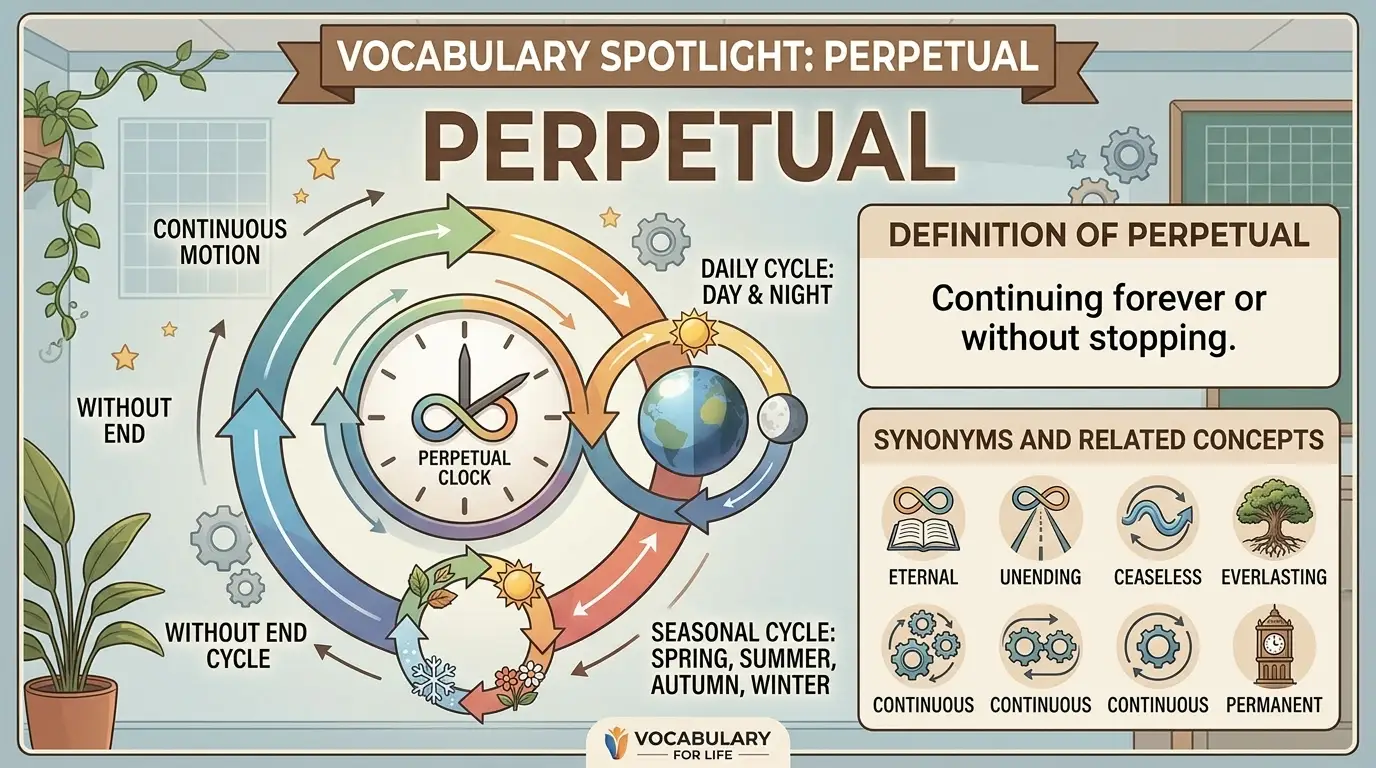
Synonym of perpetual means a word that expresses something continuing forever, for a very long time, or repeatedly without seeming to stop. Common alternatives include eternal, everlasting, endless, continuous, constant, permanent, and unceasing.
A synonym of perpetual becomes useful when you want your English to sound more precise. Imagine a student describing a sound that seems to continue all day. Instead of repeating “perpetual,” a suitable synonym can make the sentence clearer.
A writer may use “everlasting” for emotional writing, while “continuous” may suit academic work. Each synonym adds a slightly different shade of meaning to the sentence.
Learning the synonym of perpetual can strengthen vocabulary for students, bloggers, content writers, and daily English users. It also helps avoid unnecessary repetition.
Whether you are writing an essay, blog post, email, or casual message, knowing several alternatives makes your language more flexible, natural, and expressive.
What Does “Perpetual” Really Mean?
Perpetual is an adjective used to describe something that continues forever, lasts for an extremely long time, or happens repeatedly and seems difficult to stop.
In simple English, perpetual means “continuing without end” or “happening again and again.” Cambridge Dictionary gives both meanings: something can continue forever, or it can occur repeatedly.
For example:
The village lived under perpetual threat.
Here, “perpetual” suggests a threat that seems constant or never-ending.
It can also describe repeated behavior:
His perpetual complaining annoyed everyone.
In this sentence, the word suggests that the complaining happens repeatedly.
Part of speech: Adjective
Perpetual commonly appears with nouns such as fear, motion, change, conflict, noise, struggle, student, problem, debate, growth, and movement.
The word can sound neutral, positive, or negative depending on the noun it describes.
Connotative Meaning of Perpetual
Connotation (the feeling or emotional association connected with a word beyond its basic dictionary meaning) can change how “perpetual” feels in a sentence.
Positive Tone
“Perpetual” can sound positive when it describes something valued, such as perpetual love, perpetual peace, or perpetual friendship.
Negative Tone
The word can sound negative when it describes an unwanted condition, such as perpetual noise, perpetual stress, perpetual delays, or perpetual complaining.
Neutral Tone
It can also be neutral when describing something that continues for a long time, such as perpetual motion, perpetual change, or a perpetual calendar.
Etymology of Perpetual
The word perpetual entered English through Old French perpetuel and ultimately comes from Latin perpetuus, meaning “continuous” or “universal.” Etymological sources trace its development through Medieval Latin perpetualis.
Old English Period: 450–1100
“Perpetual” was not an ordinary native Old English word. English vocabulary at this time was largely Germanic, while many learned Latin-derived terms had not yet entered everyday English.
Middle English Period: 1100–1500
The word appeared in Middle English around the mid-14th century as forms related to perpetuel. Its early meanings included everlasting, unceasing, and continuing indefinitely. By the late 14th century, it also developed the sense of being uninterrupted or continuous.
Modern English Period: 1500–Present
Modern English retained the central idea of something lasting indefinitely. The word became useful in literature, formal writing, law, finance, science, and everyday descriptions of repeated behavior.
Today, “perpetual” can refer both to something theoretically everlasting and to something that happens so frequently that it seems never to stop.
Affixation Pattern of Perpetual
Root
The deeper historical root is connected with Latin perpetuus, meaning continuous or lasting.
Prefix
There is no productive English prefix that modern speakers normally analyze in “perpetual.”
Suffix
The ending -al helps form an adjective in English, although the historical development of the word comes through Latin and French rather than a simple modern English root-plus-suffix construction.
Synonyms List
Below are 40 useful alternatives. Some are very close synonyms, while others work best in specific contexts where the idea of continuing, lasting, or recurring is important.
1. Everlasting (Adjective)
Meaning: Continuing forever or seeming to have no end.
Tone/Register: Formal, literary, emotional
Example: Their friendship created an everlasting bond.
The poem celebrates everlasting love.
2. Eternal (Adjective)
Meaning: Existing or continuing forever without an end.
Tone/Register: Formal, literary, philosophical
Example: The story explores the idea of eternal hope.
Many traditions discuss eternal life.
3. Endless (Adjective)
Meaning: Continuing without a visible or expected end.
Tone/Register: Neutral, conversational
Example: We had an endless conversation about travel.
The road seemed endless at night.
4. Unending (Adjective)
Meaning: Continuing without stopping or reaching an end.
Tone/Register: Neutral, formal
Example: The team faced an unending series of challenges.
Her unending patience impressed everyone.
5. Ceaseless (Adjective)
Meaning: Continuing continuously without a break.
Tone/Register: Formal, literary
Example: The ceaseless rain flooded several streets.
We could hear the ceaseless sound of traffic.
6. Incessant (Adjective)
Meaning: Continuing repeatedly without interruption, often in an annoying way.
Tone/Register: Formal, usually negative
Example: The incessant noise made it hard to study.
His incessant questions delayed the meeting.
7. Unceasing (Adjective)
Meaning: Continuing without stopping.
Tone/Register: Formal, literary
Example: She showed unceasing support for her family.
The machine produced an unceasing hum.
8. Continuous (Adjective)
Meaning: Continuing without a break or interruption.
Tone/Register: Neutral, academic, professional
Example: The system requires continuous monitoring.
Continuous rain caused problems for the farmers.
9. Continual (Adjective)
Meaning: Happening repeatedly, often with short breaks between occurrences.
Tone/Register: Neutral, formal
Example: The project faced continual delays.
His continual efforts eventually paid off.
10. Constant (Adjective)
Meaning: Happening continuously or occurring very frequently.
Tone/Register: Neutral, everyday, professional
Example: The city experiences constant traffic.
Her constant encouragement helped me continue.
11. Permanent (Adjective)
Meaning: Intended to last indefinitely rather than being temporary.
Tone/Register: Neutral, professional
Example: She accepted a permanent position.
The building suffered permanent damage.
12. Enduring (Adjective)
Meaning: Continuing for a long time despite difficulties or change.
Tone/Register: Positive, formal
Example: They built an enduring friendship.
The novel has enduring appeal.
13. Abiding (Adjective)
Meaning: Continuing for a long time and remaining firmly established.
Tone/Register: Formal, literary
Example: He has an abiding respect for his teacher.
Her abiding faith helped her through difficult times.
14. Lasting (Adjective)
Meaning: Continuing for a long period and having a durable effect.
Tone/Register: Neutral, positive
Example: The experience had a lasting impact.
They formed a lasting connection.
15. Sustained (Adjective)
Meaning: Continuing at a steady level for a period of time.
Tone/Register: Academic, professional
Example: The company experienced sustained growth.
The athlete maintained sustained effort throughout the race.
16. Uninterrupted (Adjective)
Meaning: Continuing without being stopped or broken.
Tone/Register: Neutral, formal
Example: We enjoyed three hours of uninterrupted study.
The broadcast continued uninterrupted.
17. Unremitting (Adjective)
Meaning: Continuing steadily without becoming weaker or stopping.
Tone/Register: Formal, literary
Example: Her unremitting effort impressed the entire team.
The rescue workers showed unremitting dedication.
18. Interminable (Adjective)
Meaning: Seeming to continue for an extremely long time and never finish.
Tone/Register: Formal, usually negative
Example: The lecture felt interminable.
They were tired of the interminable discussion.
19. Infinite (Adjective)
Meaning: Having no limit or end.
Tone/Register: Academic, philosophical, formal
Example: The universe raises questions about infinite space.
She has infinite curiosity about science.
20. Timeless (Adjective)
Meaning: Remaining valuable, attractive, or meaningful despite the passage of time.
Tone/Register: Positive, literary
Example: The film has a timeless message.
Her simple style remains timeless.
21. Ageless (Adjective)
Meaning: Not appearing to grow old or losing relevance with age.
Tone/Register: Positive, descriptive
Example: The actor has an ageless appearance.
The story has an ageless appeal.
22. Undying (Adjective)
Meaning: Continuing forever, especially when referring to love, loyalty, admiration, or devotion.
Tone/Register: Emotional, literary
Example: She expressed her undying love for her family.
The fans showed undying loyalty to the singer.
23. Immortal (Adjective)
Meaning: Living forever or remaining famous and remembered indefinitely.
Tone/Register: Literary, formal
Example: The poet created an immortal work.
His achievements made his name immortal.
24. Perennial (Adjective)
Meaning: Continuing for a long time or recurring regularly over many years.
Tone/Register: Formal, academic
Example: Water shortages are a perennial problem.
The novel remains a perennial favorite among readers.
25. Sempiternal (Adjective)
Meaning: Existing or continuing forever.
Tone/Register: Very formal, literary
Example: The poem reflects on sempiternal questions of existence.
The writer describes a sempiternal bond between generations.
26. Perdurable (Adjective)
Meaning: Able to last for a very long time or remain permanent.
Tone/Register: Rare, formal, literary
Example: The monument became a perdurable symbol of the city.
The writer searched for a perdurable form of artistic expression.
27. Never-ending (Adjective)
Meaning: Continuing without reaching a final point.
Tone/Register: Neutral, conversational
Example: The children seemed to have never-ending energy.
We faced a never-ending list of small tasks.
28. Long-lasting (Adjective)
Meaning: Remaining effective, useful, or present for a long period.
Tone/Register: Neutral, everyday
Example: Their friendship became long-lasting.
The lesson had a long-lasting effect on her.
29. Durable (Adjective)
Meaning: Able to remain useful or strong despite extended use or difficulty.
Tone/Register: Neutral, professional
Example: The material is durable enough for daily use.
Good habits can create durable changes.
30. Persistent (Adjective)
Meaning: Continuing despite attempts to stop, remove, or change something.
Tone/Register: Neutral, professional
Example: She made persistent efforts to improve.
The region experienced persistent rainfall.
31. Ongoing (Adjective)
Meaning: Continuing or currently in progress.
Tone/Register: Neutral, professional, academic
Example: The investigation is ongoing.
We discussed the ongoing changes in education.
32. Recurrent (Adjective)
Meaning: Happening repeatedly, especially at intervals.
Tone/Register: Academic, medical, formal
Example: The report identified recurrent problems.
The town faces recurrent flooding during the rainy season.
33. Repeated (Adjective)
Meaning: Happening more than once or occurring again and again.
Tone/Register: Neutral, everyday
Example: Repeated mistakes slowed the project.
The teacher gave repeated reminders.
34. Chronic (Adjective)
Meaning: Continuing for a long time or repeatedly occurring, often describing an unwanted condition.
Tone/Register: Formal, professional, often negative
Example: The city has a chronic traffic problem.
His chronic lateness frustrated his coworkers.
35. Unrelenting (Adjective)
Meaning: Continuing strongly without becoming weaker or stopping.
Tone/Register: Formal, usually negative or intense
Example: The team worked under unrelenting pressure.
The unrelenting heat made travel difficult.
36. Relentless (Adjective)
Meaning: Continuing with great force or determination without stopping.
Tone/Register: Strong, formal, literary
Example: The storm brought relentless rain.
Her relentless pursuit of improvement inspired the team.
37. Ever-present (Adjective)
Meaning: Seeming to be present or noticeable at all times.
Tone/Register: Formal, descriptive
Example: Technology is an ever-present part of modern life.
The ever-present risk made everyone cautious.
38. Everlasting (Adjective)
Meaning: Continuing forever or for an indefinitely long period.
Tone/Register: Literary, emotional, formal
Example: The story presents hope as everlasting.
Their ceremony represented everlasting commitment.
39. Unfailing (Adjective)
Meaning: Always reliable, dependable, or consistently present.
Tone/Register: Formal, positive
Example: She offered unfailing support during difficult times.
His unfailing kindness made people trust him.
40. Unstopping (Adjective)
Meaning: Continuing without stopping; used less commonly than “unceasing” or “continuous.”
Tone/Register: Uncommon, descriptive
Example: The river seemed to have an unstopping flow.
The machine produced an unstopping rhythm throughout the night.
Synonyms of Perpetual by Tone
Tone matters because two words can share a basic meaning but create very different feelings.
Positive Synonyms
Enduring, abiding, lasting, timeless, undying, everlasting, eternal, perennial, unfailing, immortal
These choices work well when discussing love, friendship, loyalty, beauty, hope, influence, or achievements.
Neutral Synonyms
Continuous, continual, constant, permanent, ongoing, sustained, uninterrupted, persistent, repeated, recurrent
These are useful in academic writing, workplace communication, reports, and everyday descriptions.
Negative Synonyms
Incessant, interminable, chronic, unrelenting, relentless, ceaseless
These words often describe problems, noise, pressure, delays, complaints, or difficult conditions.
Playful or Informal Synonyms
Never-ending, endless, long-lasting, always-there
These can sound more conversational than highly formal alternatives.
Choosing the right synonym helps your writing communicate not only duration but also attitude.
Perpetual vs Close Alternatives
Perpetual can mean forever, but it can also describe something that happens repeatedly.
Eternal is more strongly connected with something existing outside or beyond time.
Use perpetual for ongoing conditions or repeated events. Use eternal for ideas such as eternal life, eternal love, or philosophical existence.
Perpetual vs Continuous
Continuous usually emphasizes an unbroken flow.
For example, continuous rain means the rain does not stop during the period being discussed.
Perpetual can suggest something lasting indefinitely or happening so often that it seems never to stop.
Perpetual vs Permanent
Permanent emphasizes that something is not temporary.
Perpetual emphasizes continuation or repeated existence.
A permanent job is a position intended to continue. A perpetual problem is a problem that seems to continue repeatedly.
How “Perpetual” Changes by Context
Daily Conversation
In everyday speech, “perpetual” is less common than words such as constant, endless, always, continuous, or never-ending.
For example, instead of saying, “There is perpetual noise outside,” a casual speaker might say, “There is constant noise outside.”
Writing and Blogging
Bloggers can use “perpetual” to add variety and precision.
For example, “The perpetual search for better content” sounds more polished than repeatedly using “constant search.”
However, writers should not use it simply to sound sophisticated. The word should match the intended meaning.
Professional or Academic Writing
“Perpetual” works well in formal contexts when discussing continuing conditions, systems, processes, or repeated issues.
Examples include perpetual change, perpetual motion, perpetual conflict, and perpetual development.
Academic writers should choose “continuous,” “ongoing,” “persistent,” or “recurrent” when those words express the exact relationship more clearly.
Creative or Informal Writing
Creative writers may use “perpetual” to create an emotional or dramatic effect.
For example:
She carried a perpetual sense of wonder.
The word gives the sentence a literary quality.
Common Mistakes Learners Make
Mistake 1: Treating Every Long Event as Perpetual
Something lasting several hours is not automatically perpetual.
“Perpetual” usually suggests indefinite continuation or repeated occurrence.
Mistake 2: Confusing Perpetual With Temporary
These meanings are opposite in many contexts.
A temporary condition has a limited duration, while a perpetual condition is presented as continuing indefinitely.
Mistake 3: Using Perpetual for Every Repeated Event
A repeated event is not always perpetual.
“Repeated” simply means something happens more than once. “Perpetual” creates a stronger idea of continuous or seemingly endless recurrence.
Mistake 4: Overusing Formal Synonyms
Words such as sempiternal and perdurable are valid but uncommon.
In normal conversation, endless, constant, continuous, lasting, or permanent will usually sound more natural.
Native Usage Notes
Native speakers often choose the synonym according to the noun that follows it.
For example, perpetual motion is a familiar formal expression. Perpetual complaining has a negative tone. Everlasting love sounds emotional and literary.
This shows why a synonym is not always a perfect one-to-one replacement.
One useful way to improve your vocabulary is to compare related words before using them in your own sentences. For additional vocabulary study, a dictionary such as Cambridge can help you check definitions and usage examples. Cambridge Dictionary: perpetual
Real-Life Mini Scenarios Using Perpetual and Its Synonyms
Workplace Scenario
A manager may describe ongoing training, continuous improvement, or persistent technical problems.
For example, “The team is focused on continuous improvement” sounds natural in professional communication.
Social Scenario
Someone may describe a friend’s constant support or unfailing kindness.
These choices sound more natural than using “perpetual” in every casual conversation.
Media and Pop Culture
A review may describe a classic film as having timeless appeal.
A celebrity’s influence may be described as enduring or long-lasting.
Writing and Storytelling
A novelist may describe endless darkness, eternal love, or an unending journey.
The choice depends on the emotional atmosphere the writer wants to create.
Why Learning Synonyms of Perpetual Matters
Vocabulary is not only about memorizing large word lists. It is about understanding which word fits a particular situation.
Knowing alternatives to “perpetual” helps you avoid repetition. It also allows you to control tone.
For example, incessant can suggest irritation, while everlasting can suggest beauty or emotional depth.
A student may use continuous in an academic essay. A blogger may choose endless for a friendly article. A novelist may prefer eternal or timeless.
This flexibility makes writing more natural and expressive.
Interactive Practice Quiz
Test your understanding by choosing the word that best fits each situation.
1. The company has experienced ______ growth for five years.
A. eternal
B. sustained
C. immortal
D. timeless
2. The children had ______ energy throughout the afternoon.
A. endless
B. permanent
C. immortal
D. sempiternal
3. The poet wrote about ______ love that could never disappear.
A. eternal
B. recurrent
C. chronic
D. repeated
4. The office was filled with ______ noise from construction.
A. timeless
B. incessant
C. enduring
D. permanent
5. The investigation is still ______.
A. ongoing
B. immortal
C. ageless
D. everlasting
6. The painting has a ______ quality that still attracts visitors.
A. chronic
B. timeless
C. recurrent
D. incessant
7. The city faces ______ flooding every rainy season.
A. recurrent
B. eternal
C. immortal
D. ageless
8. She gave her friend ______ support during a difficult year.
A. unceasing
B. unfailing
C. interminable
D. chronic
9. The lecture seemed ______ because it lasted far longer than expected.
A. enduring
B. interminable
C. permanent
D. eternal
10. The company wants to create a ______ solution rather than a temporary fix.
A. permanent
B. repeated
C. incessant
D. endless
11. The athlete showed ______ determination despite repeated setbacks.
A. relentless
B. recurrent
C. temporary
D. timeless
12. The old tradition has remained ______ for generations.
A. enduring
B. chronic
C. incessant
D. repeated
13. Which word is most suitable for a formal discussion of something that exists forever?
A. eternal
B. ongoing
C. repeated
D. durable
14. Which word usually describes something that happens again and again?
A. recurrent
B. immortal
C. permanent
D. ageless
15. Which synonym is especially suitable for something that remains fashionable or meaningful over time?
A. timeless
B. incessant
C. chronic
D. unremitting
Reflection Task
Write one original sentence using perpetual, everlasting, continuous, enduring, timeless, or another synonym from this article. Then replace your chosen word with a different synonym and compare how the tone changes.
Answer Key: 1-B | 2-A | 3-A | 4-B | 5-A | 6-B | 7-A | 8-B | 9-B | 10-A | 11-A | 12-A | 13-A | 14-A | 15-A
Frequently Asked Questions
1. What is the best synonym of perpetual in simple English?
The simplest alternatives to “perpetual” are endless, continuous, constant, never-ending, and everlasting. The best choice depends on context. “Endless” works well in everyday English, while “everlasting” often sounds more emotional. “Continuous” is useful when something happens without interruption. “Constant” is suitable when something remains present or happens very frequently.
2. What is the difference between perpetual and permanent?
“Perpetual” focuses on continuing indefinitely or repeatedly, while “permanent” focuses on not being temporary. For example, a permanent position is expected to last rather than end after a short period. A perpetual problem suggests an issue that keeps occurring or seems impossible to end. The two words overlap, but their emphasis is different.
3. Is eternal stronger than perpetual?
In many contexts, “eternal” carries a stronger sense of existing forever. It is especially common with concepts such as eternal life, eternal love, or eternal truth. “Perpetual” has a broader practical use because it can also describe repeated behavior or conditions. For example, “perpetual complaints” does not necessarily mean the complaints literally continue forever.
4. What is a good synonym for perpetual in academic writing?
Useful academic alternatives include continuous, continual, sustained, persistent, ongoing, recurrent, and permanent. The correct choice depends on the relationship being described. “Continuous” suggests no interruption, “recurrent” suggests repeated occurrence, and “ongoing” indicates that something is still happening. Academic writers should choose the word that expresses the exact meaning rather than simply choosing a more formal word.
5. What is a positive synonym for perpetual?
Positive alternatives include everlasting, eternal, enduring, abiding, timeless, undying, and unfailing. For example, “everlasting friendship” has a warm emotional tone, while “timeless beauty” suggests that something remains attractive or meaningful despite the passage of time. “Enduring” is especially useful when something remains strong despite challenges or changing circumstances.
6. What is a negative synonym for perpetual?
When “perpetual” describes an unwanted situation, words such as incessant, interminable, chronic, relentless, unrelenting, and ceaseless may work. For example, “perpetual noise” can become “incessant noise” when the writer wants to emphasize irritation. These alternatives should be used carefully because many carry a stronger negative emotional tone than “perpetual.”
7. Can perpetual mean repeated?
Yes. “Perpetual” can describe something that happens repeatedly and so frequently that it seems continuous. For example, “perpetual complaints” means complaints that occur again and again. However, “repeated” is more neutral and simply means something happened more than once. “Perpetual” often creates a stronger impression of frequency, continuation, or lack of an ending.
8. How can learning synonyms of perpetual improve English?
Learning synonyms helps you choose words according to meaning, tone, and context. Instead of repeatedly using “perpetual,” you can select “continuous” for an unbroken process, “recurrent” for something that returns, or “everlasting” for emotional writing. This improves essays, blog posts, emails, storytelling, conversations, and general vocabulary flexibility.
Conclusion
Learning the synonym of perpetual gives you more control over your English. Words such as endless, eternal, continuous, and enduring can express similar ideas with different shades.
Strong vocabulary is not about using the most difficult word. It is about choosing the word that sounds natural and communicates your exact meaning clearly.
For students, bloggers, writers, and daily English users, these alternatives make communication more flexible. They also reduce repetition in essays, articles, emails, and conversations.
Start practicing today by writing a few sentences with perpetual and its synonyms. Try using these words in your own emails, essays, and daily conversations to make your English stronger.

Mehtab Yasir is a passionate writer and English language enthusiast dedicated to making vocabulary learning simple, practical, and enjoyable. As an author at SynonymDesk.com, she creates helpful content covering synonyms, antonyms, word meanings, vocabulary, phrases, and everyday English usage. Her goal is to provide clear and easy-to-understand information that helps students, writers, professionals, and English learners choose the right words and communicate with greater confidence. Mehtab believes that a strong vocabulary can improve both writing and communication skills. She enjoys researching new words, exploring their meanings and uses, and turning complex language concepts into useful, reader-friendly content. Through her work, she strives to make SynonymDesk.com a reliable resource for anyone looking to improve their English vocabulary and language skills.