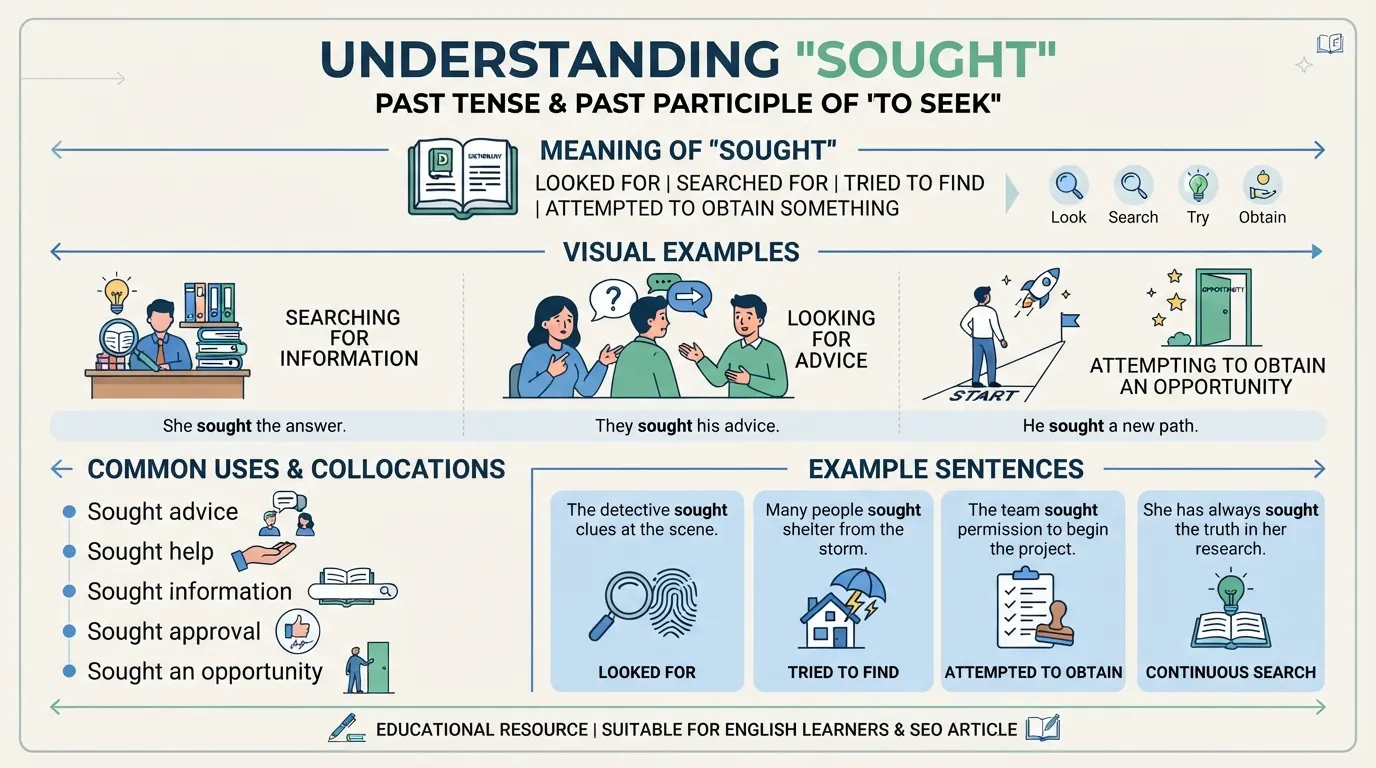
Synonyms of sought include searched for, looked for, pursued, requested, asked for, desired, wanted, aimed for, and attempted to obtain. The best alternative depends on context because sought can describe looking for something, asking for something, pursuing a goal, or turning to someone for help.
Synonyms of sought become useful when you want to avoid repeating the same verb in essays, articles, emails, stories, or everyday conversations.
Imagine a student who sought advice before an important exam. Using words such as requested or asked for can make the sentence more precise.
Learning synonyms of sought also helps students, bloggers, content writers, and daily English users express intentions more naturally and accurately.
The word sought is common because English speakers use it for searching, requesting, pursuing goals, and looking for solutions in many situations.
What Does “Sought” Really Mean?
Sought is the past tense and past participle of seek. It means that someone looked for something, tried to obtain something, asked for something, or actively pursued a particular goal.
For example:
“She sought advice from her teacher.”
Here, sought means asked for or looked for advice.
Another example is:
“The company sought new opportunities.”
In this sentence, sought means actively tried to find or obtain new opportunities.
As a verb, sought usually suggests purposeful action. It often describes someone who deliberately tries to find, achieve, obtain, or receive something.
Native speakers commonly encounter sought in academic writing, professional communication, journalism, literature, formal speeches, and everyday expressions.
The word can sound slightly more formal than simple alternatives such as looked for or asked for. However, it is completely natural in both spoken and written English.
Connotative Meaning of “Sought”
Connotation (the feeling, attitude, or association a word may carry beyond its basic dictionary meaning) can change depending on the situation.
Positive Tone
Sought can suggest determination, ambition, curiosity, wisdom, or purposeful effort.
“She sought a better solution.”
This can suggest that she was thoughtful and proactive.
Negative Tone
In some contexts, sought can suggest excessive ambition, pursuit of power, attention, or approval.
“He sought attention from the audience.”
The word itself is not necessarily negative, but the surrounding context can create a negative impression.
Neutral Tone
In many sentences, sought is completely neutral.
“The researchers sought evidence to support the theory.”
It simply describes an attempt to find something.
Etymology of “Sought”
Sought comes from the verb seek, which has deep Germanic roots. Old English used forms such as sēcan, meaning “to seek, look for, search for, inquire, or strive after.”
The irregular past form developed historically from the older form sōhte, which eventually became the modern English sought.
Old English: 450–1100
Old English used sēcan for the idea of looking for something, searching, asking, or trying to obtain something.
Middle English: 1100–1500
During Middle English, forms related to seken and sohte became common. The word continued to express searching, pursuing, and requesting.
Modern English: 1500–Present
Modern English retained seek as the base verb and sought as its irregular past and past participle form.
Pronunciation of “Sought”
US: /sɔt/
UK: /sɔːt/
Pronunciation can vary slightly among English accents, especially in the vowel sound.
Syllables
sought
It is a one-syllable word.
Affixation Pattern of “Sought”
Root
The historical root is connected with the Germanic family of words related to seeking and searching.
Prefix
No productive prefix appears in modern English sought.
Suffix
No productive suffix appears in modern English sought.
45 Synonyms of Sought
The word sought has several meanings. Because of this, its closest alternatives depend on what the person was trying to find, obtain, request, achieve, or pursue.
1. Searched For (Verb Phrase) — US: /sɝːtʃt fɔr/ | UK: /sɜːtʃt fɔː/
Meaning: Means actively looking for a person, object, answer, place, or piece of information.
Tone/Register: Neutral, everyday, and widely used.
Example:
“She searched for her keys before leaving.”
“The team searched for evidence online.”
2. Looked For (Verb Phrase) — US: /lʊkt fɔr/ | UK: /lʊkt fɔː/
Meaning: Means trying to find something or someone.
Tone/Register: Informal to neutral; extremely common in conversation.
Example:
“I looked for a quiet place to study.”
“They looked for a solution together.”
3. Pursued (Verb) — US: /pərˈsuːd/ | UK: /pəˈsjuːd/
Meaning: Means actively continuing after a goal, opportunity, interest, or objective.
Tone/Register: Neutral to formal.
Example:
“She pursued a career in journalism.”
“He pursued his goal despite several setbacks.”
4. Requested (Verb) — US: /rɪˈkwestɪd/ | UK: /rɪˈkwestɪd/
Meaning: Means formally or politely asked for something.
Tone/Register: Formal, professional, and polite.
Example:
“The manager requested additional information.”
“She requested a copy of the report.”
5. Asked For (Verb Phrase) — US: /æskt fɔr/ | UK: /ɑːskt fɔː/
Meaning: Means directly requested or wanted something.
Tone/Register: Neutral and conversational.
Example:
“He asked for extra time.”
“She asked for help with the assignment.”
6. Desired (Verb) — US: /dɪˈzaɪərd/ | UK: /dɪˈzaɪəd/
Meaning: Means wanted something strongly or considered it worth having.
Tone/Register: Formal, literary, or polished.
Example:
“She desired greater independence.”
“He desired a peaceful life.”
7. Wanted (Verb) — US: /ˈwɑːntɪd/ | UK: /ˈwɒntɪd/
Meaning: Means wished to have, obtain, experience, or achieve something.
Tone/Register: Neutral and extremely common.
Example:
“They wanted better results.”
“She wanted an honest answer.”
8. Aimed For (Verb Phrase) — US: /eɪmd fɔr/ | UK: /eɪmd fɔː/
Meaning: Means deliberately tried to achieve a particular result or target.
Tone/Register: Neutral, professional, and academic.
Example:
“The campaign aimed for wider public awareness.”
“She aimed for a higher score.”
9. Strived For (Verb Phrase) — US: /straɪvd fɔr/ | UK: /straɪvd fɔː/
Meaning: Means made a serious effort to achieve something desirable.
Tone/Register: Formal to neutral.
Example:
“The team strived for excellence.”
“She strived for balance in her work.”
10. Endeavored To Obtain (Verb Phrase) — US: /enˈdevərd tu əbˈteɪn/ | UK: /ɪnˈdevəd tu əbˈteɪn/
Meaning: Means made a determined effort to obtain something.
Tone/Register: Formal and literary.
Example:
“The researchers endeavored to obtain reliable data.”
“He endeavored to obtain permission.”
11. Tried To Get (Verb Phrase) — US: /traɪd tə ɡet/ | UK: /traɪd tə ɡet/
Meaning: Means attempted to obtain or achieve something.
Tone/Register: Informal and conversational.
Example:
“She tried to get a seat near the window.”
“He tried to get more information.”
12. Sought After (Adjectival Phrase) — US: /sɔt ˈæftər/ | UK: /sɔːt ˈɑːftə/
Meaning: Highly desired or wanted by many people.
Tone/Register: Neutral to formal.
Example:
“She is a sought-after designer.”
“That neighborhood is highly sought after.”
13. Pursued After (Verb Phrase) — US: /pərˈsuːd ˈæftər/ | UK: /pəˈsjuːd ˈɑːftə/
Meaning: In limited contexts, describes actively chasing or following something; however, pursued alone is usually more natural.
Tone/Register: Formal to neutral.
Example:
“The investigator pursued every possible lead.”
“She pursued the opportunity with confidence.”
14. Chased (Verb) — US: /tʃeɪst/ | UK: /tʃeɪst/
Meaning: Means actively tried to catch, reach, obtain, or achieve something.
Tone/Register: Informal to neutral.
Example:
“He chased his dream of becoming a musician.”
“She chased every opportunity to improve.”
15. Followed (Verb) — US: /ˈfɑːloʊd/ | UK: /ˈfɒləʊd/
Meaning: Means continued to pursue a path, goal, person, idea, or course of action.
Tone/Register: Neutral.
Example:
“She followed her ambition into science.”
“He followed every possible lead.”
16. Approached (Verb) — US: /əˈproʊtʃt/ | UK: /əˈprəʊtʃt/
Meaning: Means went to someone for help, information, permission, or discussion.
Tone/Register: Neutral to formal.
Example:
“She approached her teacher for advice.”
“He approached the manager about the problem.”
17. Consulted (Verb) — US: /kənˈsʌltɪd/ | UK: /kənˈsʌltɪd/
Meaning: Sought advice, information, or professional guidance from someone.
Tone/Register: Formal, professional, and academic.
Example:
“She consulted a lawyer before signing.”
“The doctor consulted a specialist.”
18. Turned To (Phrasal Verb) — US: /tɝːnd tuː/ | UK: /tɜːnd tuː/
Meaning: Means sought help, support, advice, or comfort from someone or something.
Tone/Register: Neutral and natural.
Example:
“He turned to his friend for advice.”
“She turned to books for inspiration.”
19. Resort To (Phrasal Verb) — US: /rɪˈzɔːrt tuː/ | UK: /rɪˈzɔːt tuː/
Meaning: Means sought or used a particular method, often because easier options were unavailable.
Tone/Register: Formal and often slightly negative.
Example:
“They resorted to negotiation after the dispute.”
“He resorted to silence when the argument became heated.”
20. Applied For (Phrasal Verb) — US: /əˈplaɪd fɔr/ | UK: /əˈplaɪd fɔː/
Meaning: Means formally requested consideration for a job, position, program, permit, or opportunity.
Tone/Register: Neutral and professional.
Example:
“She applied for a teaching position.”
“He applied for a scholarship.”
21. Solicited (Verb) — US: /səˈlɪsɪtɪd/ | UK: /səˈlɪsɪtɪd/
Meaning: Means formally asked for something, especially information, support, opinions, or contributions.
Tone/Register: Formal, business, or institutional.
Example:
“The editor solicited opinions from readers.”
“The organization solicited feedback after the event.”
22. Petitioned (Verb) — US: /pəˈtɪʃənd/ | UK: /pəˈtɪʃənd/
Meaning: Means formally asked an authority or organization to take a particular action.
Tone/Register: Formal and legal.
Example:
“The residents petitioned the council.”
“She petitioned the court for a review.”
23. Appealed For (Phrasal Verb) — US: /əˈpiːld fɔr/ | UK: /əˈpiːld fɔː/
Meaning: Means publicly or strongly asked for help, support, information, or action.
Tone/Register: Formal, public, or journalistic.
Example:
“The family appealed for information.”
“Officials appealed for calm.”
24. Called For (Phrasal Verb) — US: /kɔːld fɔr/ | UK: /kɔːld fɔː/
Meaning: Means publicly demanded, requested, or advocated a particular action.
Tone/Register: Formal, journalistic, or political.
Example:
“Experts called for stronger safety measures.”
“Residents called for better public transport.”
25. Solicited Help (Verb Phrase) — US: /səˈlɪsɪtɪd help/ | UK: /səˈlɪsɪtɪd help/
Meaning: Means deliberately requesting assistance from others.
Tone/Register: Formal.
Example:
“She solicited help from experienced colleagues.”
“The team solicited help during the investigation.”
26. Inquired About (Verb Phrase) — US: /ɪnˈkwaɪərd əˈbaʊt/ | UK: /ɪnˈkwaɪəd əˈbaʊt/
Meaning: Means sought information by asking questions.
Tone/Register: Formal to neutral.
Example:
“He inquired about the course schedule.”
“She inquired about available positions.”
27. Investigated (Verb) — US: /ɪnˈvestəɡeɪtɪd/ | UK: /ɪnˈvestɪɡeɪtɪd/
Meaning: Means deliberately seeking facts or explanations through careful examination.
Tone/Register: Formal, academic, professional, or journalistic.
Example:
“Reporters investigated the unusual claim.”
“The researchers investigated possible causes.”
28. Explored (Verb) — US: /ɪkˈsplɔːrd/ | UK: /ɪkˈsplɔːd/
Meaning: Means sought to understand, discover, examine, or experience something.
Tone/Register: Neutral, academic, and creative.
Example:
“She explored new ways to teach vocabulary.”
“The article explored the history of the expression.”
29. Probed (Verb) — US: /proʊbd/ | UK: /prəʊbd/
Meaning: Sought detailed information by examining or questioning something deeply.
Tone/Register: Formal, journalistic, or analytical.
Example:
“The journalist probed the reasons behind the decision.”
“Researchers probed the unusual results.”
30. Examined (Verb) — US: /ɪɡˈzæmɪnd/ | UK: /ɪɡˈzæmɪnd/
Meaning: Means carefully looked into something to understand or evaluate it.
Tone/Register: Academic, formal, and professional.
Example:
“The study examined several possible explanations.”
“She examined the evidence carefully.”
31. Investigated For (Verb Phrase) — US: /ɪnˈvestəɡeɪtɪd fɔr/ | UK: /ɪnˈvestɪɡeɪtɪd fɔː/
Meaning: This construction can describe an investigation conducted to discover a specific fact, cause, or answer, although investigated alone is usually more natural.
Tone/Register: Formal.
Example:
“The team investigated for signs of contamination.”
“Researchers investigated for possible errors in the data.”
32. Searched Out (Phrasal Verb) — US: /sɝːtʃt aʊt/ | UK: /sɜːtʃt aʊt/
Meaning: Means deliberately searching until a particular person, source, or thing was found.
Tone/Register: Neutral and slightly emphatic.
Example:
“She searched out reliable sources for her article.”
“He searched out a quiet place to work.”
33. Hunted For (Verb Phrase) — US: /ˈhʌntɪd fɔr/ | UK: /ˈhʌntɪd fɔː/
Meaning: Means actively and persistently looked for something.
Tone/Register: Informal, vivid, or conversational.
Example:
“They hunted for the missing document.”
“She hunted for the perfect birthday gift.”
34. Looked Into (Phrasal Verb) — US: /lʊkt ˈɪntuː/ | UK: /lʊkt ˈɪntuː/
Meaning: Means investigated or sought more information about a matter.
Tone/Register: Neutral and conversational.
Example:
“I looked into the issue this morning.”
“She looked into several possible solutions.”
35. Searched For Information (Verb Phrase) — US: /sɝːtʃt fɔr ˌɪnfərˈmeɪʃən/ | UK: /sɜːtʃt fɔː ˌɪnfəˈmeɪʃən/
Meaning: Means actively trying to find facts, explanations, or useful knowledge.
Tone/Register: Neutral and academic.
Example:
“Students searched for information before writing their essays.”
“She searched for information about the topic.”
36. Sought Advice From (Verb Phrase) — US: /sɔt ədˈvaɪs frəm/ | UK: /sɔːt ədˈvaɪs frəm/
Meaning: Means asked a person for guidance or an informed opinion.
Tone/Register: Neutral to formal.
Example:
“He sought advice from his mentor.”
“She sought advice from an experienced writer.”
37. Desired To Obtain (Verb Phrase) — US: /dɪˈzaɪərd tə əbˈteɪn/ | UK: /dɪˈzaɪəd tə əbˈteɪn/
Meaning: Means strongly wished to receive, gain, or acquire something.
Tone/Register: Formal and literary.
Example:
“The applicant desired to obtain further experience.”
“She desired to obtain a deeper understanding.”
38. Aspired To (Verb Phrase) — US: /əˈspaɪərd tuː/ | UK: /əˈspaɪəd tuː/
Meaning: Means strongly hoped or worked toward achieving an important goal.
Tone/Register: Formal, motivational, and professional.
Example:
“She aspired to become a published author.”
“He aspired to lead the research team.”
39. Worked Toward (Verb Phrase) — US: /wɝːkt təˈwɔːrd/ | UK: /wɜːkt təˈwɔːd/
Meaning: Means consistently made efforts to achieve a goal.
Tone/Register: Neutral and professional.
Example:
“They worked toward a common goal.”
“She worked toward improving her writing.”
40. Struggled To Find (Verb Phrase) — US: /ˈstrʌɡəld tə faɪnd/ | UK: /ˈstrʌɡəld tə faɪnd/
Meaning: Means tried hard to find something while facing difficulty.
Tone/Register: Neutral and expressive.
Example:
“He struggled to find the right words.”
“She struggled to find a reliable source.”
41. Searched High and Low (Idiom) — US: /sɝːtʃt haɪ ənd loʊ/ | UK: /sɜːtʃt haɪ ənd ləʊ/
Meaning: Means searched everywhere or made a very thorough effort to find something.
Tone/Register: Informal and idiomatic.
Example:
“I searched high and low for my notebook.”
“They searched high and low for the missing file.”
42. Went Looking For (Verb Phrase) — US: /went ˈlʊkɪŋ fɔr/ | UK: /went ˈlʊkɪŋ fɔː/
Meaning: Means deliberately started looking for someone or something.
Tone/Register: Informal and conversational.
Example:
“She went looking for a quiet café.”
“He went looking for answers.”
43. Reached Out To (Phrasal Verb) — US: /riːtʃt aʊt tuː/ | UK: /riːtʃt aʊt tuː/
Meaning: Means contacting someone to seek help, advice, information, or a connection.
Tone/Register: Neutral, professional, and modern.
Example:
“She reached out to a mentor for guidance.”
“He reached out to the editor with a question.”
44. Courted (Verb) — US: /ˈkɔːrtɪd/ | UK: /ˈkɔːtɪd/
Meaning: Means deliberately tried to attract, obtain, or win something such as support, attention, approval, or a relationship.
Tone/Register: Formal, literary, journalistic, or figurative.
Example:
“The candidate courted support from young voters.”
“The brand courted international attention.”
45. Wooed (Verb) — US: /wuːd/ | UK: /wuːd/
Meaning: Means tried persistently to gain someone’s affection, support, attention, or favor.
Tone/Register: Literary, expressive, or figurative.
Example:
“The company wooed talented graduates.”
“He wooed the audience with a warm speech.”
Synonyms of Sought by Tone
Tone matters because two words can communicate a similar basic idea while creating very different impressions.
Positive Synonyms
Pursued, aspired to, worked toward, explored, sought advice from, reached out to
These choices can suggest ambition, curiosity, effort, learning, or constructive action.
Neutral Synonyms
Searched for, looked for, wanted, requested, asked for, followed, approached, examined, looked into
These are useful when you want a straightforward meaning without a strong emotional effect.
Formal Synonyms
Solicited, petitioned, consulted, investigated, endeavored to obtain, inquired about
These work well in professional, academic, legal, or institutional writing.
Negative or Potentially Negative Synonyms
Resorted to, chased, courted
These are not automatically negative. However, their surrounding context can suggest desperation, excessive ambition, or questionable motivation.
Playful or Informal Synonyms
Hunted for, went looking for, searched high and low, tried to get
These expressions are useful in friendly conversations, stories, and informal writing.
“Sought” vs Close Alternatives
Sought can mean searched for, but it has a broader range of meanings.
“She sought an answer.”
“She searched for an answer.”
Both are correct. Sought can sound more formal, while searched for emphasizes the act of looking.
Sought vs Pursued
Pursued often suggests continued effort toward a goal.
“She sought a new opportunity.”
“She pursued a new career.”
The first focuses on looking for or wanting something. The second emphasizes active, sustained effort.
Sought vs Requested
Requested specifically focuses on asking for something.
“She sought assistance.”
“She requested assistance.”
The two can overlap, but requested makes the act of asking more explicit.
How “Sought” Changes by Context
Daily Conversation
In everyday speech, people often replace sought with simpler phrases such as looked for, asked for, or wanted.
For example, “I sought help” is correct, but “I asked for help” sounds more conversational.
Writing and Blogging
Sought works well in articles because it is concise and professional.
A blogger might write, “Readers sought practical advice about improving their writing.”
Using alternatives such as searched for or looked for can make repeated sentences feel more natural.
Professional and Academic English
In formal writing, sought is especially useful when describing goals, research, applications, requests, or investigations.
For example, “The researchers sought to identify the main cause.”
This construction is common in academic and professional communication.
Creative and Informal Writing
Creative writers can choose more vivid alternatives such as hunted for, chased, or searched high and low.
These words create stronger imagery and can make a story feel more energetic.
Common Mistakes Learners Make
Mistake 1: Using “Sought” as a Regular Past Tense
Do not write seeked in standard English.
Use sought instead.
Correct: “She sought advice.”
Incorrect: “She seeked advice.”
Mistake 2: Using “Sought” for Every Type of Request
Sought can mean requested, but requested is sometimes more precise.
“The manager requested a report” clearly describes a formal request.
“The manager sought a report” can sound less direct.
Mistake 3: Confusing “Sought” With “Sought After”
These forms have different grammatical functions.
“She sought a job” means she looked for a job.
“She was a sought-after employee” means many people wanted to employ her.
Mistake 4: Overusing Formal Alternatives
Words such as solicited, petitioned, endeavored, and aspired can sound too formal in casual conversation.
Choose simple language when the situation is informal.
Native Usage Note
Native speakers commonly use sought in phrases such as sought advice, sought help, sought information, sought opportunities, sought approval, sought answers, and sought to improve.
The phrase sought to + verb is especially common in formal writing.
Register Notes
Formal English
Use sought, pursued, solicited, consulted, petitioned, investigated, and endeavored when a polished or professional tone is appropriate.
Informal English
Use looked for, asked for, wanted, tried to get, went looking for, or hunted for in casual situations.
Spoken English
Simple alternatives usually sound more natural in conversation.
“I looked for my phone” is more conversational than “I sought my phone.”
Written English
Sought is highly useful in essays, reports, articles, biographies, and professional documents because it is concise and versatile.
Real-Life Mini Scenarios Using “Sought”
Workplace
A new employee sought advice from a senior colleague before handling an unfamiliar task.
Social Situation
A friend sought support after having a difficult day.
Media and Pop Culture
An actor sought new roles that would challenge her creative skills.
Writing and Storytelling
The main character sought answers after discovering a mysterious letter.
Why Synonyms of Sought Matter
Knowing synonyms of sought is not simply about memorizing a long vocabulary list. The real goal is understanding which word communicates your intended meaning most naturally.
For example, looked for is excellent for everyday speech. Pursued is stronger when a person continues working toward a goal. Requested is clearer when someone formally asks for something.
Similarly, consulted suggests seeking expert advice, while investigated focuses on discovering facts. Aspired to emphasizes ambition, and reached out to emphasizes contacting another person.
This distinction is especially valuable for students and content writers. A precise synonym can make an essay clearer, an article more engaging, and a professional email more polished.
Practical Word Choice Guide
Use “Looked For” When:
You are talking about ordinary searching in everyday English.
Use “Searched For” When:
You want to emphasize an active attempt to find something.
Use “Pursued” When:
The person is actively working toward a goal or opportunity.
Use “Requested” When:
The person directly asks for something.
Use “Consulted” When:
The person seeks advice or professional knowledge.
Use “Investigated” When:
The person seeks facts through careful examination.
Use “Aspired To” When:
The focus is on a long-term ambition.
Use “Reached Out To” When:
Someone contacts another person for help, advice, or connection.
Use “Sought” When:
You want a concise word that can cover searching, requesting, pursuing, or trying to obtain something.
Interactive Practice Quiz
Test your understanding of synonyms of sought by choosing the most suitable word for each situation.
1. Which word best fits a formal request for information?
A. Hunted for
B. Solicited
C. Chased
D. Wanted
2. Which phrase sounds most natural in casual conversation?
A. Looked for
B. Petitioned
C. Endeavored to obtain
D. Solicited
3. A student asks an expert for guidance. Which word fits best?
A. Consulted
B. Chased
C. Courted
D. Hunted
4. Which word best describes working continuously toward a career goal?
A. Pursued
B. Asked for
C. Looked into
D. Requested
5. A person formally asks a court to take action. Which word is most precise?
A. Wanted
B. Petitioned
C. Looked for
D. Explored
6. Which phrase means contacting someone for help or advice?
A. Reached out to
B. Chased
C. Searched high and low
D. Desired
7. Which word best describes seeking facts through careful examination?
A. Investigated
B. Wanted
C. Wooed
D. Asked for
8. Which expression is most vivid and informal for searching everywhere?
A. Consulted
B. Searched high and low
C. Petitioned
D. Solicited
9. Which word best describes a long-term ambition?
A. Aspired to
B. Asked for
C. Looked for
D. Inquired about
10. Which word is most appropriate for a professional request?
A. Requested
B. Hunted for
C. Chased
D. Went looking for
Part Two
11. Which alternative emphasizes strong desire?
A. Desired
B. Examined
C. Investigated
D. Consulted
12. Which phrase best fits someone investigating a problem?
A. Looked into
B. Wanted
C. Wooed
D. Applied for
13. Which word can describe trying to attract support or approval?
A. Courted
B. Examined
C. Searched for
D. Inquired about
14. Which word best fits someone formally asking for feedback?
A. Solicited
B. Chased
C. Hunted
D. Pursued
15. Which simple phrase can replace “sought a solution” in everyday speech?
A. Looked for a solution
B. Petitioned a solution
C. Courted a solution
D. Wooed a solution
Reflection Task
Choose one synonym from this article and write one original sentence about your school, workplace, family, hobby, or daily routine.
Answer Key: 1-B | 2-A | 3-A | 4-A | 5-B | 6-A | 7-A | 8-B | 9-A | 10-A | 11-A | 12-A | 13-A | 14-A | 15-A
FAQs
What is the simplest synonym of sought?
The simplest synonym depends on the sentence. Looked for is usually the easiest alternative when sought means searched for something. Asked for works when it means requested something. Wanted can work when the meaning is simply having a desire for something.
What is the difference between sought and searched for?
Sought has a broader meaning than searched for. It can describe searching, requesting, pursuing, or trying to obtain something. Searched for focuses more specifically on the act of looking for a person, object, answer, or piece of information.
Is sought a formal word?
Sought can sound somewhat more formal than looked for or asked for, especially in academic and professional writing. However, it is a standard and natural English word. Expressions such as “sought advice” and “sought opportunities” are common in both formal writing and everyday communication.
Can sought mean requested?
Yes. Sought can mean requested when someone actively asks for something. For example, “She sought permission from her manager” means that she requested permission. However, requested is more direct when the sentence specifically emphasizes the act of making a request.
What does sought after mean?
Sought after means highly desired or wanted by many people. For example, “She is a sought-after speaker” means that many people want her to speak. This expression differs from “she sought a speaker,” which means she looked for or tried to find a speaker.
Is “seeked” the past tense of seek?
No. Seek is an irregular verb. Its past tense and past participle are sought. The correct sentence is “He sought help,” not “He seeked help.” Learning this irregular form is important for accurate English writing and speaking.
Which synonym of sought is best for academic writing?
Words such as pursued, investigated, examined, explored, consulted, and sought can work well in academic writing. The correct choice depends on the intended meaning. Use investigated for research, consulted for expert guidance, and pursued for an ongoing academic or professional goal.
How can I practice using synonyms of sought?
Start with simple sentences using looked for, searched for, requested, pursued, and consulted. Then replace each word with another suitable synonym and compare the change in tone. Practicing with emails, essays, journal entries, and everyday conversations will make the differences easier to remember.
Conclusion
Learning synonyms of sought gives you more control over your English. You can choose simple, formal, professional, or expressive words based on your audience.
Strong vocabulary also improves blogging and academic writing. The right synonym can remove repetition while making your meaning more exact and natural.
For speaking and communication, practice matters most. Try using these alternatives in short emails, essays, stories, and daily conversations to build confidence.
Keep practicing one word at a time. Choose a synonym today, write your own sentence, and notice how naturally it fits your real-life communication.

Mehtab Yasir is a passionate writer and English language enthusiast dedicated to making vocabulary learning simple, practical, and enjoyable. As an author at SynonymDesk.com, she creates helpful content covering synonyms, antonyms, word meanings, vocabulary, phrases, and everyday English usage. Her goal is to provide clear and easy-to-understand information that helps students, writers, professionals, and English learners choose the right words and communicate with greater confidence. Mehtab believes that a strong vocabulary can improve both writing and communication skills. She enjoys researching new words, exploring their meanings and uses, and turning complex language concepts into useful, reader-friendly content. Through her work, she strives to make SynonymDesk.com a reliable resource for anyone looking to improve their English vocabulary and language skills.