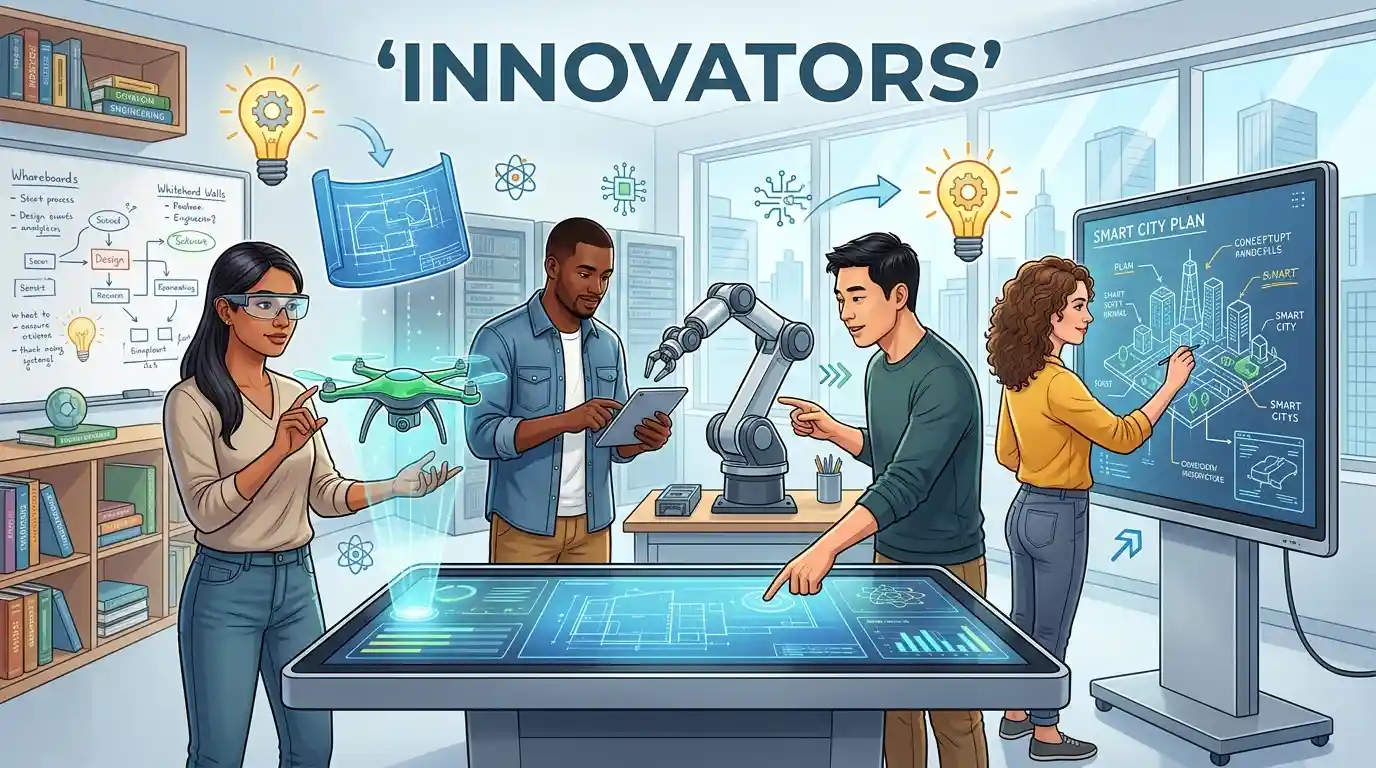
Synonyms for innovators can completely transform how you talk about creative thinkers, visionaries, and industry leaders in modern English.
Imagine you are writing a blog post about tech pioneers. Repeating the same term makes your writing feel dull and uninspiring to readers.
Using strong vocabulary keeps your audience engaged. For instance, calling Steve Jobs a trailblazer paints a much clearer picture of his impact.
Learning these semantic variants helps students, bloggers, content writers, and daily English users express ideas with precision and confidence.
📚 CORE MEANING SECTION
What Does “Innovators” Really Mean?
An innovator is a person who introduces new ideas, original methods, or groundbreaking products into a specific field.
Native English speakers view innovators as proactive problem solvers who push boundaries and change the status quo. You will often see this word used in technology, business, science, and the arts.
- Part of Speech: Noun (plural)
- Simple Definition: People who create or introduce new and better ways of doing things.
🧠 Connotative Meaning
Connotation is the emotional feeling or cultural association that a word carries beyond its explicit definition.
- Positive Tone: Associated with progress, genius, growth, and forward-thinking vision.
- Negative Tone: Rarely negative, but can occasionally imply disruptive behavior or reckless disregard for tradition.
- Neutral Tone: Simply identifies people who make changes or introduce new processes.
📖 Etymology
The word stems from the Latin verb innovare, which means “to renew or alter.”
- Old English (450–1100): The concept existed through Germanic terms for “renewal,” but the word itself was not present.
- Middle English (1100–1500): The root entered English via Anglo-Norman French as innovat-, meaning “made new.”
- Modern English (1500–Present): The noun evolved into its current form to describe people who drive technological and social progress.
🗣️ Pronunciation (US & UK – IPA)
- US: /ˈɪn.ə.veɪ.t̬ɚz/
- UK: /ˈɪn.ə.veɪ.təz/
🧩 Syllables & Affixation
- Syllable Break: in-no-va-tors
- Root: nova (Latin for “new”)
- Prefix: in- (into/upon)
- Suffix: -tor (one who does) + -s (plural)
📖 SYNONYMS LIST
Pioneers (Noun) — US: /ˈpaɪ.əˌnɪrz/ | UK: /ˌpaɪ.əˈnɪəz/
Meaning: People who are among the first to explore or settle a new area or field of knowledge. Tone/Register: Positive / General
- Example 1: Early space scientists were true pioneers of modern astronomy.
- Example 2: She is considered one of the pioneers of renewable energy design.
Trailblazers (Noun) — US: /ˈtreɪlˌbleɪ.zɚz/ | UK: /ˈtreɪlˌbleɪ.zəz/
Meaning: Leaders who make a new path through wild countryside or a new field of action. Tone/Register: Highly Positive / Informal to Professional
- Example 1: These young engineers act as trailblazers in autonomous vehicle design.
- Example 2: The university honored female trailblazers in medical research.
Visionaries (Noun) — US: /ˈvɪʒ.ə.ner.iz/ | UK: /ˈvɪʒ.nər.iz/
Meaning: People with clear, imaginative ideas about what the future could or should be like. Tone/Register: Inspirational / Formal
- Example 1: Visionaries often see opportunities where others only notice obstacles.
- Example 2: Tech visionaries met to discuss the ethical future of artificial intelligence.
Groundbreakers (Noun) — US: /ˈɡraʊndˌbreɪ.kɚz/ | UK: /ˈɡraʊndˌbreɪ.kəz/
Meaning: Individuals who make outstanding discoveries or initiate new, original methods. Tone/Register: Positive / Media & Business
- Example 1: Medical groundbreakers uncovered a safer treatment for the virus.
- Example 2: The studio hired groundbreakers to revamp their animation pipeline.
Pathfinders (Noun) — US: /ˈpæθˌfaɪn.dɚz/ | UK: /ˈpɑːθˌfaɪn.dəz/
Meaning: People who discover a new route or pioneer a new way of doing something. Tone/Register: Literary / Positive
- Example 1: Deep-sea pathfinders mapped the ocean floor using advanced sonar.
- Example 2: Literary pathfinders broke away from traditional narrative structures.
Originators (Noun) — US: /əˈrɪdʒ.ə.neɪ.t̬ɚz/ | UK: /əˈrɪdʒ.ɪ.neɪ.təz/
Meaning: The creators or initial instigators of a particular thought, plan, or movement. Tone/Register: Academic / Formal
- Example 1: They are the true originators of this open-source coding language.
- Example 2: Originators of the movement published their manifesto online.
Architects (Noun) — US: /ˈɑːr.kə.tekts/ | UK: /ˈɑː.kɪ.tekts/
Meaning: People who design, plan, and build complex systems, ideas, or organizations. Tone/Register: Professional / Metaphorical
- Example 1: Economic architects designed a framework to reduce urban poverty.
- Example 2: The chief architects of the deal celebrated their successful merger.
Avant-gardists (Noun) — US: /ˌæv.ɑːŋˈɡɑːr.dɪsts/ | UK: /ˌæv.ɑ̃ːˈɡɑː.dɪsts/
Meaning: People who introduce new and experimental ideas and concepts in the arts. Tone/Register: Cultural / Artistic
- Example 1: Modernist avant-gardists challenged traditional portrait painting standards.
- Example 2: The film festival featured works by rising avant-gardists.
Disruptors (Noun) — US: /dɪsˈrʌp.tɚz/ | UK: /dɪsˈrʌp.təz/
Meaning: People or companies that dramatically alter an industry through radically new ideas. Tone/Register: Business / Modern
- Example 1: Digital disruptors forced legacy banks to upgrade their mobile apps.
- Example 2: Young disruptors are changing how consumers buy eco-friendly clothes.
Inventors (Noun) — US: /ɪnˈven.t̬ɚz/ | UK: /ɪnˈven.təz/
Meaning: Individuals who design or create entirely new devices, processes, or machines. Tone/Register: Neutral / Educational
- Example 1: Early inventors spent years refining the mechanical printing press.
- Example 2: The exhibition highlighted student inventors from around the world.
Trendsetters (Noun) — US: /ˈtrendˌset.ɚz/ | UK: /ˈtrendˌset.əz/
Meaning: People who start new fashions, styles, or popular cultural movements. Tone/Register: Informal / Casual
- Example 1: Fashion trendsetters introduced sustainable fabrics to the runway.
- Example 2: Social media trendsetters shifted music discovery to short video clips.
Instigators (Noun) — US: /ˈɪn.stə.ɡeɪ.t̬ɚz/ | UK: /ˈɪn.stɪ.ɡeɪ.təz/
Meaning: People who cause a process or event to begin, often challenging existing rules. Tone/Register: Neutral to Slightly Negative / Context-dependent
- Example 1: Policy instigators pushed for immediate changes to climate regulations.
- Example 2: The instigators of the project demanded faster execution.
Developers (Noun) — US: /dɪˈvel.ə.pɚz/ | UK: /dɪˈvel.ə.pəz/
Meaning: People who expand, refine, and bring new products or systems into existence. Tone/Register: Technical / Professional
- Example 1: Software developers built a secure tool for online learning.
- Example 2: Real estate developers created solar-powered housing communities.
Founders (Noun) — US: /ˈfaʊn.dɚz/ | UK: /ˈfaʊn.dəz/
Meaning: People who establish an institution, business, or system based on new ideas. Tone/Register: Business / Formal
- Example 1: Startup founders pitched their new logistics platform to investors.
- Example 2: The founders established strict rules for environmental conservation.
Modernizers (Noun) — US: /ˈmɑː.dɚ.naɪ.zɚz/ | UK: /ˈmɒd.ən.aɪ.zəz/
Meaning: People who bring modern methods, ideas, or equipment to older systems. Tone/Register: Political / Professional
- Example 1: Government modernizers updated the national tax collection software.
- Example 2: Factory modernizers replaced aging machinery with automated robotics.
Reformers (Noun) — US: /rɪˈfɔːr.mɚz/ | UK: /rɪˈfɔː.məz/
Meaning: People who work to improve a system or organization by making changes. Tone/Register: Historical / Political
- Example 1: Educational reformers argued for active learning over memorization.
- Example 2: Social reformers spent decades fighting for fairer workplace safety laws.
Game-changers (Noun) — US: /ˈɡeɪmˌtʃeɪn.dʒɚz/ | UK: /ˈɡeɪmˌtʃeɪn.dʒəz/
Meaning: Individuals whose new ideas completely transform a situation, industry, or activity. Tone/Register: Informal / High-Energy
- Example 1: AI research teams proved to be true game-changers in healthcare diagnosis.
- Example 2: Her sudden arrival made her one of the key game-changers of the debate.
Strategists (Noun) — US: /ˈstræt.ə.dʒɪsts/ | UK: /ˈstræt.ə.dʒɪsts/
Meaning: People skilled in planning clever actions and policies to achieve specific goals. Tone/Register: Formal / Executive
- Example 1: Brand strategists devised a clever launch campaign for the gadget.
- Example 2: Military strategists used satellite mapping to secure supply lines.
Masterminds (Noun) — US: /ˈmæs.tɚ.maɪndz/ | UK: /ˈmɑː.stə.maɪndz/
Meaning: Highly intelligent people who plan and direct complex or difficult projects. Tone/Register: Informal to Semi-Formal
- Example 1: The masterminds behind the cybersecurity shield prevented a major breach.
- Example 2: Creative masterminds designed the immersive theme park experience.
Precursors (Noun) — US: /ˌpriːˈkɝː.sɚz/ | UK: /ˌpriːˈkɜː.səz/
Meaning: People or things that come before another of the same type and herald its arrival. Tone/Register: Academic / Technical
- Example 1: Early mechanical calculators were important precursors to modern computers.
- Example 2: Those philosophical thinkers acted as precursors to the Enlightenment.
🔍 SYNONYMS BY TONE
Word choice shapes how your audience feels about the subject. Categorizing these synonyms helps you pick the right word for the right context:
- Positive (Inspiring & Admirable): Pioneers, Visionaries, Trailblazers, Groundbreakers, Pathfinders. Use these when praising achievements.
- Neutral (Objective & Descriptive): Inventors, Originators, Developers, Founders, Modernizers. Use these for news reporting, technical writing, or research papers.
- Negative / Disruptive (Challenging the Status Quo): Disruptors, Instigators. Use these when emphasizing tension or market shake-ups.
- Informal / Conversational: Game-changers, Trendsetters, Masterminds. Ideal for casual blogs, social media posts, and everyday discussions.
⚖️ MINI COMPARISON
Innovators vs. Inventors vs. Visionaries
- Innovators vs. Inventors: An inventor creates something entirely new from scratch (like a physical machine). An innovator improves upon an existing concept or introduces a practical way to apply it to real life.
- Innovators vs. Visionaries: A visionary focuses on grand future ideas and possibilities, often on a conceptual level. An innovator puts those forward-thinking ideas into action to create tangible results.
🧠 CONTEXT-BASED USAGE
Daily Conversation
In casual talk, keep it simple. Terms like game-changers or trendsetters sound natural when talking about friends, athletes, or popular culture.
Writing or Blogging
Bloggers benefit from words with high visual impact. Using trailblazers or groundbreakers makes headline copy feel energetic and inviting.
Professional & Academic Tone
Stick to precise, objective terms in research papers or business reports. Originators, architects, and developers maintain professional authority.
⚠️ COMMON MISTAKES & NATIVE USAGE
Learners often use inventors and innovators interchangeably, which can sound imprecise to native speakers. Remember: inventors build the tool, while innovators change how society uses it.
Another common error is applying art-specific terms like avant-gardists to traditional corporate settings. Match the tone to the industry.
To learn more about related words, explore our comprehensive guide on professional action verbs to improve your executive writing style.
🧩 REAL-LIFE MINI SCENARIOS
- Workplace: “Our engineering team acted as true groundbreakers when they reduced cloud server costs by forty percent.”
- Social Media: “Streetwear trendsetters in Tokyo are reviving early 2000s fashion trends this season.”
- Media / News: “Silicon Valley disruptors are reshaping traditional automotive manufacturing standards.”
10 MCQs on “Innovators” 📝
1. What does “innovators” mean?
A) People who avoid change
B) People who create new ideas or methods
C) People who copy others
D) People who reject technology
Answer: B
2. Which word is closest in meaning to “innovators”?
A) Pioneers
B) Followers
C) Observers
D) Spectators
Answer: A
3. Innovators are usually known for:
A) Developing new ideas
B) Avoiding challenges
C) Repeating old methods
D) Rejecting creativity
Answer: A
4. Which person can be described as an innovator?
A) Someone who develops a new technology
B) Someone who refuses to learn
C) Someone who copies an existing product
D) Someone who avoids new ideas
Answer: A
5. “Trailblazers” is a synonym for:
A) Innovators
B) Critics
C) Followers
D) Assistants
Answer: A
6. What is an important quality of innovators?
A) Creativity
B) Laziness
C) Resistance to change
D) Carelessness
Answer: A
7. Which word is most closely related to “innovators”?
A) Inventors
B) Spectators
C) Consumers
D) Traditionalists
Answer: A
8. Innovators often help society by:
A) Introducing new solutions
B) Preventing progress
C) Removing opportunities
D) Discouraging creativity
Answer: A
9. A person who introduces a new approach to solving a problem is an:
A) Innovator
B) Observer
C) Follower
D) Opponent
Answer: A
10. Which phrase best describes an innovator?
A) A person who creates new and useful ideas
B) A person who avoids all changes
C) A person who only follows instructions
D) A person who rejects new solutions
Answer: A
Application Task: Write one short sentence using the word trailblazer to describe someone you admire in your personal or professional life.
✅ FAQS
1. What are the most common synonyms of innovators in business?
The most effective business synonyms include pioneers, disruptors, trailblazers, groundbreakers, and visionaries. These words highlight leadership, forward-thinking strategies, and market transformation.
2. Is there a difference between an innovator and a pioneer?
Yes, a pioneer is typically the very first person to enter an unexplored field or region. An innovator may work in an established field but introduces novel methods or better solutions.
3. What is a good formal synonym for innovator in academic writing?
In academic papers, use formal terms like originators, architects, developers, or precursors. These words maintain an objective, authoritative tone without sounding overly casual or promotional.
4. Can the word disruptor be used as a positive synonym?
Yes, in modern business contexts, disruptor is usually a compliment. It describes a person or company that challenges outdated practices with smarter, more efficient digital technology.
5. What is an informal synonym for innovators used in everyday speech?
In casual conversation, words like game-changers, trendsetters, or masterminds are popular choices. They clearly convey creativity and success in an engaging, easy-to-understand way.
✅ CONCLUSION
Expanding your vocabulary with synonyms of innovators gives you the exact tools you need to write engaging, persuasive, and varied English content every day.
Swapping overused words for vivid alternatives makes your blog posts, essays, emails, and daily speeches stand out with greater clarity and style.
Try using two or three of these new terms in your next writing project or professional conversation to see how much more dynamic your English becomes.

Mehtab Yasir is a passionate writer and English language enthusiast dedicated to making vocabulary learning simple, practical, and enjoyable. As an author at SynonymDesk.com, she creates helpful content covering synonyms, antonyms, word meanings, vocabulary, phrases, and everyday English usage. Her goal is to provide clear and easy-to-understand information that helps students, writers, professionals, and English learners choose the right words and communicate with greater confidence. Mehtab believes that a strong vocabulary can improve both writing and communication skills. She enjoys researching new words, exploring their meanings and uses, and turning complex language concepts into useful, reader-friendly content. Through her work, she strives to make SynonymDesk.com a reliable resource for anyone looking to improve their English vocabulary and language skills.