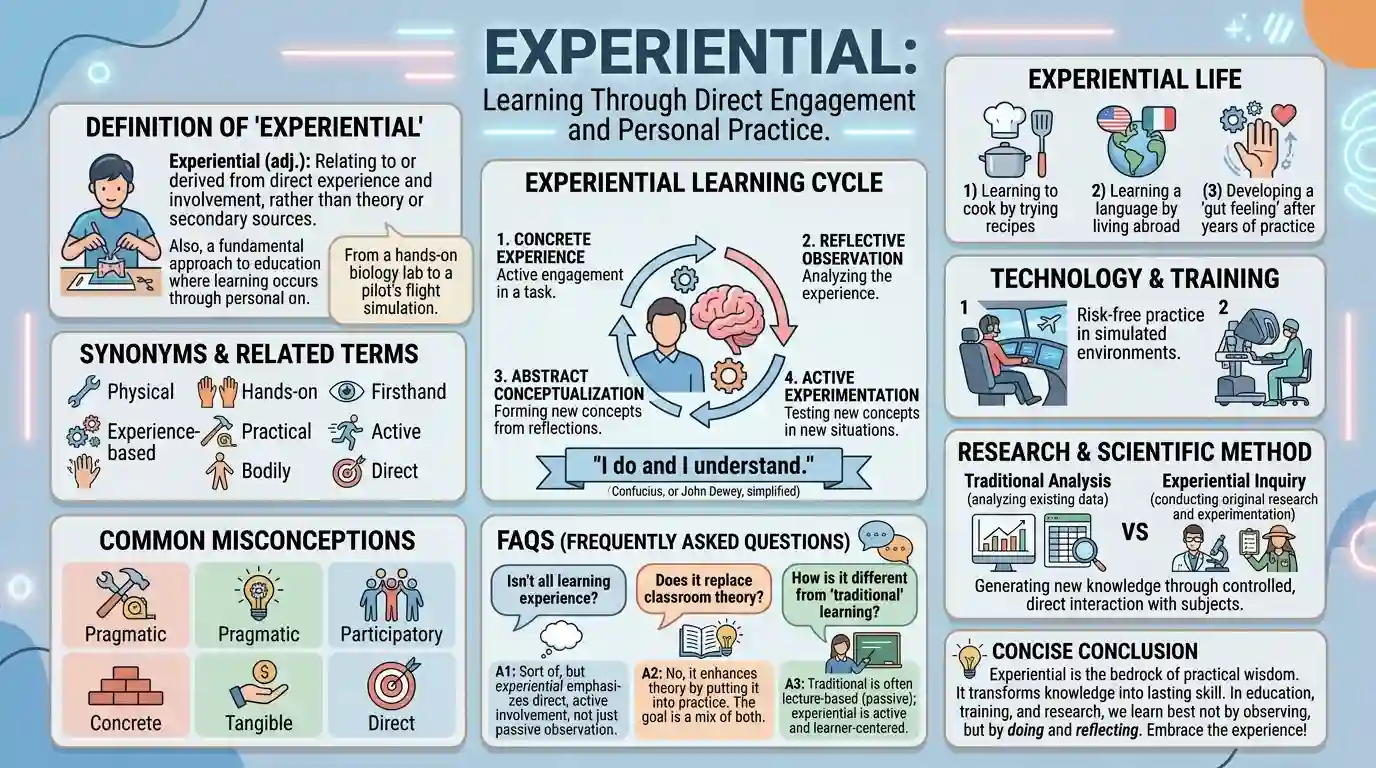
Synonyms of experiential can transform how you share hands-on moments and real-life activities in your daily writing and speaking.
Imagine visiting a museum where you build a model instead of just reading facts off a wall. That dynamic approach is a classic example of active, hands-on learning.
Using synonyms for experiential helps you describe these active moments precisely, avoiding repetitive phrasing across your projects and essays.
These terms are essential for students, bloggers, content writers, and daily English speakers who want to make their communication clear and engaging.
What Does “Experiential” Really Mean?
The word “experiential” describes anything based on direct observation, personal trial, or practical experience rather than theory. Native speakers use it to highlight real-world practice over textbook knowledge. It carries a practical, grounded tone that stresses action. You will often see it in education, business strategy, and travel writing. As an adjective, it modifies nouns to show that involvement drives the activity.
Connotative Meaning
(Connotation refers to the emotional feeling or secondary meaning that a word carries beyond its strict definition.)
- Positive tone: Implies active growth, discovery, and practical mastery.
- Negative tone: Can imply an unproven method based only on trial and error.
- Neutral tone: Describes a practical method involving personal participation.
Etymology
The word originates from the Latin experientia, meaning “proof, trial, or experiment.”
- Old English (450–1100): Not present in Old English; concepts were expressed using Germanic roots for wisdom or doing.
- Middle English (1100–1500): Adapted from Old French to form terms related to physical trial and testing.
- Modern English (1500–Present): Formed in the 19th century by adding the suffix “-ial” to “experience” to create an adjective.
Pronunciation
- US: /ɪkˌspɪr.iˈɛn.ʃəl/
- UK: /ɪkˌspɪər.iˈɛn.ʃəl/
Syllable Breakdown
ex-pe-ri-en-tial
Affixation Pattern
- Root: Experience
- Prefix: Ex- (meaning “out of” or “from”)
- Suffix: -ial (meaning “relating to”)
Synonyms List
Empirical (Adj) — US: /ɛmˈpɪr.ɪ.kəl/ | UK: /ɪmˈpɪr.ɪ.kəl/
- Meaning: Based on testing, observation, or experiment rather than theory alone.
- Tone/Register: Academic, Formal, Scientific
- Example 1: The team collected empirical data to prove the strategy worked.
- Example 2: She prefers empirical evidence over office rumors.
Hands-on (Adj) — US: /ˌhændzˈɑn/ | UK: /ˌhændzˈɒn/
- Meaning: Involving direct, active physical participation in an activity.
- Tone/Register: Informal, Business, Conversational
- Example 1: The workshop offers hands-on practice with new coding tools.
- Example 2: He is a hands-on manager who works alongside his team.
Practical (Adj) — US: /ˈpræk.tɪ.kəl/ | UK: /ˈpræk.tɪ.kəl/
- Meaning: Related to actual action or use rather than ideas and theories.
- Tone/Register: General, Neutral, Everyday
- Example 1: She has practical knowledge of how small businesses run.
- Example 2: We need a practical solution to this scheduling problem.
Applied (Adj) — US: /əˈplaɪd/ | UK: /əˈplaɪd/
- Meaning: Put to practical use as opposed to remaining theoretical.
- Tone/Register: Academic, Professional
- Example 1: He decided to major in applied mathematics this semester.
- Example 2: Applied science turns laboratory discoveries into real products.
Pragmatic (Adj) — US: /præɡˈmæt.ɪk/ | UK: /præɡˈmæt.ɪk/
- Meaning: Dealing with things sensibly based on realistic considerations.
- Tone/Register: Formal, Business
- Example 1: They took a pragmatic approach to solving the budget deficit.
- Example 2: Her pragmatic leadership kept the project on track.
Observational (Adj) — US: /ˌɑb.zɚˈveɪ.ʃən.əl/ | UK: /ˌɒb.zəˈveɪ.ʃən.əl/
- Meaning: Obtained by watching events or behaviors as they happen naturally.
- Tone/Register: Academic, Scientific
- Example 1: The scientists conducted an observational study in the forest.
- Example 2: Her observational skills helped her spot tiny details in the design.
Firsthand (Adj) — US: /ˌfɝːstˈhænd/ | UK: /ˌfɜːstˈhænd/
- Meaning: Coming directly from personal observation or experience.
- Tone/Register: General, Conversational
- Example 1: He gave a firsthand account of the storm’s arrival.
- Example 2: Nothing beats firsthand experience when learning a language.
Action-based (Adj) — US: /ˈæk.ʃənˌbeɪst/ | UK: /ˈæk.ʃənˌbeɪst/
- Meaning: Centered on taking physical steps or performing tasks.
- Tone/Register: Business, Modern, Educational
- Example 1: The course uses action-based lessons to keep students engaged.
- Example 2: Our team thrives in an action-based environment.
Interactive (Adj) — US: /ˌɪn.tɚˈæk.tɪv/ | UK: /ˌɪn.tərˈæk.tɪv/
- Meaning: Requiring active participation and continuous two-way communication.
- Tone/Register: General, Tech, Marketing
- Example 1: The museum features an interactive display for young visitors.
- Example 2: Interactive software helps pupils learn at their own pace.
Direct (Adj) — US: /dəˈrɛkt/ | UK: /daɪˈrɛkt/
- Meaning: Involving immediate contact or personal involvement without intermediaries.
- Tone/Register: General, Clear
- Example 1: She gained direct knowledge of the market through client visits.
- Example 2: Direct involvement in the project built his confidence quickly.
Real-world (Adj) — US: /ˈriːəlˌwɝːld/ | UK: /ˈrɪəlˌwɜːld/
- Meaning: Existing in practical human experience rather than in academic theory.
- Tone/Register: Modern, Educational, Business
- Example 1: Students need real-world experience before starting their careers.
- Example 2: The training simulates real-world challenges under pressure.
Participatory (Adj) — US: /pɑːrˈtɪs.ə.pə.tɔːr.i/ | UK: /pɑːˈtɪs.ɪ.pə.tər.i/
- Meaning: Designed to allow every member of a group to take an active role.
- Tone/Register: Formal, Academic, Political
- Example 1: The city organized a participatory workshop for urban planning.
- Example 2: Participatory teaching methods encourage everyone to speak up.
Active (Adj) — US: /ˈæk.tɪv/ | UK: /ˈæk.tɪv/
- Meaning: Involving energetic action, effort, or physical participation.
- Tone/Register: Everyday, General
- Example 1: She takes an active role in planning community events.
- Example 2: Active learning techniques improve long-term memory retention.
Immersive (Adj) — US: /ɪˈmɝː.sɪv/ | UK: /ɪˈmɜː.sɪv/
- Meaning: Deeply absorbing or involving the participant completely in an environment.
- Tone/Register: Modern, Tech, Marketing
- Example 1: The theatre company created an immersive story experience for the audience.
- Example 2: Language immersion offers an immersive way to gain fluency fast.
Experimental (Adj) — US: /ɪkˌspɛr.əˈmɛn.təl/ | UK: /ɪkˌspɛr.ɪˈmɛn.təl/
- Meaning: Based on untried concepts, novel ideas, or ongoing testing.
- Tone/Register: Academic, Creative, Scientific
- Example 1: The artist uses experimental techniques to paint portraits.
- Example 2: The hospital is testing an experimental therapy today.
Lived (Adj) — US: /lɪvd/ | UK: /lɪvd/
- Meaning: Known directly through personal life experiences.
- Tone/Register: Academic, Personal, Expressive
- Example 1: Her memoir shares lived wisdom from decades of world travel.
- Example 2: They value lived experience over theoretical degrees.
Action-oriented (Adj) — US: /ˈæk.ʃənˌɔːr.i.ɛn.təd/ | UK: /ˈæk.ʃənˌɔː.ri.ən.tɪd/
- Meaning: Focused on practical movement and getting results directly.
- Tone/Register: Business, Corporate
- Example 1: Our goal is to develop action-oriented solutions for the team.
- Example 2: She is an action-oriented leader who dislikes delays.
Practice-based (Adj) — US: /ˈpræk.tɪsˌbeɪst/ | UK: /ˈpræk.tɪsˌbeɪst/
- Meaning: Founded upon actual practice and physical repetition.
- Tone/Register: Educational, Professional
- Example 1: Medical school requires practice-based training in real clinics.
- Example 2: The artist took a practice-based approach to master sculpture.
Practice-oriented (Adj) — US: /ˈpræk.tɪsˌɔːr.i.ɛn.təd/ | UK: /ˈpræk.tɪsˌɔː.ri.ən.tɪd/
- Meaning: Focused primarily on performing work rather than reading theory.
- Tone/Register: Professional, Technical
- Example 1: The university launched a practice-oriented law program.
- Example 2: We offer practice-oriented seminars for new engineers.
Field-based (Adj) — US: /ˈfiːldˌbeɪst/ | UK: /ˈfiːldˌbeɪst/
- Meaning: Conducted outside a laboratory or office in natural settings.
- Tone/Register: Academic, Scientific
- Example 1: Biologists prefer field-based research to observe wild animals.
- Example 2: The geology course includes field-based trips to the mountains.
Real-life (Adj) — US: /ˈriːəlˌlaɪf/ | UK: /ˈrɪəlˌlaɪf/
- Meaning: Occurring in actual daily reality rather than fiction or theory.
- Tone/Register: General, Conversational
- Example 1: The book provides real-life examples of business growth.
- Example 2: She loves applying classroom math to real-life problems.
Activity-based (Adj) — US: /ækˈtɪv.ə.tiˌbeɪst/ | UK: /ækˈtɪv.ə.tiˌbeɪst/
- Meaning: Structured around performing specific tasks or exercises.
- Tone/Register: Educational, Corporate
- Example 1: The primary school uses activity-based learning modules.
- Example 2: Activity-based training helps employees learn faster.
Personal (Adj) — US: /ˈpɝː.sən.əl/ | UK: /ˈpɜː.sən.əl/
- Meaning: Relating directly to an individual’s private life or self.
- Tone/Register: General, Casual
- Example 1: He spoke from personal knowledge during the interview.
- Example 2: She has a personal connection to this charity project.
Concrete (Adj) — US: /ˈkɑːn.kriːt/ | UK: /ˈkɒŋ.kriːt/
- Meaning: Specific, definite, and grounded in clear physical facts.
- Tone/Register: Business, General
- Example 1: Please provide concrete proof to back up your claim.
- Example 2: We need a concrete plan before starting construction.
Evidence-based (Adj) — US: /ˈɛv.ə.dənsˌbeɪst/ | UK: /ˈɛv.ɪ.dənsˌbeɪst/
- Meaning: Founded upon verified research, facts, and systematic testing.
- Tone/Register: Academic, Medical, Scientific
- Example 1: Doctors rely on evidence-based medicine to treat patients.
- Example 2: The policy was designed using evidence-based findings.
Fact-based (Adj) — US: /ˈfæktˌbeɪst/ | UK: /ˈfæktˌbeɪst/
- Meaning: Anchored strictly in real facts rather than opinions.
- Tone/Register: Journalistic, Formal
- Example 1: The reporter wrote a fact-based summary of the incident.
- Example 2: We built a fact-based model for financial planning.
Phenomenological (Adj) — US: /fəˌnɑː.mən.əˈlɑː.dʒɪ.kəl/ | UK: /fɪˌnɒm.ɪ.nəˈlɒdʒ.ɪ.kəl/
- Meaning: Related to conscious human experience and direct perception.
- Tone/Register: Academic, Philosophical
- Example 1: The researcher used a phenomenological method for her thesis.
- Example 2: It explores the phenomenological nature of memory loss.
Heuristic (Adj) — US: /hjʊəˈrɪs.tɪk/ | UK: /hjʊəˈrɪs.tɪk/
- Meaning: Allowing a person to learn or discover something for themselves.
- Tone/Register: Academic, Technical
- Example 1: The software uses heuristic rules to solve complex problems.
- Example 2: Trial and error is a classic heuristic learning process.
Operational (Adj) — US: /ˌɑː.pəˈreɪ.ʃən.əl/ | UK: /ˌɒp.ərˈeɪ.ʃən.əl/
- Meaning: Relating to practical functioning and day-to-day operation.
- Tone/Register: Business, Technical
- Example 1: The factory will become fully operational next month.
- Example 2: She manages the operational details of the warehouse.
On-the-job (Adj) — US: /ˌɑːn.ðəˈdʒɑːb/ | UK: /ˌɒn.ðəˈdʒɒb/
- Meaning: Happening while carrying out normal work duties.
- Tone/Register: Business, Vocational
- Example 1: The company provides on-the-job training for all recruits.
- Example 2: He gained on-the-job expertise over five years.
Functional (Adj) — US: /ˈfʌŋk.ʃən.əl/ | UK: /ˈfʌŋk.ʃən.əl/
- Meaning: Designed to be useful or practical rather than decorative.
- Tone/Register: General, Technical
- Example 1: The new software design is clean and functional.
- Example 2: We focus on functional furniture for compact apartments.
Experienced (Adj) — US: /ɪkˈspɪr.i.ənst/ | UK: /ɪkˈspɪə.ri.ənst/
- Meaning: Having gathered knowledge through personal practice over time.
- Tone/Register: General, Professional
- Example 1: She is an experienced teacher who knows how to engage students.
- Example 2: The firm hired experienced developers for the project.
Tested (Adj) — US: /ˈtɛs.təd/ | UK: /ˈtɛs.tɪd/
- Meaning: Proven through direct trial and real examination.
- Tone/Register: General, Technical
- Example 1: This is a tested method for building durable structures.
- Example 2: They trust tested formulas during safety inspections.
Verified (Adj) — US: /ˈvɛr.ə.faɪd/ | UK: /ˈvɛr.ɪ.faɪd/
- Meaning: Confirmed to be true through actual testing or evidence.
- Tone/Register: Scientific, Legal
- Example 1: The user account was verified through a quick security check.
- Example 2: We only share verified claims in our scientific reports.
Proven (Adj) — US: /ˈpruː.vən/ | UK: /ˈpruː.vən/
- Meaning: Shown to be real, effective, or true through experience.
- Tone/Register: Business, Marketing
- Example 1: They rely on a proven strategy to increase sales revenue.
- Example 2: She has a proven record of managing successful campaigns.
Actual (Adj) — US: /ˈæk.tʃu.əl/ | UK: /ˈæk.tʃu.əl/
- Meaning: Existing in fact or reality rather than theory.
- Tone/Register: General, Direct
- Example 1: The actual cost was lower than the initial estimate.
- Example 2: We saw the actual results of the test this morning.
Factual (Adj) — US: /ˈfæk.tʃu.əl/ | UK: /ˈfæk.tʃu.əl/
- Meaning: Based on or restricted to facts and real occurrences.
- Tone/Register: Academic, Legal, Formal
- Example 1: The witness provided a factual statement to the police.
- Example 2: Avoid emotional opinions and keep the paper factual.
Grounded (Adj) — US: /ˈɡraʊn.dəd/ | UK: /ˈɡraʊn.dɪd/
- Meaning: Rooted firmly in realistic experience and solid facts.
- Tone/Register: Casual, Expressive
- Example 1: Her leadership style is grounded in daily operational reality.
- Example 2: He stays grounded despite his massive career success.
Realistic (Adj) — US: /ˌriː.əˈlɪs.tɪk/ | UK: /ˌrɪəˈlɪs.tɪk/
- Meaning: Expressing or showing things as they really are in practical life.
- Tone/Register: Everyday, Business
- Example 1: Set realistic goals when starting a new fitness routine.
- Example 2: The film offers a realistic look at modern working life.
Down-to-earth (Adj) — US: /ˌdaʊn.tuːˈɝːθ/ | UK: /ˌdaʊn.tuːˈɜːθ/
- Meaning: Practical, sensible, and focused on unpretentious real life.
- Tone/Register: Informal, Friendly
- Example 1: Despite her wealth, she remains remarkably down-to-earth.
- Example 2: We appreciate his down-to-earth advice during crises.
Sensible (Adj) — US: /ˈsɛn.sə.bəl/ | UK: /ˈsɛn.sɪ.bəl/
- Meaning: Showing wisdom and practical judgment in real situations.
- Tone/Register: General, Conversational
- Example 1: It is sensible to save money for emergency expenses.
- Example 2: Wearing sturdy boots was a sensible choice for hiking.
Utilitarian (Adj) — US: /juːˌtɪl.əˈtɛr.i.ən/ | UK: /juːˌtɪl.ɪˈtɛə.ri.ən/
- Meaning: Designed to be useful or practical rather than decorative.
- Tone/Register: Academic, Formal
- Example 1: The building has a plain, utilitarian design.
- Example 2: They chose utilitarian gear suitable for tough outdoor conditions.
Workable (Adj) — US: /ˈwɝː.kə.bəl/ | UK: /ˈwɜː.kə.bəl/
- Meaning: Capable of producing practical results in real scenarios.
- Tone/Register: Business, General
- Example 1: The team created a workable compromise for the project deadline.
- Example 2: We need a workable system for tracking inventory.
Feasible (Adj) — US: /ˈfiː.zə.bəl/ | UK: /ˈfiː.zə.bəl/
- Meaning: Possible and practical to achieve in real conditions.
- Tone/Register: Formal, Professional
- Example 1: It is not feasible to finish the construction in one day.
- Example 2: She presented a feasible budget for the coming year.
Executable (Adj) — US: /ɛkˈsɛk.jə.tə.bəl/ | UK: /ɪɡˈzɛk.juː.tə.bəl/
- Meaning: Capable of being performed, processed, or put into action.
- Tone/Register: Business, Technical
- Example 1: The manager gave us an executable plan for the product launch.
- Example 2: Make sure your strategy consists of executable steps.
Non-theoretical (Adj) — US: /ˌnɑːn.θiː.əˈrɛt.ɪ.kəl/ | UK: /ˌnɒn.θɪəˈrɛt.ɪ.kəl/
- Meaning: Focusing directly on active reality rather than speculative ideas.
- Tone/Register: Academic, Technical
- Example 1: The course offers non-theoretical practice for young coders.
- Example 2: He prefers non-theoretical debates backed by real numbers.
Doing-based (Adj) — US: /ˈduː.ɪŋˌbeɪst/ | UK: /ˈduː.ɪŋˌbeɪst/
- Meaning: Focused on taking direct physical action rather than reading.
- Tone/Register: Informal, Modern
- Example 1: We ran a doing-based workshop for young entrepreneurs.
- Example 2: Her doing-based strategy improved student engagement.
Onsite (Adj) — US: /ˌɑːnˈsaɪt/ | UK: /ˌɒnˈsaɪt/
- Meaning: Taking place at the actual physical location of an activity.
- Tone/Register: Business, Corporate
- Example 1: Engineers conducted an onsite inspection of the facility.
- Example 2: The firm offers onsite health screenings for workers.
In-situ (Adj) — US: /ɪnˈsɪt.juː/ | UK: /ɪnˈsɪt.juː/
- Meaning: Examined or tested in its natural or original position.
- Tone/Register: Academic, Scientific
- Example 1: Archeologists studied the ancient artifacts in-situ.
- Example 2: The team measured soil quality in-situ across the valley.
Trial-and-error (Adj) — US: /ˈtraɪ.əl.ændˈɛr.ɚ/ | UK: /ˈtraɪ.əl.əndˈɛr.ər/
- Meaning: Involving repeated practical attempts until finding a working method.
- Tone/Register: General, Casual
- Example 1: Cooking without a recipe requires a trial-and-error approach.
- Example 2: They fixed the machine through simple trial-and-error testing.
Exploratory (Adj) — US: /ɪkˈsplɔːr.ə.tɔːr.i/ | UK: /ɪkˈsplɒr.ə.tər.i/
- Meaning: Aimed at discovering new practical information through direct search.
- Tone/Register: Formal, Scientific
- Example 1: Doctors performed an exploratory procedure to find the problem.
- Example 2: The company launched an exploratory survey in new markets.
Pilot (Adj) — US: /ˈpaɪ.lət/ | UK: /ˈpaɪ.lət/
- Meaning: Serving as an initial practical trial before full deployment.
- Tone/Register: Business, Professional
- Example 1: The city initiated a pilot project to test public electric buses.
- Example 2: We ran a pilot program in three schools last term.
Test (Adj) — US: /tɛst/ | UK: /tɛst/
- Meaning: Conducted as a trial to gather direct performance information.
- Tone/Register: General, Technical
- Example 1: Drivers completed a test run on the new track today.
- Example 2: The team launched a test market for their new product line.
Foundational (Adj) — US: /faʊnˈdeɪ.ʃən.əl/ | UK: /faʊnˈdeɪ.ʃən.əl/
- Meaning: Serving as the underlying practical basis for further activity.
- Tone/Register: Academic, General
- Example 1: Hands-on reading skills are foundational for young students.
- Example 2: They built foundational routines to improve office work.
User-oriented (Adj) — US: /ˈjuː.zɚˌɔːr.i.ɛn.təd/ | UK: /ˈjuː.zərˌɔː.ri.ən.tɪd/
- Meaning: Designed specifically around practical end-user experience.
- Tone/Register: Technical, Business
- Example 1: Designers focused on building a user-oriented interface.
- Example 2: The company transitioned to user-oriented service delivery.
Dynamic (Adj) — US: /daɪˈnæm.ɪk/ | UK: /daɪˈnæm.ɪk/
- Meaning: Characterized by continuous activity, energy, and change.
- Tone/Register: General, Expressive
- Example 1: Teachers used dynamic activities to hold students’ attention.
- Example 2: The market requires a dynamic strategy to stay competitive.
Active-learning (Adj) — US: /ˈæk.tɪvˈlɝː.nɪŋ/ | UK: /ˈæk.tɪvˈlɜː.nɪŋ/
- Meaning: Involving students directly in the educational process through tasks.
- Tone/Register: Educational, Professional
- Example 1: Active-learning classrooms encourage teamwork and critical thought.
- Example 2: The school shifted toward active-learning modules.
Practical-minded (Adj) — US: /ˈpræk.tɪ.kəlˈmaɪn.dəd/ | UK: /ˈpræk.tɪ.kəlˈmaɪn.dɪd/
- Meaning: Inclined to solve problems through direct, practical action.
- Tone/Register: Casual, Personal
- Example 1: A practical-minded leader focuses on immediate work solutions.
- Example 2: She is a practical-minded individual who values clear results.
In-person (Adj) — US: /ɪnˈpɝː.sən/ | UK: /ɪnˈpɜː.sən/
- Meaning: Taking place through direct physical presence rather than online.
- Tone/Register: General, Modern
- Example 1: We held an in-person meeting to resolve the client dispute.
- Example 2: Students prefer in-person lab sessions over digital simulations.
Body-based (Adj) — US: /ˈbɑː.diˌbeɪst/ | UK: /ˈbɒd.iˌbeɪst/
- Meaning: Involving physical movement and direct bodily awareness.
- Tone/Register: Academic, Wellness
- Example 1: The therapist introduced body-based exercises for relaxation.
- Example 2: Dance is a body-based art form that expresses deep emotion.
Kinesthetic (Adj) — US: /ˌkɪn.əsˈθɛt.ɪk/ | UK: /ˌkɪn.iːsˈθɛt.ɪk/
- Meaning: Related to learning through physical touch and bodily movement.
- Tone/Register: Academic, Educational
- Example 1: Kinesthetic learners retain knowledge best when moving around.
- Example 2: Building block sets cater directly to kinesthetic learners.
Touch-based (Adj) — US: /tʌtʃˌbeɪst/ | UK: /tʌtʃˌbeɪst/
- Meaning: Relying on physical contact and touch interactions.
- Tone/Register: Tech, Modern
- Example 1: Modern tablets utilize touch-based screens for fast navigation.
- Example 2: The exhibit features touch-based interactive maps.
Case-based (Adj) — US: /ˈkeɪsˌbeɪst/ | UK: /ˈkeɪsˌbeɪst/
- Meaning: Built upon analyzing real-world practical examples and cases.
- Tone/Register: Academic, Professional
- Example 1: Business schools rely heavily on case-based learning.
- Example 2: They used a case-based approach to resolve legal issues.
Reality-based (Adj) — US: /riˈæl.ə.tiˌbeɪst/ | UK: /riˈæl.ə.tiˌbeɪst/
- Meaning: Anchored directly in true life events and actual facts.
- Tone/Register: General, Media
- Example 1: The studio produced a reality-based drama about urban life.
- Example 2: Keep your business goals grounded in reality-based planning.
Experiential-based (Adj) — US: /ɪkˌspɪr.iˈɛn.ʃəlˌbeɪst/ | UK: /ɪkˌspɪər.iˈɛn.ʃəlˌbeɪst/
- Meaning: Directly built upon personal participation and practical trial.
- Tone/Register: Educational, Professional
- Example 1: The degree program uses an experience-based framework.
- Example 2: Experiential-based training builds long-term confidence.
Life-based (Adj) — US: /ˈlaɪfˌbeɪst/ | UK: /ˈlaɪfˌbeɪst/
- Meaning: Drawn directly from living, daily personal circumstances.
- Tone/Register: Personal, Educational
- Example 1: The author writes life-based stories that touch readers deeply.
- Example 2: They built a life-based skill set working on local farms.
Lived-in (Adj) — US: /ˈlɪvdˌɪn/ | UK: /ˈlɪvdˌɪn/
- Meaning: Showing clear signs of actual use and real human activity.
- Tone/Register: Expressive, General
- Example 1: The cozy cottage had a warm, lived-in feel to it.
- Example 2: His worn jacket reflected a long, lived-in journey.
Practical-use (Adj) — US: /ˈpræk.tɪ.kəlˌjuːs/ | UK: /ˈpræk.tɪ.kəlˌjuːs/
- Meaning: Designed explicitly for immediate daily functional application.
- Tone/Register: General, Business
- Example 1: The tool was built for practical-use scenarios in the field.
- Example 2: We focus on practical-use skills during tech bootcamps.
User-tested (Adj) — US: /ˈjuː.zɚˌtɛs.təd/ | UK: /ˈjuː.zərˌtɛs.tɪd/
- Meaning: Tried and evaluated by real everyday users.
- Tone/Register: Tech, Marketing
- Example 1: The software app is user-tested for fast, easy navigation.
- Example 2: Always release user-tested updates to avoid digital bugs.
Worldly (Adj) — US: /ˈwɝːld.li/ | UK: /ˈwɜːld.li/
- Meaning: Experienced in human life and practical world affairs.
- Tone/Register: General, Expressive
- Example 1: Travelling widely gave her a worldly perspective on life.
- Example 2: He offered worldly wisdom to the young graduates.
Synonyms for “Experiential” by Tone
Choosing the right word depends heavily on your setting and reader expectations.
- Positive Tone: Immersive, Hands-on, Interactive, Real-world
- Neutral Tone: Experiential, Practical, Applied, Direct, Observational, Action-based
- Academic Tone: Empirical, Pragmatic, Participatory, Experimental
- Informal/Playful Tone: Hands-on, Firsthand, Down-to-earth
Using appropriate shades of tone ensures your writing fits the occasion. A formal paper benefits from empirical, while a casual conversation works best with hands-on.
Experiential vs. Close Alternatives
| Word | Key Meaning | Tone | Best Usage |
| Experiential | Learning through personal experience | Formal, Educational | Describing educational models or total experiences |
| Empirical | Based strictly on verified data and testing | Academic, Scientific | Presenting research facts, studies, or statistics |
| Hands-on | Involving physical work and participation | Casual, Professional | Describing daily tasks, jobs, or physical training |
How “Experiential” Changes by Context
- Daily Conversation: Use terms like hands-on or firsthand when describing personal activities to keep speech natural.
- Writing or Blogging: Words like immersive and real-world hook readers by building vivid mental images.
- Professional or Academic Tone: Choose empirical, applied, or pragmatic to project authority in business reports.
- Creative Use: Leverage immersive or experimental to depict atmospheric scenes in narrative storytelling.
Common Mistakes & Native Usage
Learners often confuse experiential with experimental. While experiential focuses on learning through lived experience, experimental means trying something new that might fail.
Another mistake is using empirical in casual settings. Saying “I have empirical evidence that this pizza is good” sounds overly rigid. Use firsthand instead.
For deeper insights into formal vocabulary, check out our guide on advanced academic vocabulary choices.
Real-Life Mini Scenarios
- Workplace: An executive requests a hands-on workshop so employees can practice using new software directly.
- Social Situations: A friend describes their trip as an immersive cultural journey rather than a simple vacation.
- Media & Tech: A review praises a video game for its interactive environment and rich storytelling.
- Writing: An author uses empirical evidence to convince readers of a historical argument.
10 MCQs on “Experiential” 📝
1. What does “experiential” primarily mean?
A) Based on theory only
B) Based on personal experience
C) Based on imagination
D) Based on predictions
Answer: B
2. Which word is closest in meaning to “experiential”?
A) Practical
B) Theoretical
C) Abstract
D) Hypothetical
Answer: A
3. Experiential learning emphasizes:
A) Memorization
B) Reading only
C) Learning through experience
D) Avoiding practice
Answer: C
4. Which is an example of experiential learning?
A) Reading about cooking
B) Watching someone cook
C) Actually preparing a meal
D) Memorizing recipes
Answer: C
5. “Firsthand” is a synonym of:
A) Experiential
B) Imaginary
C) Theoretical
D) Artificial
Answer: A
6. Which activity is most experiential?
A) Taking part in a science experiment
B) Reading a science textbook
C) Memorizing scientific terms
D) Listening to a lecture
Answer: A
7. The word “experiential” is most closely associated with:
A) Experience
B) Prediction
C) Fiction
D) Opinion
Answer: A
8. Which phrase best describes an experiential approach?
A) Learning by doing
B) Learning by guessing
C) Learning without practice
D) Learning through memorization only
Answer: A
9. “Hands-on” learning can be described as:
A) Experiential
B) Theoretical
C) Passive
D) Imaginary
Answer: A
10. An experiential activity allows people to:
A) Avoid real-world situations
B) Gain knowledge through direct experience
C) Depend only on theories
D) Memorize information without practice
Answer: B
Reflection Task: Write one original sentence using either immersive or pragmatic to describe a recent experience in your own life.
Frequently Asked Questions
1. What is the difference between experiential and experimental?
Experiential refers to gaining knowledge through direct personal experience and observation. Experimental refers to testing new ideas or techniques that are untried. Experiential focuses on participation, while experimental focuses on innovation or trial.
2. Can empirical replace experiential in formal writing?
Yes, empirical can replace experiential when referring to data gathered from direct observation. However, empirical carries a stronger scientific tone. Use empirical for data and research, and experiential for personal learning or activities.
3. What is the best casual synonym for experiential?
The word hands-on is the most common casual synonym for experiential. It fits workplace discussions, casual conversations, and general training descriptions seamlessly. It implies direct physical or practical involvement in a task.
4. Is experiential used as a noun?
No, experiential is primarily used as an adjective to modify nouns, such as in “experiential learning.” The noun form is experience or experientialism, depending on whether you mean the event or the philosophy.
5. Why is tone important when picking a synonym for experiential?
Tone determines whether your message sounds academic, casual, or professional. Choosing pragmatic fits a corporate strategy, while hands-on suits a team task. Matching the tone ensures clear, natural communication.
Conclusion
Expanding your vocabulary with these synonyms allows you to describe real-world moments with greater precision.
Using varied terms keeps your essays, blog posts, and daily conversations dynamic and engaging for every audience.
Start applying two or three of these new words in your emails and practice writing today to build lasting confidence!

Mehtab Yasir is a passionate writer and English language enthusiast dedicated to making vocabulary learning simple, practical, and enjoyable. As an author at SynonymDesk.com, she creates helpful content covering synonyms, antonyms, word meanings, vocabulary, phrases, and everyday English usage. Her goal is to provide clear and easy-to-understand information that helps students, writers, professionals, and English learners choose the right words and communicate with greater confidence. Mehtab believes that a strong vocabulary can improve both writing and communication skills. She enjoys researching new words, exploring their meanings and uses, and turning complex language concepts into useful, reader-friendly content. Through her work, she strives to make SynonymDesk.com a reliable resource for anyone looking to improve their English vocabulary and language skills.