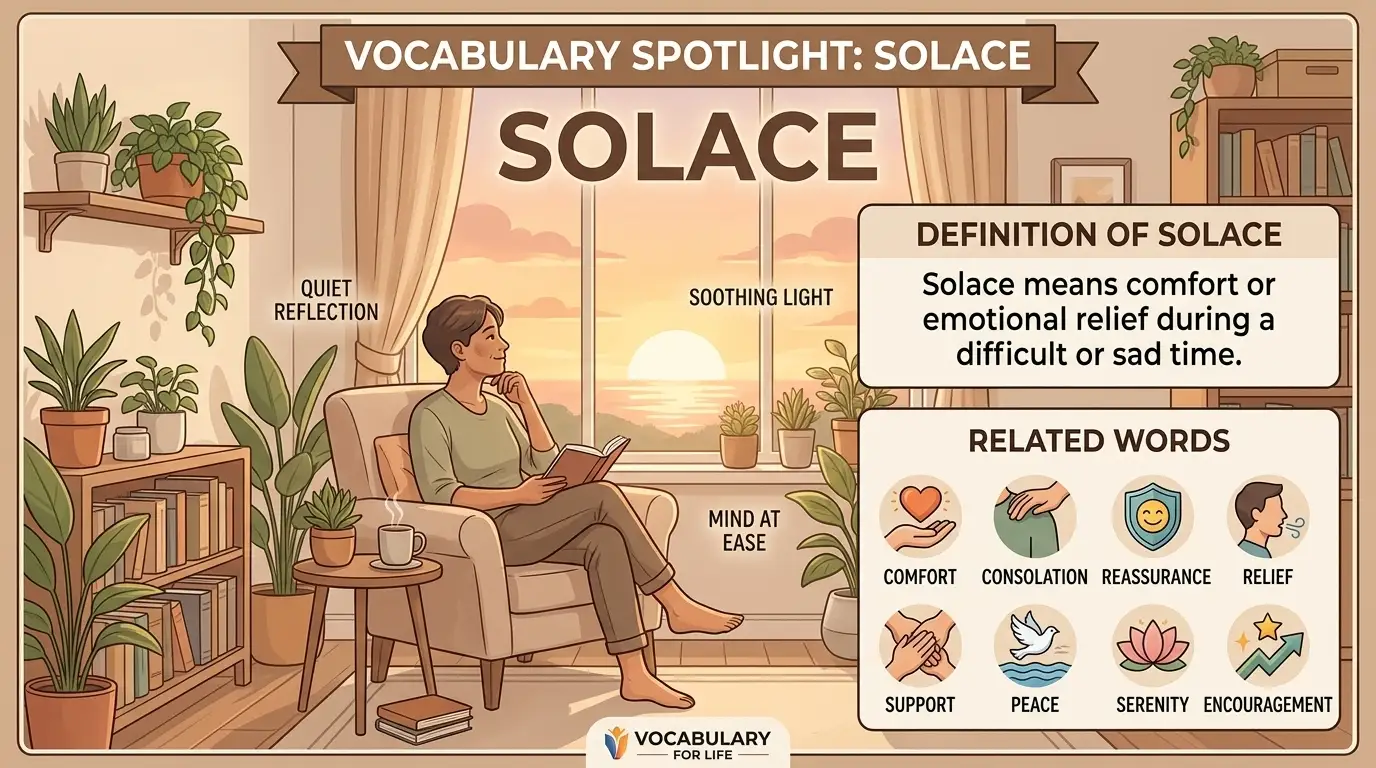
Synonyms for solace include comfort, consolation, reassurance, relief, support, and peace. Solace means comfort or emotional support during sadness, worry, grief, or difficulty. The best synonym depends on the situation and tone.
The synonym of solace becomes useful when a difficult day leaves you searching for the right word. A quiet song, kind friend, or peaceful place can bring solace.
Imagine a student feeling stressed before an exam. Talking to a friend may comfort and reassure her, helping her feel less alone.
The word solace is common in emotional writing, conversations, stories, and thoughtful discussions. Its alternatives make your vocabulary more flexible.
For students, bloggers, writers, and daily English users, learning synonyms helps express feelings clearly. It also prevents repeated use of the same word.
What Does “Solace” Really Mean?
Solace means comfort, help, or emotional relief that makes sadness, worry, grief, or distress easier to bear.
Cambridge Dictionary defines solace as help and comfort when someone feels sad or worried. It can function as both a noun and a verb, although the noun is especially common in expressions such as “find solace in” and “take solace in.”
As a noun, solace refers to the comfort itself.
Example:
Music gave him solace after a difficult week.
As a verb, solace means to comfort someone who is experiencing sadness or worry.
Example:
Her kind words solaced the grieving family.
The word often carries a gentle, serious, and emotional tone. Native speakers commonly use it when talking about grief, disappointment, loneliness, memories, faith, music, nature, relationships, or difficult experiences.
Simple Definition
Solace = comfort or emotional relief during sadness, worry, grief, or trouble.
Common Expressions With Solace
- find solace in something
- take solace in something
- seek solace
- provide solace
- offer solace
- draw solace from something
- gain solace from something
- a source of solace
- a great solace
- little solace
🧠 Connotative Meaning
Connotation (the emotional feeling or association a word carries beyond its basic dictionary meaning) helps explain why solace feels different from simple words such as help.
Positive Tone
Solace usually has a positive emotional tone because it suggests comfort, peace, support, or relief during a difficult experience.
Negative Tone
The word itself is not normally negative. However, it often appears in negative situations such as grief, loss, loneliness, failure, or emotional pain.
Neutral Tone
In neutral contexts, solace can simply describe something that provides comfort.
Example:
She found solace in reading after a stressful day.
📖 Etymology of Solace
The English word solace has roots in Latin. It is connected with Latin solacium, meaning comfort, consolation, or relief. The word entered English through Old French and developed into the Middle English forms that eventually became modern solace.
Old English: 450–1100
Solace was not a major native Old English word. Its history is connected more directly with French and Latin vocabulary that entered English after the Norman Conquest.
Middle English: 1100–1500
During Middle English, forms related to solace became established in English. The word was associated with comfort, consolation, and relief from distress.
Modern English: 1500–Present
Modern English retained the emotional meaning of solace. Today, it is particularly common in literary, reflective, formal, and emotional writing.
The modern meaning remains closely connected to comfort during sadness or worry.
Syllables
sol-ace
Affixation Pattern of Solace
Root: Related to Latin solacium
Prefix: None in modern English
Suffix: No productive English suffix
Synonyms List
Not every word below can replace solace in every sentence. Some are direct synonyms, while others are contextual alternatives that express a particular shade of comfort, emotional support, peace, or relief. This distinction helps you choose words naturally.
1. Comfort (Noun)
Meaning: A feeling or source of relief that makes sadness, pain, or worry easier to bear.
Tone/Register: Neutral, common, everyday.
Examples:
Her family gave her great comfort during the difficult time.
He found comfort in his favorite music.
2. Consolation (Noun)
Meaning: Something that reduces sadness or disappointment by offering emotional comfort.
Tone/Register: Formal, literary.
Examples:
The kind message was a small consolation after the loss.
She found consolation in her memories.
3. Reassurance (Noun)
Meaning: Words or actions that reduce fear, doubt, or worry.
Tone/Register: Neutral, professional, everyday.
Examples:
His calm voice gave her reassurance.
The teacher offered reassurance before the exam.
4. Relief (Noun)
Meaning: A feeling of reduced pain, worry, or emotional pressure.
Tone/Register: Neutral, very common.
Examples:
Talking to her sister brought some relief.
He felt relief after sharing his concerns.
5. Support (Noun)
Meaning: Help and encouragement given to someone facing difficulty.
Tone/Register: Neutral, common.
Examples:
Her friends provided emotional support.
The team gave him support after the setback.
6. Encouragement (Noun)
Meaning: Words or actions that give someone confidence and hope.
Tone/Register: Positive, neutral.
Examples:
Her teacher’s encouragement helped her continue.
A few words of encouragement lifted his mood.
7. Succor (Noun)
Meaning: Help or relief given to someone suffering or in difficulty.
Tone/Register: Formal, literary.
Examples:
The shelter offered succor to families in need.
He looked to his community for succor.
8. Aid (Noun)
Meaning: Help given to someone experiencing a problem or difficult situation.
Tone/Register: Neutral, formal.
Examples:
Her friends offered aid during the crisis.
The organization provided aid to struggling families.
9. Help (Noun)
Meaning: Assistance that makes a difficult situation easier.
Tone/Register: Everyday, neutral.
Examples:
A friendly conversation was a great help.
She asked her brother for help.
10. Sympathy (Noun)
Meaning: Feelings of care or sadness for someone experiencing pain or loss.
Tone/Register: Neutral, common.
Examples:
Her colleagues expressed sympathy after the loss.
He appreciated everyone’s sympathy.
11. Compassion (Noun)
Meaning: A strong feeling of concern for someone who is suffering.
Tone/Register: Neutral, formal, positive.
Examples:
Her compassion brought comfort to the family.
The nurse treated every patient with compassion.
12. Commiseration (Noun)
Meaning: An expression of sympathy with someone experiencing trouble or disappointment.
Tone/Register: Formal, less common.
Examples:
His friends offered commiseration after the failed project.
She called to express her commiseration.
13. Empathy (Noun)
Meaning: The ability to understand or share another person’s feelings.
Tone/Register: Neutral, academic, common.
Examples:
Her empathy made the conversation easier.
Good listeners often show empathy.
14. Kindness (Noun)
Meaning: A caring action or attitude that can bring emotional comfort.
Tone/Register: Everyday, positive.
Examples:
His kindness helped her through the afternoon.
A little kindness can comfort someone who feels alone.
15. Care (Noun)
Meaning: Concern, attention, and kindness shown toward another person.
Tone/Register: Everyday, neutral.
Examples:
Her care gave him strength.
The child’s care for his grandmother was touching.
16. Tenderness (Noun)
Meaning: Gentle affection or kindness that provides emotional warmth.
Tone/Register: Emotional, literary.
Examples:
She remembered her grandmother’s tenderness.
His tenderness brought peace to the conversation.
17. Warmth (Noun)
Meaning: A friendly and affectionate feeling that can make someone feel safe.
Tone/Register: Neutral, emotional.
Examples:
Her smile brought warmth to the room.
He remembered the warmth of his childhood home.
18. Understanding (Noun)
Meaning: A sympathetic awareness of another person’s feelings or situation.
Tone/Register: Neutral, everyday.
Examples:
Her understanding helped him speak honestly.
He needed patience and understanding.
19. Fellowship (Noun)
Meaning: A feeling of friendship and shared connection with others.
Tone/Register: Formal, literary, social.
Examples:
The group found fellowship in their shared interests.
Community fellowship helped ease her loneliness.
20. Companionship (Noun)
Meaning: The comfort and enjoyment that come from being with someone.
Tone/Register: Neutral, warm.
Examples:
Her dog provided wonderful companionship.
He valued his friend’s companionship during recovery.
21. Friendship (Noun)
Meaning: A close relationship that can provide emotional support and comfort.
Tone/Register: Everyday, positive.
Examples:
Their friendship gave her strength.
He found solace in an old friendship.
22. Refuge (Noun)
Meaning: A safe place or source of protection from emotional or physical difficulty.
Tone/Register: Literary, formal.
Examples:
The library became a refuge from the noisy city.
She found refuge in quiet evenings.
23. Haven (Noun)
Meaning: A peaceful or safe place that offers protection and comfort.
Tone/Register: Literary, common enough in writing.
Examples:
Her garden became a peaceful haven.
The small café was a haven after work.
24. Sanctuary (Noun)
Meaning: A safe and peaceful place where someone can feel protected.
Tone/Register: Formal, literary.
Examples:
The room became her private sanctuary.
Nature offered him a quiet sanctuary.
25. Shelter (Noun)
Meaning: A place or source of protection from difficulty or distress.
Tone/Register: Neutral, common.
Examples:
Her family home offered emotional shelter.
He found shelter from stress in creative work.
26. Retreat (Noun)
Meaning: A place or activity where someone can withdraw from pressure and regain peace.
Tone/Register: Neutral, literary.
Examples:
The countryside became her retreat.
Reading was his favorite retreat from daily stress.
27. Respite (Noun)
Meaning: A short period of rest or relief from difficulty.
Tone/Register: Formal, literary.
Examples:
The weekend gave her a welcome respite.
A quiet walk offered a brief respite from work.
28. Repose (Noun)
Meaning: A state of rest, calm, or peacefulness.
Tone/Register: Formal, literary.
Examples:
The garden provided a sense of repose.
He enjoyed the repose of the quiet countryside.
29. Rest (Noun)
Meaning: A period of relaxation that allows the body or mind to recover.
Tone/Register: Everyday, neutral.
Examples:
A little rest helped clear her mind.
He needed rest after the stressful week.
30. Tranquility (Noun)
Meaning: A state of calm and freedom from disturbance.
Tone/Register: Formal, descriptive.
Examples:
She enjoyed the tranquility of the mountains.
The quiet lake brought him tranquility.
31. Peace (Noun)
Meaning: A calm emotional state without conflict, fear, or disturbance.
Tone/Register: Neutral, universal.
Examples:
Meditation gave her a sense of peace.
He found peace while walking alone.
32. Calm (Noun)
Meaning: A peaceful mental or emotional state.
Tone/Register: Everyday, neutral.
Examples:
The music brought calm after a stressful day.
She searched for calm in the quiet room.
33. Serenity (Noun)
Meaning: Deep calmness and peacefulness.
Tone/Register: Formal, literary.
Examples:
The sunrise filled him with serenity.
She enjoyed the serenity of the garden.
34. Quiet (Noun)
Meaning: A peaceful absence of noise or activity that can help the mind relax.
Tone/Register: Everyday.
Examples:
She needed some quiet after the busy meeting.
The quiet of the evening comforted him.
35. Ease (Noun)
Meaning: Freedom from worry, tension, pain, or difficulty.
Tone/Register: Neutral, common.
Examples:
Her kind words brought some ease.
The familiar place gave him emotional ease.
36. Soothing (Noun/Adjective)
Meaning: Something that calms emotional tension or reduces distress.
Tone/Register: Neutral, descriptive.
Examples:
The song had a soothing effect.
Her soothing voice helped the child relax.
37. Appeasement (Noun)
Meaning: An action intended to reduce anger, tension, or emotional distress.
Tone/Register: Formal.
Examples:
The apology offered some appeasement after the argument.
His explanation brought appeasement to the tense discussion.
38. Assuagement (Noun)
Meaning: A reduction in emotional pain, worry, or distress.
Tone/Register: Formal, literary.
Examples:
The letter brought some assuagement of her grief.
He found assuagement through quiet reflection.
39. Alleviation (Noun)
Meaning: A reduction in pain, suffering, worry, or difficulty.
Tone/Register: Formal, academic.
Examples:
The conversation brought some alleviation of her anxiety.
Rest provided temporary alleviation from stress.
40. Balm (Noun)
Meaning: Something that comforts or soothes emotional pain.
Tone/Register: Literary, metaphorical.
Examples:
Her grandmother’s words were a balm to her sadness.
The poem became a balm during his grief.
41. Healing (Noun)
Meaning: The process of recovering emotionally or physically after pain or loss.
Tone/Register: Neutral, emotional.
Examples:
Writing became part of her healing.
Time gave him space for healing.
42. Restoration (Noun)
Meaning: The process of returning to a stronger or more peaceful emotional state.
Tone/Register: Formal, reflective.
Examples:
The peaceful trip supported his emotional restoration.
Nature gave her a feeling of restoration.
43. Renewal (Noun)
Meaning: A feeling of fresh energy, hope, or emotional strength.
Tone/Register: Positive, literary.
Examples:
The spring garden gave her a sense of renewal.
A short holiday brought emotional renewal.
44. Uplift (Noun)
Meaning: An improvement in mood or emotional strength.
Tone/Register: Neutral, positive.
Examples:
The cheerful message gave him an emotional uplift.
Music can provide a quick uplift after a difficult day.
45. Cheer (Noun)
Meaning: Happiness or encouragement that improves someone’s mood.
Tone/Register: Informal, everyday.
Examples:
Her friends brought cheer during the difficult week.
The children filled the room with cheer.
46. Hope (Noun)
Meaning: A feeling that better circumstances may come in the future.
Tone/Register: Neutral, positive.
Examples:
Her family gave her hope during the crisis.
The message restored his hope.
47. Peacefulness (Noun)
Meaning: A state of being calm, quiet, and emotionally settled.
Tone/Register: Neutral, descriptive.
Examples:
The peacefulness of the park relaxed her.
He enjoyed the peacefulness of early mornings.
48. Relaxation (Noun)
Meaning: A state of reduced physical or emotional tension.
Tone/Register: Everyday, neutral.
Examples:
Reading gives her a sense of relaxation.
The weekend was filled with relaxation.
49. Contentment (Noun)
Meaning: A quiet feeling of satisfaction and emotional acceptance.
Tone/Register: Neutral, literary.
Examples:
Gardening brought him a feeling of contentment.
She felt contentment while sitting beside the sea.
50. Emotional Support (Noun Phrase)
Meaning: Care, encouragement, and understanding offered during emotional difficulty.
Tone/Register: Neutral, modern.
Examples:
She needed emotional support after the breakup.
Her friends provided emotional support throughout the week.
51. Moral Support (Noun Phrase)
Meaning: Encouragement that gives someone confidence during a difficult situation.
Tone/Register: Everyday, neutral.
Examples:
My sister came for moral support before the interview.
His friends gave him moral support during the competition.
52. Consoling Presence (Noun Phrase)
Meaning: The comforting effect of having someone nearby during sadness or stress.
Tone/Register: Warm, descriptive.
Examples:
Her mother’s consoling presence helped her cope.
His friend’s quiet presence was deeply comforting.
53. Reassuring Presence (Noun Phrase)
Meaning: The calming effect created by someone whose presence reduces fear or worry.
Tone/Register: Neutral.
Examples:
The doctor had a reassuring presence.
Her brother’s reassuring presence helped her stay calm.
54. Emotional Relief (Noun Phrase)
Meaning: A reduction in emotional pressure, sadness, or worry.
Tone/Register: Neutral, modern.
Examples:
Talking openly gave him emotional relief.
Writing in her journal provided emotional relief.
55. Peace of Mind (Noun Phrase)
Meaning: A calm mental state without strong worry or uncertainty.
Tone/Register: Everyday, common.
Examples:
Knowing her family was safe gave her peace of mind.
Planning gave him peace of mind.
56. Inner Peace (Noun Phrase)
Meaning: A deep feeling of calm and emotional balance within oneself.
Tone/Register: Reflective, common.
Examples:
Meditation helped her find inner peace.
He discovered inner peace through quiet walks.
57. Escape (Noun)
Meaning: An activity or place that temporarily takes someone’s mind away from stress or sadness.
Tone/Register: Neutral, contextual.
Examples:
Books offered an escape from her stressful routine.
Painting became his escape after work.
58. Distraction (Noun)
Meaning: Something that temporarily shifts attention away from emotional pain or worry.
Tone/Register: Neutral, everyday.
Examples:
The movie provided a welcome distraction.
Cooking became a useful distraction after the difficult news.
59. Safe Harbor (Noun Phrase)
Meaning: A person, place, or situation that provides emotional safety and comfort.
Tone/Register: Literary, metaphorical.
Examples:
Her best friend became a safe harbor during hard times.
The old family home felt like a safe harbor.
60. Comforting Presence (Noun Phrase)
Meaning: Someone’s presence that creates a sense of emotional safety, warmth, or calm.
Tone/Register: Neutral, warm.
Examples:
Her grandmother’s comforting presence made the room feel peaceful.
The teacher’s comforting presence helped the student relax.
Synonyms by Tone
The tone of a synonym matters because two words can share a similar meaning but create different feelings.
Positive
Words such as comfort, reassurance, encouragement, compassion, kindness, hope, peace, serenity, warmth, and uplift usually create a positive emotional effect.
They work well when you want to emphasize emotional strength, care, recovery, or optimism.
Neutral
Words such as help, support, relief, rest, calm, care, understanding, and companionship are flexible and natural in everyday English.
They can fit conversations, emails, essays, and general writing.
Formal or Literary
Words such as consolation, succor, assuagement, alleviation, repose, sanctuary, serenity, and balm often sound more formal or literary.
They can work especially well in essays, reflective writing, stories, and serious discussions.
Informal or Everyday
Words such as help, comfort, cheer, rest, calm, friendship, and peace of mind sound natural in ordinary conversation.
Why Tone Matters
Choosing the right synonym makes your writing sound natural. For example, comfort is simple and common, while consolation sounds more formal. Balm is more poetic and metaphorical.
“Solace” vs. Close Alternatives
Solace usually suggests comfort during sadness, grief, worry, or emotional difficulty.
Comfort is broader. It can describe emotional comfort, physical comfort, or something that makes life easier.
Use solace for deeper emotional situations.
Use comfort for general situations.
Solace vs. Consolation
Consolation often refers to something that makes disappointment, grief, or sadness easier to bear.
Solace emphasizes the comfort itself.
For example, a kind message may provide consolation, while a peaceful place may offer solace.
Solace vs. Relief
Relief usually means a reduction in pain, pressure, worry, or difficulty.
Solace focuses more strongly on emotional comfort.
You may feel relief when a problem ends, but find solace while living through a difficult experience.
How “Solace” Changes by Context
Daily Conversation
In everyday speech, comfort, support, peace, and relief are often more natural than solace.
Instead of saying, “I found solace after work,” you might say, “I found some peace after work.”
Writing and Blogging
Solace works well in thoughtful blog posts, personal essays, emotional stories, and articles about grief, relationships, nature, books, music, or personal growth.
Synonyms help prevent repetition and allow writers to create different emotional shades.
Professional or Academic Writing
In formal writing, consolation, emotional support, reassurance, relief, alleviation, and compassion can be useful.
Choose a word based on the exact idea rather than replacing solace automatically.
Creative or Informal Writing
Creative writers can use balm, sanctuary, haven, refuge, inner peace, and safe harbor to create stronger imagery.
These alternatives can make descriptions more vivid and emotional.
Common Mistakes Learners Make
Mistake 1: Using Every Synonym Interchangeably
Not every synonym works in every sentence.
For example, refuge usually suggests safety, while reassurance usually involves reducing doubt or worry.
Mistake 2: Using Solace for Ordinary Happiness
Solace normally appears when some form of sadness, worry, pain, or difficulty exists.
A fun party may bring happiness, but it would not normally be described as solace.
Mistake 3: Forgetting the “Find Solace In” Pattern
A common structure is:
find solace in + noun/gerund
Examples:
- She found solace in music.
- He found solace in writing.
- They found solace in nature.
Mistake 4: Making Every Sentence Too Formal
Words such as succor, assuagement, and repose can sound formal or literary.
For everyday conversations, comfort, support, help, or peace may sound more natural.
Register Notes
Solace is generally formal or literary, especially compared with comfort.
It appears frequently in reflective writing and serious discussions.
In casual conversation, people often choose simpler alternatives such as comfort, peace, relief, support, or reassurance.
For additional vocabulary research, learners can compare definitions and thesaurus information in the Cambridge Dictionary entry for “solace” and its Cambridge Thesaurus entry.
Real-Life Mini Scenarios Using Solace
Workplace
After a difficult project failed, Maya found solace in talking with a trusted colleague.
Social Situation
After an argument with a friend, Amir found solace in spending time with his family.
Media and Pop Culture
A sad character may find solace in music, memories, books, or a meaningful relationship.
Writing and Storytelling
A novelist may use solace to describe how a character copes with grief or loneliness.
Why Learning Synonyms of Solace Matters
Learning synonyms does more than expand your vocabulary. It teaches you how to express small differences in emotion.
For example, comfort sounds simple and direct. Consolation sounds more formal. Serenity focuses on deep calm. Reassurance focuses on reducing doubt or fear.
This flexibility is valuable for students writing essays, bloggers creating useful content, and English learners building natural communication skills.
It also helps writers avoid repetition. Instead of using solace several times in one paragraph, you can select a suitable alternative based on meaning and tone.
Interactive Practice Quiz
Choose the best answer for each situation. Do not check the answer key until you finish.
Part One: Meaning and Context
1. After losing her pet, Lina found ______ in talking with her family.
A. confusion
B. comfort
C. argument
D. excitement
2. Which word best describes help that reduces someone’s fear or doubt?
A. reassurance
B. retreat
C. refuge
D. distraction
3. A peaceful garden that helps someone escape stress can be called a ______.
A. haven
B. argument
C. failure
D. complaint
4. Which word best describes a reduction in worry or pain?
A. relief
B. friendship
C. fellowship
D. kindness
5. Which word is especially suitable for formal or literary writing?
A. succor
B. fun
C. help
D. chat
6. “She found solace in music” means that music ______.
A. made her angry
B. gave her comfort
C. confused her
D. increased her worries
7. Which word focuses on understanding another person’s feelings?
A. empathy
B. retreat
C. quiet
D. escape
Part Two: Tone and Real-Life Usage
8. Which alternative sounds most natural in everyday speech?
A. assuagement
B. comfort
C. succor
D. repose
9. A student receives kind words before an important exam. Which word fits best?
A. reassurance
B. sanctuary
C. refuge
D. repose
10. Which word describes a deep state of calm?
A. serenity
B. distraction
C. aid
D. commiseration
11. A book helps someone forget stress for a short time. Which word fits best?
A. distraction
B. compassion
C. reassurance
D. sympathy
12. Which phrase means a calm mental state without strong worry?
A. moral support
B. peace of mind
C. safe harbor
D. emotional support
13. Which word is most suitable for a poetic sentence about emotional comfort?
A. balm
B. help
C. aid
D. support
14. A friend stays beside someone during grief. What phrase best describes the friend’s effect?
A. comforting presence
B. physical shelter
C. quick distraction
D. formal aid
15. Which word best describes emotional encouragement during a difficult situation?
A. support
B. noise
C. confusion
D. conflict
Reflection Task: Write one sentence using solace, comfort, reassurance, consolation, or serenity. Then write a second sentence using a different synonym with a slightly different tone.
Answer Key: 1-B | 2-A | 3-A | 4-A | 5-A | 6-B | 7-A | 8-B | 9-A | 10-A | 11-A | 12-B | 13-A | 14-A | 15-A
Frequently Asked Questions
1. What is the best synonym of solace in simple English?
The simplest and most natural synonym of solace is comfort. It describes a feeling or source of emotional support during sadness, worry, grief, or difficulty. Depending on context, consolation, relief, reassurance, support, peace, and comfort can also work. The best choice depends on the exact emotional meaning you want to express.
2. What is a synonym of solace for sadness?
For sadness, comfort and consolation are usually strong choices. Comfort is simple and widely used, while consolation sounds more formal and often relates to grief, disappointment, or loss. For example, “Her family gave her comfort” sounds natural in everyday English, while “The message offered consolation” has a more formal tone.
3. What is the difference between solace and comfort?
Solace and comfort are very close, but solace often has a stronger connection with sadness, grief, worry, or emotional pain. Comfort has a wider meaning and can refer to emotional or physical comfort. “She found solace in music” emphasizes emotional relief, while “The chair provides comfort” refers to physical ease.
4. Can solace be used in everyday English?
Yes, but solace can sound more formal or literary than comfort. Native speakers commonly use expressions such as find solace in, seek solace, and take solace in. In casual conversation, people may choose simpler words such as comfort, peace, support, or relief.
5. What are some synonyms of solace for essays?
Useful essay choices include consolation, reassurance, emotional support, compassion, relief, tranquility, serenity, refuge, and comfort. The right word depends on your subject. Academic writing should prioritize accuracy over impressive vocabulary. If the idea is emotional comfort after loss, consolation may fit better than a word such as peace.
6. Is solace a positive or negative word?
Solace generally has a positive emotional meaning because it describes comfort or relief. However, it often appears in negative situations such as grief, loneliness, disappointment, or worry. The surrounding situation may be sad, but the word solace itself usually points to something that makes the situation easier to bear.
7. What does “find solace in” mean?
Find solace in means to receive comfort, peace, or emotional support from something during a difficult time. For example, “She found solace in writing” means that writing helped her cope emotionally. The expression is common in reflective, literary, and serious English writing.
8. Which synonym of solace sounds the most formal?
Words such as succor, consolation, assuagement, alleviation, repose, and sanctuary can sound more formal or literary than comfort. However, they do not have the same meaning. Choose them only when their specific shade fits the sentence. Clear and accurate vocabulary is usually better than unnecessarily formal wording.
Conclusion
Learning the synonym of solace helps you describe comfort, hope, peace, and emotional support with greater accuracy. Each alternative adds a slightly different shade.
Words such as comfort and support work well in daily English, while consolation, serenity, and balm can suit more thoughtful or creative writing.
For stronger communication, practice these synonyms in emails, essays, stories, blog posts, and everyday conversations. Small vocabulary choices can make writing clearer.
Keep practicing one new synonym at a time. Create your own examples, compare their tones, and use the words naturally as your English vocabulary grows.

Mehtab Yasir is a passionate writer and English language enthusiast dedicated to making vocabulary learning simple, practical, and enjoyable. As an author at SynonymDesk.com, she creates helpful content covering synonyms, antonyms, word meanings, vocabulary, phrases, and everyday English usage. Her goal is to provide clear and easy-to-understand information that helps students, writers, professionals, and English learners choose the right words and communicate with greater confidence. Mehtab believes that a strong vocabulary can improve both writing and communication skills. She enjoys researching new words, exploring their meanings and uses, and turning complex language concepts into useful, reader-friendly content. Through her work, she strives to make SynonymDesk.com a reliable resource for anyone looking to improve their English vocabulary and language skills.