Synonyms of candidly help you express truthfulness with exact precision. When you speak openly in a job interview or write an honest blog post, using the right word matters. Varying your word choice keeps your audience engaged and clear about your true intent.
Imagine telling your best friend that their new business idea needs work. Saying it politely yet directly requires a specific touch. Using the right vocabulary allows you to share honest feedback without causing unnecessary offense or misunderstanding.
Learning synonyms of candidly expands your expressive range as a writer or speaker. Students improve their essay scores, bloggers create engaging articles, and professionals build trust through clear communication. Mastering these words refines your daily conversations significantly.
What Does “Candidly” Really Mean?
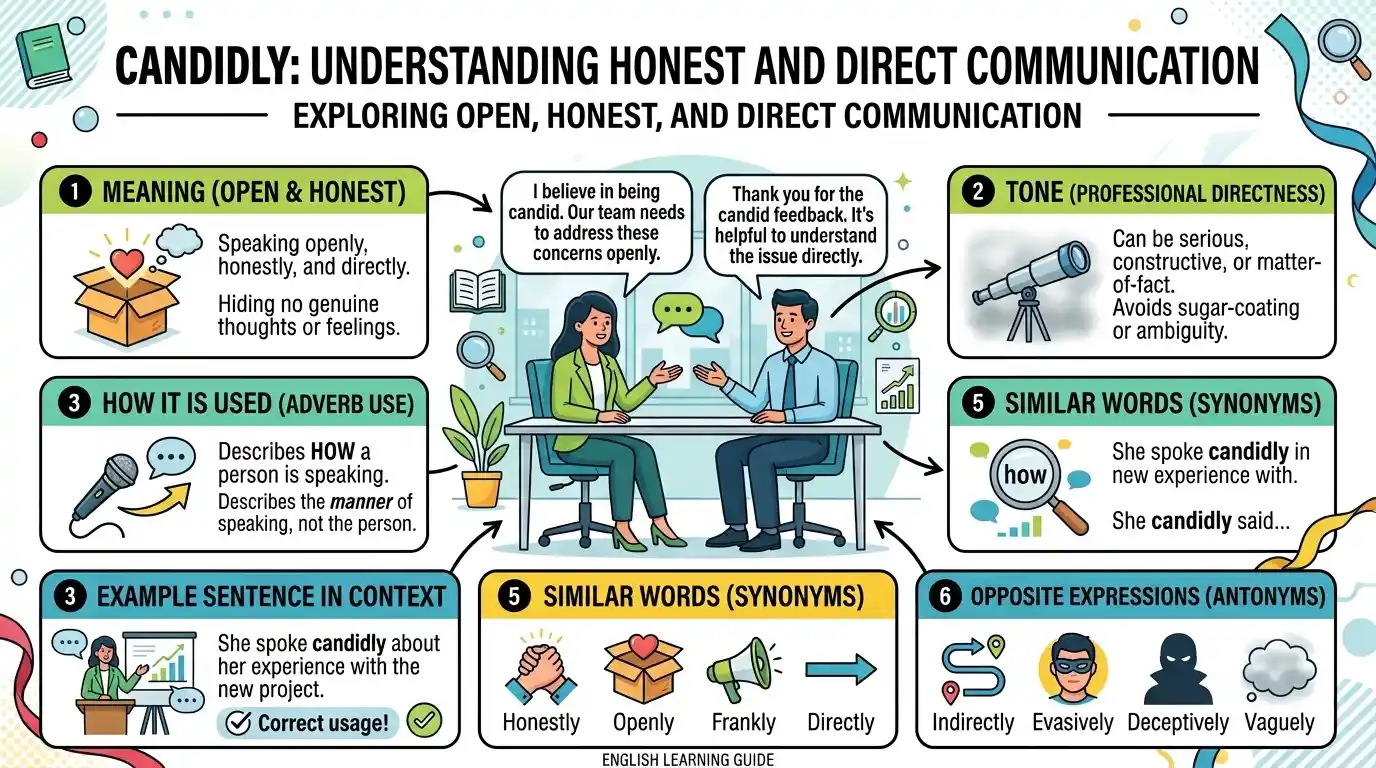
“Candidly” means speaking or acting with complete honesty, frankness, and directness. It comes from an attitude of openness without trying to hide uncomfortable facts. Native speakers understand it as dropping all pretense to share genuine thoughts. You will often hear it at the start of a sentence when someone delivers a hard truth.
Part of Speech: Adverb
Simple Definition: In an honest, direct, and straightforward manner.
Connotative Meaning
Connotation is the emotional or cultural feeling attached to a word beyond its literal definition.
- Positive tone: Expresses refreshing honesty, authenticity, and brave transparency.
- Negative tone: Can imply bluntness, unintended harshness, or a lack of tact.
- Neutral tone: Simply states facts plainly without emotional exaggeration.
Etymology
The word stems from the Latin candidus, meaning “shining white” or “pure.” In ancient Rome, office candidates wore white togas to symbolize pure intentions.
- Old English (450–1100): Not present in the language; native Germanic words were used instead.
- Middle English (1100–1500): The root word entered through French influences after the Norman Conquest.
- Modern English (1500–Present): Adopted as “candid” in the 1600s, later adding “-ly” to form the adverb.
Pronunciation
- US: /ˈkæn.dɪd.li/
- UK: /ˈkæn.dɪd.li/
Syllables & Structure
- Syllables: can-did-ly
- Root: Candid
- Prefix: None
- Suffix: -ly (adverbial suffix)
Synonyms List
1. Frankly (Adv) — US: /ˈfræŋk.li/ | UK: /ˈfræŋk.li/
Meaning: Speaking in an open, direct, and transparent manner without hiding facts.
Tone/Register: Neutral, Professional
- Example 1: She frankly stated that the current budget was insufficient.
- Example 2: The manager spoke frankly about the company’s plans.
2. Honestly (Adv) — US: /ˈɑː.nɪst.li/ | UK: /ˈɒn.ɪst.li/
Meaning: In a truthful manner that avoids deceit or falsehood.
Tone/Register: Informal, Everyday
- Example 1: I honestly believe we can finish this project on time.
- Example 2: He answered every question honestly during the interview.
3. Directly (Adv) — US: /dəˈrekt.li/ | UK: /daɪˈrekt.li/
Meaning: Without evasiveness or detour in communication.
Tone/Register: Professional, Direct
- Example 1: The CEO addressed the staff’s concerns directly.
- Example 2: Please tell me directly if you disagree with the plan.
4. Plainly (Adv) — US: /ˈpleɪn.li/ | UK: /ˈpleɪn.li/
Meaning: Expressed clearly and simply without elaborate phrasing.
Tone/Register: Neutral, General
- Example 1: The instructions were plainly written for everyone to read.
- Example 2: She plainly expressed her dissatisfaction with the results.
5. Openly (Adv) — US: /ˈoʊ.pən.li/ | UK: /ˈəʊ.pən.li/
Meaning: Without concealment, secrecy, or reservation.
Tone/Register: Warm, Personal
- Example 1: They openly discussed their feelings about the upcoming move.
- Example 2: The team openly shared ideas during the brainstorming session.
6. Bluntly (Adv) — US: /ˈblʌnt.li/ | UK: /ˈblʌnt.li/
Meaning: Speaking in a very direct way that may seem uncompromising or rude.
Tone/Register: Informal, Critical
- Example 1: He bluntly told us that the design was terrible.
- Example 2: Bluntly put, we are running out of time.
7. Sincerely (Adv) — US: /sɪnˈsɪr.li/ | UK: /sɪnˈsɪə.li/
Meaning: With genuine feeling and without pretense or deceit.
Tone/Register: Formal, Warm
- Example 1: She sincerely apologized for the mistake in the report.
- Example 2: I sincerely hope you achieve all your goals this year.
8. Truthfully (Adv) — US: /ˈtruːθ.fəl.i/ | UK: /ˈtruːθ.fəl.i/
Meaning: In accordance with the facts or reality.
Tone/Register: Neutral, Legal, Formal
- Example 1: The witness swore to answer all questions truthfully.
- Example 2: Truthfully speaking, I have never seen a performance like that.
9. Straightforwardly (Adv) — US: /ˌstreɪtˈfɔːr.wɚd.li/ | UK: /ˌstreɪtˈfɔː.wəd.li/
Meaning: In a clear, uncomplicated, and honest manner.
Tone/Register: Professional, Practical
- Example 1: He explained the technical process straightforwardly to the clients.
- Example 2: She handled the negotiation straightforwardly without mind games.
10. Forthrightly (Adv) — US: /ˈfɔːrθ.raɪt.li/ | UK: /ˈfɔːθ.raɪt.li/
Meaning: Direct and outspoken without hesitation or evasion.
Tone/Register: Formal, Firm
- Example 1: The director forthrightly answered the committee’s questions.
- Example 2: She stated her terms forthrightly during the agreement phase.
11. Outspokenly (Adv) — US: /aʊtˈspoʊ.kən.li/ | UK: /aʊtˈspəʊ.kən.li/
Meaning: Expressing strong opinions openly and publicly.
Tone/Register: Public, Assertive
- Example 1: He outspokenly criticized the new environmental policy.
- Example 2: She outspokenly defends equal opportunities in the industry.
12. Explicitly (Adv) — US: /ɪkˈsplɪs.ɪt.li/ | UK: /ɪkˈsplɪs.ɪt.li/
Meaning: Stated fully and clearly with no room for doubt.
Tone/Register: Academic, Formal, Legal
- Example 1: The contract explicitly states the payment deadline.
- Example 2: She explicitly asked us not to share the news yet.
13. Unreservedly (Adv) — US: /ˌʌn.rɪˈzɝː.vɪd.li/ | UK: /ˌʌn.rɪˈzɜː.vɪd.li/
Meaning: Without any limitation, hesitation, or condition.
Tone/Register: High Formal, Expressive
- Example 1: We unreservedly support the proposal presented today.
- Example 2: The board unreservedly accepted responsibility for the error.
14. Genuinely (Adv) — US: /ˈdʒen.ju.ɪn.li/ | UK: /ˈdʒen.ju.ɪn.li/
Meaning: In an authentic and heartfelt manner.
Tone/Register: Personal, Warm
- Example 1: She genuinely cares about the well-being of her team.
- Example 2: He genuinely offered his support to the new members.
15. Unfeignedly (Adv) — US: /ʌnˈfeɪn.ɪd.li/ | UK: /ʌnˈfeɪn.ɪd.li/
Meaning: Real and not pretended or fake.
Tone/Register: Literary, Formal
- Example 1: She was unfeignedly happy to see her childhood friend again.
- Example 2: His gratitude was unfeignedly expressed in the letter.
16. Intimately (Adv) — US: /ˈɪn.t̬ə.mət.li/ | UK: /ˈɪn.tɪ.mət.li/
Meaning: Shared in a personal, deep, and private way.
Tone/Register: Personal, Confidential
- Example 1: They spoke intimately about their life experiences.
- Example 2: The author wrote intimately about overcoming personal struggles.
17. Boldly (Adv) — US: /ˈboʊld.li/ | UK: /ˈbəʊld.li/
Meaning: Speaking or acting with confidence and courage.
Tone/Register: Inspiring, Energetic
- Example 1: She boldly proposed a complete redesign of the product.
- Example 2: He boldly challenged the traditional rules of the industry.
18. Unabashedly (Adv) — US: /ˌʌn.əˈbæʃ.ɪd.li/ | UK: /ˌʌn.əˈbæʃ.tli/
Meaning: Without embarrassment, shame, or hesitation.
Tone/Register: Informal, Expressive
- Example 1: He unabashedly admitted his love for animated films.
- Example 2: She unabashedly wore her unique outfit to the event.
19. Glaringly (Adv) — US: /ˈɡler.ɪŋ.li/ | UK: /ˈɡleə.rɪŋ.li/
Meaning: In an obvious, undeniable, and clear way.
Tone/Register: Critical, Analytical
- Example 1: The accounting discrepancy was glaringly obvious.
- Example 2: His lack of preparation was glaringly evident during the pitch.
20. Heartily (Adv) — US: /ˈhɑːr.t̬əl.i/ | UK: /ˈhɑː.tɪ.li/
Meaning: With warmth, sincerity, and enthusiasm.
Tone/Register: Warm, Traditional
- Example 1: The host heartily welcomed all the guests to the dinner.
- Example 2: I heartily agree with your assessment of the situation.
21. Unconditionally (Adv) — US: /ˌʌn.kənˈdɪʃ.ən.əl.i/ | UK: /ˌʌn.kənˈdɪʃ.ən.əl.i/
Meaning: Without any limits, terms, or conditions attached.
Tone/Register: Emotional, Absolute
- Example 1: Parents love their children unconditionally.
- Example 2: The company offered to refund the purchase unconditionally.
22. Transparently (Adv) — US: /trænˈsper.ənt.li/ | UK: /trænˈspær.ənt.li/
Meaning: In a way that is open and easy to see through.
Tone/Register: Corporate, Modern
- Example 1: The charity transparently publishes its financial records.
- Example 2: The policy was explained transparently to all stakeholders.
23. Point-blank (Adv) — US: /ˌpɔɪntˈblæŋk/ | UK: /ˌpɔɪntˈblæŋk/
Meaning: Direct and sudden, without polite softening.
Tone/Register: Sharp, Direct
- Example 1: She refused point-blank to sign the contract.
- Example 2: He asked me point-blank if I took the document.
24. Flatly (Adv) — US: /ˈflæt.li/ | UK: /ˈflæt.li/
Meaning: Showing a lack of emotion, enthusiasm, or hesitation.
Tone/Register: Firm, Unyielding
- Example 1: The spokesperson flatly denied all allegations.
- Example 2: She flatly rejected the low offer on the home.
25. Unvarnishedly (Adv) — US: /ʌnˈvɑːr.nɪʃt.li/ | UK: /ʌnˈvɑː.nɪʃt.li/
Meaning: Without adding decorative details or artificial improvements.
Tone/Register: Literary, Direct
- Example 1: The memoir tells the story unvarnishedly from start to finish.
- Example 2: He presented the facts unvarnishedly to the board.
26. Brusquely (Adv) — US: /ˈbrʌsk.li/ | UK: /ˈbruːsk.li/
Meaning: Expressed in a quick, blunt, and somewhat rude way.
Tone/Register: Informal, Impatient
- Example 1: The clerk answered brusquely before hanging up the phone.
- Example 2: He waved his hand brusquely to end the meeting.
27. Succinctly (Adv) — US: /səkˈsɪŋkt.li/ | UK: /səkˈsɪŋkt.li/
Meaning: Expressed clearly using very few words.
Tone/Register: Concise, Professional
- Example 1: She summarized the core idea succinctly in one sentence.
- Example 2: Please present your conclusions succinctly during your talk.
28. Categorically (Adv) — US: /ˌkæt̬.əˈɡɔːr.ɪ.kəl.i/ | UK: /ˌkæt.əˈɡɒr.ɪ.kəl.i/
Meaning: Without any qualification, exception, or condition.
Tone/Register: Formal, Official
- Example 1: The minister categorically denied any involvement in the scandal.
- Example 2: We categorically refuse to compromise on product safety.
29. Unequivocally (Adv) — US: /ˌʌn.ɪˈkwɪv.ə.kəl.i/ | UK: /ˌʌn.ɪˈkwɪv.ə.kəl.i/
Meaning: In a manner that leaves no doubt or confusion.
Tone/Register: High Formal, Legal
- Example 1: The findings unequivocally support the initial scientific theory.
- Example 2: She stated her intentions unequivocally before the team.
30. Barefacedly (Adv) — US: /ˈber.feɪst.li/ | UK: /ˈbeə.feɪst.li/
Meaning: Done openly without any attempt to hide bad behavior.
Tone/Register: Critical, Negative
- Example 1: He barefacedly lied about his attendance at the meeting.
- Example 2: The competitor barefacedly copied our core design features.
31. Intentionally (Adv) — US: /ɪnˈten.ʃən.əl.i/ | UK: /ɪnˈten.ʃən.əl.i/
Meaning: On purpose and with full deliberation.
Tone/Register: Neutral, Legal
- Example 1: She intentionally simplified the text for young readers.
- Example 2: He intentionally left out details to save valuable time.
32. Manifestly (Adv) — US: /ˈmæn.ə.fest.li/ | UK: /ˈmæn.ɪ.fest.li/
Meaning: In a way that is clear and obvious to the mind or eye.
Tone/Register: Formal, Academic
- Example 1: The policy was manifestly unfair to small business owners.
- Example 2: The project was manifestly successful by all metrics.
33. Unashamedly (Adv) — US: /ˌʌn.əˈʃeɪm.ɪd.li/ | UK: /ˌʌn.əˈʃeɪm.ɪd.li/
Meaning: Expressed without feeling guilt, remorse, or embarrassment.
Tone/Register: Assertive, Personal
- Example 1: She unashamedly admitted her lack of interest in sports.
- Example 2: He unashamedly promotes his work across social channels.
34. Sharply (Adv) — US: /ˈʃɑːrp.li/ | UK: /ˈʃɑːp.li/
Meaning: Expressed in a harsh, critical, or sudden manner.
Tone/Register: Direct, Critical
- Example 1: The judge sharply corrected the lawyer during trial.
- Example 2: She replied sharply when questioned about her motives.
35. Plain-spokenly (Adv) — US: /ˌpleɪnˈspoʊ.kən.li/ | UK: /ˌpleɪnˈspəʊ.kən.li/
Meaning: Using simple, clear language without elaborate jargon.
Tone/Register: Down-to-earth, Conversational
- Example 1: The farmer plain-spokenly described the changes in local weather.
- Example 2: She spoke plain-spokenly about the risks involved.
36. Uncompromisingly (Adv) — US: /ʌnˈkɑːm.prə.maɪ.zɪŋ.li/ | UK: /ʌnˈkɒm.prə.maɪ.zɪŋ.li/
Meaning: Unwilling to change views or grant concessions.
Tone/Register: Serious, Firm
- Example 1: The team stayed uncompromisingly focused on high standards.
- Example 2: He held fast to his personal moral values.
37. Realistically (Adv) — US: /ˌriː.əˈlɪs.tɪ.kəl.i/ | UK: /ˌrɪəˈlɪs.tɪ.kəl.i/
Meaning: According to how things truly are in fact.
Tone/Register: Practical, Business
- Example 1: Realistically speaking, we need two more days to complete this.
- Example 2: She realistically assessed her team’s current capacities.
38. Truly (Adv) — US: /ˈtruː.li/ | UK: /ˈtruː.li/
Meaning: In accordance with truth, fact, or genuine feeling.
Tone/Register: Universal, Natural
- Example 1: I am truly sorry for arriving late to the session.
- Example 2: This is truly a remarkable achievement for everyone.
39. Unmaskedly (Adv) — US: /ʌnˈmæs.kɪd.li/ | UK: /ʌnˈmɑːsk.tli/
Meaning: Expressed without disguise or artificial concealment.
Tone/Register: Literary, Dramatic
- Example 1: His true motives showed unmaskedly during the debate.
- Example 2: She presented her emotions unmaskedly on stage.
40. Directly-spoken (Adv/Adj) — US: /dəˈrekt.li ˈspoʊ.kən/ | UK: /daɪˈrekt.li ˈspəʊ.kən/
Meaning: Communicated without indirect phrasing or pretense.
Tone/Register: Clear, Practical
- Example 1: His directly spoken style won the respect of his colleagues.
- Example 2: She delivered a directly spoken summary of the crisis.
41. Undisguisedly (Adv) — US: /ˌʌn.dɪsˈɡaɪzd.li/ | UK: /ˌʌn.dɪsˈɡaɪz.dli/
Meaning: Clear for anyone to see without attempt at concealment.
Tone/Register: Expressive, Observational
- Example 1: She looked undisguisedly surprised by the secret party.
- Example 2: His relief was undisguisedly visible when news arrived.
42. Candid-like (Adv/Adj) — US: /ˈkæn.dɪd.laɪk/ | UK: /ˈkæn.dɪd.laɪk/
Meaning: Resembling an informal, unposed, or honest capture of a moment.
Tone/Register: Creative, Informal
- Example 1: He captured the scene in a candid-like manner with his camera.
- Example 2: Her commentary flowed in a candid-like, natural tone.
43. Unpretentiously (Adv) — US: /ˌʌn.prɪˈten.ʃəs.li/ | UK: /ˌʌn.prɪˈten.ʃəs.li/
Meaning: Modest, natural, and free from artificial elegance.
Tone/Register: Warm, Modest
- Example 1: She unpretentiously explained her award-winning research paper.
- Example 2: The small restaurant unpretentiously served world-class meals.
44. Fairly (Adv) — US: /ˈfer.li/ | UK: /ˈfeə.li/
Meaning: Expressed in a balanced, honest, and just manner.
Tone/Register: Neutral, Legal
- Example 1: The judge evaluated the presented evidence fairly.
- Example 2: She treated all suggestions fairly during the review.
45. Matter-of-factly (Adv) — US: /ˌmæt̬.ɚ.əvˈfækt.li/ | UK: /ˌmæt.ər.əvˈfækt.li/
Meaning: Stating facts calmly without demonstrating emotional excitement.
Tone/Register: Neutral, Calm
- Example 1: He matter-of-factly explained why the project was delayed.
- Example 2: She matter-of-factly stated her decision to move abroad.
46. Authentically (Adv) — US: /ɔːˈθen.t̬ɪk.li/ | UK: /ɔːˈθen.tɪk.li/
Meaning: In a true, original, and non-imitative manner.
Tone/Register: Warm, Modern
- Example 1: She authentically connected with her online audience.
- Example 2: The artist authentically represented her cultural heritage.
47. Unreservedly (Adv) — US: /ˌʌn.rɪˈzɝː.vɪd.li/ | UK: /ˌʌn.rɪˈzɜː.vɪd.li/
Meaning: Without holding back thoughts or reservations.
Tone/Register: Formal, Full
- Example 1: He unreservedly gave his time to help the team.
- Example 2: The board unreservedly commended her exceptional work.
48. Distinctly (Adv) — US: /dɪˈstɪŋkt.li/ | UK: /dɪˈstɪŋkt.li/
Meaning: Expressed in a sharp, clearly defined, and noticeable way.
Tone/Register: Clear, Emphatic
- Example 1: She distinctly remembered putting the key on the desk.
- Example 2: His voice rang out distinctly across the quiet hall.
49. Unmistakably (Adv) — US: /ˌʌn.mɪˈsteɪ.kə.bli/ | UK: /ˌʌn.mɪˈsteɪ.kə.bli/
Meaning: In a manner that cannot be misinterpreted or doubted.
Tone/Register: Certain, Clear
- Example 1: Her tone was unmistakably firm during the announcement.
- Example 2: The signature was unmistakably authentic upon inspection.
50. Wholeheartedly (Adv) — US: /ˌhoʊlˈhɑːr.t̬ɪd.li/ | UK: /ˌhəʊlˈhɑː.tɪd.li/
Meaning: With complete commitment, enthusiasm, and sincerity.
Tone/Register: Warm, Emotional
- Example 1: She wholeheartedly accepted the new leadership role.
- Example 2: I wholeheartedly agree with your visionary strategy.
Synonyms by Tone
Choosing synonyms based on tone keeps your intent clear and avoids emotional misunderstandings.
Positive Tone
Words that express constructive, genuine, or courageous openness.
- Sincerely
- Transparently
- Openly
- Heartily
- Unpretentiously
Neutral Tone
Words that convey plain facts directly without added emotional weight.
- Plainly
- Straightforwardly
- Truthfully
- Realistically
- Matter-of-factly
Negative Tone
Words that feel overly blunt, sharp, or potentially impolite.
- Bluntly
- Brusquely
- Point-blank
- Barefacedly
- Sharply
Informal Tone
Casual terms suited for conversations with close friends or colleagues.
- Honestly
- Unabashedly
- Plain-spokenly
Mini Comparison: Candidly vs. Close Alternatives
| Term | Core Meaning | Tone | Best Context |
| Candidly | Sharing genuine truth with gentle openness | Warm, Reflective | Personal reflections, performance reviews |
| Bluntly | Delivering truth directly without care for feelings | Harsh, Uncompromising | Warning someone, sharp criticism |
| Frankly | Speaking directly on business or serious matters | Professional, Direct | Meetings, policy discussions |
How Usage Changes by Context
- Daily Conversation: Use terms like honestly or openly. They feel natural when chatting with friends or family.
- Writing & Blogging: Words like candidly, transparently, or straightforwardly build trust with online audiences.
- Professional & Academic Settings: Rely on frankly, succinctly, or unequivocally to sound clear, professional, and precise.
- Creative Writing: Use descriptive adverbs like unvarnishedly or matter-of-factly to give characters distinct personalities.
Common Mistakes & Native Usage
Overusing “Honestly”
English learners often start every sentence with “Honestly.” This lowers the impact of your statement. Save it for moments that genuinely require emphasis.
Confusing Tone Intensity
Using bluntly instead of candidly can make you sound accidentally rude in workplace emails. Match the word to your actual emotional intent.
Register Alignment
Avoid using unequivocally in casual texts or point-blank in formal research papers. Match word choice to the surrounding context.
Candid vs. Candidly: Meaning, Synonyms, and Antonyms
Candid and candidly are closely related English words, but they serve different grammatical purposes. Understanding their meanings helps you choose the correct expression when describing honesty, openness, and direct communication.
Is Candidly a Word?
Yes, candidly is a valid English word. It is an adverb derived from the adjective candid. It describes speaking or expressing thoughts honestly, openly, and directly without hiding the truth.
Examples:
- She candidly discussed her concerns during the meeting.
- He spoke candidly about the challenges he faced at work.
What Is a Synonym for Candid?
Candid is an adjective that describes someone who expresses genuine thoughts without pretending or hiding important information.
Common synonyms of candid include:
- Honest: Telling the truth without deception.
- Frank: Expressing opinions openly and directly.
- Sincere: Showing genuine feelings and intentions.
- Straightforward: Communicating clearly without avoiding the truth.
- Forthright: Speaking openly without hesitation.
- Truthful: Providing accurate and honest information.
- Open: Willing to share thoughts and feelings freely.
Examples:
- She gave a candid response to the interviewer’s question.
- The manager appreciated his frank and honest feedback.
What Are the Synonyms and Antonyms of Candid?
The synonyms and antonyms of candid help explain the difference between honest communication and deliberately hiding information.
| Synonyms of Candid | Antonyms of Candid |
|---|---|
| Honest | Dishonest |
| Frank | Deceptive |
| Sincere | Insincere |
| Truthful | Untruthful |
| Open | Secretive |
| Straightforward | Evasive |
| Forthright | Guarded |
| Outspoken | Reserved |
These words are not interchangeable in every context. For example, reserved may describe someone who shares little personal information without necessarily being dishonest.
Examples:
- Candid: The employee gave an honest explanation of the mistake.
- Not candid: The employee provided an evasive response and avoided important details.
What Is the Difference Between Candid and Candidly?
The main difference is their grammatical role. Candid is an adjective that describes a person, statement, or conversation. Candidly is an adverb that explains how someone speaks or acts.
Examples:
- Candid: She gave a candid opinion about the proposal.
- Candidly: She spoke candidly about the proposal.
Both expressions convey openness and honesty, but their sentence structures differ.
Real-Life Mini Scenarios
- Workplace: “Candidly speaking, our sales strategy needs a fresh approach.”
- Social Situations: “She openly shared her story to encourage others.”
- Media & Journalism: “The politician responded frankly to questions about public spending.”
- Creative Writing: “He matter-of-factly packed his bags, accepting the outcome.”
Interactive Practice Quiz
Test your understanding of these vocabulary nuances:
Part One
1. Which word is closest in meaning to “candidly”?
A) Secretly
B) Honestly
C) Carefully
D) Quietly
2. “She spoke candidly about her experience.” What does “candidly” mean?
A) Honestly
B) Angrily
C) Nervously
D) Indirectly
3. Which is a synonym of “candidly”?
A) Frankly
B) Rudely
C) Slowly
D) Sadly
4. Which word best describes someone who speaks candidly?
A) Secretive
B) Open
C) Confused
D) Hesitant
5. Choose the closest synonym for “candidly.”
A) Directly
B) Suddenly
C) Silently
D) Randomly
6. “He candidly admitted his mistake.” Which word can replace “candidly”?
A) Honestly
B) Secretly
C) Reluctantly
D) Accidentally
7. Which word means “openly and truthfully”?
A) Candidly
B) Quietly
C) Carelessly
D) Vaguely
8. Which is another synonym for “candidly”?
A) Frankly
B) Politely
C) Softly
D) Rarely
9. “She answered the question candidly.” What does this suggest?
A) She avoided the question
B) She gave an honest answer
C) She changed the subject
D) She whispered the answer
10. Which word is most similar to “candidly”?
A) Openly
B) Secretly
C) Unwillingly
D) Uncertainly
Part Two
11. Which synonym of “candidly” means “in a straightforward manner”?
A) Directly
B) Slowly
C) Nervously
D) Carefully
12. “The manager candidly discussed the problem.” Which word fits best?
A) Frankly
B) Secretly
C) Lazily
D) Randomly
13. Which word is NOT a synonym of “candidly”?
A) Honestly
B) Frankly
C) Openly
D) Deceptively
14. Choose the best synonym for “candidly.”
A) Truthfully
B) Uncertainly
C) Quietly
D) Accidentally
15. “He spoke candidly with his friend.” This means he spoke:
A) Honestly and openly
B) Secretly and carefully
C) Angrily and loudly
D) Slowly and nervously
16. Which word can replace “candidly” in “She candidly shared her opinion”?
A) Frankly
B) Rarely
C) Sadly
D) Quickly
17. Which synonym suggests speaking without hiding the truth?
A) Openly
B) Indirectly
C) Secretly
D) Unwillingly
18. “The author candidly revealed his feelings.” Which synonym is most appropriate?
A) Honestly
B) Hesitantly
C) Accidentally
D) Quietly
19. Which word has the closest meaning to “candidly”?
A) Truthfully
B) Carelessly
C) Vaguely
D) Politely
20. Which sentence uses “candidly” correctly?
A) She candidly told us what she really thought.
B) He candidly hid the information.
C) They candidly refused to speak at all.
D) She candidly kept everything secret.
Answer Key
- B
- A
- A
- B
- A
- A
- A
- A
- B
- A
- A
- A
- D
- A
- A
- A
- A
- A
- A
- A
Conclusion
Expanding your vocabulary with various options helps you express every thought clearly and accurately. Selecting precise terms improves your overall impact across all communication channels.
Practicing new words enhances your writing, speaking, and everyday professional interactions naturally. Using varied phrasing makes your articles and emails much more compelling.
Try using two new expressions in your upcoming writing projects or daily conversations. Small changes in word choice can quickly boost your confidence and English fluency. Check out our comprehensive guide on synonyms of candidly to master modern language usage.
Frequently Asked Questions
1. What is the primary difference between candidly and frankly?
Candidly focuses on gentle, open sincerity, while frankly emphasizes directness on serious or professional matters.
2. Can candidly be used in formal academic papers?
Yes, but words like explicitly, straightforwardly, or unequivocally are often preferred in formal academic writing.
3. What is a good negative synonym for candidly?
Bluntly or brusquely are ideal negative alternatives, as they suggest directness that may ignore another person’s feelings.
4. How does candidly differ from honestly in everyday conversations?
Honestly is casual and used broadly, while candidly carries a slightly elevated tone, suggesting deliberate transparency.
5. Which synonym of candidly works best in corporate emails?
Transparently, straightforwardly, and frankly are excellent choices for professional workplace communications.

Mehtab Yasir is a passionate writer and English language enthusiast dedicated to making vocabulary learning simple, practical, and enjoyable. As an author at SynonymDesk.com, she creates helpful content covering synonyms, antonyms, word meanings, vocabulary, phrases, and everyday English usage. Her goal is to provide clear and easy-to-understand information that helps students, writers, professionals, and English learners choose the right words and communicate with greater confidence. Mehtab believes that a strong vocabulary can improve both writing and communication skills. She enjoys researching new words, exploring their meanings and uses, and turning complex language concepts into useful, reader-friendly content. Through her work, she strives to make SynonymDesk.com a reliable resource for anyone looking to improve their English vocabulary and language skills.