Synonyms of conserving help you express preservation, protection, and wise resource management with accurate detail. You might talk about saving energy at home or protecting wildlife in local habitats. Using varied vocabulary keeps your communication fresh and precise across every topic.
Imagine lowering your electricity usage during a long summer month. You are protecting your monthly budget and helping the power grid stay stable. Knowing different words for this habit allows you to share your practical ideas with friends clearly.
Learning synonyms of conserving expands your expressive abilities as a writer or everyday speaker. Students write stronger academic papers, bloggers produce insightful articles, and professionals communicate efficiency in project plans. Building this word collection improves your daily conversations significantly.
What Does “Conserving” Really Mean?
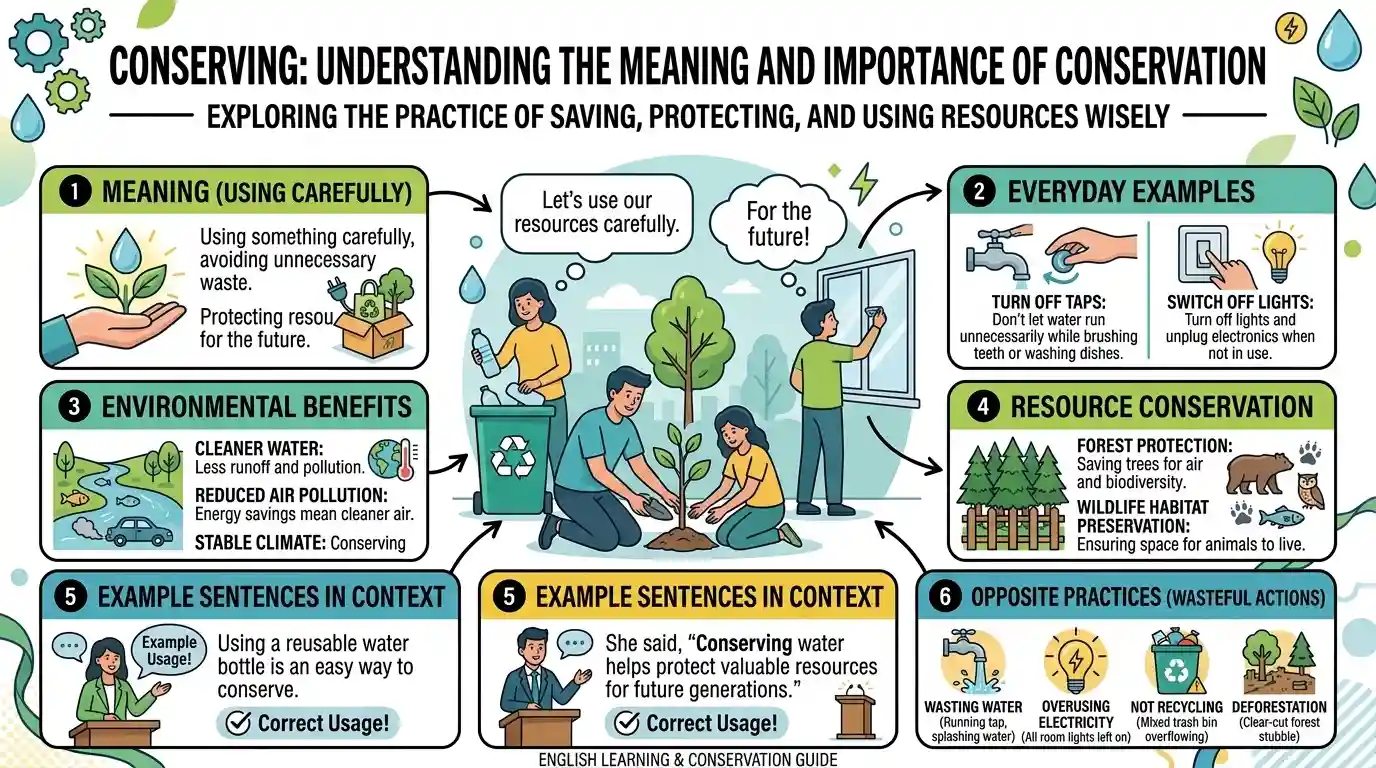
“Conserving” means protecting something valuable from loss, waste, damage, or rapid decay. It reflects a thoughtful effort to maintain resources for future use. Native speakers understand it as managing energy, the environment, or finances wisely without being wasteful. You often hear it used in discussions about nature, personal habits, or business management.
Part of Speech: Verb (Present Participle / Gerund) or Adjective
Simple Definition: Protecting something from harm, waste, or loss by using it carefully.
Connotative Meaning
Connotation is the emotional or cultural association connected to a word beyond its strict literal definition.
- Positive tone: Represents wisdom, responsibility, sustainability, and care for the future.
- Negative tone: Can occasionally imply excessive tightness, reluctance to spend, or strict restriction.
- Neutral tone: Simply describes the physical act of storing, holding back, or saving materials.
Etymology
The word originates from the Latin conservare, formed by combining com- (together) and servare (to keep or guard).
- Old English (450–1100): Not present in Old English; native Germanic terms like healdan (to hold) were used.
- Middle English (1100–1500): Entered the language through Anglo-Norman French as conserven, meaning to preserve or keep safe.
- Modern English (1500–Present): Evolved into “conserve,” adding “-ing” to form the continuous participle and active gerund.
Pronunciation
- US: /kənˈsɝː.vɪŋ/
- UK: /kənˈsɜː.vɪŋ/
Syllables & Structure
- Syllables: con-serv-ing
- Root: Serve (from Latin servare)
- Prefix: Con- (meaning together or thoroughly)
- Suffix: -ing (participle or gerund suffix)
Synonyms List
1. Preserving (Verb/Adj) — US: /prɪˈzɝː.vɪŋ/ | UK: /prɪˈzɜː.vɪŋ/
Meaning: Keeping something in its original state or protecting it from decay.
Tone/Register: Formal, Academic
- Example 1: The team spent years preserving the historic landmark.
- Example 2: She focuses on preserving family traditions for the children.
2. Saving (Verb/Adj) — US: /ˈseɪ.vɪŋ/ | UK: /ˈseɪ.vɪŋ/
Meaning: Setting aside resources or avoiding unnecessary expenditure.
Tone/Register: Everyday, General
- Example 1: He is saving energy by turning off unused lights.
- Example 2: Saving money now will help us during emergencies later.
3. Protecting (Verb/Adj) — US: /prəˈtek.tɪŋ/ | UK: /prəˈtek.tɪŋ/
Meaning: Guarding something from harm, injury, or external damage.
Tone/Register: Neutral, Direct
- Example 1: Community members are protecting local wetlands from development.
- Example 2: Wearing a helmet is essential for protecting your head.
4. Safeguarding (Verb/Adj) — US: /ˈseɪf.ɡɑːr.dɪŋ/ | UK: /ˈseɪf.ɡɑː.dɪŋ/
Meaning: Providing formal protection against potential dangers or risks.
Tone/Register: Formal, Legal
- Example 1: The legal team is safeguarding our intellectual property rights.
- Example 2: Strict rules exist for safeguarding consumer financial data online.
5. Sustaining (Verb/Adj) — US: /səˈsteɪ.nɪŋ/ | UK: /səˈsteɪ.nɪŋ/
Meaning: Providing support to keep an effort or life form going continuously.
Tone/Register: Professional, Ecological
- Example 1: Healthy soil is key to sustaining farm production every season.
- Example 2: She found ways of sustaining motivation during long work hours.
6. Maintaining (Verb/Adj) — US: /meɪnˈteɪ.nɪŋ/ | UK: /meɪnˈteɪ.nɪŋ/
Meaning: Keeping something in proper condition through regular care.
Tone/Register: Practical, Technical
- Example 1: Regular maintenance helps maintain high engine performance.
- Example 2: He is maintaining a steady routine throughout the month.
7. Husbanding (Verb/Adj) — US: /ˈhʌz.bən.dɪŋ/ | UK: /ˈhʌz.bən.dɪŋ/
Meaning: Managing and using resources carefully and economically.
Tone/Register: Literary, Formal
- Example 1: The nation is husbanding its reserves during the crisis.
- Example 2: She was husbanding her strength for the final race stage.
8. Economizing (Verb/Adj) — US: /ɪˈkɑː.nə.maɪ.zɪŋ/ | UK: /ɪˈkɒn.ə.maɪ.zɪŋ/
Meaning: Reducing expenses or resource usage to avoid financial waste.
Tone/Register: Practical, Financial
- Example 1: Many households are economizing due to rising living costs.
- Example 2: He suggested economizing on paper supplies at the office.
9. Stashing (Verb/Adj) — US: /stæʃ.ɪŋ/ | UK: /stæʃ.ɪŋ/
Meaning: Storing something away safely in a secret or secure place.
Tone/Register: Informal, Casual
- Example 1: She is stashing extra snacks in her desk drawer.
- Example 2: He has been stashing cash away for his summer vacation.
10. Hoarding (Verb/Adj) — US: /ˈhɔːr.dɪŋ/ | UK: /ˈhɔː.dɪŋ/
Meaning: Accumulating items excessively beyond practical necessity.
Tone/Register: Critical, Negative
- Example 1: News reports warned against hoarding basic household supplies.
- Example 2: He stopped hoarding old newspapers in his home attic.
11. Husbanding-up (Verb/Adj) — US: /ˈhʌz.bən.dɪŋ ʌp/ | UK: /ˈhʌz.bən.dɪŋ ʌp/
Meaning: Gathering and holding resources tightly for impending needs.
Tone/Register: Rare, Formal
- Example 1: They were husbanding up supplies before the winter storm arrived.
- Example 2: The firm was husbanding up capital for a planned acquisition.
12. Storing (Verb/Adj) — US: /ˈstɔːr.ɪŋ/ | UK: /ˈstɔː.rɪŋ/
Meaning: Placing items in a designated location for future use.
Tone/Register: Neutral, Practical
- Example 1: Farmers are storing grain inside large dry silos safely.
- Example 2: The system is storing data securely on external servers.
13. Securing (Verb/Adj) — US: /səˈkjʊr.ɪŋ/ | UK: /səˈkjʊə.rɪŋ/
Meaning: Fixing something firmly in place or making it safe from harm.
Tone/Register: Direct, Business
- Example 1: Guards are securing the perimeter around the event venue.
- Example 2: She succeeded in securing funding for her research project.
14. Shielding (Verb/Adj) — US: /ˈʃiːl.dɪŋ/ | UK: /ˈʃiːl.dɪŋ/
Meaning: Protecting someone or something from impact, harm, or harsh weather.
Tone/Register: Protective, Expressive
- Example 1: The trees are shielding the small house from cold winds.
- Example 2: She was shielding her child from negative public attention.
15. Keeping (Verb/Adj) — US: /ˈkiː.pɪŋ/ | UK: /ˈkiː.pɪŋ/
Meaning: Holding something in your possession or maintaining a condition.
Tone/Register: Basic, Universal
- Example 1: Thank you for keeping these files safe for me.
- Example 2: He is keeping his promises to all team members.
16. Retaining (Verb/Adj) — US: /rɪˈteɪ.nɪŋ/ | UK: /rɪˈteɪ.nɪŋ/
Meaning: Continuing to possess or hold onto something over time.
Tone/Register: Professional, Academic
- Example 1: The company focuses on retaining skilled staff members long-term.
- Example 2: This fabric excels at retaining body heat in winter.
17. Guarding (Verb/Adj) — US: /ˈɡɑːr.dɪŋ/ | UK: /ˈɡɑː.dɪŋ/
Meaning: Watching over something carefully to prevent theft, loss, or escape.
Tone/Register: Watchful, Firm
- Example 1: Dogs are guarding the entrance to the farm equipment.
- Example 2: He is guarding his private life against media intrusion.
18. Sheltering (Verb/Adj) — US: /ˈʃel.t̬ɚ.ɪŋ/ | UK: /ˈʃel.tər.ɪŋ/
Meaning: Providing a safe cover or sanctuary against harsh elements.
Tone/Register: Caring, Environmental
- Example 1: The roof is sheltering families from heavy monsoonal rain.
- Example 2: They were sheltering lost animals until homes were found.
19. Sparing (Verb/Adj) — US: /ˈsper.ɪŋ/ | UK: /ˈspeə.rɪŋ/
Meaning: Using something in limited quantities or refraining from punishment.
Tone/Register: Modest, Considerate
- Example 1: Please be sparing with the salt in this recipe.
- Example 2: The manager was sparing in his criticism of new employees.
20. Skimping (Verb/Adj) — US: /skɪm.pɪŋ/ | UK: /skɪm.pɪŋ/
Meaning: Spending or using less than necessary, often lowering quality.
Tone/Register: Informal, Critical
- Example 1: You should avoid skimping on safety equipment for work.
- Example 2: They were skimping on ingredients to lower manufacturing costs.
21. Pinching (Verb/Adj) — US: /pɪn.tʃɪŋ/ | UK: /pɪn.tʃɪŋ/
Meaning: Cutting back on small expenses to stretch a limited budget.
Tone/Register: Idiomatic, Informal
- Example 1: She is pinching pennies so she can afford university books.
- Example 2: They have been pinching every dollar to complete construction.
22. Rationing (Verb/Adj) — US: /ˈræʃ.ən.ɪŋ/ | UK: /ˈræʃ.ən.ɪŋ/
Meaning: Controlling the distribution of scarce goods in fixed amounts.
Tone/Register: Serious, Official
- Example 1: Officials started rationing fuel during the severe transport strike.
- Example 2: The expedition team was rationing water carefully in desert regions.
23. Holding (Verb/Adj) — US: /ˈhoʊl.dɪŋ/ | UK: /ˈhəʊl.dɪŋ/
Meaning: Grasping or maintaining control of a physical object or state.
Tone/Register: Neutral, Direct
- Example 1: She is holding the heavy door open for everyone behind.
- Example 2: He was holding back his anger during the debate.
24. Reserving (Verb/Adj) — US: /rɪˈzɝː.vɪŋ/ | UK: /rɪˈzɜː.vɪŋ/
Meaning: Setting aside something specifically for a future time or purpose.
Tone/Register: Formal, Administrative
- Example 1: I am reserving this table for our anniversary dinner tonight.
- Example 2: They are reserving judgment until all evidence is presented.
25. Stockpiling (Verb/Adj) — US: /ˈstɑːk.paɪ.lɪŋ/ | UK: /ˈstɒk.paɪ.lɪŋ/
Meaning: Accumulating large quantities of goods for anticipated shortages.
Tone/Register: Industrial, Critical
- Example 1: Factories are stockpiling raw materials ahead of international trade shifts.
- Example 2: Consumers started stockpiling canned goods before the harsh winter.
26. Bottling (Verb/Adj) — US: /ˈbɑː.t̬əl.ɪŋ/ | UK: /ˈbɒt.əl.ɪŋ/
Meaning: Sealing liquids in containers or holding emotions inside tightly.
Tone/Register: Practical, Psychological
- Example 1: The factory is bottling fresh spring water for distribution.
- Example 2: Bottling up your feelings can cause high stress over time.
27. Canning (Verb/Adj) — US: /kæn.ɪŋ/ | UK: /kæn.ɪŋ/
Meaning: Preserving food items in sealed cans or jars for long storage.
Tone/Register: Domestic, Agricultural
- Example 1: She spends late summer canning fresh tomatoes from her garden.
- Example 2: Canning fruit helps families eat healthy during cold winters.
28. Freezing (Verb/Adj) — US: /ˈfriː.zɪŋ/ | UK: /ˈfriː.zɪŋ/
Meaning: Preserving perishable food using very low temperatures to halt decay.
Tone/Register: Everyday, Practical
- Example 1: Freezing extra soups helps prepare easy weeknight family meals.
- Example 2: We are freezing fresh berries to keep them good all year.
29. Locking away (Verb/Adj) — US: /ˈlɑː.kɪŋ əˈweɪ/ | UK: /ˈlɒk.ɪŋ əˈweɪ/
Meaning: Placing items in a secure, locked compartment to prevent theft.
Tone/Register: Direct, Security-focused
- Example 1: She is locking away important legal papers inside the safe.
- Example 2: He was locking away valuable gems after the museum closed.
30. Banking (Verb/Adj) — US: /ˈbæŋ.kɪŋ/ | UK: /ˈbæŋ.kɪŋ/
Meaning: Depositing money in a bank or counting securely on a plan.
Tone/Register: Financial, Idiomatic
- Example 1: She is banking her monthly bonuses to buy a car.
- Example 2: He is banking on good weather for the outdoor concert.
31. Protecting-over (Verb/Adj) — US: /prəˈtek.tɪŋ ˈoʊ.vɚ/ | UK: /prəˈtek.tɪŋ ˈəʊ.vər/
Meaning: Watching over resources continuously to prevent unexpected degradation.
Tone/Register: Observational, Protective
- Example 1: Rangers are protecting wild forests through daily aerial patrols.
- Example 2: She was protecting her young plants during frost nights.
32. Harboring (Verb/Adj) — US: /ˈhɑːr.bɚ.ɪŋ/ | UK: /ˈhɑː.bər.ɪŋ/
Meaning: Sheltering or maintaining thoughts, feelings, or entities privately over time.
Tone/Register: Expressive, Literary
- Example 1: The forest bay is harboring small boats during heavy coastal storms.
- Example 2: He was harboring deep hopes of returning to his hometown.
33. Defending (Verb/Adj) — US: /dɪˈfen.dɪŋ/ | UK: /dɪˈfen.dɪŋ/
Meaning: Resisting attacks or guarding rights against active external threats.
Tone/Register: Assertive, Legal
- Example 1: Lawyers are defending the environmental treaty in court today.
- Example 2: The army was defending border outposts against opposing forces.
34. Sustaining-up (Verb/Adj) — US: /səˈsteɪ.nɪŋ ʌp/ | UK: /səˈsteɪ.nɪŋ ʌp/
Meaning: Propping up or keeping an ongoing resource flow stable.
Tone/Register: Descriptive, Informal
- Example 1: Community grants are sustaining local public libraries this year.
- Example 2: They were sustaining power levels during the system test.
35. Storing-up (Verb/Adj) — US: /ˈstɔːr.ɪŋ ʌp/ | UK: /ˈstɔː.rɪŋ ʌp/
Meaning: Accumulating reserves gradually in anticipation of future needs.
Tone/Register: Conversational, Practical
- Example 1: Animals are storing up fat reserves before entering winter hibernation.
- Example 2: She was storing up energy by resting before the match.
36. Caching (Verb/Adj) — US: /kæʃ.ɪŋ/ | UK: /kæʃ.ɪŋ/
Meaning: Storing digital data or supplies temporarily in an accessible location.
Tone/Register: Technical, Technological
- Example 1: Web browsers are caching image files to speed up page loads.
- Example 2: Hikers were caching food supplies along the mountain trail.
37. Guarding-over (Verb/Adj) — US: /ˈɡɑːr.dɪŋ ˈoʊ.vɚ/ | UK: /ˈɡɑː.dɪŋ ˈəʊ.vər/
Meaning: Keeping a watchful eye on valuable items continuously.
Tone/Register: Watchful, Vigilant
- Example 1: Elders are guarding tribal oral histories for new generations.
- Example 2: The security team was guarding high-value art shipments.
38. Husbanding-in (Verb/Adj) — US: /ˈhʌz.bən.dɪŋ ɪn/ | UK: /ˈhʌz.bən.dɪŋ ɪn/
Meaning: Gathering resources inward to prevent outward leakage or waste.
Tone/Register: Specialized, Formal
- Example 1: The manager is husbanding-in remaining project funds carefully now.
- Example 2: They were husbanding-in heat supplies during power grid outages.
39. Securing-away (Verb/Adj) — US: /səˈkjʊr.ɪŋ əˈweɪ/ | UK: /səˈkjʊə.rɪŋ əˈweɪ/
Meaning: Putting items safely out of reach of unauthorized individuals.
Tone/Register: Methodical, Firm
- Example 1: Clerks are securing away private personnel records inside locked cabinets.
- Example 2: He was securing away valuable tools before leaving the site.
40. Preserving-alive (Verb/Adj) — US: /prɪˈzɝː.vɪŋ əˈlaɪv/ | UK: /prɪˈzɜː.vɪŋ əˈlaɪv/
Meaning: Keeping endangered species or cultural elements active and living.
Tone/Register: Academic, Biological
- Example 1: Zoos focus on preserving rare animal species through breeding.
- Example 2: Community classes are preserving ancient weaving techniques today.
41. Tucking-away (Verb/Adj) — US: /ˈtʌk.ɪŋ əˈweɪ/ | UK: /ˈtʌk.ɪŋ əˈweɪ/
Meaning: Storing small items neatly and out of sight in compact spaces.
Tone/Register: Informal, Domestic
- Example 1: She is tucking away extra blankets inside the storage bench.
- Example 2: He enjoyed tucking away small savings from his daily allowance.
42. Shielding-over (Verb/Adj) — US: /ˈʃiːl.dɪŋ ˈoʊ.vɚ/ | UK: /ˈʃiːl.dɪŋ ˈəʊ.vər/
Meaning: Placing a protective layer directly above vulnerable objects.
Tone/Register: Descriptive, Protective
- Example 1: Tarps are shielding-over construction materials during heavy rainstorms.
- Example 2: She was shielding young seedlings with light fabric covers.
43. Salting-away (Verb/Adj) — US: /ˈsɑːl.tɪŋ əˈweɪ/ | UK: /ˈsɒl.tɪŋ əˈweɪ/
Meaning: Saving money or assets quietly over an extended time period.
Tone/Register: Idiomatic, Financial
- Example 1: He has been salting away money for his eventual retirement.
- Example 2: She was salting away profits to fund future business expansion.
44. Keeping back (Verb/Adj) — US: /ˈkiː.pɪŋ bæk/ | UK: /ˈkiː.pɪŋ bæk/
Meaning: Withholding a portion of resources rather than spending everything.
Tone/Register: Cautionary, Practical
- Example 1: The farmer is keeping back seeds for next spring planting.
- Example 2: They were keeping back extra emergency rations during the trip.
45. Holding on to (Verb/Adj) — US: /ˈhoʊl.dɪŋ ˌɑːn.tuː/ | UK: /ˈhəʊl.dɪŋ ˌɒn.tuː/
Meaning: Retaining possession of items despite temptations to sell or throw away.
Tone/Register: Casual, Personal
- Example 1: She is holding on to vintage clothing items that might return to fashion.
- Example 2: He was holding on to original company stock options for years.
46. Caring-for (Verb/Adj) — US: /ˈker.ɪŋ fɔːr/ | UK: /ˈkeə.rɪŋ fɔːr/
Meaning: Looking after the needs and protection of living things or property.
Tone/Register: Warm, Compassionate
- Example 1: She is caring for orphaned wildlife at the regional shelter.
- Example 2: He has been caring for his family home with great dedication.
47. Managing (Verb/Adj) — US: /ˈmæn.ə.dʒɪŋ/ | UK: /ˈmæn.ɪ.dʒɪŋ/
Meaning: Controlling and directing the deployment of time, money, or resources.
Tone/Register: Business, Professional
- Example 1: The director is managing department budgets to prevent overspending.
- Example 2: She excels at managing her time between study and work.
48. Curating (Verb/Adj) — US: /ˈkjʊr.eɪ.t̬ɪŋ/ | UK: /ˈkjʊə.reɪ.tɪŋ/
Meaning: Selecting and organizing items carefully for presentation or preservation.
Tone/Register: Cultural, Modern
- Example 1: The gallery is curating rare historic photos for a new exhibit.
- Example 2: She enjoys curating educational resources for her online readers.
49. Watching-over (Verb/Adj) — US: /ˈwɑː.tʃɪŋ ˈoʊ.vɚ/ | UK: /ˈwɒtʃ.ɪŋ ˈəʊ.vər/
Meaning: Monitoring situations or items closely to ensure safety and order.
Tone/Register: Protective, Attentive
- Example 1: Lifeguards are watching over swimmers along the busy public beach.
- Example 2: She was watching over her younger brother at the park.
50. Protecting-back (Verb/Adj) — US: /prəˈtek.tɪŋ bæk/ | UK: /prəˈtek.tɪŋ bæk/
Meaning: Safeguarding foundational resources against past vulnerabilities.
Tone/Register: Analytical, Technical
- Example 1: Engineers are protecting-back core electrical lines against grid failures.
- Example 2: They were protecting archival records using digital scans.
51. Holding-in-reserve (Verb/Adj) — US: /ˈhoʊl.dɪŋ ɪn rɪˈzɝːv/ | UK: /ˈhəʊl.dɪŋ ɪn rɪˈzɜːv/
Meaning: Keeping backup resources ready for unexpected emergencies or demands.
Tone/Register: Formal, Strategic
- Example 1: The hospital is holding in reserve extra beds for weekend spikes.
- Example 2: They were holding in reserve several generators during the storm.
52. Keeping-intact (Verb/Adj) — US: /ˈkiː.pɪŋ ɪnˈtækt/ | UK: /ˈkiː.pɪŋ ɪnˈtækt/
Meaning: Ensuring something remains whole, undamaged, and complete.
Tone/Register: Precise, Preservation-focused
- Example 1: Conservationists focus on keeping intact natural forest corridors.
- Example 2: She succeeded in keeping her original business model intact.
53. Cushioning (Verb/Adj) — US: /ˈkʊʃ.ən.ɪŋ/ | UK: /ˈkʊʃ.ən.ɪŋ/
Meaning: Softening the impact of sudden changes or financial shocks.
Tone/Register: Financial, Protective
- Example 1: Emergency funds are cushioning families against sudden job losses.
- Example 2: Packaging foam is cushioning fragile items during international delivery.
54. Insulating (Verb/Adj) — US: /ˈɪn.sə.leɪ.t̬ɪŋ/ | UK: /ˈɪn.sjə.leɪ.tɪŋ/
Meaning: Protecting from temperature shifts or shielding from negative influences.
Tone/Register: Technical, Protective
- Example 1: Adding fiberglass insulation helps insulate homes during cold winters.
- Example 2: The firm is insulating its business against market fluctuations.
55. Nurturing (Verb/Adj) — US: /ˈnɝː.tʃɚ.ɪŋ/ | UK: /ˈnɜː.tʃər.ɪŋ/
Meaning: Supporting the development and healthy growth of living things.
Tone/Register: Warm, Supportive
- Example 1: Teachers spend time nurturing young minds in elementary school.
- Example 2: She is nurturing new fruit trees in her home garden.
Synonyms by Tone
Choosing synonyms based on tone helps you match your communication style to your specific audience.
Positive Tone
Words that reflect thoughtful care, ecological responsibility, or wise long-term planning.
- Preserving
- Sustaining
- Safeguarding
- Nurturing
- Curating
Neutral Tone
Words that objectively state the physical storage or protection of materials.
- Saving
- Storing
- Maintaining
- Retaining
- Managing
Negative Tone
Words that describe excessive accumulation, stinginess, or forced restriction.
- Hoarding
- Skimping
- Pinching
- Stockpiling
Informal Tone
Casual terms suitable for everyday conversations with friends or family.
- Stashing
- Tucking-away
- Banking
- Locking-away
Mini Comparison: Conserving vs. Close Alternatives
| Term | Core Meaning | Tone | Best Context |
| Conserving | Using resources wisely to prevent wasteful depletion | Responsible, Green | Energy saving, environmental work, personal habits |
| Preserving | Keeping something completely unchanged or saved from decay | Formal, Historical | Historic buildings, food canning, art restoration |
| Hoarding | Accumulating materials excessively due to fear or greed | Negative, Critical | Emergency supply panics, psychological conditions |
How Usage Changes by Context
- Daily Conversation: Use accessible terms like saving, stashing, or keeping. They sound natural when discussing daily household choices.
- Writing & Blogging: Terms like conserving, sustaining, or curating build authority and hold reader interest in online articles.
- Professional & Academic Settings: Rely on safeguarding, husbanding, or retaining to deliver precise, executive-level reports.
- Creative Writing: Use vivid terms like sheltering, harboring, or tucking away to convey strong moods in stories.
Common Mistakes & Native Usage
Overusing “Saving”
English learners often use “saving” for every single situation. Try replacing it with conserving for energy or preserving for historical items.
Confusing “Conserving” with “Preserving”
Conserving allows for controlled, wise usage of resources. Preserving means keeping something exactly as it is without using it up at all.
Register Alignment
Avoid using casual terms like stashing in formal academic papers, or heavy terms like husbanding in casual daily text messages.
Real-Life Mini Scenarios
- Workplace: “We are conserving project funds to cover unexpected development costs later.”
- Social Situations: “She is saving extra food from dinner so nothing goes to waste.”
- Media & Journalism: “The city council announced new plans for safeguarding public water supplies.”
- Creative Writing: “He was harboring old family letters inside a locked wooden box.”
Practice Quiz
Test your understanding of these vocabulary terms:
Part One
1. Which word is closest in meaning to “conserving”?
A) Wasting
B) Preserving
C) Destroying
D) Removing
2. “Conserving water is important.” What does “conserving” mean here?
A) Wasting
B) Saving
C) Polluting
D) Selling
3. Which is a synonym of “conserving”?
A) Protecting
B) Damaging
C) Spending
D) Losing
4. Which word means “using something carefully to avoid waste”?
A) Conserving
B) Destroying
C) Ignoring
D) Abandoning
5. “They are conserving energy.” Which word can replace “conserving”?
A) Saving
B) Wasting
C) Increasing
D) Removing
6. Which word is most similar to “conserving” natural resources?
A) Preserving
B) Destroying
C) Polluting
D) Exhausting
7. Which is NOT a synonym of “conserving”?
A) Protecting
B) Preserving
C) Safeguarding
D) Wasting
8. “Conserving forests helps protect wildlife.” What does “conserving” mean?
A) Cutting down
B) Protecting
C) Selling
D) Burning
9. Choose the best synonym for “conserving.”
A) Maintaining
B) Damaging
C) Throwing away
D) Consuming
10. Which word suggests keeping something safe and protected?
A) Safeguarding
B) Wasting
C) Breaking
D) Removing
Part Two
11. “We should conserve electricity.” Which meaning is correct?
A) Use electricity carefully
B) Waste electricity
C) Stop producing electricity
D) Sell electricity
12. Which word can replace “conserving” in “conserving wildlife”?
A) Protecting
B) Hunting
C) Destroying
D) Ignoring
13. Which synonym of “conserving” means keeping something for future use?
A) Reserving
B) Spending
C) Wasting
D) Removing
14. “The organization is conserving endangered species.” This means it is:
A) Protecting them
B) Destroying them
C) Ignoring them
D) Selling them
15. Which word is closest to “conserving resources”?
A) Saving
B) Wasting
C) Consuming
D) Losing
16. Which synonym means “keeping something in good condition”?
A) Maintaining
B) Destroying
C) Neglecting
D) Removing
17. “Conserving food can reduce waste.” Which word best replaces “conserving”?
A) Saving
B) Throwing away
C) Spoiling
D) Wasting
18. Which word is most closely related to conserving the environment?
A) Preserving
B) Polluting
C) Damaging
D) Exploiting
19. Which sentence uses “conserving” correctly?
A) We are conserving water during the drought.
B) We are conserving water by wasting it.
C) She is conserving the forest by destroying it.
D) They are conserving energy by leaving every light on.
20. What is the closest meaning of “conserving” in general?
A) Saving and protecting
B) Destroying and wasting
C) Removing and replacing
D) Buying and selling
Answer Key
- B
- B
- A
- A
- A
- A
- D
- B
- A
- A
- A
- A
- A
- A
- A
- A
- A
- A
- A
- A
Conclusion
Building your vocabulary with these synonyms allows you to express ideas about care and protection clearly. Selecting precise terms improves your overall impact across all written and spoken formats.
Practicing new words enhances your writing, academic essays, and daily professional conversations naturally. Using varied phrasing makes your blog posts and emails far more engaging to read.
Try using two new terms in your next writing draft or daily discussion. Small adjustments in word choice can boost your communication confidence and overall English fluency. Explore our complete guide on synonyms of conserving to master modern language usage.
Frequently Asked Questions
1. What is the primary difference between conserving and preserving?
Conserving means using resources carefully without waste, whereas preserving means maintaining something in its original, untouched condition.
2. Can conserving be used in formal business contexts?
Yes, conserving is widely used in business reports to describe cost reduction, energy management, and efficient resource allocation.
3. What is a negative synonym for conserving?
Hoarding and skimping are negative alternatives, as they imply excessive accumulation or cutting back to the detriment of quality.
4. How does conserving differ from saving in casual conversations?
Saving is a broad everyday word for keeping anything, while conserving specifically implies mindful, sustainable management of limited resources.
5. Which synonym of conserving works best for digital data?
Caching or storing are ideal terms when referring to the retention and temporary preservation of digital files or computer memory.

Mehtab Yasir is a passionate writer and English language enthusiast dedicated to making vocabulary learning simple, practical, and enjoyable. As an author at SynonymDesk.com, she creates helpful content covering synonyms, antonyms, word meanings, vocabulary, phrases, and everyday English usage. Her goal is to provide clear and easy-to-understand information that helps students, writers, professionals, and English learners choose the right words and communicate with greater confidence. Mehtab believes that a strong vocabulary can improve both writing and communication skills. She enjoys researching new words, exploring their meanings and uses, and turning complex language concepts into useful, reader-friendly content. Through her work, she strives to make SynonymDesk.com a reliable resource for anyone looking to improve their English vocabulary and language skills.