Synonyms of invoking include calling upon, appealing to, citing, summoning, requesting, and evoking. The best alternative depends on whether someone is seeking help, referring to authority, activating a rule, or bringing an emotion to mind. Understanding these differences helps you choose accurate words for everyday speech, academic writing, and professional communication.
Imagine a lawyer invoking a legal right during a difficult case. The word shows that the lawyer is using an established rule to support an argument.
Learning synonyms of invoking helps you express ideas more precisely. Each alternative offers a slightly different meaning for a particular situation.
Students, bloggers, content writers, and everyday English users benefit from this vocabulary. It makes explanations clearer and prevents repeated wording.
You may encounter invoking in news reports, literature, religious discussions, and workplace policies. Knowing its alternatives makes these contexts easier to understand.
What Does “Invoking” Really Mean?
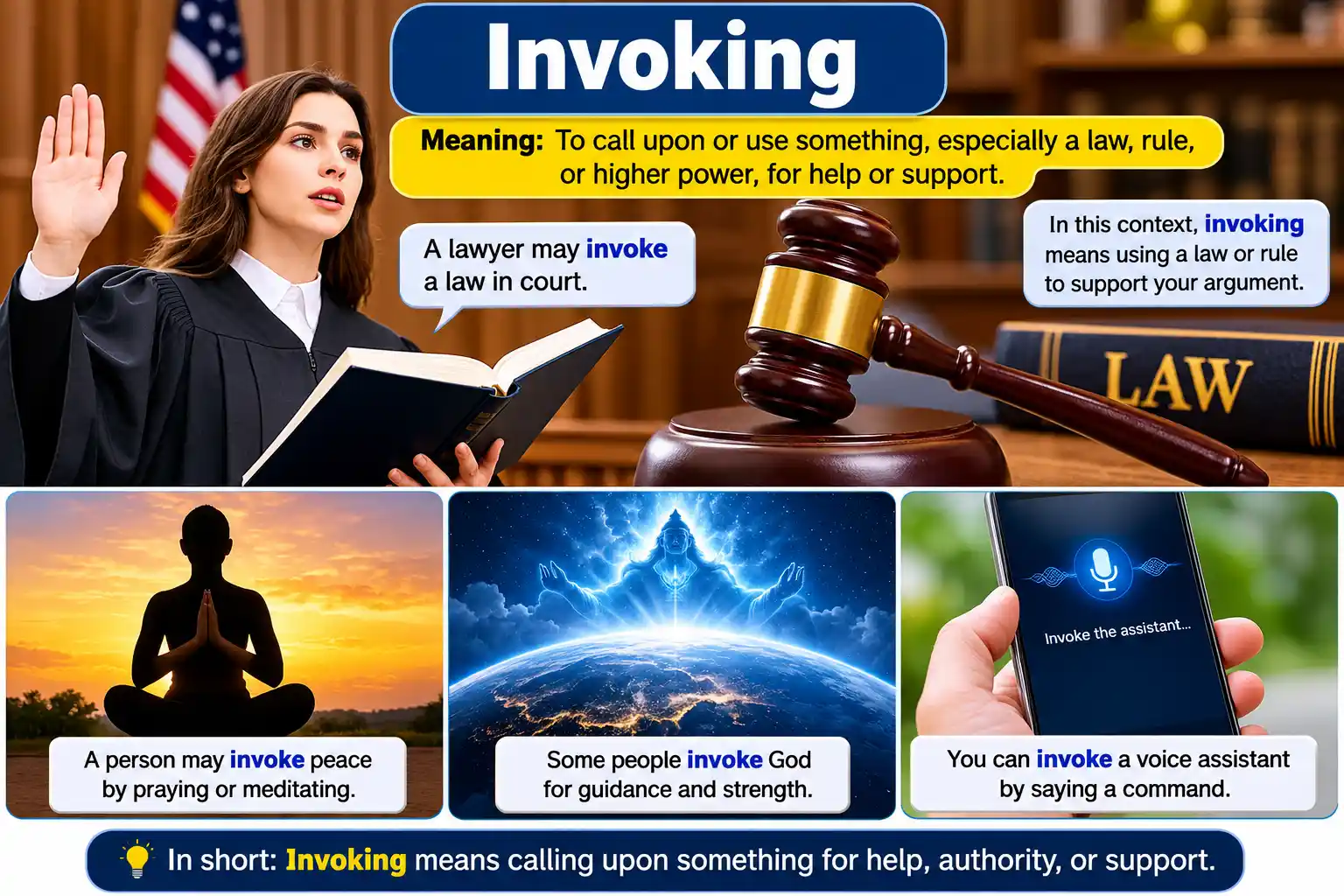
Invoking means calling upon someone or something for help, support, authority, or inspiration. It can also mean referring to a law, principle, memory, or emotion to produce a particular effect.
The word often describes a deliberate action. Someone invokes something because they want to achieve a result.
For example:
- A lawyer is invoking a constitutional right.
- A speaker is invoking memories of childhood.
- A programmer is invoking a function.
- A community leader is invoking public support.
In these examples, invoking has different meanings. The shared idea is bringing something into use or calling upon it.
Part of Speech
Invoking is the present participle of the verb invoke. It also appears in continuous verb forms and as a gerund.
Base form: Invoke
Past tense: Invoked
Past participle: Invoked
Present participle: Invoking
Example 1: The manager is invoking company policy.
Example 2: Invoking an old tradition can create a sense of belonging.
Connotative Meaning of Invoking
(Connotation is the emotional or cultural meaning a word suggests beyond its basic dictionary definition.)
Invoking does not always carry one fixed emotional meaning. Its tone depends on the subject and the speaker’s intention.
Positive Tone
Invoking can suggest hope, inspiration, respect, or encouragement.
Example: The teacher was invoking the values of kindness and cooperation.
Here, the word creates a constructive impression.
Negative Tone
It can suggest manipulation, fear, conflict, or the deliberate use of authority against someone.
Example: The politician was invoking public fears to gain support.
The context gives the word a negative meaning.
Neutral Tone
Invoking often describes a factual action without expressing approval or criticism.
Example: The software is invoking a function to process the request.
In this sentence, the word has a technical meaning.
Etymology of Invoking
The verb invoke comes from the Latin word invocare, meaning to call upon or appeal to.
It combines two Latin elements:
In-
A prefix meaning toward, upon, or into.
Vocare
A Latin verb meaning to call.
Together, these elements express the idea of calling upon someone or something.
Old English (450–1100)
The modern English word invoke did not exist during the Old English period. Speakers used native expressions related to calling, praying, and asking for help.
Middle English (1100–1500)
English gradually absorbed vocabulary from Latin and French. Related religious and formal expressions became increasingly common.
The verb invoke entered English toward the end of the Middle English period.
Modern English (1500–Present)
The meaning expanded beyond religious appeals.
Today, invoking appears in legal writing, politics, literature, technology, academic discussions, and ordinary communication.
Pronunciation of Invoking
US pronunciation: /ɪnˈvoʊ.kɪŋ/
UK pronunciation: /ɪnˈvəʊ.kɪŋ/
Syllable Breakdown
in-vok-ing
Number of syllables: 3
The main stress falls on the second syllable: VOK.
Affixation Pattern of Invoking
Root: voc- (from Latin vocare, meaning to call)
Prefix: in-
Suffix: -ing
Word formation: invoke + -ing → invoking
The final silent e disappears before adding -ing.
Synonyms List
The following alternatives cover the major meanings of invoking.
Each entry includes pronunciation, meaning, tone, and practical examples.
1. Calling Upon (Phrasal Verb) — US /ˈkɔː.lɪŋ əˈpɑːn/ | UK /ˈkɔː.lɪŋ əˈpɒn/
Meaning: Asking someone or something for help, support, or action.
Tone/Register: Neutral, Formal.
Example 1: The mayor is calling upon residents to conserve water.
Example 2: She is calling upon her experience to solve the problem.
2. Appealing To (Phrasal Verb) — US /əˈpiː.lɪŋ tuː/ | UK /əˈpiː.lɪŋ tuː/
Meaning: Requesting assistance or using a principle to gain support.
Tone/Register: Formal, Persuasive.
Example 1: The charity is appealing to local businesses for donations.
Example 2: He is appealing to common sense during the discussion.
3. Summoning (Verb) — US /ˈsʌm.ən.ɪŋ/ | UK /ˈsʌm.ən.ɪŋ/
Meaning: Calling someone or something to appear or become available.
Tone/Register: Formal, Literary.
Example 1: The captain is summoning the crew for an emergency meeting.
Example 2: She is summoning the courage to speak publicly.
4. Citing (Verb) — US /ˈsaɪ.tɪŋ/ | UK /ˈsaɪ.tɪŋ/
Meaning: Referring to information, evidence, or authority to support a statement.
Tone/Register: Academic, Legal, Professional.
Example 1: The researcher is citing several recent studies.
Example 2: The employee is citing workplace regulations.
5. Referencing (Verb) — US /ˈref.ər.ən.sɪŋ/ | UK /ˈref.ər.ən.sɪŋ/
Meaning: Mentioning a source, idea, or authority in support of a point.
Tone/Register: Academic, Neutral.
Example 1: The blogger is referencing an earlier interview.
Example 2: Our supervisor is referencing the official guidelines.
6. Quoting (Verb) — US /ˈkwoʊ.tɪŋ/ | UK /ˈkwəʊ.tɪŋ/
Meaning: Repeating someone’s exact words as evidence or support.
Tone/Register: Academic, Journalistic.
Example 1: The journalist is quoting the minister’s statement.
Example 2: Maria is quoting a famous author in her presentation.
7. Mentioning (Verb) — US /ˈmen.ʃən.ɪŋ/ | UK /ˈmen.ʃən.ɪŋ/
Meaning: Briefly bringing a person, idea, or subject into discussion.
Tone/Register: Neutral, Conversational.
Example 1: He keeps mentioning the agreement during negotiations.
Example 2: The teacher is mentioning a historical example.
8. Adducing (Verb) — US /əˈduː.sɪŋ/ | UK /əˈdjuː.sɪŋ/
Meaning: Presenting evidence or reasons to support an argument.
Tone/Register: Formal, Legal, Academic.
Example 1: The attorney is adducing evidence from previous cases.
Example 2: The scholar is adducing new facts to defend her theory.
9. Calling On (Phrasal Verb) — US /ˈkɔː.lɪŋ ɑːn/ | UK /ˈkɔː.lɪŋ ɒn/
Meaning: Asking someone to act or provide assistance.
Tone/Register: Neutral, Professional.
Example 1: The principal is calling on parents to attend the meeting.
Example 2: The coach is calling on experienced players for leadership.
10. Petitioning (Verb) — US /pəˈtɪʃ.ən.ɪŋ/ | UK /pəˈtɪʃ.ən.ɪŋ/
Meaning: Making a formal request to a person or authority.
Tone/Register: Formal, Legal.
Example 1: Residents are petitioning the council for better roads.
Example 2: The organization is petitioning the court for protection.
11. Requesting (Verb) — US /rɪˈkwes.tɪŋ/ | UK /rɪˈkwes.tɪŋ/
Meaning: Politely or formally asking for something.
Tone/Register: Neutral, Professional.
Example 1: The employee is requesting additional assistance.
Example 2: Our team is requesting guidance from the director.
12. Beseeching (Verb) — US /bɪˈsiː.tʃɪŋ/ | UK /bɪˈsiː.tʃɪŋ/
Meaning: Asking someone urgently and emotionally for help.
Tone/Register: Literary, Emotional.
Example 1: The villagers are beseeching the authorities for protection.
Example 2: She is beseeching her friend to reconsider the decision.
13. Imploring (Verb) — US /ɪmˈplɔːr.ɪŋ/ | UK /ɪmˈplɔː.rɪŋ/
Meaning: Making a serious and heartfelt request.
Tone/Register: Emotional, Formal.
Example 1: The mother is imploring the doctors to help her child.
Example 2: The activist is imploring officials to protect the forest.
14. Entreating (Verb) — US /ɪnˈtriː.tɪŋ/ | UK /ɪnˈtriː.tɪŋ/
Meaning: Asking earnestly for someone’s help or cooperation.
Tone/Register: Literary, Formal.
Example 1: The villagers are entreating the king to show mercy.
Example 2: He is entreating his colleagues to support the proposal.
15. Pleading (Verb) — US /ˈpliː.dɪŋ/ | UK /ˈpliː.dɪŋ/
Meaning: Asking desperately or emotionally for assistance or understanding.
Tone/Register: Emotional, Conversational.
Example 1: The passengers are pleading for accurate information.
Example 2: She is pleading with her manager for another opportunity.
16. Praying (Verb) — US /ˈpreɪ.ɪŋ/ | UK /ˈpreɪ.ɪŋ/
Meaning: Addressing a divine being to seek help, guidance, or blessings.
Tone/Register: Religious, Spiritual.
Example 1: The family is praying for their father’s recovery.
Example 2: Worshippers are praying for peace in their community.
17. Supplicating (Verb) — US /ˈsʌp.lɪ.keɪ.tɪŋ/ | UK /ˈsʌp.lɪ.keɪ.tɪŋ/
Meaning: Humbly asking a powerful person or divine being for help.
Tone/Register: Religious, Literary.
Example 1: The pilgrims are supplicating for divine mercy.
Example 2: The character is supplicating before the ruler.
18. Inviting (Verb) — US /ɪnˈvaɪ.tɪŋ/ | UK /ɪnˈvaɪ.tɪŋ/
Meaning: Asking someone to participate, respond, or become involved.
Tone/Register: Neutral, Friendly.
Example 1: The moderator is inviting comments from the audience.
Example 2: The organizer is inviting community leaders to participate.
19. Soliciting (Verb) — US /səˈlɪs.ɪ.tɪŋ/ | UK /səˈlɪs.ɪ.tɪŋ/
Meaning: Actively seeking assistance, opinions, contributions, or support.
Tone/Register: Formal, Business.
Example 1: The company is soliciting feedback from customers.
Example 2: The campaign is soliciting support from local organizations.
20. Evoking (Verb) — US /ɪˈvoʊ.kɪŋ/ | UK /ɪˈvəʊ.kɪŋ/
Meaning: Bringing a feeling, image, or memory into someone’s mind.
Tone/Register: Literary, Descriptive.
Example 1: The old photograph is evoking memories of childhood.
Example 2: Her speech is evoking a strong sense of hope.
21. Conjuring (Verb) — US /ˈkʌn.dʒɚ.ɪŋ/ | UK /ˈkʌn.dʒər.ɪŋ/
Meaning: Bringing an image, idea, or imagined presence into the mind.
Tone/Register: Creative, Literary.
Example 1: The storyteller is conjuring images of a magical forest.
Example 2: His description is conjuring memories of our hometown.
22. Recalling (Verb) — US /rɪˈkɑː.lɪŋ/ | UK /rɪˈkɔː.lɪŋ/
Meaning: Bringing a previous experience or piece of information back into memory.
Tone/Register: Neutral, Reflective.
Example 1: She is recalling her first day at university.
Example 2: The speaker is recalling an important historical event.
23. Reminding (Verb) — US /rɪˈmaɪn.dɪŋ/ | UK /rɪˈmaɪn.dɪŋ/
Meaning: Causing someone to remember a person, fact, or experience.
Tone/Register: Neutral, Conversational.
Example 1: The song is reminding me of summer holidays.
Example 2: His remarks are reminding everyone of their responsibilities.
24. Awakening (Verb) — US /əˈweɪ.kən.ɪŋ/ | UK /əˈweɪ.kən.ɪŋ/
Meaning: Causing a feeling, awareness, or interest to become active.
Tone/Register: Literary, Inspirational.
Example 1: The documentary is awakening interest in environmental protection.
Example 2: Her story is awakening a sense of compassion.
25. Stirring (Verb) — US /ˈstɝː.ɪŋ/ | UK /ˈstɜː.rɪŋ/
Meaning: Producing or strengthening emotions within someone.
Tone/Register: Emotional, Descriptive.
Example 1: The music is stirring feelings of nostalgia.
Example 2: The announcement is stirring excitement among students.
26. Arousing (Verb) — US /əˈraʊ.zɪŋ/ | UK /əˈraʊ.zɪŋ/
Meaning: Causing a particular emotion, reaction, or interest to develop.
Tone/Register: Formal, Descriptive.
Example 1: The decision is arousing public concern.
Example 2: The mysterious message is arousing curiosity.
27. Eliciting (Verb) — US /iˈlɪs.ɪ.tɪŋ/ | UK /iˈlɪs.ɪ.tɪŋ/
Meaning: Drawing out a response, feeling, or piece of information.
Tone/Register: Academic, Professional.
Example 1: The teacher is eliciting thoughtful answers from students.
Example 2: The advertisement is eliciting emotional reactions.
28. Inspiring (Verb) — US /ɪnˈspaɪr.ɪŋ/ | UK /ɪnˈspaɪə.rɪŋ/
Meaning: Creating motivation, enthusiasm, or a desire to act.
Tone/Register: Positive, Inspirational.
Example 1: The coach is inspiring confidence in the team.
Example 2: Her achievements are inspiring young entrepreneurs.
29. Triggering (Verb) — US /ˈtrɪɡ.ɚ.ɪŋ/ | UK /ˈtrɪɡ.ər.ɪŋ/
Meaning: Causing a reaction, memory, or process to begin.
Tone/Register: Neutral, Technical, Sometimes Negative.
Example 1: The smell is triggering memories of my grandmother’s kitchen.
Example 2: The warning is triggering an automatic security response.
30. Calling Forth (Phrasal Verb) — US /ˈkɔː.lɪŋ fɔːrθ/ | UK /ˈkɔː.lɪŋ fɔːθ/
Meaning: Causing a feeling, quality, or response to emerge.
Tone/Register: Formal, Literary.
Example 1: The crisis is calling forth extraordinary courage.
Example 2: Her performance is calling forth admiration from the audience.
31. Activating (Verb) — US /ˈæk.tə.veɪ.tɪŋ/ | UK /ˈæk.tɪ.veɪ.tɪŋ/
Meaning: Making a system, process, or mechanism start working.
Tone/Register: Technical, Professional.
Example 1: The application is activating its security features.
Example 2: The technician is activating the backup system.
32. Initiating (Verb) — US /ɪˈnɪʃ.i.eɪ.tɪŋ/ | UK /ɪˈnɪʃ.i.eɪ.tɪŋ/
Meaning: Starting an action, procedure, or process.
Tone/Register: Formal, Technical.
Example 1: The software is initiating a data transfer.
Example 2: The manager is initiating an emergency procedure.
33. Executing (Verb) — US /ˈek.sɪ.kjuː.tɪŋ/ | UK /ˈek.sɪ.kjuː.tɪŋ/
Meaning: Carrying out an instruction, command, or computer operation.
Tone/Register: Technical, Professional.
Example 1: The system is executing the requested command.
Example 2: The program is executing a scheduled task.
34. Running (Verb) — US /ˈrʌn.ɪŋ/ | UK /ˈrʌn.ɪŋ/
Meaning: Starting or operating a computer program, command, or function.
Tone/Register: Informal, Technical.
Example 1: The developer is running a function to check the results.
Example 2: My computer is running a background process.
35. Applying (Verb) — US /əˈplaɪ.ɪŋ/ | UK /əˈplaɪ.ɪŋ/
Meaning: Putting a rule, principle, or method into practical use.
Tone/Register: Neutral, Professional.
Example 1: The judge is applying the relevant legal standard.
Example 2: Our department is applying the updated safety guidelines.
36. Enforcing (Verb) — US /ɪnˈfɔːr.sɪŋ/ | UK /ɪnˈfɔː.sɪŋ/
Meaning: Making sure a rule, law, or requirement is obeyed.
Tone/Register: Legal, Authoritative.
Example 1: The school is enforcing its attendance policy.
Example 2: Inspectors are enforcing environmental regulations.
37. Exercising (Verb) — US /ˈek.sɚ.saɪ.zɪŋ/ | UK /ˈek.sə.saɪ.zɪŋ/
Meaning: Making use of a right, power, or authority.
Tone/Register: Formal, Legal.
Example 1: The employee is exercising her right to appeal.
Example 2: The committee is exercising its legal authority.
38. Claiming (Verb) — US /ˈkleɪ.mɪŋ/ | UK /ˈkleɪ.mɪŋ/
Meaning: Asserting a right, privilege, or entitlement.
Tone/Register: Neutral, Legal.
Example 1: The tenant is claiming protection under the law.
Example 2: The witness is claiming a legal privilege.
39. Asserting (Verb) — US /əˈsɝː.tɪŋ/ | UK /əˈsɜː.tɪŋ/
Meaning: Expressing a right, belief, or authority firmly and confidently.
Tone/Register: Formal, Assertive.
Example 1: The lawyer is asserting her client’s rights.
Example 2: The director is asserting his authority over the project.
40. Relying On (Phrasal Verb) — US /rɪˈlaɪ.ɪŋ ɑːn/ | UK /rɪˈlaɪ.ɪŋ ɒn/
Meaning: Depending on someone or something for support, guidance, or justification.
Tone/Register: Neutral, Professional.
Example 1: The lawyer is relying on an earlier court decision.
Example 2: The team is relying on established procedures.
41. Drawing On (Phrasal Verb) — US /ˈdrɔː.ɪŋ ɑːn/ | UK /ˈdrɔː.ɪŋ ɒn/
Meaning: Using knowledge, experience, or resources to achieve something.
Tone/Register: Neutral, Academic.
Example 1: The writer is drawing on personal experiences.
Example 2: Our manager is drawing on years of industry knowledge.
42. Resorting To (Phrasal Verb) — US /rɪˈzɔːr.tɪŋ tuː/ | UK /rɪˈzɔː.tɪŋ tuː/
Meaning: Turning to a particular action or method, often when other options fail.
Tone/Register: Neutral, Sometimes Negative.
Example 1: The company is resorting to emergency procedures.
Example 2: The negotiator is resorting to legal arguments.
43. Employing (Verb) — US /ɪmˈplɔɪ.ɪŋ/ | UK /ɪmˈplɔɪ.ɪŋ/
Meaning: Using a method, principle, or resource for a particular purpose.
Tone/Register: Formal, Professional.
Example 1: The speaker is employing historical examples to explain her point.
Example 2: The organization is employing established safety procedures.
44. Utilizing (Verb) — US /ˈjuː.t̬əl.aɪ.zɪŋ/ | UK /ˈjuː.tɪ.laɪ.zɪŋ/
Meaning: Making practical use of an available resource, method, or system.
Tone/Register: Formal, Technical.
Example 1: The researcher is utilizing a recognized analytical framework.
Example 2: The company is utilizing its emergency response system.
45. Harnessing (Verb) — US /ˈhɑːr.nəs.ɪŋ/ | UK /ˈhɑː.nəs.ɪŋ/
Meaning: Bringing a resource, power, or ability into effective use.
Tone/Register: Positive, Professional.
Example 1: The community is harnessing volunteer support.
Example 2: The organization is harnessing local expertise.
46. Bringing Into Play (Verb Phrase) — US /ˈbrɪŋ.ɪŋ ˈɪn.tuː pleɪ/ | UK /ˈbrɪŋ.ɪŋ ˈɪn.tuː pleɪ/
Meaning: Introducing a factor, power, or resource into a situation.
Tone/Register: Neutral, Descriptive.
Example 1: The dispute is bringing several legal principles into play.
Example 2: The decision is bringing new responsibilities into play.
47. Calling Into Action (Verb Phrase) — US /ˈkɔː.lɪŋ ˈɪn.tuː ˈæk.ʃən/ | UK /ˈkɔː.lɪŋ ˈɪn.tuː ˈæk.ʃən/
Meaning: Making a person, group, or system begin performing its role.
Tone/Register: Formal, Descriptive.
Example 1: The emergency is calling rescue teams into action.
Example 2: The alert is calling the response unit into action.
48. Bringing To Mind (Verb Phrase) — US /ˈbrɪŋ.ɪŋ tə maɪnd/ | UK /ˈbrɪŋ.ɪŋ tə maɪnd/
Meaning: Causing someone to remember or think about something.
Tone/Register: Neutral, Conversational.
Example 1: The painting is bringing childhood memories to mind.
Example 2: His voice is bringing an old friend to mind.
49. Alluding To (Phrasal Verb) — US /əˈluː.dɪŋ tuː/ | UK /əˈluː.dɪŋ tuː/
Meaning: Referring indirectly to a person, event, or idea.
Tone/Register: Literary, Academic.
Example 1: The novelist is alluding to an ancient myth.
Example 2: The speaker is alluding to a previous disagreement.
50. Appealing For (Phrasal Verb) — US /əˈpiː.lɪŋ fɔːr/ | UK /əˈpiː.lɪŋ fɔː/
Meaning: Making a serious request for help, support, or a particular outcome.
Tone/Register: Formal, Emotional.
Example 1: The charity is appealing for emergency donations.
Example 2: Local families are appealing for government assistance.
Synonyms for Invoking by Tone
Tone matters because two words can express similar ideas while creating different impressions.
For example, requesting sounds calm and professional. Imploring suggests emotional urgency. Choosing the wrong alternative can change how readers understand a sentence.
Positive Tone
- Inspiring
- Harnessing
- Awakening
- Drawing on
- Calling forth
- Inviting
- Calling upon
These alternatives often suggest cooperation, motivation, or the constructive use of available resources.
Neutral Tone
- Citing
- Referencing
- Mentioning
- Recalling
- Requesting
- Applying
- Activating
- Initiating
- Employing
- Utilizing
- Executing
- Running
These words generally describe an action without expressing a strong emotional judgment.
Negative or Potentially Negative Tone
- Triggering
- Resorting to
- Enforcing
- Asserting
- Pleading
- Beseeching
- Imploring
These alternatives can suggest pressure, urgency, conflict, or emotional intensity. Their meanings are not automatically negative.
Playful or Informal Tone
- Conjuring
- Stirring
- Bringing to mind
- Calling on
- Running
These expressions can make everyday communication sound more relaxed or imaginative.
Invoking vs Close Alternatives
Three particularly useful alternatives are evoking, citing, and summoning.
Although they share certain meanings with invoking, they are not interchangeable in every sentence.
| Word | Main Meaning | Tone | Best Context |
|---|---|---|---|
| Invoking | Calling upon or bringing something into use | Formal, neutral | Rights, authority, principles |
| Evoking | Bringing feelings or memories to mind | Emotional, descriptive | Literature, art, memories |
| Citing | Referring to evidence or authority | Academic, formal | Research, law, arguments |
| Summoning | Calling someone or something to appear or become available | Formal, dramatic | Assistance, courage, authority |
Invoking vs Evoking
Invoking often involves deliberately calling upon something. Evoking focuses on producing a feeling, image, or memory.
Invoking: The politician is invoking the memory of a national hero to support her message.
Evoking: The photograph is evoking memories of a family holiday.
Invoking vs Citing
Citing means referring to evidence or an authority. Invoking may go further by appealing to that authority or putting it into use.
Invoking: The lawyer is invoking constitutional protection.
Citing: The lawyer is citing a previous court decision.
Invoking vs Summoning
Summoning often suggests calling a person, force, or quality into action.
Invoking can refer to a wider range of things, including laws, principles, emotions, and technical processes.
Invoking: The official is invoking emergency powers.
Summoning: The official is summoning the emergency response team.
How Invoking Changes by Context
The meaning of invoking becomes clearer when you consider the situation in which it appears.
Daily Conversation
In ordinary speech, people often replace invoking with simpler expressions such as calling on, asking for, or bringing up.
Example: She is invoking her father’s advice.
Simpler version: She is drawing on her father’s advice.
Both sentences are understandable. The second sounds more conversational.
Writing and Blogging
Bloggers frequently use invoking when discussing memories, emotions, public figures, or cultural references.
Example: The article is invoking the spirit of traditional storytelling.
A writer might choose evoking when the focus is the emotional response created in readers.
Professional Communication
Invoking often appears in discussions about rules, policies, responsibilities, and authority.
Example: The company is invoking a clause in the employment agreement.
In this context, applying or relying on may be suitable alternatives.
Academic Writing
Researchers use invoking when referring to theories, concepts, or established principles.
Example: The researcher is invoking a well-known psychological theory.
Depending on the intended meaning, citing, referencing, or drawing on may offer greater precision.
Legal Communication
Invoking can describe the deliberate use of a legal right or established protection.
Example: The witness is invoking the right to remain silent.
Here, exercising is often a more natural alternative than mentioning.
Religious Context
Invoking traditionally describes calling upon divine assistance, protection, or guidance.
Example: The worshippers are invoking divine blessings.
Related alternatives include praying, supplicating, and calling upon.
Creative and Informal Writing
Writers sometimes use invoking to create a dramatic or imaginative effect.
Example: The mysterious stranger is invoking an ancient power.
Summoning or conjuring may work when the sentence describes a supernatural or imaginary force.
Technology and Programming
In programming, invoking commonly means calling a function, method, or procedure so that it performs an operation.
Example: The application is invoking a function to validate the input.
Calling is often the closest technical alternative. Executing describes carrying out instructions and is not always an exact substitute.
Common Mistakes Learners Make
Invoking is useful, but incorrect word choices can make sentences sound unnatural.
The following mistakes are especially common among English learners.
Mistake 1: Confusing Invoking With Evoking
These words look similar but have different typical uses.
Incorrect: The beautiful song is invoking happy memories.
More natural: The beautiful song is evoking happy memories.
Invoking is possible in some deliberate rhetorical contexts. However, evoking is generally better for an emotional response caused by music, art, or sensory experiences.
Mistake 2: Using Invoking for Every Request
Invoking sounds more formal than asking.
Unnatural: I am invoking my friend to bring some coffee.
Natural: I am asking my friend to bring some coffee.
Use invoking when calling upon authority, support, assistance, or a recognized principle.
Mistake 3: Confusing Invoking With Provoking
Invoking means calling upon or bringing something into use.
Provoking means causing a reaction, often deliberately.
Invoking: The lawyer is invoking a legal principle.
Provoking: The speaker is provoking an angry response.
The two verbs express different actions.
Mistake 4: Using the Wrong Preposition
The verb invoke usually takes a direct object.
Incorrect: The employee is invoking to the company policy.
Correct: The employee is invoking the company policy.
You can also say:
Correct: The employee is appealing to the company policy.
Mistake 5: Overusing Formal Vocabulary
Using invoking repeatedly in casual writing can make your sentences sound unnecessarily serious.
Instead of writing:
The speaker is invoking an example and invoking an earlier discussion.
Write:
The speaker is citing an example and referring to an earlier discussion.
Natural variation improves readability.
Native Usage and Register Notes
Formal English
Native speakers commonly use invoking in legal, political, academic, and institutional contexts.
Typical combinations include:
- Invoking a legal right
- Invoking authority
- Invoking a principle
- Invoking a precedent
- Invoking emergency powers
Informal English
Everyday speakers often prefer simpler alternatives.
For example:
Formal: She is invoking her previous experience.
Informal: She is drawing on her past experience.
Spoken English
Invoking is less common in relaxed conversation unless the topic involves law, religion, politics, or technology.
Written English
The word appears naturally in reports, essays, news articles, analytical writing, and formal explanations.
For related vocabulary, readers can also explore synonyms of sought to understand different ways of expressing requests and efforts.
Real-Life Examples Using Invoking
These scenarios demonstrate how the word works in different situations.
Workplace Scenario
An employee believes a new decision conflicts with company rules.
Sentence: The employee is invoking the workplace policy to challenge the decision.
Here, invoking means relying on an established rule.
Social Situation
A community organizer wants residents to participate in a local project.
Sentence: The organizer is invoking a shared sense of responsibility.
The word describes an appeal to common values.
Media and Pop Culture
A film director uses familiar images from classic adventure movies.
Sentence: The director is invoking the style of early adventure films.
This usage suggests a deliberate reference to an established artistic tradition.
Writing and Storytelling
A novelist describes an abandoned house and its mysterious history.
Sentence: The writer is invoking images of a forgotten world.
The expression gives the description a literary quality.
Legal Scenario
A lawyer challenges a decision using an established legal protection.
Sentence: The attorney is invoking a constitutional right.
The word indicates a formal appeal to legal authority.
Technical Scenario
A developer tests a feature inside a mobile application.
Sentence: The application is invoking a function whenever the user submits a form.
Here, invoking refers to calling a computer function.
Practice Quiz
Test your understanding of the different meanings, tones, and contexts of invoking.
Choose the most natural answer for each situation.
Part One: Meaning and Word Choice
1. A lawyer refers to an earlier court decision to support an argument. Which word fits best?
A) Stirring B) Citing C) Praying D) Awakening
2. A song brings back memories of someone’s childhood. Which word is most suitable?
A) Enforcing B) Petitioning C) Evoking D) Executing
3. A programmer calls a function inside an application. Which alternative fits naturally?
A) Pleading B) Running C) Beseeching D) Entreating
4. A community leader asks residents to support a campaign. Which phrase works best?
A) Calling upon B) Triggering C) Recalling D) Quoting
5. A company makes employees follow its safety rules. Which word is correct?
A) Inspiring B) Conjuring C) Enforcing D) Reminding
6. A speaker uses personal experience to support an argument. Which phrase fits best?
A) Drawing on B) Pleading with C) Summoning D) Praying for
Part Two: Tone and Context
7. A frightened person makes an urgent emotional request for help. Which word fits best?
A) Referencing B) Imploring C) Executing D) Utilizing
8. A researcher introduces evidence to support a theory. Which formal word is appropriate?
A) Adducing B) Stirring C) Inviting D) Awakening
9. An employee makes use of a legal right. Which word fits naturally?
A) Conjuring B) Exercising C) Eliciting D) Reminding
10. A motivational speech causes people to feel hopeful. Which word is most suitable?
A) Petitioning B) Enforcing C) Inspiring D) Executing
11. A writer indirectly refers to a famous historical event. Which phrase is correct?
A) Alluding to B) Running C) Activating D) Supplicating
12. A charity formally asks the public for donations. Which expression works best?
A) Recalling B) Appealing for C) Executing D) Enforcing
13. A security alert causes an automatic response to begin. Which word fits best?
A) Beseeching B) Entreating C) Triggering D) Quoting
14. A leader makes effective use of volunteers’ abilities. Which word is appropriate?
A) Pleading B) Harnessing C) Mentioning D) Supplicating
15. A person firmly expresses their right to speak during a meeting. Which word fits best?
A) Evoking B) Recalling C) Asserting D) Conjuring
Answer Key
1-B | 2-C | 3-B | 4-A | 5-C | 6-A | 7-B | 8-A | 9-B | 10-C | 11-A | 12-B | 13-C | 14-B | 15-C
Reflection and Application Task
Write one original sentence using any synonym of invoking.
Then rewrite the sentence using a different alternative.
Consider whether the new word changes the meaning, emotional tone, or level of formality.
Suggested External Reference
For additional linguistic verification, readers can consult the Merriam-Webster Dictionary entry for Invoke.
It provides definitions, pronunciation guidance, usage information, and historical background that can help learners understand the word more accurately.
Conclusion
Understanding synonyms of invoking helps you express requests, authority, emotions, and actions with greater accuracy. Every context deserves a thoughtful word choice.
These alternatives strengthen your writing and blogging. They also help you avoid repetition while making your ideas clearer, more natural, and easier to follow.
Learning synonyms of invoking can improve speaking and daily communication. You gain the confidence to choose words that match your meaning and emotional tone.
Practice synonyms of invoking in emails, essays, and everyday conversations. Try a few new expressions each day and notice how your vocabulary becomes richer.
Frequently Asked Questions About Synonyms of Invoking
1. What is another word for invoking a person’s name?
Mentioning, citing, and calling upon are possible alternatives, depending on the intention. If someone invokes a famous person’s name to strengthen an argument, citing may be appropriate. If the name is used to request spiritual help, calling upon is more accurate. Simply referring to someone without appealing to their authority is usually described as mentioning.
2. What does invoking the Fifth mean in American English?
Invoking the Fifth means exercising the protection against compelled self-incrimination under the Fifth Amendment to the United States Constitution. People commonly use this expression when discussing legal proceedings or testimony. In informal American conversation, someone may also say they are invoking the Fifth humorously to avoid answering an uncomfortable question.
3. Can invoking be used when talking about memories?
Yes. Invoking memories can describe deliberately calling upon past experiences for a particular purpose. However, evoking is generally more natural when something automatically produces a memory or emotional response. For example, a speaker may invoke memories of an important event, while an old photograph may evoke memories of childhood.
4. Is invoking a strong word in persuasive writing?
Invoking can be a powerful word in persuasive writing because it suggests a deliberate appeal to authority, values, traditions, or shared experiences. It is particularly useful when describing how speakers strengthen their arguments. However, it should not replace simpler words unnecessarily. The best choice depends on the writer’s purpose and the intended audience.
5. What is the difference between invoking and calling a function?
In programming, invoking a function and calling a function generally describe the same action. Both expressions refer to requesting that a function perform its defined operation. Calling is common in everyday technical explanations. Invoking also appears in documentation, especially when discussing methods, procedures, and program execution. Some programming languages make more specific distinctions.
6. Can invoking describe something supernatural?
Yes. Invoking can describe calling upon a supernatural being, spiritual force, or divine power. This meaning is especially common in mythology, fantasy literature, and religious discussions. For example, a fictional character might invoke an ancient spirit for guidance. Summoning is another possible word, although it more strongly suggests calling something into one’s presence.
7. What is the noun form of invoking?
The main noun form is invocation. It refers to the act of invoking someone or something. In religious contexts, an invocation may be a prayer requesting divine assistance. In technical contexts, it can describe a function or method call. The noun invoking is also possible as a gerund, but invocation is the established noun in many formal expressions.
8. How can I use invoking naturally in an English essay?
Use invoking when describing a deliberate appeal to an authority, tradition, principle, or shared idea. For example: “The author strengthens her argument by invoking the importance of freedom.” Make sure the object of the verb is clear. If you are simply referring to a source, citing or mentioning may communicate your meaning more precisely.

Mehtab Yasir is a passionate writer and English language enthusiast dedicated to making vocabulary learning simple, practical, and enjoyable. As an author at SynonymDesk.com, she creates helpful content covering synonyms, antonyms, word meanings, vocabulary, phrases, and everyday English usage. Her goal is to provide clear and easy-to-understand information that helps students, writers, professionals, and English learners choose the right words and communicate with greater confidence. Mehtab believes that a strong vocabulary can improve both writing and communication skills. She enjoys researching new words, exploring their meanings and uses, and turning complex language concepts into useful, reader-friendly content. Through her work, she strives to make SynonymDesk.com a reliable resource for anyone looking to improve their English vocabulary and language skills.