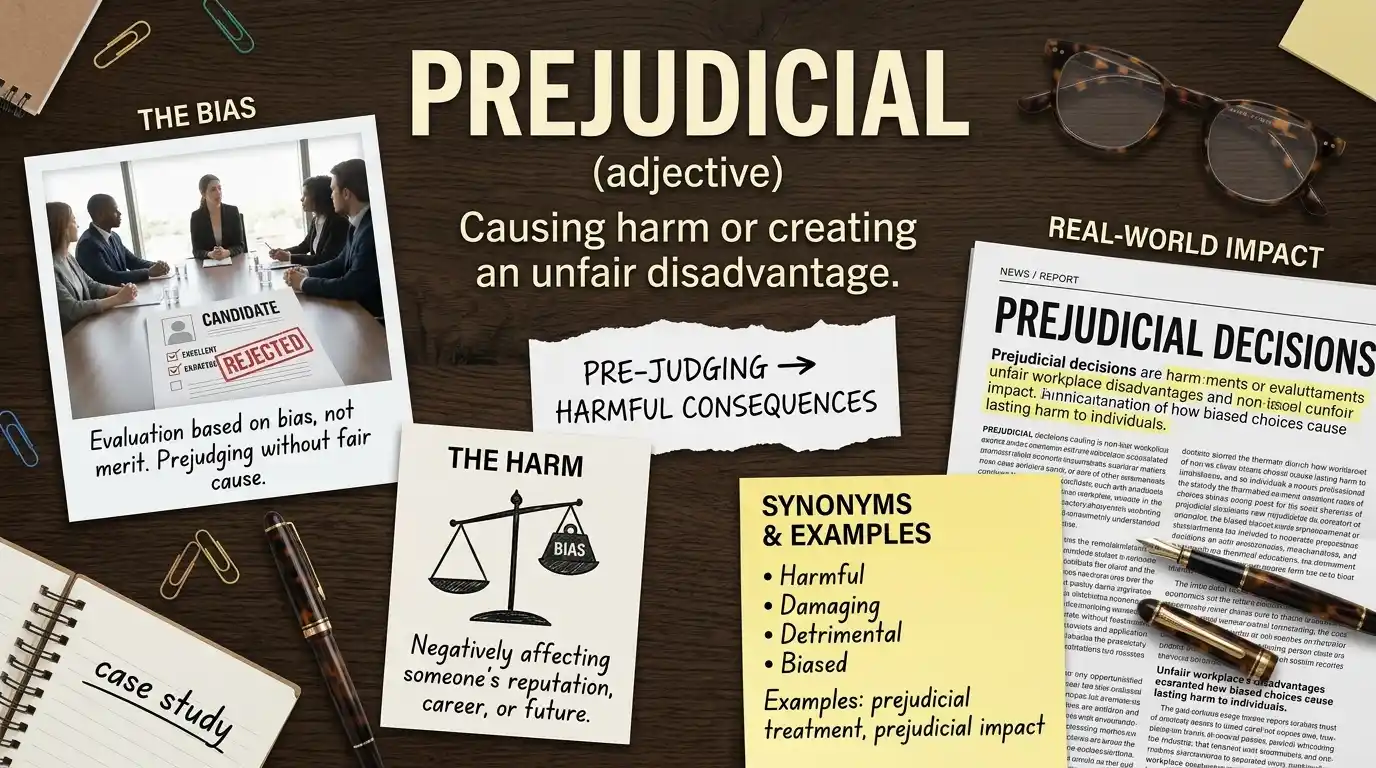
Synonyms of prejudicial include harmful, damaging, detrimental, disadvantageous, biased, unfair, discriminatory, and adverse. These words describe actions, opinions, or conditions that cause harm, create disadvantages, or unfairly influence a person or situation.
Imagine a student being judged before a teacher reads their work. The judgment may be prejudicial because it creates an unfair disadvantage before the student gets a chance.
Learning the synonyms of prejudicial helps you explain unfair treatment, harmful decisions, and negative effects with greater accuracy. Each alternative carries a slightly different meaning.
The word prejudicial appears in legal documents, academic discussions, workplace policies, and everyday conversations. Understanding it helps students, bloggers, content writers, and English learners communicate clearly.
Using suitable synonyms also makes your writing more natural. Instead of repeating one word, you can select an alternative that expresses the exact meaning and tone you need.
What Does “Prejudicial” Really Mean?
Prejudicial is an adjective that describes something likely to cause harm, create a disadvantage, or unfairly influence someone’s judgment. It often refers to actions, statements, rules, or evidence that negatively affect a person or situation.
In simple English, something prejudicial is harmful or unfair in its effects.
For example, a prejudicial hiring policy might disadvantage qualified applicants because of their background. A prejudicial remark might influence other people’s opinions before they learn the facts.
Native English speakers commonly use this word in formal, legal, academic, and professional settings. It can describe actual harm or a risk of harm. The precise meaning depends on the context.
Part of Speech
Prejudicial — Adjective
The word describes a noun rather than an action.
- A prejudicial comment
- A prejudicial decision
- Prejudicial evidence
- A prejudicial policy
Connotative Meaning
(Connotation means the feelings, associations, or attitudes that a word suggests beyond its basic dictionary definition.)
- Positive tone: The word prejudicial rarely carries a positive connotation. However, identifying prejudicial behavior can support fairness and accountability.
- Negative tone: This is the usual tone. The word suggests harm, bias, unfair influence, or disadvantage.
- Neutral tone: In legal or academic analysis, it can function as a precise descriptive term without expressing personal anger.
Etymology of Prejudicial
The word prejudicial comes through French from Latin roots associated with prior judgment. It is related to prejudice, which refers to a judgment formed before all relevant facts are known.
The prefix pre- means “before,” while the Latin element judicium relates to judgment. Over time, prejudicial developed its modern sense of causing harm or producing an unfair disadvantage.
Historical Development
Old English period (450–1100): The modern word prejudicial was not established in Old English. English speakers used other vocabulary to express ideas about judgment, injury, and unfair treatment.
Middle English period (1100–1500): Following the Norman Conquest, French and Latin vocabulary influenced English legal and scholarly language. Words related to prejudice entered English through these linguistic influences.
Modern English period (1500–present): Prejudicial became established in formal English. It is now especially common in law, public policy, education, and discussions of discrimination or harmful effects.
Pronunciation (US and UK — IPA)
- US: /ˌprɛdʒ.əˈdɪʃ.əl/
- UK: /ˌprɛdʒ.ʊˈdɪʃ.əl/
Pronunciation may vary slightly by accent.
Syllables
prej-u-di-cial
Affixation Pattern
- Root: judic, associated with judgment
- Prefix: pre-, meaning “before,” inherited through the related word prejudice
- Suffix: -ial, forming an adjective
The word’s history helps explain its connection to prior judgment and its present-day meaning of causing harm or disadvantage.
Synonyms List
Not every synonym of prejudicial fits every sentence. Some emphasize harm, while others focus on unfairness, bias, or negative consequences. The following alternatives are useful in everyday English, academic writing, professional communication, and formal discussions.
1. Harmful (Adjective) — US / UK: /ˈhɑːrm.fəl/ / /ˈhɑːm.fəl/
Meaning: Causing damage, injury, or a negative effect on someone or something.
Tone/Register: Neutral; everyday and professional.
Example:
Spreading false rumors can be harmful to someone’s reputation.
Too much screen time may have harmful effects on sleep.
2. Damaging (Adjective) — US / UK: /ˈdæm.ɪ.dʒɪŋ/ / /ˈdæm.ɪ.dʒɪŋ/
Meaning: Causing harm to a person’s reputation, confidence, relationships, or interests.
Tone/Register: Neutral to formal.
Example:
The false accusation was damaging to her career.
A careless comment can be damaging to a friendship.
3. Detrimental (Adjective) — US / UK: /ˌdɛt.rəˈmɛn.təl/ / /ˌdɛt.rɪˈmɛn.təl/
Meaning: Having an unfavorable effect on progress, health, success, or well-being.
Tone/Register: Formal; academic and professional.
Example:
Poor communication can be detrimental to teamwork.
Skipping regular practice may be detrimental to your progress.
4. Disadvantageous (Adjective) — US / UK: /ˌdɪs.æd.vænˈteɪ.dʒəs/ / /ˌdɪs.æd.vɑːnˈtɪdʒəs/
Meaning: Creating a situation in which someone has fewer opportunities or a weaker position.
Tone/Register: Formal; business and academic.
Example:
The new schedule was disadvantageous to employees with long commutes.
Accepting the offer without reviewing the terms could be disadvantageous.
5. Adverse (Adjective) — US / UK: /ˈæd.vɝːs/ / /ˈæd.vɜːs/
Meaning: Unfavorable or harmful in its effects or consequences.
Tone/Register: Formal; legal, medical, and professional.
Example:
The policy had adverse effects on small businesses.
Bad weather created adverse conditions for the outdoor event.
6. Unfavorable (Adjective) — US / UK: /ʌnˈfeɪ.vɚ.ə.bəl/ / /ʌnˈfeɪ.vər.ə.bəl/
Meaning: Not helpful, supportive, or likely to produce a good result.
Tone/Register: Neutral to formal.
Example:
The report presented an unfavorable view of the proposal.
Unfavorable conditions delayed the construction project.
7. Injurious (Adjective) — US / UK: /ɪnˈdʒʊr.i.əs/ / /ɪnˈdʒʊə.ri.əs/
Meaning: Causing physical, emotional, or reputational injury.
Tone/Register: Formal; legal and academic.
Example:
The court considered whether the statement was injurious to his reputation.
Repeated insults can be injurious to a child’s confidence.
8. Detracting (Adjective) — US / UK: /dɪˈtræk.tɪŋ/ / /dɪˈtræk.tɪŋ/
Meaning: Reducing the value, quality, or positive effect of something.
Tone/Register: Formal; analytical.
Example:
The distracting background music was detracting from the presentation.
Several errors were detracting from the report’s credibility.
9. Prejudiced (Adjective) — US / UK: /ˈprɛdʒ.ə.dɪst/ / /ˈprɛdʒ.ə.dɪst/
Meaning: Showing an opinion or attitude formed without fair consideration of the facts.
Tone/Register: Neutral to formal; often critical.
Example:
The interviewer seemed prejudiced against candidates from smaller colleges.
A prejudiced assumption can prevent people from understanding one another.
10. Biased (Adjective) — US / UK: /ˈbaɪ.əst/ / /ˈbaɪ.əst/
Meaning: Favoring one person, group, or viewpoint unfairly over another.
Tone/Register: Neutral; widely used in everyday and professional English.
Example:
The article seemed biased because it included only one side of the debate.
A biased selection process can exclude qualified applicants.
11. Unfair (Adjective) — US / UK: /ʌnˈfɛr/ / /ʌnˈfeə/
Meaning: Not treating people reasonably, equally, or according to accepted standards of justice.
Tone/Register: Informal to formal; very common.
Example:
It is unfair to blame one student for the whole group’s mistake.
The unfair rule gave some employees fewer opportunities.
12. Discriminatory (Adjective) — US / UK: /dɪˈskrɪm.ə.nə.tɔːr.i/ / /dɪˈskrɪm.ɪ.nə.tri/
Meaning: Treating people unfairly because of characteristics such as race, sex, disability, religion, or age.
Tone/Register: Formal; legal, social, and professional.
Example:
The company reviewed its policy after employees raised concerns about discriminatory treatment.
A discriminatory rule can limit access to education or employment.
13. Hurtful (Adjective) — US / UK: /ˈhɝːt.fəl/ / /ˈhɜːt.fəl/
Meaning: Causing emotional pain, offense, or distress.
Tone/Register: Everyday; personal and conversational.
Example:
Her hurtful remark made the discussion more difficult.
Try to explain your disagreement without using hurtful language.
14. Offensive (Adjective) — US / UK: /əˈfɛn.sɪv/ / /əˈfɛn.sɪv/
Meaning: Causing anger, upset, or insult because something is disrespectful or unacceptable.
Tone/Register: Neutral to formal.
Example:
The advertisement was criticized for its offensive stereotypes.
He apologized after realizing that his joke was offensive.
15. Damagingly Biased (Adjectival Phrase) — US / UK: /ˈdæm.ɪ.dʒɪŋ.li ˈbaɪ.əst/
Meaning: Describes a viewpoint or action that combines unfair bias with harmful consequences.
Tone/Register: Analytical; formal writing.
Example:
The report was damagingly biased against the smaller communities.
A damagingly biased review can mislead readers about a product’s quality.
16. Disadvantaging (Adjective/Participle) — US / UK: /ˌdɪs.ədˈvæn.tɪ.dʒɪŋ/ / /ˌdɪs.ədˈvɑːn.tɪ.dʒɪŋ/
Meaning: Placing a person or group in a less favorable position.
Tone/Register: Formal; policy and social analysis.
Example:
The revised timetable was disadvantaging students who relied on public transport.
An inaccessible application process may be disadvantaging some candidates.
17. Prejudicially Influential (Adjectival Phrase) — US / UK: /ˌprɛdʒ.əˈdɪʃ.əl.i ˌɪn.fluˈɛn.ʃəl/
Meaning: Having an unfair influence on a judgment, decision, or outcome.
Tone/Register: Highly formal; legal or analytical.
Example:
The lawyer argued that the remark was prejudicially influential during the trial.
The committee examined whether the statement had been prejudicially influential.
18. Impartiality-Undermining (Adjectival Phrase) — US / UK: /ɪmˌpɑːr.ʃiˈæl.ə.ti ʌnˌdɚˈmaɪ.nɪŋ/
Meaning: Describing something that weakens a person’s ability to make a fair, unbiased judgment.
Tone/Register: Formal; analytical.
Example:
The undisclosed relationship was impartiality-undermining for the review panel.
An impartiality-undermining comment raised concerns about the investigation.
19. One-Sided (Adjective) — US / UK: /ˌwʌnˈsaɪ.dɪd/ / /ˌwʌnˈsaɪ.dɪd/
Meaning: Presenting only one viewpoint in a way that may lead to an unfair impression.
Tone/Register: Neutral; conversational and journalistic.
Example:
The documentary offered a one-sided account of the disagreement.
A one-sided argument may overlook important evidence.
20. Partial (Adjective) — US / UK: /ˈpɑːr.ʃəl/ / /ˈpɑː.ʃəl/
Meaning: Favoring one person or side instead of judging all sides fairly.
Tone/Register: Formal to neutral.
Example:
The referee appeared partial toward the home team.
A partial assessment may fail to recognize the other candidate’s strengths.
21. Prepossessing (Adjective) — US / UK: /ˌpriː.pəˈzɛs.ɪŋ/ / /ˌpriː.pəˈzɛs.ɪŋ/
Meaning: Usually means attractive or appealing at first sight, so it is not a true synonym of prejudicial; it is included here as a contrast to prevent confusion.
Tone/Register: Literary; formal.
Example:
The building had a prepossessing entrance and elegant windows.
Her friendly expression made a prepossessing first impression.
22. Unjust (Adjective) — US / UK: /ʌnˈdʒʌst/ / /ʌnˈdʒʌst/
Meaning: Contrary to fairness, justice, or reasonable treatment.
Tone/Register: Neutral to formal.
Example:
The workers challenged the unjust decision.
An unjust policy can damage trust in an organization.
23. Inequitable (Adjective) — US / UK: /ɪnˈɛk.wɪ.tə.bəl/ / /ɪnˈɛk.wɪ.tə.bəl/
Meaning: Not fair or equal in the distribution of opportunities, resources, or treatment.
Tone/Register: Formal; academic and policy writing.
Example:
The study identified inequitable access to health services.
An inequitable grading system can disadvantage some students.
24. Oppressive (Adjective) — US / UK: /əˈprɛs.ɪv/ / /əˈprɛs.ɪv/
Meaning: Unreasonably harsh or controlling in a way that restricts people’s freedom or well-being.
Tone/Register: Strongly negative; social and political discussion.
Example:
The employees spoke out against oppressive workplace rules.
The novel portrays life under an oppressive regime.
25. Repressive (Adjective) — US / UK: /rɪˈprɛs.ɪv/ / /rɪˈprɛs.ɪv/
Meaning: Restricting freedom or expression, often through strict control or punishment.
Tone/Register: Formal; political and social.
Example:
The report described repressive measures against peaceful protesters.
A repressive school environment may discourage students from asking questions.
26. Prejudging (Verb/Gerund) — US / UK: /ˌpriːˈdʒʌdʒ.ɪŋ/ / /ˌpriːˈdʒʌdʒ.ɪŋ/
Meaning: Forming an opinion about someone or something before considering sufficient evidence.
Tone/Register: Neutral; everyday and professional.
Example:
Prejudging the applicant could prevent the manager from recognizing genuine talent.
Try not to prejudge the film before watching it.
27. Inimical (Adjective) — US / UK: /ɪˈnɪm.ɪ.kəl/ / /ɪˈnɪm.ɪ.kəl/
Meaning: Harmful or hostile to a person, interest, or goal.
Tone/Register: Formal; literary and academic.
Example:
Constant interruptions are inimical to productive discussion.
The policy was considered inimical to the interests of small businesses.
28. Unwholesome (Adjective) — US / UK: /ʌnˈhoʊl.səm/ / /ʌnˈhəʊl.səm/
Meaning: Harmful to moral, emotional, or physical well-being.
Tone/Register: Neutral to formal; sometimes old-fashioned.
Example:
The article warned about the unwholesome effects of persistent online harassment.
The coach discouraged an unwholesome team culture built around humiliation.
29. Deleterious (Adjective) — US / UK: /ˌdɛl.əˈtɪr.i.əs/ / /ˌdɛl.ɪˈtɪə.ri.əs/
Meaning: Causing gradual or serious harm, especially to health, an environment, or a system.
Tone/Register: Formal; scientific and academic.
Example:
Researchers examined the deleterious effects of prolonged sleep deprivation.
The report discussed deleterious changes in the local environment.
30. Pernicious (Adjective) — US / UK: /pɚˈnɪʃ.əs/ / /pəˈnɪʃ.əs/
Meaning: Causing serious harm in a gradual, subtle, or difficult-to-detect way.
Tone/Register: Formal; strongly negative.
Example:
The teacher warned that pernicious rumors could divide the class.
A pernicious stereotype can shape decisions without people noticing.
31. Prejudicially Harmful (Adjectival Phrase) — US / UK: /ˌprɛdʒ.əˈdɪʃ.əl.i ˈhɑːrm.fəl/
Meaning: Describes an effect that is both harmful and connected to unfair prejudice or disadvantage.
Tone/Register: Formal; analytical.
Example:
The panel reviewed whether the comments were prejudicially harmful to the applicant.
The organization revised language that could be prejudicially harmful to vulnerable groups.
32. Hostile (Adjective) — US / UK: /ˈhɑː.stəl/ / /ˈhɒs.taɪl/
Meaning: Showing opposition, aggression, or an unfriendly attitude toward someone.
Tone/Register: Neutral to formal; often strongly negative.
Example:
The candidate faced a hostile interview panel.
A hostile response made it harder to resolve the disagreement.
33. Antagonistic (Adjective) — US / UK: /ænˌtæɡ.əˈnɪs.tɪk/ / /ænˌtæɡ.əˈnɪs.tɪk/
Meaning: Actively opposing someone or something in a way that creates conflict.
Tone/Register: Formal; interpersonal and professional.
Example:
His antagonistic attitude prevented the team from reaching an agreement.
The discussion became antagonistic after personal accusations began.
34. Corrosive (Adjective) — US / UK: /kəˈroʊ.sɪv/ / /kəˈrəʊ.sɪv/
Meaning: Gradually damaging trust, relationships, values, or an institution.
Tone/Register: Figurative; analytical and formal.
Example:
Constant dishonesty can have a corrosive effect on workplace trust.
The writer explored the corrosive influence of public humiliation.
35. Erosive (Adjective) — US / UK: /ɪˈroʊ.sɪv/ / /ɪˈrəʊ.sɪv/
Meaning: Gradually weakening something, such as confidence, authority, or public trust.
Tone/Register: Formal; analytical.
Example:
Repeated broken promises had an erosive effect on public confidence.
The manager recognized the erosive impact of ongoing favoritism.
36. Unbeneficial (Adjective) — US / UK: /ˌʌnˌbɛn.əˈfɪʃ.əl/ / /ˌʌnˌbɛn.əˈfɪʃ.əl/
Meaning: Not providing a benefit or positive result.
Tone/Register: Neutral; less common than harmful or unhelpful.
Example:
The team stopped using an unbeneficial review process.
The extra restriction proved unbeneficial to student learning.
37. Counterproductive (Adjective) — US / UK: /ˌkaʊn.tɚ.prəˈdʌk.tɪv/ / /ˌkaʊn.tə.prəˈdʌk.tɪv/
Meaning: Producing the opposite of the intended result.
Tone/Register: Neutral to formal; workplace and academic.
Example:
Publicly shaming employees can be counterproductive.
The strict rule became counterproductive because students stopped asking for help.
38. Preclusive (Adjective) — US / UK: /prɪˈkluː.sɪv/ / /prɪˈkluː.sɪv/
Meaning: Preventing something from happening or making an action or outcome impossible.
Tone/Register: Formal; legal and technical.
Example:
The deadline created a preclusive barrier for applicants who needed extra time.
The contract contained a preclusive condition that limited further claims.
Usage note: Preclusive is not a general synonym for prejudicial. It fits only when the intended meaning involves prevention or exclusion.
39. Unfounded (Adjective) — US / UK: /ʌnˈfaʊn.dɪd/ / /ʌnˈfaʊn.dɪd/
Meaning: Not supported by adequate facts or evidence, potentially creating an unfair impression.
Tone/Register: Neutral to formal; journalism and professional writing.
Example:
The unfounded accusation harmed the employee’s reputation.
The committee rejected an unfounded claim about the candidate.
40. Misleading (Adjective) — US / UK: /ˌmɪsˈliː.dɪŋ/ / /ˌmɪsˈliː.dɪŋ/
Meaning: Giving an inaccurate impression that may cause people to misunderstand the facts or make poor judgments.
Tone/Register: Neutral to formal; everyday, academic, and media.
Example:
The headline was misleading because it left out important details.
A misleading comparison can influence readers unfairly.
Important vocabulary note: Some entries above are phrases or context-specific alternatives rather than exact synonyms. In most everyday sentences, harmful, damaging, detrimental, biased, unfair, and disadvantageous are safer choices. Words such as prepossessing and preclusive should not replace prejudicial without a specific contextual reason.
Synonyms of Prejudicial by Tone
Choosing a synonym depends on the message you want to communicate. A word that works in a legal report may sound too formal in a casual conversation.
Positive or Constructive Framing
Prejudicial itself is usually negative. However, you can describe efforts to reduce prejudice using words that emphasize fairness.
- Fair-minded: Willing to consider different viewpoints fairly.
- Impartial: Not favoring one side over another.
- Equitable: Fair in the way people receive opportunities and resources.
- Unbiased: Free from unfair preferences or assumptions.
These are not direct synonyms of prejudicial. They are useful opposites when discussing how to prevent prejudicial decisions.
Neutral Synonyms
- Adverse: Suitable for describing unfavorable outcomes.
- Harmful: A clear, everyday word for something that causes damage.
- Detrimental: Useful in academic and professional writing.
- Disadvantageous: Appropriate when someone faces an unfair or unfavorable position.
- Damaging: Effective when discussing reputations, relationships, or results.
- Unfavorable: Suitable for describing circumstances or conditions.
Negative Synonyms
- Biased: Emphasizes unfair preference.
- Discriminatory: Highlights unequal treatment based on personal characteristics.
- Unjust: Focuses on a lack of fairness.
- Injurious: Emphasizes harm or injury.
- Pernicious: Suggests subtle or gradually developing harm.
- Oppressive: Describes harsh control or restrictions.
- Hostile: Emphasizes aggression or opposition.
Playful or Informal Alternatives
There are few genuinely playful synonyms for prejudicial. In casual English, speakers often use simpler expressions instead.
- Not fair: Common when someone believes a decision is unreasonable.
- Bad for: A conversational way to describe negative effects.
- Stacked against: An idiom suggesting that circumstances favor one side.
- Working against: Useful for describing a disadvantage or obstacle.
Example: “The selection process seemed stacked against new applicants.”
Why Tone Matters in Word Choice
Tone helps readers understand whether you are describing harm, condemning unfair treatment, or making a neutral observation. Biased identifies favoritism, detrimental emphasizes negative effects, and discriminatory specifically concerns unequal treatment.
Selecting the right word makes your argument more accurate and credible.
“Prejudicial” vs. Close Alternatives
The following words are related, but they are not interchangeable in every situation.
Prejudicial vs. Harmful
Prejudicial often suggests that something creates a disadvantage or unfairly influences judgment. Harmful is broader and can describe any negative effect.
Use prejudicial when fairness or an unfavorable influence matters. Use harmful when the main concern is damage.
Examples:
- The comment was prejudicial because it could influence the jury unfairly.
- Excessive noise can be harmful to sleep.
Prejudicial vs. Biased
Biased describes a preference or viewpoint that favors one side. Prejudicial describes something that causes harm or unfair disadvantage, often because of bias.
A person can hold a biased opinion, while a prejudicial policy may turn unfair assumptions into harmful consequences.
Examples:
- The reviewer was biased toward familiar brands.
- The prejudicial policy limited opportunities for qualified applicants.
Prejudicial vs. Detrimental
Detrimental focuses on negative effects. Prejudicial can also emphasize unfair influence or disadvantage.
Use detrimental when discussing performance, health, progress, or well-being. Choose prejudicial when the issue involves unfair treatment, judgment, or harm to someone’s interests.
Examples:
- Poor planning is detrimental to productivity.
- The unsupported allegation was prejudicial to the defendant’s case.
How Prejudicial Changes by Context
Daily Conversation
In everyday English, people often choose simple alternatives such as unfair, harmful, or biased. These words are easier to understand and sound natural in informal discussions.
For example, you might say, “That rule is unfair to new students,” instead of “That rule is prejudicial to new students.”
Writing and Blogging
Bloggers and content writers can use prejudicial when discussing discrimination, stereotypes, misinformation, or unfair decisions. The word is useful when the article needs a precise and serious tone.
However, avoid repeating it in every paragraph. Alternate with accurate terms such as biased, damaging, or disadvantageous when the meaning supports them.
Professional and Academic Writing
In academic papers, legal discussions, and workplace reports, prejudicial, detrimental, adverse, and inequitable can communicate specific ideas.
Choose the term that matches your evidence. For example, a report about unequal access may use inequitable, while a study of negative health outcomes may use detrimental.
Creative and Informal Writing
Writers can use hurtful, hostile, unfair, or damaging to make dialogue sound more natural. These alternatives help communicate emotion without making every character sound overly formal.
For instance, a character might say, “You judged me before hearing my side.” This conveys a prejudicial attitude without using the word itself.
Common Mistakes Learners Make
Confusing Prejudicial With Prejudiced
Prejudicial usually describes something that causes harm or disadvantage. Prejudiced usually describes a person, attitude, or opinion shaped by unfair assumptions.
- Correct: The rule was prejudicial to part-time workers.
- Correct: The manager held prejudiced views about part-time workers.
Treating Every Negative Word as a Synonym
Words such as hostile, offensive, and counterproductive describe different problems. Hostility involves opposition, offensiveness involves causing insult, and counterproductive behavior produces an unwanted result.
Use these alternatives only when their meanings match the sentence.
Confusing Bias With Discrimination
Bias can refer to a preference or tendency. Discrimination involves unfair distinctions or treatment. A biased opinion does not automatically establish that discriminatory conduct occurred.
This difference is particularly important in legal, academic, and workplace writing.
Using Formal Words in Casual Conversation
Terms such as deleterious, inimical, and injurious may sound unnatural in ordinary conversation.
Instead of saying, “That habit is deleterious to my schedule,” say, “That habit is bad for my schedule,” or “That habit disrupts my schedule.”
Repeating the Same Synonym Too Often
Replacing every occurrence of prejudicial with harmful can make writing repetitive. It can also change the meaning if the sentence specifically concerns unfair judgment.
Use synonyms to add precision, not merely to increase word variety.
Register Notes: Formal vs. Informal English
Formal English: Prejudicial, detrimental, adverse, inequitable, and injurious can suit reports, essays, legal writing, and academic discussions.
Informal English: Unfair, hurtful, bad for, and damaging often work better in conversations, messages, and everyday explanations.
Spoken English: Prefer familiar words unless the situation requires a technical term.
Written English: Choose a precise synonym based on the subject, audience, and evidence. Formal language should improve clarity rather than make a sentence harder to understand.
For further vocabulary practice, you can connect this topic with an article about synonyms of bias on your vocabulary website.
Real-Life Mini Scenarios Using Prejudicial Language
Workplace Scenario
A manager rejects an applicant because of an unsupported assumption about their background. The decision may be prejudicial because it creates an unfair disadvantage.
A more precise description might be biased hiring or discriminatory treatment, depending on the facts.
Social Situation
Someone assumes that a new neighbor is unfriendly before speaking to them. That assumption may reflect prejudice and could lead to unfair treatment.
Here, prejudice describes the attitude, while unfair describes how the neighbor is treated.
Media and Pop Culture
A headline presents only negative details about one person while ignoring relevant evidence that changes the story. Readers might call the coverage one-sided or misleading.
If the presentation unfairly influences an important judgment, prejudicial may also be appropriate.
Writing and Storytelling
A novelist portrays a character who receives fewer opportunities because others judge them before learning the truth. The author can describe the treatment as prejudicial, unjust, or disadvantageous, depending on the scene.
Each word gives readers a slightly different understanding of the conflict.
External Reference for Further Learning
For a reliable dictionary definition, pronunciation, and usage guidance, consult the Cambridge Dictionary entry for prejudicial. Read the Cambridge Dictionary definition of prejudicial
Use a trusted dictionary to check unfamiliar alternatives before including them in formal writing. This is especially useful when the difference between two words affects the meaning of a sentence.
Practice Quiz
Test your understanding of prejudicial and its related vocabulary. Choose the word that best fits each situation.
Part One: Meaning and Everyday Usage
1. A company rule gives some qualified applicants fewer opportunities because of their background. Which word best describes the rule?
- A. Equitable
- B. Discriminatory
- C. Beneficial
- D. Impartial
2. Poor sleep negatively affects a student’s concentration. Which word fits best?
- A. Detrimental
- B. Unbiased
- C. Friendly
- D. Favorable
3. A reviewer praises only one brand and ignores its competitors. What describes the review?
- A. Impartial
- B. Equitable
- C. Biased
- D. Unfounded
4. Someone makes a cruel remark that upsets their friend. Which word is most suitable?
- A. Adverse
- B. Hurtful
- C. Inimical
- D. Inequitable
5. A newspaper headline leaves out key facts and gives readers the wrong impression. Which word fits best?
- A. Misleading
- B. Impartial
- C. Equitable
- D. Beneficial
6. A student believes an applicant is unqualified before reviewing their work. What is the student doing?
- A. Encouraging
- B. Supporting
- C. Prejudging
- D. Evaluating fairly
7. A policy distributes educational resources unfairly between schools. Which word is most appropriate?
- A. Inequitable
- B. Unbiased
- C. Favorable
- D. Helpful
Part Two: Context and Tone
8. Which word best fits a formal report about harmful effects on public health?
- A. Playful
- B. Deleterious
- C. Cheerful
- D. Attractive
9. A manager’s repeated dishonesty slowly destroys trust within the team. Which adjective fits best?
- A. Corrosive
- B. Equitable
- C. Prepossessing
- D. Impartial
10. A strict rule produces the opposite of what its creators intended. Which word describes the result?
- A. Detrimental
- B. Counterproductive
- C. Unbiased
- D. Favorable
11. A person treats both sides fairly when resolving a disagreement. Which word best describes that person?
- A. Hostile
- B. Partial
- C. Impartial
- D. Oppressive
12. A court considers whether a statement could unfairly influence a trial. Which word is most relevant?
- A. Prejudicial
- B. Prepossessing
- C. Playful
- D. Beneficial
13. A supervisor makes an unreasonable decision that violates basic fairness. Which word fits best?
- A. Unjust
- B. Unbiased
- C. Advantageous
- D. Favorable
14. A policy places workers in a weaker position than their colleagues. Which word best describes this effect?
- A. Disadvantageous
- B. Appealing
- C. Impartial
- D. Beneficial
15. A person accuses without evidence, harming another person’s reputation. Which word describes the accusation?
- A. Equitable
- B. Unfounded
- C. Impartial
- D. Favorable
Reflection Task
Write one sentence using prejudicial, detrimental, biased, or unfair. Describe a realistic situation and explain why your chosen word fits.
Answer Key
1. B 2. A 3. C 4. B 5. A 6. C 7. A 8. B 9. A 10. B 11. C 12. A 13. A 14. A 15. B
FAQs
1. What is the difference between prejudicial and prejudice?
Prejudice is a noun that refers to an opinion or judgment formed without fair consideration of the facts. Prejudicial is an adjective describing something that causes harm, creates a disadvantage, or unfairly influences a judgment. For example, prejudice may influence a manager’s thinking, while a prejudicial decision may result in an applicant losing a fair opportunity.
2. Can prejudicial be used in a legal sentence?
Yes. Prejudicial is frequently used in legal discussions to describe evidence, statements, or conduct that may unfairly affect a legal proceeding or someone’s interests. For example, a lawyer might argue that a remark could unfairly influence a jury. Its precise legal significance depends on the jurisdiction, procedural rules, and circumstances of the case.
3. What is the opposite of prejudicial?
The best opposite depends on the context. Fair, impartial, unbiased, and equitable can describe the absence of unfair treatment or influence. For example, an impartial review considers relevant evidence without favoring one side. When discussing effects rather than fairness, beneficial or helpful may provide a suitable contrast to harmful consequences.
4. Is prejudicial the same as discriminatory?
No. The words are related, but they have different meanings. Prejudicial describes something that causes harm, disadvantage, or unfair influence. Discriminatory specifically describes unfair distinctions or treatment, often based on personal characteristics. A discriminatory policy may also be prejudicial, but the two words emphasize different aspects of the situation.
5. What are the best synonyms of prejudicial for academic writing?
Detrimental, adverse, inequitable, harmful, and disadvantageous are useful choices in academic writing. Select a word that accurately describes your evidence. Use detrimental for negative effects, inequitable for unfair distribution, and disadvantageous for an unfavorable position. Avoid choosing a formal word simply because it sounds more sophisticated.
6. How can I use prejudicial in a sentence correctly?
Use prejudicial before a noun or after a linking verb when describing something that causes harm or unfair disadvantage. For example, “The policy was prejudicial to applicants with disabilities.” You can also write, “The lawyer challenged the prejudicial statement.” Make sure the context involves harmful effects or unfair influence rather than merely expressing dislike.
7. Is prejudicial always a negative word?
Yes, prejudicial generally has a negative meaning because it describes harm, disadvantage, or unfair influence. However, using the word to identify a problem can support a constructive discussion about fairness. For example, identifying prejudicial language in a policy can help an organization review its practices and improve equal treatment.
Conclusion
Learning synonyms for prejudicial helps you express unfairness, harm, and negative influence more accurately. The right word makes your message clearer and more meaningful.
Words such as harmful, biased, detrimental, and discriminatory carry different shades of meaning. Understanding these differences helps you choose vocabulary that suits your purpose.
For students, bloggers, and everyday English users, practicing synonyms improves essays, articles, emails, conversations, and critical thinking. It also helps you explain complex situations in simple language.
Start by using one new synonym in an email, essay, or daily conversation today. Practice regularly, compare meanings, and build a vocabulary that makes your English more confident and precise.

Mehtab Yasir is a passionate writer and English language enthusiast dedicated to making vocabulary learning simple, practical, and enjoyable. As an author at SynonymDesk.com, she creates helpful content covering synonyms, antonyms, word meanings, vocabulary, phrases, and everyday English usage. Her goal is to provide clear and easy-to-understand information that helps students, writers, professionals, and English learners choose the right words and communicate with greater confidence. Mehtab believes that a strong vocabulary can improve both writing and communication skills. She enjoys researching new words, exploring their meanings and uses, and turning complex language concepts into useful, reader-friendly content. Through her work, she strives to make SynonymDesk.com a reliable resource for anyone looking to improve their English vocabulary and language skills.