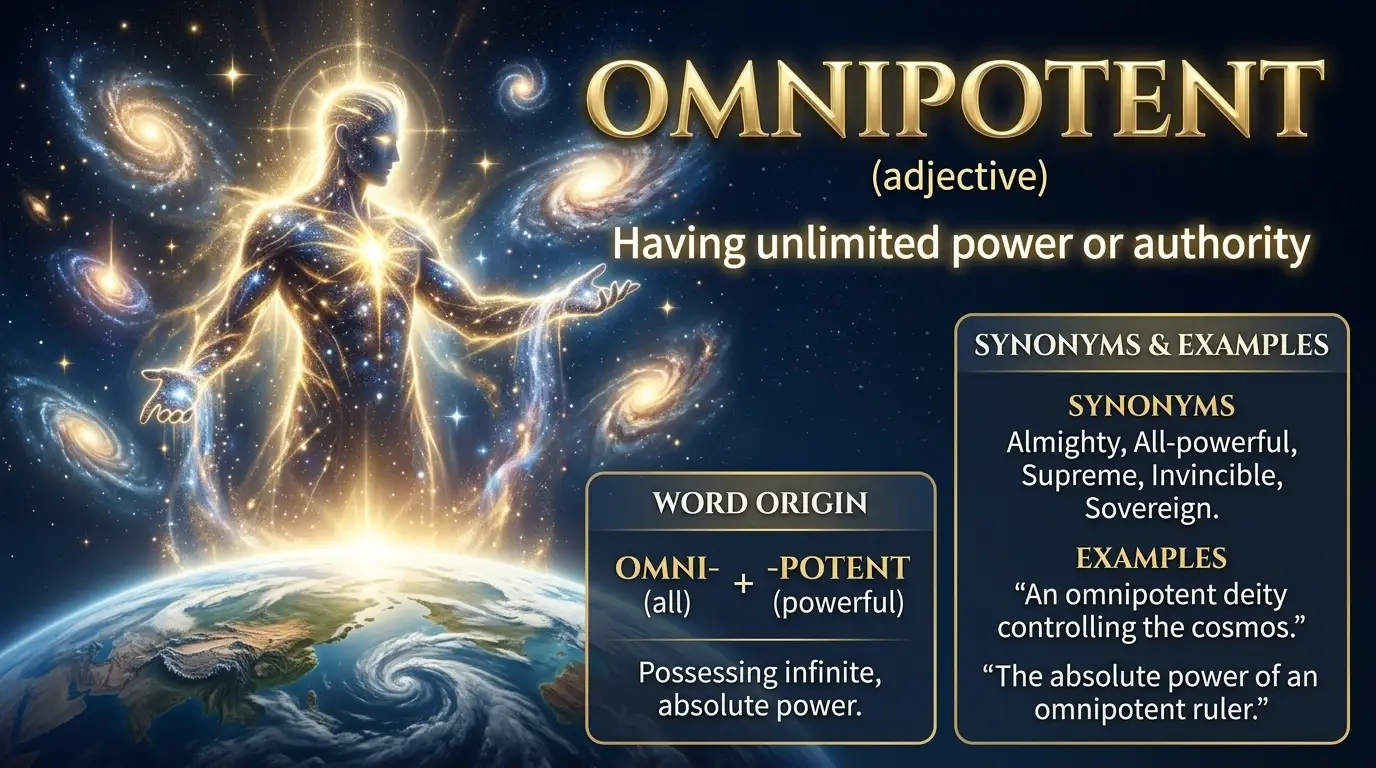
Synonyms of omnipotent describe words that express unlimited power, supreme authority, or the ability to do anything. Common alternatives include all-powerful, almighty, supreme, invincible, and omnipotent. The best choice depends on whether you are describing a deity, a powerful leader, or someone with extraordinary abilities.
Imagine reading a story about a character who can control time, change reality, and overcome every obstacle. Calling that character all-powerful communicates the idea immediately. However, words such as almighty or supreme can create different impressions.
Learning synonyms helps you express ideas with greater accuracy. Students can improve essays, bloggers can create engaging content, and writers can avoid repeating the same vocabulary.
The word omnipotent appears in religious discussions, philosophy, literature, and conversations about authority. Understanding its alternatives helps daily English users choose words that fit their message and audience.
What Does “Omnipotent” Really Mean?
Omnipotent is an adjective that means having unlimited power or the ability to do anything. It is most commonly associated with God in religious and philosophical discussions, but it can also describe fictional beings or seemingly absolute authority.
For example, a writer might describe a fictional character as omnipotent because the character can change the laws of nature. In everyday conversation, someone might use the word humorously to describe a person who seems to control every decision.
Native English speakers generally understand omnipotent as a strong, formal word. It suggests power without meaningful limits rather than simply being strong, influential, or successful.
Part of Speech
Adjective: Omnipotent describes a person, being, character, or imagined force that possesses unlimited power.
Example: The novel features an omnipotent being who can create entire worlds.
Simple Definition
Omnipotent means all-powerful or capable of doing anything.
Connotative Meaning
(Connotation is the emotional or cultural association that a word carries beyond its basic dictionary meaning.)
Positive tone: The word can suggest greatness, protection, extraordinary ability, or divine power.
Negative tone: It can suggest excessive control, unchecked authority, or a frightening lack of limits.
Neutral tone: In philosophy or literary analysis, it can simply describe the concept of unlimited power without expressing approval or criticism.
Etymology of Omnipotent
The word omnipotent comes through Middle French and Latin, ultimately combining two Latin elements: omni-, meaning “all,” and potens, meaning “powerful” or “able.”
Its literal sense is therefore “all-powerful.”
Old English Period (450–1100)
The modern English word omnipotent was not established in Old English. However, English religious writing already expressed the idea of almighty power through native words and Latin-derived religious vocabulary.
Middle English Period (1100–1500)
During the Middle English period, Latin and French influenced English religious and scholarly language. Terms associated with divine power became increasingly familiar through theological writing and religious teaching.
Modern English Period (1500–Present)
Omnipotent became established in religious, philosophical, and literary English. Today, it also appears in discussions of fictional superheroes, absolute authority, artificial intelligence, and hypothetical powers.
Pronunciation of Omnipotent
- US IPA: /ɑːmˈnɪpətənt/
- UK IPA: /ɒmˈnɪpətənt/
Pronunciation can vary slightly by accent.
Syllables
om-nip-o-tent
The word has four syllables.
Affixation Pattern of Omnipotent
Root: potent, meaning powerful or capable.
Prefix: omni-, meaning all or every.
Suffix: There is no productive suffix added to omnipotent in its modern structure. The ending -ent is part of the inherited Latin-derived word form.
45 Synonyms of Omnipotent With Meanings and Examples
The following words and expressions describe unlimited power, supreme authority, or closely related forms of extraordinary power. Some are direct alternatives, while others work only in specific contexts. Choose the word that matches your intended meaning.
1. All-Powerful (Adjective) — US / UK: /ˌɔːl ˈpaʊərfəl/
Meaning: Having unlimited power or the ability to do anything.
Tone/Register: Neutral, religious, everyday.
Example: The story features an all-powerful creator.
The hero believes the ancient being is all-powerful.
2. Almighty (Adjective) — US / UK: /ɔːlˈmaɪti/
Meaning: Possessing supreme or unlimited power, especially in religious contexts.
Tone/Register: Religious, formal, emphatic.
Example: The prayer begins with a reference to the Almighty.
The poem describes an almighty force watching over humanity.
3. Omnific (Adjective) — US / UK: /ɑːmˈnɪfɪk/
Meaning: Having the power to create everything; this is a rare, specialized alternative rather than a general synonym.
Tone/Register: Literary, philosophical, rare.
Example: The poet imagined an omnific force behind creation.
The fantasy novel describes an omnific intelligence shaping new worlds.
4. Supreme (Adjective) — US / UK: /suːˈpriːm/
Meaning: Having the highest rank, authority, or degree of power.
Tone/Register: Formal, academic, professional.
Example: The council held supreme authority over the kingdom.
The story follows a ruler seeking supreme control.
5. Absolute (Adjective) — US / UK: /ˈæbsəluːt/
Meaning: Complete and unrestricted, particularly when describing authority or control.
Tone/Register: Formal, political, philosophical.
Example: The king demanded absolute obedience.
The debate examined the dangers of absolute power.
6. Omnipresent (Adjective) — US / UK: /ˌɑːmnɪˈprezənt/
Meaning: Present everywhere at once; related to traditional descriptions of divine attributes, but not a synonym for unlimited power.
Tone/Register: Formal, religious, academic.
Example: The novel portrays the spirit as omnipresent.
Digital technology can feel omnipresent in modern life.
7. Infinite (Adjective) — US / UK: /ˈɪnfɪnət/
Meaning: Having no limit or end; suitable for describing power only when the emphasis is on its limitless extent.
Tone/Register: Academic, philosophical, literary.
Example: The myth gives the creator infinite power.
The character believes the universe contains infinite possibilities.
8. Limitless (Adjective) — US / UK: /ˈlɪmətləs/
Meaning: Having no apparent boundaries or restrictions.
Tone/Register: Neutral, inspirational, descriptive.
Example: The fictional machine seems to have limitless power.
Her imagination feels limitless when she writes.
9. Boundless (Adjective) — US / UK: /ˈbaʊndləs/
Meaning: Having no obvious limits; often used for energy, potential, or influence rather than literal omnipotence.
Tone/Register: Literary, positive, descriptive.
Example: The legend celebrates a being with boundless strength.
The young inventor has boundless curiosity.
10. Unlimited (Adjective) — US / UK: /ʌnˈlɪmətɪd/
Meaning: Not restricted in amount, range, or extent.
Tone/Register: Neutral, practical, formal.
Example: The fantasy character possesses unlimited magical energy.
The position gave her unlimited authority over the project.
11. Omniscient (Adjective) — US / UK: /ɑːmˈnɪʃənt/
Meaning: Knowing everything; associated with divine qualities but referring to knowledge rather than power.
Tone/Register: Literary, religious, academic.
Example: The novel uses an omniscient narrator.
The story presents the deity as both omniscient and omnipotent.
12. Invincible (Adjective) — US / UK: /ɪnˈvɪnsəbəl/
Meaning: Impossible or extremely difficult to defeat.
Tone/Register: Neutral, dramatic, informal.
Example: The hero appears invincible during battle.
The champion seemed invincible after ten consecutive wins.
13. All-Mighty (Adjective) — US / UK: /ˌɔːl ˈmaɪti/
Meaning: An alternative spelling of almighty, generally less conventional than the standard one-word form.
Tone/Register: Religious, emphatic.
Example: The old hymn praises the all-mighty creator.
The writer used all-mighty to emphasize the character’s divine strength.
14. Omnipotent-Like (Adjective) — US / UK: /ˌɑːmˈnɪpətənt laɪk/
Meaning: Resembling something with unlimited power without necessarily possessing it.
Tone/Register: Informal, analytical.
Example: The fictional system seems omnipotent-like to its users.
The villain’s influence gives him an almost omnipotent-like presence.
15. Potent (Adjective) — US / UK: /ˈpoʊtənt/; UK /ˈpəʊtənt/
Meaning: Having strong power or influence, although not necessarily unlimited power.
Tone/Register: Formal, scientific, descriptive.
Example: The story introduces a potent magical force.
Her speech became a potent symbol of resistance.
16. Powerful (Adjective) — US / UK: /ˈpaʊərfəl/
Meaning: Having great strength, influence, or authority.
Tone/Register: Neutral, professional, everyday.
Example: The novel features a powerful ruler.
She delivered a powerful argument in the debate.
17. Mighty (Adjective) — US / UK: /ˈmaɪti/
Meaning: Possessing great strength or power, often with a grand or heroic tone.
Tone/Register: Literary, dramatic, conversational.
Example: The mighty guardian protected the ancient city.
The tale describes a mighty force rising from the sea.
18. Sovereign (Adjective) — US / UK: /ˈsɑːvrən/; UK /ˈsɒvrɪn/
Meaning: Possessing supreme authority within a state or domain, not necessarily unlimited ability.
Tone/Register: Political, legal, formal.
Example: The sovereign ruler controlled the kingdom’s laws.
The constitution defines the limits of sovereign authority.
19. Omnipotent in Power (Phrase) — US / UK: varies by accent
Meaning: An emphatic phrase describing someone or something as having seemingly unlimited power.
Tone/Register: Formal, rhetorical.
Example: The epic portrays the deity as omnipotent in power.
The author depicts the machine as omnipotent in power, though its limits remain unclear.
20. All-Controlling (Adjective) — US / UK: varies by accent
Meaning: Exercising control over every part of a situation.
Tone/Register: Neutral, critical, descriptive.
Example: The story describes an all-controlling ruler.
An all-controlling system leaves little room for personal choice.
21. Unconstrained (Adjective) — US / UK: /ˌʌnkənˈstreɪnd/
Meaning: Free from restrictions or limitations.
Tone/Register: Formal, academic, professional.
Example: The fictional entity acts with unconstrained power.
The report warns against unconstrained executive authority.
22. Unrestricted (Adjective) — US / UK: /ˌʌnrɪˈstrɪktɪd/
Meaning: Not limited by rules, conditions, or boundaries.
Tone/Register: Formal, legal, neutral.
Example: The villain seeks unrestricted control.
The committee questioned the risks of unrestricted authority.
23. Unbounded (Adjective) — US / UK: /ʌnˈbaʊndɪd/
Meaning: Not confined by limits; often used in philosophical or literary descriptions.
Tone/Register: Formal, literary, academic.
Example: The poem imagines an unbounded cosmic force.
The character’s ambition appears unbounded.
24. All-Prevailing (Adjective) — US / UK: varies by accent
Meaning: Dominating or extending throughout a situation; it describes pervasive influence rather than literal unlimited power.
Tone/Register: Formal, literary.
Example: The story depicts an all-prevailing force of darkness.
The ruler’s all-prevailing influence shapes every decision.
25. Omnipotent Ruler (Noun Phrase) — US / UK: pronunciation varies
Meaning: A ruler portrayed as having unlimited power.
Tone/Register: Formal, historical, literary.
Example: The novel follows an omnipotent ruler who fears no rival.
The historian questioned whether any ruler could truly be omnipotent.
26. All-Powerful Being (Noun Phrase) — US / UK: pronunciation varies
Meaning: A being believed to possess unlimited power.
Tone/Register: Religious, philosophical, literary.
Example: The myth begins with an all-powerful being creating the world.
The children imagined an all-powerful being living among the stars.
27. Omnipotent Deity (Noun Phrase) — US / UK: pronunciation varies
Meaning: A god or divine being described as possessing unlimited power.
Tone/Register: Religious, theological, academic.
Example: The philosopher explored the concept of an omnipotent deity.
The novel presents an omnipotent deity facing a moral dilemma.
28. Supreme Being (Noun Phrase) — US / UK: pronunciation varies
Meaning: A highest divine entity, often understood as possessing ultimate power or authority.
Tone/Register: Religious, philosophical, formal.
Example: The discussion focused on belief in a supreme being.
The story depicts a supreme being guiding the universe.
29. Unassailable (Adjective) — US / UK: /ˌʌnəˈseɪləbəl/
Meaning: Impossible to challenge, attack, or successfully question in a particular context.
Tone/Register: Formal, academic, professional.
Example: The ruler believed his authority was unassailable.
The evidence gave her an unassailable position in the debate.
30. Unbeatable (Adjective) — US / UK: /ʌnˈbiːtəbəl/
Meaning: Impossible or extremely difficult to defeat, especially in competition.
Tone/Register: Everyday, informal, sports-related.
Example: The superhero seemed unbeatable.
Their team looked unbeatable throughout the tournament.
31. Irresistible (Adjective) — US / UK: /ˌɪrɪˈzɪstəbəl/
Meaning: Too strong or appealing to resist; it describes compelling force or appeal rather than unlimited power.
Tone/Register: Neutral, literary, descriptive.
Example: The villain exerted an irresistible influence over the crowd.
The king’s charisma proved irresistible to his followers.
32. Dominant (Adjective) — US / UK: /ˈdɑːmɪnənt/
Meaning: Having greater influence or control than others.
Tone/Register: Neutral, professional, academic.
Example: One dominant ruler controlled the fictional empire.
The company became dominant in its market.
33. Authoritative (Adjective) — US / UK: /əˈθɔːrəteɪtɪv/
Meaning: Having recognized authority or the ability to command respect.
Tone/Register: Professional, formal, academic.
Example: The novel gives the council an authoritative voice.
Her authoritative response settled the discussion.
34. Commanding (Adjective) — US / UK: /kəˈmændɪŋ/
Meaning: Showing impressive authority or control over others.
Tone/Register: Professional, descriptive, literary.
Example: The commander had a commanding presence.
The king spoke in a commanding voice.
35. Mighty-Powerful (Adjective) — US / UK: varies by accent
Meaning: An emphatic, nonstandard combination suggesting considerable strength.
Tone/Register: Informal, emphatic.
Example: The children’s story features a mighty-powerful giant.
The game introduces a mighty-powerful guardian at the final level.
36. All-Prevailing Power (Noun Phrase) — US / UK: pronunciation varies
Meaning: A force that influences or dominates nearly everything in a given setting.
Tone/Register: Literary, formal.
Example: The poet describes love as an all-prevailing power.
Fear becomes an all-prevailing power in the dystopian story.
37. Unfettered (Adjective) — US / UK: /ʌnˈfetərd/
Meaning: Free from restraints or restrictions, particularly in action or decision-making.
Tone/Register: Formal, political, literary.
Example: The character seeks unfettered control over the kingdom.
The debate raised concerns about unfettered authority.
38. Unchecked (Adjective) — US / UK: /ˌʌnˈtʃekt/
Meaning: Not restrained, controlled, or challenged; often carries a negative implication.
Tone/Register: Critical, political, formal.
Example: The story explores the danger of unchecked power.
Unchecked authority can threaten individual freedom.
39. Unchallengeable (Adjective) — US / UK: /ˌʌnˈtʃælɪndʒəbəl/
Meaning: Not open to effective challenge in a particular situation.
Tone/Register: Formal, political, academic.
Example: The emperor considered his power unchallengeable.
The ruling made the agency’s authority seem unchallengeable.
40. Omnipotence (Noun) — US / UK: /ɑːmˈnɪpətəns/
Meaning: The state or quality of having unlimited power; this is the noun form of omnipotent.
Tone/Register: Philosophical, religious, academic.
Example: The essay examines the meaning of divine omnipotence.
The story questions whether omnipotence comes with responsibility.
41. Omnipotently (Adverb) — US / UK: /ɑːmˈnɪpətəntli/
Meaning: In an all-powerful manner; this is the adverb form rather than a direct adjective synonym.
Tone/Register: Literary, rare, formal.
Example: The narrator portrays the creator as acting omnipotently.
The author describes the imaginary force as if it could act omnipotently.
42. Invulnerable (Adjective) — US / UK: /ɪnˈvʌlnərəbəl/
Meaning: Unable to be harmed or damaged in a particular context.
Tone/Register: Neutral, dramatic, literary.
Example: The hero believed his magical armor made him invulnerable.
The ruler acted as though his reputation were invulnerable.
43. Unconquerable (Adjective) — US / UK: /ʌnˈkɑːŋkərəbəl/
Meaning: Impossible or extremely difficult to conquer or overcome.
Tone/Register: Dramatic, literary, inspirational.
Example: The legend describes an unconquerable warrior.
The resistance seemed unconquerable to the invading army.
44. Supreme-Powered (Adjective) — US / UK: varies by accent
Meaning: An uncommon, nonstandard expression suggesting exceptionally high power; it is not a conventional dictionary synonym.
Tone/Register: Informal, fictional.
Example: The game introduces a supreme-powered guardian.
The comic features a supreme-powered device capable of changing reality.
45. Godlike (Adjective) — US / UK: /ˈɡɑːdlaɪk/
Meaning: Resembling a god in power, ability, or stature without necessarily possessing unlimited power.
Tone/Register: Literary, informal, dramatic.
Example: The character displays godlike abilities throughout the film.
The athlete’s performance seemed almost godlike.
Synonyms of Omnipotent by Tone
Tone affects how readers understand a word. A religious description may need almighty, while a fantasy story may work better with all-powerful. Choosing carefully makes your writing more precise.
Positive Synonyms
- All-powerful: Emphasizes extraordinary ability.
- Almighty: Often conveys reverence or divine greatness.
- Mighty: Creates a heroic, impressive feeling.
- Godlike: Suggests exceptional or supernatural abilities.
- Boundless: Highlights freedom from limits.
- Supreme: Emphasizes the highest level of authority.
Neutral Synonyms
- Powerful: Suitable for everyday speech.
- Unlimited: Highlights the absence of restrictions.
- Absolute: Describes complete authority or control.
- Unrestricted: Focuses on freedom from rules.
- Sovereign: Fits political and legal contexts.
- Omnific: Refers specifically to the power to create everything.
Negative Synonyms
- Unchecked: Suggests power without proper restraint.
- All-controlling: Emphasizes excessive control.
- Unfettered: Can suggest freedom from necessary safeguards.
- Dominant: May imply control over others.
- Unconstrained: Can highlight a lack of restrictions.
Playful or Informal Alternatives
- All-powerful: Natural in casual storytelling.
- Unbeatable: Useful for games and competitions.
- Mighty: Works in playful stories and dramatic descriptions.
- Godlike: Common in informal descriptions of extraordinary performance.
Not every word in these groups means the same thing as omnipotent. The context determines whether a word describes unlimited ability, extraordinary strength, or control over others.
Omnipotent vs. Close Alternatives
Omnipotent vs. Almighty
Both words can describe unlimited divine power. Omnipotent is more common in philosophical, theological, and academic discussion. Almighty often sounds more devotional or reverential.
Use omnipotent when discussing the concept of unlimited power. Choose almighty when the religious or emotional tone is important.
Omnipotent vs. Powerful
Powerful describes someone or something with great strength or influence. That power may still have limits. Omnipotent makes a much stronger claim: the subject has unlimited power.
For example, a president may be powerful but is not necessarily omnipotent. A fictional creator who can do anything may be described as omnipotent.
Omnipotent vs. Omniscient
These words describe different abilities. Omnipotent means all-powerful, while omniscient means all-knowing.
A character may know everything without being able to change anything. Similarly, a character may possess extraordinary power without knowing everything.
How Omnipotent Changes by Context
Daily Conversation
In everyday speech, powerful, all-powerful, and unbeatable often sound more natural than omnipotent. The latter can sound exaggerated unless you are discussing a god, a fantasy character, or a philosophical idea.
Example: “That game boss feels unbeatable.”
Writing and Blogging
Writers can use omnipotent to explain a character’s abilities or explore the limits of authority. Alternatives such as supreme, absolute, and all-powerful help prevent repetition.
Example: “The story questions whether an all-powerful ruler can remain fair.”
Professional and Academic Writing
Use omnipotent when the discussion specifically concerns unlimited power. Use supreme authority for the highest level of control, and unchecked power when emphasizing the risks of authority without accountability.
Example: “The paper examines the philosophical problem of omnipotence.”
Creative and Informal Writing
Fantasy, science fiction, games, and comics often use words such as godlike, mighty, and invincible. These alternatives can make a character sound impressive without claiming that the character can literally do anything.
Example: “The hero’s godlike abilities changed the course of the battle.”
Common Mistakes Learners Make
Confusing Power With Knowledge
Omnipotent means all-powerful. Omniscient means all-knowing. They are not interchangeable.
Treating Every Strong Person as Omnipotent
A talented athlete, influential leader, or powerful company may have considerable ability. That does not mean they possess unlimited power.
Using Almighty in Every Formal Sentence
Almighty often has a religious or reverential tone. In academic writing, omnipotent may be more appropriate when discussing the concept itself.
Using Rare Expressions as Standard Synonyms
Expressions such as supreme-powered and mighty-powerful are not standard replacements for omnipotent. Prefer established words such as all-powerful, almighty, and omnipotent unless you deliberately want an unusual creative effect.
Overusing Synonyms
Changing every occurrence of a word can make an article confusing. Repeat omnipotent when it is the precise term, and use alternatives only when they preserve your intended meaning.
Register Notes: Formal vs. Informal English
Formal and Academic English
Omnipotent, supreme, and absolute fit philosophical, theological, and academic discussions. Use them when the topic requires precision.
Informal and Spoken English
Powerful, mighty, and unbeatable are easier to use in ordinary conversations. They communicate strength without sounding overly technical.
Written English
In essays and educational articles, explain the difference between unlimited power and ordinary influence. This helps readers understand why two similar words may not be interchangeable.
Optional Internal Linking
For related vocabulary learning, connect this article with an existing article about synonyms of powerful or supreme on your vocabulary website.
Real-Life Mini Scenarios Using Omnipotent
Workplace
A manager who makes many important decisions may seem powerful. However, calling that person omnipotent would exaggerate their authority unless the description is intentionally humorous.
Social Situations
Someone who organizes every detail of a group trip might jokingly be called all-powerful. This informal usage is playful rather than literal.
Media and Pop Culture
A fantasy villain who can reshape reality may be described as omnipotent. If the villain can be defeated by a particular weakness, nearly omnipotent may be more accurate.
Writing and Storytelling
A novelist may describe a deity as omnipotent but give the main character limited power. This contrast creates tension and helps readers understand the difference between ordinary strength and unlimited ability.
Interactive Practice Quiz: Synonyms of Omnipotent
Choose the best answer for each situation. The questions test meaning, tone, and everyday usage.
Part One: Meaning and Vocabulary
1. Which word most directly means having unlimited power?
A. Omniscient
B. Omnipotent
C. Unbeatable
D. Dominant
2. Which word is especially common in religious descriptions of divine power?
A. Almighty
B. Potent
C. Authoritative
D. Commanding
3. A character knows everything but cannot change events. Which word describes this ability?
A. Omnipotent
B. Omniscient
C. Invincible
D. Sovereign
4. Which word best describes a leader with the highest legal authority in a state?
A. Boundless
B. Sovereign
C. Omnific
D. Unbeatable
5. Which word describes a person who is extremely difficult to defeat?
A. Omniscient
B. Absolute
C. Invincible
D. Unrestricted
6. Which alternative sounds most natural in everyday English when describing a very strong team?
A. Omnipotent
B. Unbeatable
C. Omnific
D. Omnipotence
Part Two: Context and Tone
7. A philosophy essay discusses whether God can do anything. Which term fits best?
A. Omnipotent
B. Mighty
C. Unbeatable
D. Dominant
8. Which phrase suggests authority without proper restraint?
A. Boundless curiosity
B. Unchecked power
C. Omniscient narrator
D. Potent medicine
9. A storyteller wants to describe a hero with supernatural abilities. Which word is suitable?
A. Godlike
B. Sovereign
C. Omniscient
D. Authoritative
10. Which word means having no restrictions?
A. Unrestricted
B. Omniscient
C. Invincible
D. Mighty
11. Which word refers to the quality of having unlimited power?
A. Omnipotence
B. Omnipresent
C. Omniscience
D. Dominance
12. A character is powerful but can still lose a battle. Which word is the safest choice?
A. Omnipotent
B. Powerful
C. Omnific
D. Almighty
13. Which word describes something present everywhere rather than having unlimited power?
A. Omnipresent
B. Omnipotent
C. Invincible
D. Absolute
14. A writer wants to emphasize a ruler’s freedom from restrictions. Which word fits best?
A. Unfettered
B. Omniscient
C. Invulnerable
D. Omnific
15. Which sentence uses omnipotent most accurately?
A. The omnipotent narrator knew one secret.
B. The omnipotent being could do anything.
C. The omnipotent runner won one race.
D. The omnipotent manager led a small team.
Reflection and Application Task
Write two short sentences describing a fictional character with extraordinary abilities. Use omnipotent in one sentence and a suitable alternative in the other. Explain why you chose each word.
Answer Key
1-B | 2-A | 3-B | 4-B | 5-C | 6-B | 7-A | 8-B | 9-A | 10-A | 11-A | 12-B | 13-A | 14-A | 15-B
FAQs
1. What is the closest synonym of omnipotent in English?
The closest and most widely used synonym of omnipotent is all-powerful. Both words describe the ability to do anything without limits. Almighty is another close alternative, particularly in religious contexts. For academic writing, omnipotent is often the most precise choice when discussing the philosophical idea of unlimited power.
2. Can omnipotent be used to describe a person?
Yes, but the word usually suggests unlimited power rather than ordinary strength or authority. You can use it for fictional characters, mythological beings, or people who appear to control everything. When describing a real person, powerful, influential, or authoritative is usually more accurate.
3. What is the difference between omnipotent, omniscient, and omnipresent?
These three words describe different qualities. Omnipotent means all-powerful, omniscient means all-knowing, and omnipresent means present everywhere. They are frequently discussed together in theology, but they are not interchangeable. Remembering the differences will help you use each term correctly in essays and conversations.
4. What is the noun form of omnipotent?
The noun form is omnipotence, which means the state or quality of having unlimited power. For example, “The philosopher explored the concept of divine omnipotence.” Use omnipotent when describing a being and omnipotence when discussing the quality or concept of unlimited power.
5. What is the opposite of omnipotent?
There is no single perfect antonym in every context. Words such as powerless, weak, limited, and helpless can express an absence or restriction of power. Choose powerless when someone cannot act, or limited when their abilities exist within clear boundaries.
6. Is omnipotent a formal or informal word?
Omnipotent is generally a formal word. It appears in religious studies, philosophy, literature, and academic writing. In everyday conversation, people often prefer all-powerful or extremely powerful. The best choice depends on the audience and whether the intended meaning is literal, technical, or exaggerated.
7. How can I use synonyms of omnipotent in an essay?
Start by deciding what kind of power you mean. Use omnipotent for unlimited ability, supreme for the highest authority, and unchecked for power without adequate restraint. Introduce the precise term first, then use appropriate alternatives to improve readability without changing the argument.
8. Where can I check the exact meaning and pronunciation of omnipotent?
A reliable dictionary can help you verify definitions, pronunciation, grammatical forms, and example sentences. Consult Merriam-Webster’s entry for omnipotent for an established reference. Comparing dictionary examples with your own sentences is a useful way to learn how the word works in real English.
Conclusion
Learning synonyms of omnipotent helps you describe extraordinary power with greater accuracy. Words such as all-powerful, almighty, and supreme bring different shades of meaning to your writing.
The right synonym can make an essay clearer, a blog post more engaging, and a conversation more natural. Understanding each word’s tone also helps you avoid confusing power with knowledge or authority.
Keep practicing these alternatives in emails, essays, stories, and daily conversations. Small vocabulary improvements can make your English more confident, precise, and expressive.
Choose one new synonym today and write your own sentence with it. Regular practice will help you remember the meaning and use each word naturally.

Mehtab Yasir is a passionate writer and English language enthusiast dedicated to making vocabulary learning simple, practical, and enjoyable. As an author at SynonymDesk.com, she creates helpful content covering synonyms, antonyms, word meanings, vocabulary, phrases, and everyday English usage. Her goal is to provide clear and easy-to-understand information that helps students, writers, professionals, and English learners choose the right words and communicate with greater confidence. Mehtab believes that a strong vocabulary can improve both writing and communication skills. She enjoys researching new words, exploring their meanings and uses, and turning complex language concepts into useful, reader-friendly content. Through her work, she strives to make SynonymDesk.com a reliable resource for anyone looking to improve their English vocabulary and language skills.