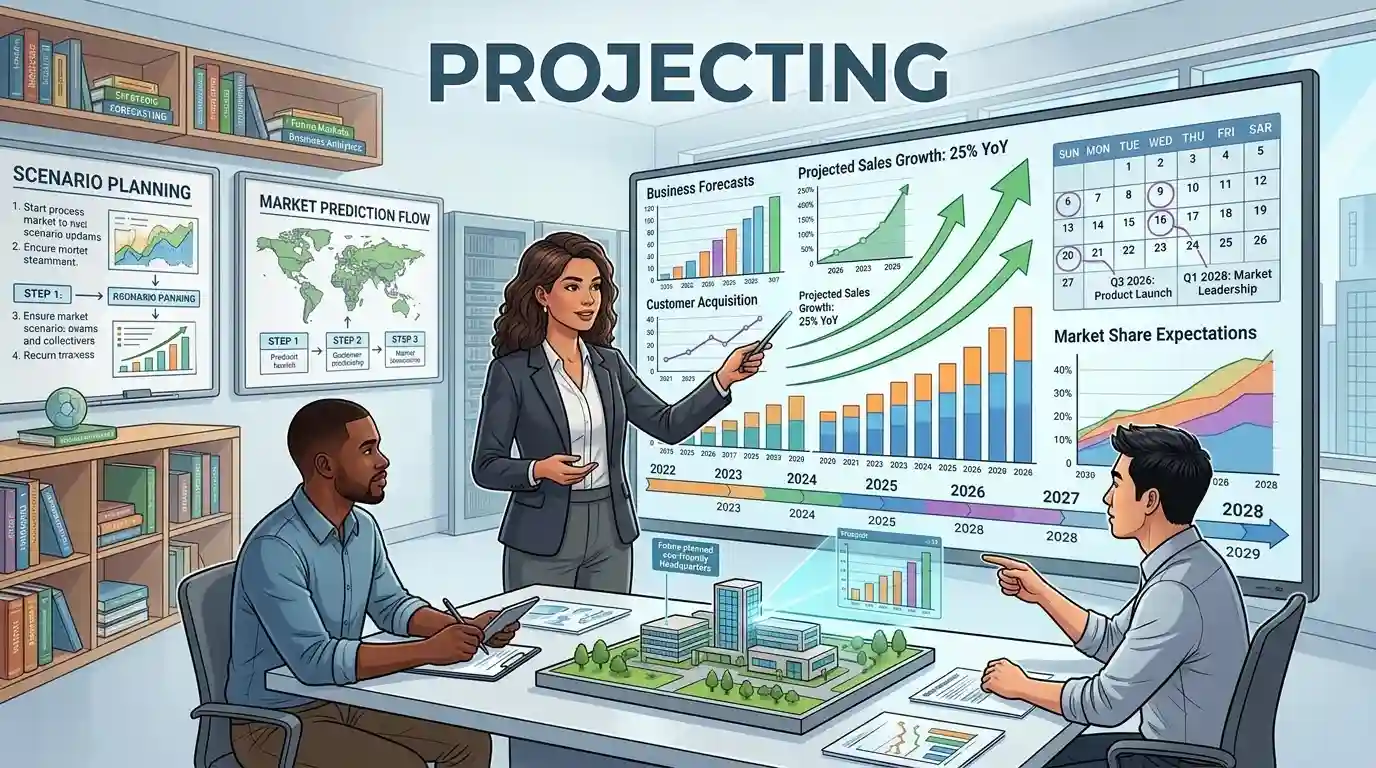
Synonyms for projecting can transform a simple sentence when you want clearer, stronger English. Students often know one word but need natural alternatives.
Imagine saying, “Sales are projecting to rise.” A writer could instead say, “Sales are expected to rise,” making the idea clearer and more natural.
The synonyms of projecting help you avoid repetition and choose words that match your exact meaning, tone, and audience. This makes your English more flexible.
The word is common in business, education, media, design, and conversation. Students, bloggers, content writers, and daily English users can all benefit from learning its alternatives.
What Does “Projecting” Really Mean?
Projecting is the present participle or gerund form of the verb project.
In simple English, projecting can mean predicting something, extending something outward, displaying something, or communicating an image or impression.
The exact meaning depends on the context.
For example, “Analysts are projecting higher profits” means analysts are predicting higher profits.
“The balcony is projecting from the building” means the balcony is extending outward.
“The screen is projecting the movie” means the screen is displaying an image.
“She is projecting confidence” means she is giving an impression of confidence.
Part of Speech
Projecting is mainly a verb form. It can also function as a gerund or participle.
Its meaning changes according to the sentence and context.
Connotative Meaning
Connotation (the emotional or implied meaning associated with a word) can affect how projecting sounds.
Positive tone:
It can suggest confidence, leadership, optimism, creativity, or strong communication.
Negative tone:
In some situations, it can suggest exaggeration, pretending, or deliberately creating a false impression.
Neutral tone:
In business, mathematics, engineering, and media, it can simply describe prediction, extension, or display.
Etymology of “Projecting”
The word project ultimately comes from the Latin proicere, meaning “to throw forward” or “to cast forth.”
It developed through Latin and French before becoming part of English vocabulary.
Old English: 450–1100
The modern word project was not a common Old English vocabulary item. Similar ideas of throwing or putting something forward were expressed through other Germanic words.
Middle English: 1100–1500
The word entered English through learned Latin and French influence. Its meanings became associated with proposing, planning, and putting something forward.
Modern English: 1500–Present
The word developed several meanings, including planning, predicting, displaying, extending, and presenting an image.
The form projecting developed as the present participle of project.
Pronunciation
US: /prəˈdʒɛktɪŋ/
UK: /prəˈdʒektɪŋ/
Syllables
pro-ject-ing
Affixation Pattern
Root: ject
Prefix: pro-
Suffix: -ing
The Latin root associated with ject carries the idea of throwing or putting. The prefix pro- suggests forward movement.
60 Synonyms of “Projecting”
Forecasting (Verb) — US /ˈfɔːrkæstɪŋ/ | UK /ˈfɔːkɑːstɪŋ/
Meaning: Forecasting means predicting what is likely to happen in the future.
Tone/Register: Formal, business, academic.
Examples
Analysts are forecasting stronger demand next year.
The company is forecasting steady growth.
Predicting (Verb) — US /prɪˈdɪktɪŋ/ | UK /prɪˈdɪktɪŋ/
Meaning: Predicting means saying what you believe will happen in the future.
Tone/Register: Neutral, academic.
Examples
Experts are predicting warmer temperatures.
She is predicting a close election.
Anticipating (Verb) — US /ænˈtɪsəpeɪtɪŋ/ | UK /ænˈtɪsɪpeɪtɪŋ/
Meaning: Anticipating means expecting something before it happens.
Tone/Register: Formal, neutral.
Examples
We are anticipating a busy weekend.
The team is anticipating several questions.
Estimating (Verb) — US /ˈɛstəmeɪtɪŋ/ | UK /ˈɛstɪmeɪtɪŋ/
Meaning: Estimating means making an approximate judgment about a future amount or result.
Tone/Register: Neutral, professional.
Examples
Engineers are estimating the repair time.
The accountant is estimating next quarter’s costs.
Calculating (Verb) — US /ˈkælkjəleɪtɪŋ/ | UK /ˈkælkjəleɪtɪŋ/
Meaning: Calculating means working out an expected result using information or numbers.
Tone/Register: Academic, technical.
Examples
The researchers are calculating future demand.
The software is calculating the expected output.
Foreseeing (Verb) — US /fɔːrˈsiːɪŋ/ | UK /fɔːˈsiːɪŋ/
Meaning: Foreseeing means imagining or recognizing something before it occurs.
Tone/Register: Formal, literary.
Examples
Few people were foreseeing such rapid change.
She was foreseeing problems with the plan.
Expecting (Verb) — US /ɪkˈspɛktɪŋ/ | UK /ɪkˈspɛktɪŋ/
Meaning: Expecting means believing that something will probably happen.
Tone/Register: Neutral, conversational.
Examples
We are expecting more visitors tomorrow.
They are expecting good results.
Envisaging (Verb) — US /ɪnˈvɪzɪdʒɪŋ/ | UK /ɪnˈvɪzɪdʒɪŋ/
Meaning: Envisaging means imagining a possible future situation.
Tone/Register: Formal, British, academic.
Examples
The planners are envisaging a greener city.
She is envisaging a different future.
Foretelling (Verb) — US /fɔːrˈtɛlɪŋ/ | UK /fɔːˈtɛlɪŋ/
Meaning: Foretelling means indicating or predicting something before it happens.
Tone/Register: Literary, formal.
Examples
The signs seemed to be foretelling trouble.
The story is foretelling a major change.
Extrapolating (Verb) — US /ɪkˈstræpəleɪtɪŋ/ | UK /ɪkˈstræpəleɪtɪŋ/
Meaning: Extrapolating means extending existing data to estimate a future result.
Tone/Register: Academic, technical.
Examples
Researchers are extrapolating from recent data.
The report extrapolates future demand.
Speculating (Verb) — US /ˈspɛkjəleɪtɪŋ/ | UK /ˈspɛkjʊleɪtɪŋ/
Meaning: Speculating means forming an uncertain idea about what may happen.
Tone/Register: Neutral, journalistic.
Examples
Investors are speculating about the merger.
People are speculating about her next move.
Projecting Forward (Verb Phrase) — US /prəˈdʒɛktɪŋ ˈfɔːrwərd/ | UK /prəˈdʒektɪŋ ˈfɔːwəd/
Meaning: Projecting forward means considering what may happen in the future.
Tone/Register: Business, academic.
Examples
We are projecting forward over five years.
The model projects forward expected demand.
Prophesying (Verb) — US /ˈprɑːfəsaɪɪŋ/ | UK /ˈprɒfɪsaɪɪŋ/
Meaning: Prophesying means predicting future events with a dramatic or religious tone.
Tone/Register: Literary, dramatic.
Examples
The novel seems to be prophesying disaster.
He was prophesying a major transformation.
Predicting (Verb Phrase) — US /prɪˈdɪktɪŋ əˈhɛd/ | UK /prɪˈdɪktɪŋ əˈhɛd/
Meaning: Predicting means making a judgment about future events.
Tone/Register: Informal, conversational.
Examples
Nobody can predict with complete accuracy.
The team is predicting for the next season.
Estimating Ahead (Verb Phrase) — US /ˈɛstəmeɪtɪŋ əˈhɛd/ | UK /ˈɛstɪmeɪtɪŋ əˈhɛd/
Meaning: Estimating ahead means approximating a future amount or outcome.
Tone/Register: Neutral, professional.
Examples
We are estimating ahead for staffing needs.
The manager is estimating ahead for the project.
Presenting (Verb) — US /prɪˈzɛntɪŋ/ | UK /prɪˈzentɪŋ/
Meaning: Presenting means showing or communicating information to others.
Tone/Register: Neutral, professional.
Examples
She is presenting the findings today.
The speaker is presenting a new idea.
Displaying (Verb) — US /dɪˈspleɪɪŋ/ | UK /dɪˈspleɪɪŋ/
Meaning: Displaying means showing something so people can see or understand it.
Tone/Register: Neutral, technical.
Examples
The screen is displaying the results.
The website is displaying updated information.
Showing (Verb) — US /ˈʃoʊɪŋ/ | UK /ˈʃəʊɪŋ/
Meaning: Showing means making something visible or understandable.
Tone/Register: Informal, everyday.
Examples
The projector is showing the presentation.
The graph is showing a clear trend.
Casting (Verb) — US /ˈkæstɪŋ/ | UK /ˈkɑːstɪŋ/
Meaning: Casting can mean throwing light, an image, or a shadow onto a surface.
Tone/Register: Neutral, technical, creative.
Examples
The lamp is casting a shadow.
The screen is casting images onto the wall.
Broadcasting (Verb) — US /ˈbrɔːdkæstɪŋ/ | UK /ˈbrɔːdkɑːstɪŋ/
Meaning: Broadcasting means transmitting information, sound, or images to an audience.
Tone/Register: Media, professional.
Examples
The station is broadcasting the interview.
The network is broadcasting the event live.
Emitting (Verb) — US /ɪˈmɪtɪŋ/ | UK /ɪˈmɪtɪŋ/
Meaning: Emitting means sending out light, sound, energy, or another substance.
Tone/Register: Scientific, technical.
Examples
The device is emitting a soft signal.
The lamp is emitting bright light.
Radiating (Verb) — US /ˈreɪdieɪtɪŋ/ | UK /ˈreɪdieɪtɪŋ/
Meaning: Radiating means spreading something outward from a central point.
Tone/Register: Neutral, descriptive.
Examples
The heater is radiating warmth.
The light is radiating across the room.
Extending (Verb) — US /ɪkˈstɛndɪŋ/ | UK /ɪkˈstendɪŋ/
Meaning: Extending means reaching outward beyond a normal boundary.
Tone/Register: Neutral.
Examples
The roof is extending over the entrance.
The branch is extending across the path.
Protruding (Verb) — US /proʊˈtruːdɪŋ/ | UK /prəˈtruːdɪŋ/
Meaning: Protruding means sticking outward from a surface.
Tone/Register: Neutral, descriptive.
Examples
A pipe is protruding from the wall.
The shelf is protruding slightly.
Sticking Out (Verb Phrase) — US /ˌstɪkɪŋ ˈaʊt/ | UK /ˌstɪkɪŋ ˈaʊt/
Meaning: Sticking out means extending visibly beyond a surface or boundary.
Tone/Register: Informal.
Examples
One nail is sticking out of the board.
The handle is sticking out too far.
Overhanging (Verb) — US /ˌoʊvərˈhæŋɪŋ/ | UK /ˌəʊvəˈhæŋɪŋ/
Meaning: Overhanging means extending above or beyond something below it.
Tone/Register: Neutral, architectural.
Examples
The balcony is overhanging the garden.
Branches are overhanging the road.
Jutting (Verb) — US /ˈdʒʌtɪŋ/ | UK /ˈdʒʌtɪŋ/
Meaning: Jutting means sticking sharply outward.
Tone/Register: Descriptive, informal.
Examples
A rock was jutting from the cliff.
The corner is jutting into the walkway.
Bulging (Verb) — US /ˈbʌldʒɪŋ/ | UK /ˈbʌldʒɪŋ/
Meaning: Bulging means swelling or pushing outward from a surface.
Tone/Register: Neutral, descriptive.
Examples
The bag is bulging with clothes.
The wall appears to be bulging outward.
Swelling (Verb) — US /ˈswɛlɪŋ/ | UK /ˈswelɪŋ/
Meaning: Swelling means becoming larger and extending outward.
Tone/Register: Neutral.
Examples
The material is swelling under pressure.
The surface is swelling slightly.
Advancing (Verb) — US /ədˈvænsɪŋ/ | UK /ədˈvɑːnsɪŋ/
Meaning: Advancing means moving forward or making progress toward something.
Tone/Register: Formal, neutral.
Examples
The team is advancing toward its goal.
Technology is advancing quickly.
Putting Forward (Verb Phrase) — US /ˌpʊtɪŋ ˈfɔːrwərd/ | UK /ˌpʊtɪŋ ˈfɔːwəd/
Meaning: Putting forward means presenting an idea, proposal, or argument.
Tone/Register: Neutral, professional.
Examples
She is putting forward a practical solution.
The committee put forward three proposals.
Proposing (Verb) — US /prəˈpoʊzɪŋ/ | UK /prəˈpəʊzɪŋ/
Meaning: Proposing means formally suggesting an idea or plan.
Tone/Register: Formal, professional.
Examples
The board is proposing a new policy.
He is proposing a different approach.
Suggesting (Verb) — US /səˈdʒɛstɪŋ/ | UK /səˈdʒestɪŋ/
Meaning: Suggesting means putting forward an idea for consideration.
Tone/Register: Neutral, everyday.
Examples
She is suggesting a shorter route.
The evidence is suggesting another explanation.
Offering (Verb) — US /ˈɔːfərɪŋ/ | UK /ˈɒfərɪŋ/
Meaning: Offering means presenting something for consideration or acceptance.
Tone/Register: Neutral.
Examples
He is offering a useful alternative.
The report offers a new perspective.
Advancing an Idea (Verb Phrase) — US /ədˈvænsɪŋ ən aɪˈdiə/ | UK /ədˈvɑːnsɪŋ ən aɪˈdɪə/
Meaning: Advancing an idea means actively presenting it for discussion or acceptance.
Tone/Register: Academic, formal.
Examples
The researcher is advancing a new theory.
The paper advances an important argument.
Conveying (Verb) — US /kənˈveɪɪŋ/ | UK /kənˈveɪɪŋ/
Meaning: Conveying means communicating an idea, feeling, or impression.
Tone/Register: Formal, academic.
Examples
Her expression is conveying confidence.
The article conveys a hopeful message.
Communicating (Verb) — US /kəˈmjuːnɪkeɪtɪŋ/ | UK /kəˈmjuːnɪkeɪtɪŋ/
Meaning: Communicating means sharing information, thoughts, or feelings.
Tone/Register: Neutral, professional.
Examples
He is communicating his concerns clearly.
The campaign communicates a positive message.
Expressing (Verb) — US /ɪkˈsprɛsɪŋ/ | UK /ɪkˈspresɪŋ/
Meaning: Expressing means showing or communicating a thought, feeling, or attitude.
Tone/Register: Neutral, academic.
Examples
She is expressing strong confidence.
His tone is expressing frustration.
Signaling (Verb) — US /ˈsɪɡnəlɪŋ/ | UK /ˈsɪɡnəlɪŋ/
Meaning: Signaling means giving a sign that communicates information or intention.
Tone/Register: Professional, academic.
Examples
The data is signaling a change.
His response is signaling concern.
Indicating (Verb) — US /ˈɪndəkeɪtɪŋ/ | UK /ˈɪndɪkeɪtɪŋ/
Meaning: Indicating means showing that something is likely, true, or present.
Tone/Register: Formal, academic.
Examples
The figures are indicating steady growth.
The results indicate a clear pattern.
Demonstrating (Verb) — US /ˈdɛmənstreɪtɪŋ/ | UK /ˈdemənstreɪtɪŋ/
Meaning: Demonstrating means clearly showing a quality, fact, or ability.
Tone/Register: Academic, professional.
Examples
The results are demonstrating strong progress.
She is demonstrating excellent leadership.
Exhibiting (Verb) — US /ɪɡˈzɪbɪtɪŋ/ | UK /ɪɡˈzɪbɪtɪŋ/
Meaning: Exhibiting means showing a particular quality or behavior.
Tone/Register: Formal, academic.
Examples
The material is exhibiting unusual strength.
The child is exhibiting great curiosity.
Projecting an Image (Verb Phrase) — US /prəˈdʒɛktɪŋ ən ˈɪmɪdʒ/ | UK /prəˈdʒektɪŋ ən ˈɪmɪdʒ/
Meaning: Projecting an image means deliberately creating a particular impression of yourself or an organization.
Tone/Register: Business, social.
Examples
The company is projecting a modern image.
He is projecting an image of confidence.
Portraying (Verb) — US /pɔːrˈtreɪɪŋ/ | UK /pɔːˈtreɪɪŋ/
Meaning: Portraying means presenting someone or something in a particular way.
Tone/Register: Creative, media, formal.
Examples
The film is portraying the leader sympathetically.
The article portrays the city as vibrant.
Depicting (Verb) — US /dɪˈpɪktɪŋ/ | UK /dɪˈpɪktɪŋ/
Meaning: Depicting means representing someone or something through words, images, or art.
Tone/Register: Formal, artistic.
Examples
The painting depicts a quiet village.
The novel depicts life during wartime.
Representing (Verb) — US /ˌrɛprɪˈzɛntɪŋ/ | UK /ˌreprɪˈzentɪŋ/
Meaning: Representing means standing for or presenting something in a particular form.
Tone/Register: Neutral, academic.
Examples
The graph is representing population growth.
The symbol represents peace.
Illustrating (Verb) — US /ˈɪləstreɪtɪŋ/ | UK /ˈɪləstreɪtɪŋ/
Meaning: Illustrating means making an idea clearer through an example, image, or explanation.
Tone/Register: Academic, educational.
Examples
The diagram illustrates the process.
Her example illustrates the main point.
Visualizing (Verb) — US /ˈvɪʒuəlaɪzɪŋ/ | UK /ˈvɪʒuəlaɪzɪŋ/
Meaning: Visualizing means forming or presenting a mental or visual picture.
Tone/Register: Neutral, academic.
Examples
The designer is visualizing the final layout.
The chart helps users visualize growth.
Imagining (Verb) — US /ɪˈmædʒɪnɪŋ/ | UK /ɪˈmædʒɪnɪŋ/
Meaning: Imagining means forming a mental picture of something that may not exist or happen yet.
Tone/Register: Neutral, creative.
Examples
She is imagining her future career.
The writer is imagining another world.
Envisioning (Verb) — US /ɪnˈvɪʒənɪŋ/ | UK /ɪnˈvɪʒənɪŋ/
Meaning: Envisioning means imagining a desired or possible future.
Tone/Register: Professional, inspirational.
Examples
The founders are envisioning global growth.
She is envisioning a better workplace.
Shaping (Verb) — US /ˈʃeɪpɪŋ/ | UK /ˈʃeɪpɪŋ/
Meaning: Shaping means influencing how something develops or appears.
Tone/Register: Neutral, professional.
Examples
The campaign is shaping public opinion.
New technology is shaping modern education.
Influencing (Verb) — US /ˈɪnfluənsɪŋ/ | UK /ˈɪnfluənsɪŋ/
Meaning: Influencing means affecting how someone thinks, feels, or behaves.
Tone/Register: Neutral, academic.
Examples
The advertisement is influencing customer attitudes.
Social media is influencing young audiences.
Promoting (Verb) — US /prəˈmoʊtɪŋ/ | UK /prəˈməʊtɪŋ/
Meaning: Promoting means encouraging acceptance, awareness, or support of something.
Tone/Register: Business, public communication.
Examples
The campaign is promoting healthy habits.
The speaker is promoting a positive message.
Projecting Confidence (Verb Phrase) — US /prəˈdʒɛktɪŋ ˈkɑːnfɪdəns/ | UK /prəˈdʒektɪŋ ˈkɒnfɪdəns/
Meaning: Projecting confidence means giving others the impression that you feel capable and assured.
Tone/Register: Social, professional.
Examples
She is projecting confidence during the interview.
His posture projects confidence.
Radiating Confidence (Verb Phrase) — US /ˈreɪdieɪtɪŋ ˈkɑːnfɪdəns/ | UK /ˈreɪdieɪtɪŋ ˈkɒnfɪdəns/
Meaning: Radiating confidence means visibly expressing a strong sense of self-assurance.
Tone/Register: Informal, expressive.
Examples
She walked into the room radiating confidence.
His presentation was radiating confidence.
Giving Off (Phrasal Verb) — US /ˈɡɪvɪŋ ɔːf/ | UK /ˈɡɪvɪŋ ɒf/
Meaning: Giving off means producing or communicating an impression, feeling, smell, or signal.
Tone/Register: Informal.
Examples
The room is giving off a relaxed feeling.
He is giving off positive energy.
Exuding (Verb) — US /ɪɡˈzuːdɪŋ/ | UK /ɪɡˈzjuːdɪŋ/
Meaning: Exuding means showing a quality strongly and naturally.
Tone/Register: Formal, expressive.
Examples
She is exuding confidence today.
The restaurant exudes warmth.
Projecting Authority (Verb Phrase) — US /prəˈdʒɛktɪŋ əˈθɔːrəti/ | UK /prəˈdʒektɪŋ ɔːˈθɒrəti/
Meaning: Projecting authority means communicating an impression of control, expertise, or leadership.
Tone/Register: Professional.
Examples
The manager projects authority without sounding harsh.
His calm voice projects authority.
Casting Forward (Verb Phrase) — US /ˈkæstɪŋ ˈfɔːrwərd/ | UK /ˈkɑːstɪŋ ˈfɔːwəd/
Meaning: Casting forward means directing thought or attention toward the future.
Tone/Register: Literary, formal.
Examples
The speech casts forward to a new era.
The story casts forward into an uncertain future.
Extending Outward (Verb Phrase) — US /ɪkˈstɛndɪŋ ˈaʊtwərd/ | UK /ɪkˈstendɪŋ ˈaʊtwəd/
Meaning: Extending outward means reaching beyond an existing edge or boundary.
Tone/Register: Neutral, descriptive.
Examples
The structure is extending outward from the wall.
The roots are extending outward beneath the soil.
Synonyms of “Projecting” by Tone
Positive Synonyms
Envisioning, conveying, demonstrating, exuding, radiating, promoting, and shaping can sound positive when they describe confidence, progress, creativity, or leadership.
Neutral Synonyms
Showing, displaying, indicating, presenting, estimating, expecting, predicting, extending, and representing are generally neutral.
Negative or Uncertain Synonyms
Some alternatives can become negative depending on context. Speculating may suggest uncertainty, while portraying can sometimes imply a selective or misleading presentation.
Playful and Informal Synonyms
Sticking out, giving off, showing, and jutting are more conversational or descriptive.
Why Tone Matters
A synonym is not always interchangeable with another word.
For example, predicting sounds straightforward, while prophesying can sound dramatic. Protruding is more precise for physical extension than showing.
Choosing the right word makes your English sound more natural.
“Projecting” vs Close Alternatives
| Word | Meaning Difference | Tone |
|---|---|---|
| Projecting | Can mean predicting, displaying, extending, or communicating an impression | Neutral |
| Forecasting | Focuses mainly on predicting future results | Professional |
| Predicting | Broadly means saying what may happen | General |
| Envisioning | Focuses on imagining a possible or desired future | Positive |
| Protruding | Specifically describes physical extension | Descriptive |
Apply projecting when the intended meaning is clear from the context.
Use forecasting for data-driven predictions.
Apply envisioning when discussing future goals or possibilities.
Use protruding when describing something physically extending outward.
How “Projecting” Changes by Context
Daily Conversation
In everyday English, projecting often describes the impression someone gives.
Someone may be projecting confidence during a conversation. It can also describe something that extends outward.
Simple alternatives such as showing, giving off, expressing, or sticking out often sound more natural in casual speech.
Writing and Blogging
Bloggers should choose alternatives according to the exact meaning.
Instead of repeatedly using projecting, a writer can use conveying, presenting, illustrating, portraying, or indicating.
This makes content easier to read and prevents unnecessary repetition.
Professional and Academic English
Business and academic writing frequently use projecting for future estimates.
Words such as forecasting, estimating, extrapolating, anticipating, and predicting can provide greater precision.
For example, “The researchers are forecasting increased demand” sounds more specific than simply saying “They are projecting growth.”
Creative or Informal Use
Creative writing may use radiating, exuding, portraying, depicting, visualizing, or imagining.
These words can create stronger mental images and make descriptions more engaging.
Common Mistakes Learners Make
Mistake 1: Treating Every Synonym as Identical
Not every alternative works in every sentence.
“Sales are protruding” is incorrect if you mean that sales are expected to increase. Forecasting or predicting would be appropriate.
Mistake 2: Using a Formal Word in Casual Speech
Words such as extrapolating and envisaging can sound overly formal in ordinary conversation.
Use expecting, thinking, or imagining when the situation is casual.
Mistake 3: Confusing Physical and Abstract Meanings
Projecting can describe physical extension or future prediction.
“The balcony is projecting outward” and “The company is projecting growth” use different meanings.
Mistake 4: Overusing the Word
Repeatedly using projecting can make writing feel mechanical.
Choose a synonym only when it preserves the intended meaning.
Native Usage Notes
Native speakers usually choose the synonym that gives the most precise meaning.
When it comes to business writing, forecasting and estimating are common.
For everyday speech, expecting and showing are often easier.
When used in creative writing, portraying, depicting, and exuding can create a stronger effect.
For related vocabulary, an internal article on synonyms of predicting can help expand this semantic group.
Real-Life Mini Scenarios
Workplace
A manager says, “We are forecasting stronger sales next quarter.”
Here, forecasting is more precise because the statement suggests a business-based prediction.
Social Situation
Someone entering an interview may be projecting confidence through posture, eye contact, and speech.
Here, the phrase describes the impression being communicated.
Media and Pop Culture
A film may be portraying a character as brave even when the character has flaws.
Portraying works because the filmmaker is presenting the character in a particular way.
Writing and Storytelling
A novelist may be envisioning a future city where technology controls transportation.
Here, envisioning emphasizes imagination rather than certainty.
Interactive Practice Quiz
Choose the best answer for each situation.
1. Analysts believe profits will increase next year. Which word fits best?
A. Protruding
B. Forecasting
C. Jutting
D. Casting
2. A pipe sticks outward from a wall. Which word is most precise?
A. Predicting
B. Anticipating
C. Protruding
D. Envisioning
3. An artist presents a historical scene in a painting. Which word fits best?
A. Depicting
B. Estimating
C. Forecasting
D. Speculating
4. A company wants to communicate a modern public image. Which phrase works best?
A. Projecting a modern image
B. Bulging a modern image
C. Jutting a modern image
D. Extrapolating a modern image
5. A scientist uses current data to estimate future results. Which word is strongest?
A. Extrapolating
B. Sticking out
C. Portraying
D. Giving off
6. Someone gives the impression of confidence during a presentation. Which phrase fits?
A. Projecting confidence
B. Extending confidence
C. Protruding confidence
D. Forecasting confidence
7. A television station sends a live event to viewers. Which word is correct?
A. Broadcasting
B. Bulging
C. Foreseeing
D. Envisioning
8. A student wants to communicate an idea clearly. Which word is appropriate?
A. Conveying
B. Jutting
C. Overhanging
D. Swelling
9. A balcony reaches beyond the building wall. Which word is most precise?
A. Predicting
B. Overhanging
C. Forecasting
D. Speculating
10. A person imagines a successful future career. Which word fits best?
A. Envisioning
B. Protruding
C. Casting
D. Broadcasting
11. A report shows evidence of a developing trend. Which word works well?
A. Indicating
B. Jutting
C. Bulging
D. Sticking out
12. Someone discusses what might happen without strong evidence. Which word is appropriate?
A. Speculating
B. Demonstrating
C. Displaying
D. Extending
13. A designer creates a mental picture of a new building. Which word fits best?
A. Visualizing
B. Broadcasting
C. Overhanging
D. Forecasting
14. A campaign communicates optimism to the public. Which word can describe this?
A. Conveying
B. Protruding
C. Extrapolating
D. Jutting
15. A graph makes a complicated trend easier to understand. Which word is suitable?
A. Illustrating
B. Swelling
C. Sticking out
D. Overhanging
Answer Key: 1-B | 2-C | 3-A | 4-A | 5-A | 6-A | 7-A | 8-A | 9-B | 10-A | 11-A | 12-A | 13-A | 14-A | 15-A
Reflection Task
Write one sentence using a synonym of projecting. Try using your new word in an email, essay, blog post, or everyday conversation.
Frequently Asked Questions
What are the best synonyms of projecting when talking about future results?
The strongest alternatives are forecasting, predicting, estimating, anticipating, extrapolating, and expecting. The best choice depends on certainty and context. Forecasting often suggests analysis of data, while predicting is broader. Estimating suggests an approximate calculation, and expecting sounds more natural in everyday conversation.
Which synonym of projecting is best for business writing?
Forecasting is often the best choice when discussing future sales, revenue, demand, costs, or performance. It sounds professional and usually suggests that the prediction is based on available information. Estimating is useful when the figure is approximate, while anticipating works well when discussing expected developments or outcomes.
Is projecting formal or informal English?
Projecting is neither strictly formal nor informal. Its register depends on its meaning. It is common in professional and academic writing when discussing predictions. In everyday conversation, speakers may prefer simpler words such as expecting, showing, or giving off, depending on the intended meaning.
What is the difference between projecting and forecasting?
Projecting is broader and can mean predicting, displaying, or extending outward. Forecasting specifically focuses on predicting future conditions or results, often using data or trends. For example, a company can project revenue, but a financial analyst may forecast revenue based on historical performance and market information.
Can projecting describe a physical object?
Yes. Projecting can describe something that extends beyond a surface or boundary. For example, a balcony can be projecting from a building. In this meaning, close alternatives include protruding, jutting, extending, sticking out, and overhanging. The best choice depends on the shape and position of the object.
What is a good synonym for projecting confidence?
Useful alternatives include expressing confidence, conveying confidence, radiating confidence, exuding confidence, demonstrating confidence, and projecting authority. The nuance differs. Exuding suggests that confidence appears very strongly, while demonstrating focuses more on visible evidence of confidence.
How can learning synonyms of projecting improve English vocabulary?
Learning these alternatives helps you distinguish between prediction, presentation, physical extension, and emotional impression. It also reduces repetition in essays, articles, emails, and conversations. More importantly, it teaches you to select vocabulary according to context rather than simply memorizing long lists of interchangeable words.
Which synonym of projecting is easiest for ESL learners?
For general English, predicting, expecting, showing, presenting, extending, and expressing are useful starting points. They are common and relatively easy to use. More advanced learners can add forecasting, extrapolating, envisioning, portraying, conveying, and exuding to develop greater precision.
Conclusion
Learning the synonyms of projecting is not simply about memorizing sixty words. It is about understanding the small differences that make English clearer and more natural.
A strong vocabulary helps you choose forecasting for data, envisioning for future ideas, and protruding for physical extension with confidence.
These distinctions can improve essays, blogs, emails, presentations, and everyday conversations. The right synonym makes your message more precise and easier to understand.
Start practicing today by using three new alternatives in your own sentences. Try them in an email, essay, or daily conversation and notice how much stronger your English becomes.

Mehtab Yasir is a passionate writer and English language enthusiast dedicated to making vocabulary learning simple, practical, and enjoyable. As an author at SynonymDesk.com, she creates helpful content covering synonyms, antonyms, word meanings, vocabulary, phrases, and everyday English usage. Her goal is to provide clear and easy-to-understand information that helps students, writers, professionals, and English learners choose the right words and communicate with greater confidence. Mehtab believes that a strong vocabulary can improve both writing and communication skills. She enjoys researching new words, exploring their meanings and uses, and turning complex language concepts into useful, reader-friendly content. Through her work, she strives to make SynonymDesk.com a reliable resource for anyone looking to improve their English vocabulary and language skills.