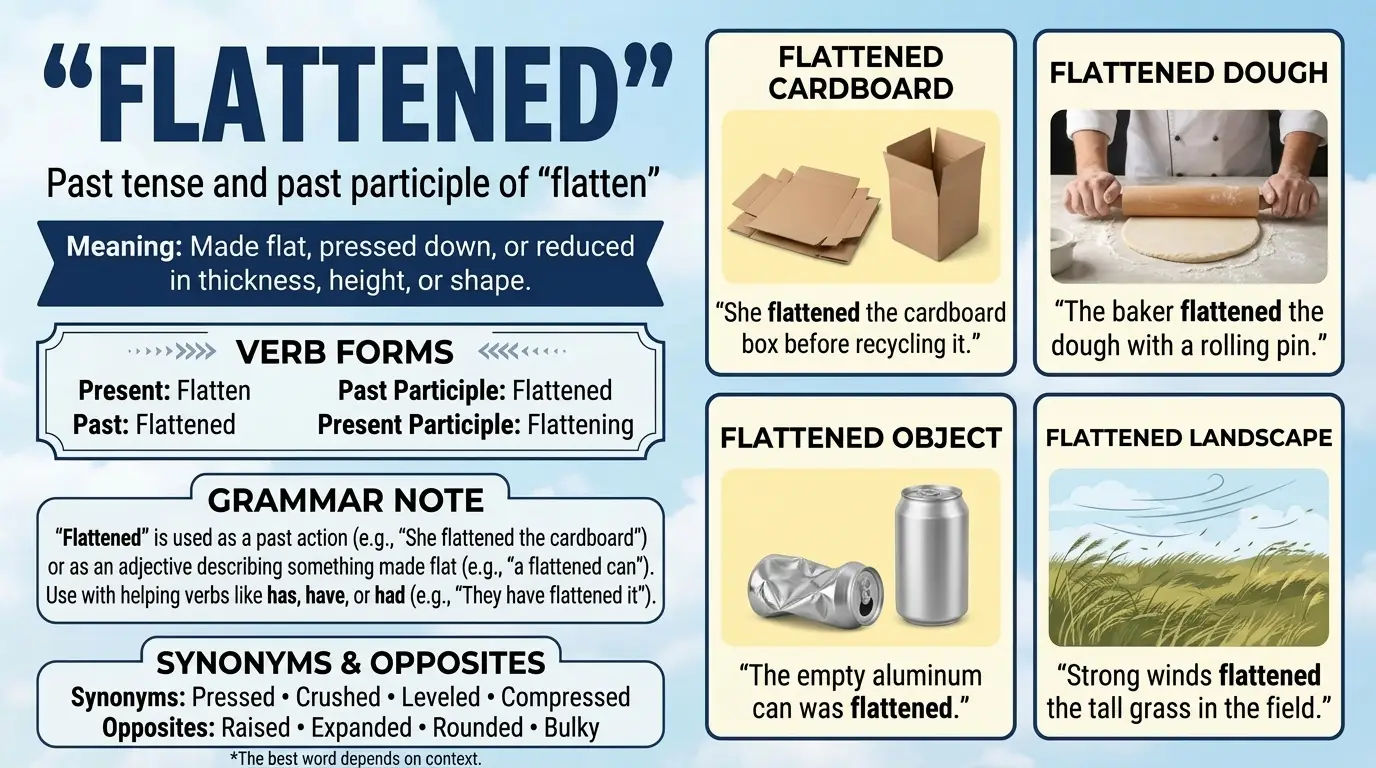
Synonyms of flattened include leveled, compressed, crushed, squashed, smoothed, pressed, flattened out, and evened out. These words describe something made flat, reduced in height, or pressed into a thinner shape. Figuratively, flattened can also mean defeated, exhausted, or emotionally overwhelmed. The best alternative depends on the situation.
Imagine dropping a heavy box onto a soft cushion. The cushion becomes flattened under its weight. A simple word describes a clear physical change.
However, synonyms of flattened can express more than physical pressure. They help describe damaged buildings, smooth surfaces, emotional setbacks, and everyday experiences.
Students, bloggers, and content writers benefit from understanding these differences. Choosing accurate vocabulary makes explanations clearer and more engaging.
Learning synonyms of flattened also improves daily communication. You can describe an object, experience, or feeling without relying on the same expression.
What Does Flattened Really Mean?
Flattened means made flat, pressed down, reduced in thickness, or changed from an uneven shape into a level surface.
The word can describe a physical action or a figurative experience.
For example:
- The worker flattened the cardboard before recycling it.
- Heavy rain flattened the flowers in the garden.
- The unexpected criticism flattened his confidence.
In the first example, something becomes physically thinner.
The second describes plants being pressed downward.
The third uses flattened figuratively. It suggests a strong emotional setback.
Native English speakers commonly use this word when discussing construction, cooking, packaging, natural disasters, sports, and personal experiences.
Part of Speech
Verb: Flattened is the simple past tense and past participle of the verb flatten.
Example: The machine flattened the metal sheet.
Adjective: Flattened can describe something that has become flat.
Example: The flattened cardboard was ready for recycling.
Connotative Meaning of Flattened
(Connotation is the emotional feeling, attitude, or association that a word carries beyond its basic dictionary meaning.)
Flattened does not always communicate the same emotional message. Its meaning changes with the surrounding words.
Positive Tone
Flattened can suggest improvement when someone makes a surface smooth, even, or suitable for use.
Example: The workers flattened the ground before building the playground.
Negative Tone
It can describe destruction, exhaustion, disappointment, or overwhelming defeat.
Example: The powerful storm flattened several houses.
Neutral Tone
The word often describes an ordinary physical process without expressing approval or criticism.
Example: She flattened the dough with a rolling pin.
Etymology of Flattened
The word flattened comes from the verb flatten, which developed from the adjective flat.
The adjective has Germanic roots. It is historically related to Old Norse flatr, meaning flat or level.
The verb flatten developed in English by adding the verb-forming ending -en to flat.
The ending -ed creates its regular past-tense and past-participle forms.
Old English (450–1100)
Old English had vocabulary for describing level surfaces and objects lying flat.
However, the modern word flattened did not exist in its present form during this period.
Middle English (1100–1500)
The adjective flat entered Middle English through Germanic linguistic influence, particularly from Old Norse.
It meant level, smooth, or horizontally extended surfaces.
Modern English (1500–Present)
The verb flatten became established in Early Modern English.
Its meanings gradually expanded beyond physical surfaces.
Today, flattened can describe physical compression, destruction, financial changes, emotional exhaustion, and overwhelming defeat.
Pronunciation of Flattened
American English (US)
IPA: /ˈflæt.ənd/
British English (UK)
IPA: /ˈflæt.ənd/
Both varieties generally pronounce the word similarly.
The first syllable receives the main stress.
Syllables
Flat-tened
Flattened has two spoken syllables.
Affixation Pattern
Root: Flat
Prefix: None
Verb-forming suffix: -en
Past-tense suffix: -ed
Formation: Flat + en + ed = Flattened
The word follows a regular verb pattern.
Synonyms List
The following alternatives cover the major meanings of flattened. Some describe physical pressure, while others refer to leveling, destruction, or figurative defeat.
1. Leveled (Verb) — US /ˈlev.əld/ | UK /ˈlev.əld/
Meaning: Made a surface even or brought something down to a particular level.
Tone/Register: Neutral, Construction, Professional.
Example 1: The builders leveled the ground before construction.
Example 2: The storm leveled several abandoned buildings.
2. Compressed (Verb) — US /kəmˈprest/ | UK /kəmˈprest/
Meaning: Pressed something into a smaller space or reduced its thickness through pressure.
Tone/Register: Technical, Neutral, Scientific.
Example 1: The machine compressed the cardboard boxes.
Example 2: Heavy equipment compressed the soil.
3. Crushed (Verb) — US /krʌʃt/ | UK /krʌʃt/
Meaning: Pressed something with enough force to damage or destroy its original shape.
Tone/Register: Strong, Negative, Everyday.
Example 1: The truck crushed the empty cans.
Example 2: The falling shelf crushed the plastic container.
4. Squashed (Verb) — US /skwɑːʃt/ | UK /skwɒʃt/
Meaning: Pressed something until it became flatter or lost its natural shape.
Tone/Register: Informal, Conversational.
Example 1: Someone squashed my sandwich inside the bag.
Example 2: The child accidentally squashed the soft toy.
5. Pressed (Verb) — US /prest/ | UK /prest/
Meaning: Applied pressure to make something flatter, thinner, or smoother.
Tone/Register: Neutral, Everyday.
Example 1: She pressed the dough with her hands.
Example 2: The tailor pressed the fabric before sewing.
6. Smoothed (Verb) — US /smuːðd/ | UK /smuːðd/
Meaning: Removed bumps, wrinkles, or irregularities from a surface.
Tone/Register: Positive, Neutral.
Example 1: He smoothed the blanket across the bed.
Example 2: The painter smoothed the wall before applying paint.
7. Evened Out (Phrasal Verb) — US /ˈiː.vənd aʊt/ | UK /ˈiː.vənd aʊt/
Meaning: Made something more uniform by removing differences in height or thickness.
Tone/Register: Neutral, Conversational.
Example 1: The gardener evened out the soil.
Example 2: She evened out the icing with a spatula.
8. Flattened Out (Phrasal Verb) — US /ˈflæt.ənd aʊt/ | UK /ˈflæt.ənd aʊt/
Meaning: Became completely flat or stopped rising and falling.
Tone/Register: Neutral, Everyday.
Example 1: The road flattened out after the steep hill.
Example 2: Sales flattened out during the summer.
9. Rolled Out (Phrasal Verb) — US /roʊld aʊt/ | UK /rəʊld aʊt/
Meaning: Made dough or another flexible material flatter by using a roller.
Tone/Register: Everyday, Culinary.
Example 1: She rolled out the pastry for the pie.
Example 2: Dad rolled out the pizza dough.
10. Ironed (Verb) — US /ˈaɪ.ɚnd/ | UK /ˈaɪ.ənd/
Meaning: Made fabric smooth and flat by applying heat and pressure.
Tone/Register: Neutral, Domestic.
Example 1: She ironed her shirt before the interview.
Example 2: He ironed the wrinkled tablecloth.
11. Planished (Verb) — US /ˈplæn.ɪʃt/ | UK /ˈplæn.ɪʃt/
Meaning: Smoothed and flattened metal through controlled hammering or pressure.
Tone/Register: Technical, Metalworking.
Example 1: The craftsperson planished the copper bowl.
Example 2: She planished the metal to remove small dents.
12. Pounded (Verb) — US /ˈpaʊn.dɪd/ | UK /ˈpaʊn.dɪd/
Meaning: Repeatedly struck something to reduce its thickness or change its shape.
Tone/Register: Everyday, Culinary.
Example 1: The chef pounded the chicken until it was thin.
Example 2: He pounded the clay into a flat shape.
13. Mashed (Verb) — US /mæʃt/ | UK /mæʃt/
Meaning: Crushed a soft substance through pressure until its original shape disappeared.
Tone/Register: Informal, Culinary.
Example 1: She mashed the boiled potatoes with a fork.
Example 2: The toddler mashed the banana against the plate.
14. Smashed (Verb) — US /smæʃt/ | UK /smæʃt/
Meaning: Struck or pressed something violently until it became damaged or lost its shape.
Tone/Register: Strong, Informal.
Example 1: The falling branch smashed the cardboard model.
Example 2: He smashed the empty can under his shoe.
15. Trampled (Verb) — US /ˈtræm.pəld/ | UK /ˈtræm.pəld/
Meaning: Pressed something down or damaged it by repeatedly stepping on it.
Tone/Register: Negative, Descriptive.
Example 1: The crowd trampled the grass near the stage.
Example 2: Running children trampled the flowers.
16. Tramped Down (Phrasal Verb) — US /træmpt daʊn/ | UK /træmpt daʊn/
Meaning: Made loose material flatter or more compact by walking heavily over it.
Tone/Register: Neutral, Descriptive.
Example 1: The hikers tramped down the fresh snow.
Example 2: Workers tramped down the loose soil.
17. Tamp Down (Verb Phrase) — US /tæmp daʊn/ | UK /tæmp daʊn/
Meaning: Press something firmly downward to create a compact, level surface.
Tone/Register: Technical, Construction.
Example 1: Workers tamp down the gravel before paving.
Example 2: Gardeners tamp down the soil around new plants.
Usage note: The past-tense form is tamped down.
18. Compacted (Verb) — US /kəmˈpæk.tɪd/ | UK /kəmˈpæk.tɪd/
Meaning: Pressed loose material together to reduce the space between its particles.
Tone/Register: Scientific, Technical.
Example 1: Heavy vehicles compacted the wet ground.
Example 2: The machine compacted the rubbish.
19. Depressed (Verb) — US /dɪˈprest/ | UK /dɪˈprest/
Meaning: Pushed a surface downward or lowered it below its original position.
Tone/Register: Formal, Technical.
Example 1: The heavy object depressed the foam cushion.
Example 2: Constant pressure depressed the soft surface.
20. Crumpled (Verb) — US /ˈkrʌm.pəld/ | UK /ˈkrʌm.pəld/
Meaning: Crushed or folded something into an uneven, compressed shape.
Tone/Register: Neutral, Everyday.
Example 1: He crumpled the paper beneath his palm.
Example 2: The heavy suitcase crumpled the cardboard packaging.
21. Squeezed (Verb) — US /skwiːzd/ | UK /skwiːzd/
Meaning: Applied pressure from opposite sides, sometimes making an object thinner or flatter.
Tone/Register: Neutral, Conversational.
Example 1: She squeezed the soft sponge between two boards.
Example 2: The machine squeezed the material into a thin layer.
22. Spread (Verb) — US /spred/ | UK /spred/
Meaning: Extended a substance across a surface to form a thinner, flatter layer.
Tone/Register: Neutral, Everyday.
Example 1: She spread the butter evenly across the bread.
Example 2: The builder spread the cement over the floor.
23. Stretched Out (Phrasal Verb) — US /stretʃt aʊt/ | UK /stretʃt aʊt/
Meaning: Extended flexible material until it became broader, thinner, or flatter.
Tone/Register: Informal, Everyday.
Example 1: She stretched out the dough with her fingers.
Example 2: He stretched out the fabric across the frame.
24. Flattened Down (Phrasal Verb) — US /ˈflæt.ənd daʊn/ | UK /ˈflæt.ənd daʊn/
Meaning: Pressed something downward until it became flatter.
Tone/Register: Informal, Descriptive.
Example 1: She flattened down the loose cardboard flap.
Example 2: He flattened down the grass to make a small path.
25. Laid Flat (Verb Phrase) — US /leɪd flæt/ | UK /leɪd flæt/
Meaning: Placed something horizontally so it rested against a level surface.
Tone/Register: Neutral, Everyday.
Example 1: She laid the poster flat on the table.
Example 2: He laid the wet shirt flat to dry.
26. Pinned Down (Phrasal Verb) — US /pɪnd daʊn/ | UK /pɪnd daʊn/
Meaning: Held something against a surface to prevent it from rising or moving.
Tone/Register: Neutral, Descriptive.
Example 1: She pinned down the curling paper.
Example 2: The gardener pinned down the fabric covering.
27. Knocked Flat (Verb Phrase) — US /nɑːkt flæt/ | UK /nɒkt flæt/
Meaning: Struck something with enough force to make it fall into a flat position.
Tone/Register: Informal, Descriptive.
Example 1: Strong winds knocked the fence flat.
Example 2: The football knocked the cardboard display flat.
28. Knocked Down (Phrasal Verb) — US /nɑːkt daʊn/ | UK /nɒkt daʊn/
Meaning: Caused something standing upright to fall or collapse.
Tone/Register: Neutral, Everyday.
Example 1: The storm knocked down the wooden shed.
Example 2: The construction team knocked down the old wall.
29. Demolished (Verb) — US /dɪˈmɑː.lɪʃt/ | UK /dɪˈmɒl.ɪʃt/
Meaning: Destroyed a building or structure.
Tone/Register: Formal, Construction.
Example 1: Workers demolished the abandoned factory.
Example 2: The earthquake demolished several houses.
30. Razed (Verb) — US /reɪzd/ | UK /reɪzd/
Meaning: Destroyed a building or settlement, often leaving it level with the ground.
Tone/Register: Formal, Journalistic.
Example 1: The fire razed the old warehouse.
Example 2: The village was razed during the conflict.
31. Destroyed (Verb) — US /dɪˈstrɔɪd/ | UK /dɪˈstrɔɪd/
Meaning: Damaged something so severely that it could no longer function or retain its original form.
Tone/Register: Strong, Neutral.
Example 1: The hurricane destroyed the coastal homes.
Example 2: The explosion destroyed the temporary structure.
32. Toppled (Verb) — US /ˈtɑː.pəld/ | UK /ˈtɒp.əld/
Meaning: Caused something upright to lose balance and fall over.
Tone/Register: Descriptive, Journalistic.
Example 1: Powerful winds toppled the garden statue.
Example 2: The earthquake toppled the stone pillars.
33. Felled (Verb) — US /feld/ | UK /feld/
Meaning: Caused a tree or another upright object to fall to the ground.
Tone/Register: Formal, Descriptive.
Example 1: The storm felled several large trees.
Example 2: Workers felled the damaged oak.
34. Overwhelmed (Verb) — US /ˌoʊ.vɚˈwelmd/ | UK /ˌəʊ.vəˈwelmd/
Meaning: Affected someone so strongly that they struggled to cope or respond.
Tone/Register: Emotional, Neutral.
Example 1: The unexpected news overwhelmed her.
Example 2: The sudden workload overwhelmed the new employee.
35. Defeated (Verb) — US /dɪˈfiː.tɪd/ | UK /dɪˈfiː.tɪd/
Meaning: Overcame an opponent or caused someone to experience failure.
Tone/Register: Neutral, Competitive.
Example 1: Our team defeated the champions easily.
Example 2: The experienced player defeated his younger rival.
36. Crushed (Figurative Verb) — US /krʌʃt/ | UK /krʌʃt/
Meaning: Caused severe emotional disappointment or delivered an overwhelming defeat.
Tone/Register: Strong, Emotional.
Example 1: The rejection crushed his confidence.
Example 2: The visiting team crushed its opponents.
37. Devastated (Verb) — US /ˈdev.ə.steɪ.tɪd/ | UK /ˈdev.ə.steɪ.tɪd/
Meaning: Caused extreme emotional pain or severe damage.
Tone/Register: Strong, Emotional.
Example 1: The unexpected loss devastated the family.
Example 2: The disappointing announcement devastated the supporters.
38. Exhausted (Verb) — US /ɪɡˈzɑː.stɪd/ | UK /ɪɡˈzɔː.stɪd/
Meaning: Made someone extremely tired or completely drained of energy.
Tone/Register: Neutral, Everyday.
Example 1: The long journey exhausted the passengers.
Example 2: Working overnight exhausted the entire team.
39. Drained (Verb) — US /dreɪnd/ | UK /dreɪnd/
Meaning: Left someone without much physical or emotional energy.
Tone/Register: Conversational, Emotional.
Example 1: The difficult conversation drained her energy.
Example 2: Preparing for the event drained the volunteers.
40. Worn Out (Phrasal Verb) — US /wɔːrn aʊt/ | UK /wɔːn aʊt/
Meaning: Made someone extremely tired through continued effort or activity.
Tone/Register: Informal, Everyday.
Example 1: The long hike wore everyone out.
Example 2: Cleaning the entire house wore him out.
41. Floored (Verb) — US /flɔːrd/ | UK /flɔːd/
Meaning: Overwhelmed, shocked, or defeated someone so strongly that they struggled to respond.
Tone/Register: Informal, Figurative.
Example 1: The unexpected announcement floored everyone.
Example 2: Her opponent’s final move completely floored her.
42. Flattened Out Financially (Figurative Phrase) — US /ˈflæt.ənd aʊt/ | UK /ˈflæt.ənd aʊt/
Meaning: Describes a financial trend that has stopped increasing or decreasing significantly.
Tone/Register: Business, Analytical.
Example 1: Revenue flattened out after several months of growth.
Example 2: The company’s sales flattened out in September.
43. Stabilized (Verb) — US /ˈsteɪ.bə.laɪzd/ | UK /ˈsteɪ.bɪ.laɪzd/
Meaning: Became steady after a period of movement, growth, or decline.
Tone/Register: Professional, Analytical.
Example 1: Prices stabilized after several weeks of uncertainty.
Example 2: Demand stabilized toward the end of the quarter.
44. Plateaued (Verb) — US /plæˈtoʊd/ | UK /ˈplæt.əʊd/
Meaning: Reached a relatively steady level after previously increasing or improving.
Tone/Register: Academic, Business.
Example 1: Website traffic plateaued after the initial increase.
Example 2: Her training progress plateaued during the summer.
45. Equalized (Verb) — US /ˈiː.kwə.laɪzd/ | UK /ˈiː.kwə.laɪzd/
Meaning: Made different levels, values, or amounts equal.
Tone/Register: Formal, Technical.
Example 1: The adjustment equalized the pressure in both chambers.
Example 2: The system equalized the temperature across the rooms.
Synonyms for Flattened by Tone
The emotional tone of a word matters because it changes how readers interpret a sentence.
A word that works in a construction report may sound unnatural in a casual conversation.
Positive Tone
These alternatives can suggest improvement, preparation, or successful adjustment:
- Smoothed
- Leveled
- Evened out
- Ironed
- Equalized
- Stabilized
Example: The team smoothed the surface before painting.
Neutral Tone
These words usually describe a physical process without strong emotion:
- Pressed
- Compressed
- Compacted
- Rolled out
- Spread
- Stretched out
- Laid flat
Example: She compressed the packaging before recycling it.
Negative Tone
These alternatives suggest damage, force, destruction, or emotional distress:
- Crushed
- Smashed
- Demolished
- Razed
- Destroyed
- Devastated
- Overwhelmed
- Trampled
Example: The storm demolished several coastal buildings.
Playful or Informal Tone
These words sound natural in casual speech:
- Squashed
- Mashed
- Floored
- Worn out
- Knocked flat
Example: That surprise announcement completely floored me!
Flattened vs Close Alternatives
Flattened, compressed, crushed, and leveled share similar meanings. However, each highlights a different result.
| Word | Main Difference | Best Context |
|---|---|---|
| Flattened | Became flat or less raised | General descriptions |
| Compressed | Became smaller through pressure | Packaging and materials |
| Crushed | Lost shape through strong force | Damage and destruction |
| Leveled | Became even or was brought down | Construction and surfaces |
Flattened vs Compressed
Flattened emphasizes the final shape.
Compressed emphasizes the pressure that reduces an object’s size or volume.
Example: The cardboard was flattened for recycling.
Example: The cardboard was compressed into a smaller block.
Flattened vs Crushed
Flattened does not always suggest damage.
Crushed usually implies stronger pressure and a loss of the original structure.
Example: She flattened the dough carefully.
Example: The heavy box crushed the delicate decoration.
Flattened vs Leveled
Flattened describes a change toward a flat shape.
Leveled emphasizes making something even or bringing it to a particular height.
Example: The roller flattened the soft clay.
Example: The workers leveled the uneven ground.
How Flattened Changes by Context
The surrounding situation determines which alternative sounds most natural.
Daily Conversation
In everyday speech, flattened often describes objects pressed down by weight.
Example: My pillow got flattened inside the suitcase.
More conversational alternatives include squashed, pressed down, and crushed.
Writing and Blogging
Content writers can choose precise vocabulary to help readers visualize an event.
For example, flattened describes a general result, while razed creates a clearer picture of complete structural destruction.
Example: The wildfire razed several buildings.
Professional or Academic Writing
Technical communication benefits from specific verbs.
Engineers may use compressed when discussing materials. Researchers may use plateaued when describing a trend that stops increasing.
Example: The material was compressed under controlled pressure.
Creative Writing
Writers can use flattened to express both physical and emotional experiences.
Example: The unexpected silence flattened his excitement.
Alternatives such as devastated, crushed, and overwhelmed create stronger emotional effects.
Business Communication
In business English, flattened often describes trends that have become relatively steady.
Example: Customer demand flattened out after the initial surge.
Plateaued and stabilized may be suitable alternatives, depending on the trend.
Common Mistakes Learners Make
Understanding the difference between related words helps prevent awkward or misleading sentences.
Mistake 1: Using Crushed for Every Flat Object
Incorrect: She crushed her shirt with an iron.
Better: She ironed her shirt.
Crushed suggests excessive pressure or damage. Ironed describes the intended action.
Mistake 2: Confusing Flattened With Destroyed
A flattened object is not necessarily destroyed.
For example, flattening a cardboard box makes it easier to store.
Destroying the box means damaging it beyond its intended use.
Mistake 3: Using Razed for Small Objects
Razed is mainly used for buildings, settlements, and similar structures.
Incorrect: He razed the sandwich.
Better: He squashed the sandwich.
Mistake 4: Confusing Emotional and Physical Meanings
Consider these sentences:
The machine flattened the metal.
The criticism flattened his confidence.
The first sentence describes a physical change. The second communicates emotional damage.
Mistake 5: Overusing Flattened
Repeating flattened in every paragraph can make descriptions feel monotonous.
Choose a more specific alternative when the context allows it.
For example, use compacted for soil, ironed for clothing, and plateaued for a growth trend.
Native Usage and Register Notes
Formal English
Formal writing often favors precise vocabulary.
Suitable choices include:
- Compressed
- Compacted
- Leveled
- Demolished
- Stabilized
- Plateaued
Informal English
Casual conversations often use familiar expressions.
Examples include squashed, smashed, worn out, and floored.
Spoken English
Native speakers frequently use flattened when discussing damaged objects, natural disasters, or sudden exhaustion.
Example: That long workout completely flattened me.
Written English
In journalism, flattened can create a strong image of destruction.
In business reports, flattened out often describes a trend that has stopped changing significantly.
For further vocabulary practice, readers can explore related synonyms of compressed to understand how pressure-related words differ.
Real-Life Examples Using Flattened
Workplace Scenario
A warehouse employee notices several damaged packages.
He explains:
“The heavy shipment flattened the smaller boxes underneath.”
The word describes pressure that changed the boxes’ shape.
Social Situation
A friend accidentally sits on someone’s paper hat.
The owner laughs:
“You completely flattened my hat!”
Squashed would also sound natural in this situation.
Media and Pop Culture
A sports commentator describes a one-sided match.
“The home team completely flattened its opponents.”
Here, flattened means defeated by a large margin.
Writing and Storytelling
A novelist describes the aftermath of a storm.
“By morning, the fierce winds had flattened the little wooden shelter.”
The expression creates a clear visual image of destruction.
Interactive Practice Quiz: Test Your Understanding
Choose the most suitable answer for each situation.
Part One: Meaning and Everyday Usage
1. A worker makes an uneven surface level. Which word fits best?
A) Devastated
B) Leveled
C) Floored
D) Exhausted
2. A heavy suitcase presses a soft sandwich into a thinner shape. What happened?
A) Stabilized
B) Equalized
C) Squashed
D) Ironed
3. A machine reduces the volume of recyclable cardboard through pressure. Which word is most accurate?
A) Compressed
B) Toppled
C) Felled
D) Overwhelmed
4. A tailor removes wrinkles from a shirt using heat. Which verb fits?
A) Razed
B) Trampled
C) Demolished
D) Ironed
5. A chef uses a rolling pin to make pastry thinner. What does the chef do?
A) Destroys it
B) Rolls it out
C) Topples it
D) Stabilizes it
6. A storm destroys several buildings. Which formal word works best?
A) Smoothed
B) Spread
C) Razed
D) Stretched
Part Two: Tone and Context
7. Someone feels extremely tired after a long journey. Which alternative fits?
A) Exhausted
B) Leveled
C) Planished
D) Equalized
8. A company’s revenue stops increasing after months of growth. Which word is suitable?
A) Trampled
B) Smashed
C) Pounded
D) Plateaued
9. A surprise announcement leaves everyone speechless. Which informal expression works?
A) Compacted
B) Floored
C) Ironed
D) Rolled out
10. A gardener presses loose soil firmly around a new plant. Which phrase fits best?
A) Raze it
B) Topple it
C) Tamp it down
D) Devastate it
11. A person receives disappointing news and feels emotionally overwhelmed. Which word is strongest?
A) Devastated
B) Spread
C) Equalized
D) Plundered
12. A construction team makes an uneven foundation surface level. Which word is most precise?
A) Floored
B) Mashed
C) Drained
D) Leveled
13. A powerful wind causes a tall tree to fall. Which verb fits?
A) Ironed
B) Felled
C) Stabilized
D) Compressed
14. Someone makes a blanket smooth across a bed. Which verb sounds most natural?
A) Demolished
B) Razed
C) Smoothed
D) Crushed
15. A football team wins by an overwhelming margin. Which informal expression is appropriate?
A) Flattened its opponents
B) Ironed its opponents
C) Spread its opponents
D) Compacted its opponents
Answer Key
1-B | 2-C | 3-A | 4-D | 5-B | 6-C | 7-A | 8-D | 9-B | 10-C | 11-A | 12-D | 13-B | 14-C | 15-A
Reflection and Application Task
Write three original sentences using alternatives to flattened.
Try these situations:
- Describe a physical object.
- Describe someone’s emotional reaction.
- Describe a change in a business or scientific trend.
Choose different synonyms for each sentence. Check whether the meaning and emotional tone fit naturally.
Suggested External Reference
Cambridge Dictionary: https://dictionary.cambridge.org/dictionary/english/flatten
This dictionary provides pronunciation, grammatical information, definitions, and practical examples of the verb flatten.
FAQs
1. What is another word for flattened hair?
Suitable alternatives include pressed down, smoothed down, slicked down, and plastered down. The best choice depends on how the hair became flat.
For example, a tight hat may leave your hair pressed down. Hair gel can make it slicked down. Plastered down suggests that the hair is held very close to the head, often by moisture or styling products.
2. What is a better word for flattened land after construction?
Leveled and graded are useful alternatives when describing land prepared for construction.
Leveled emphasizes making the ground even. Graded refers to adjusting the ground’s height or slope, often to support drainage or construction requirements.
Compacted is more appropriate when workers press soil particles together to create a firmer surface. These terms describe related but different processes.
3. Can flattened describe someone’s emotions?
Yes. Flattened can figuratively describe someone who feels emotionally overwhelmed, discouraged, or completely exhausted.
For example, “The disappointing result flattened her” suggests that the experience affected her deeply.
Other suitable expressions include devastated, crushed, drained, and overwhelmed. Devastated communicates severer emotional pain, while drained focuses more on a loss of energy.
4. What is the difference between flattened and flattened out in business English?
Flattened can describe a general reduction in height, shape, or intensity.
Flattened out is especially common when describing a trend that has become relatively steady.
For example, “Sales flattened out in August” suggests that sales stopped increasing or decreasing significantly. It does not necessarily mean sales fell. Plateaued is another useful expression when growth reaches a steady level.
5. Is flattened a formal or informal English word?
Flattened is suitable for both formal and informal English.
Its register depends on the surrounding sentence. A scientific report may discuss a flattened material, while a friend might say that a difficult workout completely flattened them.
In technical writing, more specific alternatives such as compressed, compacted, or leveled may communicate the intended meaning more precisely.
6. What is the opposite of flattened?
The opposite depends on the original meaning.
For a physical object, possible antonyms include raised, inflated, expanded, elevated, and thickened.
For example, inflated is suitable when something becomes fuller through air pressure. Raised works when an object moves upward.
In emotional contexts, encouraged, energized, or uplifted may express the opposite of feeling figuratively flattened.
7. What does flattened mean in a sports commentary?
In sports commentary, flattened often means defeated decisively or by a large margin.
For example, “The visitors flattened the home team” suggests an overwhelming victory.
Similar expressions include crushed, demolished, thrashed, and overwhelmed. These words create a dramatic impression and are more common in informal reporting than in neutral match statistics.
8. Is flattened the same as flat?
No. Flat and flattened have different grammatical functions and implications.
Flat is primarily an adjective that describes a shape or surface. Flattened is the past tense or past participle of flatten. It can also function adjectivally.
A flat surface may naturally have that shape. A flattened surface usually suggests that pressure, force, or another process changed its original form.
Conclusion
Learning synonyms of flattened helps you describe physical changes and emotional experiences with greater accuracy. Every alternative adds a different shade of meaning.
Words such as compressed, leveled, and crushed make writing more precise. They also help bloggers and students create clearer, more engaging explanations.
Understanding synonyms of flattened strengthens speaking, writing, and everyday communication. It helps you choose words that match your intended message.
Practice synonyms of flattened in emails, essays, and daily conversations. Try one new alternative each day and notice how naturally your vocabulary grows.

Mehtab Yasir is a passionate writer and English language enthusiast dedicated to making vocabulary learning simple, practical, and enjoyable. As an author at SynonymDesk.com, she creates helpful content covering synonyms, antonyms, word meanings, vocabulary, phrases, and everyday English usage. Her goal is to provide clear and easy-to-understand information that helps students, writers, professionals, and English learners choose the right words and communicate with greater confidence. Mehtab believes that a strong vocabulary can improve both writing and communication skills. She enjoys researching new words, exploring their meanings and uses, and turning complex language concepts into useful, reader-friendly content. Through her work, she strives to make SynonymDesk.com a reliable resource for anyone looking to improve their English vocabulary and language skills.