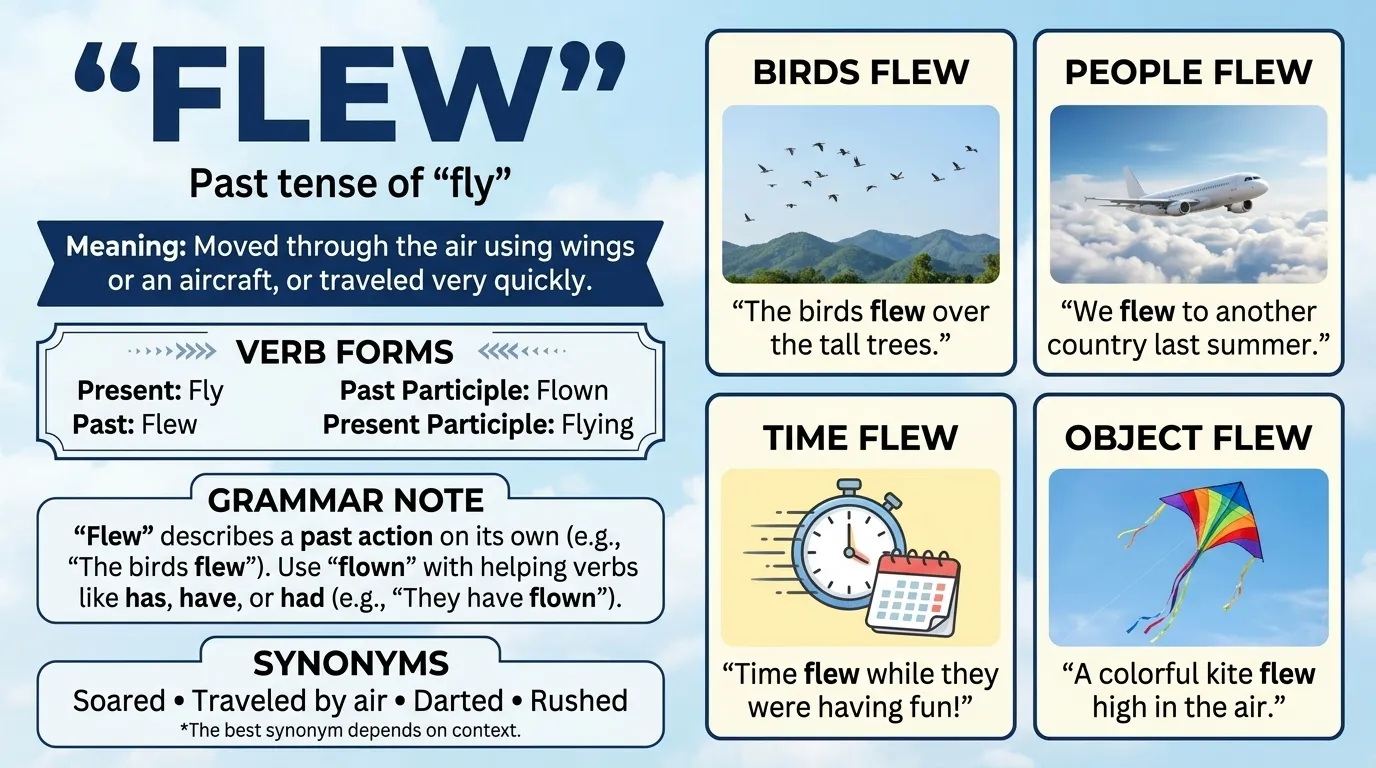
Synonyms of flew include soared, glided, hovered, darted, sailed, ascended, and sped. Flew is the past tense of fly. It describes movement through the air or rapid travel from one place to another. The best alternative depends on the subject, direction, speed, and context of the action.
Imagine watching a bird cross the morning sky. You could say it flew overhead. However, saying it soared or glided creates a clearer picture of its movement.
The word flew appears in everyday conversations, stories, travel descriptions, and news reports. It helps people describe movement, journeys, and even passing time.
Learning synonyms of flew helps students improve vocabulary. Bloggers and content writers can also use these alternatives to make their descriptions more engaging.
Daily English users benefit from knowing synonyms of flew because each alternative expresses a different type of movement, speed, direction, or emotion.
What Does Flew Really Mean?
Flew is the simple past tense of the irregular verb fly. It usually means moving through the air using wings, aircraft, or another means of flight.
It can also describe traveling quickly, moving suddenly, or passing rapidly.
Part of Speech: Verb (simple past tense)
Simple Definition: Moved through the air or traveled rapidly from one location to another.
Consider these examples:
- The eagle flew over the mountain.
- We flew to London last summer.
- The ball flew across the playground.
- The weekend flew by.
Native English speakers understand the meaning through context. A bird flying suggests physical movement. Time flying suggests that something passed surprisingly quickly.
The word itself does not express a strong emotion. However, the surrounding sentence can create excitement, fear, freedom, or urgency.
Connotative Meaning of Flew
(Connotation refers to the feelings, associations, or attitudes a word suggests beyond its literal definition.)
Positive Tone
Flew can suggest freedom, achievement, adventure, and progress.
Example: Her confidence grew as she flew toward her dreams.
Negative Tone
It may suggest panic, sudden departure, danger, or loss of control.
Example: The documents flew everywhere when the window opened.
Neutral Tone
It simply describes past movement or transportation without suggesting emotion.
Example: The plane flew from Dubai to Karachi.
The surrounding words determine whether flew feels exciting, frightening, peaceful, or ordinary.
Etymology and History of Flew
The word flew developed from the long history of the English verb fly.
Its linguistic roots reach back to Proto-Germanic, where related forms expressed movement through the air.
Old English (450–1100)
The Old English verb flēogan meant to fly or move through the air.
Its past-tense singular form was flēag. This form eventually developed into modern flew.
Middle English (1100–1500)
During Middle English, the verb appeared in forms such as flen and flyen. Its past-tense spelling gradually changed.
Writers used the word to describe birds, movement, and escape.
Modern English (1500–Present)
The spelling flew became established as the simple past tense of fly.
Today, it describes aviation, natural flight, rapid movement, and figurative experiences.
Pronunciation of Flew
American English (US)
IPA: /fluː/
British English (UK)
IPA: /fluː/
Both varieties generally pronounce flew the same way.
It rhymes with blue, true, and grew.
Syllables
Flew has one syllable.
Breakdown: flew
Affixation Pattern
- Root: fly (historically related to Old English flēogan)
- Prefix: None
- Suffix: None
Flew is an irregular past-tense form. It does not use the regular -ed ending.
Its verb forms are:
Fly – Flew – Flown
40 Synonyms of Flew With Meanings, Pronunciation, and Examples
The following alternatives describe different types of flight, airborne movement, and rapid travel.
Some are direct substitutes in specific contexts. Others require a different sentence structure because they describe a particular direction, speed, or style of movement.
Understanding these differences helps you choose words accurately.
1. Soared (Verb) — US /sɔrd/ | UK /sɔːd/
Meaning: Flew high into the air, often with smooth or impressive movement.
Tone/Register: Positive, descriptive, literary.
Example 1: The eagle soared above the valley.
Example 2: The glider soared over the green hills.
2. Glided (Verb) — US /ˈɡlaɪdɪd/ | UK /ˈɡlaɪdɪd/
Meaning: Moved smoothly through the air with little visible effort.
Tone/Register: Neutral, descriptive.
Example 1: The swan glided across the lake.
Example 2: The aircraft glided toward the runway.
3. Hovered (Verb) — US /ˈhʌvərd/ | UK /ˈhɒvəd/
Meaning: Remained suspended in the air near one position.
Tone/Register: Neutral, technical.
Example 1: The helicopter hovered above the stadium.
Example 2: A hummingbird hovered beside the flowers.
4. Darted (Verb) — US /ˈdɑrtɪd/ | UK /ˈdɑːtɪd/
Meaning: Moved suddenly and quickly in a particular direction.
Tone/Register: Energetic, descriptive.
Example 1: The small bird darted between the trees.
Example 2: A butterfly darted past my window.
5. Swooped (Verb) — US /swupt/ | UK /swuːpt/
Meaning: Flew downward quickly, often before rising again.
Tone/Register: Dramatic, descriptive.
Example 1: The owl swooped toward the field.
Example 2: A seagull swooped over our picnic table.
6. Sailed (Verb) — US /seɪld/ | UK /seɪld/
Meaning: Moved smoothly through the air, often in a graceful manner.
Tone/Register: Neutral, figurative.
Example 1: The paper plane sailed across the classroom.
Example 2: A colorful kite sailed above the beach.
7. Ascended (Verb) — US /əˈsɛndɪd/ | UK /əˈsendɪd/
Meaning: Moved upward toward a higher position.
Tone/Register: Formal, academic.
Example 1: The balloon ascended into the clouds.
Example 2: The aircraft ascended steadily after takeoff.
8. Descended (Verb) — US /dɪˈsɛndɪd/ | UK /dɪˈsendɪd/
Meaning: Moved downward from a higher position.
Tone/Register: Neutral, formal.
Example 1: The helicopter descended toward the landing pad.
Example 2: The eagle descended from the sky.
9. Zoomed (Verb) — US /zumd/ | UK /zuːmd/
Meaning: Moved through the air or another space at great speed.
Tone/Register: Informal, energetic.
Example 1: The toy rocket zoomed across the yard.
Example 2: The jet zoomed overhead.
10. Sped (Verb) — US /spɛd/ | UK /sped/
Meaning: Traveled rapidly from one place to another.
Tone/Register: Neutral, everyday English.
Example 1: The aircraft sped through the clear sky.
Example 2: The rescue helicopter sped toward the coast.
11. Whizzed (Verb) — US /wɪzd/ | UK /wɪzd/
Meaning: Moved very quickly, often making a light rushing sound.
Tone/Register: Informal, expressive.
Example 1: The ball whizzed past his head.
Example 2: A tiny drone whizzed above the garden.
12. Whirled (Verb) — US /wɜrld/ | UK /wɜːld/
Meaning: Moved rapidly while turning or spinning.
Tone/Register: Descriptive, literary.
Example 1: Dry leaves whirled through the air.
Example 2: The feather whirled in the strong wind.
13. Fluttered (Verb) — US /ˈflʌtərd/ | UK /ˈflʌtəd/
Meaning: Moved through the air with quick, light movements.
Tone/Register: Gentle, descriptive.
Example 1: The butterfly fluttered around the roses.
Example 2: A small bird fluttered near the balcony.
14. Flitted (Verb) — US /ˈflɪtɪd/ | UK /ˈflɪtɪd/
Meaning: Flew lightly and quickly between different places.
Tone/Register: Literary, descriptive.
Example 1: The sparrow flitted from branch to branch.
Example 2: Several moths flitted around the porch light.
15. Drifted (Verb) — US /ˈdrɪftɪd/ | UK /ˈdrɪftɪd/
Meaning: Moved slowly through the air under the influence of wind.
Tone/Register: Neutral, descriptive.
Example 1: The balloon drifted across the evening sky.
Example 2: A feather drifted past the open window.
16. Floated (Verb) — US /ˈfloʊtɪd/ | UK /ˈfləʊtɪd/
Meaning: Remained suspended or moved gently through the air.
Tone/Register: Neutral, gentle.
Example 1: The lantern floated above the crowd.
Example 2: Soap bubbles floated around the children.
17. Circled (Verb) — US /ˈsɜrkəld/ | UK /ˈsɜːkəld/
Meaning: Flew around a particular place in a circular path.
Tone/Register: Neutral, descriptive.
Example 1: The hawk circled above the farm.
Example 2: The plane circled the airport before landing.
18. Cruised (Verb) — US /kruzd/ | UK /kruːzd/
Meaning: Traveled through the air at a steady and comfortable speed.
Tone/Register: Neutral, aviation, professional.
Example 1: The airplane cruised above the clouds.
Example 2: The passenger jet cruised at a steady altitude.
19. Winged (Verb) — US /wɪŋd/ | UK /wɪŋd/
Meaning: Traveled through the air, especially by flying toward a destination.
Tone/Register: Literary, expressive.
Example 1: The birds winged their way south.
Example 2: The flock winged its way across the valley.
20. Swept (Verb) — US /swɛpt/ | UK /swept/
Meaning: Moved rapidly and smoothly across an area.
Tone/Register: Descriptive, literary.
Example 1: The eagle swept across the open field.
Example 2: A strong gust swept the leaves into the air.
21. Shot (Verb) — US /ʃɑt/ | UK /ʃɒt/
Meaning: Moved suddenly through the air at high speed.
Tone/Register: Informal, dramatic.
Example 1: The arrow shot across the field.
Example 2: The rocket shot into the night sky.
22. Bolted (Verb) — US /ˈboʊltɪd/ | UK /ˈbəʊltɪd/
Meaning: Moved away suddenly and very quickly.
Tone/Register: Informal, urgent.
Example 1: The frightened pigeon bolted from its perch.
Example 2: The bird bolted into the air when the dog barked.
23. Rushed (Verb) — US /rʌʃt/ | UK /rʌʃt/
Meaning: Moved rapidly through a space or toward a destination.
Tone/Register: Neutral, urgent.
Example 1: The aircraft rushed through the storm clouds.
Example 2: The wind rushed through the narrow valley.
24. Hurried (Verb) — US /ˈhɜrid/ | UK /ˈhʌrid/
Meaning: Traveled quickly because of urgency or limited time.
Tone/Register: Neutral, everyday English.
Example 1: The pilot hurried toward the airport.
Example 2: The birds hurried back to their nests before sunset.
25. Streaked (Verb) — US /strikt/ | UK /striːkt/
Meaning: Moved extremely quickly across the sky or another space.
Tone/Register: Dramatic, descriptive.
Example 1: A meteor streaked across the dark sky.
Example 2: The fighter jet streaked above the desert.
26. Plummeted (Verb) — US /ˈplʌmɪtɪd/ | UK /ˈplʌmɪtɪd/
Meaning: Fell or moved downward through the air very rapidly.
Tone/Register: Dramatic, often negative.
Example 1: The damaged drone plummeted toward the ground.
Example 2: The loose package plummeted from the aircraft.
27. Dived (Verb) — US /daɪvd/ | UK /daɪvd/
Meaning: Flew or moved sharply downward.
Tone/Register: Neutral, descriptive.
Example 1: The falcon dived toward its prey.
Example 2: The aircraft dived below the clouds.
Usage note: Dived is standard in both British and American English. The alternative past-tense form dove is also common in American English.
28. Climbed (Verb) — US /klaɪmd/ | UK /klaɪmd/
Meaning: Gained height while moving upward through the air.
Tone/Register: Neutral, aviation.
Example 1: The plane climbed above the mountain range.
Example 2: The eagle climbed higher on a warm air current.
29. Lifted Off (Phrasal Verb) — US /ˌlɪftɪd ˈɔf/ | UK /ˌlɪftɪd ˈɒf/
Meaning: Rose from the ground and began flying.
Tone/Register: Neutral, aviation.
Example 1: The helicopter lifted off at sunrise.
Example 2: The rocket lifted off without any delay.
30. Took Off (Phrasal Verb) — US /tʊk ˈɔf/ | UK /tʊk ˈɒf/
Meaning: Left the ground and began a flight.
Tone/Register: Neutral, conversational.
Example 1: Our plane took off at seven.
Example 2: The pigeon took off when I opened the gate.
31. Touched Down (Phrasal Verb) — US /tʌtʃt ˈdaʊn/ | UK /tʌtʃt ˈdaʊn/
Meaning: Completed a flight by landing on the ground or another surface.
Tone/Register: Neutral, aviation.
Example 1: The aircraft touched down safely.
Example 2: The helicopter touched down beside the hospital.
32. Landed (Verb) — US /ˈlændɪd/ | UK /ˈlændɪd/
Meaning: Reached a surface after traveling through the air.
Tone/Register: Neutral, everyday English.
Example 1: The bird landed on our fence.
Example 2: The flight landed earlier than expected.
33. Skimmed (Verb) — US /skɪmd/ | UK /skɪmd/
Meaning: Moved quickly and lightly just above a surface.
Tone/Register: Descriptive, literary.
Example 1: The seagull skimmed over the water.
Example 2: The drone skimmed above the grass.
34. Flapped (Verb) — US /flæpt/ | UK /flæpt/
Meaning: Moved the wings up and down to produce or maintain flight.
Tone/Register: Neutral, descriptive.
Example 1: The young bird flapped toward a nearby branch.
Example 2: The duck flapped its wings and rose into the air.
35. Flapped Away (Phrasal Verb) — US /flæpt əˈweɪ/ | UK /flæpt əˈweɪ/
Meaning: Departed by flying with repeated wing movements.
Tone/Register: Informal, descriptive.
Example 1: The pigeon flapped away from the balcony.
Example 2: The frightened crow flapped away into the trees.
36. Glided Down (Phrasal Verb) — US /ˈɡlaɪdɪd daʊn/ | UK /ˈɡlaɪdɪd daʊn/
Meaning: Descended smoothly through the air without sudden movement.
Tone/Register: Neutral, descriptive.
Example 1: The parachutist glided down toward the beach.
Example 2: The paper airplane glided down beside my desk.
37. Swooped Down (Phrasal Verb) — US /swupt daʊn/ | UK /swuːpt daʊn/
Meaning: Flew rapidly downward toward something.
Tone/Register: Dramatic, descriptive.
Example 1: The hawk swooped down toward the grass.
Example 2: The owl swooped down from the old tree.
38. Spiraled (Verb) — US /ˈspaɪrəld/ | UK /ˈspaɪrəld/
Meaning: Moved through the air along a circular or twisting path.
Tone/Register: Descriptive, technical.
Example 1: The falling leaf spiraled toward the pavement.
Example 2: The damaged model plane spiraled downward.
39. Whirred (Verb) — US /wɜrd/ | UK /wɜːd/
Meaning: Moved while producing a continuous mechanical buzzing sound.
Tone/Register: Descriptive, often mechanical.
Example 1: The drone whirred above the parking lot.
Example 2: The miniature helicopter whirred across the room.
40. Jetted (Verb) — US /ˈdʒɛtɪd/ | UK /ˈdʒetɪd/
Meaning: Traveled quickly by jet aircraft.
Tone/Register: Informal, travel-related.
Example 1: The singer jetted to Paris for a concert.
Example 2: The team jetted across the country for the final.
Synonyms of Flew by Tone
Different alternatives create different impressions. A peaceful movement needs different vocabulary from an emergency or dramatic action.
Positive Tone
- Soared
- Glided
- Sailed
- Floated
- Cruised
- Winged
These words often suggest grace, freedom, comfort, or effortless movement.
Neutral Tone
- Ascended
- Descended
- Circled
- Climbed
- Landed
- Lifted off
- Took off
- Touched down
These alternatives mainly describe physical movement, direction, or a particular stage of flight.
Negative or Dramatic Tone
- Plummeted
- Dived
- Bolted
- Shot
- Swooped down
- Spiraled
These words can suggest danger, urgency, sudden movement, or loss of control.
However, their emotional meaning still depends on context.
Playful or Informal Tone
- Zoomed
- Whizzed
- Darted
- Flitted
- Jetted
These alternatives make descriptions sound energetic and conversational.
Why does tone matter?
Compare these sentences:
The bird glided toward the ground.
The bird plummeted toward the ground.
The first sounds peaceful. The second suggests danger.
Both describe downward movement, but their emotional effects are very different.
Flew vs Close Alternatives
Although flew, soared, glided, and hovered describe airborne movement, they are not always interchangeable.
| Word | Meaning Difference | Tone | Best Usage |
|---|---|---|---|
| Flew | General movement through the air | Neutral | Everyday descriptions |
| Soared | Flew high or rose impressively | Positive | Birds, gliders, creative writing |
| Glided | Moved smoothly with little effort | Gentle | Smooth or unpowered flight |
| Hovered | Stayed airborne near one position | Neutral | Helicopters, drones, hummingbirds |
Flew vs Soared
Flew describes general airborne movement. Soared emphasizes height, smoothness, or impressive upward movement.
Example: The eagle soared above the mountains.
Use soared when you want readers to imagine a bird flying majestically.
Flew vs Glided
Glided emphasizes smooth movement with little visible effort.
Example: The glider moved silently through the valley.
Choose glided when describing gentle or controlled movement.
Flew vs Hovered
Hovered describes remaining airborne near one position rather than traveling across a distance.
Example: The rescue helicopter hovered above the building.
Use hovered when the subject stays almost stationary in the air.
How Flew Changes by Context
The meaning of flew changes depending on what is moving and how the sentence is structured.
Daily Conversation
People commonly use flew when discussing travel or sudden movement.
Example: We flew to Islamabad for the wedding.
In casual speech, took a flight is another natural expression.
Writing or Blogging
Travel bloggers often use flew when explaining journeys.
Example: We flew across the country before starting our road trip.
Words such as jetted or cruised can add variety when their specific meanings fit.
Professional or Academic Writing
Formal descriptions benefit from precise verbs.
Example: The aircraft ascended to its assigned altitude.
Technical writing may use climbed, descended, hovered, or touched down instead of the general verb flew.
Creative or Informal Writing
Storytelling allows more expressive vocabulary.
Example: The dragon soared above the sleeping village.
Creative writers may also use swooped, darted, fluttered, or streaked to create vivid images.
Figurative Usage
Flew can describe events that pass quickly.
Example: The afternoon flew by while we talked.
In this context, passed quickly is more accurate than soared or hovered.
Common Mistakes Learners Make
Understanding grammar and context is just as important as memorizing synonyms.
Mistake 1: Using Flew Instead of Flown
Incorrect: She has flew to Canada.
Correct: She has flown to Canada.
Flew is the simple past tense. Flown is the past participle.
Mistake 2: Using Soared for Every Type of Flight
Soared usually suggests impressive height, rising movement, or smooth flight.
It does not automatically replace flew in ordinary travel sentences.
Natural: We flew to Turkey yesterday.
Less natural: We soared to Turkey yesterday.
Mistake 3: Confusing Hovered With Flew
Hovered means remaining airborne near one position.
A helicopter can hover above a building, but it cannot hover across an entire country in the ordinary sense.
Mistake 4: Confusing Fled With Flew
Fled is the past tense of flee, meaning escaped from danger or an unwanted situation.
Flew is the past tense of fly.
Example: The family fled the burning building.
The word fled does not necessarily mean anyone traveled through the air.
Mistake 5: Overusing Dramatic Alternatives
Words such as plummeted, bolted, and streaked create strong mental images.
Avoid using them when the original action was ordinary or peaceful.
Precise vocabulary matters more than complicated vocabulary.
Native English Usage and Register Notes
Formal English
Academic and technical writing often favors precise alternatives such as ascended, descended, cruised, and hovered.
These words describe specific movements without unnecessary emotion.
Informal English
Everyday conversations commonly use flew, zoomed, took off, and jetted.
These expressions sound natural when discussing travel, activities, or quick movement.
Spoken English
Flew is extremely useful in conversation because it is short and easy to understand.
Example: I flew home last night.
Written English
Writers can select more descriptive alternatives when movement is important to the scene.
For additional vocabulary practice, explore related expressions in an article about synonyms of landing.
Real-Life Examples Using Flew
Workplace Scenario
A manager describes an urgent business journey.
Sentence: Our director flew to Dubai for an important meeting.
The sentence communicates travel without unnecessary detail.
Social Situation
Two friends discuss their recent holiday.
Sentence: We flew to Malaysia and spent a week exploring the city.
Flew sounds natural in everyday travel conversations.
Media and Pop Culture
A journalist describes a celebrity’s international schedule.
Sentence: The actor jetted to New York after the film premiere.
Jetted creates a lively and modern tone.
Creative Storytelling
An author describes a dramatic natural scene.
Sentence: The golden eagle soared above the snowy peaks.
Soared makes the image more expressive than the general verb flew.
Interactive Practice Quiz: Test Your Understanding
Choose the most suitable answer for each situation.
Part One: Meaning and Context
1. The eagle moved high above the mountain. Which word fits best?
A) Landed
B) Soared
C) Hovered
D) Plummeted
2. A helicopter remained in one position above a building. It:
A) Jetted
B) Drifted
C) Hovered
D) Landed
3. Which sentence uses the correct past tense?
A) She has flew home.
B) She flying home yesterday.
C) She fly home yesterday.
D) She flew home yesterday.
4. A paper plane moved smoothly across the room. It:
A) Glided
B) Bolted
C) Plummeted
D) Climbed
5. A hawk suddenly flew downward toward its prey. It:
A) Floated
B) Cruised
C) Swooped
D) Hovered
6. Which word best describes an aircraft beginning its flight?
A) Touched down
B) Took off
C) Descended
D) Landed
Part Two: Tone and Real-Life Usage
7. A damaged drone fell rapidly toward the ground. It:
A) Soared
B) Cruised
C) Hovered
D) Plummeted
8. Which word creates the most peaceful image?
A) Glided
B) Bolted
C) Shot
D) Plummeted
9. The singer traveled quickly to Paris by jet. She:
A) Circled
B) Fluttered
C) Jetted
D) Hovered
10. A meteor moved rapidly across the sky. It:
A) Floated
B) Streaked
C) Landed
D) Hovered
11. Which sentence correctly describes a completed flight?
A) The aircraft touched down safely.
B) The aircraft hovered across the ocean.
C) The aircraft soared on the runway.
D) The aircraft fluttered at the airport.
12. A butterfly moved lightly between flowers. It:
A) Cruised
B) Plummeted
C) Jetted
D) Flitted
13. Which word best describes a plane gaining altitude?
A) Landed
B) Climbed
C) Touched down
D) Descended
14. A seagull moved quickly just above the water. It:
A) Bolted
B) Ascended
C) Skimmed
D) Jetted
15. Which sentence uses flew figuratively?
A) The bird flew over the garden.
B) The plane flew to London.
C) The drone flew above the roof.
D) The weekend flew by.
Answer Key
1-B | 2-C | 3-D | 4-A | 5-C | 6-B | 7-D | 8-A | 9-C | 10-B | 11-A | 12-D | 13-B | 14-C | 15-D
Reflection and Application Task
Write one original sentence using a synonym of flew.
Choose a situation involving a bird, airplane, helicopter, or another flying object.
Then explain why your chosen synonym expresses the movement more accurately than flew.
Suggested External Reference
For additional linguistic accuracy, readers can explore the Cambridge Dictionary entry for fly. It provides pronunciation, grammatical forms, definitions, and examples of everyday English usage.
https://dictionary.cambridge.org/dictionary/english/fly
Conclusion
Learning synonyms of flew helps you describe movement with greater confidence. Each alternative adds a different feeling, direction, or level of detail.
Strong vocabulary makes writing and blogging more engaging. It also helps students express ideas clearly without relying on the same familiar words.
Using synonyms of flew in speaking improves communication. Simple changes can make your stories, travel experiences, and everyday descriptions more vivid.
Keep practicing synonyms of flew in emails, essays, and daily conversations. Try one new expression each day and enjoy watching your English vocabulary grow.
FAQs
1. What is another word for flew in a sentence about time?
When flew describes time passing quickly, suitable alternatives include passed quickly, raced by, sped past, and slipped away.
For example, instead of saying, “The weekend flew by,” you could write, “The weekend passed quickly.”
These expressions describe the feeling that time moved faster than expected. They do not refer to physical flight.
2. What are the best synonyms for flew away?
Suitable alternatives depend on how something departed.
Darted away suggests sudden, quick movement. Flapped away describes departure using wings. Drifted away suggests gentle movement caused by air.
For example, “The frightened bird darted away” creates a different image from “The balloon drifted away.”
Choose the alternative that matches the actual movement.
3. Can flew and flown be used interchangeably?
No. Flew and flown are different grammatical forms of the same irregular verb.
Flew is the simple past tense.
Example: She flew to London yesterday.
Flown is the past participle. It usually appears with auxiliary verbs such as has, have, or had.
Example: She has flown to London several times.
Using the correct form makes your English grammatically accurate.
4. What is a more formal way to say flew to another country?
For professional or formal writing, you can use traveled by air, departed by air, or took an international flight.
For example, “The delegation traveled by air to Singapore” sounds suitable for an official report.
However, flew is already acceptable in formal English. There is no need to replace it unless the alternative adds useful information.
5. What is the difference between flew and fled?
Flew is the past tense of fly. It usually describes movement through the air or travel by aircraft.
Fled is the past tense of flee. It means escaping from danger, trouble, or an unwanted situation.
For example, “The bird flew over the house” describes flight. “The residents fled the building” describes escape.
These words have different meanings despite their similar appearance.
6. Which synonyms of flew work best in poetry?
Poetry often benefits from expressive alternatives such as soared, glided, fluttered, drifted, and winged.
Soared can suggest freedom or ambition. Glided creates a peaceful image. Fluttered suggests delicate movement.
For example, “A lonely feather drifted through the evening air” creates a softer mood than “A feather flew through the air.”
The best choice depends on the image and emotion you want to communicate.
7. Is flew a regular or irregular verb?
Flew is an irregular verb form because it does not follow the standard past-tense pattern of adding -ed.
Its three main forms are fly, flew, and flown.
For example:
Present: Birds fly across the lake.
Past: Birds flew across the lake.
Past participle: Birds have flown across the lake.
Learning these forms helps English learners avoid common grammar mistakes.
8. What does the expression “flew off the handle” mean?
Flew off the handle is an English idiom meaning someone suddenly became very angry or lost emotional control.
For example, “He flew off the handle when he heard the news.”
The expression does not describe physical flight. It describes an emotional reaction.
Possible alternatives include lost his temper, became furious, and erupted in anger. These expressions are useful in conversations and storytelling.

Mehtab Yasir is a passionate writer and English language enthusiast dedicated to making vocabulary learning simple, practical, and enjoyable. As an author at SynonymDesk.com, she creates helpful content covering synonyms, antonyms, word meanings, vocabulary, phrases, and everyday English usage. Her goal is to provide clear and easy-to-understand information that helps students, writers, professionals, and English learners choose the right words and communicate with greater confidence. Mehtab believes that a strong vocabulary can improve both writing and communication skills. She enjoys researching new words, exploring their meanings and uses, and turning complex language concepts into useful, reader-friendly content. Through her work, she strives to make SynonymDesk.com a reliable resource for anyone looking to improve their English vocabulary and language skills.