Synonyms of veritable include words such as true, genuine, real, authentic, actual, factual, truthful, legitimate, confirmed, verified, and bona fide. The best synonym depends on whether you mean something genuinely real, factually true, officially confirmed, or completely authentic.
Synonyms of veritable can make your writing sound more precise. A student may use genuine in an essay, while a blogger may choose authentic for a natural tone.
Imagine a friend showing you a real antique. You might call it veritable, authentic, or genuine. Each word adds a slightly different shade.
Learning synonyms of veritable helps students, writers, bloggers, and daily English users avoid repeating the same word in every sentence.
The word veritable is useful when something is genuinely what it appears to be. Its alternatives help speakers choose between formal, neutral, factual, and conversational English.
What Does “Veritable” Really Mean?
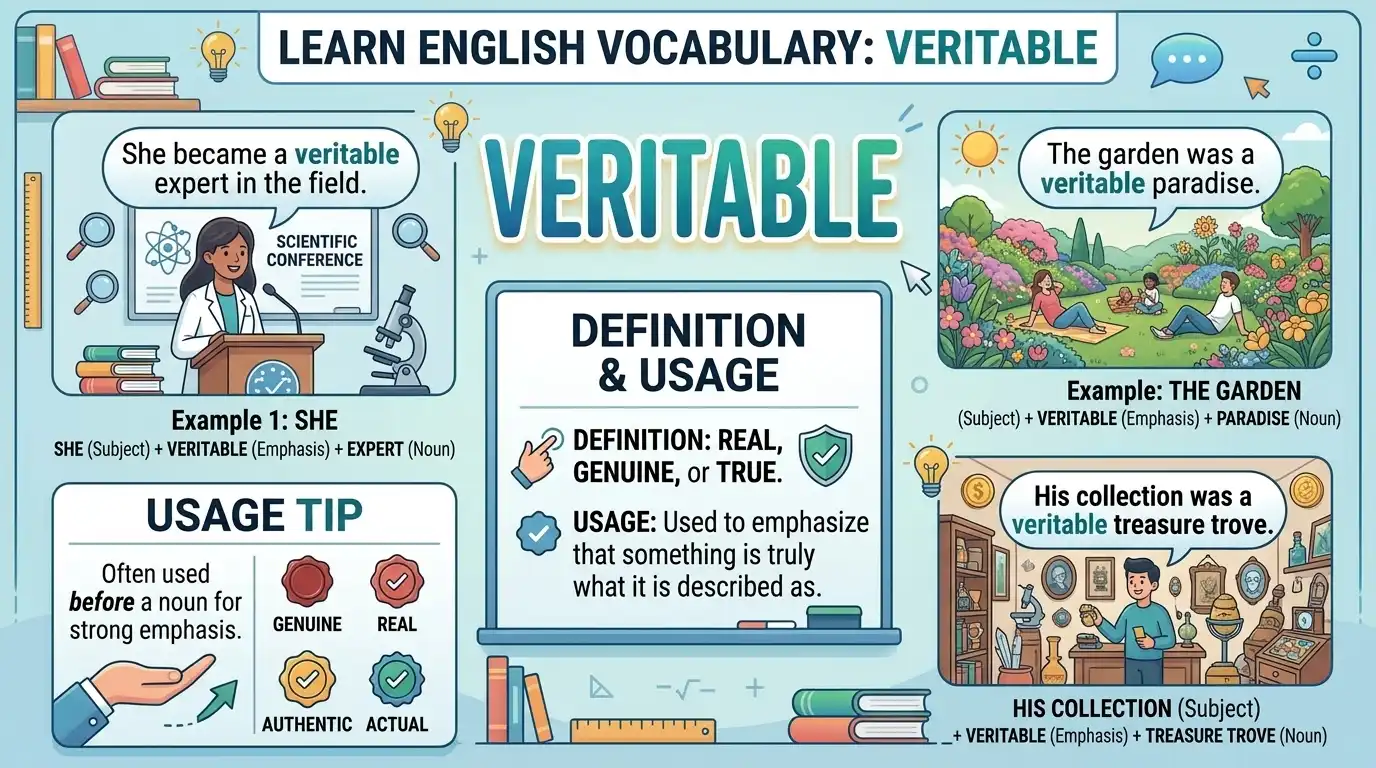
Veritable means real, genuine, true, or authentic, especially when emphasizing that something truly deserves the description given to it.
For example:
She was a veritable expert in ancient languages.
This means she was truly an expert, not merely someone who claimed to be one.
Part of speech: Adjective
Simple definition:
Veritable describes something that is genuinely or truly what it is said to be.
Native speakers often use veritable in formal, literary, journalistic, and expressive writing. It can add emphasis to a description.
Connotative Meaning
Connotation (the feeling or association a word creates beyond its basic dictionary meaning) can affect how veritable sounds.
Positive tone: It can emphasize something admirable, impressive, or authentic.
Negative tone: The word itself is not negative, but it can describe something unpleasant when the noun has a negative meaning.
Neutral tone: It can simply emphasize that something is genuinely or truly what it is described as.
For example:
- A veritable genius sounds strongly positive.
- A veritable disaster sounds strongly negative.
- A veritable fact emphasizes truth without necessarily adding emotion.
Etymology of Veritable
Veritable entered English through Old French and Middle French, from forms related to Latin veritas, meaning “truth,” and verus, meaning “true.”
Old English: 450–1100
The exact word veritable was not part of ordinary Old English vocabulary. English speakers instead used native Germanic words connected with ideas such as true, truth, and faithfulness.
Middle English: 1100–1500
After the Norman Conquest, French and Latin vocabulary strongly influenced English. Words associated with truth and certainty increasingly entered English through French and scholarly Latin.
Modern English: 1500–Present
Veritable developed into a formal adjective meaning genuinely or truly what something is described as. Modern English commonly uses it in phrases such as “a veritable treasure,” “a veritable expert,” and “a veritable disaster.”
Pronunciation of Veritable
US: /ˈverɪtəbəl/
UK: /ˈverɪtəbəl/
Syllables
ver-i-ta-ble
Affixation Pattern of Veritable
Root: related to Latin verus, meaning “true”
Prefix: none in the modern English form
Suffix: -able
The modern word developed historically through French rather than being formed directly in English by simply adding a suffix to true.
45 Synonyms of Veritable
The following words cover the main meanings associated with veritable, including genuine, true, authentic, factual, confirmed, and unquestionably real.
1. True (Adjective) — US /truː/ — UK /truː/
Meaning: True describes something that agrees with reality, fact, or what is actually the case.
Tone/Register: Neutral, everyday, academic
Example:
The story is true and well documented.
She proved that his statement was true.
2. Genuine (Adjective) — US /ˈdʒenjuɪn/ — UK /ˈdʒenjuɪn/
Meaning: Genuine means real, sincere, or not fake or artificial.
Tone/Register: Neutral, formal, everyday
Example:
The museum confirmed that the painting is genuine.
Her genuine smile made everyone feel welcome.
3. Real (Adjective) — US /riːl/ — UK /rɪəl/
Meaning: Real refers to something that actually exists or is not imaginary, fake, or artificial.
Tone/Register: Everyday, neutral
Example:
The danger was real.
He wanted to know whether the opportunity was real.
4. Authentic (Adjective) — US /ɔːˈθentɪk/ — UK /ɔːˈθentɪk/
Meaning: Authentic means genuinely belonging to the claimed source, origin, or identity.
Tone/Register: Formal, academic, cultural
Example:
The restaurant serves authentic regional dishes.
Experts confirmed that the document was authentic.
5. Actual (Adjective) — US /ˈæktʃuəl/ — UK /ˈæktʃuəl/
Meaning: Actual refers to something that really exists or happened rather than something imagined or estimated.
Tone/Register: Neutral, academic, professional
Example:
The actual cost was lower than expected.
We finally learned the actual reason for the delay.
6. Factual (Adjective) — US /ˈfæktʃuəl/ — UK /ˈfæktʃuəl/
Meaning: Factual describes information that is based on facts rather than opinions or inventions.
Tone/Register: Academic, professional, journalistic
Example:
Please keep the report factual.
The article provides factual information about the event.
7. Truthful (Adjective) — US /ˈtruːθfəl/ — UK /ˈtruːθfəl/
Meaning: Truthful describes a person, statement, or account that does not contain deliberate lies.
Tone/Register: Neutral, formal
Example:
She gave a truthful answer.
A truthful account helped resolve the disagreement.
8. Legitimate (Adjective) — US /ləˈdʒɪtəmət/ — UK /lɪˈdʒɪtɪmət/
Meaning: Legitimate can mean genuine, lawful, or officially acceptable.
Tone/Register: Formal, legal, professional
Example:
The company is a legitimate business.
He had a legitimate reason for missing the meeting.
9. Bona Fide (Adjective) — US /ˌboʊnə ˈfaɪdi/ — UK /ˌbəʊnə ˈfaɪdi/
Meaning: Bona fide means genuine, sincere, or officially real.
Tone/Register: Formal, legal, business
Example:
She is a bona fide expert in the field.
The organization accepted him as a bona fide member.
10. Undisputed (Adjective) — US /ˌʌndɪˈspjuːtɪd/ — UK /ˌʌndɪˈspjuːtɪd/
Meaning: Undisputed describes something that is accepted as true because no one is successfully challenging it.
Tone/Register: Formal, academic, journalistic
Example:
Her talent is undisputed.
He became the undisputed leader of the team.
11. Unquestionable (Adjective) — US /ʌnˈkwestʃənəbəl/ — UK /ʌnˈkwestʃənəbəl/
Meaning: Unquestionable means so clear or certain that it is not reasonably open to doubt.
Tone/Register: Formal, emphatic
Example:
Her dedication is unquestionable.
The evidence provided an unquestionable answer.
12. Indisputable (Adjective) — US /ˌɪndɪˈspjuːtəbəl/ — UK /ˌɪndɪˈspjuːtəbəl/
Meaning: Indisputable describes something that cannot reasonably be denied or challenged.
Tone/Register: Formal, academic
Example:
The evidence was indisputable.
His influence on the industry is indisputable.
13. Certain (Adjective) — US /ˈsɜːrtən/ — UK /ˈsɜːtən/
Meaning: Certain means known or believed to be true without significant doubt.
Tone/Register: Neutral, formal
Example:
I am certain that she told the truth.
The result is not yet certain.
14. Sure (Adjective) — US /ʃʊr/ — UK /ʃʊə/
Meaning: Sure means confident that something is true or correct.
Tone/Register: Everyday, informal, neutral
Example:
Are you sure this information is accurate?
She was sure that she had locked the door.
15. Confirmed (Adjective) — US /kənˈfɜːrmd/ — UK /kənˈfɜːmd/
Meaning: Confirmed means officially established as true or correct.
Tone/Register: Professional, neutral, journalistic
Example:
The meeting date is confirmed.
Police confirmed the details of the report.
16. Verified (Adjective) — US /ˈverɪfaɪd/ — UK /ˈverɪfaɪd/
Meaning: Verified means checked and shown to be accurate, genuine, or true.
Tone/Register: Professional, technical, academic
Example:
The information has been verified.
Use only verified sources for your research.
17. Substantiated (Adjective) — US /səbˈstænʃieɪtɪd/ — UK /səbˈstænʃieɪtɪd/
Meaning: Substantiated means supported by evidence or convincing facts.
Tone/Register: Formal, academic, professional
Example:
The report contained substantiated claims.
Her concerns were later substantiated by evidence.
18. Established (Adjective) — US /ɪˈstæblɪʃt/ — UK /ɪˈstæblɪʃt/
Meaning: Established describes something accepted as true, known, or firmly proven over time.
Tone/Register: Academic, professional
Example:
The research is based on facts.
It is an established principle in science.
19. Documented (Adjective) — US /ˈdɑːkjəmentɪd/ — UK /ˈdɒkjumentɪd/
Meaning: Documented means supported or recorded by written, visual, or official evidence.
Tone/Register: Formal, academic, professional
Example:
The event is well documented.
We found documented evidence of the agreement.
20. Attested (Adjective) — US /əˈtestɪd/ — UK /əˈtestɪd/
Meaning: Attested means supported by reliable evidence or recorded proof.
Tone/Register: Formal, academic, linguistic
Example:
The word is attested in early English texts.
The historical claim is well attested.
21. Proven (Adjective) — US /ˈpruːvən/ — UK /ˈpruːvən/
Meaning: Proven describes something shown to be true, effective, or reliable through evidence or experience.
Tone/Register: Neutral, professional, academic
Example:
The method is proven to work.
She has a proven record of success.
22. Demonstrable (Adjective) — US /dɪˈmɑːnstrəbəl/ — UK /dɪˈmɒnstrəbəl/
Meaning: Demonstrable means capable of being shown or supported with evidence.
Tone/Register: Academic, formal
Example:
The project produced demonstrable results.
There was a demonstrable performance improvement.
23. Concrete (Adjective) — US /ˈkɑːnkriːt/ — UK /ˈkɒŋkriːt/
Meaning: Concrete describes something definite, specific, and supported by observable evidence rather than vague ideas.
Tone/Register: Professional, academic
Example:
We need concrete evidence before making a decision.
The proposal includes several concrete examples.
24. Objective (Adjective) — US /əbˈdʒektɪv/ — UK /əbˈdʒektɪv/
Meaning: Objective describes information based on observable facts rather than personal feelings or bias.
Tone/Register: Academic, professional
Example:
The report should present objective information.
Try to give an objective assessment of the situation.
25. Accurate (Adjective) — US /ˈækjərət/ — UK /ˈækjərət/
Meaning: Accurate means correct and free from important errors.
Tone/Register: Neutral, academic, professional
Example:
The article contains accurate information.
Please make sure the figures are accurate.
26. Correct (Adjective) — US /kəˈrekt/ — UK /kəˈrekt/
Meaning: Correct means free from mistakes and matching the facts or accepted standard.
Tone/Register: Everyday, academic, professional
Example:
Your answer is correct.
She gave the correct address.
27. Faithful (Adjective) — US /ˈfeɪθfəl/ — UK /ˈfeɪθfəl/
Meaning: Faithful can describe something that accurately represents an original, source, or version.
Tone/Register: Formal, literary, academic
Example:
The film is a faithful adaptation of the novel.
The translation remains faithful to the original meaning.
28. Trustworthy (Adjective) — US /ˈtrʌstwɜːrði/ — UK /ˈtrʌstwɜːði/
Meaning: Trustworthy describes a person or source that can be relied upon to be honest and dependable.
Tone/Register: Neutral, everyday, professional
Example:
She is a trustworthy colleague.
Choose trustworthy sources for your assignment.
29. Reliable (Adjective) — US /rɪˈlaɪəbəl/ — UK /rɪˈlaɪəbəl/
Meaning: Reliable describes something or someone that consistently provides dependable information or results.
Tone/Register: Neutral, professional
Example:
This is a reliable source of information.
We need reliable data before publishing the report.
30. Sincere (Adjective) — US /sɪnˈsɪr/ — UK /sɪnˈsɪə/
Meaning: Sincere means genuine in feelings, intentions, or expression.
Tone/Register: Neutral, formal, personal
Example:
She gave him a sincere apology.
His sincere appreciation was obvious.
31. Honest (Adjective) — US /ˈɑːnɪst/ — UK /ˈɒnɪst/
Meaning: Honest describes someone or something that expresses truth without deliberate deception.
Tone/Register: Everyday, neutral
Example:
Please give me an honest opinion.
He was honest about his mistake.
32. Unfeigned (Adjective) — US /ʌnˈfeɪnd/ — UK /ʌnˈfeɪnd/
Meaning: Unfeigned means genuine and not pretended or artificial.
Tone/Register: Formal, literary
Example:
She showed unfeigned concern for the child.
His unfeigned enthusiasm impressed the audience.
33. Unadulterated (Adjective) — US /ˌʌnəˈdʌltəreɪtɪd/ — UK /ˌʌnəˈdʌltəreɪtɪd/
Meaning: Unadulterated means pure and not mixed with anything that changes its original quality.
Tone/Register: Formal, descriptive
Example:
The village offered unadulterated natural beauty.
He enjoyed the unadulterated joy of the moment.
34. Pure (Adjective) — US /pjʊr/ — UK /pjʊə/
Meaning: Pure can mean unmixed, genuine, or free from something unwanted.
Tone/Register: Everyday, literary
Example:
Her excitement was pure and spontaneous.
The artist was driven by pure curiosity.
35. Unmistakable (Adjective) — US /ˌʌnmɪˈsteɪkəbəl/ — UK /ˌʌnmɪˈsteɪkəbəl/
Meaning: Unmistakable means so clear or distinctive that it cannot easily be confused with something else.
Tone/Register: Neutral, formal
Example:
There was an unmistakable change in his voice.
Her style has an unmistakable elegance.
36. Veracious (Adjective) — US /vəˈreɪʃəs/ — UK /vəˈreɪʃəs/
Meaning: Veracious means truthful, accurate, and committed to telling the truth.
Tone/Register: Formal, literary
Example:
The historian was known for veracious reporting.
The witness gave a veracious account.
37. Fact-Based (Adjective) — US /ˈfækt beɪst/ — UK /ˈfækt beɪst/
Meaning: Fact-based describes information or writing that relies primarily on facts.
Tone/Register: Academic, journalistic, professional
Example:
The article takes a fact-based approach.
Students should support their arguments with fact-based evidence.
38. Well-Founded (Adjective) — US /ˌwel ˈfaʊndɪd/ — UK /ˌwel ˈfaʊndɪd/
Meaning: Well-founded describes a belief, claim, or conclusion supported by good reasons or evidence.
Tone/Register: Formal, academic
Example:
Her concerns were well-founded.
The researcher presented a well-founded argument.
39. Well-Established (Adjective) — US /ˌwel ɪˈstæblɪʃt/ — UK /ˌwel ɪˈstæblɪʃt/
Meaning: Well-established describes something widely accepted because it has strong evidence or a long history of recognition.
Tone/Register: Academic, professional
Example:
It is a well-established scientific principle.
The technique is well-established in modern research.
40. Beyond Doubt (Phrase) — US /bɪˈjɑːnd daʊt/ — UK /bɪˈjɒnd daʊt/
Meaning: Beyond doubt means completely certain and not reasonably open to question.
Tone/Register: Formal, emphatic
Example:
Her talent is beyond doubt.
The evidence placed his identity beyond doubt.
41. Undeniable (Adjective) — US /ˌʌndɪˈnaɪəbəl/ — UK /ˌʌndɪˈnaɪəbəl/
Meaning: Undeniable means impossible or very difficult to reasonably deny.
Tone/Register: Neutral, formal, emphatic
Example:
She has undeniable talent.
The results show an undeniable improvement.
42. Unquestioned (Adjective) — US /ʌnˈkwestʃənd/ — UK /ʌnˈkwestʃənd/
Meaning: Unquestioned describes something accepted without serious challenge or doubt.
Tone/Register: Formal, academic
Example:
His authority remained unquestioned for years.
The tradition was once considered unquestioned.
43. Certified (Adjective) — US /ˈsɜːrtəfaɪd/ — UK /ˈsɜːtɪfaɪd/
Meaning: Certified describes something officially examined and confirmed as meeting a particular standard.
Tone/Register: Professional, official
Example:
The document is certified as authentic.
She is a certified language teacher.
44. Credible (Adjective) — US /ˈkredəbəl/ — UK /ˈkredəbəl/
Meaning: Credible means believable or worthy of trust because it appears reliable or well supported.
Tone/Register: Neutral, academic, professional
Example:
The journalist used a credible source.
His explanation sounded credible.
45. Substantial (Adjective) — US /səbˈstænʃəl/ — UK /səbˈstænʃəl/
Meaning: Substantial can describe something significant or firmly supported, especially when evidence or achievement is involved.
Tone/Register: Formal, academic, professional
Example:
The researchers found substantial evidence.
The project made substantial progress this year.
Synonyms of Veritable by Tone
Positive Synonyms
Words such as genuine, authentic, sincere, trustworthy, faithful, pure, bona fide, and unadulterated often create a positive impression.
They work well when discussing people, emotions, cultural objects, achievements, or experiences.
For example, genuine suggests sincerity, while authentic often suggests originality or cultural accuracy.
Neutral Synonyms
True, real, actual, factual, accurate, correct, confirmed, verified, established, and documented are generally neutral.
These words are useful when the goal is simply to communicate information clearly.
Negative Contexts
The word veritable itself is not negative. However, it can emphasize an unpleasant reality.
For example:
The town became a veritable disaster zone after the storm.
In this sentence, veritable means genuinely or truly, while disaster provides the negative meaning.
Similar neutral or emphatic words include actual, undeniable, unquestionable, and indisputable.
Formal or Literary Synonyms
Veracious, unfeigned, attested, substantiated, demonstrable, bona fide, and well-founded are more formal.
They are particularly useful in academic writing, journalism, professional communication, and literary prose.
Informal Alternatives
In everyday speech, people usually prefer simple words such as real, true, genuine, sure, and honest.
Using veritable in casual conversation can sound more formal or literary than necessary.
Why Tone Matters in Word Choice
A synonym is not always a perfect replacement.
For example, real is natural in everyday conversation, while substantiated is more appropriate when discussing evidence.
Similarly, authentic is ideal for originality or cultural genuineness, while verified focuses on checking information.
Choosing the right synonym makes your writing sound more natural and precise.
“Veritable” vs Close Alternatives
Veritable vs Genuine
- Veritable emphasizes that something truly fits the description being given.
- Genuine emphasizes that something is real, sincere, or not fake.
- Use veritable for strong descriptive emphasis.
- Use genuine when discussing authenticity or sincerity.
Authentic vs Veritable
Veritable means genuinely or truly what something is described as.
Authentic usually means original, genuine, or faithful to its claimed source.
For example, an authentic painting is genuinely from the claimed artist, while a veritable masterpiece emphasizes that the painting truly deserves that description.
Veritable vs True
True is much more common in everyday English.
Veritable is more formal and emphatic.
Use true for simple communication. Use veritable when you want a stronger descriptive effect.
How “Veritable” Changes by Context
Daily Conversation
In daily conversation, real, true, and genuine are usually more natural than veritable.
Instead of saying, “That was a veritable surprise,” most speakers might say, “That was a real surprise.”
Writing and Blogging
Bloggers can use veritable when they want a sentence to sound expressive without becoming overly dramatic.
For example:
The city is a veritable paradise for book lovers.
The word adds emphasis and gives the sentence a polished written style.
Professional or Academic Writing
Academic writing usually benefits from more precise alternatives.
Use verified, documented, substantiated, or factual when evidence matters.
For example:
The researchers used verified data.
This is more precise than simply calling the information veritable.
Creative or Informal Writing
Creative writers can use veritable for emphasis and style.
For example:
The tiny kitchen became a veritable battlefield during the cooking competition.
Here, the word creates an expressive comparison.
Common Mistakes Learners Make
Mistake 1: Treating Every Synonym as Identical
Not every synonym can replace veritable in every sentence.
Verified focuses on checking facts, while genuine focuses on authenticity.
Mistake 2: Using Veritable Too Often
Veritable is less common than real, true, or genuine.
Repeated use can make ordinary writing sound unnecessarily formal.
Mistake 3: Confusing Veritable With Verifiable
These words look similar but have different meanings.
Veritable means genuinely or truly what is described.
Verifiable means capable of being checked or proven.
Mistake 4: Assuming Veritable Means “Verified”
A veritable expert means a person who truly deserves to be called an expert.
A verified expert suggests that someone or something has been officially checked or confirmed.
Register Notes
Veritable is mainly associated with formal, written, literary, and expressive English.
Real, true, honest, and genuine are more natural in ordinary conversation.
Substantiated, attested, demonstrable, and verified are particularly useful when evidence is important.
For more vocabulary practice, you can connect this topic with other synonym-focused vocabulary articles on your site.
Real-Life Mini Scenarios
Workplace
A manager may describe a successful employee as a veritable leader.
A formal report might instead call the employee an established or proven leader.
Social Situations
If someone gives you a heartfelt apology, you may describe it as genuine or sincere.
Using veritable would sound more formal.
Media and Pop Culture
A journalist might describe a performer as a veritable icon to emphasize that the person truly deserves that description.
In everyday conversation, real icon or true icon may sound more natural.
Writing and Storytelling
A novelist might write:
The old library was a veritable treasure house.
A simpler version would be:
The old library was a real treasure.
Both communicate the basic idea, but veritable creates a more literary tone.
When Should You Use “Veritable”?
Use veritable when you want to emphasize that something genuinely deserves the description that follows.
It works especially well in phrases such as:
- a veritable expert
- a veritable genius
- a veritable treasure
- a veritable paradise
- a veritable disaster
- a veritable masterpiece
- a veritable feast
The structure is often:
veritable + noun
This makes the word particularly useful for expressive descriptive writing.
Interactive Practice Quiz
Part One
1. Which synonym of veritable is most suitable for something that is not fake?
A. Genuine
B. Substantial
C. Demonstrable
D. Established
2. Which word is best for information that has been checked?
A. Sincere
B. Verified
C. Pure
D. Faithful
3. Which word is most natural in everyday speech?
A. Attested
B. Substantiated
C. Real
D. Unfeigned
4. Which synonym best describes an original cultural product?
A. Authentic
B. Certain
C. Concrete
D. Correct
5. Which word means supported by evidence?
A. Substantiated
B. Honest
C. Sure
D. Pure
6. Which word best describes a person who tells the truth?
A. Truthful
B. Actual
C. Concrete
D. Certified
7. Which word suggests official confirmation?
A. Verified
B. Real
C. Sincere
D. Pure
Part Two
8. Which word fits an academic report based on facts?
A. Factual
B. Playful
C. Sincere
D. Pure
9. Which synonym means impossible to reasonably deny?
A. Indisputable
B. Faithful
C. Honest
D. Reliable
10. Which word best describes a sincere feeling that is not pretended?
A. Unfeigned
B. Actual
C. Certified
D. Concrete
11. Which word is closest to “believable and worthy of trust”?
A. Credible
B. Unadulterated
C. Substantial
D. Certain
12. Which word means capable of being demonstrated with evidence?
A. Demonstrable
B. Genuine
C. Honest
D. Sure
13. Which synonym works best when something is officially recognized as genuine?
A. Certified
B. Real
C. True
D. Sincere
14. Which phrase means completely certain?
A. Beyond doubt
B. Well-founded
C. Fact-based
D. Faithful
15. Which synonym is especially suitable for a reliable source?
A. Trustworthy
B. Pure
C. Unfeigned
D. Veracious
Reflection Task: Choose one synonym of veritable and write your own sentence about school, work, family, travel, or everyday life.
Answer Key: 1-A | 2-B | 3-C | 4-A | 5-A | 6-A | 7-A | 8-A | 9-A | 10-A | 11-A | 12-A | 13-A | 14-A | 15-A
Frequently Asked Questions
1. What is the closest synonym of veritable in everyday English?
The closest everyday alternatives are usually real, true, or genuine. The best choice depends on context. Real is highly conversational, true focuses on truth, and genuine often emphasizes authenticity. Veritable is more formal and is frequently used to emphasize that something truly deserves the description that follows.
2. Is veritable a positive or negative word?
Veritable is generally neutral in itself. Its emotional effect comes from the noun or description that follows it. For example, “a veritable masterpiece” has a positive meaning, while “a veritable disaster” has a negative meaning. The word mainly adds emphasis rather than expressing a positive or negative judgment itself.
3. What is the difference between veritable and authentic?
Veritable emphasizes that something truly deserves a particular description. Authentic usually means genuine, original, or faithful to its claimed source. For example, “a veritable genius” emphasizes the person’s true status, while “an authentic painting” emphasizes that the painting is genuinely from its claimed source.
4. Can veritable be used in academic writing?
Yes, but it should be used selectively. Veritable is grammatically appropriate in academic writing, especially when making an expressive description. However, technical writing often benefits from more precise terms such as verified, documented, factual, or substantiated when evidence or accuracy is the main concern.
5. Is veritable the same as verified?
No. Veritable means genuinely or truly what something is described as. Verified means that something has been checked and confirmed. A “veritable expert” is genuinely an expert, while “verified information” is information that has been checked for accuracy or authenticity.
6. Why does veritable sound formal?
The word has strong French and Latin historical connections and is more common in formal, literary, journalistic, and written English than in casual conversation. Native speakers generally understand it easily, but everyday speakers often choose simpler words such as real, true, or genuine.
7. What is a good synonym for veritable in an essay?
Genuine, authentic, factual, true, actual, verified, and substantiated can work well depending on the sentence. For an essay, choose the word that matches your intended meaning rather than replacing veritable automatically. Precision is more important than using a sophisticated-sounding synonym.
Conclusion
Learning the synonyms of veritable gives you more ways to express truth, authenticity, certainty, and genuineness without repeating the same word.
Words such as genuine, authentic, true, verified, factual, and credible each carry a slightly different meaning and tone.
These alternatives can improve essays, blog posts, emails, conversations, and professional communication by helping you choose more precise vocabulary.
Start practicing today. Pick three synonyms, write one sentence for each, and use them naturally in your next email, essay, or daily conversation.

Mehtab Yasir is a passionate writer and English language enthusiast dedicated to making vocabulary learning simple, practical, and enjoyable. As an author at SynonymDesk.com, she creates helpful content covering synonyms, antonyms, word meanings, vocabulary, phrases, and everyday English usage. Her goal is to provide clear and easy-to-understand information that helps students, writers, professionals, and English learners choose the right words and communicate with greater confidence. Mehtab believes that a strong vocabulary can improve both writing and communication skills. She enjoys researching new words, exploring their meanings and uses, and turning complex language concepts into useful, reader-friendly content. Through her work, she strives to make SynonymDesk.com a reliable resource for anyone looking to improve their English vocabulary and language skills.