Synonyms of were are not simple one-word replacements because were is an irregular past-tense form of the verb be. Depending on context, it can express existence, location, condition, identity, appearance, or a past action in progress. The best substitute therefore depends on the sentence.
Synonyms of were can make writing more varied when repetition becomes noticeable. A student might replace “They were present” with “They remained present” when the context supports it.
Writers often use were because it is one of English’s most common verbs. Learning contextual alternatives helps students, bloggers, and content writers create clearer sentences.
For daily English users, understanding synonyms of were also makes grammar easier. You learn when were should stay and when another expression sounds more natural.
The key is accuracy. A replacement should preserve the original meaning instead of simply changing a word for variety.
What Does “Were” Really Mean?
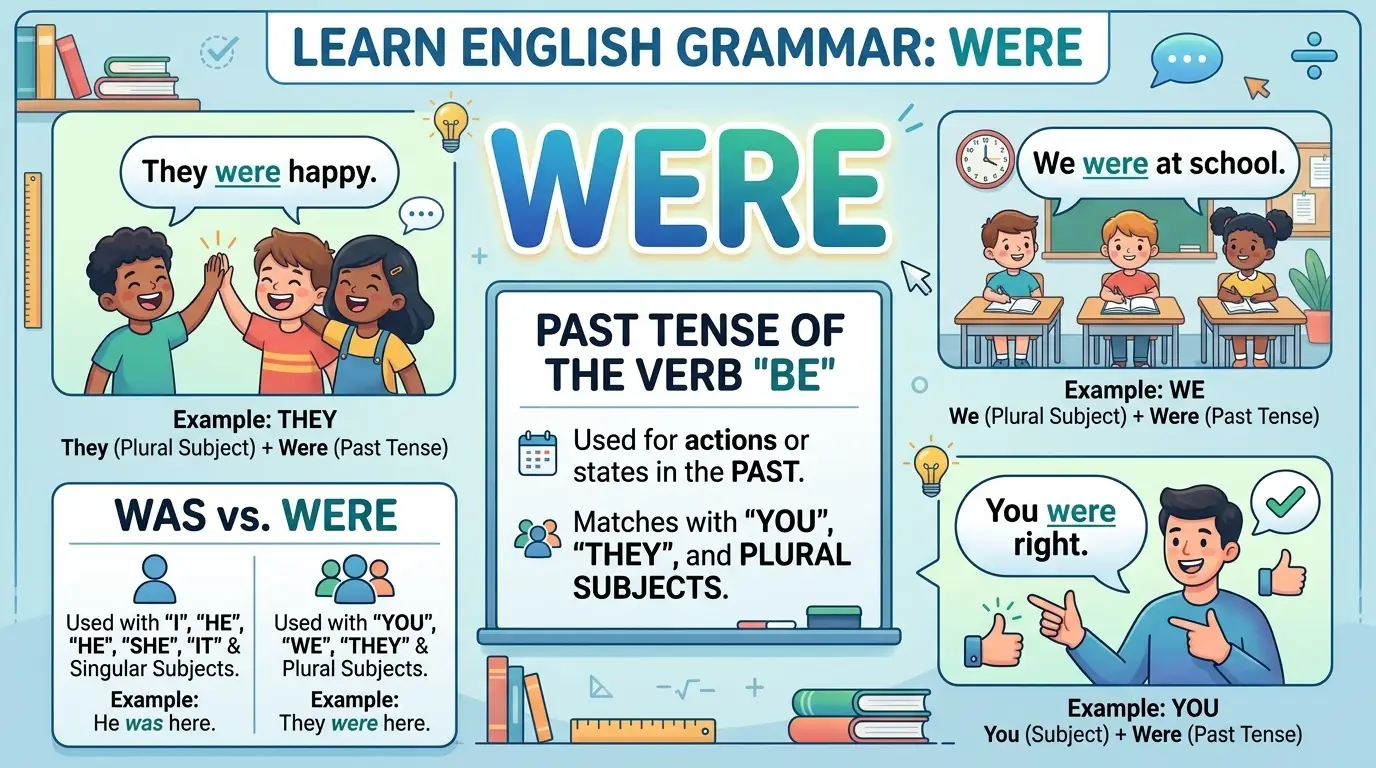
Were is a past-tense form of the irregular verb be. It is commonly used with you, we, they, and plural nouns.
Examples include:
- They were happy.
- We were at home.
- You were correct.
- The books were on the desk.
It can also appear with the subjunctive mood, especially in hypothetical statements:
If I were you, I would apologize.
Cambridge Dictionary identifies were as a past form of be and notes its use in hypothetical or possible conditions.
Part of Speech
Were is a verb, specifically an inflected form of the irregular verb be.
Simple Definition
Were: the past-tense form of be used mainly with you, plural subjects, and hypothetical if clauses.
Common Contexts
Were commonly appears when talking about:
- Past states
- Past locations
- Past identities
- Past conditions
- Past descriptions
- Past continuous actions
- Passive constructions
- Hypothetical situations
🧠 Connotative Meaning
Connotation (the feeling or association a word can carry beyond its basic dictionary meaning) varies according to the sentence.
Positive Tone
Were can appear in positive descriptions.
Example:
“They were delighted with the result.”
Negative Tone
It can also describe an unpleasant past condition.
Example:
“They were disappointed by the decision.”
Neutral Tone
Most uses of were are neutral and simply describe a past fact.
Example:
“They were at school yesterday.”
The word itself does not normally carry a strong emotional attitude. The surrounding vocabulary creates the tone.
📖 Etymology of “Were”
The history of were is especially interesting because modern English be is made from forms that came from more than one historical verb.
Etymonline traces were to Old English forms including wæron, the plural past indicative of wesan, and wære, an earlier second-person singular and subjunctive form.
Old English: 450–1100
Old English had several forms expressing ideas now covered by be. The past plural form included wæron, while wære had other grammatical functions.
The verb system was much more varied than modern English.
Middle English: 1100–1500
During Middle English, different forms of be gradually developed and merged. Forms related to were continued to express past states and plural subjects.
English grammar gradually moved toward the system familiar today.
Modern English: 1500–Present
Modern English uses were primarily as the past form of be for plural subjects and you. It also remains important in hypothetical constructions such as “If I were…”
The modern verb be represents a historical merger of different verb forms.
🔊 Pronunciation of “Were”
US: /wɝː/
UK: /wɜː/
In connected speech, the pronunciation may become shorter and less prominent.
Syllables
were
It is a one-syllable word.
Affixation Pattern of “Were”
Root: historically connected with the wes- family of forms associated with being or remaining.
Prefix: none.
Suffix: none.
Modern were is an irregular inflected form rather than a word formed by adding a normal prefix or suffix.
Contextual Alternatives to “Were”
Important linguistic note: There are no 40 exact synonyms for were. Because were is a grammatical form of be, replacing it depends heavily on what the original sentence means. The following 40 words and phrases are contextual alternatives, not interchangeable synonyms in every sentence.
1. Existed (verb) — US /ɪɡˈzɪstɪd/ | UK /ɪɡˈzɪstɪd/
Meaning: Means that someone or something was real or present in existence.
Tone/Register: Neutral, academic.
Example:
Ancient settlements existed near the river.
Several traditions existed before the reform.
2. Remained (verb) — US /rɪˈmeɪnd/ | UK /rɪˈmeɪnd/
Meaning: Means continued to be in a particular state or place.
Tone/Register: Neutral, formal.
Example:
They remained calm during the meeting.
The doors remained open all evening.
3. Stayed (verb) — US /steɪd/ | UK /steɪd/
Meaning: Means continued to be somewhere or continued in a condition.
Tone/Register: Informal, everyday.
Example:
We stayed at the hotel overnight.
The children stayed quiet during the movie.
4. Lived (verb) — US /lɪvd/ | UK /lɪvd/
Meaning: Describes having a home or existing as a living person.
Tone/Register: Neutral.
Example:
They lived in a small village.
Her grandparents lived nearby.
5. Resided (verb) — US /rɪˈzaɪdɪd/ | UK /rɪˈzaɪdɪd/
Meaning: Means lived in a particular place, usually in formal language.
Tone/Register: Formal, legal.
Example:
The family resided in Lahore for several years.
The author resided abroad during that period.
6. Dwelled (verb) — US /dweld/ | UK /dweld/
Meaning: Means lived in a particular place, often with a literary feeling.
Tone/Register: Literary, formal.
Example:
The villagers dwelled among the hills.
Few families dwelled in that remote area.
7. Occurred (verb) — US /əˈkɝːd/ | UK /əˈkɜːd/
Meaning: Describes something that happened at a particular time.
Tone/Register: Formal, academic.
Example:
The accident occurred after midnight.
The change occurred unexpectedly.
8. Happened (verb) — US /ˈhæpənd/ | UK /ˈhæpənd/
Meaning: Means that an event took place.
Tone/Register: Neutral, conversational.
Example:
The incident happened yesterday.
Something unusual happened at school.
9. Took place (verb phrase) — US /tʊk pleɪs/ | UK /tʊk pleɪs/
Meaning: Means that an event occurred.
Tone/Register: Neutral, formal.
Example:
The ceremony took place on Friday.
The discussion took place online.
10. Appeared (verb) — US /əˈpɪrd/ | UK /əˈpɪəd/
Meaning: Means seemed to become visible or became present.
Tone/Register: Neutral.
Example:
Several stars appeared after sunset.
A new message appeared on my screen.
11. Seemed (verb) — US /siːmd/ | UK /siːmd/
Meaning: Means appeared to have a particular quality or condition.
Tone/Register: Neutral.
Example:
They seemed nervous before the interview.
The plan seemed reasonable.
12. Looked (verb) — US /lʊkt/ | UK /lʊkt/
Meaning: Describes how someone or something appeared visually.
Tone/Register: Everyday.
Example:
They looked tired after the journey.
The rooms looked bright in daylight.
13. Felt (verb) — US /felt/ | UK /felt/
Meaning: Describes an experienced physical or emotional condition.
Tone/Register: Neutral, conversational.
Example:
We felt happy about the news.
The students felt confident before the test.
14. Sounded (verb) — US /ˈsaʊndɪd/ | UK /ˈsaʊndɪd/
Meaning: Describes how something seemed based on what was heard.
Tone/Register: Neutral.
Example:
Their ideas sounded promising.
The instructions sounded confusing.
15. Stood (verb) — US /stʊd/ | UK /stʊd/
Meaning: Can describe being positioned upright in a particular place.
Tone/Register: Neutral.
Example:
The students stood outside the classroom.
Several cars stood along the road.
16. Sat (verb) — US /sæt/ | UK /sæt/
Meaning: Describes being seated or positioned in a sitting posture.
Tone/Register: Everyday.
Example:
They sat near the window.
We sat quietly during the presentation.
17. Lay (verb) — US /leɪ/ | UK /leɪ/
Meaning: Describes something positioned or extending in a particular place.
Tone/Register: Literary, descriptive.
Example:
The village lay beyond the mountain.
A blanket lay across the chair.
18. Functioned (verb) — US /ˈfʌŋkʃənd/ | UK /ˈfʌŋkʃənd/
Meaning: Means operated or worked in a particular role.
Tone/Register: Formal, technical.
Example:
The room functioned as a temporary office.
The system functioned well during testing.
19. Operated (verb) — US /ˈɑːpəreɪtɪd/ | UK /ˈɒpəreɪtɪd/
Meaning: Means worked or conducted activities in a particular way.
Tone/Register: Professional, formal.
Example:
The company operated in three cities.
The machine operated without problems.
20. Served as (verb phrase) — US /sɝːvd æz/ | UK /sɜːvd æz/
Meaning: Means performed a particular function or role.
Tone/Register: Formal, academic.
Example:
The building served as a hospital.
The letter served as official proof.
21. Represented (verb) — US /ˌrɛprɪˈzɛntɪd/ | UK /ˌreprɪˈzentɪd/
Meaning: Means symbolized or stood for something.
Tone/Register: Academic, formal.
Example:
The colors represented different groups.
The sculpture represented freedom.
22. Signified (verb) — US /ˈsɪɡnəfaɪd/ | UK /ˈsɪɡnɪfaɪd/
Meaning: Means indicated or expressed a particular meaning.
Tone/Register: Formal, academic.
Example:
The gesture signified respect.
The symbol signified peace.
23. Indicated (verb) — US /ˈɪndəkeɪtɪd/ | UK /ˈɪndɪkeɪtɪd/
Meaning: Means showed or suggested something.
Tone/Register: Formal, academic.
Example:
The results indicated a clear trend.
His expression indicated concern.
24. Reflected (verb) — US /rɪˈflɛktɪd/ | UK /rɪˈflektɪd/
Meaning: Means showed a quality, feeling, or condition.
Tone/Register: Formal, analytical.
Example:
Their actions reflected strong teamwork.
The design reflected local culture.
25. Comprised (verb) — US /kəmˈpraɪzd/ | UK /kəmˈpraɪzd/
Meaning: Means consisted of particular parts or members.
Tone/Register: Formal, academic.
Example:
The committee comprised ten members.
The collection comprised rare manuscripts.
26. Consisted of (verb phrase) — US /kənˈsɪstɪd əv/ | UK /kənˈsɪstɪd əv/
Meaning: Means was or were made up of particular elements.
Tone/Register: Formal, academic.
Example:
The team consisted of six researchers.
The meal consisted of three courses.
27. Included (verb) — US /ɪnˈkluːdɪd/ | UK /ɪnˈkluːdɪd/
Meaning: Means contained someone or something as part of a group.
Tone/Register: Neutral.
Example:
The guests included several teachers.
The package included two notebooks.
28. Contained (verb) — US /kənˈteɪnd/ | UK /kənˈteɪnd/
Meaning: Means had something inside or within a particular space.
Tone/Register: Neutral, formal.
Example:
The box contained old photographs.
The report contained useful evidence.
29. Belonged to (verb phrase) — US /bɪˈlɔːŋd tuː/ | UK /bɪˈlɒŋd tuː/
Meaning: Means was owned by or associated with a person or group.
Tone/Register: Neutral.
Example:
The old bicycle belonged to my uncle.
Those books belonged to the library.
30. Related to (verb phrase) — US /rɪˈleɪtɪd tuː/ | UK /rɪˈleɪtɪd tuː/
Meaning: Means having a connection with something or someone.
Tone/Register: Neutral, academic.
Example:
The questions related to environmental issues.
The findings related to childhood development.
31. Associated with (verb phrase) — US /əˈsoʊsieɪtɪd wɪð/ | UK /əˈsəʊsieɪtɪd wɪð/
Meaning: Means connected with a person, idea, event, or quality.
Tone/Register: Formal.
Example:
The color was associated with royalty.
The tradition was associated with winter festivals.
32. Involved (adjective/verb) — US /ɪnˈvɑːlvd/ | UK /ɪnˈvɒlvd/
Meaning: Describes participation or connection with an activity.
Tone/Register: Neutral.
Example:
They were involved in the project.
Several volunteers were involved in the event.
33. Engaged in (verb phrase) — US /ɪnˈɡeɪdʒd ɪn/ | UK /ɪnˈɡeɪdʒd ɪn/
Meaning: Means actively participating in an activity.
Tone/Register: Formal, professional.
Example:
The researchers were engaged in fieldwork.
The students were engaged in discussion.
34. Occupied (verb/adjective) — US /ˈɑːkjupaɪd/ | UK /ˈɒkjupaɪd/
Meaning: Means using or filling a place or being busy with something.
Tone/Register: Formal.
Example:
All the seats were occupied.
The workers were occupied with repairs.
35. Present (adjective) — US /ˈprezənt/ | UK /ˈprezənt/
Meaning: Means physically available or attending a place.
Tone/Register: Neutral, formal.
Example:
Several experts were present at the meeting.
All members were present before noon.
36. Available (adjective) — US /əˈveɪləbəl/ | UK /əˈveɪləbəl/
Meaning: Means ready for use or accessible at a particular time.
Tone/Register: Neutral, professional.
Example:
Several seats were available after lunch.
The records were available online.
37. Located (adjective) — US /ˈloʊkeɪtɪd/ | UK /ləʊˈkeɪtɪd/
Meaning: Positioned in a particular geographical place.
Tone/Register: Neutral, formal.
Example:
The offices were located downtown.
The houses were located near the river.
38. Situated (adjective) — US /ˈsɪtʃueɪtɪd/ | UK /ˈsɪtʃueɪtɪd/
Meaning: Means positioned in a specific place.
Tone/Register: Formal, descriptive.
Example:
The hotel was situated beside the lake.
The school was situated near the market.
39. Underwent (verb) — US /ˌʌndərˈwɛnt/ | UK /ˌʌndəˈwent/
Meaning: Describes experiencing a process, change, treatment, or event.
Tone/Register: Formal, professional.
Example:
The buildings underwent major repairs.
The patients underwent routine tests.
40. Became (verb) — US /bɪˈkeɪm/ | UK /bɪˈkeɪm/
Meaning: Means changed into a new state, condition, or role.
Tone/Register: Neutral.
Example:
They became close friends at university.
The small shop became a popular café.
Synonyms of Were by Tone
Because were itself is usually neutral, the alternatives above can create different effects.
Positive
Words such as remained, represented, reflected, served as, became, and engaged in can create a constructive or purposeful tone when the surrounding context is positive.
Neutral
Existed, happened, occurred, stayed, lived, included, contained, present, and located are generally factual.
Negative
The alternative itself is not necessarily negative. However, words such as underwent can appear in sentences describing difficult experiences.
Playful or Informal
Stayed, happened, looked, felt, and sat are common in everyday conversation and often sound less formal.
Why Tone Matters
Choosing an alternative is not simply about avoiding repetition. It changes precision and style.
For example:
They were in the building.
This is neutral.
They remained in the building.
This suggests that they continued to stay there.
They resided in the building.
This suggests that the building was their home.
The grammar and meaning must come first.
“Were” vs. Close Alternatives
Were vs. Remained
- Were simply identifies a past state or condition.
- Remained emphasizes continuation.
- Use were for a straightforward fact. Use remained when you want to show that the condition continued.
Existed vs. Were
Were has many grammatical functions.
Existed specifically emphasizes existence.
For example:
Ancient communities were here.
This can describe their location or condition.
Ancient communities existed here.
This emphasizes their existence.
Were vs. Became
Were describes a state.
Became describes a change into a state.
Compare:
They were friends.
They became friends.
The first describes their relationship. The second describes how the relationship developed.
How “Were” Changes by Context
Daily Conversation
In ordinary conversation, were is extremely common.
People use it to discuss past locations, feelings, conditions, relationships, and experiences.
We were tired after the trip.
In casual speech, alternatives such as stayed, looked, felt, and seemed can sometimes make a sentence more specific.
Writing and Blogging
Bloggers should not replace were simply to make writing appear sophisticated.
Instead, choose a more precise verb when it adds information.
Instead of:
The results were surprising.
You might write:
The results revealed a surprising pattern.
The second sentence provides more information.
Professional and Academic English
Formal writing may use words such as occurred, consisted of, represented, indicated, comprised, and resided when their meanings genuinely fit.
However, simple words are not incorrect or unprofessional.
Clear writing is more important than unnecessary vocabulary.
Creative or Informal Writing
Creative writing may use verbs such as lay, stood, appeared, remained, and dwelt to create stronger imagery.
For example:
The old house stood beyond the trees.
This gives the reader a clearer picture than:
The old house was beyond the trees.
Common Mistakes Learners Make
Mistake 1: Treating Every Alternative as an Exact Synonym
You cannot replace were with existed in every sentence.
They were happy.
“They existed happy” is incorrect.
The correct word depends on the meaning.
Mistake 2: Replacing Simple Grammar With Difficult Vocabulary
Some learners believe formal words always make writing better.
They do not.
They were at home.
is often better than an unnecessarily complicated alternative.
Mistake 3: Confusing “Were” and “Was”
Use were with plural subjects:
They were ready.
It is also used with you:
You were right.
The special hypothetical form is:
If I were you, I would wait.
Mistake 4: Forgetting the Subjunctive
The phrase “If I were” is standard in careful English for hypothetical situations.
If I were you, I would check the answer.
Register Notes
Were is neutral and extremely common in both speech and writing.
Stayed and looked are everyday choices.
Resided, occurred, comprised, signified, and situated are more formal.
Lay and dwelled can sound literary depending on context.
One useful internal-linking opportunity is to connect this article with your site’s related pages about synonyms of was, because learners often confuse was and were.
Real-Life Mini Scenarios
Workplace
A manager might write:
The employees were in the conference room.
For more specific writing:
The employees remained in the conference room until noon.
Social Situation
A friend might say:
We were tired after dinner.
A more expressive version could be:
We felt exhausted after dinner.
Media and Pop Culture
A journalist may write:
The performers were on stage for two hours.
A more precise version could be:
The performers remained on stage for two hours.
Writing and Storytelling
A storyteller might write:
The castle was beyond the forest.
A more vivid version could be:
The castle stood beyond the forest.
The second version creates a stronger visual image.
Why Context Matters More Than Simple Synonym Replacement
The most important lesson is that were is a grammatical form, not a normal descriptive word with dozens of interchangeable synonyms.
Consider these sentences:
They were teachers.
They worked as teachers.
They served as teachers.
They became teachers.
These sentences are related, but they are not identical.
Were identifies a state or identity.
Worked as emphasizes an activity or role.
Served emphasizes a function.
Became emphasizes a change.
This distinction is especially important for students, bloggers, and SEO writers. A more unusual word is not automatically a better word.
Good vocabulary means selecting the word that communicates the intended meaning most precisely.
Native Usage Tips
Native speakers use were constantly because it is grammatically necessary in many sentences.
Do not avoid it simply because you want to reduce repetition.
Instead, ask:
- What does were mean in this sentence?
- Is it describing existence?
- Is it describing location?
- Is it describing a condition?
- Is it part of a passive construction?
- Is it forming the past continuous?
- Is it expressing a hypothetical situation?
Once you answer these questions, you can decide whether a contextual alternative is appropriate.
For example:
They were working.
The word were is functioning as an auxiliary verb. Replacing it with existed would completely change the grammar.
A natural rewrite might be:
They worked.
Here, the tense and aspect have changed, so the meaning is slightly different.
That is why contextual understanding is more useful than memorizing a long list of supposed synonyms.
Interactive Practice Quiz
Part One
1. Which alternative best replaces “The family was living in Lahore” when emphasizing their home there?
A. Happened
B. Resided
C. Occurred
D. Signified
2. Which word best means “continued to be”?
A. Remained
B. Became
C. Happened
D. Included
3. Which alternative focuses on something taking place?
A. Located
B. Occurred
C. Resided
D. Reflected
4. Which sentence uses “were” correctly for a hypothetical situation?
A. If I was you, I would wait.
B. If I were you, I would wait.
C. If I be you, I would wait.
D. If I am you, I would wait.
5. Which word best describes a building’s position?
A. Situated
B. Happened
C. Felt
D. Became
6. Which word means “changed into”?
A. Remained
B. Became
C. Existed
D. Stood
7. Which alternative sounds more formal than “lived”?
A. Resided
B. Stayed
C. Sat
D. Looked
Part Two
8. Which word best describes how something seemed visually?
A. Looked
B. Occurred
C. Comprised
D. Underwent
9. Which phrase means “was made up of”?
A. Served as
B. Consisted of
C. Related to
D. Belonged to
10. Which word best means “showed or suggested”?
A. Indicated
B. Stayed
C. Dwelled
D. Sat
11. Which alternative best describes participation in an activity?
A. Engaged in
B. Located
C. Existed
D. Lay
12. Which sentence correctly uses “remained”?
A. The students remained calm.
B. The students remained became calm.
C. The students remained happened calm.
D. The students remained occurred calm.
13. Which word can describe something positioned beyond a location?
A. Lay
B. Included
C. Felt
D. Became
14. Which alternative means “had something inside”?
A. Contained
B. Reflected
C. Resided
D. Appeared
15. Create your own sentence using one contextual alternative to were. Choose a word that changes the meaning naturally rather than simply replacing were.
Answer Key: 1-B | 2-A | 3-B | 4-B | 5-A | 6-B | 7-A | 8-A | 9-B | 10-A | 11-A | 12-A | 13-A | 14-A
FAQs
1. What is the closest synonym for “were” in English?
There is no single exact synonym for were because it is a grammatical form of the irregular verb be. Depending on context, alternatives can include existed, remained, stayed, lived, occurred, or seemed. The correct choice depends on whether were expresses existence, location, condition, identity, appearance, or another grammatical function.
2. Can “were” be replaced with “existed” in every sentence?
No. Existed specifically focuses on existence, while were has several grammatical uses. For example, “They were happy” cannot naturally become “They existed happy.” However, “Ancient settlements were here” may sometimes be rewritten as “Ancient settlements existed here” when existence is the intended meaning.
3. What can I use instead of “were” in formal writing?
Formal writing may use words such as occurred, remained, consisted of, represented, indicated, resided, or situated when their meanings fit. However, replacing were is not automatically an improvement. Clear and precise English is preferable to unnecessarily complicated vocabulary.
4. Why is “were” used with “I” in “If I were you”?
“If I were you” uses the traditional English subjunctive for a hypothetical situation. The speaker is not literally the other person. The phrase therefore describes an imagined condition. “If I were you, I would ask for more information” is a standard and widely accepted construction.
5. What is the difference between “were” and “remained”?
Were simply describes a past state or condition. Remained emphasizes that the state continued. Compare “They were quiet” with “They remained quiet.” The first gives a past description, while the second suggests that their quietness continued over a period of time.
6. What is a good replacement for “were” in storytelling?
The best replacement depends on what the sentence describes. Storytellers can sometimes use stood, lay, appeared, remained, seemed, or looked to create stronger imagery. For example, “The house stood beyond the trees” gives a more visual description than the basic sentence “The house was beyond the trees.”
7. Are “was” and “were” synonyms?
Was and were are both forms of the verb be, but they are used in different grammatical contexts. Was is generally used with singular subjects such as I, he, she, and it, while were is used with you and plural subjects. Were also occurs in hypothetical subjunctive constructions.
8. Should students avoid using “were” to make their writing stronger?
No. Students should not avoid were simply because it is common. It is an essential English verb form. Better writing comes from using precise vocabulary where it adds meaning. If were accurately communicates the idea, keeping it is often the best choice.
Conclusion
Learning synonyms of were is really about understanding context. Different alternatives express existence, location, continuation, change, appearance, or participation.
Students can improve their writing by choosing precise verbs instead of changing words only for variety. This creates clearer and more natural English.
Bloggers and content writers can also use contextual alternatives to make descriptions more vivid. The goal is accuracy, not complicated vocabulary.
Practice these alternatives in emails, essays, stories, and daily conversations. Write your own examples and notice how each word changes the meaning.

Mehtab Yasir is a passionate writer and English language enthusiast dedicated to making vocabulary learning simple, practical, and enjoyable. As an author at SynonymDesk.com, she creates helpful content covering synonyms, antonyms, word meanings, vocabulary, phrases, and everyday English usage. Her goal is to provide clear and easy-to-understand information that helps students, writers, professionals, and English learners choose the right words and communicate with greater confidence. Mehtab believes that a strong vocabulary can improve both writing and communication skills. She enjoys researching new words, exploring their meanings and uses, and turning complex language concepts into useful, reader-friendly content. Through her work, she strives to make SynonymDesk.com a reliable resource for anyone looking to improve their English vocabulary and language skills.