Synonyms of unemotional include impassive, detached, stoic, dispassionate, reserved, calm, composed, objective, and aloof. These words describe someone who shows little emotion, but each has a different shade of meaning and tone.
Synonyms of unemotional can make everyday English more precise. Instead of repeating one word, you can choose a term that shows calmness, distance, restraint, or limited emotional expression.
Imagine a student receiving surprising news but responding with a calm face. Calling that person unemotional works, but composed may sound more positive and natural.
For students, bloggers, writers, and daily English users, synonyms of unemotional add variety. They also help you describe people, reactions, characters, and writing more accurately.
Learning these alternatives improves vocabulary because emotional language often depends on context. The right synonym can make a sentence sound warmer, more formal, more neutral, or more critical.
What Does “Unemotional” Really Mean?
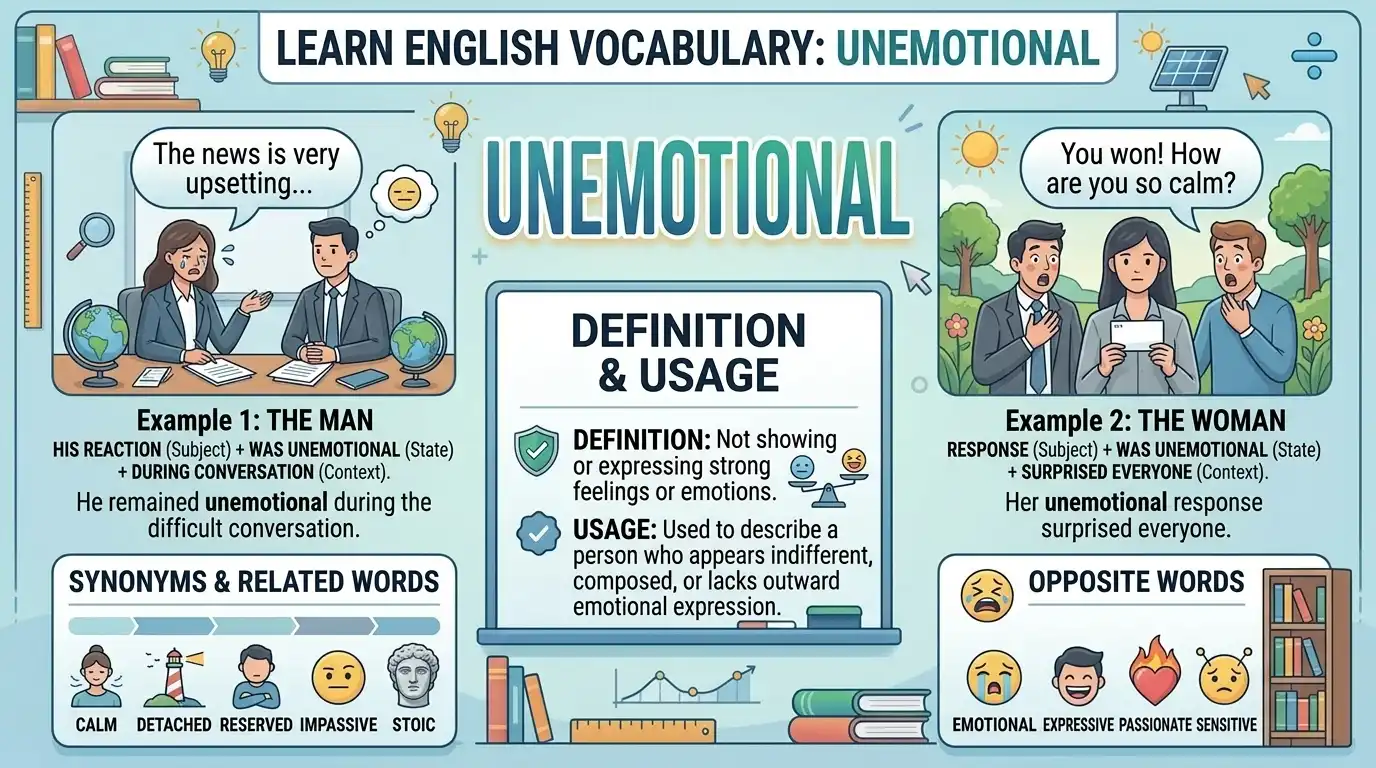
Unemotional is an adjective that describes someone or something that does not show strong feelings or emotional reactions.
In simple English, unemotional means showing little emotion or not being strongly affected emotionally.
For example:
She remained unemotional during the difficult discussion.
This means she did not visibly show strong feelings during the conversation.
The word does not always mean that a person has no emotions. Someone may feel deeply but choose not to express those feelings openly.
Part of Speech
Unemotional is an adjective.
It can describe:
- a person
- a reaction
- a response
- a voice
- a conversation
- a decision
- a writing style
- a performance
Emotional Tone
The tone depends strongly on context.
Someone may be described as unemotional because they are calm and controlled. In another situation, the same word may suggest emotional distance or a lack of warmth.
Connotative Meaning
Connotation (the feeling or association a word creates beyond its basic dictionary meaning) can change how unemotional sounds.
Positive Tone
In a positive context, unemotional can suggest:
- calmness
- self-control
- composure
- rational thinking
- emotional stability
Example:
The doctor remained unemotional and focused during the emergency.
Negative Tone
In a negative context, it can suggest:
- coldness
- emotional distance
- lack of empathy
- indifference
- detachment
Example:
His unemotional response made his friend feel ignored.
Neutral Tone
In neutral writing, unemotional may simply describe a lack of visible emotional expression.
Example:
The report uses an unemotional style to present the facts.
Etymology of “Unemotional”
The word unemotional is built from the prefix un- and the adjective emotional.
The word emotion ultimately comes from Latin emovere, meaning “to move out” or “to disturb,” through French influence. English later developed emotion as a word for a strong feeling or mental response.
Old English: 450–1100
The exact modern word unemotional did not exist in Old English. Anglo-Saxon English used different vocabulary to describe feelings, moods, courage, fear, sorrow, joy, and mental states.
Middle English: 1100–1500
French and Latin influence expanded English vocabulary related to feelings and mental experiences. Words connected with emotion gradually became more common.
Modern English: 1500–Present
The noun emotion developed into a familiar English term, followed by emotional and later formations such as unemotional. The modern word describes a person or response that shows little outward feeling.
Pronunciation
- US: /ˌʌnɪˈmoʊʃənəl/
- UK: /ˌʌnɪˈməʊʃənəl/
Syllables
un-em-o-tion-al
Affixation Pattern
Root/base: emotion
Prefix: un-
Suffix: -al
The structure is:
un- + emotion + -al → unemotional
The prefix un- commonly creates a negative or opposite meaning, while -al helps form an adjective.
50 Synonyms of Unemotional
The following list includes direct synonyms and close alternatives. Some words describe a lack of emotional expression, while others emphasize calmness, restraint, distance, or indifference. Choosing the right shade is important because these words are not interchangeable in every sentence.
1. Impassive (Adjective) — US /ɪmˈpæsɪv/ — UK /ɪmˈpæsɪv/
Meaning: Showing little or no visible emotion, especially during a difficult situation.
Tone/Register: Neutral to formal.
Example:
The witness remained impassive during the questioning.
Her impassive expression revealed nothing about her thoughts.
2. Emotionless (Adjective) — US /ɪˈmoʊʃənləs/ — UK /ɪˈməʊʃənləs/
Meaning: Showing no visible emotion.
Tone/Register: Neutral, sometimes negative.
Example:
His voice sounded emotionless on the phone.
The actor delivered the line with an emotionless stare.
3. Detached (Adjective) — US /dɪˈtætʃt/ — UK /dɪˈtætʃt/
Meaning: Emotionally separate from a person, situation, or event.
Tone/Register: Neutral to formal.
Example:
She sounded detached while discussing the argument.
The journalist kept a detached tone throughout the report.
4. Dispassionate (Adjective) — US /dɪˈspæʃənət/ — UK /dɪˈspæʃənət/
Meaning: Not influenced by strong personal feelings.
Tone/Register: Formal, academic, professional.
Example:
The committee gave a dispassionate review of the evidence.
He offered a dispassionate explanation of what happened.
5. Stoic (Adjective) — US /ˈstoʊɪk/ — UK /ˈstəʊɪk/
Meaning: Showing emotional strength by not openly displaying pain or distress.
Tone/Register: Neutral to literary.
Example:
She remained stoic after hearing the disappointing news.
His stoic response impressed everyone in the room.
6. Reserved (Adjective) — US /rɪˈzɝːvd/ — UK /rɪˈzɜːvd/
Meaning: Not openly expressing feelings, opinions, or personal thoughts.
Tone/Register: Neutral.
Example:
He is friendly but naturally reserved.
Her reserved manner made the first meeting quiet.
7. Composed (Adjective) — US /kəmˈpoʊzd/ — UK /kəmˈpəʊzd/
Meaning: Calm and in control of emotions.
Tone/Register: Positive, professional.
Example:
She stayed composed during the difficult interview.
He looked composed despite the sudden problem.
8. Calm (Adjective) — US /kɑːm/ — UK /kɑːm/
Meaning: Relaxed and not emotionally disturbed.
Tone/Register: Neutral and very common.
Example:
The teacher remained calm during the disagreement.
Try to stay calm when explaining your concerns.
9. Unexpressive (Adjective) — US /ˌʌnɪkˈspresɪv/ — UK /ˌʌnɪkˈspresɪv/
Meaning: Showing very little emotion through words, facial expressions, or behavior.
Tone/Register: Neutral.
Example:
His face was unusually unexpressive.
She has an unexpressive style when speaking publicly.
10. Unmoved (Adjective) — US /ˌʌnˈmuːvd/ — UK /ˌʌnˈmuːvd/
Meaning: Not emotionally affected by something.
Tone/Register: Neutral to formal.
Example:
He remained unmoved by the emotional speech.
She seemed unmoved by the criticism.
11. Unresponsive (Adjective) — US /ˌʌnrɪˈspɑːnsɪv/ — UK /ˌʌnrɪˈspɒnsɪv/
Meaning: Showing little emotional or verbal reaction.
Tone/Register: Neutral to formal.
Example:
The audience was strangely unresponsive.
He remained unresponsive to her emotional appeal.
12. Unruffled (Adjective) — US /ˌʌnˈrʌfəld/ — UK /ˌʌnˈrʌfəld/
Meaning: Calm and not upset by difficulties.
Tone/Register: Positive, polished.
Example:
She stayed unruffled when the schedule changed.
The pilot appeared completely unruffled.
13. Restrained (Adjective) — US /rɪˈstreɪnd/ — UK /rɪˈstreɪnd/
Meaning: Controlled rather than openly expressed.
Tone/Register: Formal, professional.
Example:
His response was restrained but respectful.
The article uses restrained language throughout.
14. Self-controlled (Adjective) — US /ˌself kənˈtroʊld/ — UK /ˌself kənˈtrəʊld/
Meaning: Able to control emotional reactions and impulses.
Tone/Register: Neutral to positive.
Example:
She is remarkably self-controlled under pressure.
A self-controlled response prevented a larger argument.
15. Unemotive (Adjective) — US /ˌʌnɪˈmoʊtɪv/ — UK /ˌʌnɪˈməʊtɪv/
Meaning: Not expressing or showing emotion.
Tone/Register: Formal, less common.
Example:
The report uses an unemotive style.
His unemotive delivery made the announcement sound factual.
16. Unreactive (Adjective) — US /ˌʌnriˈæktɪv/ — UK /ˌʌnriˈæktɪv/
Meaning: Showing little reaction to something that might normally produce a response.
Tone/Register: Neutral, technical.
Example:
She appeared unreactive to the criticism.
His unreactive expression was difficult to interpret.
17. Matter-of-fact (Adjective) — US /ˌmætər əv ˈfækt/ — UK /ˌmætər əv ˈfækt/
Meaning: Direct and practical without emotional emphasis.
Tone/Register: Neutral, conversational.
Example:
He gave a matter-of-fact explanation.
Her matter-of-fact tone kept the conversation focused.
18. Clinical (Adjective) — US /ˈklɪnɪkəl/ — UK /ˈklɪnɪkəl/
Meaning: Extremely objective or emotionally detached in style.
Tone/Register: Formal, professional.
Example:
The report gives a clinical description of the incident.
His clinical tone made the discussion feel distant.
19. Objective (Adjective) — US /əbˈdʒektɪv/ — UK /əbˈdʒektɪv/
Meaning: Based on facts rather than personal feelings or preferences.
Tone/Register: Academic, professional.
Example:
The editor tried to remain objective.
We need an objective assessment of the results.
20. Impersonal (Adjective) — US /ɪmˈpɝːsənəl/ — UK /ɪmˈpɜːsənəl/
Meaning: Lacking personal warmth or emotional involvement.
Tone/Register: Formal.
Example:
The message sounded cold and impersonal.
His writing style is clear but sometimes impersonal.
21. Aloof (Adjective) — US /əˈluːf/ — UK /əˈluːf/
Meaning: Emotionally distant or unwilling to become friendly.
Tone/Register: Usually negative.
Example:
The new student seemed aloof at first.
His aloof manner made conversation difficult.
22. Indifferent (Adjective) — US /ɪnˈdɪfərənt/ — UK /ɪnˈdɪfərənt/
Meaning: Showing little interest, concern, or emotional response.
Tone/Register: Neutral to negative.
Example:
She seemed indifferent to the criticism.
He was indifferent to the outcome of the contest.
23. Cold (Adjective) — US /koʊld/ — UK /kəʊld/
Meaning: Showing little warmth, sympathy, or emotion.
Tone/Register: Common, usually negative.
Example:
His reply sounded cold.
She worried that her message had seemed cold.
24. Callous (Adjective) — US /ˈkæləs/ — UK /ˈkæləs/
Meaning: Showing little concern for other people’s feelings or suffering.
Tone/Register: Strongly negative.
Example:
His callous comment upset the team.
The article criticized the company’s callous response.
25. Heartless (Adjective) — US /ˈhɑːrtləs/ — UK /ˈhɑːtləs/
Meaning: Showing an extreme lack of sympathy or compassion.
Tone/Register: Strongly negative, emotional.
Example:
The decision seemed heartless to many families.
Calling her heartless was unfair.
26. Stolid (Adjective) — US /ˈstɑːlɪd/ — UK /ˈstɒlɪd/
Meaning: Calm and showing little outward emotion.
Tone/Register: Formal, literary.
Example:
The stolid guard barely reacted to the noise.
His stolid expression remained unchanged.
27. Phlegmatic (Adjective) — US /fleɡˈmætɪk/ — UK /fleɡˈmætɪk/
Meaning: Calm and not easily excited or upset.
Tone/Register: Formal, literary.
Example:
Her phlegmatic personality helped during the crisis.
He remained phlegmatic when others became nervous.
28. Nonchalant (Adjective) — US /ˌnɑːnʃəˈlɑːnt/ — UK /ˌnɒnʃəlɑːnt/
Meaning: Appearing relaxed and unconcerned.
Tone/Register: Informal to neutral.
Example:
He gave a nonchalant shrug.
She sounded nonchalant about the unexpected change.
29. Unconcerned (Adjective) — US /ˌʌnkənˈsɝːnd/ — UK /ˌʌnkənˈsɜːnd/
Meaning: Not worried or concerned about something.
Tone/Register: Neutral.
Example:
He looked completely unconcerned about the delay.
She seemed unconcerned by the negative comments.
30. Passionless (Adjective) — US /ˈpæʃənləs/ — UK /ˈpæʃənləs/
Meaning: Lacking strong feeling, enthusiasm, or passion.
Tone/Register: Formal, sometimes negative.
Example:
The speech sounded passionless.
His passionless delivery weakened the emotional impact.
31. Cool (Adjective) — US /kuːl/ — UK /kuːl/
Meaning: Calm and controlled, especially in a stressful situation.
Tone/Register: Informal to neutral.
Example:
She kept a cool head during the crisis.
He stayed cool when everyone else panicked.
32. Level-headed (Adjective) — US /ˌlevəl ˈhedɪd/ — UK /ˌlevəl ˈhedɪd/
Meaning: Sensible and calm rather than controlled by emotion.
Tone/Register: Positive, conversational.
Example:
My sister is very level-headed in emergencies.
We need someone level-headed to lead the discussion.
33. Even-tempered (Adjective) — US /ˌiːvən ˈtempərd/ — UK /ˌiːvən ˈtempəd/
Meaning: Usually calm and not easily angered or upset.
Tone/Register: Positive, everyday.
Example:
Our coach is patient and even-tempered.
Her even-tempered nature helps settle disagreements.
34. Unflappable (Adjective) — US /ʌnˈflæpəbəl/ — UK /ʌnˈflæpəbəl/
Meaning: Remaining calm despite pressure or unexpected problems.
Tone/Register: Positive, informal to neutral.
Example:
The receptionist was unflappable during the busy morning.
Her unflappable attitude reassured the customers.
35. Unperturbed (Adjective) — US /ˌʌnpərˈtɝːbd/ — UK /ˌʌnpəˈtɜːbd/
Meaning: Not worried, upset, or disturbed by something.
Tone/Register: Formal.
Example:
He remained unperturbed by the sudden criticism.
She looked completely unperturbed by the noise.
36. Unshaken (Adjective) — US /ʌnˈʃeɪkən/ — UK /ʌnˈʃeɪkən/
Meaning: Not emotionally weakened or disturbed by an event.
Tone/Register: Neutral to positive.
Example:
She remained unshaken after the setback.
His confidence appeared unshaken.
37. Unfazed (Adjective) — US /ʌnˈfeɪzd/ — UK /ʌnˈfeɪzd/
Meaning: Not bothered, frightened, or upset by something.
Tone/Register: Informal, common.
Example:
He was unfazed by the difficult question.
She looked unfazed after the sudden interruption.
38. Unflustered (Adjective) — US /ˌʌnˈflʌstərd/ — UK /ˌʌnˈflʌstəd/
Meaning: Not confused, worried, or upset by pressure.
Tone/Register: Neutral.
Example:
The nurse remained unflustered during the emergency.
She gave an unflustered response.
39. Steady (Adjective) — US /ˈstedi/ — UK /ˈstedi/
Meaning: Calm and controlled rather than emotionally unstable.
Tone/Register: Neutral.
Example:
His voice stayed steady throughout the interview.
She gave the team a steady response.
40. Controlled (Adjective) — US /kənˈtroʊld/ — UK /kənˈtrəʊld/
Meaning: Carefully restrained rather than openly emotional.
Tone/Register: Neutral to formal.
Example:
She gave a controlled response to the accusation.
His controlled tone prevented the discussion from escalating.
41. Restrainedly (Adverb) — US /rɪˈstreɪnɪdli/ — UK /rɪˈstreɪnɪdli/
Meaning: In a controlled way that avoids strong emotional display.
Tone/Register: Formal.
Example:
He responded restrainedly to the criticism.
She spoke restrainedly during the interview.
42. Matter-of-factly (Adverb) — US /ˌmætər əv ˈfæktli/ — UK /ˌmætər əv ˈfæktli/
Meaning: In a direct, practical, and unemotional way.
Tone/Register: Neutral, conversational.
Example:
She matter-of-factly explained what had happened.
He matter-of-factly accepted the decision.
43. Dispassionately (Adverb) — US /dɪˈspæʃənətli/ — UK /dɪˈspæʃənətli/
Meaning: Without allowing personal feelings to affect judgment.
Tone/Register: Formal, academic.
Example:
The issue should be examined dispassionately.
The researcher evaluated the evidence dispassionately.
44. Stoically (Adverb) — US /ˈstoʊɪkli/ — UK /ˈstəʊɪkli/
Meaning: In a way that hides or controls emotional suffering.
Tone/Register: Literary to neutral.
Example:
She stoically accepted the difficult news.
He stoically continued working after the setback.
45. Coolly (Adverb) — US /ˈkuːlli/ — UK /ˈkuːlli/
Meaning: In a calm or emotionally controlled manner.
Tone/Register: Neutral, sometimes negative.
Example:
He coolly rejected the accusation.
She coolly explained why the plan would fail.
46. Unsentimental (Adjective) — US /ˌʌnsentəˈmentəl/ — UK /ˌʌnsentɪˈmentəl/
Meaning: Not guided or influenced by sentimental feelings.
Tone/Register: Neutral to formal.
Example:
The novel gives an unsentimental view of family life.
Her unsentimental advice was practical and clear.
47. Hard-bitten (Adjective) — US /ˌhɑːrd ˈbɪtən/ — UK /ˌhɑːd ˈbɪtən/
Meaning: Toughened by difficult experiences and less emotionally sensitive.
Tone/Register: Informal, literary.
Example:
The hard-bitten reporter had seen many difficult stories.
His hard-bitten attitude came from years of experience.
48. Hardened (Adjective) — US /ˈhɑːrdənd/ — UK /ˈhɑːdənd/
Meaning: Less emotionally sensitive because of difficult experiences.
Tone/Register: Neutral to negative.
Example:
Years of conflict had left him hardened.
The hardened officer rarely showed fear.
49. Sphinx-like (Adjective) — US /ˈsfɪŋks laɪk/ — UK /ˈsfɪŋks laɪk/
Meaning: Mysteriously silent or difficult to read emotionally.
Tone/Register: Literary, descriptive.
Example:
The actor maintained a sphinx-like expression.
Her sphinx-like silence made everyone curious.
50. Neutral (Adjective) — US /ˈnuːtrəl/ — UK /ˈnjuːtrəl/
Meaning: Not showing a strong emotional position or preference.
Tone/Register: Neutral, academic, professional.
Example:
The moderator used a neutral tone.
Try to keep your language neutral during the discussion.
Synonyms of Unemotional by Tone
Positive Synonyms
These words can suggest emotional strength, calmness, or self-control:
- Composed
- Calm
- Collected
- Unruffled
- Unflappable
- Unperturbed
- Cool-headed
- Serene
- Even-tempered
- Steady
- Self-controlled
- Stoic
These choices are useful when you want to describe emotional control without sounding critical.
Neutral Synonyms
These alternatives can describe limited emotional expression without strongly praising or criticizing the person:
- Unemotive
- Unexpressive
- Reserved
- Restrained
- Matter-of-fact
- Detached
- Impassive
- Unaffected
- Objective
- Impersonal
Negative Synonyms
These words can suggest emotional distance, lack of concern, or limited warmth:
- Cold
- Aloof
- Indifferent
- Apathetic
- Unmoved
- Unresponsive
- Curt
The context determines whether the negative implication is intended.
Formal or Academic Synonyms
For essays, reports, analysis, and professional writing, these choices are often useful:
- Dispassionate
- Objective
- Impersonal
- Rational
- Unsentimental
- Clinical
- Disinterested
Why Tone Matters in Word Choice
Choosing a synonym is not only about replacing one word with another.
For example, calling someone composed usually suggests self-control. Calling the same person cold can suggest a lack of warmth.
Similarly, stoic can emphasize endurance, while apathetic suggests a lack of interest or concern.
The best synonym depends on the exact message you want your reader to understand.
“Unemotional” vs Close Alternatives
Unemotional broadly describes limited emotional expression.
Impassive focuses more strongly on a face or outward expression that reveals little feeling.
Use unemotional for general descriptions. Use impassive when someone’s visible reaction is especially difficult to read.
Unemotional vs Stoic
Unemotional describes what someone appears to express.
Stoic often suggests that a person deliberately endures difficulty without showing pain or distress.
A person can be unemotional without being stoic.
Unemotional vs Detached
Unemotional focuses on emotional expression.
Detached emphasizes emotional separation or distance from a situation.
For example, a journalist may be detached to remain objective, while a person may simply look unemotional because they rarely display feelings.
How “Unemotional” Changes by Context
Daily Conversation
In everyday speech, unemotional can describe someone’s reaction, voice, facial expression, or personality.
She sounded unemotional when she told me the news.
Here, the word focuses on her outward response rather than proving that she felt nothing.
Writing and Blogging
Writers often use unemotional to describe a factual or restrained style.
A blog post may be unemotional when the writer presents information without personal reactions.
For a more positive tone, measured, objective, or composed may work better.
Professional and Academic English
In professional writing, dispassionate, objective, impersonal, and matter-of-fact can be more precise.
These words help describe reports, analyses, evaluations, and formal communication.
Creative and Informal Writing
Creative writers may choose cold, aloof, stoic, impassive, or taciturn to develop a character.
The choice can reveal personality without directly telling the reader how the character feels.
Common Mistakes Learners Make
Mistake 1: Assuming Unemotional Means Emotionless
These words are related but not always identical.
Unemotional often means that emotions are not openly displayed. It does not necessarily mean that emotions do not exist.
Mistake 2: Using Apathetic as a Perfect Synonym
Apathetic usually suggests a lack of interest, enthusiasm, or concern.
Someone can be calm and unemotional while still caring deeply.
Mistake 3: Using Cold When You Mean Calm
Cold can imply emotional distance or lack of warmth.
If you want a positive description, calm, composed, or collected is usually safer.
Mistake 4: Confusing Uninterested and Unemotional
Uninterested means not interested.
Unemotional means showing little emotion.
These meanings can overlap in some contexts, but they are not interchangeable.
Mistake 5: Overusing One Synonym
Repeating unemotional in every paragraph can make writing sound flat.
Choose a synonym based on the exact shade of meaning.
Register Notes
Unemotional is neutral and works in both spoken and written English.
Impassive, dispassionate, phlegmatic, taciturn, and equable are more formal or literary.
Cool, cool-headed, and matter-of-fact are common in everyday communication.
For academic writing, objective and dispassionate are often useful when discussing evidence or analysis.
For character descriptions, aloof, stoic, cold, reserved, and impassive can create stronger imagery.
You can also connect this topic with other vocabulary resources on your site through one relevant internal link.
Real-Life Mini Scenarios Using “Unemotional”
Workplace
A manager receives criticism during a meeting. She remains composed and responds without becoming defensive.
Social Situation
A new classmate speaks very little and rarely shows facial reactions. Someone might describe him as reserved or taciturn.
Media and Pop Culture
A fictional detective may appear stoic when facing danger. The word highlights emotional endurance.
Writing and Storytelling
A narrator may use an impassive character to create mystery because readers cannot easily understand what the character feels.
How to Choose the Right Synonym
Ask yourself one simple question:
- What exactly do I want to describe?
- If you mean calm under pressure, choose composed, unflappable, or cool-headed.
- If you mean little visible emotion, choose impassive, unexpressive, or unemotive.
- If you mean emotional distance, choose detached or aloof.
- If you mean lack of concern, choose indifferent or apathetic.
- If you mean objective analysis, choose dispassionate or objective.
- This approach helps you avoid using synonyms that only look similar in a dictionary.
Interactive Practice Quiz
Choose the word that best fits each situation.
Part One
1. Sara stayed calm when the computer suddenly stopped working. Which word fits best?
A. Composed
B. Apathetic
C. Curt
D. Cold
2. The journalist presented both sides without personal emotion. Which word is most suitable?
A. Aloof
B. Dispassionate
C. Taciturn
D. Cold
3. The character rarely speaks and gives very short answers. Which word fits best?
A. Serene
B. Taciturn
C. Composed
D. Unperturbed
4. Someone shows no concern about an important result. Which word is most precise?
A. Apathetic
B. Collected
C. Unruffled
D. Stoic
5. A person remains calm during a difficult emergency. Which synonym works best?
A. Unflappable
B. Curt
C. Aloof
D. Indifferent
6. A report avoids personal opinions and focuses on facts. Which word is most suitable?
A. Objective
B. Cold
C. Taciturn
D. Aloof
7. Someone seems emotionally distant from close friends. Which word fits best?
A. Serene
B. Detached
C. Collected
D. Unruffled
Part Two
8. A person gives a short answer that sounds unfriendly. Which word fits best?
A. Curt
B. Serene
C. Stoic
D. Objective
9. Someone does not show pain during a difficult experience. Which word is suitable?
A. Stoic
B. Apathetic
C. Unresponsive
D. Impersonal
10. A person’s face reveals almost nothing about their feelings. Which word fits best?
A. Impassive
B. Rational
C. Even-tempered
D. Disinterested
11. A peaceful person rarely becomes angry or excited. Which word fits best?
A. Placid
B. Curt
C. Cold
D. Indifferent
12. A message sounds formal and lacks personal warmth. Which word is most appropriate?
A. Impersonal
B. Unflappable
C. Stoic
D. Serene
13. A person is not worried about a delay. Which word fits best?
A. Unconcerned
B. Taciturn
C. Unexpressive
D. Curt
14. A person is unaffected by criticism and continues calmly. Which word fits best?
A. Unperturbed
B. Apathetic
C. Cold
D. Aloof
15. A writer describes an event without sentimental feelings. Which word is most suitable?
A. Unsentimental
B. Placid
C. Taciturn
D. Curt
Reflection Task: Write one sentence using composed, detached, stoic, impassive, or dispassionate to describe a real or imaginary situation.
Answer Key: 1-A | 2-B | 3-B | 4-A | 5-A | 6-A | 7-B | 8-A | 9-A | 10-A | 11-A | 12-A | 13-A | 14-A | 15-A
FAQs
1. What is the difference between unemotional and emotionless?
Unemotional usually means showing little emotion, while emotionless can sound stronger and suggest an absence of visible emotion altogether. A person may be unemotional because they control their reactions, even though they still experience strong feelings internally. Context matters because emotionless can sometimes sound colder or more absolute than unemotional.
2. Which synonym of unemotional is best for academic writing?
Dispassionate and objective are useful choices in academic contexts when you mean that an analysis is not driven by personal feelings. For example, “The researcher provides a dispassionate analysis” emphasizes emotional neutrality. However, unemotional may still be appropriate when directly describing someone’s emotional expression.
3. Is stoic a positive synonym for unemotional?
Stoic can carry a positive meaning when it describes someone who remains calm and resilient during difficulty. It often suggests endurance rather than simply a lack of emotion. However, it does not mean the same thing as unemotional because stoicism specifically emphasizes maintaining control despite pain, stress, or hardship.
4. What is a polite way to describe someone who is unemotional?
Words such as reserved, composed, calm, collected, and self-controlled can sound more neutral or positive. The best choice depends on what you mean. If someone simply does not openly express feelings, reserved is often appropriate. If they remain calm during pressure, composed may communicate the idea more positively.
5. Can unemotional describe writing?
Yes. Unemotional can describe writing that presents information without strong emotional language. For example, a factual report may use an unemotional style. Depending on the intended meaning, writers can also use objective, dispassionate, restrained, impersonal, or matter-of-fact to describe different kinds of emotionally neutral writing.
6. Is indifferent the same as unemotional?
Not exactly. Indifferent usually means showing little concern, interest, or preference. Unemotional focuses on the expression of feelings. Someone can be unemotional while caring deeply about an issue. Conversely, someone may show strong emotions but still be indifferent to a particular outcome.
7. What is the best synonym for unemotional when describing a facial expression?
Impassive and unexpressive are especially useful for facial expressions. Impassive suggests that the face reveals little or nothing about the person’s feelings. Unexpressive is broader and simply describes limited outward emotional expression.
8. How can learning synonyms of unemotional improve English vocabulary?
Learning these alternatives helps you express subtle differences in emotion, attitude, and communication style. Instead of using the same adjective repeatedly, you can choose words such as composed, detached, stoic, impassive, objective, or aloof according to context. This makes essays, blogs, conversations, and creative writing more precise.
Conclusion
Learning synonyms of unemotional helps you describe feelings and reactions with greater precision. Words such as composed, stoic, and detached each add a different shade of meaning.
Good vocabulary is not about using difficult words. It is about choosing the word that communicates your exact idea clearly in the right situation.
For speaking, blogging, essays, emails, and daily conversations, these alternatives can make your English more natural and expressive without sounding repetitive.
Practice a few synonyms today by writing your own sentences. Try using composed, impassive, detached, or dispassionate in a real situation to strengthen your vocabulary.

Mehtab Yasir is a passionate writer and English language enthusiast dedicated to making vocabulary learning simple, practical, and enjoyable. As an author at SynonymDesk.com, she creates helpful content covering synonyms, antonyms, word meanings, vocabulary, phrases, and everyday English usage. Her goal is to provide clear and easy-to-understand information that helps students, writers, professionals, and English learners choose the right words and communicate with greater confidence. Mehtab believes that a strong vocabulary can improve both writing and communication skills. She enjoys researching new words, exploring their meanings and uses, and turning complex language concepts into useful, reader-friendly content. Through her work, she strives to make SynonymDesk.com a reliable resource for anyone looking to improve their English vocabulary and language skills.