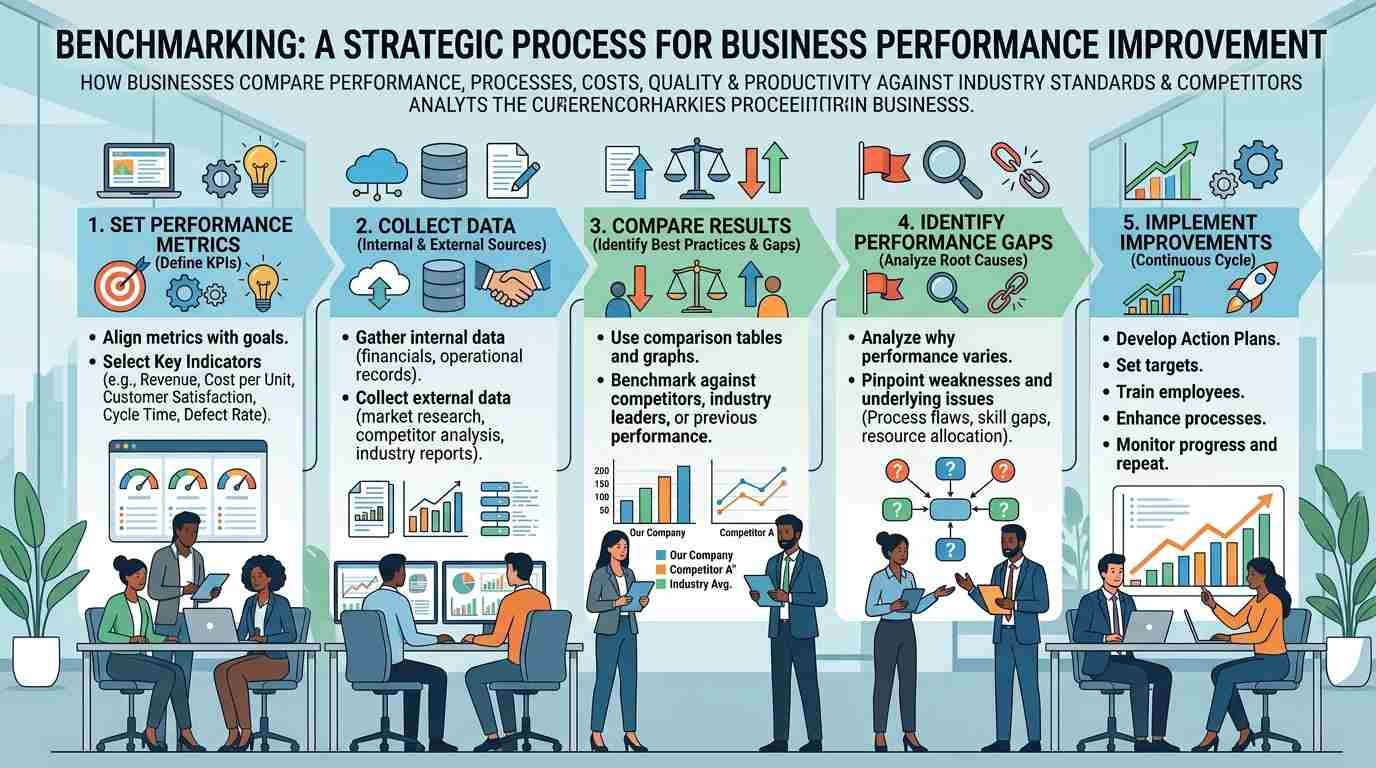
Synonyms of benchmarking help you express measurement, comparison, and evaluation with remarkable clarity and precision in every piece of writing.
Imagine a team working hard to improve their app performance without knowing what success looks like. They need clear standards to guide their progress effectively.
Using synonyms of benchmarking enables bloggers, content creators, and students to avoid repetition while maintaining strong engagement across all digital platforms.
Mastering synonyms of benchmarking allows you to choose the exact word needed for academic essays, professional business reports, and natural daily conversations.
What Does “Benchmarking” Really Mean?
Benchmarking means comparing something against an established standard to measure quality, efficiency, or performance level. Native speakers use it when evaluating progress or setting goals in business, tech, and everyday planning.
- Part of Speech: Noun (Gerund) / Verb
- Simple Definition: Comparing performance against a recognized standard or goal.
- Emotional Tone: Professional, objective, analytical, and structured.
Connotative Meaning
Connotation is the emotional tone or implied meaning associated with a word beyond its strict literal definition (the literal definition).
- Positive Tone: Associated with self-improvement, high quality, growth, and achieving excellence.
- Negative Tone: Can imply strict corporate pressure, rigid control, or uncreative standardization.
- Neutral Tone: Simple evaluation, standard baseline measurement, or systematic comparison.
Etymology and History
The term originates from the mark cut into stone by surveyors to support a “bench” for measuring accurate levels.
- Old English (450–1100): Rooted in words related to physical benches or seats.
- Middle English (1100–1500): Developed into benc, referring to a table or raised surface.
- Modern English (1500–Present): Shifted into surveying terminology in the 1800s, later becoming a widespread management term in the late 20th century.
Pronunciation (US & UK – IPA)
- US: /ˈbɛntʃˌmɑrkɪŋ/
- UK: /ˈbɛntʃˌmɑːkɪŋ/
Syllables
bench-mark-ing
Affixation Pattern
- Root: Bench (Noun) + Mark (Noun)
- Suffix: -ing (Gerund/Participle)
Synonyms List (Core Section)
1. Evaluating (Verb) — US: /ɪˈvæljueɪtɪŋ/ | UK: /ɪˈvæljʊeɪtɪŋ/
- Meaning: Assessing the amount, value, or quality of something systematically.
- Tone/Register: Formal, Academic, Business
- Example 1: The manager is evaluating our quarterly sales results today.
- Example 2: She spends hours evaluating student projects before grading.
2. Baselining (Verb) — US: /ˈbeɪsˌlaɪnɪŋ/ | UK: /ˈbeɪslaɪnɪŋ/
- Meaning: Establishing a starting point or fixed level for future comparison.
- Tone/Register: Technical, Business, Analytical
- Example 1: Our tech team is baselining server performance this week.
- Example 2: We need proper baselining before starting the new project.
3. Measuring (Verb) — US: /ˈmɛʒərɪŋ/ | UK: /ˈmɛʒərɪŋ/
- Meaning: Ascertaining the size, amount, or degree of something using standard units.
- Tone/Register: Neutral, Everyday, Professional
- Example 1: He is measuring the speed of our new internet connection.
- Example 2: Measuring customer satisfaction helps us grow our business.
4. Gauging (Verb) — US: /ˈɡeɪdʒɪŋ/ | UK: /ˈɡeɪdʒɪŋ/
- Meaning: Estimating or determining the magnitude, amount, or volume of something.
- Tone/Register: Neutral, Professional, Conversational
- Example 1: She is gauging public interest in our new product line.
- Example 2: The teacher is gauging how well students grasp the lesson.
5. Standardizing (Verb) — US: /ˈstændərˌdaɪzɪŋ/ | UK: /ˈstændədaɪzɪŋ/
- Meaning: Causing something to conform to a standard or uniform measure.
- Tone/Register: Business, Formal, Technical
- Example 1: The company is standardizing customer service protocols across branches.
- Example 2: Standardizing safety tests ensures uniform product quality everywhere.
6. Rating (Verb) — US: /ˈreɪtɪŋ/ | UK: /ˈreɪtɪŋ/
- Meaning: Assigning a value, rank, or position to something based on quality.
- Tone/Register: Informal, Commercial, Everyday
- Example 1: Users are rating our mobile app very highly this month.
- Example 2: Critics are rating the new film as a masterpiece.
7. Assessing (Verb) — US: /əˈsɛsɪŋ/ | UK: /əˈsɛsɪŋ/
- Meaning: Evaluating or estimating the nature, ability, or quality of something.
- Tone/Register: Academic, Formal, Business
- Example 1: Experts are assessing the environmental impact of the project.
- Example 2: We spent the morning assessing team strengths and weaknesses.
8. Comparing (Verb) — US: /kəmˈpɛrɪŋ/ | UK: /kəmˈpeərɪŋ/
- Meaning: Estimating or measuring the similarity or dissimilarity between things.
- Tone/Register: General, Neutral, Everyday
- Example 1: She is comparing the prices of different laptops online.
- Example 2: Comparing past performance helps us set realistic goals.
9. Grading (Verb) — US: /ˈɡreɪdɪŋ/ | UK: /ˈɡreɪdɪŋ/
- Meaning: Arranging or classifying according to quality, rank, or size.
- Tone/Register: Educational, Technical, Neutral
- Example 1: The inspector is grading the quality of the harvested apples.
- Example 2: Professors spend weekends grading final research papers carefully.
10. Ranking (Verb) — US: /ˈræŋkɪŋ/ | UK: /ˈræŋkɪŋ/
- Meaning: Giving a specified position within a scale or list of quality.
- Tone/Register: Competitive, Business, General
- Example 1: Search engines are ranking our blog posts higher this week.
- Example 2: The magazine is ranking the top universities in the region.
11. Testing (Verb) — US: /ˈtɛstɪŋ/ | UK: /ˈtɛstɪŋ/
- Meaning: Subjecting something to a test to reveal its strengths and weaknesses.
- Tone/Register: Practical, Technical, General
- Example 1: Developers are testing the new application for hidden bugs.
- Example 2: We are testing our marketing strategy on a smaller audience.
12. Appraising (Verb) — US: /əˈpreɪzɪŋ/ | UK: /əˈpreɪzɪŋ/
- Meaning: Assessing the value, quality, or condition of something formally.
- Tone/Register: Formal, Professional, Financial
- Example 1: The auditor is appraising the total assets of the firm.
- Example 2: Managers are appraising employee achievements during annual reviews.
13. Indexing (Verb) — US: /ˈɪndɛksɪŋ/ | UK: /ˈɪndɛksɪŋ/
- Meaning: Recording, classifying, or comparing against a statistical index.
- Tone/Register: Technical, Financial, Academic
- Example 1: Analysts are indexing market prices to track inflation trends.
- Example 2: The database is indexing new pages for faster user searches.
14. Auditing (Verb) — US: /ˈɔdɪtɪŋ/ | UK: /ˈɔːdɪtɪŋ/
- Meaning: Conducting an official, systematic examination or verification.
- Tone/Register: Formal, Corporate, Legal
- Example 1: The finance team is auditing our expenses from last year.
- Example 2: External consultants are auditing our security measures this month.
15. Calibrating (Verb) — US: /ˈkælɪˌbreɪtɪŋ/ | UK: /ˈkælɪbreɪtɪŋ/
- Meaning: Adjusting precise measurements to match a precise reference standard.
- Tone/Register: Technical, Scientific, Precise
- Example 1: Engineers are calibrating sensors before starting the high-tech experiment.
- Example 2: We are calibrating our targets to match market trends.
16. Analyzing (Verb) — US: /ˈænəˌlaɪzɪŋ/ | UK: /ˈænəlaɪzɪŋ/
- Meaning: Examining methodically by separating into components for comparison.
- Tone/Register: Academic, Business, Technical
- Example 1: Analysts are analyzing user feedback to refine product features.
- Example 2: She spent hours analyzing dataset variations against target benchmarks.
17. Profiling (Verb) — US: /ˈproʊfaɪlɪŋ/ | UK: /ˈprəʊfaɪlɪŋ/
- Meaning: Constructing a structured performance summary against standard criteria.
- Tone/Register: Technical, Business, Analytical
- Example 1: System architects are profiling memory usage during peak hours.
- Example 2: Profiling customer behavior gives us clear competitive baselines.
18. Classifying (Verb) — US: /ˈklæsəˌfaɪɪŋ/ | UK: /ˈklæsɪfaɪɪŋ/
- Meaning: Organizing items into distinct groups based on standard attributes.
- Tone/Register: Academic, Formal, Scientific
- Example 1: The team is classifying sales leads according to potential value.
- Example 2: Classifying products by benchmark standards simplifies inventory tracking.
19. Sizing (Verb) — US: /ˈsaɪzɪŋ/ | UK: /ˈsaɪzɪŋ/
- Meaning: Determining dimensions or capacity relative to an accepted standard scale.
- Tone/Register: Practical, Commercial, Informal
- Example 1: Engineers are sizing the database servers for anticipated traffic.
- Example 2: Sizing market opportunities allows teams to focus efforts wisely.
20. Checking (Verb) — US: /ˈtʃɛkɪŋ/ | UK: /ˈtʃɛkɪŋ/
- Meaning: Verifying accuracy, quality, or condition against basic parameters.
- Tone/Register: Everyday, Informal, Neutral
- Example 1: She is checking the project timeline against client deadlines.
- Example 2: Checking error logs daily ensures system stability.
21. Scaling (Verb) — US: /ˈskeɪlɪŋ/ | UK: /ˈskeɪlɪŋ/
- Meaning: Adjusting or comparing size according to a fixed proportion or standard.
- Tone/Register: Business, Tech, Analytica
- Example 1: Founders are scaling operations based on growth benchmarks.
- Example 2: Scaling test metrics ensures fair performance comparisons.
22. Weighting (Verb) — US: /ˈweɪtɪŋ/ | UK: /ˈweɪtɪŋ/
- Meaning: Assigning relative importance or value to factors in an evaluation.
- Tone/Register: Academic, Technical, Statistical
- Example 1: Statisticians are weighting survey responses to reflect demographics.
- Example 2: Weighting score criteria creates a balanced evaluation model.
23. Sorting (Verb) — US: /ˈsɔrtɪŋ/ | UK: /ˈsɔːtɪŋ/
- Meaning: Arranging items systematically according to specified quality levels.
- Tone/Register: Everyday, Practical, Neutral
- Example 1: Workers are sorting materials based on quality standards.
- Example 2: Sorting search results by relevance saves user time.
24. Verifying (Verb) — US: /ˈvɛrəˌfaɪɪŋ/ | UK: /ˈvɛrɪfaɪɪŋ/
- Meaning: Confirming that something meets prescribed criteria or truth standards.
- Tone/Register: Formal, Legal, Technical
- Example 1: Inspectors are verifying code compliance across all builds.
- Example 2: Verifying metric accuracy prevents misleading reports.
25. Scoring (Verb) — US: /ˈskɔrɪŋ/ | UK: /ˈskɔːrɪŋ/
- Meaning: Assigning numerical points based on standardized evaluation rules.
- Tone/Register: Competitive, Business, General
- Example 1: Judges are scoring contestants against strict artistic rubrics.
- Example 2: Scoring lead activity helps sales teams target prospects.
26. Contextualizing (Verb) — US: /kənˈtɛkstʃuəlˌaɪzɪŋ/ | UK: /kənˈtɛkstjʊəlaɪzɪŋ/
- Meaning: Placing metrics into appropriate context to ensure fair comparison.
- Tone/Register: Academic, Professional, Analytical
- Example 1: Researchers are contextualizing data against historical trends.
- Example 2: Contextualizing sales figures clarifies real growth rates.
27. Cross-checking (Verb) — US: /krɔsˈtʃɛkɪŋ/ | UK: /krɒsˈtʃɛkɪŋ/
- Meaning: Verifying findings by comparing multiple independent standards.
- Tone/Register: Practical, Professional, Thorough
- Example 1: Accountants are cross-checking invoices with bank statements.
- Example 2: Cross-checking data points catches minor measurement errors.
28. Reviewing (Verb) — US: /rɪˈvjuɪŋ/ | UK: /rɪˈvjuːɪŋ/
- Meaning: Examining subject matter formally to assess necessary corrections or quality.
- Tone/Register: Business, Educational, General
- Example 1: Executives are reviewing quarterly performance targets today.
- Example 2: Reviewing work against guidelines maintains high output.
29. Surveying (Verb) — US: /ˈsɜrˌveɪɪŋ/ | UK: /ˈsɜːveɪɪŋ/
- Meaning: Examining comprehensive details to map overall performance standards.
- Tone/Register: Technical, Academic, Business
- Example 1: Analysts are surveying competitor features across the market.
- Example 2: Surveying employee satisfaction provides clear operational standards.
30. Quantifying (Verb) — US: /ˈkwɑntəˌfaɪɪŋ/ | UK: /ˈkwɒntɪfaɪɪŋ/
- Meaning: Expressing or measuring quality as a precise numerical value.
- Tone/Register: Academic, Scientific, Business
- Example 1: Scientists are quantifying experiment results using exact metrics.
- Example 2: Quantifying performance gains justifies budget investments.
31. Cataloging (Verb) — US: /ˈkætəlˌɔɡɪŋ/ | UK: /ˈkætəlɒɡɪŋ/
- Meaning: Systematically listing items alongside standardized descriptive metrics.
- Tone/Register: Formal, Technical, Academic
- Example 1: Librarians are cataloging archive items by historical periods.
- Example 2: Cataloging software features help customers compare options.
32. Contrasting (Verb) — US: /kənˈtræstɪŋ/ | UK: /kənˈtrɑːstɪŋ/
- Meaning: Comparing two things to emphasize dynamic differences in quality.
- Tone/Register: Academic, Analytical, Conversational
- Example 1: The report is contrasting legacy systems with cloud benchmarks.
- Example 2: Contrasting old and new metrics highlights clear progress.
33. Aligning (Verb) — US: /əˈlaɪnɪŋ/ | UK: /əˈlaɪnɪŋ/
- Meaning: Adjusting internal standards to match recognized external targets.
- Tone/Register: Business, Corporate, Strategic
- Example 1: Leadership is aligning internal goals with global benchmarks.
- Example 2: Aligning process steps increases operational efficiency.
34. Charting (Verb) — US: /ˈtʃɑrtɪŋ/ | UK: /ˈtʃɑːtɪŋ/
- Meaning: Mapping progress or values systematically over time on a grid.
- Tone/Register: Analytical, Technical, Visual
- Example 1: Marketers are charting campaign performance against quarterly goals.
- Example 2: Charting growth metrics clarifies upcoming objectives.
35. Normalizing (Verb) — US: /ˈnɔrməˌlaɪzɪŋ/ | UK: /ˈnɔːməlaɪzɪŋ/
- Meaning: Adjusting measurements to a shared baseline scale for fair comparison.
- Tone/Register: Technical, Statistical, Academic
- Example 1: Data engineers are normalizing traffic metrics across regions.
- Example 2: Normalizing score distributions ensures objective grading.
36. Validating (Verb) — US: /ˈvæləˌdeɪtɪŋ/ | UK: /ˈvælɪdeɪtɪŋ/
- Meaning: Confirming that performance meets required strict operational standards.
- Tone/Register: Technical, Business, Formal
- Example 1: Testers are validating app stability against load targets.
- Example 2: Validating key assumptions prevents costly operational mistakes.
37. Tabulating (Verb) — US: /ˈtæbjəˌleɪtɪŋ/ | UK: /ˈtæbjʊleɪtɪŋ/
- Meaning: Arranging quantitative data in clean tables to enable swift comparison.
- Tone/Register: Academic, Statistical, Corporate
- Example 1: Researchers are tabulating survey responses for comparison.
- Example 2: Tabulating monthly sales figures highlights key trends.
38. Monitoring (Verb) — US: /ˈmɑnətərɪŋ/ | UK: /ˈmɒnɪtərɪŋ/
- Meaning: Observing metrics continuously to track deviations from standard levels.
- Tone/Register: Technical, Everyday, Professional
- Example 1: Admins are monitoring bandwidth usage against network capacity.
- Example 2: Monitoring daily output keeps projects on schedule.
39. Tracking (Verb) — US: /ˈtrækɪŋ/ | UK: /ˈtrækɪŋ/
- Meaning: Following performance metrics continuously over time against target levels.
- Tone/Register: Everyday, Business, Practical.
- Example 1: The fitness app is tracking step counts against my goal.
- Example 2: Tracking open rates helps refine newsletter strategy.
40. Inspecting (Verb) — US: /ɪnˈspɛktɪŋ/ | UK: /ɪnˈspɛktɪŋ/
- Meaning: Examining closely and critically to ensure absolute quality compliance.
- Tone/Register: Formal, Technical, Legal.
- Example 1: Quality agents are inspecting manufactured parts on the line.
- Example 2: Inspecting building blueprints prevents safety hazards.
41. Estimating (Verb) — US: /ˈɛstəˌmeɪtɪŋ/ | UK: /ˈɛstɪmeɪtɪŋ/
- Meaning: Approximating values relative to known reference standards.
- Tone/Register: Business, Everyday, Neutral.
- Example 1: Contractors are estimating project costs based on market rates.
- Example 2: Estimating completion times helps set customer expectations.
42. Setting Baselines (Phrase) — US: /ˈsɛtɪŋ ˈbeɪsˌlaɪnz/ | UK: /ˈsɛtɪŋ ˈbeɪslaɪnz/
- Meaning: Defining initial standard points for future progress measurement.
- Tone/Register: Corporate, Analytical, Technical.
- Example 1: The team is setting baselines before launching the campaign.
- Example 2: Setting baselines clarifies expected performance targets.
43. Standardizing Targets (Phrase) — US: /ˈstændərˌdaɪzɪŋ ˈtɑrɡəts/ | UK: /ˈstændədaɪzɪŋ ˈtɑːɡɪts/
- Meaning: Establishing uniform goals across different teams or systems.
- Tone/Register: Corporate, Strategic, Formal.
- Example 1: Executives are standardizing targets across regional offices.
- Example 2: Standardizing targets ensures fair performance reviews.
44. Determining Values (Phrase) — US: /dəˈtɜrmənɪŋ ˈvæljuːz/ | UK: /dɪˈtɜːmɪnɪŋ ˈvæljuːz/
- Meaning: Calculating exact metrics against preset evaluation criteria.
- Tone/Register: Academic, Formal, Scientific.
- Example 1: Analysts are determining values for market investments.
- Example 2: Determining values accurately requires valid source data.
45. Mapping Metrics (Phrase) — US: /ˈmæpɪŋ ˈmɛtrɪks/ | UK: /ˈmæpɪŋ ˈmɛtrɪks/
- Meaning: Aligning collected data points visually with desired reference levels.
- Tone/Register: Tech, Visual, Business.
- Example 1: Designers are mapping metrics to user engagement dashboards.
- Example 2: Mapping metrics highlights operational gaps immediately.
46. Ratio Analysis (Noun) — US: /ˈreɪʃiˌoʊ əˈnæləsəs/ | UK: /ˈreɪʃɪəʊ əˈnæləsɪs/
- Meaning: Comparing numerical proportions against industry standard ratios.
- Tone/Register: Financial, Formal, Academic.
- Example 1: Financial teams use ratio analysis to evaluate liquidity.
- Example 2: Ratio analysis highlights structural spending concerns quickly.
47. Metric-checking (Verb) — US: /ˈmɛtrɪk ˈtʃɛkɪŋ/ | UK: /ˈmɛtrɪk ˈtʃɛkɪŋ/
- Meaning: Verifying individual numeric performance indicators against standards.
- Tone/Register: Tech, Business, Informal.
- Example 1: Developers spend mornings metric-checking system load times.
- Example 2: Metric-checking ensures continuous application stability.
48. Target-matching (Verb) — US: /ˈtɑrɡət ˈmætʃɪŋ/ | UK: /ˈtɑːɡɪt ˈmætʃɪŋ/
- Meaning: Adjusting internal outputs to meet precise externally set goals.
- Tone/Register: Business, Strategic, Corporate.
- Example 1: The sales division is target-matching top industry leaders.
- Example 2: Target-matching improves overall market competitiveness.
49. Value-checking (Verb) — US: /ˈvæljuː ˈtʃɛkɪŋ/ | UK: /ˈvæljuː ˈtʃɛkɪŋ/
- Meaning: Reviewing asset or output worth compared to established standards.
- Tone/Register: Commercial, Everyday, Business.
- Example 1: Buyers are value-checking wholesale prices against market rates.
- Example 2: Value-checking prevents overpaying for commercial goods.
50. Criterion-matching (Verb) — US: /kraɪˈtɪriən ˈmætʃɪŋ/ | UK: /kraɪˈtɪərɪən ˈmætʃɪŋ/
- Meaning: Confirming an item matches explicit, standardized specifications.
- Tone/Register: Academic, Formal, Technical.
- Example 1: Admission officers use criterion-matching for applicant scores.
- Example 2: Criterion-matching ensures absolute objectivity in reviews.
51. Level-checking (Verb) — US: /ˈlɛvəl ˈtʃɛkɪŋ/ | UK: /ˈlɛvəl ˈtʃɛkɪŋ/
- Meaning: Inspecting current measurements against expected baseline threshold levels.
- Tone/Register: Practical, Technical, Neutral.
- Example 1: Technicians are level-checking fluid pressures in machines.
- Example 2: Level-checking operational outputs maintains safety.
52. Quality-checking (Verb) — US: /ˈkwɑləti ˈtʃɛkɪŋ/ | UK: /ˈkwɒlɪti ˈtʃɛkɪŋ/
- Meaning: Testing products directly against defined baseline quality rules.
- Tone/Register: Practical, Commercial, Everyday.
- Example 1: Supervisors are quality-checking items before shipping.
- Example 2: Quality-checking reduces customer return rates significantly.
53. Goal-tracking (Verb) — US: /ɡoʊl ˈtrækɪŋ/ | UK: /ɡəʊl ˈtrækɪŋ/
- Meaning: Monitoring progress systematically toward explicitly targeted levels.
- Tone/Register: Everyday, Business, Productive.
- Example 1: Our team relies on goal-tracking tools to meet deadlines.
- Example 2: Goal-tracking keeps projects aligned with strategic visions.
54. Performance-mapping (Verb) — US: /pərˈfɔrməns ˈmæpɪŋ/ | UK: /pəˈfɔːməns ˈmæpɪŋ/
- Meaning: Visualizing operational output against comprehensive standard models.
- Tone/Register: Corporate, Visual, Analytical.
- Example 1: HR is performance-mapping employee output across departments.
- Example 2: Performance-mapping reveals key areas needing operational training.
55. Standard-setting (Verb) — US: /ˈstændərd ˈsɛtɪŋ/ | UK: /ˈstændəd ˈsɛtɪŋ/
- Meaning: Defining explicit quality thresholds that others must aim to meet.
- Tone/Register: Formal, Industry-leading, Strategic.
- Example 1: The institute is standard-setting for cybersecurity safety.
- Example 2: Standard-setting establishes industry leadership over competitors.
56. Index-linking (Verb) — US: /ˈɪndɛks ˈlɪŋkɪŋ/ | UK: /ˈɪndɛks ˈlɪŋkɪŋ/
- Meaning: Connecting values dynamically to a standardized economic index.
- Tone/Register: Financial, Technical, Legal.
- Example 1: Financial firms are index-linking pension payouts to inflation.
- Example 2: Index-linking contracts protect investments against volatility.
57. Score-balancing (Verb) — US: /skɔr ˈbælənsɪŋ/ | UK: /skɔː ˈbælənsɪŋ/
- Meaning: Adjusting target parameters to evaluate overall performance fairly.
- Tone/Register: Technical, Statistical, Academic.
- Example 1: Educators rely on score-balancing to standardize exam grades.
- Example 2: Score-balancing accounts for varied testing environments.
58. Scale-matching (Verb) — US: /skeɪl ˈmætʃɪŋ/ | UK: /skeɪl ˈmætʃɪŋ/
- Meaning: Aligning local values directly with global reference scales.
- Tone/Register: Scientific, Technical, Business.
- Example 1: Geologists are scale-matching local mapping data with global models.
- Example 2: Scale-matching streamlines comparative analysis across regions.
59. Data-baselining (Verb) — US: /ˈdeɪtə ˈbeɪsˌlaɪnɪŋ/ | UK: /ˈdeɪtə ˈbeɪslaɪnɪŋ/
- Meaning: Collecting baseline data points before beginning system alterations.
- Tone/Register: Tech, Data, Formal.
- Example 1: Analysts spend time data-baselining before cloud migration.
- Example 2: Data-baselining provides clear reference metrics later.
60. Output-grading (Verb) — US: /ˈaʊtˌpʊt ˈɡreɪdɪŋ/ | UK: /ˈaʊtpʊt ˈɡreɪdɪŋ/
- Meaning: Categorizing finished products based on stringent standard metrics.
- Tone/Register: Industrial, Commercial, Technical.
- Example 1: Factories use automated output-grading to sort finished goods.
- Example 2: Output-grading guarantees that customers receive uniform quality.
Synonyms for “Benchmarking” by Tone
Positive Tone
- Evaluating: Focuses on constructive analysis and quality improvement.
- Standardizing: Suggests reliability, high quality, and organizational stability.
Neutral Tone
- Measuring: Objective calculation without emotional weight.
- Comparing: Direct observation of similarities and differences.
- Grading: Simple categorization based on specific parameters.
Negative / Strict Tone
- Auditing: Often carries an intimidating sense of strict investigation.
- Appraising: Can feel formal, stressful, or overly critical.
“Benchmarking” vs Close Alternatives
- Benchmarking vs. Evaluating: Benchmarking strictly requires a specific external standard or target. Evaluating simply means judging value or quality, even without a clear baseline.
- Benchmarking vs. Measuring: Measuring gives you raw data (numbers, metrics). Benchmarking interprets that raw data against best-in-class standards to determine quality.
How “Benchmarking” Changes by Context
- Daily Conversation: Used casually to mean checking where you stand compared to others (“I am benchmarking my workout times against average runners”).
- Writing or Blogging: Serves as a precise term when writing productivity tips, business guides, or educational comparisons.
- Professional & Academic: Indicates systematic methodology, competitive research, and corporate strategy frameworks.
Common Mistakes & Native Usage
- Mistake: Confusing measuring with benchmarking. Simply measuring weight is not benchmarking; comparing your weight against ideal health charts is.
- Tone Warning: Do not use auditing when you mean a friendly comparison; auditing sounds like a legal or financial threat.
- Register: Use rating or ranking in casual context, but stick to benchmarking, evaluating, or baselining in formal writing.
Real-Life Scenarios
- Workplace: A team sets a benchmark for customer response times based on market leaders.
- Media & Tech: A tech reviewer compares phone battery life against the industry benchmark.
- Education: A student benchmarks their essay quality against top-scoring sample papers.
Conclusion
Building a clear vocabulary through synonyms of benchmarking empowers you to write with exactness and confidence in any professional or creative setting.
Understanding how to substitute words like evaluating, baselining, and measuring naturally elevates your writing style across blogs, essays, and reports.
Practicing these semantic variations helps you communicate complex ideas clearly while keeping your readers thoroughly engaged from start to finish.
Try incorporating two or three new synonyms into your next written piece or email to make your communication clear, dynamic, and memorable.
Interactive Practice Quiz
Part One
- Which word is closest in meaning to benchmarking?
A) Comparison
B) Ignoring
C) Removing
D) Hiding - Benchmarking involves comparing performance with a:
A) Standard
B) Hobby
C) Story
D) Vacation - Which term is related to benchmarking?
A) Evaluation
B) Decoration
C) Celebration
D) Transportation - What is one main purpose of benchmarking?
A) Measuring performance
B) Planning holidays
C) Buying products
D) Writing stories - Which phrase is closest in meaning to benchmarking?
A) Performance comparison
B) Employee dismissal
C) Product packaging
D) Customer service - A business uses benchmarking to compare its results with:
A) Established standards
B) Random guesses
C) Personal hobbies
D) Unrelated activities - Which word can be associated with the process of comparing performance?
A) Benchmarking
B) Recruiting
C) Decorating
D) Traveling - Benchmarking can help a company identify:
A) Performance gaps
B) Vacation plans
C) Food preferences
D) Travel destinations - Which phrase could be used as a synonym for benchmarking?
A) Comparative analysis
B) Personal opinion
C) Employee resignation
D) Product delivery - What does benchmarking allow organizations to do?
A) Compare their performance
B) Hire tourists
C) Decorate offices
D) Plan parties
Part Two
- Which word is NOT related to benchmarking?
A) Comparison
B) Evaluation
C) Performance measurement
D) Forgetting - Which phrase has a meaning similar to benchmarking?
A) Comparative evaluation
B) Employee vacation
C) Product delivery
D) Office decoration - Companies often use benchmarking to compare themselves with:
A) Industry standards
B) Random objects
C) Weather conditions
D) Personal interests - Which word best describes the process of measuring results against a standard?
A) Benchmarking
B) Advertising
C) Recruiting
D) Packaging - Which activity is an example of benchmarking?
A) Comparing company results with competitors
B) Buying office supplies
C) Writing a diary
D) Planning a holiday - Which term refers to evaluating performance against a reference point?
A) Benchmarking
B) Recruiting
C) Marketing
D) Training - Select the correctly matched pair.
A) Benchmarking — Comparison
B) Benchmarking — Ignoring
C) Benchmarking — Sleeping
D) Benchmarking — Decorating - In business, benchmarking is best described as:
A) Comparative evaluation
B) Personal entertainment
C) Employee resignation
D) Product cleaning - Benchmarking is mainly used to measure and:
A) Improve performance
B) Hide information
C) Reduce communication
D) Avoid evaluation - Which option contains a suitable synonym for benchmarking?
A) Performance comparison
B) Performance avoidance
C) Performance hiding
D) Performance destruction
Answer Key — Benchmarking
A A A A A A A A A A D A A A A A A A A
FAQs
1. What is the most common synonym for benchmarking in business?
The most common synonym in business is “evaluating” or “baselining.” Both words clearly describe comparing current performance levels against established goals or industry standards.
2. Can “measuring” be used interchangeably with “benchmarking”?
They are similar, but not identical. Measuring focuses on collecting raw quantitative data, whereas benchmarking involves comparing that data against a specific standard or competitor.
3. What is a more casual word for benchmarking?
In casual conversation, words like “comparing,” “rating,” or “checking against” work best because they sound natural and avoid corporate jargon.
4. Why is baselining considered a technical synonym of benchmarking?
Baselining specifically refers to defining a starting metric before making changes, making it a critical technical phase within the overall benchmarking process.
5. How does tone change when using auditing instead of benchmarking?
Auditing carries a much stricter, legal, or financial connotation. It implies formal compliance checking, whereas benchmarking focuses on improvement and performance goals.

Mehtab Yasir is a passionate writer and English language enthusiast dedicated to making vocabulary learning simple, practical, and enjoyable. As an author at SynonymDesk.com, she creates helpful content covering synonyms, antonyms, word meanings, vocabulary, phrases, and everyday English usage. Her goal is to provide clear and easy-to-understand information that helps students, writers, professionals, and English learners choose the right words and communicate with greater confidence. Mehtab believes that a strong vocabulary can improve both writing and communication skills. She enjoys researching new words, exploring their meanings and uses, and turning complex language concepts into useful, reader-friendly content. Through her work, she strives to make SynonymDesk.com a reliable resource for anyone looking to improve their English vocabulary and language skills.