Synonyms of signage include terms such as signs, signboards, displays, notices, markers, placards, wayfinding signs, directional signs, and information signs. The best alternative depends on whether the signs provide information, direction, warnings, identification, or promotion.
Synonyms of signage become useful when a writer wants to avoid repeating “signage” while describing signs in buildings, streets, shops, offices, or public spaces.
Imagine entering a large hospital and immediately seeing arrows for the emergency room. That helpful system is a simple example of signage guiding visitors.
For students, bloggers, and content writers, learning synonyms of signage adds precision and makes descriptions sound more natural, varied, and professional.
The word is common in business, architecture, travel, retail, transport, and public information because it describes signs collectively rather than just one individual sign.
What Does “Signage” Really Mean?
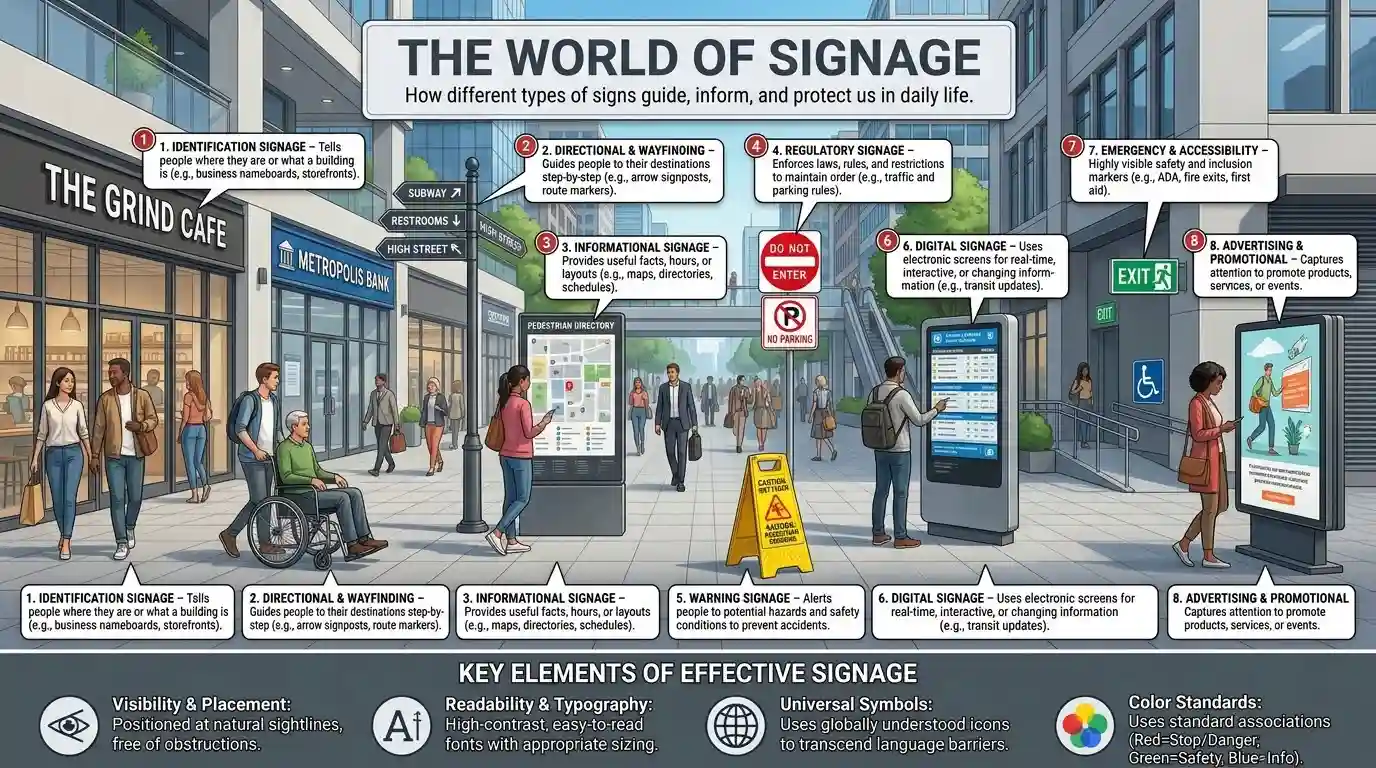
Signage is a noun that refers to a collection or system of signs used to provide information, directions, warnings, identification, or instructions.
In simple English, signage means signs used together to communicate information to people.
For example, an airport may have signage showing gates, exits, baggage collection areas, toilets, and security points.
Oxford defines signage as signs, especially those that give instructions or directions to the public, and identifies it as a formal, uncountable noun.
Part of Speech
Signage — noun
It is normally treated as an uncountable noun.
Natural: “The new signage is easy to follow.”
Less natural: “The new signages are easy to follow.”
When referring to individual items, use signs rather than “signages.”
Emotional Tone
“Signage” usually has a neutral and practical tone. It does not normally express happiness, anger, criticism, or affection.
It is especially common in professional, architectural, business, transportation, and public-information contexts.
Connotative Meaning
Connotation (the feeling or association a word can suggest beyond its basic dictionary meaning) can change depending on the alternative selected.
Positive Tone
Words such as guidance, wayfinding, orientation, and display can suggest helpfulness, clarity, or good organization.
Negative Tone
Words such as warning, restriction, notice, or caution may suggest danger, limits, or something that requires attention.
Neutral Tone
Words such as signs, markers, indicators, labels, and signboards usually describe visual communication without a strong emotional judgment.
Etymology of “Signage”
The word signage is formed from sign + -age.
The older word sign has a much longer history. Oxford traces sign through Middle English from Old French signe, ultimately from Latin signum, meaning “mark” or “token.”
Old English: 450–1100
The modern word sign was not yet established in its present form. English used other native terms for marks, indications, tokens, or signals.
Middle English: 1100–1500
After the Norman influence on English, forms related to Old French signe entered English. The word gradually developed meanings connected with marks, indications, symbols, and visible messages.
Modern English: 1500–Present
The meaning of sign expanded into many areas, including public notices, traffic signs, symbols, gestures, commercial displays, and indications.
Signage developed as a collective term for signs, especially signs used as a coordinated visual communication system.
Pronunciation
US Pronunciation
/ˈsaɪnɪdʒ/
UK Pronunciation
/ˈsaɪnɪdʒ/
Syllables
sign-age
Affixation Pattern of “Signage”
Root: sign
Prefix: none
Suffix: -age
The suffix -age can form nouns referring to a collection, process, condition, or related concept.
Synonyms List
The alternatives below are not all perfect one-for-one replacements. Some are direct synonyms, while others work best in specific contexts such as transportation, retail, architecture, safety, or public communication.
1. Signs (Noun) — US /saɪnz/ — UK /saɪnz/
Meaning: Signs are individual visual messages that provide information, instructions, warnings, directions, or identification.
Tone/Register: Neutral, everyday, widely used.
Example:
The building has clear signs near every entrance.
Visitors followed the signs to reach the conference room.
2. Signboards (Noun) — US /ˈsaɪnˌbɔrd/ — UK /ˈsaɪnˌbɔːd/
Meaning: A signboard is a board displaying words, symbols, or images for public information or identification.
Tone/Register: Neutral, descriptive.
Example:
The restaurant replaced its old signboard.
A wooden signboard marked the entrance to the village.
3. Displays (Noun) — US /dɪˈspleɪz/ — UK /dɪˈspleɪz/
Meaning: Displays are arranged visual materials designed to communicate information or attract attention.
Tone/Register: Business, retail, general.
Example:
The store updated its window displays.
Interactive displays helped visitors understand the exhibit.
4. Notices (Noun) — US /ˈnoʊtɪsɪz/ — UK /ˈnəʊtɪsɪz/
Meaning: Notices are written messages that give people information, instructions, or warnings.
Tone/Register: Neutral, formal.
Example:
The school posted notices about the holiday schedule.
Please read the notices before entering the laboratory.
5. Placards (Noun) — US /ˈplækɑrdz/ — UK /ˈplækɑːdz/
Meaning: Placards are signs or boards carrying a short public message.
Tone/Register: Formal, public, political, informational.
Example:
Protesters carried placards through the city.
A placard explained the history of the monument.
6. Markers (Noun) — US /ˈmɑrkərz/ — UK /ˈmɑːkəz/
Meaning: Markers are visible objects or signs used to identify a location, boundary, route, or point of interest.
Tone/Register: Neutral, technical.
Example:
Trail markers showed hikers which path to take.
Small markers identified each section of the garden.
7. Signposts (Noun) — US /ˈsaɪnˌpoʊsts/ — UK /ˈsaɪnˌpəʊsts/
Meaning: Signposts are signs placed along roads or paths to show directions or destinations.
Tone/Register: Neutral, practical.
Example:
We followed the signposts toward the town center.
A wooden signpost pointed toward the hiking trail.
8. Waymarkers (Noun) — US /ˈweɪˌmɑrkərz/ — UK /ˈweɪˌmɑːkəz/
Meaning: Waymarkers are signs or visible marks that help people follow a route.
Tone/Register: Travel, hiking, technical.
Example:
The walking route uses bright waymarkers.
We looked for the next waymarker near the bridge.
9. Directional Signs (Noun Phrase) — US /dəˈrɛkʃənəl saɪnz/ — UK /daɪˈrekʃənəl saɪnz/
Meaning: Directional signs tell people where to go or how to reach a destination.
Tone/Register: Professional, public information.
Example:
Directional signs guided passengers to the platform.
The mall added directional signs near the parking area.
10. Wayfinding Signs (Noun Phrase) — US /ˈweɪˌfaɪndɪŋ saɪnz/ — UK /ˈweɪˌfaɪndɪŋ saɪnz/
Meaning: Wayfinding signs help people navigate through unfamiliar places.
Tone/Register: Professional, architectural.
Example:
The hospital installed better wayfinding signs.
Clear wayfinding signs reduced confusion among visitors.
11. Information Signs (Noun Phrase) — US /ˌɪnfərˈmeɪʃən saɪnz/ — UK /ˌɪnfəˈmeɪʃən saɪnz/
Meaning: Information signs provide facts, instructions, or useful details to the public.
Tone/Register: Neutral, formal.
Example:
Information signs explained the park rules.
Tourists checked the information signs before entering the museum.
12. Guidance Signs (Noun Phrase) — US /ˈɡaɪdəns saɪnz/ — UK /ˈɡaɪdəns saɪnz/
Meaning: Guidance signs help people make decisions about where to go or what to do.
Tone/Register: Formal, professional.
Example:
Guidance signs directed visitors toward the exit.
The new guidance signs made the station easier to navigate.
13. Warning Signs (Noun Phrase) — US /ˈwɔrnɪŋ saɪnz/ — UK /ˈwɔːnɪŋ saɪnz/
Meaning: Warning signs alert people to possible danger or risk.
Tone/Register: Safety, formal.
Example:
Warning signs were placed near the wet floor.
Drivers should pay attention to warning signs on mountain roads.
14. Safety Signs (Noun Phrase) — US /ˈseɪfti saɪnz/ — UK /ˈseɪfti saɪnz/
Meaning: Safety signs communicate information intended to prevent accidents or unsafe behavior.
Tone/Register: Professional, regulatory.
Example:
Workers must follow the safety signs.
Bright safety signs marked the emergency exits.
15. Regulatory Signs (Noun Phrase) — US /ˈreɡjəˌlætəri saɪnz/ — UK /ˈreɡjʊlətri saɪnz/
Meaning: Regulatory signs communicate rules, restrictions, or legal requirements.
Tone/Register: Formal, legal, transportation.
Example:
Drivers must obey regulatory signs.
The road contains several regulatory signs near the intersection.
16. Identification Signs (Noun Phrase) — US /aɪˌdentəfəˈkeɪʃən saɪnz/ — UK /aɪˌdentɪfɪˈkeɪʃən saɪnz/
Meaning: Identification signs show the name or identity of a person, building, room, or location.
Tone/Register: Formal, professional.
Example:
Identification signs were placed outside each office.
The museum uses large identification signs for every gallery.
17. Nameplates (Noun) — US /ˈneɪmˌpleɪts/ — UK /ˈneɪmˌpleɪts/
Meaning: Nameplates are small signs that display a person’s, room’s, building’s, or object’s name.
Tone/Register: Neutral, professional.
Example:
Each office has a nameplate beside the door.
The brass nameplates give the building a traditional appearance.
18. Labels (Noun) — US /ˈleɪbəlz/ — UK /ˈleɪbəlz/
Meaning: Labels identify or describe an object, place, product, or feature.
Tone/Register: Neutral, everyday, technical.
Example:
The exhibition uses labels beside each painting.
Read the labels before handling the equipment.
19. Banners (Noun) — US /ˈbænərz/ — UK /ˈbænəz/
Meaning: Banners are large pieces of printed material used to display messages, names, announcements, or promotions.
Tone/Register: Informal to professional.
Example:
Colorful banners welcomed visitors to the festival.
The school hung banners across the entrance.
20. Posters (Noun) — US /ˈpoʊstərz/ — UK /ˈpəʊstəz/
Meaning: Posters are printed sheets containing information, images, announcements, or messages.
Tone/Register: General, educational, promotional.
Example:
The library displayed posters about reading programs.
Students created posters for the science exhibition.
21. Announcements (Noun) — US /əˈnaʊnsmənts/ — UK /əˈnaʊnsmənts/
Meaning: Announcements communicate important information publicly, sometimes through written visual messages.
Tone/Register: Neutral, formal.
Example:
The station posted announcements about the delay.
New announcements appeared near the main entrance.
22. Public Notices (Noun Phrase) — US /ˈpʌblɪk ˈnoʊtɪsɪz/ — UK /ˈpʌblɪk ˈnəʊtɪsɪz/
Meaning: Public notices are messages displayed to inform members of a community.
Tone/Register: Formal, administrative.
Example:
Public notices explained the temporary road closure.
The council placed public notices around the neighborhood.
23. Road Signs (Noun Phrase) — US /ˈroʊd saɪnz/ — UK /ˈrəʊd saɪnz/
Meaning: Road signs communicate directions, warnings, restrictions, or information to road users.
Tone/Register: Everyday, transportation.
Example:
Road signs warned drivers about the sharp turn.
We followed the road signs toward the airport.
24. Traffic Signs (Noun Phrase) — US /ˈtræfɪk saɪnz/ — UK /ˈtræfɪk saɪnz/
Meaning: Traffic signs provide instructions, warnings, or rules for people using roads.
Tone/Register: Technical, transportation.
Example:
Traffic signs control the flow of vehicles.
Drivers should understand common traffic signs.
25. Street Signs (Noun Phrase) — US /ˈstriːt saɪnz/ — UK /ˈstriːt saɪnz/
Meaning: Street signs identify roads, streets, avenues, or other public routes.
Tone/Register: Everyday, geographic.
Example:
The street signs were difficult to read at night.
New street signs helped visitors find the neighborhood.
26. Commercial Signs (Noun Phrase) — US /kəˈmɜrʃəl saɪnz/ — UK /kəˈmɜːʃəl saɪnz/
Meaning: Commercial signs identify businesses, products, services, or promotional messages.
Tone/Register: Business, retail.
Example:
The shop installed new commercial signs.
Bright commercial signs made the stores easy to recognize.
27. Storefront Signs (Noun Phrase) — US /ˈstɔrˌfrʌnt saɪnz/ — UK /ˈstɔːˌfrʌnt saɪnz/
Meaning: Storefront signs are signs placed on or near the front of a shop to identify the business.
Tone/Register: Retail, everyday.
Example:
The bakery replaced its faded storefront sign.
A simple storefront sign made the café easy to spot.
28. Environmental Graphics (Noun Phrase) — US /ɪnˌvaɪrənˈmentəl ˈɡræfɪks/ — UK /ɪnˌvaɪərənˈmentəl ˈɡræfɪks/
Meaning: Environmental graphics are visual elements used within physical spaces to communicate information, identity, or direction.
Tone/Register: Architectural, professional.
Example:
The museum uses environmental graphics to guide visitors.
Large environmental graphics give the building a clear visual identity.
29. Environmental Signage (Noun Phrase) — US /ɪnˌvaɪrənˈmentəl ˈsaɪnɪdʒ/ — UK /ɪnˌvaɪərənˈmentəl ˈsaɪnɪdʒ/
Meaning: Environmental signage refers to signs integrated into physical environments to guide, identify, or inform people.
Tone/Register: Architectural, business.
Example:
The architect designed environmental signage for the campus.
Good environmental signage makes large spaces easier to understand.
30. Visual Communication (Noun Phrase) — US /ˈvɪʒuəl kəˌmjuːnɪˈkeɪʃən/ — UK /ˈvɪʒuəl kəˌmjuːnɪˈkeɪʃən/
Meaning: Visual communication uses images, symbols, text, and design to convey information.
Tone/Register: Academic, professional.
Example:
Effective signage is an important form of visual communication.
The designer focused on simple visual communication.
31. Visual Cues (Noun Phrase) — US /ˈvɪʒuəl kjuːz/ — UK /ˈvɪʒuəl kjuːz/
Meaning: Visual cues are visible features that help people understand what to do or where to look.
Tone/Register: Neutral, educational.
Example:
Arrows acted as visual cues for visitors.
The color change provided a useful visual cue.
32. Visual Markers (Noun Phrase) — US /ˈvɪʒuəl ˈmɑrkərz/ — UK /ˈvɪʒuəl ˈmɑːkəz/
Meaning: Visual markers are noticeable features that identify a location, object, route, or boundary.
Tone/Register: Technical, descriptive.
Example:
Bright visual markers identified the emergency exits.
The museum uses visual markers to separate different sections.
33. Orientation Signs (Noun Phrase) — US /ˌɔriənˈteɪʃən saɪnz/ — UK /ˌɔːriənˈteɪʃən saɪnz/
Meaning: Orientation signs help people understand where they are within a particular place.
Tone/Register: Formal, architectural.
Example:
Orientation signs were installed near the main entrance.
The campus map works with the orientation signs.
34. Instructional Signs (Noun Phrase) — US /ɪnˈstrʌkʃənəl saɪnz/ — UK /ɪnˈstrʌkʃənəl saɪnz/
Meaning: Instructional signs tell people how to perform an action or follow a procedure.
Tone/Register: Formal, educational.
Example:
Instructional signs explained how to use the machine.
Please follow the instructional signs beside the equipment.
35. Warning Notices (Noun Phrase) — US /ˈwɔrnɪŋ ˈnoʊtɪsɪz/ — UK /ˈwɔːnɪŋ ˈnəʊtɪsɪz/
Meaning: Warning notices are written messages designed to alert people to danger or potential problems.
Tone/Register: Formal, safety-focused.
Example:
Warning notices were placed near the construction area.
Visitors read the warning notices before entering.
36. Direction Markers (Noun Phrase) — US /dəˈrɛkʃən ˈmɑrkərz/ — UK /daɪˈrekʃən ˈmɑːkəz/
Meaning: Direction markers are signs or visible features that show the direction of a route.
Tone/Register: Technical, travel-related.
Example:
Direction markers showed cyclists where to turn.
The trail uses simple direction markers.
37. Information Displays (Noun Phrase) — US /ˌɪnfərˈmeɪʃən dɪˈspleɪz/ — UK /ˌɪnfəˈmeɪʃən dɪˈspleɪz/
Meaning: Information displays present useful facts or instructions through text, graphics, or digital content.
Tone/Register: Professional, educational.
Example:
Information displays explained the history of the building.
Visitors stopped to read the information displays.
38. Sign Systems (Noun Phrase) — US /ˈsaɪn ˌsɪstəmz/ — UK /ˈsaɪn ˌsɪstəmz/
Meaning: Sign systems are coordinated groups of signs designed to communicate consistently within a place.
Tone/Register: Professional, architectural.
Example:
The airport redesigned its sign system.
A consistent sign system helps travelers move confidently.
39. Graphic Signs (Noun Phrase) — US /ˈɡræfɪk saɪnz/ — UK /ˈɡræfɪk saɪnz/
Meaning: Graphic signs use visual design, symbols, typography, or images to communicate information.
Tone/Register: Design, professional.
Example:
Graphic signs made the exhibition easier to navigate.
The designer used simple graphic signs throughout the building.
40. Public Signage (Noun Phrase) — US /ˈpʌblɪk ˈsaɪnɪdʒ/ — UK /ˈpʌblɪk ˈsaɪnɪdʒ/
Meaning: Public signage refers to signs intended to inform, guide, warn, or direct people in shared public spaces.
Tone/Register: Formal, public-information.
Example:
The city improved public signage around the station.
Clear public signage can make unfamiliar areas less confusing.
A Quick Note About These Synonyms
Not every word above can replace signage in every sentence.
For example, signs is the broadest everyday alternative. Wayfinding signs are more specific because they focus on navigation. Warning signs emphasize danger, while nameplates focus on identification.
This distinction matters because good vocabulary is not simply about finding a different word. It is about selecting the word that communicates the intended meaning most accurately.
Synonyms of Signage by Tone
Positive
Guidance signs, wayfinding signs, orientation signs, visual cues, information displays, and sign systems can suggest clarity, organization, and helpful communication.
Neutral
Signs, signboards, markers, labels, notices, displays, and street signs usually carry little emotional force.
Negative
Warning signs, warning notices, regulatory signs, and safety signs can create a sense of danger, restriction, or urgency.
Playful or Informal
Posters, banners, and displays may sound more casual when used in social, school, festival, or creative settings.
Tone matters because two words can describe a similar object while creating different impressions. A professional report may prefer wayfinding system, while an everyday conversation may simply use signs.
“Signage” vs Close Alternatives
Signage vs Signs
The Signage usually refers to a collection or coordinated system of signs. Signs can refer to individual pieces.
Use signage when discussing an entire visual system.
Use signs when talking about specific items.
Signage vs Signboards
Signboard usually describes a physical board carrying information, often outside a shop or building.
Signage is broader and can include many types of signs and visual guidance.
Signage vs Displays
Displays may contain products, images, decorations, or information.
Signage has a stronger communication and identification function.
How “Signage” Changes by Context
Daily Conversation
In everyday speech, signs is often more natural than signage.
For example, someone might say, “Follow the signs to the station.”
“Signage” sounds more professional and is more likely to appear in workplace discussions.
Writing and Blogging
Bloggers can use signage when discussing shops, travel destinations, public spaces, architecture, or visitor experiences.
To avoid repetition, terms such as directional signs, public notices, and information displays can be selected according to meaning.
Professional or Academic Writing
In architecture, urban planning, transportation, retail, and design, signage is especially useful.
A professional report might discuss “a consistent signage system,” “accessible signage,” or “effective wayfinding.”
Creative and Informal Writing
Creative writers often prefer concrete terms.
Instead of saying that “the signage was visible,” a story might say that “a faded wooden sign pointed toward the village.”
Specific nouns can make descriptions more vivid.
Common Mistakes Learners Make
Mistake 1: Treating “signage” as Countable
Avoid saying “three signages.”
Prefer:
“Three signs were installed.”
Or:
“The new signage includes three directional signs.”
Mistake 2: Using Every Synonym Interchangeably
A nameplate identifies something.
A warning sign alerts people to danger.
A wayfinding sign helps people navigate.
These terms overlap with signage but have different purposes.
Mistake 3: Using “Signage” in Casual Situations
In everyday conversation, “signage” can sound more formal than necessary.
“I followed the signs” is usually more natural than “I followed the signage.”
Mistake 4: Confusing Signs With Symbols
A symbol can be part of a sign, but the two terms are not always interchangeable.
A sign may contain words, arrows, symbols, colors, or several elements together.
Native Usage and Register Notes
Signage is especially common in professional and written English.
It appears frequently in architecture, transportation, retail, hospitality, construction, public planning, and business communication.
In casual spoken English, signs is often the simpler choice.
For more precise writing, choose a context-specific term such as directional signs, safety signs, or identification signs.
For related vocabulary on your site, an internal article about signs, symbols, markers, or indicators can naturally support readers who want to compare nearby terms.
Real-Life Mini Scenarios
Workplace
A new employee enters a large office building. Clear wayfinding signs point toward reception, meeting rooms, elevators, and emergency exits.
Social Situation
Friends meet at a crowded event. A large banner identifies the entrance and smaller directional signs point toward the seating area.
Media and Pop Culture
A movie scene may show bright storefront signs and colorful posters to establish the atmosphere of a busy city street.
Writing and Storytelling
A travel writer may describe an old signboard hanging outside a village café, creating a stronger visual image than simply using the word “signage.”
Why Choosing the Right Synonym Matters
- Good synonym choice improves precision.
- If you write about a hospital, wayfinding signs may be the best choice because the signs help visitors navigate.
- If you discuss a construction site, warning signs or safety signs may be more accurate.
- If you describe a shop, storefront signs may provide a clearer picture.
- If you discuss a complete visual system, signage or sign system is usually more suitable.
- This is why vocabulary learning should focus on meaning, context, tone, and natural usage rather than memorizing long lists of words.
External reference:
For a reliable dictionary definition and pronunciation reference, consult the Oxford Learner’s Dictionaries entry for “signage”.
Interactive Practice Quiz
Part One: Choose the Best Word
1. Visitors followed the ______ to find the emergency department.
A) nameplates
B) wayfinding signs
C) posters
D) banners
2. The museum placed ______ beside every painting.
A) labels
B) traffic signs
C) signposts
D) road signs
3. The road contained several ______ warning drivers about sharp bends.
A) storefront signs
B) nameplates
C) traffic signs
D) displays
4. The hotel installed new ______ near the elevators to show room locations.
A) directional signs
B) posters
C) placards
D) banners
5. A large ______ welcomed guests to the annual festival.
A) marker
B) banner
C) nameplate
D) regulatory sign
6. The factory placed ______ near the machinery to reduce accidents.
A) safety signs
B) storefront signs
C) posters
D) street signs
7. Each office door had a small ______ displaying the employee’s name.
A) signpost
B) nameplate
C) banner
D) waymarker
Part Two: Context and Tone
8. Which word sounds most appropriate in an architectural report?
A) signage
B) stuff
C) decorations
D) pictures
9. Which term specifically refers to signs that help people navigate?
A) labels
B) wayfinding signs
C) posters
D) banners
10. Which term is most closely connected with rules and restrictions?
A) regulatory signs
B) displays
C) posters
D) visual cues
11. Which word is the simplest everyday alternative to “signage”?
A) environmental graphics
B) signs
C) sign system
D) visual communication
12. A printed sheet announcing a school event is most naturally called a ______.
A) poster
B) signpost
C) marker
D) nameplate
13. A sign showing the name of a building is primarily an ______ sign.
A) identification
B) warning
C) traffic
D) regulatory
14. A trail symbol showing hikers where to go can function as a ______.
A) waymarker
B) storefront sign
C) nameplate
D) public notice
15. Which alternative best describes coordinated signs throughout an airport?
A) sign system
B) poster
C) label
D) placard
Reflection Task
Write one original sentence using signage, wayfinding signs, signboard, display, or another synonym from this article. Then replace your chosen word with a different suitable alternative and compare the change in meaning or tone.
Answer Key: 1-B | 2-A | 3-C | 4-A | 5-B | 6-A | 7-B | 8-A | 9-B | 10-A | 11-B | 12-A | 13-A | 14-A | 15-A
Frequently Asked Questions
1. What is the best synonym for signage in everyday English?
The simplest everyday synonym for signage is usually signs. It works when you are talking about individual signs or a group of signs in a general way. For more precise writing, choose a term that explains the function, such as directional signs, warning signs, information signs, or wayfinding signs.
2. Is “signage” singular or plural?
Signage is normally an uncountable noun, so it is generally treated as singular. Say, “The signage is clear,” rather than “The signage are clear.” When counting individual items, use signs, as in “The building has five signs.”
3. What is the difference between signage and signs?
Signage commonly refers to a collection, arrangement, or system of signs, especially in a public or professional environment. Signs can refer to individual items. For example, an airport may have a complete signage system containing many individual directional and information signs.
4. What synonym of signage is best for directions?
Directional signs and wayfinding signs are strong choices when the main purpose is helping people navigate. Directional signs usually point toward destinations, while wayfinding signs can be part of a broader navigation system that helps people understand where they are and where they should go.
5. What is another word for signage in a business context?
Depending on the situation, business writers can use commercial signs, storefront signs, displays, identification signs, or sign system. The best choice depends on whether the communication identifies a business, promotes something, guides customers, or forms part of a larger visual identity.
6. Can “signage” and “signboard” be used interchangeably?
Not always. A signboard usually means a physical board carrying information, often outside a shop, hotel, or building. Signage is broader and can include multiple signs, directional systems, warning signs, labels, and other forms of visual information.
7. What are professional alternatives to the word signage?
Professional alternatives include sign system, wayfinding signs, environmental signage, environmental graphics, visual communication, and information displays. These expressions are useful in architecture, urban planning, transportation, retail, hospitality, and design writing because they identify the specific function of the visual information.
8. Why should English learners study synonyms of signage?
Learning alternatives helps English learners avoid repetition and choose vocabulary that matches the exact context. Knowing the difference between a warning sign, nameplate, waymarker, and directional sign also makes writing more precise and natural.
Conclusion
Learning synonyms of signage helps you describe signs with greater accuracy. The right word can show whether a message gives directions, identifies a place, warns people, or provides information.
For students and writers, these alternatives make essays, blogs, reports, and descriptions more varied. They also make everyday communication clearer because each word carries a slightly different purpose.
Strong vocabulary is not about replacing every word with a difficult synonym. It is about choosing natural language that fits the audience, situation, tone, and message you want to express.
Practice these words in emails, essays, travel descriptions, and daily conversations. Start with a few useful terms, create your own examples, and gradually build confidence with synonyms of signage.

Mehtab Yasir is a passionate writer and English language enthusiast dedicated to making vocabulary learning simple, practical, and enjoyable. As an author at SynonymDesk.com, she creates helpful content covering synonyms, antonyms, word meanings, vocabulary, phrases, and everyday English usage. Her goal is to provide clear and easy-to-understand information that helps students, writers, professionals, and English learners choose the right words and communicate with greater confidence. Mehtab believes that a strong vocabulary can improve both writing and communication skills. She enjoys researching new words, exploring their meanings and uses, and turning complex language concepts into useful, reader-friendly content. Through her work, she strives to make SynonymDesk.com a reliable resource for anyone looking to improve their English vocabulary and language skills.