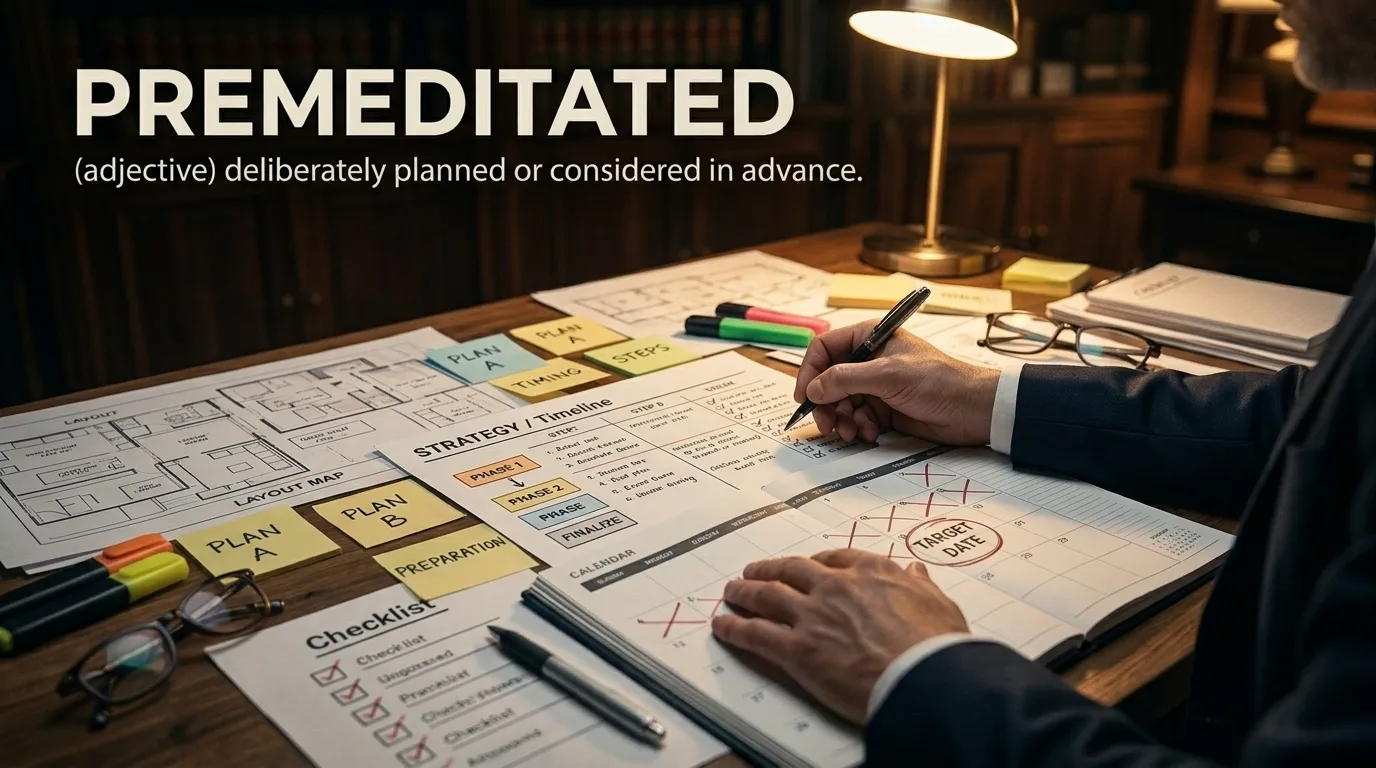
Synonyms of premeditated include planned, deliberate, intentional, calculated, preplanned, preconceived, purposeful, and forethoughtful. The word describes something considered and planned before it happens, often with careful intention.
Synonyms of premeditated can make your writing more precise. Imagine someone carefully planning an action days before carrying it out; calling it “premeditated” shows that it was not accidental.
Students, bloggers, and content writers often need alternatives to avoid repeating the same word. These synonyms also help daily English users express intention more clearly.
The word is common in news reports, legal discussions, storytelling, and serious conversations. Learning its alternatives helps you choose the right level of formality and meaning.
When you understand synonyms of premeditated, you can describe planned actions with greater accuracy. A good synonym can make an essay, article, email, or conversation sound more natural.
What Does “Premeditated” Really Mean?
Premeditated is an adjective that describes an action or decision planned before it happens, especially when the person has had time to think about what they intend to do.
In simple English, premeditated means planned rather than done suddenly or accidentally.
For example:
The attack was described as premeditated.
This means the attack was allegedly planned.
The word often carries a serious tone. It is especially common when discussing harmful acts, crimes, conflicts, or decisions that appear to have been carefully considered.
Native speakers may use premeditated when they want to emphasize prior planning. It can suggest that the person had enough time to think about the action before carrying it out.
Part of Speech
Premeditated is an adjective.
It describes a noun:
- a premeditated attack
- a premeditated decision
- a premeditated act
- a premeditated crime
- a premeditated response
The related verb is premeditate, while the noun is premeditation.
Connotative Meaning
Connotation means the emotional or implied feeling that a word carries beyond its basic dictionary meaning.
Positive Tone
Premeditated usually does not have a strongly positive tone. However, in some contexts, its idea of careful planning can overlap with positive concepts such as preparation, forethought, or deliberate decision-making.
Negative Tone
The word often has a negative tone when it describes harmful behavior. Phrases such as “premeditated murder” or “premeditated attack” strongly suggest deliberate wrongdoing.
Neutral Tone
In neutral contexts, premeditated can simply mean planned. The surrounding noun determines whether the overall expression sounds negative, neutral, or serious.
Etymology of “Premeditated”
The word premeditated comes from the Latin verb praemeditari, meaning “to think over beforehand” or “to consider in advance.”
It developed through French and Latin-based vocabulary before becoming established in English. The underlying idea has remained remarkably stable: thinking about something before doing it.
Old English: 450–1100
The exact modern form premeditated was not part of Old English vocabulary. Old English expressed similar ideas through native Germanic words related to thinking, planning, considering, and intending.
Middle English: 1100–1500
After the Norman Conquest, English absorbed many French and Latin-derived terms. Concepts involving intention, preparation, and deliberate action became increasingly expressed through Romance vocabulary.
Modern English: 1500–Present
Premeditate and related forms became established in Modern English. Today, premeditated is particularly frequent in legal, journalistic, academic, and formal contexts.
Pronunciation
US Pronunciation
/ˌpriːˈmedɪteɪtɪd/
UK Pronunciation
/ˌpriːˈmedɪteɪtɪd/
Syllables
pre-med-i-ta-ted
Affixation Pattern of “Premeditated”
Root
medit — connected with thinking, considering, or reflecting.
Prefix
pre- — means “before.”
Suffix
-ated — forms the past participle/adjectival form related to the verb.
The structure therefore reflects the basic idea of thinking beforehand.
Synonyms List
1. Planned (Adjective) — US: /plænd/ | UK: /plænd/
Meaning: Planned describes something arranged or decided before it takes place.
Tone/Register: Neutral, common, and widely used.
Example:
The meeting was carefully planned.
Her response sounded planned rather than spontaneous.
Usage note: “Planned” is broader and less serious than “premeditated.” It can describe ordinary activities as well as serious actions.
2. Deliberate (Adjective) — US: /dɪˈlɪbərət/ | UK: /dɪˈlɪbərət/
Meaning: Deliberate describes something done intentionally and with conscious thought.
Tone/Register: Neutral to formal.
Example:
His silence was deliberate.
The company made a deliberate choice to reduce waste.
Usage note: “Deliberate” is one of the closest everyday alternatives to “premeditated,” especially when intention matters.
3. Intentional (Adjective) — US: /ɪnˈtenʃənəl/ | UK: /ɪnˈtenʃənəl/
Meaning: Intentional means done on purpose rather than by accident.
Tone/Register: Neutral and widely used.
Example:
The mistake was not intentional.
Her decision to wait was intentional.
Usage note: “Intentional” emphasizes purpose more than planning.
4. Calculated (Adjective) — US: /ˈkælkjəleɪtɪd/ | UK: /ˈkælkjəleɪtɪd/
Meaning: Calculated describes an action carefully considered to achieve a particular result.
Tone/Register: Formal, analytical, sometimes negative.
Example:
The politician made a calculated statement.
His calculated move changed the direction of the discussion.
Usage note: “Calculated” often suggests strategy or careful consideration of consequences.
5. Preplanned (Adjective) — US: /ˌpriːˈplænd/ | UK: /ˌpriːˈplænd/
Meaning: Preplanned means arranged or organized before the event occurs.
Tone/Register: Neutral.
Example:
The emergency exercise was preplanned.
They followed a preplanned route through the city.
Usage note: This is a very direct alternative when the key idea is preparation.
6. Purposeful (Adjective) — US: /ˈpɜːrpəsfəl/ | UK: /ˈpɜːpəsfəl/
Meaning: Purposeful describes an action performed with a clear aim or intention.
Tone/Register: Neutral to positive.
Example:
She took a purposeful step toward the stage.
His questions were purposeful and focused.
Usage note: Unlike “premeditated,” “purposeful” does not necessarily suggest long-term planning.
7. Intent (Adjective) — US: /ɪnˈtent/ | UK: /ɪnˈtent/
Meaning: Intent can describe something carried out with a specific purpose or intention.
Tone/Register: Formal.
Example:
The action appeared intent on causing disruption.
His remarks were intent on challenging the existing policy.
Usage note: This is less interchangeable with “premeditated” than “deliberate,” so context matters.
8. Forethoughtful (Adjective) — US: /ˈfɔːrθɔːtfəl/ | UK: /ˈfɔːθɔːtfəl/
Meaning: Forethoughtful describes someone who considers future needs or consequences before acting.
Tone/Register: Formal and relatively uncommon.
Example:
Her forethoughtful preparation prevented several problems.
His forethoughtful approach made the project easier to manage.
Usage note: This word usually has a positive meaning and should not replace “premeditated” in serious criminal contexts.
9. Considered (Adjective) — US: /kənˈsɪdərd/ | UK: /kənˈsɪdəd/
Meaning: Considered describes something carefully thought about before a decision is made.
Tone/Register: Formal and neutral.
Example:
She gave a considered response to the criticism.
It was a considered decision, not an emotional reaction.
Usage note: “Considered” focuses on careful thought rather than secret or harmful planning.
10. Calculating (Adjective) — US: /ˈkælkjəleɪtɪŋ/ | UK: /ˈkælkjəleɪtɪŋ/
Meaning: Calculating describes someone who carefully plans actions to gain a particular advantage.
Tone/Register: Formal, often negative.
Example:
His calculating behavior worried his colleagues.
She made a calculating move to strengthen her position.
Usage note: The word can suggest coldness or self-interest.
11. Concocted (Adjective) — US: /kənˈkɑːktɪd/ | UK: /kənˈkɒktɪd/
Meaning: Concocted describes something deliberately created or devised, often a plan, excuse, or story.
Tone/Register: Informal to neutral.
Example:
He gave a concocted excuse for missing the appointment.
The story sounded carefully concocted.
Usage note: It often suggests that something has been invented rather than simply planned.
12. Devised (Adjective) — US: /dɪˈvaɪzd/ | UK: /dɪˈvaɪzd/
Meaning: Devised describes something developed through thought to achieve a specific purpose.
Tone/Register: Formal and academic.
Example:
The researchers devised a new method.
They devised a strategy before the competition began.
Usage note: “Devised” is especially useful for plans, methods, strategies, and solutions.
13. Arranged (Adjective) — US: /əˈreɪndʒd/ | UK: /əˈreɪndʒd/
Meaning: Arranged means organized or prepared before something happens.
Tone/Register: Neutral.
Example:
Everything was arranged before the guests arrived.
The appointment had been arranged weeks earlier.
Usage note: It is suitable for ordinary plans but usually lacks the serious implication of “premeditated.”
14. Organized (Adjective) — US: /ˈɔːrɡənaɪzd/ | UK: /ˈɔːɡənaɪzd/
Meaning: Organized describes something structured or prepared systematically.
Tone/Register: Neutral.
Example:
The event was carefully organized.
The group carried out an organized campaign.
Usage note: “Organized” focuses on structure and preparation rather than intention alone.
15. Orchestrated (Adjective) — US: /ˈɔːrkəstreɪtɪd/ | UK: /ˈɔːkɪstreɪtɪd/
Meaning: Orchestrated describes an event or action deliberately coordinated to produce a particular outcome.
Tone/Register: Formal and journalistic.
Example:
The campaign appeared carefully orchestrated.
The entire publicity event was orchestrated by the team.
Usage note: This word suggests coordination among multiple actions or people.
16. Strategized (Adjective) — US: /ˈstrætədʒaɪzd/ | UK: /ˈstrætədʒaɪzd/
Meaning: Strategized describes something developed through strategic planning.
Tone/Register: Business and professional.
Example:
The team used a strategized approach to the problem.
Their response was carefully strategized.
Usage note: This term works best for competitive, professional, or organizational situations.
17. Preconceived (Adjective) — US: /ˌpriːkənˈsiːvd/ | UK: /ˌpriːkənˈsiːvd/
Meaning: Preconceived describes an idea or opinion formed before receiving all relevant information.
Tone/Register: Academic and formal.
Example:
She entered the discussion without preconceived ideas.
His preconceived opinion affected his judgment.
Usage note: “Preconceived” usually applies to ideas or opinions, not physical actions.
18. Foreplanned (Adjective) — US: /ˌfɔːrˈplænd/ | UK: /ˌfɔːˈplænd/
Meaning: Foreplanned means thought about and organized ahead of time.
Tone/Register: Formal and uncommon.
Example:
The response was clearly foreplanned.
Their foreplanned strategy reduced confusion.
Usage note: “Foreplanned” is understandable but much less common than “planned” or “preplanned.”
19. Predetermined (Adjective) — US: /ˌpriːdɪˈtɜːrmɪnd/ | UK: /ˌpriːdɪˈtɜːmɪnd/
Meaning: Predetermined means decided or established before a particular event occurs.
Tone/Register: Formal and academic.
Example:
The winner was not predetermined.
The committee followed a predetermined procedure.
Usage note: It emphasizes an outcome or condition decided beforehand.
20. Premeditative (Adjective) — US: /ˌpriːˈmedɪteɪtɪv/ | UK: /ˌpriːˈmedɪteɪtɪv/
Meaning: Premeditative describes something involving advance thought or preparation.
Tone/Register: Formal and uncommon.
Example:
The evidence suggested a premeditative process.
His actions showed a premeditative quality.
Usage note: This is closely related to “premeditated,” but it is much less common in everyday English.
21. Intentionalized (Adjective) — US: /ɪnˈtenʃənəlaɪzd/ | UK: /ɪnˈtenʃənəlaɪzd/
Meaning: Intentionalized describes something made or treated as intentional.
Tone/Register: Technical and uncommon.
Example:
The behavior was later interpreted as intentionalized.
The researcher examined how the action became intentionalized.
Usage note: This is not a normal substitute for “premeditated.” Use it only in specialized academic contexts.
22. Thought-out (Adjective) — US: /ˌθɔːt ˈaʊt/ | UK: /ˌθɔːt ˈaʊt/
Meaning: Thought-out describes something carefully considered before being implemented.
Tone/Register: Neutral and conversational.
Example:
That sounds like a well-thought-out plan.
Her answer was thoughtful and well thought-out.
Usage note: This is excellent for ordinary conversation and writing.
23. Well-planned (Adjective) — US: /ˌwel ˈplænd/ | UK: /ˌwel ˈplænd/
Meaning: Well-planned describes something organized carefully before it happens.
Tone/Register: Neutral.
Example:
The trip was well-planned from the beginning.
It was a well-planned campaign.
Usage note: It usually has a positive tone and should not replace “premeditated” in negative legal contexts.
24. Intentionalist (Adjective) — US: /ɪnˈtenʃənəlɪst/ | UK: /ɪnˈtenʃənəlɪst/
Meaning: Intentionalist relates to an approach that gives importance to intention when interpreting an action, text, or work.
Tone/Register: Academic.
Example:
The critic used an intentionalist approach.
The paper presents an intentionalist interpretation of the text.
Usage note: This is a specialist term and is not a direct everyday replacement for “premeditated.”
25. Designed (Adjective) — US: /dɪˈzaɪnd/ | UK: /dɪˈzaɪnd/
Meaning: Designed describes something deliberately created for a particular purpose.
Tone/Register: Neutral and versatile.
Example:
The campaign was designed to attract younger readers.
Her comment seemed designed to provoke a reaction.
Usage note: “Designed” emphasizes purpose and intended effect.
26. Engineered (Adjective) — US: /ˌendʒɪˈnɪrd/ | UK: /ˌendʒɪˈnɪəd/
Meaning: Engineered describes an outcome deliberately produced through careful planning or manipulation.
Tone/Register: Formal, professional, sometimes negative.
Example:
The situation appeared carefully engineered.
The company engineered a solution to the problem.
Usage note: It can imply deliberate control over circumstances.
27. Manipulated (Adjective) — US: /məˈnɪpjəleɪtɪd/ | UK: /məˈnɪpjəleɪtɪd/
Meaning: Manipulated describes something deliberately influenced or controlled, often unfairly.
Tone/Register: Formal and usually negative.
Example:
The figures appeared manipulated.
He felt that the situation had been manipulated.
Usage note: “Manipulated” adds the idea of control or unfair influence.
28. Contrived (Adjective) — US: /kənˈtraɪvd/ | UK: /kənˈtraɪvd/
Meaning: Contrived describes something deliberately created in a way that seems unnatural or forced.
Tone/Register: Formal to literary.
Example:
The dialogue felt contrived.
The coincidence seemed too contrived to be believable.
Usage note: This word often criticizes something for looking artificially arranged.
29. Intentionalized (Adjective) — US: /ɪnˈtenʃənəlaɪzd/ | UK: /ɪnˈtenʃənəlaɪzd/
Meaning: Intentionalized refers to something interpreted or transformed as having deliberate intention.
Tone/Register: Technical.
Example:
The study explored how behavior becomes intentionalized.
The action was viewed through an intentionalized framework.
Usage note: Because this is highly specialized, everyday writers should normally choose “intentional” instead.
30. Programmed (Adjective) — US: /ˈproʊɡræmd/ | UK: /ˈprəʊɡræmd/
Meaning: Programmed describes something arranged or set to happen according to a prior plan.
Tone/Register: Technical and neutral.
Example:
The system was programmed to respond automatically.
The sequence was programmed before the presentation.
Usage note: This works especially well for machines, systems, and automated processes.
31. Predesigned (Adjective) — US: /ˌpriːdɪˈzaɪnd/ | UK: /ˌpriːdɪˈzaɪnd/
Meaning: Predesigned means created or planned before it is needed or used.
Tone/Register: Technical and professional.
Example:
The software uses a predesigned template.
The team selected a predesigned layout.
Usage note: It is best suited to objects, systems, templates, and structures.
32. Prearranged (Adjective) — US: /ˌpriːəˈreɪndʒd/ | UK: /ˌpriːəˈreɪndʒd/
Meaning: Prearranged means organized or agreed upon beforehand.
Tone/Register: Neutral and formal.
Example:
They met at a prearranged location.
The interview followed a prearranged schedule.
Usage note: This is useful when people agree on something before an event.
33. Preconceived (Adjective) — US: /ˌpriːkənˈsiːvd/ | UK: /ˌpriːkənˈsiːvd/
Meaning: Preconceived describes a belief or idea formed before careful examination.
Tone/Register: Academic and formal.
Example:
Try to approach the topic without preconceived opinions.
The lesson challenged several preconceived assumptions.
Usage note: This word is about thoughts and beliefs rather than planned physical actions.
34. Deliberately Planned (Adjective Phrase) — US: /dɪˈlɪbərətli plænd/ | UK: /dɪˈlɪbərətli plænd/
Meaning: Deliberately planned means intentionally organized after conscious consideration.
Tone/Register: Neutral to formal.
Example:
The campaign was deliberately planned to reach new audiences.
The timing was deliberately planned.
Usage note: This phrase clearly communicates both intention and planning.
35. Carefully Considered (Adjective Phrase) — US: /ˈkerfəli kənˈsɪdərd/ | UK: /ˈkeəfəli kənˈsɪdəd/
Meaning: Carefully considered describes something examined thoughtfully before a decision is made.
Tone/Register: Formal and professional.
Example:
Her proposal was carefully considered.
The board issued a carefully considered response.
Usage note: It is a strong choice when you want a neutral and professional tone.
36. Thoughtfully Planned (Adjective Phrase) — US: /ˈθɔːtfəli plænd/ | UK: /ˈθɔːtfəli plænd/
Meaning: Thoughtfully planned describes something prepared with attention to detail and possible needs.
Tone/Register: Neutral to positive.
Example:
The workshop was thoughtfully planned.
The itinerary was thoughtfully planned for first-time visitors.
Usage note: This phrase usually carries a positive impression.
37. Strategically Planned (Adjective Phrase) — US: /strəˈtiːdʒɪkli plænd/ | UK: /strəˈtiːdʒɪkli plænd/
Meaning: Strategically planned means organized with a specific long-term objective in mind.
Tone/Register: Business, professional, and academic.
Example:
The expansion was strategically planned.
Their strategically planned campaign reached a wider audience.
Usage note: It emphasizes goals, competition, and long-term results.
38. Purposefully Arranged (Adjective Phrase) — US: /ˈpɜːrpəsfəli əˈreɪndʒd/ | UK: /ˈpɜːpəsfəli əˈreɪndʒd/
Meaning: Purposefully arranged means organized intentionally to create a particular result.
Tone/Register: Formal and descriptive.
Example:
The photographs were purposefully arranged.
The seating was purposefully arranged for discussion.
Usage note: This phrase is useful when describing intentional organization.
39. Intentionally Designed (Adjective Phrase) — US: /ɪnˈtenʃənəli dɪˈzaɪnd/ | UK: /ɪnˈtenʃənəli dɪˈzaɪnd/
Meaning: Intentionally designed means deliberately created to serve a particular purpose.
Tone/Register: Professional and neutral.
Example:
The website was intentionally designed for easy reading.
The lesson was intentionally designed around practical examples.
Usage note: It is especially useful in educational, technical, and design-related writing.
40. Deliberately Engineered (Adjective Phrase) — US: /dɪˈlɪbərətli ˌendʒɪˈnɪrd/ | UK: /dɪˈlɪbərətli ˌendʒɪˈnɪəd/
Meaning: Deliberately engineered describes something intentionally created or manipulated to produce a desired result.
Tone/Register: Formal and analytical.
Example:
The outcome seemed deliberately engineered.
The campaign was deliberately engineered to attract attention.
Usage note: This phrase is stronger than “planned” because it suggests purposeful construction or manipulation.
Synonyms of Premeditated by Tone
Positive or Constructive
Some alternatives can have a positive or neutral sense when planning is useful or responsible.
- Purposeful
- Forethoughtful
- Considered
- Thought-out
- Well-planned
- Thoughtfully planned
- Strategically planned
- Carefully considered
These are suitable when describing preparation, organization, good judgment, or thoughtful decision-making.
Neutral
These words usually describe planning without strongly judging the action.
- Planned
- Intentional
- Preplanned
- Arranged
- Organized
- Prearranged
- Designed
- Predetermined
They work well in everyday English, educational writing, and general explanations.
Negative or Serious
Some alternatives can suggest manipulation, strategy, or questionable intention.
- Calculated
- Calculating
- Manipulated
- Contrived
- Engineered
- Deliberately engineered
- Concocted
These words are useful when the writer wants to suggest that the planning had a questionable purpose.
Formal or Academic
For academic and professional writing, these options can be more precise:
- Considered
- Devised
- Predetermined
- Preconceived
- Strategized
- Strategically planned
- Carefully considered
Tone matters because replacing “premeditated” with the wrong synonym can change the emotional meaning of a sentence.
“Premeditated” vs Close Alternatives
Premeditated vs Deliberate
It strongly emphasizes planning before an action. Deliberate emphasizes conscious intention.
Use “premeditated” when preparation is important. Use “deliberate” when you mainly want to show that something was done intentionally.
Premeditated vs Intentional
Intentional means “done on purpose.” It does not necessarily suggest that the person spent a long time planning.
For example, accidentally breaking a glass is not intentional. Breaking it after deciding to do so is intentional. A premeditated action generally involves more advance thought.
Premeditated vs Calculated
Calculated suggests that someone carefully considered the likely results of an action. It can also imply strategy or self-interest.
“Premeditated” focuses on planning, while “calculated” often focuses on strategic purpose and consequences.
How “Premeditated” Changes by Context
Daily Conversation
In casual conversation, “planned,” “intentional,” or “deliberate” is usually more natural than “premeditated.”
For example, someone might say:
“That was deliberate.”
The word “premeditated” can sound unusually serious in an ordinary conversation.
Writing or Blogging
Bloggers can use “premeditated” when discussing planned behavior, controversial events, fictional plots, or deliberate decisions.
However, alternatives such as “planned,” “calculated,” and “intentional” can make the writing more varied and accessible.
Professional or Academic Tone
Professional writers may choose “deliberate,” “strategically planned,” “carefully considered,” or “predetermined.”
These words work well in reports, essays, research papers, and business communication.
Creative or Informal Use
Creative writers can use “calculated,” “contrived,” “carefully planned,” or “deliberately engineered” depending on the mood.
For example, a thriller may describe a villain’s “calculated move,” while a comedy might call an awkward situation “deliberately contrived.”
Common Mistakes Learners Make
Mistake 1: Using “Premeditated” for Every Planned Activity
Not every planned activity is premeditated.
A planned birthday party is normally just planned, not “premeditated.”
Mistake 2: Confusing Intention With Planning
“Intentional” means done on purpose. “Premeditated” goes further by emphasizing thought or planning beforehand.
Mistake 3: Using Negative Synonyms in Positive Contexts
Words such as “manipulated,” “calculating,” and “contrived” can sound negative.
A learner should not replace “carefully planned” with “calculating” unless the context supports that tone.
Mistake 4: Using Rare Words to Sound More Advanced
Words such as “premeditative” or highly technical forms may look sophisticated, but native speakers generally prefer clearer alternatives.
Natural vocabulary is more useful than unnecessarily complicated vocabulary.
Register Notes
Formal vs Informal
“Premeditated” is relatively formal and serious.
“Planned,” “intentional,” and “thought-out” are more flexible for everyday English.
Spoken vs Written English
In speech, “planned,” “deliberate,” and “intentional” are common.
In formal writing, “premeditated,” “calculated,” “predetermined,” and “carefully considered” may be more appropriate.
Legal and Journalistic Writing
“Premeditated” is particularly important in legal and news contexts because it can describe an action allegedly planned before it happened.
The exact legal meaning can depend on the jurisdiction, so writers should avoid treating the word as a universal legal conclusion.
Real-Life Mini Scenarios
Workplace
A manager creates a detailed presentation before an important meeting.
You could say:
“The presentation was carefully planned.”
If the strategy was designed to influence a negotiation, “calculated” may be more suitable.
Social Situation
Someone intentionally ignores another person’s message.
You could say:
“Her decision not to respond seemed deliberate.”
“Premeditated” would sound unusually serious unless there was substantial prior planning.
Media and Pop Culture
A fictional character prepares a secret plan several days before carrying it out.
A writer might describe the character’s actions as premeditated or calculated.
Writing and Storytelling
A novelist reveals that a character has been preparing a major plot twist from the beginning.
The author might describe the character’s actions as carefully planned, deliberate, or premeditated.
Why Choosing the Right Synonym Matters
Vocabulary is not only about finding words with similar dictionary meanings.
Good word choice also communicates attitude, seriousness, certainty, and context.
For example, “planned” sounds ordinary. “Calculated” can sound strategic. “Premeditated” can sound serious and even legal.
That difference matters in essays, blog posts, stories, reports, emails, and everyday conversations.
A strong vocabulary allows writers to avoid unnecessary repetition without changing the intended meaning.
Practice Quiz
Choose the best answer for each situation.
1. Which word best describes an action that was planned before it happened?
A. Accidental
B. Premeditated
C. Random
D. Unclear
2. Which synonym is most suitable for a normal event that was organized in advance?
A. Planned
B. Manipulated
C. Contrived
D. Calculating
3. Which word best emphasizes that an action was done on purpose?
A. Intentional
B. Accidental
C. Uncertain
D. Unplanned
4. Which word can suggest careful strategy and consideration of consequences?
A. Calculated
B. Arranged
C. Thoughtful
D. Casual
5. Which synonym fits a formal academic sentence about a carefully considered decision?
A. Considered
B. Random
C. Casual
D. Playful
6. Which word is most appropriate for an idea formed before someone receives all the facts?
A. Preconceived
B. Planned
C. Organized
D. Engineered
7. Which synonym works well for a plan developed to achieve a particular purpose?
A. Devised
B. Accidental
C. Uncertain
D. Spontaneous
8. Which word can suggest that an outcome was deliberately manipulated?
A. Engineered
B. Friendly
C. Natural
D. Unplanned
9. Which synonym is generally positive when describing careful preparation?
A. Thoughtfully planned
B. Manipulated
C. Contrived
D. Calculating
10. Which word is especially suitable for a plan agreed upon before an event?
A. Prearranged
B. Accidental
C. Spontaneous
D. Uncertain
Part Two
11. Which word best fits a business strategy created with long-term goals in mind?
A. Strategically planned
B. Accidental
C. Random
D. Unprepared
12. Which word often suggests that something feels artificially created?
A. Contrived
B. Planned
C. Intentional
D. Considered
13. Which word is usually more conversational than “premeditated”?
A. Thought-out
B. Predetermined
C. Premeditative
D. Orchestrated
14. Which synonym focuses on an action being arranged in advance?
A. Preplanned
B. Accidental
C. Emotional
D. Spontaneous
15. Which phrase best describes a response that was carefully evaluated before being given?
A. Carefully considered
B. Randomly selected
C. Accidentally created
D. Casually ignored
Reflection Task
Write one sentence using premeditated, deliberate, calculated, or intentional. Then explain why your chosen synonym fits the situation.
Answer Key
1-B | 2-A | 3-A | 4-A | 5-A | 6-A | 7-A | 8-A | 9-A | 10-A | 11-A | 12-A | 13-A | 14-A | 15-A
FAQs
1. What is the closest synonym for premeditated in everyday English?
The closest everyday synonym is usually deliberate when you want to emphasize that an action was intentional. Planned is also useful when the main idea is preparation. The best choice depends on whether you want to highlight intention, planning, strategy, or seriousness.
2. Is premeditated always a negative word?
No. The basic meaning is that something was considered or planned. However, the word often appears in serious or negative contexts, especially when discussing crimes or harmful actions. The surrounding noun determines much of its emotional effect.
3. What is the difference between premeditated and intentional?
Intentional means something was done on purpose. Premeditated usually suggests that the person thought about or planned the action before carrying it out. Therefore, something can be intentional without being strongly premeditated.
4. Can premeditated be used for positive actions?
Yes, but it can sound unusually serious. For positive situations, words such as planned, purposeful, thoughtful, or carefully considered are usually more natural. “Premeditated” is especially associated with serious or formal contexts.
5. Which synonyms of premeditated are best for academic writing?
Academic writing can benefit from deliberate, considered, predetermined, calculated, devised, strategically planned, and carefully considered. The correct option depends on the subject. “Considered” works well for decisions, while “predetermined” is useful for conditions or outcomes established in advance.
6. What is the difference between premeditated and calculated?
“Premeditated” emphasizes that an action was planned. “Calculated” often adds the idea that someone carefully considered the likely result or advantage. A calculated action may therefore sound more strategic, cold, or self-interested.
7. Is planned a good synonym for premeditated?
Yes, but it is broader and less emotionally loaded. Planned can describe anything arranged ahead of time, such as a trip or meeting. Premeditated usually carries a stronger sense of deliberate prior thought and is more common in serious contexts.
8. How can learning synonyms of premeditated improve English vocabulary?
Learning related words helps you express different shades of meaning instead of repeating one term. It also improves writing style, speaking accuracy, and comprehension. Practicing words such as deliberate, calculated, intentional, planned, and considered helps you select vocabulary that matches each situation.
Conclusion
Learning synonyms of premeditated helps you describe planned actions with greater accuracy. Words such as deliberate, intentional, and calculated each add a different shade of meaning.
Strong vocabulary improves writing because it lets you avoid repetition without losing meaning. It also helps bloggers, students, and writers communicate ideas more naturally.
In conversation, the right synonym can make your message clearer and more appropriate. A simple word like “planned” may sound more natural than “premeditated” in casual situations.
Keep practicing these words in emails, essays, stories, and daily conversations. Try creating your own examples and notice how each synonym changes the tone.

Mehtab Yasir is a passionate writer and English language enthusiast dedicated to making vocabulary learning simple, practical, and enjoyable. As an author at SynonymDesk.com, she creates helpful content covering synonyms, antonyms, word meanings, vocabulary, phrases, and everyday English usage. Her goal is to provide clear and easy-to-understand information that helps students, writers, professionals, and English learners choose the right words and communicate with greater confidence. Mehtab believes that a strong vocabulary can improve both writing and communication skills. She enjoys researching new words, exploring their meanings and uses, and turning complex language concepts into useful, reader-friendly content. Through her work, she strives to make SynonymDesk.com a reliable resource for anyone looking to improve their English vocabulary and language skills.