Synonyms of inhibitor include blocker, obstacle, barrier, restraint, suppressor, deterrent, hindrance, and impediment. An inhibitor is something that prevents, slows, limits, or reduces an action, process, or development. The best alternative depends on context. For example, a barrier blocks progress, while a suppressor reduces activity or expression.
Imagine preparing for an important presentation. You know your subject well, but fear stops you from speaking confidently. That fear becomes an inhibitor.
A scientist may describe a chemical as an inhibitor because it slows a reaction. A business leader may use the same word to describe something that limits growth.
Learning synonyms of inhibitor helps students, bloggers, and content writers express different types of restrictions. It also makes everyday communication clearer.
The word appears frequently in science, psychology, medicine, and business. Understanding its alternatives helps you choose language that matches your exact meaning.
What Does Inhibitor Really Mean?
An inhibitor is a person, substance, condition, or factor that prevents something from happening or reduces its activity.
In simple English, it is something that holds another thing back.
The word is a countable noun. Its plural form is inhibitors.
Consider these examples:
- Stress can become an inhibitor of creativity.
- Certain substances act as inhibitors of chemical reactions.
- Poor communication is a major inhibitor of teamwork.
Native English speakers often understand inhibitor as a relatively formal word. It suggests restriction, prevention, or reduced activity.
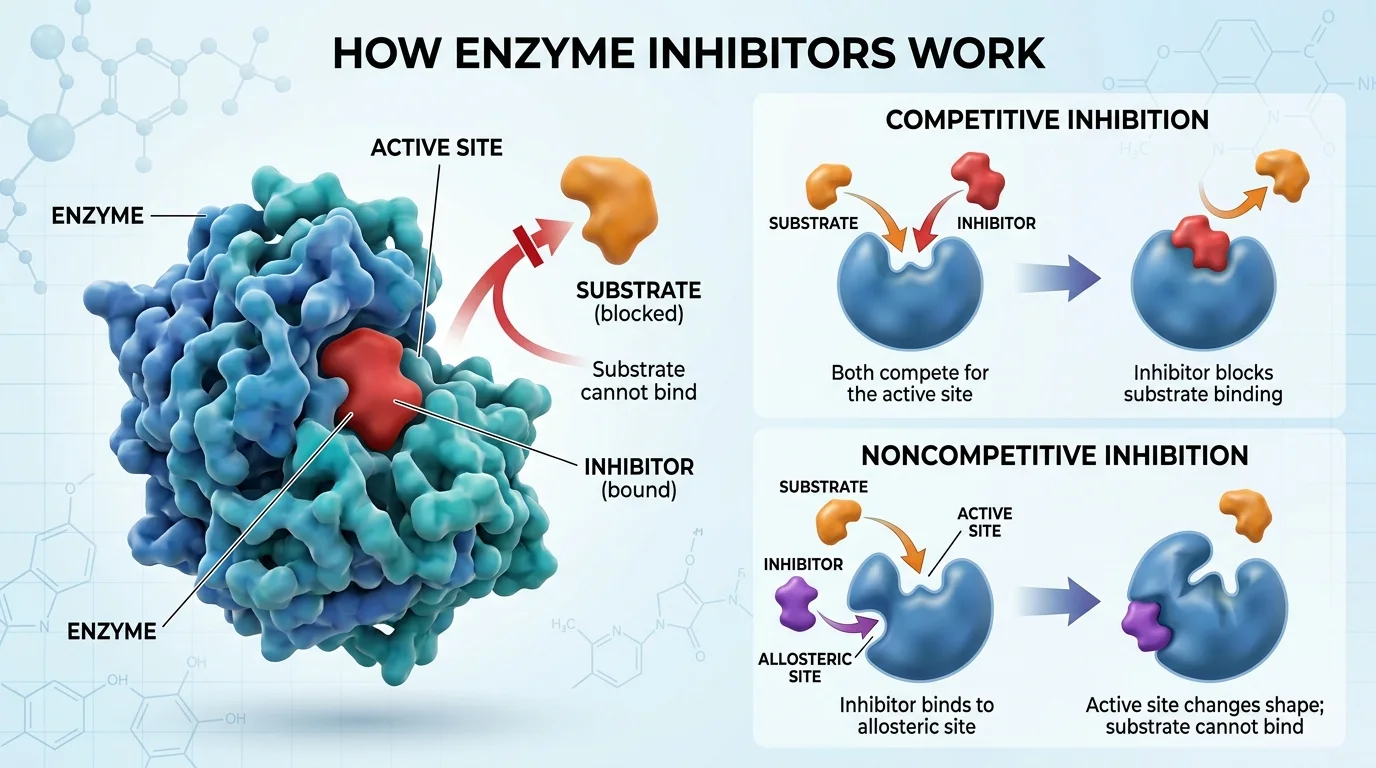
In scientific writing, it has a more specific meaning. An inhibitor may interfere with an enzyme, chemical reaction, or biological process.
In everyday situations, it can describe fear, hesitation, social pressure, or anything that limits progress.
Connotative Meaning of Inhibitor
(Connotation is the emotional or cultural meaning a word carries beyond its basic dictionary definition.)
Positive Tone
An inhibitor can suggest protection when it prevents something harmful.
For example, a corrosion inhibitor protects metal from damage.
Negative Tone
The word may describe an unwanted restriction.
For example, financial uncertainty can become an inhibitor of business expansion.
Neutral Tone
In scientific contexts, inhibitor often describes a measurable function without emotional judgment.
For example, researchers studied an inhibitor of enzyme activity.
The surrounding sentence determines whether the word sounds helpful, harmful, or purely descriptive.
Etymology of Inhibitor
The word inhibitor comes from the Latin verb inhibere, meaning to restrain, hold back, or prevent.
Its historical components include in- and habere, meaning to hold.
The related English verb inhibit developed before the modern noun became established.
Old English (450–1100)
The modern word inhibitor did not exist in Old English.
Speakers expressed similar ideas through native vocabulary connected with stopping, holding, and preventing.
Middle English (1100–1500)
The related verb inhibit entered English through Latin influence during the Middle English period.
It was associated with restriction and prevention, particularly in formal contexts.
Modern English (1500–Present)
The noun inhibitor developed within Modern English.
Its meaning expanded across chemistry, biology, medicine, psychology, engineering, and everyday communication.
Today, it describes both physical substances and abstract factors that reduce activity.
Pronunciation of Inhibitor
- US: /ɪnˈhɪb.ɪ.t̬ɚ/
- UK: /ɪnˈhɪb.ɪ.tə/
Syllables
in-hib-i-tor
The word contains four syllables.
The primary stress falls on the second syllable: HIB.
Affixation Pattern of Inhibitor
- Root/Base: inhibit
- Historical prefix: in- (part of the Latin source)
- Modern suffix: -or
- Formation: inhibit + -or = inhibitor
The suffix -or forms nouns that identify an agent or something performing a particular function.
Inhibitor therefore refers to something that inhibits.
Synonyms List
The following collection includes direct synonyms, close alternatives, and specialized terms.
Not every word is interchangeable in every sentence. Some describe physical restrictions. Others refer to psychological, social, biological, or professional limitations.
Understanding these differences helps you communicate accurately.
1. Blocker (Noun) — US /ˈblɑː.kɚ/ | UK /ˈblɒk.ə/
Meaning: Something that prevents an action, movement, or process from continuing.
Tone/Register: Neutral, Everyday, Technical
Example 1: A software blocker prevented access to the website.
Example 2: The medication works as a blocker of certain receptors.
2. Obstacle (Noun) — US /ˈɑːb.stə.kəl/ | UK /ˈɒb.stə.kəl/
Meaning: Something that makes progress or achievement difficult.
Tone/Register: Neutral, Professional
Example 1: Limited funding became an obstacle to the project.
Example 2: Her lack of experience was an obstacle at first.
3. Barrier (Noun) — US /ˈber.i.ɚ/ | UK /ˈbær.i.ə/
Meaning: Something that separates, restricts, or prevents access or progress.
Tone/Register: Neutral, Academic
Example 1: Language barriers made communication difficult.
Example 2: High costs created a barrier to education.
4. Restraint (Noun) — US /rɪˈstreɪnt/ | UK /rɪˈstreɪnt/
Meaning: A limitation that controls or restricts behavior and activity.
Tone/Register: Formal, Neutral
Example 1: Financial restraint slowed the expansion.
Example 2: She showed restraint during the heated discussion.
5. Suppressor (Noun) — US /səˈpres.ɚ/ | UK /səˈpres.ə/
Meaning: Something that reduces or stops an activity, response, or expression.
Tone/Register: Scientific, Technical
Example 1: Researchers examined a suppressor of immune activity.
Example 2: The substance acts as a suppressor of unwanted signals.
6. Deterrent (Noun) — US /dɪˈtɝː.ənt/ | UK /dɪˈter.ənt/
Meaning: Something that discourages an action by making it less attractive.
Tone/Register: Formal, Business
Example 1: Strict penalties can act as a deterrent to fraud.
Example 2: Expensive transport became a deterrent for visitors.
7. Hindrance (Noun) — US /ˈhɪn.drəns/ | UK /ˈhɪn.drəns/
Meaning: Something that makes an activity or achievement more difficult.
Tone/Register: Neutral, Formal
Example 1: Constant interruptions became a hindrance to productivity.
Example 2: Poor lighting was a hindrance during the examination.
8. Impediment (Noun) — US /ɪmˈped.ə.mənt/ | UK /ɪmˈped.ɪ.mənt/
Meaning: A condition or obstacle that delays or interferes with progress.
Tone/Register: Formal, Academic
Example 1: Outdated regulations became an impediment to innovation.
Example 2: Heavy traffic was an impediment to timely delivery.
9. Restriction (Noun) — US /rɪˈstrɪk.ʃən/ | UK /rɪˈstrɪk.ʃən/
Meaning: A rule or condition that limits what someone can do.
Tone/Register: Formal, Administrative
Example 1: Travel restrictions affected international students.
Example 2: The new restriction limited access to sensitive information.
10. Constraint (Noun) — US /kənˈstreɪnt/ | UK /kənˈstreɪnt/
Meaning: A limitation that reduces available choices or actions.
Tone/Register: Professional, Academic
Example 1: Time constraints affected the research schedule.
Example 2: Budget constraints delayed the renovation.
11. Obstruction (Noun) — US /əbˈstrʌk.ʃən/ | UK /əbˈstrʌk.ʃən/
Meaning: Something that blocks a passage, process, or activity.
Tone/Register: Formal, Technical
Example 1: A fallen tree caused an obstruction on the road.
Example 2: Doctors identified an obstruction in the patient’s airway.
12. Preventer (Noun) — US /prɪˈven.tɚ/ | UK /prɪˈven.tə/
Meaning: Something that stops a particular event or condition from occurring.
Tone/Register: Descriptive, Technical
Example 1: The device serves as an overflow preventer.
Example 2: Engineers installed a backflow preventer in the system.
13. Limiter (Noun) — US /ˈlɪm.ɪ.t̬ɚ/ | UK /ˈlɪm.ɪ.tə/
Meaning: Something that keeps an activity or quantity within a set boundary.
Tone/Register: Technical, Neutral
Example 1: The vehicle has an electronic speed limiter.
Example 2: A sound limiter protects the speakers from excessive volume.
14. Check (Noun) — US /tʃek/ | UK /tʃek/
Meaning: A force or measure that controls or prevents excessive activity.
Tone/Register: Neutral, Formal
Example 1: Independent oversight provides a check on executive power.
Example 2: Regular inspections act as a check against unsafe practices.
15. Brake (Noun) — US /breɪk/ | UK /breɪk/
Meaning: Something that slows movement, development, or progress.
Tone/Register: Everyday, Figurative
Example 1: Rising costs put a brake on company growth.
Example 2: Uncertainty acted as a brake on consumer spending.
16. Curb (Noun) — US /kɝːb/ | UK /kɜːb/
Meaning: A measure or influence that controls excessive behavior or activity.
Tone/Register: Neutral, Journalistic
Example 1: The government introduced curbs on unnecessary spending.
Example 2: New safety rules provided a curb on dangerous practices.
17. Regulator (Noun) — US /ˈreɡ.jə.leɪ.t̬ɚ/ | UK /ˈreɡ.jə.leɪ.tə/
Meaning: Something that controls the rate, level, or operation of a process.
Tone/Register: Technical, Scientific
Example 1: The device contains a regulator for water pressure.
Example 2: Scientists identified a regulator of gene activity.
18. Controller (Noun) — US /kənˈtroʊ.lɚ/ | UK /kənˈtrəʊ.lə/
Meaning: Something that directs or limits the operation of a system.
Tone/Register: Technical, Professional
Example 1: The temperature controller prevents overheating.
Example 2: An electronic controller manages the motor’s speed.
19. Retardant (Noun) — US /rɪˈtɑːr.dənt/ | UK /rɪˈtɑː.dənt/
Meaning: A substance that slows a physical or chemical process.
Tone/Register: Scientific, Industrial
Example 1: The material contains a flame retardant.
Example 2: Workers applied a setting retardant to the concrete.
20. Suppressant (Noun) — US /səˈpres.ənt/ | UK /səˈpres.ənt/
Meaning: A substance or agent that reduces an unwanted response or activity.
Tone/Register: Medical, Technical
Example 1: The doctor recommended a cough suppressant.
Example 2: Firefighters used a specialized fire suppressant.
21. Depressant (Noun) — US /dɪˈpres.ənt/ | UK /dɪˈpres.ənt/
Meaning: A substance that reduces activity in the central nervous system or another system.
Tone/Register: Medical, Scientific
Example 1: Alcohol acts as a central nervous system depressant.
Example 2: The report examined the effects of different depressants.
22. Antagonist (Noun) — US /ænˈtæɡ.ə.nɪst/ | UK /ænˈtæɡ.ə.nɪst/
Meaning: In pharmacology, a substance that blocks or reduces the action of a receptor.
Tone/Register: Scientific, Medical
Example 1: The medicine acts as a receptor antagonist.
Example 2: Researchers tested an antagonist against the targeted response.
23. Repressor (Noun) — US /rɪˈpres.ɚ/ | UK /rɪˈpres.ə/
Meaning: Something that suppresses an activity, especially gene expression.
Tone/Register: Scientific, Academic
Example 1: The repressor protein reduced gene transcription.
Example 2: Researchers studied how the repressor binds to DNA.
24. Neutralizer (Noun) — US /ˈnuː.trə.laɪ.zɚ/ | UK /ˈnjuː.trə.laɪ.zə/
Meaning: Something that counteracts or removes the effect of another substance or force.
Tone/Register: Scientific, Technical
Example 1: The neutralizer reduced the solution’s acidity.
Example 2: The cleaning process required a suitable neutralizer.
25. Counteragent (Noun) — US /ˈkaʊn.t̬ɚˌeɪ.dʒənt/ | UK /ˈkaʊn.təˌeɪ.dʒənt/
Meaning: An agent that works against the effect of another agent.
Tone/Register: Technical, Scientific
Example 1: The researchers investigated a possible counteragent.
Example 2: The treatment required a carefully selected counteragent.
26. Interference (Noun) — US /ˌɪn.t̬ɚˈfɪr.əns/ | UK /ˌɪn.təˈfɪə.rəns/
Meaning: An action or influence that disrupts a process or prevents normal operation.
Tone/Register: Neutral, Technical
Example 1: Electronic interference disrupted the radio signal.
Example 2: Outside interference delayed the investigation.
27. Disincentive (Noun) — US /ˌdɪs.ɪnˈsen.tɪv/ | UK /ˌdɪs.ɪnˈsen.tɪv/
Meaning: Something that reduces motivation to act.
Tone/Register: Business, Academic
Example 1: Excessive paperwork became a disincentive to investment.
Example 2: Low rewards created a disincentive for extra effort.
28. Discouragement (Noun) — US /dɪˈskɝː.ɪdʒ.mənt/ | UK /dɪˈskʌr.ɪdʒ.mənt/
Meaning: Something that reduces confidence, motivation, or willingness to act.
Tone/Register: Emotional, Everyday
Example 1: Repeated criticism became a source of discouragement.
Example 2: Early failures caused temporary discouragement among the volunteers.
29. Roadblock (Noun) — US /ˈroʊd.blɑːk/ | UK /ˈrəʊd.blɒk/
Meaning: A problem that prevents progress toward a particular goal.
Tone/Register: Informal, Business
Example 1: Missing documents created a roadblock for the application.
Example 2: The team encountered an unexpected roadblock during testing.
30. Bottleneck (Noun) — US /ˈbɑː.t̬əl.nek/ | UK /ˈbɒt.əl.nek/
Meaning: A point in a process where limited capacity slows overall progress.
Tone/Register: Business, Technical
Example 1: The approval process became a production bottleneck.
Example 2: Limited storage created a bottleneck in the supply chain.
31. Stumbling Block (Noun) — US /ˈstʌm.blɪŋ ˌblɑːk/ | UK /ˈstʌm.blɪŋ ˌblɒk/
Meaning: A difficulty that prevents someone from achieving a goal.
Tone/Register: Conversational, Figurative
Example 1: Poor planning became a stumbling block for the event.
Example 2: Grammar was his biggest stumbling block in English class.
32. Encumbrance (Noun) — US /ɪnˈkʌm.brəns/ | UK /ɪnˈkʌm.brəns/
Meaning: A burden or restriction that makes movement or progress difficult.
Tone/Register: Formal, Legal
Example 1: The legal encumbrance complicated the property sale.
Example 2: Additional responsibilities became an encumbrance during her studies.
33.Disability (Noun) — US /ˈhæn.di.kæp/ | UK /ˈhæn.di.kæp/
Meaning: A disadvantage that makes success in a particular activity more difficult.
Tone/Register: Traditional, Context-Sensitive
Example 1: Limited experience was a disability in the competition.
Example 2: The team’s small budget proved a significant disadvantage.
Usage note: Avoid using this word as a general label for people with disabilities. Disadvantage or obstacle is often more appropriate.
34. Disadvantage (Noun) — US /ˌdɪs.ədˈvæn.tɪdʒ/ | UK /ˌdɪs.ədˈvɑːn.tɪdʒ/
Meaning: An unfavorable condition that reduces someone’s chances of success.
Tone/Register: Neutral, Academic
Example 1: Lack of internet access placed students at a disadvantage.
Example 2: The late start was a disadvantage for the new company.
35. Drawback (Noun) — US /ˈdrɑː.bæk/ | UK /ˈdrɔː.bæk/
Meaning: A negative feature that reduces the usefulness or effectiveness of something.
Tone/Register: Neutral, Everyday
Example 1: The main drawback of the apartment was its location.
Example 2: Slow processing speed is a drawback of the older system.
36. Limitation (Noun) — US /ˌlɪm.əˈteɪ.ʃən/ | UK /ˌlɪm.ɪˈteɪ.ʃən/
Meaning: A condition that restricts ability, capacity, or possible results.
Tone/Register: Academic, Neutral
Example 1: The study had several important limitations.
Example 2: Limited battery life is a major limitation of the device.
37. Inhibition (Noun) — US /ˌɪn.həˈbɪʃ.ən/ | UK /ˌɪn.hɪˈbɪʃ.ən/
Meaning: The act or state of preventing, restricting, or reducing an activity.
Tone/Register: Psychological, Scientific
Example 1: Social inhibition made public speaking uncomfortable.
Example 2: The experiment measured enzyme inhibition.
38. Damper (Noun) — US /ˈdæm.pɚ/ | UK /ˈdæm.pə/
Meaning: Something that reduces enthusiasm, excitement, or intensity.
Tone/Register: Conversational, Figurative
Example 1: Heavy rain put a damper on the celebration.
Example 2: Unexpected expenses put a damper on their holiday plans.
39. Dampener (Noun) — US /ˈdæm.pə.nɚ/ | UK /ˈdæm.pə.nə/
Meaning: Something that weakens enthusiasm or reduces the strength of an effect.
Tone/Register: Neutral, Informal
Example 1: The disappointing results were a dampener on team morale.
Example 2: Rising prices acted as a dampener on demand.
40. Interrupter (Noun) — US /ˌɪn.təˈrʌp.tɚ/ | UK /ˌɪn.təˈrʌp.tə/
Meaning: A person or device that breaks the continuity of an activity or process.
Tone/Register: Neutral, Technical
Example 1: The circuit interrupter stopped the electrical flow.
Example 2: The meeting’s frequent interruptions slowed the discussion.
41. Stumbling Point (Noun Phrase) — US /ˈstʌm.blɪŋ pɔɪnt/ | UK /ˈstʌm.blɪŋ pɔɪnt/
Meaning: A particular issue that causes difficulty or prevents further progress.
Tone/Register: Conversational, Descriptive
Example 1: The payment terms became a stumbling point in negotiations.
Example 2: Finding a suitable venue was the main stumbling point.
42. Countermeasure (Noun) — US /ˈkaʊn.t̬ɚˌmeʒ.ɚ/ | UK /ˈkaʊn.təˌmeʒ.ə/
Meaning: An action or measure designed to prevent or reduce an unwanted effect.
Tone/Register: Formal, Technical
Example 1: The company introduced countermeasures against cyberattacks.
Example 2: Engineers developed a countermeasure to reduce vibration.
43. Preventive (Noun) — US /prɪˈven.tɪv/ | UK /prɪˈven.tɪv/
Meaning: A measure or substance intended to stop something undesirable from happening.
Tone/Register: Medical, Formal
Example 1: Vaccination is an important preventive measure against certain diseases.
Example 2: The clinic recommended additional preventives for travelers.
44. Inactivator (Noun) — US /ɪnˈæk.tɪ.veɪ.t̬ɚ/ | UK /ɪnˈæk.tɪ.veɪ.tə/
Meaning: An agent that causes a substance or biological component to lose activity.
Tone/Register: Scientific, Technical
Example 1: Scientists tested an inactivator of the target enzyme.
Example 2: The chemical served as an inactivator during processing.
45. Quencher (Noun) — US /ˈkwen.tʃɚ/ | UK /ˈkwen.tʃə/
Meaning: A substance that reduces or suppresses a particular physical or chemical effect.
Tone/Register: Scientific, Technical
Example 1: The laboratory added a fluorescence quencher.
Example 2: Researchers measured the effect of the quencher on the signal.
46. Sequestrant (Noun) — US /sɪˈkwes.trənt/ | UK /sɪˈkwes.trənt/
Meaning: A substance that binds or isolates another substance and limits its availability.
Tone/Register: Scientific, Medical
Example 1: The treatment included a bile acid sequestrant.
Example 2: A suitable sequestrant reduced the availability of certain ions.
47. Chelator (Noun) — US /ˈkiː.leɪ.t̬ɚ/ | UK /ˈkiː.leɪ.tə/
Meaning: A substance that binds metal ions and can limit their chemical or biological activity.
Tone/Register: Scientific, Medical
Example 1: The scientist used a chelator to bind excess metal ions.
Example 2: The experiment examined how the chelator affected the reaction.
48. Growth Retarder (Noun Phrase) — US /ɡroʊθ rɪˈtɑːr.dɚ/ | UK /ɡrəʊθ rɪˈtɑː.də/
Meaning: A substance or factor that slows the rate of growth.
Tone/Register: Scientific, Agricultural
Example 1: The gardener applied a growth retarder to control plant height.
Example 2: Researchers studied a growth retarder under different conditions.
49. Stabilizer (Noun) — US /ˈsteɪ.bə.laɪ.zɚ/ | UK /ˈsteɪ.bɪ.laɪ.zə/
Meaning: Something that maintains stability by limiting unwanted changes.
Tone/Register: Technical, Neutral
Example 1: The manufacturer added a stabilizer to prevent degradation.
Example 2: The equipment uses a stabilizer to reduce unwanted movement.
50. Blocking Agent (Noun Phrase) — US /ˈblɑː.kɪŋ ˈeɪ.dʒənt/ | UK /ˈblɒk.ɪŋ ˈeɪ.dʒənt/
Meaning: A substance that prevents or reduces a specific chemical or biological interaction.
Tone/Register: Scientific, Medical
Example 1: The laboratory introduced a blocking agent during testing.
Example 2: The blocking agent reduced unwanted binding in the experiment.
Synonyms for Inhibitor by Tone
Tone matters because two words can describe similar restrictions while creating different impressions.
A deterrent may sound protective. A roadblock usually suggests frustration. A regulator often sounds technical and neutral.
Choose a word according to the effect you want readers to understand.
Positive or Protective Tone
- Preventive
- Regulator
- Stabilizer
- Countermeasure
- Check
- Neutralizer
These words can describe useful controls that prevent harm or maintain stability.
Neutral Tone
- Blocker
- Limiter
- Restriction
- Constraint
- Controller
- Inhibition
- Blocking agent
- Suppressor
These alternatives describe a function without necessarily expressing approval or criticism.
Negative Tone
- Obstacle
- Hindrance
- Impediment
- Roadblock
- Disadvantage
- Encumbrance
- Disincentive
- Discouragement
These words often suggest unwanted difficulty, frustration, or reduced opportunity.
Playful or Informal Tone
- Brake
- Damper
- Dampener
- Stumbling block
- Bottleneck
These alternatives work well in relaxed conversation, commentary, and creative writing.
For example, saying that bad weather put a damper on the party sounds more natural than calling the weather an inhibitor of celebration.
Inhibitor vs Close Alternatives
Although inhibitor, blocker, suppressor, and deterrent share related meanings, they describe different functions.
| Word | Main Meaning | Tone | Best Context |
|---|---|---|---|
| Inhibitor | Reduces or prevents activity | Technical, formal | Science, psychology |
| Blocker | Prevents access or action | Neutral, direct | Technology, medicine |
| Suppressor | Reduces an existing activity | Scientific, formal | Biology, medicine |
| Deterrent | Discourages an action | Formal, practical | Rules, behavior |
Inhibitor vs Blocker
An inhibitor may reduce activity without stopping it completely.
A blocker generally emphasizes prevention or obstruction.
For example:
An enzyme inhibitor may reduce the rate of a reaction.
A website blocker may prevent access to selected pages.
Inhibitor vs Suppressor
Inhibitor is a broad term for something that reduces or prevents activity.
Suppressor emphasizes keeping an existing response or activity under control.
For example, a gene repressor reduces gene expression. A cough suppressant reduces coughing.
Inhibitor vs Deterrent
An inhibitor directly limits a process or prevents its development.
A deterrent discourages someone from taking an action.
For example, fear may inhibit public speaking. A large fine may deter unsafe driving.
How Inhibitor Changes by Context
The meaning of inhibitor remains connected to restriction, but its practical use changes across different situations.
Daily Conversation
In casual English, people usually prefer obstacle, blocker, or something holding them back.
Example: Fear was the biggest thing holding me back from applying.
This sounds more conversational than describing fear as an inhibitor.
Writing or Blogging
Writers often use inhibitor when discussing factors that prevent success or development.
Example: Poor communication is a major inhibitor of workplace productivity.
For a more approachable style, obstacle or barrier may work better.
Professional or Academic Writing
Inhibitor is particularly useful when describing measurable restrictions.
Example: Researchers identified a potential inhibitor of bacterial growth.
Academic writers should explain the exact process being affected.
Creative or Informal Writing
Creative writing often benefits from expressive alternatives.
Example: His fear became a roadblock between ambition and action.
Words such as brake, damper, and stumbling block can make abstract restrictions easier to imagine.
Common Mistakes Learners Make
Mistake 1: Treating Every Synonym as Interchangeable
Not every inhibitor completely blocks something.
An inhibitor may only reduce activity. A blocker may suggest stronger prevention.
Choose the word that matches the actual effect.
Mistake 2: Confusing Inhibitor With Inhibition
An inhibitor is the agent or factor responsible for restriction.
Inhibition is the process or state of being inhibited.
Correct: The chemical acts as an inhibitor.
Correct: The experiment measured chemical inhibition.
Mistake 3: Using Inhibitor for Every Difficulty
A small inconvenience is not always an inhibitor.
For everyday difficulties, obstacle, problem, or inconvenience may sound more natural.
Mistake 4: Ignoring Scientific Precision
A regulator is not automatically an inhibitor.
A regulator may increase or decrease activity. An inhibitor specifically reduces or prevents it.
Similarly, a stabilizer and an inhibitor may perform different functions.
Mistake 5: Overusing Technical Language
Using inhibitor repeatedly can make ordinary writing sound unnecessarily formal.
Consider alternatives when the context allows them.
For example:
Formal: Lack of confidence is an inhibitor of participation.
Natural: Lack of confidence can hold people back from participating.
Register Notes: Formal vs Informal English
Formal English
Inhibitor, impediment, constraint, suppressor, and disincentive work well in research papers, business reports, and professional discussions.
These words help describe specific restrictions.
Informal English
Blocker, roadblock, brake, drawback, and stumbling block often sound more natural in conversation.
They communicate problems without creating an overly academic tone.
Spoken English
Native speakers frequently use phrases such as:
- Something is holding me back.
- We hit a roadblock.
- That slowed everything down.
- It became a major obstacle.
Written English
Inhibitor is useful when precision matters.
Scientific and academic writing may require the original term rather than a general synonym.
For related vocabulary, readers can also explore synonyms of internal conflict to understand how emotional struggles affect decisions.
Real-Life Examples Using Inhibitor
Workplace Scenario
A company wants to expand internationally, but its limited budget delays the project.
Sentence: Financial uncertainty became a major inhibitor of international expansion.
Alternative: Budget constraints delayed the company’s expansion plans.
Social Scenario
A student wants to participate in class discussions but feels uncomfortable speaking publicly.
Sentence: Social anxiety can act as an inhibitor of classroom participation.
Alternative: Fear became a barrier to speaking confidently.
Media and Pop Culture Scenario
A filmmaker struggles to develop an original story because of strict creative restrictions.
Sentence: Excessive creative control became an inhibitor of artistic expression.
Alternative: The restrictions put a brake on the filmmaker’s creativity.
Writing and Storytelling Scenario
A fictional character dreams of becoming an artist but constantly doubts their abilities.
Sentence: Self-doubt was the strongest inhibitor of her artistic ambitions.
Alternative: Her uncertainty became a stumbling block on the path to success.
Interactive Practice Quiz
Choose the most suitable answer for each situation.
Part One: Meaning and Context
1. A chemical reduces enzyme activity. Which word best describes its role?
A) Promoter
B) Inhibitor
C) Accelerator
D) Activator
2. A company cannot expand because of limited funding. Which alternative fits best?
A) Encouragement
B) Opportunity
C) Constraint
D) Reward
3. A large fine discourages people from breaking a rule. It acts as a:
A) Deterrent
B) Stabilizer
C) Benefit
D) Catalyst
4. A fallen tree completely blocks a narrow road. What is it?
A) Advantage
B) Motivation
C) Improvement
D) Obstruction
5. A device prevents a machine from exceeding a certain speed. What is it?
A) Promoter
B) Limiter
C) Generator
D) Amplifier
6. A student struggles with an unfamiliar grammar rule. Which phrase sounds natural?
A) Growth enhancer
B) Neutralizer
C) Stumbling block
D) Stabilizer
Part Two: Tone and Real-Life Usage
7. Which word best describes something that reduces enthusiasm?
A) Dampener
B) Incentive
C) Inspiration
D) Encouragement
8. Which term best describes a substance that reduces coughing?
A) Catalyst
B) Activator
C) Stimulant
D) Suppressant
9. A company discovers that one slow approval stage delays the entire workflow. What is this?
A) Opportunity
B) Bottleneck
C) Advantage
D) Reward
10. Which word is especially suitable for a formal report about barriers to progress?
A) Bonus
B) Celebration
C) Impediment
D) Shortcut
11. Which word describes a substance that binds metal ions?
A) Chelator
B) Deterrent
C) Roadblock
D) Brake
12. A person avoids speaking because they fear criticism. Which term describes the psychological restriction?
A) Promotion
B) Acceleration
C) Motivation
D) Inhibition
13. Which word describes something that counteracts the effect of another substance?
A) Obstacle
B) Neutralizer
C) Hindrance
D) Disadvantage
14. Which alternative sounds most natural in the sentence: “The unexpected rain put a _____ on our outdoor celebration”?
A) Catalyst
B) Promoter
C) Damper
D) Generator
15. Which word describes a factor that makes an action less attractive?
A) Disincentive
B) Reward
C) Motivation
D) Benefit
Answer Key
1-B | 2-C | 3-A | 4-D | 5-B | 6-C | 7-A | 8-D | 9-B | 10-C | 11-A | 12-D | 13-B | 14-C | 15-A
Reflection and Application Task
Think about something that recently slowed your progress.
Write one sentence using inhibitor or one of its alternatives.
Then rewrite the sentence using a different synonym.
Notice whether the meaning or emotional tone changes.
Suggested External Reference
Merriam-Webster Dictionary: https://www.merriam-webster.com/dictionary/inhibitor
This established dictionary is a useful external reference for checking the definition, pronunciation, and standard usage of inhibitor.
Conclusion
Learning synonyms of inhibitor helps you describe the things that slow progress, restrict actions, or prevent change. Each alternative brings a different shade of meaning.
A stronger vocabulary makes writing, blogging, and speaking more expressive. The right word can turn an ordinary sentence into a clear and memorable message.
Understanding synonyms of inhibitor also builds confidence in academic and everyday English. Small improvements in word choice can make communication feel natural.
Keep practicing synonyms of inhibitor in emails, essays, and daily conversations. Try one new word each day and notice how your language gradually becomes stronger.
Frequently Asked Questions About Inhibitor
1. What is another word for inhibitor in a scientific experiment?
In scientific experiments, possible alternatives include suppressor, blocker, antagonist, repressor, and inactivator. The correct choice depends on the substance’s function.
For example, an enzyme inhibitor reduces enzyme activity, while a receptor antagonist blocks or reduces receptor activation. Scientists should choose terminology that accurately describes the mechanism rather than replacing inhibitor with a general synonym.
2. What is the difference between an inhibitor and a catalyst?
An inhibitor reduces or prevents a particular chemical reaction or process. A catalyst increases the rate of a reaction without being consumed overall.
These terms describe different functions. However, their exact relationship depends on the reaction being studied. In scientific writing, catalyst should not be used as a synonym for inhibitor because the two words communicate fundamentally different effects.
3. What are the best synonyms for inhibitor in business writing?
Obstacle, constraint, bottleneck, barrier, impediment, and disincentive are useful alternatives in business communication.
Use constraint when discussing limited resources. Choose bottleneck when one stage slows an entire process. Disincentive works when a policy discourages participation or investment. These distinctions help business reports explain the actual cause of reduced productivity or growth.
4. Can inhibitor describe a person rather than a chemical?
Yes. Inhibitor can describe a person or factor that restricts activity, although using it directly for a person is less common in everyday conversation.
For example, a controlling supervisor may become an inhibitor of creative expression. However, calling someone an obstacle or saying they hold others back often sounds more natural in informal English.
5. Is inhibitor always a negative word?
No. Inhibitor is not inherently negative. Its meaning depends on what it prevents or reduces.
A corrosion inhibitor protects metal from deterioration, making its effect beneficial. In contrast, fear may become an inhibitor of personal development. Scientific writing generally uses the term neutrally because it describes a function rather than expressing an emotional judgment.
6. What is the opposite of inhibitor in English?
Common antonyms include activator, promoter, enhancer, facilitator, and stimulant.
The best opposite depends on context. In chemistry, activator may describe a substance that increases activity. In business, facilitator describes something that makes progress easier. Promoter is useful when discussing growth or development. These words should not be treated as interchangeable in technical writing.
7. What does inhibitor mean in psychology?
In psychology, an inhibitor is a factor that reduces or prevents a particular behavior, response, or mental process.
Fear of judgment, for example, may inhibit social participation. Psychological inhibition can also serve useful functions, such as helping people control impulsive responses. The meaning depends on the behavior being restricted and the situation in which the inhibition occurs.
8. Which preposition is commonly used after inhibitor?
The preposition of frequently follows inhibitor when identifying the activity or process being affected.
For example, “an inhibitor of enzyme activity” and “an inhibitor of growth” are natural constructions.
The phrase inhibitor for may appear in specialized contexts when describing an intended application. However, inhibitor of is generally the clearer choice when naming the process being inhibited.

Mehtab Yasir is a passionate writer and English language enthusiast dedicated to making vocabulary learning simple, practical, and enjoyable. As an author at SynonymDesk.com, she creates helpful content covering synonyms, antonyms, word meanings, vocabulary, phrases, and everyday English usage. Her goal is to provide clear and easy-to-understand information that helps students, writers, professionals, and English learners choose the right words and communicate with greater confidence. Mehtab believes that a strong vocabulary can improve both writing and communication skills. She enjoys researching new words, exploring their meanings and uses, and turning complex language concepts into useful, reader-friendly content. Through her work, she strives to make SynonymDesk.com a reliable resource for anyone looking to improve their English vocabulary and language skills.