Synonyms of followed by help you explain sequences, schedules, and step-by-step events without repeating the same phrase. Imagine telling a story about your busy morning. You say breakfast was followed by a walk, which was followed by a meeting. That sounds boring and stiff. Using new words keeps your stories alive.
A strong vocabulary makes your writing flow smoothly. When you swap out overused phrases, your points become clear and sharp. Native speakers switch words based on tone and context every day. Learning these options builds real confidence in your speech.
People use this common phrase in essays, business reports, news articles, and casual chats. Writers need variety to keep readers engaged. Students need precise sequence terms to earn higher grades.
Mastering synonyms of followed by is essential for students, bloggers, content writers, and daily English speakers. Broadening your word choices sharpens your communication. Let us look at how this phrase works and how to replace it naturally.
What Does “Followed By” Really Mean?
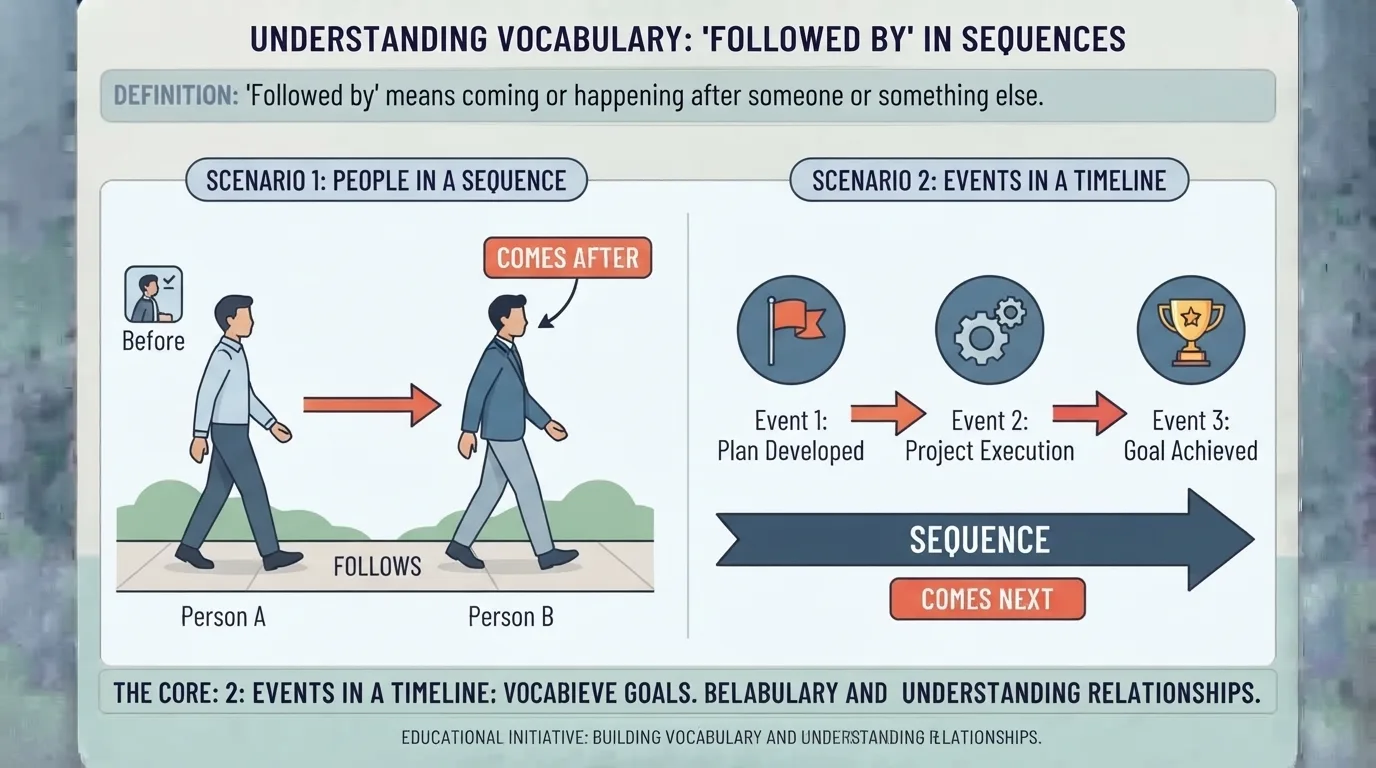
The phrase means that one event, person, or thing comes directly after another in time, space, or order. It sets up a clear sequence.
The emotional tone is neutral. It simply states an order of events without adding drama or personal feeling. Native speakers understand it as a plain structural bridge between two occurrences.
You will see it in weather reports, event schedules, recipes, and news updates.
- Part of Speech: Verb phrase (passive construction)
- Simple Definition: Coming after something else in order or time.
Connotative Meaning
Connotation is the emotional feeling or idea that a word invokes in addition to its literal meaning.
- Positive tone: Smooth transition, organized progress.
- Negative tone: Trailing behind, lacking leadership, predictable delay.
- Neutral tone: Standard chronological ordering.
Etymology
The word “follow” comes from the Old English word folgian, meaning to accompany, practice, or pursue. The preposition “by” stems from Old English be, meaning near or along.
- Old English (450–1100): Folgian meant going after someone or obeying a rule.
- Middle English (1100–1500): The word became folwen, expanding to sequential time order.
- Modern English (1500–Present): The passive form combined with “by” became a standard sequence marker.
Syllables & Structure
- Syllables: fol-lowed by
- Root: Follow
- Suffix: -ed (past participle)
- Preposition: By
Complete List
1. Pursued By (Verb Phrase)
- Meaning: Chased or tracked closely by someone or something coming behind.
- Tone/Register: Dramatic, Formal, Literary.
- Example 1: The hero ran down the dark alley, pursued by two unknown figures.
- Example 2: Intense market competition came after a period of rapid growth.
2. Succeeded By (Verb Phrase)
- Meaning: Replaced or taken over by another person or thing in a position or order.
- Tone/Register: Formal, Official, Academic.
- Example 1: The old CEO retired in May, and her top deputy took over.
- Example 2: Warm sunshine gave way to a sudden drop in temperature.
3. Superseded By (Verb Phrase)
- Meaning: Set aside or replaced by something newer, better, or more authoritative.
- Tone/Register: Formal, Technical, Legal.
- Example 1: The new legislation replaced the older tax regulations.
- Example 2: A fast cloud system replaced manual paper filing.
4. Shadowed By (Verb Phrase)
- Meaning: Closely watched or followed continuously, often in secret or a dark mood.
- Tone/Register: Dramatic, Casual, Figurative.
- Example 1: A senior officer shadowed the young detective during his first case.
- Example 2: News of a serious ankle injury overshadowed her athletic victory.
5. Chased By (Verb Phrase)
- Meaning: Ran after rapidly to catch or drive away.
- Tone/Register: Informal, Action-oriented.
- Example 1: A senior officer worked with the young detective on his first case.
- Example 2: News of a serious ankle injury took away from her athletic victory.
6. Accompanied By (Verb Phrase)
- Meaning: Happening, appearing, or going along together with something else.
- Tone/Register: Formal, Business, Neutral.
- Example 1: Severe thunderstorm warnings were accompanied by heavy flashes of lightning.
- Example 2: Every meal order is accompanied by a complimentary side salad.
7. Replaced By (Verb Phrase)
- Meaning: Swapped out so another person or thing takes the original position.
- Tone/Register: General, Direct, Business.
- Example 1: Clean solar arrays replaced the coal power generators.
- Example 2: Adjustable standing desks replaced our old office desks.
8. Dogged By (Verb Phrase)
- Meaning: Troubled or persistently followed without stopping by problems or bad luck.
- Tone/Register: Idiomatic, Journalism, Informal.
- Example 1: The construction project was dogged by constant budget delays.
- Example 2: His entire professional career was dogged by recurring back injuries.
9. Hounded By (Verb Phrase)
- Meaning: Harassed or pursued relentlessly without rest.
- Tone/Register: Informal, Dramatic, Expressive.
- Example 1: Aggressive street photographers constantly hound famous movie stars.
- Example 2: Reporters hounded the firm after the sudden news leaked.
10. Trailed By (Verb Phrase)
- Meaning: Lagging or being tracked along a path by something.
- Tone/Register: Casual, Descriptive, Neutral.
- Example 1: The parade lead float was trailed by local school marching bands.
- Example 2: The sailboat traveled slowly, trailed by a long wake of bubbles.
11. Next Came (Verb Phrase)
- Meaning: The very next item, step, or person that arrived in order.
- Tone/Register: Storytelling, Casual, Direct.
- Example 1: First we had appetizers, and next came the main course.
- Example 2: The speech ended and next came a long question period.
12. Followed Up By (Verb Phrase)
- Meaning: Continued or reinforced by a related subsequent action.
- Tone/Register: Business, Casual, Active.
- Example 1: We followed up the initial phone pitch with a detailed email proposal.
- Example 2: He followed up his strong opening argument with solid evidence.
13. Followed In Sequence By (Verb Phrase)
- Meaning: Occurring strictly according to a planned numerical or logical pattern.
- Tone/Register: Technical, Scientific, Academic.
- Example 1: Step two came after step one.
- Example 2: People played board games after playing cards.
14. Followed In Turn By (Verb Phrase)
- Meaning: Happening as part of an organized rotational cycle.
- Tone/Register: Formal, Descriptive.
- Example 1: Each speaker spoke for five minutes, followed in turn by another candidate.
- Example 2: Heavy rain fell, followed in turn by clear blue skies.
15. Followed Close Upon By (Verb Phrase)
- Meaning: Occurring almost immediately after the preceding event.
- Tone/Register: Literary, Formal.
- Example 1: A power outage came soon after the thunder strike.
- Example 2: The company made an announcement soon after her departure.
16. Followed Hard Upon By (Verb Phrase)
- Meaning: Happening with virtually no gap in time.
- Tone/Register: Archaic, Literary.
- Example 1: Even worse conditions came soon after the bad news.
- Example 2: A public scandal came soon after his election victory.
17. Succeeded Next By (Verb Phrase)
- Meaning: Positioned immediately after in rank or structural order.
- Tone/Register: Formal, Corporate.
- Example 1: The key presenter spoke after the primary speaker.
- Example 2: Structural testing came after phase one planning.
18. Followed On The Heels Of (Prepositional Phrase)
- Meaning: Coming extremely quickly after something else occurred.
- Tone/Register: Idiomatic, News.
- Example 1: The launch followed on the heels of extensive customer research.
- Example 2: A price hike followed on the heels of high shipping costs.
19. Followed Immediately By (Verb Phrase)
- Meaning: Occurring without any pause or intervening event.
- Tone/Register: Direct, Business, Technical.
- Example 1: High-intensity cardio started immediately after the warm-up stretches.
- Example 2: The main presentation started immediately after the introduction.
20. Trailed Closely By (Verb Phrase)
- Meaning: Following at a very short physical distance behind.
- Tone/Register: Descriptive, journalistic.
- Example 1: Two rival runners closely trailed the frontrunner.
- Example 2: Security vehicles closely trailed the lead car.
21. Followed Shortly By (Verb Phrase)
- Meaning: Occurring after a very small duration of time.
- Tone/Register: Standard, Conversational.
- Example 1: The race kickoff came shortly after the starter alert.
- Example 2: Strong winds came shortly after the brief warning.
22. Followed Soon After By (Verb Phrase)
- Meaning: Happening within a reasonable, short timeframe after an event.
- Tone/Register: General, Informative.
- Example 1: A patch update came soon after the initial release.
- Example 2: Small tremors came soon after the earthquake.
23. Accompanied Subsequently By (Verb Phrase)
- Meaning: Joined later by an additional element.
- Tone/Register: Academic, Formal.
- Example 1: The proposal was accompanied subsequently by financial proof.
- Example 2: Fever was accompanied subsequently by joint stiffness.
24. Followed Down The Line By (Idiomatic Phrase)
- Meaning: Occurring much later in a process or sequence of events.
- Tone/Register: Informal, Casual.
- Example 1: Major upgrades will come later after minor fixes.
- Example 2: Big results come later after small steps.
25. Followed Swiftly By (Verb Phrase)
- Meaning: Happening with remarkable speed after a previous event.
- Tone/Register: Descriptive, Literary.
- Example 1: Complete silence came soon after a sudden loud noise.
- Example 2: Government action came soon after the public request.
26. Tracked By (Verb Phrase)
- Meaning: Being monitored or followed continuously along a path.
- Tone/Register: Technical, Analytical.
- Example 1: Satellite sensors tracked the migratory flock.
- Example 2: Simple automated logs track user activity.
27. Followed Indirectly By (Verb Phrase)
- Meaning: Leading to a secondary outcome down the chain of events.
- Tone/Register: Analytical, Academic.
- Example 1: Policy shifts were followed indirectly by job market changes.
- Example 2: Cost cuts were followed indirectly by lower team morale.
28. Followed In Rapid Succession By (Verb Phrase)
- Meaning: Coming one after another at extremely fast speed.
- Tone/Register: Formal, Dramatic.
- Example 1: Smaller blasts came quickly after the loud explosion.
- Example 2: A win came quickly after the team scored three goals.
29. Followed Methodically By (Verb Phrase)
- Meaning: Progressing step-by-step according to a systematic plan.
- Tone/Register: Academic, Professional.
- Example 1: System analysis was followed methodically by software design.
- Example 2: Data gathering was followed methodically by strict verification.
30. Followed Chronologically By (Verb Phrase)
- Meaning: Moving in strict order of time occurrence.
- Tone/Register: Academic, Historical.
- Example 1: Medieval documents came after ancient records.
- Example 2: Youth journals came after early childhood notes.
31. Followed Automatically By (Verb Phrase)
- Meaning: Triggered as an instant mechanical or natural result.
- Tone/Register: Technical, General.
- Example 1: A confirmation email comes automatically after account creation.
- Example 2: Data backup starts automatically after system shutdown.s.
32. Followed Naturally By (Verb Phrase)
- Meaning: Happening as a logical or expected secondary step.
- Tone/Register: General, Conversational.
- Example 1: Learning theory is followed naturally by practical application.
- Example 2: Hard practice was followed naturally by a smooth win.
33. Followed Inevitably By (Verb Phrase)
- Meaning: Bound to happen as an unavoidable consequence.
- Tone/Register: Formal, Critical.
- Example 1: Careless spending inevitably leads to financial debt.
- Example 2: Heavy rain inevitably leads to localized flooding.
34. Followed Predictably By (Verb Phrase)
- Meaning: Happening exactly as expected based on prior patterns.
- Tone/Register: Analytical, General.
- Example 1: High heat was followed predictably by afternoon storms.
- Example 2: Poor planning was followed predictably by project delays.
35. Followed Unexpectedly By (Verb Phrase)
- Meaning: Succeeded by an unforeseen or surprising event.
- Tone/Register: Storytelling, Casual.
- Example 1: Heavy snow came unexpectedly after a dry, sunny morning.
- Example 2: A strike came unexpectedly after calm negotiations.
36. Followed Synergistically By (Verb Phrase)
- Meaning: Followed by something that enhances the overall effect.
- Tone/Register: Business, Technical.
- Example 1: Strategy meetings worked well with team-building activities.
- Example 2: Diet changes worked well with regular exercise.
37. Stalked By (Verb Phrase)
- Meaning: Pursued stealthily or threateningly.
- Tone/Register: Dramatic, Suspenseful.
- Example 1: The prey was stalked by a patient predator.
- Example 2: The traveler felt stalked by bad luck throughout the trip.
38. Escorted By (Verb Phrase)
- Meaning: Accompanied for protection, guidance, or courtesy.
- Tone/Register: Formal, Official.
- Example 1: A convoy of cars escorted the diplomat.
- Example 2: Staff escorted the guests to their reserved seats.
39. Chaperoned By (Verb Phrase)
- Meaning: Accompanied for supervision or proper behavior.
- Tone/Register: Social, General.
- Example 1: Two high school teachers chaperoned the students.
- Example 2: Parent volunteers chaperoned the youth trip.
40. Attended By (Verb Phrase)
- Meaning: Accompanied or waited upon as an assistant or companion.
- Tone/Register: Formal, Medical.
- Example 1: The patient was attended by a team of skilled specialists.
- Example 2: The queen arrived, attended by her loyal royal aides.
41. Tailgated By (Verb Phrase)
- Meaning: Followed too closely behind by a vehicle or person.
- Tone/Register: Informal, Everyday.
- Example 1: A large blue delivery truck tailgated my sedan.
- Example 2: Eager fans tailgated us as we entered the venue.
42. Flanked By (Verb Phrase)
- Meaning: Positioned directly beside or accompanied on the sides.
- Tone/Register: Descriptive, Visual.
- Example 1: The CEO stood at the podium, flanked by senior vice presidents.
- Example 2: The main walkway was flanked by tall palm trees.
43. Backed By (Verb Phrase)
- Meaning: Supported or followed up with resources or evidence.
- Tone/Register: Business, Financial.
- Example 1: The claims were backed by clear laboratory research.
- Example 2: The new venture was backed by strong investor funding.
44. Cushioned By (Verb Phrase)
- Meaning: Followed or softened by a supportive buffer.
- Tone/Register: General, Financial.
- Example 1: Emergency grant funds cushioned the policy drop.
- Example 2: A pile of autumn leaves cushioned the rough fall.
45. Supplemented By (Verb Phrase)
- Meaning: Added to in order to complete or extend a sequence.
- Tone/Register: Academic, Professional.
- Example 1: Extra reading notes supplemented the main lecture.
- Example 2: Yearly performance bonuses supplemented the base salaries.
46. Rounded Off By (Prepositional Phrase)
- Meaning: Completed or brought to a satisfying finish by a final event.
- Tone/Register: Conversational, Informal.
- Example 1: A warm slice of apple pie rounded off the dinner.
- Example 2: A relaxing weekend trip rounded off the busy week.
47. Capped By (Verb Phrase)
- Meaning: Completed or topped off by a major climax or ending action.
- Tone/Register: Journalism, General.
- Example 1: A championship win capped an amazing season.
- Example 2: A brilliant fireworks show.
48. Culminated By (Verb Phrase)
- Meaning: Reaching a final high point or decisive conclusion through an event.
- Tone/Register: Academic, Formal.
- Example 1: Years of research were culminated by the publication of the book.
- Example 2: Months of practice culminated in a flawless concert.
49. Concluded By (Verb Phrase)
- Meaning: Brought to an official end by a closing ceremony or step.
- Tone/Register: Formal, Official.
- Example 1: The meeting was concluded by a vote among board members.
- Example 2: The festival was concluded by a joint musical act.
50. Followed Sequentially By (Verb Phrase)
- Meaning: Arranged in a strict step-by-step consecutive order.
- Tone/Register: Technical, Educational.
- Example 1: Phase one testing is followed sequentially by phase two trials.
- Example 2: Module A is followed sequentially by Module B.
51. Mirror-Followed By (Verb Phrase)
- Meaning: Matched or copied directly in sequence by a similar action.
- Tone/Register: Technical, Analytical.
- Example 1: Market gains in tech were mirror-followed by retail stocks.
- Example 2: Action in regional offices was mirror-followed by main branches.
52. Preceded Inverse By (Phrasal Construct)
- Meaning: Positioned after an entity in an inverted logical system.
- Tone/Register: Logic, Mathematical.
- Example 1: Value X is preceded inverse by value Y in this formula.
- Example 2: Output levels were preceded by supply constraints.
53. Followed Upstream By (Technical Phrase)
- Meaning: Located further back or higher up in a sequence process.
- Tone/Register: Industrial, Environmental.
- Example 1: River sampling was followed upstream by water source testing.
- Example 2: Factory builds were followed upstream by component sourcing.
54. Followed Downstream By (Technical Phrase)
- Meaning: Occurring later along a flow line or distribution process.
- Tone/Register: Supply Chain, Engineering.
- Example 1: Refining raw oil is followed downstream by distribution network steps.
- Example 2: Product updates are followed downstream by partner notifications.
55. Ushered In By (Prepositional Phrase)
- Meaning: Introduced or heralded by a preceding event.
- Tone/Register: Literary, Journalism.
- Example 1: A new era was ushered in by technological breakthroughs.
- Example 2: The holiday season was ushered in by cold mountain winds.
56. Paved By (Verb Phrase)
- Meaning: Led or prepared by prior preliminary work.
- Tone/Register: Figurative, General.
- Example 1: Major reforms were paved by months of quiet negotiations.
- Example 2: Fast progress was paved by steady team effort.
57. Triggered Next By (Verb Phrase)
- Meaning: Activated immediately as a secondary reaction.
- Tone/Register: Scientific, Technical.
- Example 1: The alarm was triggered next by heat detection systems.
- Example 2: Chemical mixes were triggered next by temperature shifts.
58. Succeeded In Order By (Verb Phrase)
- Meaning: Arranged consecutively in strict structural line.
- Tone/Register: Formal, Administrative.
- Example 1: Items on the list were succeeded in order by clear priorities.
- Example 2: Department heads were succeeded in order by team leads.
59. Followed Consecutively By (Verb Phrase)
- Meaning: Following continuously without interruption.
- Tone/Register: Academic, Mathematical.
- Example 1: Three days of rain were followed consecutively by three days of frost.
- Example 2: Step A was followed consecutively by Step B and Step C.
60. Brought On By (Verb Phrase)
- Meaning: Caused or followed as a direct physical or situational result.
- Tone/Register: Casual, Medical, General.
- Example 1: A severe headache was brought on by extreme dehydration.
- Example 2: Loud cheers were brought on by the sudden goal.
Synonyms by Tone
Choosing the correct word depends heavily on your tone. Using a dramatic word in a simple report can confuse readers.
- Positive / Constructive: Succeeded by, Accompanied by, Followed up by, Capped by, Ushered in by.
- Neutral / Descriptive: Next came, Replaced by, Trailed by, Followed chronologically by, Followed in sequence by.
- Negative / Stressful: Dogged by, Hounded by, Pursued by, Stalked by, Tailgated by.
- Playful / Informal: Chased by, Shadowed by, Rounded off by.
Word choice sets the mood. If you write that a project was succeeded by new leadership, it sounds planned and professional. If you say it was dogged by new leadership, it implies trouble and conflict.
Comparison: “Followed By” vs. Close Alternatives
| Phrase | Primary Focus | Best Context | Tone |
| Followed By | General time or sequence order | Everyday, News, Standard reports | Neutral |
| Succeeded By | Formal replacement in position or order | History, Corporate titles, Official changes | Formal / Academic |
| Accompanied By | Happening at the same time | Science, Medical notes, Recipes | Professional |
- Followed by vs. Succeeded by: Use followed by for events, like dinner followed by a movie. Use succeeded by when someone takes over a role, like a manager succeeded by a new hire.
- Followed by vs. Accompanied by: Followed by happens after. Accompanied by happens alongside.
Context-Based Usage
Daily Conversation
In everyday speech, keep sentences simple. Use “next came” or “then we had” instead of formal options.
- Example: “We started with coffee, and next came breakfast.”
Writing or Blogging
Blog posts need variety to keep readers moving down the page. Use “followed up by” or “trailed by” to show flow.
- Example: “Our blog release was followed up by a social media update.”
Professional or Academic Tone
In business letters and academic essays, precise vocabulary shows expertise. Use “succeeded by” or “superseded by.”
- Example: “The original framework was superseded by modern standards.”
Common Mistakes & Native Usage
- Confusing Time with Simultaneity: Do not use “followed by” when things happen at the same time. Use “accompanied by” instead.
- Overusing Passive Voice: Writing “A was followed by B” too many times makes sentences feel weak. Try changing to active phrases like “B came right after A.”
- Wrong Tone in Business: Saying your project was “chased by deadlines” sounds informal. Use “dogged by tight deadlines” or simply “faced tight deadlines.”
Native English speakers vary their structure so their prose sounds smooth and natural.
Real-Life Mini Scenarios
- Workplace: The presentation was followed by a short group discussion.
- Social Situation: A brief speech was succeeded by live music and dancing.
- Media / News: The heatwave was accompanied by strong coastal winds.
- Storytelling: The runner crossed the line, trailed closely by her teammate.
Interactive Practice Quiz — Part One
1. The presentation was ___ a short discussion.
A. followed by
B. before
C. during
D. beside
2. Which word is most natural in casual English?
A. subsequently
B. then
C. thereafter
D. supervened
3. The company changed its policy ___ customer feedback.
A. next
B. afterward
C. in response to
D. one after another
4. Which expression means “after something”?
A. subsequently
B. previous
C. beneath
D. beside
5. The heavy rain was ___ strong winds.
A. followed by
B. before
C. instead of
D. during
6. Which word is best suited to formal writing?
A. later on
B. then
C. subsequently
D. next
7. We had dinner and ___ watched a movie.
A. thereafter
B. then
C. after
D. ensued
8. The manager retired and was ___ by her assistant.
A. followed
B. succeeded
C. afterward
D. next
9. Which phrase suggests that something happened very soon after another event?
A. on the heels of
B. years before
C. at first
D. beforehand
10. Three speakers appeared ___ during the ceremony.
A. in succession
B. in response
C. aftereffect
D. beforehand
Interactive Practice Quiz — Part Two
11. The announcement was ___ several online discussions.
A. followed by
B. before
C. instead
D. beneath
12. Which phrase is especially useful for describing a later stage of a process?
A. at a later stage
B. at the beginning
C. in advance
D. at first
13. The town began rebuilding ___ the flood.
A. in the aftermath of
B. next to
C. before
D. instead of
14. Which word means “from that time onward”?
A. thereafter
B. beforehand
C. previously
D. initially
15. The researchers ___ repeated the experiment.
A. next to
B. subsequently
C. before
D. instead
16. Which sentence sounds most conversational?
A. The meeting was followed by refreshments.
B. The meeting was subsequently refreshments.
C. We had the meeting and then got some refreshments.
D. Refreshments supervened the meeting.
17. The new evidence ___ further investigation.
A. led to
B. before
C. afterward
D. next
18. Which expression focuses on a consequence rather than simple sequence?
A. as a result of
B. next
C. afterward
D. later on
19. “The debate that followed was intense” means:
A. Debate happened before the event.
B. The debate happened afterward.
C. The debate was canceled.
D. The debate happened at the same time.
20. Which sentence uses “followed by” correctly?
A. She followed by the office.
B. The lecture was followed by questions.
C. Followed by she the lecture.
D. Questions followed by the lecture.
Answer Key: 1-A | 2-B | 3-C | 4-A | 5-A | 6-C | 7-B | 8-B | 9-A | 10-A | 11-A | 12-A | 13-A | 14-A | 15-B | 16-C | 17-A | 18-A | 19-B | 20-B
Frequently Asked Questions
1. What is the most formal synonym for “followed by”?
The phrase “succeeded by” is the most formal option. It works best in academic essays, legal files, historical records, and official business updates when one person, title, or structured event officially replaces another in order.
2. Can I use “accompanied by” instead of “followed by”?
Not always. Use “followed by” when things happen one after another in order. Use “accompanied by” only when two things happen at the same time, as a main course served alongside a cold side drink.
3. What does “dogged by” mean in sequence writing?
“Dogged by” means being persistently followed or bothered by unwanted problems, bad luck, or delays over a long period. It carries a strong negative tone and is common in journalism and descriptive storytelling.
4. How do I choose between “followed by” and “then”?
Use “then” for quick, casual transitions in speech or simple stories. Use “followed by” or its formal variants in written reports, professional communications, and academic texts where clear structure and varied style matter.
5. Is “superseded by” the same as “followed by”?
No. “Superseded by” means something is not just coming next, but is actively replacing or making the previous thing obsolete. It is common when talking about updated laws, newer tech models, or older ideas.
Conclusion
Learning diverse synonyms of followed by makes your daily writing dynamic, precise, and expressive. Switching up your phrase choices keeps readers interested and ensures your core message stays clear across all formats.
Try using two or three of these new expressions in your upcoming emails, blog posts, or academic assignments. Consistent practice is the fastest way to build lasting vocabulary skills and boost overall writing confidence.
If you want to continue improving your language skills, explore our full library of guides on natural synonyms of followed by to sharpen your communication today.

Mehtab Yasir is a passionate writer and English language enthusiast dedicated to making vocabulary learning simple, practical, and enjoyable. As an author at SynonymDesk.com, she creates helpful content covering synonyms, antonyms, word meanings, vocabulary, phrases, and everyday English usage. Her goal is to provide clear and easy-to-understand information that helps students, writers, professionals, and English learners choose the right words and communicate with greater confidence. Mehtab believes that a strong vocabulary can improve both writing and communication skills. She enjoys researching new words, exploring their meanings and uses, and turning complex language concepts into useful, reader-friendly content. Through her work, she strives to make SynonymDesk.com a reliable resource for anyone looking to improve their English vocabulary and language skills.