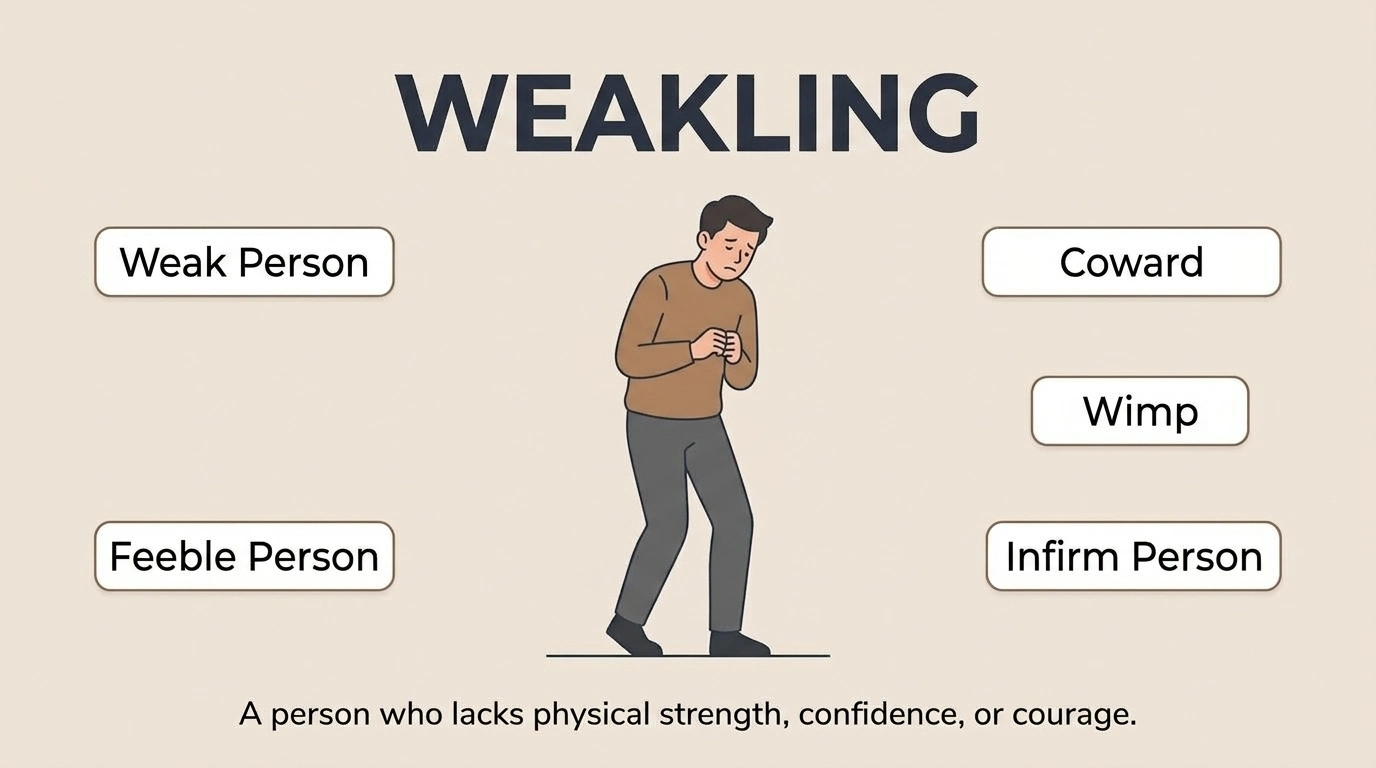
Synonyms of weakling help you describe someone lacking physical strength or moral courage. Imagine watching a sports movie where a tiny player struggles to lift heavy equipment. Everyone instantly labels him the underdog or fragile teammate.
Exploring word alternatives gives your writing greater emotional precision and depth. A person might be physically frail or simply timid in character. Choosing the correct term prevents misunderstandings in everyday conversations.
This descriptive noun appears frequently in literature, blogs, and movies. Students, bloggers, and content creators benefit greatly from expanding their vocabulary. Learning these terms helps daily English users communicate naturally.
What Does “Weakling” Really Mean?
The word describes a person who lacks physical power, stamina, or moral strength. It refers to someone easily overpowered, intimidated, or influenced by others.
Native English speakers use it to highlight physical fragility or a lack of determination. It often appears in athletic, literary, or casual descriptive settings.
Part of speech: Noun.
Simple Definition: A person who is physically weak, fragile, or lacking mental toughness.
Connotative Meaning
(Connotation is the emotional feeling or cultural idea that a word carries beyond its literal definition.)
- Positive Tone: Rarely positive, though sometimes used affectionately in fictional character growth arcs.
- Negative Tone: Strong negative feeling; implies helplessness, lack of vigor, cowardice, or physical vulnerability.
- Neutral Tone: Used neutrally in clinical, biological, or agricultural contexts to denote fragile organisms.
Etymology and History
The word combines the Middle English root weik with the diminutive suffix -ling.
- Old English (450–1100): Old Norse veikr influenced early English terms for soft or pliable materials.
- Middle English (1100–1500): Waek evolved into weik, describing physical weakness or lack of resistance.
- Modern English (1500–Present): The full noun form appeared by the mid-1500s to designate a frail person.
Pronunciation and Structure
- US Pronunciation: /ˈwiːk.lɪŋ/
- UK Pronunciation: /ˈwiːk.lɪŋ/
Syllables: weak-ling
Affixation Pattern:
- Root: weak (adjective meaning lacking strength)
- Prefix: None
- Suffix: -ling (diminutive noun suffix)
60 Synonyms of Weakling
1. Weakling (Noun) — US: /ˈwiːk.lɪŋ/ | UK: /ˈwiːk.lɪŋ/
- Meaning: A person lacking physical strength or resolve.
- Tone/Register: Informal, Descriptive.
- Example 1: He was tired of being treated like a weakling at the gym.
- Example 2: Regular exercise helped him shed his identity as a weakling.
2. Wimp (Noun) — US: /wɪmp/ | UK: /wɪmp/
- Meaning: A weak, cowardly, or unassertive person.
- Tone/Register: Informal, Casual.
- Example 1: Do not be a wimp and step up to take the lead.
- Example 2: He felt like a wimp for avoiding the cold water.
3. Milksop (Noun) — US: /ˈmɪlk.sɑːp/ | UK: /ˈmɪlk.sɒp/
- Meaning: An indecisive or timid person easily swayed by others.
- Tone/Register: Dated, Literary.
- Example 1: The novel portrayed the prince as an indecisive milksop.
- Example 2: He refused to act like a milksop during negotiations.
4. Softie (Noun) — US: /ˈsɑːf.ti/ | UK: /ˈsɒf.ti/
- Meaning: A kindhearted person who lacks toughness or discipline.
- Tone/Register: Informal, Lighthearted.
- Example 1: Our coach seems tough, but he is a softie inside.
- Example 2: She is too much of a softie to punish her puppy.
5. Coward (Noun) — US: /ˈkaʊ.ɚd/ | UK: /ˈkaʊ.əd/
- Meaning: Someone who lacks courage to face danger or difficulty.
- Tone/Register: General, Direct.
- Example 1: He was called a coward for running away from trouble.
- Example 2: A true hero never acts like a coward in crises.
6. Pushover (Noun) — US: /ˈpʊʃˌoʊ.vɚ/ | UK: /ˈpʊʃˌəʊ.və/
- Meaning: Someone who is easily defeated, persuaded, or victimized.
- Tone/Register: Informal, Business-Casual.
- Example 1: Stand firm on your price so buyers do not see you as a pushover.
- Example 2: She stopped being a pushover after taking confidence classes.
7. Sissy (Noun) — US: /ˈsɪs.i/ | UK: /ˈsɪs.i/
- Meaning: A timid or cowardly person, often used childishly.
- Tone/Register: Informal, Childish.
- Example 1: The children teased him for acting like a sissy.
- Example 2: He proved he was not a sissy by climbing the tree.
8. Featherweight (Noun) — US: /ˈfeð.ɚ.weɪt/ | UK: /ˈfeð.ə.weɪt/
- Meaning: A person of little weight, power, or influence.
- Tone/Register: General, Metaphorical.
- Example 1: In corporate debates, he was considered a political featherweight.
- Example 2: The newcomer proved he was no featherweight in competition.
9. Lightweight (Noun) — US: /ˈlaɪt.weɪt/ | UK: /ˈlaɪt.weɪt/
- Meaning: Someone lacking influence, stamina, or intellectual depth.
- Tone/Register: Informal, Professional.
- Example 1: The analyst was dismissed as an intellectual lightweight.
- Example 2: He struggled with heavy lifting because he was a lightweight.
10. Underling (Noun) — US: /ˈʌn.dɚ.lɪŋ/ | UK: /ˈʌn.də.lɪŋ/
- Meaning: A person of lower status or power in an organization.
- Tone/Register: Formal, Slightly Disparaging.
- Example 1: The manager sent his underling to deliver the bad news.
- Example 2: She refused to treat her team members like simple underlings.
11. Frail Person (Noun Phrase) — US: /freɪl ˈpɝː.sən/ | UK: /freɪl ˈpɜː.sən/
- Meaning: An individual with a delicate or physically weak constitution.
- Tone/Register: Formal, Empathetic.
- Example 1: The nurse assisted the frail person across the room.
- Example 2: Heavy cold weather poses risks to any frail person.
12. Invalid (Noun) — US: /ˈɪn.və.lɪd/ | UK: /ˈɪn.və.lɪd/
- Meaning: A person made weak or disabled by illness or injury.
- Tone/Register: Medical, Formal.
- Example 1: He spent months as an invalid after the accident.
- Example 2: Proper care helped the invalid recover full strength.
13. Drip (Noun) — US: /drɪp/ | UK: /drɪp/
- Meaning: A dull, uninteresting, or weak-willed person.
- Tone/Register: Slang, Informal.
- Example 1: Nobody invited him because he acted like such a drip.
- Example 2: Try to show enthusiasm so you do not look like a drip.
14. Wimp-out (Noun) — US: /ˈwɪmp.aʊt/ | UK: /ˈwɪmp.aʊt/
- Meaning: Someone who fails to complete a task due to fear.
- Tone/Register: Informal, Conversational.
- Example 1: He proved to be a wimp-out when the obstacle course began.
- Example 2: Avoid being a wimp-out by sticking to your commitments.
15. Doormat (Noun) — US: /ˈdɔːr.mæt/ | UK: /ˈdɔː.mæt/
- Meaning: A person who allows others to treat them poorly without complaining.
- Tone/Register: Informal, Idiomatic.
- Example 1: Assert yourself so colleagues do not use you as a doormat.
- Example 2: She refused to be a doormat for her selfish supervisor.
16. Jellyfish (Noun) — US: /ˈdʒel.i.fɪʃ/ | UK: /ˈdʒel.i.fɪʃ/
- Meaning: An individual completely lacking backbone or strength of character.
- Tone/Register: Informal, Figurative.
- Example 1: The executive acted like a jellyfish during board meetings.
- Example 2: We need a strong leader, not a political jellyfish.
17. Scrawny Person (Noun Phrase) — US: /ˈskrɑː.ni ˈpɝː.sən/ | UK: /ˈskrɔː.ni ˈpɜː.sən/
- Meaning: Someone who is unpleasantly thin and bony.
- Tone/Register: Informal, Descriptive.
- Example 1: The scrawny person struggled to lift the wooden crate.
- Example 2: A good diet and training helped the scrawny person gain muscle.
18. Puny Person (Noun Phrase) — US: /ˈpjuː.ni ˈpɝː.sən/ | UK: /ˈpjuː.ni ˈpɜː.sən/
- Meaning: Someone small and lacking physical power.
- Tone/Register: General, Critical.
- Example 1: The puny person stood out among the large athletes.
- Example 2: Never underestimate a puny person in mental challenges.
19. Mouse (Noun) — US: /maʊs/ | UK: /maʊs/
- Meaning: A quiet, timid, and easily frightened individual.
- Tone/Register: Figurative, Informal.
- Example 1: She was a quiet mouse in public, but bold at home.
- Example 2: Speak loudly so you do not sound like a timid mouse.
20. Nervous Wreck (Noun Phrase) — US: /ˈnɝː.vəs rek/ | UK: /ˈnɜː.vəs rek/
- Meaning: A person suffering from extreme anxiety or weakness.
- Tone/Register: Informal, Emotional.
- Example 1: The upcoming exam turned him into a nervous wreck.
- Example 2: She became a nervous wreck before giving her speech.
21. Crybaby (Noun) — US: /ˈkraɪ.beɪ.bi/ | UK: /ˈkraɪ.beɪ.bi/
- Meaning: Someone who complains or cries easily over minor issues.
- Tone/Register: Informal, Disparaging.
- Example 1: He was labeled a crybaby after complaining about the walk.
- Example 2: Stop acting like a crybaby and solve the issue.
22. Weak Sister (Noun Phrase) — US: /wiːk ˈsɪs.tɚ/ | UK: /wiːk ˈsɪs.tə/
- Meaning: The most unreliable or frail member of a group.
- Tone/Register: Idiomatic, Informal.
- Example 1: Their defense proved to be the weak sister of the team.
- Example 2: No company wants to be the weak sister in the market.
23. Pansy (Noun) — US: /ˈpæn.zi/ | UK: /ˈpæn.zi/
- Meaning: An overly delicate or timid person.
- Tone/Register: Informal, Slightly Dated.
- Example 1: He complained about the cold like a pansy.
- Example 2: The old coach called anyone who rested a pansy.
24. Softling (Noun) — US: /ˈsɑːft.lɪŋ/ | UK: /ˈsɒft.lɪŋ/
- Meaning: An individual unaccustomed to physical hardship or strain.
- Tone/Register: Rare, Literary.
- Example 1: City life turned the young heir into a softling.
- Example 2: Wilderness training soon changed the softling into a survivor.
25. Slacker (Noun) — US: /ˈslæk.ɚ/ | UK: /ˈslæk.ə/
- Meaning: A person who avoids work or effort due to lack of drive.
- Tone/Register: Informal, Everyday.
- Example 1: The project failed because one slacker did no research.
- Example 2: He was a slacker who relied entirely on teammates.
26. Simpleton (Noun) — US: /ˈsɪm.pəl.tən/ | UK: /ˈsɪm.pəl.tən/
- Meaning: A person lacking wisdom, mental strength, or good sense.
- Tone/Register: Formal, Dated.
- Example 1: He felt like a simpleton after making the easy mistake.
- Example 2: Do not act like a simpleton in front of experts.
27. Slowpoke (Noun) — US: /ˈsloʊ.poʊk/ | UK: /ˈsləʊ.pəʊk/
- Meaning: A person who moves or acts very slowly.
- Tone/Register: Informal, Casual.
- Example 1: Hurry up or the other hikers will call you a slowpoke.
- Example 2: The slowpoke reached the finish line long after sunset.
28. Dastard (Noun) — US: /ˈdæs.tɚd/ | UK: /ˈdæs.təd/
- Meaning: A malicious coward who attacks the defenseless.
- Tone/Register: Archaic, Literary.
- Example 1: The villain in the play was a notorious dastard.
- Example 2: History remembers the traitor as a cruel dastard.
29. Namby-pamby (Noun) — US: /ˌnæm.biˈpæm.bi/ | UK: /ˌnæm.biˈpæm.bi/
- Meaning: A person lacking energy, courage, or clear resolution.
- Tone/Register: Informal, Expressive.
- Example 1: We need decisive actions, not a namby-pamby in charge.
- Example 2: He came across as a namby-pamby during the debate.
30. Poltroon (Noun) — US: /pɑːlˈtruːn/ | UK: /pɒlˈtruːn/
- Meaning: An utter coward lacking self-respect.
- Tone/Register: Formal, Literary.
- Example 1: The officer was branded a poltroon for abandoning his post.
- Example 2: Only a true poltroon would blame others for his errors.
31. Weak Vessel (Noun Phrase) — US: /wiːk ˈves.əl/ | UK: /wiːk ˈves.əl/
- Meaning: Someone with physical or emotional vulnerabilities.
- Tone/Register: Archaic, Idiomatic.
- Example 1: Old texts often described humans as weak vessels.
- Example 2: He proved he was no weak vessel during the storm.
32. Softhead (Noun) — US: /ˈsɑːft.hed/ | UK: /ˈsɒft.hed/
- Meaning: A foolish or easily misled individual.
- Tone/Register: Informal, Critical.
- Example 1: Only a softhead would believe those false claims.
- Example 2: He was labeled a softhead for giving away his money.
33. Underdog (Noun) — US: /ˈʌn.dɚ.dɑːɡ/ | UK: /ˈʌn.də.dɒɡ/
- Meaning: A competitor thought to have little chance of winning.
- Tone/Register: General, Sympathetic.
- Example 1: The crowd cheered enthusiastically for the persistent underdog.
- Example 2: She loved reading stories where the underdog triumphs.
34. Nonentity (Noun) — US: /nɑːnˈen.t̬ə.t̬i/ | UK: /nɒnˈen.tə.ti/
- Meaning: A person of no importance or authority.
- Tone/Register: Formal, Academic.
- Example 1: He felt like a complete nonentity in the large city.
- Example 2: The manager treated junior staff as mere nonentities.
35. Half-wit (Noun) — US: /ˈhæf.wɪt/ | UK: /ˈhɑːf.wɪt/
- Meaning: A foolish or feeble-minded person.
- Tone/Register: Informal, Harsh.
- Example 1: He acted like a half-wit by ignoring the warning sign.
- Example 2: Do not let that half-wit manage the project budget.
36. Lightweight Competitor (Noun Phrase) — US: /ˈlaɪt.weɪt kəmˈpet.ə.t̬ɚ/ | UK: /ˈlaɪt.weɪt kəmˈpet.ɪ.tə/
- Meaning: An opponent with minimal strength or skills.
- Tone/Register: Business, Sports.
- Example 1: The champion easily defeated the lightweight competitor.
- Example 2: Our firm faced a lightweight competitor in the market.
37. Paper Tiger (Noun Phrase) — US: /ˈpeɪ.pɚ ˈtaɪ.ɡɚ/ | UK: /ˈpeɪ.pə ˈtaɪ.ɡə/
- Meaning: Something or someone that seems threatening but is actually weak.
- Tone/Register: Political, Idiomatic.
- Example 1: The aggressive nation turned out to be a paper tiger.
- Example 2: Do not fear his threats; he is just a paper tiger.
38. Weak-willed Person (Noun Phrase) — US: /wiːk wɪld ˈpɝː.sən/ | UK: /wiːk wɪld ˈpɜː.sən/
- Meaning: Someone lacking determination or resistance to temptation.
- Tone/Register: Formal, Psychological.
- Example 1: A weak-willed person easily gives up on fitness goals.
- Example 2: Staying disciplined prevents you from becoming a weak-willed person.
39. Flunky (Noun) — US: /ˈflʌŋ.ki/ | UK: /ˈflʌŋ.ki/
- Meaning: A person who performs minor tasks for a powerful master.
- Tone/Register: Informal, Disparaging.
- Example 1: The director arrived surrounded by his personal flunkies.
- Example 2: He refused to work as a corporate flunky.
40. Greenhorn (Noun) — US: /ˈɡriːn.hɔːrn/ | UK: /ˈɡriːn.hɔːn/
- Meaning: An inexperienced person who lacks toughness.
- Tone/Register: Informal, Casual.
- Example 1: The veteran sailors guided the nervous greenhorn.
- Example 2: As a young greenhorn, he made several small mistakes.
41. Novice (Noun) — US: /ˈnɑː.vɪs/ | UK: /ˈnɒv.ɪs/
- Meaning: A beginner in a field who lacks developed capabilities.
- Tone/Register: Neutral, Professional.
- Example 1: The yoga instructor gave simple instructions to the novice.
- Example 2: Every expert started as an inexperienced novice.
42. Fledgling (Noun) — US: /ˈfledʒ.lɪŋ/ | UK: /ˈfledʒ.lɪŋ/
- Meaning: An inexperienced individual or young organism.
- Tone/Register: Formal, Metaphorical.
- Example 1: The fledgling writer accepted constructive advice gratefully.
- Example 2: Mentors helped the fledgling overcome early hurdles.
43. Wallflower (Noun) — US: /ˈwɑːlˌflaʊ.ɚ/ | UK: /ˈwɔːlˌflaʊ.ə/
- Meaning: A shy, reserved person who avoids the social spotlight.
- Tone/Register: Informal, Idiomatic.
- Example 1: She was a wallflower at parties before gaining confidence.
- Example 2: Friendly music helped the wallflower join the dance floor.
44. Shrinking Violet (Noun Phrase) — US: /ˈʃrɪŋ.kɪŋ ˈvaɪə.lət/ | UK: /ˈʃrɪŋ.kɪŋ ˈvaɪə.lət/
- Meaning: An exceptionally timid or shy individual.
- Tone/Register: Idiomatic, Expressive.
- Example 1: The lead singer was no shrinking violet on stage.
- Example 2: She acted like a shrinking violet during her interview.
45. Scaredy-cat (Noun) — US: /ˈsker.di.kæt/ | UK: /ˈskeə.di.kæt/
- Meaning: Someone who is easily frightened by minor things.
- Tone/Register: Informal, Casual.
- Example 1: My dog is a scaredy-cat during thunderstorms.
- Example 2: Don’t be a scaredy-cat; the ride is totally safe.
46. Softie-heart (Noun Phrase) — US: /ˈsɑːf.ti hɑːrt/ | UK: /ˈsɒf.ti hɑːt/
- Meaning: A gentle individual easily moved by emotion.
- Tone/Register: Informal, Affectionate.
- Example 1: The tough detective revealed he was a softie-heart.
- Example 2: A softie-heart always helps stray animals.
47. Timid Soul (Noun Phrase) — US: /ˈtɪm.ɪd soʊl/ | UK: /ˈtɪm.ɪd səʊl/
- Meaning: A gentle person who avoids confrontation or danger.
- Tone/Register: Literary, Gentle.
- Example 1: The timid soul stayed quietly in the back row.
- Example 2: Encouraging words helped the timid soul speak up.
48. Faint-heart (Noun) — US: /ˈfeɪnt.hɑːrt/ | UK: /ˈfeɪnt.hɑːt/
- Meaning: A person lacking courage or resolution.
- Tone/Register: Archaic, Literary.
- Example 1: A faint-heart never won success in challenging endeavors.
- Example 2: He warned the team that faint-hearts would not survive the trip.
49. Weakling Organism (Noun Phrase) — US: /ˈwiːk.lɪŋ ˈɔːr.ɡə.nɪz.əm/ | UK: /ˈwiːk.lɪŋ ˈɔː.ɡən.ɪz.əm/
- Meaning: A biological creature lacking vital strength or immunity.
- Tone/Register: Scientific, Academic.
- Example 1: The weakling organism could not survive harsh winters.
- Example 2: Scientists isolated the weakling organism in the lab.
50. Lightweight Fighter (Noun Phrase) — US: /ˈlaɪt.weɪt ˈfaɪ.t̬ɚ/ | UK: /ˈlaɪt.weɪt ˈfaɪ.tə/
- Meaning: A combatant with lesser physical size or hitting power.
- Tone/Register: Athletic, Descriptive.
- Example 1: The lightweight fighter relied on speed over strength.
- Example 2: Trainers helped the lightweight fighter build endurance.
51. Frailling (Noun) — US: /ˈfreɪl.lɪŋ/ | UK: /ˈfreɪl.lɪŋ/
- Meaning: A delicate or physically weak person.
- Tone/Register: Literary, Rare.
- Example 1: The story described the boy as a gentle frailling.
- Example 2: Cold weather affected the small frailling quickly.
52. Delicate Person (Noun Phrase) — US: /ˈdel.ə.kət ˈpɝː.sən/ | UK: /ˈdel.ɪ.kət ˈpɜː.sən/
- Meaning: Someone needing careful handling due to poor health.
- Tone/Register: Polite, Formal.
- Example 1: The host accommodated the delicate person with warm tea.
- Example 2: A delicate person should avoid strenuous physical tasks.
53. Feeble Person (Noun Phrase) — US: /ˈfiː.bəl ˈpɝː.sən/ | UK: /ˈfiː.bəl ˈpɜː.sən/
- Meaning: Someone lacking physical or mental energy.
- Tone/Register: Descriptive, General.
- Example 1: The feeble person held onto the railing for support.
- Example 2: Proper nutrition revitalized the feeble person.
54. Tenderfoot (Noun) — US: /ˈten.dɚ.fʊt/ | UK: /ˈten.də.fʊt/
- Meaning: A person unaccustomed to harsh outdoor life.
- Tone/Register: Informal, Historical.
- Example 1: The guide gave extra help to the young tenderfoot.
- Example 2: Hiking over rocky terrain tested the tenderfoot.
55. Softbody (Noun) — US: /ˈsɑːft.bɑː.di/ | UK: /ˈsɒft.bɒd.i/
- Meaning: An unconditioned person without muscular endurance.
- Tone/Register: Informal, Fitness Slang.
- Example 1: Boot camp soon turned the softbody into an athlete.
- Example 2: Gym routines help any softbody gain physical stamina.
56. Lightweight Competitor (Noun Phrase) — US: /ˈlaɪt.weɪt kəmˈpet.ə.t̬ɚ/ | UK: /ˈlaɪt.weɪt kəmˈpet.ɪ.tə/
- Meaning: An entrant with minimal chance against dominant forces.
- Tone/Register: Professional, Business.
- Example 1: The startup was viewed as a lightweight competitor.
- Example 2: Strategic planning made the lightweight competitor dangerous.
57. Whipping Boy (Noun Phrase) — US: /ˈwɪp.ɪŋ bɔɪ/ | UK: /ˈwɪp.ɪŋ bɔɪ/
- Meaning: A weak target made to take blame for others.
- Tone/Register: Idiomatic, Political.
- Example 1: The junior staffer became the company whipping boy.
- Example 2: He refused to act as a whipping boy for management mistakes.
58. Helpless Person (Noun Phrase) — US: /ˈhelp.ləs ˈpɝː.sən/ | UK: /ˈhelp.ləs ˈpɜː.sən/
- Meaning: An individual unable to protect or defend themselves.
- Tone/Register: Empathetic, General.
- Example 1: The community stepped forward to support the helpless person.
- Example 2: Rescuers assisted the helpless person during the flood.
59. Mildling (Noun) — US: /ˈmaɪld.lɪŋ/ | UK: /ˈmaɪld.lɪŋ/
- Meaning: A person of soft temper who lacks assertion.
- Tone/Register: Rare, Archaic.
- Example 1: The king was a mildling who avoided harsh decisions.
- Example 2: Mildlings often face pressure in high-stress work settings.
60. Weak Sister (Noun Phrase) — US: /wiːk ˈsɪs.tɚ/ | UK: /wiːk ˈsɪs.tə/
- Meaning: The least effective unit or member within a group.
- Tone/Register: Informal, Business.
- Example 1: Their regional office was the weak sister of the brand.
- Example 2: New training helped the weak sister improve performance.
Synonyms for “Weakling” by Tone
Matching word tone to social contexts ensures effective communication.
- Positive / Empathetic Tone: Underdog, Frail Person, Gentle Soul, Tenderfoot.
- Neutral Tone: Novice, Nonentity, Invalid, Delicate Person, Fledgling.
- Negative Tone: Coward, Dastard, Crybaby, Poltroon, Half-wit, Flunky.
- Playful / Informal Tone: Wimp, Softie, Doormat, Jellyfish, Slowpoke, Scaredy-cat.
Tone matters because using harsh labels in casual settings creates unnecessary offense.
Mini Comparison: Weakling vs. Wimp vs. Underdog
| Feature | Weakling | Wimp | Underdog |
| Core Focus | Lack of physical/mental strength | Lack of courage or conviction | Predicted loser who garners support |
| Intensity | High | Medium to High | Positive / Neutral |
| Best Context | Physical or fitness contexts | Personal courage challenges | Sports and competition stories |
Use wimp for cowardice, underdog for sympathetic competitors, and weakling for physical frailty.
How “Weakling” Changes by Context
Daily Conversation
In casual talks, people prefer expressive terms like wimp, softie, or scaredy-cat. “Don’t be a wimp; jump into the swimming pool!”
Writing or Blogging
Bloggers choose vivid metaphors like doormat, jellyfish, or paper tiger to capture attention. “Without clear goals, your business plan becomes a paper tiger.”
Professional or Academic Tone
Formal texts use objective terms such as underling, nonentity, or frail person. “The study focused on health outcomes for any frail person in rural areas.”
Creative or Informal Use
Storytellers use dramatic terms like dastard, poltroon, or underdog to build conflict. “The audience rooted for the underdog throughout the entire story.”
Common Mistakes & Native Usage
- Mistake 1: Using weakling when referring to a beginner. Use novice or greenhorn instead.
- Mistake 2: Calling a sympathetic character a poltroon. Use underdog to gain audience empathy.
- Mistake 3: Overusing insult terms in professional environments. Use neutral options like inexperienced entrant.
Native speakers select milder terms in workplace settings to remain polite and professional. For related vocabulary guides, explore our resources on [descriptive English nouns].
Real-Life Mini Scenarios
- Workplace: An employee feels like a doormat when taking on extra unpaid work.
- Social Situations: A friend is teased as a scaredy-cat for avoiding horror movies.
- Media / Pop Culture: Movie reviewers describe a villain as a paper tiger after an easy defeat.
- Writing / Storytelling: An author depicts a young knight starting as an inexperienced greenhorn.
Practice Quiz
- Which word is the closest synonym of weakling?
A) Strongman
B) Wimp
C) Leader
D) Athlete - What does wimp mean?
A) A strong person
B) A timid or weak person
C) A skilled athlete
D) A brave leader - Which word describes someone who lacks courage?
A) Coward
B) Champion
C) Hero
D) Warrior - Which synonym means a timid or weak person?
A) Milquetoast
B) Giant
C) Expert
D) Champion - Which word describes someone thin and weak-looking?
A) Weedy
B) Muscular
C) Powerful
D) Sturdy - Which phrase means someone lacking physical strength?
A) Feeble person
B) Strong person
C) Powerful athlete
D) Tough person - Which word describes a person who is physically delicate or easily tired?
A) Frail
B) Robust
C) Strong
D) Sturdy - Which synonym best describes someone who is very thin and lacks muscle?
A) Scrawny
B) Muscular
C) Stout
D) Strong - What does timid mean?
A) Confident and bold
B) Shy and lacking confidence
C) Strong
D) Loud and aggressive - Which word means someone who lacks courage or determination?
A) Spineless
B) Fearless
C) Courageous
D) Determined
MCQs Part 2
- Which word describes someone who is easily controlled or persuaded?
A) Pushover
B) Leader
C) Commander
D) Authority - Which synonym of weakling can describe someone who is not physically strong?
A) Feeble
B) Powerful
C) Robust
D) Athletic - Which word means a person who is weak because of poor health or age?
A) Infirm
B) Energetic
C) Vigorous
D) Healthy - Which synonym can describe someone soft and not tough?
A) Softie
B) Fighter
C) Tough guy
D) Warrior - Which word refers to a foolish or weak-minded person?
A) Ninny
B) Genius
C) Scholar
D) Expert - Which word is closest in meaning to weakling in a physical context?
A) Frail person
B) Athlete
C) Bodybuilder
D) Strongman - Which synonym is most appropriate for a person who easily gives in to others?
A) Pushover
B) Leader
C) Commander
D) Hero - Which word is generally considered more polite than “weakling”?
A) Physically weak person
B) Wimp
C) Coward
D) Spineless person - Which of the following is NOT a synonym of weakling?
A) Wimp
B) Frail person
C) Strongman
D) Feeble person - Which sentence uses weakling correctly?
A) The strong athlete was a weakling.
B) Everyone admired the weakling for his powerful muscles.
C) The team viewed him as a weakling because he lacked physical strength.
D) The weakling easily lifted the heaviest weight.
Answer Key
| No. | Answer | No. | Answer |
|---|---|---|---|
| 1 | B | 11 | A |
| 2 | B | 12 | A |
| 3 | A | 13 | A |
| 4 | A | 14 | A |
| 5 | A | 15 | A |
| 6 | A | 16 | A |
| 7 | A | 17 | A |
| 8 | A | 18 | A |
| 9 | B | 19 | C |
| 10 | A | 20 | C |
Frequently Asked Questions
1. What is the most common informal synonym of weakling?
The word wimp is the most widely used informal synonym. It usually refers to someone lacking courage, physical toughness, or determination in everyday situations.
2. Is underdog a direct synonym for weakling?
Underdog is a context-specific synonym. While a weakling lacks power generally, an underdog is specifically a weaker competitor in a match who often receives public sympathy.
3. What formal word can I use instead of weakling in business?
In professional environments, use neutral terms like nonentity, lightweight competitor, or inexperienced party to avoid offensive language.
4. What is the difference between a wimp and a coward?
A wimp lacks general toughness or confidence, whereas a coward specifically flees from fear, danger, or moral responsibility in crucial moments.
5. Can weakling describe mental traits instead of physical ones?
Yes, native speakers frequently use weakling metaphorically to describe someone with weak resolve, poor decision-making skills, or an inability to resist peer pressure.
Conclusion
Mastering these synonyms of weakling gives you the power to describe strength and vulnerability with precision. Broadening your vocabulary enhances your creative essays, professional communications, and everyday chats.
Using exact terms helps readers connect with your message and understand subtle differences. Try incorporating options like paper tiger, underdog, or fledgling into your daily writing.
Consistent practice expands your language fluency and boosts your personal writing confidence. Start exploring new expressions today to make your communication clear and impactful!

Mehtab Yasir is a passionate writer and English language enthusiast dedicated to making vocabulary learning simple, practical, and enjoyable. As an author at SynonymDesk.com, she creates helpful content covering synonyms, antonyms, word meanings, vocabulary, phrases, and everyday English usage. Her goal is to provide clear and easy-to-understand information that helps students, writers, professionals, and English learners choose the right words and communicate with greater confidence. Mehtab believes that a strong vocabulary can improve both writing and communication skills. She enjoys researching new words, exploring their meanings and uses, and turning complex language concepts into useful, reader-friendly content. Through her work, she strives to make SynonymDesk.com a reliable resource for anyone looking to improve their English vocabulary and language skills.