Synonyms of contrasted include compared, differentiated, distinguished, juxtaposed, opposed, and set against. These words describe how someone examines differences between people, objects, ideas, or situations. The best alternative depends on context. Some emphasize careful comparison, while others highlight disagreement, opposition, or a noticeable difference between two things.
Imagine comparing two phones before buying one. You contrasted their features, prices, and designs to understand what makes each model different.
Learning synonyms of contrasted helps you describe differences more clearly. It also makes your writing sound natural and improves your everyday vocabulary.
Students, bloggers, and content writers often use this word in essays, reviews, and comparisons. Daily English users also find it helpful during discussions.
Understanding synonyms of contrasted allows you to choose precise expressions. Small changes in word choice can make your message clearer and more engaging.
What Does Contrasted Really Mean?
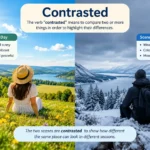
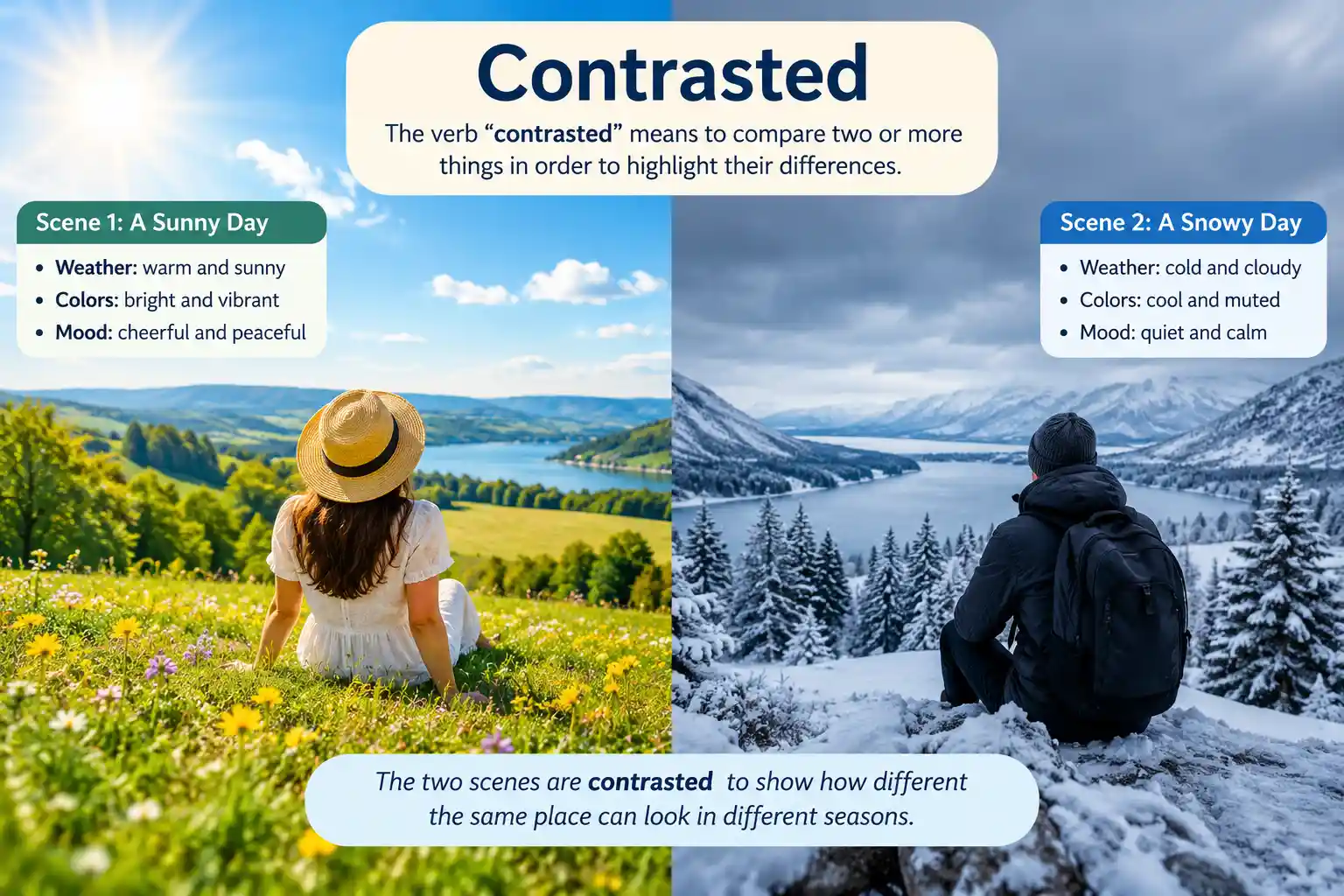
Contrasted means comparing two or more things to show how they differ. It can also describe placing opposite qualities together to make their differences easier to notice.
For example:
- The teacher contrasted traditional learning with online education.
- Her cheerful personality contrasted with his serious attitude.
The first sentence describes an intentional comparison. The second describes a noticeable difference.
Part of Speech
Contrasted is the past tense and past participle of the verb contrast.
It appears in active and passive constructions.
Active: The researcher contrasted the two results.
Passive: The two results were contrasted during the presentation.
Native English speakers commonly use contrasted when discussing differences in appearance, behavior, opinions, results, and experiences.
The word appears frequently in academic essays, product reviews, literary analysis, professional reports, and everyday descriptions.
Connotative Meaning of Contrasted
(Connotation refers to the feelings, attitudes, or associations a word suggests beyond its basic dictionary meaning.)
Contrasted usually has a neutral meaning. However, the surrounding sentence can create a positive or negative impression.
Positive Tone: Contrasted can highlight variety, balance, or complementary qualities.
Example: The colorful flowers contrasted beautifully with the white walls.
Negative Tone: It can emphasize uncomfortable differences, inequality, or disagreement.
Example: The company’s promises contrasted sharply with its actual performance.
Neutral Tone: It can simply identify differences without expressing an opinion.
Example: The report contrasted the results from both departments.
The emotional meaning depends on the subject and context rather than the word itself.
Etymology of Contrasted
The word contrasted comes from the verb contrast, which entered English through French and Italian influences.
Its deeper roots connect to the Latin elements contra, meaning “against,” and stare, meaning “to stand.”
The Italian word contrastare carried the idea of standing against, resisting, or opposing something.
Over time, English developed the modern meaning of examining or displaying differences.
Old English Period (450–1100)
The modern word contrast did not exist in Old English.
Speakers expressed ideas of difference and opposition through other Germanic vocabulary.
Middle English Period (1100–1500)
French influence introduced many new expressions into English.
However, contrast had not yet become an established English word in its modern form.
Modern English Period (1500–Present)
English adopted contrast during the Modern English period.
Its meaning gradually expanded from opposition to the comparison of differences.
Today, contrasted appears in education, journalism, design, business, literature, and everyday communication.
Syllables
Contrasted has three syllables:
con-tras-ted
Affixation Pattern of Contrasted
- Root/Base: Contrast
- Prefix: No separate productive English prefix in the modern word. Historically, contra- means against.
- Suffix: -ed
- Formation: Contrast + ed = Contrasted
The suffix -ed creates the regular past-tense and past-participle forms.
Synonyms List
Not every synonym replaces contrasted in every sentence.
Some alternatives describe direct comparison. Others express opposition, disagreement, or visible differences.
The following 45 words and expressions cover these related meanings. Each entry explains its particular use.
1. Compared (Verb)
Meaning: Examined two or more things to identify their similarities or differences.
Tone/Register: Neutral, Academic, Everyday.
Example 1: Sarah compared both laptops before choosing one.
Example 2: The teacher compared two learning methods.
2. Differentiated (Verb)
Meaning: Identified the qualities that make one thing different from another.
Tone/Register: Formal, Academic, Professional.
Example 1: The designer differentiated the two brands through their logos.
Example 2: The study differentiated experienced workers from beginners.
3. Distinguished (Verb)
Meaning: Recognized or explained the differences between similar things.
Tone/Register: Formal, Educational.
Example 1: The professor distinguished facts from personal opinions.
Example 2: Mia distinguished the original painting from its copy.
4. Juxtaposed (Verb)
Meaning: Placed two things close together to highlight their differences or similarities.
Tone/Register: Literary, Academic, Creative.
Example 1: The artist juxtaposed bright colors with dark backgrounds.
Example 2: The film juxtaposed wealth and poverty.
5. Opposed (Verb)
Meaning: Placed one idea, position, or quality against another.
Tone/Register: Formal, Argumentative.
Example 1: The speaker opposed practical solutions to unrealistic promises.
Example 2: The writer opposed freedom to strict control.
6. Set Against (Phrasal Verb)
Meaning: Placed two things in comparison or opposition to emphasize their differences.
Tone/Register: Neutral, Literary.
Example 1: The author set rural life against city living.
Example 2: The photographer set warm colors against cool shades.
7. Set Apart (Phrasal Verb)
Meaning: Made someone or something noticeably different from others.
Tone/Register: Neutral, Descriptive.
Example 1: Her creative ideas set her apart from the other applicants.
Example 2: The unusual design set the product apart.
8. Discriminated Between (Verb Phrase)
Meaning: Recognized a difference between two similar things.
Tone/Register: Formal, Technical, Academic.
Example 1: The test discriminated between two similar sounds.
Example 2: Researchers discriminated between genuine and misleading responses.
Here, discriminated between means making a distinction. It does not refer to unfair treatment.
9. Differed (Verb)
Meaning: Showed a difference in quality, appearance, behavior, or opinion.
Tone/Register: Neutral, Everyday.
Example 1: Their opinions differed on the new policy.
Example 2: The two designs differed in size and shape.
10. Diverged (Verb)
Meaning: Moved in different directions or became increasingly different.
Tone/Register: Academic, Formal.
Example 1: Their career paths diverged after graduation.
Example 2: The research findings diverged over time.
11. Varied (Verb)
Meaning: Showed differences across several examples, situations, or groups.
Tone/Register: Neutral, Descriptive.
Example 1: Customer opinions varied across age groups.
Example 2: The results varied between the two locations.
12. Disagreed (Verb)
Meaning: Expressed different opinions or failed to share the same view.
Tone/Register: Everyday, Professional.
Example 1: The managers disagreed about the project timeline.
Example 2: The students disagreed on the best solution.
13. Conflicted (Verb)
Meaning: Showed incompatibility or disagreement between ideas, interests, or statements.
Tone/Register: Formal, Professional.
Example 1: His explanation conflicted with the available evidence.
Example 2: Their personal goals conflicted with company expectations.
14. Clashed (Verb)
Meaning: Showed a big or noticeable difference that created disagreement or disharmony.
Tone/Register: Everyday, Expressive.
Example 1: Their personalities clashed during the meeting.
Example 2: The bright curtains clashed with the patterned carpet.
15. Contradicted (Verb)
Meaning: Expressed a statement or idea that directly opposed another.
Tone/Register: Formal, Academic, Everyday.
Example 1: The witness contradicted his earlier statement.
Example 2: The latest figures contradicted the original prediction.
16. Counterposed (Verb)
Meaning: Placed two opposing ideas or qualities against each other for comparison.
Tone/Register: Formal, Literary.
Example 1: The essay counterposed personal freedom and social responsibility.
Example 2: The speaker counterposed tradition and innovation.
17. Pitted Against (Verb Phrase)
Meaning: Placed two people, ideas, or things in direct competition or opposition.
Tone/Register: Informal, Journalistic.
Example 1: The competition pitted experienced players against newcomers.
Example 2: The debate pitted economic growth against environmental protection.
18. Measured Against (Verb Phrase)
Meaning: Compared something with a standard or another example to judge its quality.
Tone/Register: Business, Academic.
Example 1: The manager measured current performance against last year’s results.
Example 2: The team measured its progress against the original goals.
19. Weighed Against (Verb Phrase)
Meaning: Compared competing factors to judge their relative importance.
Tone/Register: Formal, Analytical.
Example 1: The committee weighed the benefits against the risks.
Example 2: She weighed convenience against long-term costs.
20. Evaluated Against (Verb Phrase)
Meaning: Judged something by comparing it with a specific standard or alternative.
Tone/Register: Academic, Professional.
Example 1: The teacher evaluated each answer against the marking criteria.
Example 2: The company evaluated its results against industry standards.
21. Differentiated Between (Verb Phrase)
Meaning: Clearly identified the differences between two categories or concepts.
Tone/Register: Academic, Educational.
Example 1: The instructor differentiated between formal and informal language.
Example 2: The guide differentiated between safe and unsafe practices.
22. Drew a Distinction Between (Verb Phrase)
Meaning: Explained an important difference between two related ideas.
Tone/Register: Formal, Academic.
Example 1: The lawyer distinguished intention and action.
Example 2: The article drew a distinction between confidence and arrogance.
23. Highlighted Differences (Verb Phrase)
Meaning: Drew attention to the features that make things different.
Tone/Register: Neutral, Educational.
Example 1: The presentation highlighted differences between the two plans.
Example 2: The review highlighted differences in battery performance.
24. Emphasized Differences (Verb Phrase)
Meaning: Gave special attention to the ways two things differ.
Tone/Register: Formal, Descriptive.
Example 1: The report emphasized differences in employee satisfaction.
Example 2: The discussion emphasized differences between the proposed solutions.
25. Showed Differences (Verb Phrase)
Meaning: Made the differences between things clear or noticeable.
Tone/Register: Simple, Everyday.
Example 1: The chart showed differences in monthly sales.
Example 2: The photos showed differences between the old and new designs.
26. Revealed Differences (Verb Phrase)
Meaning: Made previously unclear or unnoticed differences visible.
Tone/Register: Academic, Journalistic.
Example 1: The survey revealed differences in customer preferences.
Example 2: The experiment revealed differences between the samples.
27. Exposed Disparities (Verb Phrase)
Meaning: Revealed significant differences, especially unequal conditions or opportunities.
Tone/Register: Formal, Social Commentary.
Example 1: The study exposed disparities in access to education.
Example 2: The investigation exposed disparities between regional services.
28. Demonstrated Differences (Verb Phrase)
Meaning: Used evidence or examples to show how things differ.
Tone/Register: Academic, Professional.
Example 1: The experiment demonstrated differences in material strength.
Example 2: The report demonstrated differences between the two strategies.
29. Illustrated Differences (Verb Phrase)
Meaning: Explained differences through examples, descriptions, or visual information.
Tone/Register: Educational, Descriptive.
Example 1: The diagram illustrated differences between the two systems.
Example 2: Her story illustrated differences in family traditions.
30. Underscored Differences (Verb Phrase)
Meaning: Gave additional emphasis to an existing difference.
Tone/Register: Formal, Journalistic.
Example 1: The debate underscored differences in political priorities.
Example 2: Their responses underscored differences in management styles.
31. Brought Out Differences (Verb Phrase)
Meaning: Made differences more noticeable through comparison or interaction.
Tone/Register: Conversational, Descriptive.
Example 1: The interview brought out differences in their personalities.
Example 2: The lighting brought out differences in the fabric colors.
32. Marked a Contrast (Verb Phrase)
Meaning: Created or indicated a noticeable difference between two things.
Tone/Register: Formal, Literary.
Example 1: Her calm response marked a contrast with his angry reaction.
Example 2: The modern building marked a contrast with the historic surroundings.
33. Presented a Contrast (Verb Phrase)
Meaning: Showed a difference clearly through description or presentation.
Tone/Register: Academic, Descriptive.
Example 1: The documentary presented a contrast between urban and rural lifestyles.
Example 2: The exhibition presented a contrast between traditional and modern art.
34. Stood in Contrast (Verb Phrase)
Meaning: Appeared noticeably different when considered beside something else.
Tone/Register: Formal, Literary.
Example 1: Her optimism stood in contrast to his pessimism.
Example 2: The quiet village stood in contrast to the busy capital.
35. Stood Apart (Phrasal Verb)
Meaning: Appeared different or distinctive compared with others.
Tone/Register: Neutral, Descriptive.
Example 1: His simple design stood apart from the colorful entries.
Example 2: The restaurant stood apart because of its unusual menu.
36. Differed Sharply (Verb Phrase)
Meaning: Showed a big or easily noticeable difference.
Tone/Register: Formal, Emphatic.
Example 1: Their approaches differed sharply during the negotiations.
Example 2: The final results differed sharply from early expectations.
37. Departed From (Phrasal Verb)
Meaning: Moved away from an established approach, pattern, or expectation.
Tone/Register: Formal, Academic.
Example 1: The director departed from the traditional storytelling style.
Example 2: The new proposal departed from the original plan.
38. Deviated From (Phrasal Verb)
Meaning: Showed a difference from an expected standard, path, or pattern.
Tone/Register: Technical, Formal.
Example 1: The measurements deviated from the expected values.
Example 2: The final design deviated from the approved outline.
39. Separated (Verb)
Meaning: Kept things distinct or divided them into different groups.
Tone/Register: Neutral, Everyday.
Example 1: The teacher separated facts from assumptions.
Example 2: The researcher separated reliable responses from incomplete ones.
40. Categorized Separately (Verb Phrase)
Meaning: Placed different items into distinct groups based on their characteristics.
Tone/Register: Academic, Professional.
Example 1: The analyst categorized customer responses separately.
Example 2: The librarian categorized fiction and nonfiction separately.
41. Polarized (Verb)
Meaning: Divided opinions or groups into strongly opposing positions.
Tone/Register: Formal, Political, Social Commentary.
Example 1: The controversial decision polarized public opinion.
Example 2: The discussion polarized the audience into two groups.
42. Opposed Each Other (Verb Phrase)
Meaning: Held conflicting positions or stood against one another.
Tone/Register: Neutral, Descriptive.
Example 1: The two proposals opposed each other on several important points.
Example 2: Their views opposed each other throughout the discussion.
43. Compared Side by Side (Verb Phrase)
Meaning: Examined two things together to make their differences easier to identify.
Tone/Register: Everyday, Educational.
Example 1: We compared both photographs side by side.
Example 2: The shoppers compared the product features side by side.
44. Set in Opposition (Verb Phrase)
Meaning: Presented two ideas or qualities as opposing forces.
Tone/Register: Formal, Literary.
Example 1: The novelist set ambition in opposition to personal happiness.
Example 2: The speech set individual rights in opposition to collective duties.
45. Differed in Character (Verb Phrase)
Meaning: Showed differences in nature, personality, or essential qualities.
Tone/Register: Descriptive, Literary.
Example 1: The two neighborhoods differed in character despite their close location.
Example 2: The sisters differed in character but shared similar interests.
Synonyms for Contrasted by Tone
Tone matters because two expressions can communicate a similar idea while creating different impressions.
For example, compared sounds neutral, while clashed suggests tension.
Positive Tone
These expressions can highlight individuality, variety, or distinctive qualities.
- Set apart
- Stood apart
- Differentiated
- Illustrated differences
- Brought out differences
- Revealed differences
Example: Her creative approach set her apart from the other candidates.
Neutral Tone
These alternatives describe differences without suggesting approval or criticism.
- Compared
- Distinguished
- Differed
- Varied
- Juxtaposed
- Showed differences
- Demonstrated differences
- Compared side by side
- Presented a contrast
Example: The researcher compared the results from both groups.
Negative Tone
These expressions can suggest disagreement, conflict, inequality, or opposition.
- Clashed
- Conflicted
- Contradicted
- Polarized
- Opposed
- Exposed disparities
- Pitted against
Example: His actions contradicted his earlier promises.
These words are not always negative. Their emotional effect depends on the sentence.
Playful or Informal Tone
Informal writing often uses shorter, more expressive phrases.
- Stood apart
- Clashed
- Set against
- Brought out differences
- Compared side by side
Example: Their fashion choices clashed most funnily.
Use informal expressions in friendly discussions, personal blogs, and casual storytelling.
Contrasted vs Close Alternatives
Although contrasted, compared, juxtaposed, and contradicted share related meanings, they serve different purposes.
| Word | Main Meaning | Tone | Best Use |
|---|---|---|---|
| Contrasted | Highlighted differences | Neutral | Showing distinct qualities |
| Compared | Examined similarities or differences | Neutral | General analysis |
| Juxtaposed | Placed things together for effect | Literary | Art and creative writing |
| Contradicted | Directly opposed a statement | Stronger | Conflicting claims |
Contrasted vs Compared
Compared has a broader meaning.
You can compare two things to find similarities, differences, or both.
Contrasted focuses mainly on differences.
Compared: The teacher compared both novels.
Contrasted: The teacher contrasted the novels’ different endings.
Contrasted vs Juxtaposed
Juxtaposed emphasizes placing things close together.
Writers and artists often use this technique to create a noticeable effect.
Contrasted: The designer contrasted dark and light colors.
Juxtaposed: The designer juxtaposed dark and light colors to create visual tension.
Contrasted vs Contradicted
Contradicted suggests a direct conflict between statements, facts, or claims.
Contrasted simply identifies differences.
Contrasted: Their opinions contrasted during the discussion.
Contradicted: The new evidence contradicted his statement.
Choose contradicted only when one claim directly conflicts with another.
How Contrasted Changes by Context
The best alternative depends on what you want readers to understand.
A word that sounds natural in a research paper may feel too formal during a friendly conversation.
Daily Conversation
People often use compared, differed, or stood apart in everyday speech.
These expressions sound simple and direct.
Example: We compared both restaurants before making a reservation.
Writing or Blogging
Bloggers frequently describe differences between products, lifestyles, opinions, and experiences.
Compared, highlighted differences, and set apart work well in this context.
Example: The review highlighted differences between the two smartphones.
Professional or Academic Writing
Academic writing benefits from precise expressions.
Differentiated, distinguished, juxtaposed, and demonstrated differences can communicate specific relationships.
Example: The study differentiated between short-term and long-term outcomes.
Creative or Informal Writing
Creative writers often use contrasting details to develop characters, settings, and emotions.
Juxtaposed, clashed, and stood in contrast can make descriptions more expressive.
Example: Her laughter stood in contrast to the silence around her.
Common Mistakes Learners Make
Contrasted is a useful word, but incorrect sentence structures can change its meaning.
Mistake 1: Confusing Contrasted With Compared
These words are related, but they are not identical.
Incorrect meaning: Using contrasted when discussing only similarities.
Better: The researcher compared the similarities between the two methods.
Use contrasted when differences are the main focus.
Mistake 2: Using the Wrong Preposition
Contrasted commonly appears with with.
Correct: The writer contrasted city life with village life.
Correct: Her cheerful mood contrasted with his serious expression.
The first sentence uses contrasted as an action. The second describes an existing difference.
You may also see contrast between in noun constructions.
Example: There was a clear contrast between their opinions.
Mistake 3: Confusing Contrast With Contradiction
Two things can contrast without contradicting each other.
For example, summer and winter have contrasting temperatures. Neither season contradicts the other.
Contradiction requires a more direct conflict.
Mistake 4: Choosing an Overly Strong Synonym
Clashed and polarized suggest stronger opposition than contrasted.
Avoid using these words when describing ordinary differences.
Too strong: The two phone colors polarized each other.
Better: The two phone colors contrasted beautifully.
Mistake 5: Repeating Contrasted Too Often
Repeated vocabulary can make an essay feel mechanical.
Use alternatives when they accurately express the intended meaning.
For example:
The report compared the results. It highlighted differences in performance and distinguished the strongest method from the weakest.
This sounds more natural than repeating contrasted in every sentence.
Register Notes: Formal vs Informal English
Register refers to the level of formality in language.
Choosing the right register helps your writing match its audience.
Formal English
Formal writing often uses:
- Differentiated
- Distinguished
- Juxtaposed
- Demonstrated differences
- Evaluated against
- Counterposed
These expressions work well in essays, reports, and research papers.
Informal English
Everyday conversation commonly uses:
- Compared
- Differed
- Stood apart
- Set against
- Clashed
These choices are usually easier to understand during casual discussions.
Spoken vs Written English
In spoken English, people often prefer simple expressions such as compared or really different.
Written English allows more precise alternatives.
For additional vocabulary practice, readers can explore related expressions in an article about synonyms of compared.
Real-Life Examples Using Contrasted
Understanding vocabulary becomes easier when you connect it to familiar situations.
The following scenarios show how contrasted works naturally.
Workplace Scenario
A manager reviews two marketing campaigns.
Sentence: The manager contrasted both campaigns to identify their strengths and weaknesses.
Alternative: The manager compared both campaigns to identify their strengths and weaknesses.
Both sentences work because the manager examines differences.
Social Situation
Two friends have very different personalities.
Sentence: Emma’s outgoing personality contrasted with Noah’s quiet nature.
Alternative: Emma’s outgoing personality stood in contrast to Noah’s quiet nature.
The alternative creates a slightly more descriptive tone.
Media and Pop Culture
A film presents two characters with opposing lifestyles.
Sentence: The director contrasted the characters’ wealthy and modest backgrounds.
Alternative: The director juxtaposed their different lifestyles throughout the film.
Juxtaposed works particularly well in film analysis.
Writing and Storytelling
An author describes a peaceful village beside a busy city.
Sentence: The writer contrasted the quiet village with the crowded city.
Alternative: The writer set the peaceful village against the crowded city.
Both expressions help readers imagine the difference.
How to Choose the Best Synonym of Contrasted
A strong synonym should preserve the original meaning without changing the sentence’s intention.
Before replacing contrasted, identify what the sentence describes.
When You Mean General Comparison
Choose compared.
Example: The student compared both solutions before answering.
When You Mean a Clear Difference
Choose differed or distinguished.
Example: The two approaches differed in several important ways.
When You Mean Visual Contrast
Choose juxtaposed or set against.
Example: The artist juxtaposed bright yellow with deep blue.
When You Mean Strong Opposition
Choose opposed, conflicted, or clashed.
Example: Their opinions clashed during the discussion.
When You Mean Evidence-Based Differences
Choose demonstrated differences or revealed differences.
Example: The experiment revealed differences in the samples.
Remember that choosing a synonym involves more than finding a similar dictionary definition. Grammar, tone, and context also matter.
Interactive Practice Quiz: Synonyms of Contrasted
Test your understanding with these 15 scenario-based multiple-choice questions.
Choose the alternative that best fits each situation.
Part One: Meaning and Word Choice
1. A student examines two books to identify their similarities and differences. Which word fits best?
A) Contradicted
B) Compared
C) Polarized
D) Clashed
2. An artist places bright colors beside dark shades for visual effect. Which word works best?
A) Juxtaposed
B) Disagreed
C) Deviated
D) Separated
3. Two managers express different opinions during a meeting. Which word describes their situation?
A) Illustrated
B) Categorized
C) Disagreed
D) Measured
4. A researcher identifies important differences between two similar conditions. Which word fits best?
A) Differentiated
B) Polarized
C) Clashed
D) Contradicted
5. A new statement directly conflicts with an earlier claim. Which word is most accurate?
A) Varied
B) Compared
C) Contradicted
D) Illustrated
6. Two friends choose completely different career paths over time. Which word works best?
A) Evaluated
B) Diverged
C) Measured
D) Categorized
7. A report makes previously unnoticed inequalities visible. Which phrase fits best?
A) Compared side by side
B) Exposed disparities
C) Stood apart
D) Set apart
8. A designer wants to describe colors that look unpleasant together. Which word is suitable?
A) Distinguished
B) Demonstrated
C) Clashed
D) Evaluated
Part Two: Tone and Real-Life Context
9. A writer wants a neutral alternative to contrasted. Which is the safest choice?
A) Polarized
B) Compared
C) Clashed
D) Contradicted
10. A manager judges performance using an established standard. Which phrase fits best?
A) Evaluated against
B) Stood apart
C) Conflicted with
D) Differed sharply
11. A teacher explains the difference between facts and opinions. Which word fits naturally?
A) Polarized
B) Clashed
C) Distinguished
D) Deviated
12. A photographer places warm and cool colors together to emphasize their differences. Which expression fits best?
A) Disagreed with
B) Set against
C) Categorized separately
D) Departed from
13. A speaker gives special attention to the differences between two plans. Which phrase works best?
A) Emphasized differences
B) Contradicted
C) Polarized
D) Deviated from
14. A new product has a distinctive design that makes it different from competitors. Which expression fits best?
A) Conflicted with
B) Clashed with
C) Set apart
D) Opposed
15. A discussion divides people into two strongly opposing groups. Which word describes this effect?
A) Compared
B) Polarized
C) Illustrated
D) Distinguished
Answer Key
1-B | 2-A | 3-C | 4-A | 5-C | 6-B | 7-B | 8-C | 9-B | 10-A | 11-C | 12-B | 13-A | 14-C | 15-B
Reflection and Application Task
Write one original sentence using any synonym of contrasted.
Choose a real-life topic, such as two cities, two friends, two products, or two learning methods.
Then explain why your selected synonym fits the sentence better than contrasted.
Suggested External Reference
For additional linguistic information, readers can consult the Cambridge Dictionary: Contrast.
It provides dictionary definitions, grammatical information, and usage examples that can support further vocabulary learning.
Conclusion
Learning synonyms of contrasted helps you describe differences with greater confidence. Each alternative adds a fresh way to express your thoughts clearly.
Strong vocabulary improves essays, blogs, and everyday speaking. Choosing precise words also helps readers understand your message without confusion.
Whether you compare ideas or describe opposing personalities, synonyms of contrast make communication more expressive, thoughtful, and natural.
Practice these words in emails, essays, and daily conversations. Try one new synonym each day and notice how your writing and speaking gradually improve.
FAQs
1. What is another word for contrasted in an academic essay?
Compared, differentiated, distinguished, and juxtaposed are useful alternatives in academic essays. The correct choice depends on your argument. Use differentiated when identifying distinct characteristics. Choose juxtaposed when discussing two elements placed together for comparison. Compared is appropriate when your analysis examines both similarities and differences.
2. Can contrasted describe two people with different personalities?
Yes. Contrasted can describe people whose personalities, habits, or attitudes differ noticeably. For example, “Her energetic personality contrasted with his calm nature.” This sentence highlights their differences without suggesting disagreement. If their personalities cause actual tension, clashed may communicate the situation more accurately.
3. What is the opposite of contrasted in English?
The opposite depends on the intended meaning. When contrasted means showing differences, useful opposites include matched, resembled, corresponded, and aligned. For example, “Their opinions contrasted” expresses a difference, while “Their opinions aligned” suggests agreement. Not every opposite works in the same grammatical structure.
4. Is contrasted a positive or negative word?
Contrasted is generally neutral. It describes a noticeable difference without automatically expressing approval or criticism. A positive sentence might describe colors that contrasted beautifully. A negative sentence might highlight promises that contrasted with disappointing results. The surrounding words determine whether the overall message sounds positive, negative, or neutral.
5. What does sharply contrasted mean in a sentence?
Sharply contrasted means showed a very big, obvious, or striking difference. The adverb sharply increases the intensity of the comparison. For example, “The modern office sharply contrasted with the historic building.” This expression works well when the differences are especially noticeable rather than minor.
6. Can I use contrasted when describing photographs or artwork?
Yes. Contrasted frequently appears in visual descriptions. You can use it to discuss differences in color, lighting, texture, size, or artistic style. For example, “The photographer contrasted bright sunlight with deep shadows.” In creative analysis, juxtaposed is another useful option when the artist deliberately places different visual elements together.
7. What is the difference between contrasted with and contrasted against?
Both expressions can introduce something used as a point of comparison. However, contrasted with is the more general and widely useful construction. Contrasted against often emphasizes a visual background or a stronger sense of opposition. For example, “The white flowers contrasted against the dark fence” creates a clear visual image.
8. How can I replace contrasted without changing the original sentence’s meaning?
First, identify the relationship between the things in your sentence. If the sentence describes an intentional examination, compared may work. If it describes a noticeable difference, differed or stood in contrast may fit better. Check the grammar after replacing the word. Some alternatives require different prepositions or sentence structures.

Mehtab Yasir is a passionate writer and English language enthusiast dedicated to making vocabulary learning simple, practical, and enjoyable. As an author at SynonymDesk.com, she creates helpful content covering synonyms, antonyms, word meanings, vocabulary, phrases, and everyday English usage. Her goal is to provide clear and easy-to-understand information that helps students, writers, professionals, and English learners choose the right words and communicate with greater confidence. Mehtab believes that a strong vocabulary can improve both writing and communication skills. She enjoys researching new words, exploring their meanings and uses, and turning complex language concepts into useful, reader-friendly content. Through her work, she strives to make SynonymDesk.com a reliable resource for anyone looking to improve their English vocabulary and language skills.