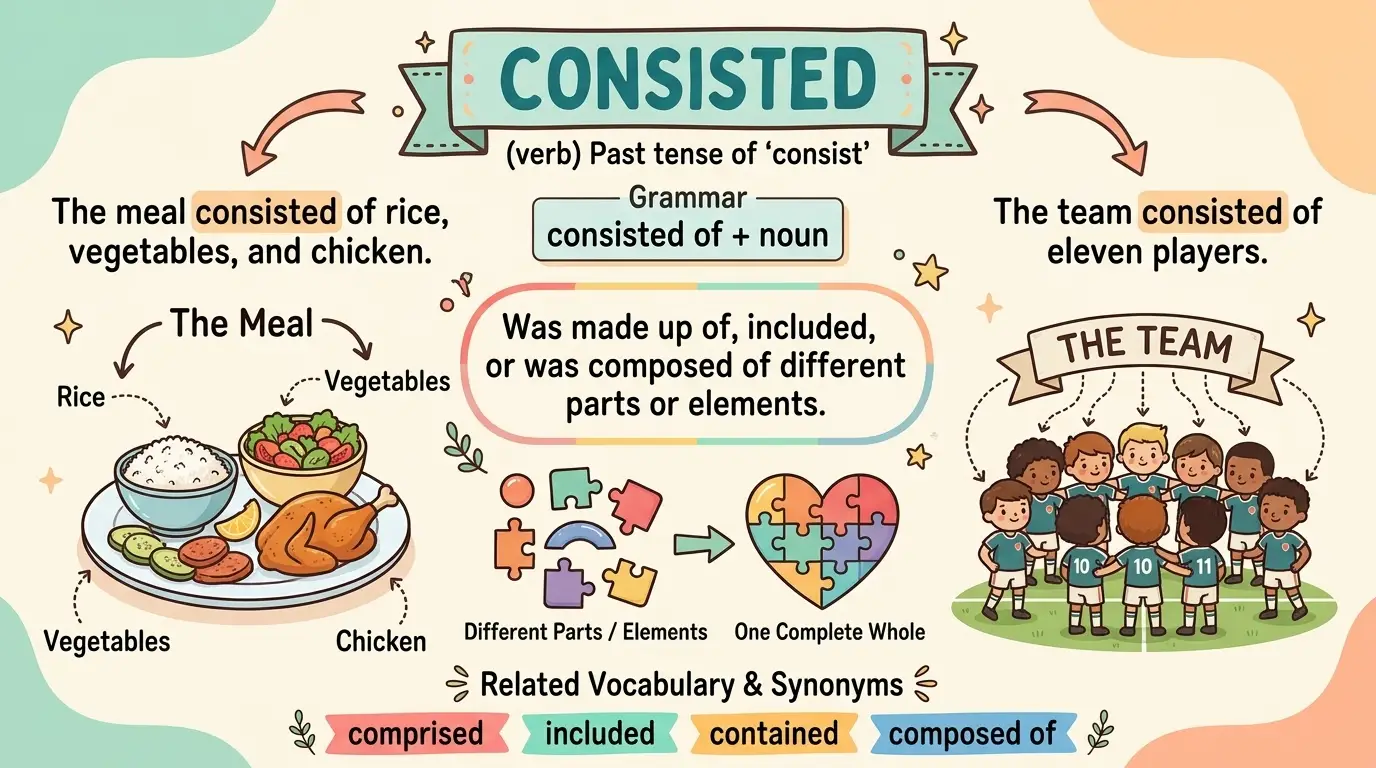
Synonyms of consisted include comprised, contained, included, involved, was made up of, and was composed of. These alternatives describe the parts, elements, or components that formed something. The best choice depends on the sentence and context.
Imagine describing a school committee in an essay. You write, “The committee consisted of five teachers.” The sentence is correct, but you may want another expression to make your writing more varied.
That is where synonyms become useful. They help you express the same idea without repeating familiar words.
The phrase consisted of appears frequently in academic writing, reports, everyday conversations, and descriptions. It explains what makes up a particular group, collection, or structure.
Learning synonyms of consisted can help students improve essays, bloggers create engaging content, and writers communicate ideas clearly. Even daily English users can benefit from knowing these alternatives.
What Does “Consisted” Really Mean?
The word consisted is the past-tense form of the verb consist. It means that something was formed from particular parts, elements, members, or ingredients.
In simple English, consisted of means was made up of something.
For example:
- The team consisted of ten players.
- The meal consisted of rice, vegetables, and chicken.
In the first example, ten players formed the team. In the second, three ingredients made up the meal.
Part of Speech
Consisted is a verb. It is the simple past tense and past participle of consist.
It commonly appears with the preposition of.
Common structure: Subject + consisted of + components.
How Native Speakers Understand It
Native English speakers generally understand consisted of as a neutral expression that identifies the parts forming a whole.
It does not usually communicate a strong emotion or personal attitude. Instead, it provides factual information.
Common Contexts
- Academic writing and research.
- Business reports and presentations.
- Descriptions of teams and organizations.
- Food and ingredient explanations.
- Historical accounts.
- Everyday conversations.
Connotative Meaning
(Connotation is the emotional or associated meaning that a word carries beyond its basic dictionary definition.)
The word consisted usually has a neutral connotation. Its emotional effect depends on the surrounding sentence.
Positive tone: It can describe a successful team, valuable collection, or impressive combination.
Negative tone: It can describe an unpleasant mixture, difficult situation, or collection of problems.
Neutral tone: It simply identifies the elements that formed something.
Etymology of Consisted
The word consisted comes from the verb consist, which entered English through Latin and French.
It traces back to the Latin word consistere, meaning “to stand together,” “to remain,” or “to be composed of.”
The word developed its modern meaning through historical changes in English.
Old English (450–1100)
The modern verb consist did not exist in Old English in its current form. English speakers used different expressions to describe things that belonged together or formed a whole.
Middle English (1100–1500)
After the Norman Conquest, French and Latin influenced English vocabulary. Forms related to consist entered English through these language influences.
Modern English (1500–Present)
The verb consist gradually developed its familiar meanings. Today, consisted of commonly describes the elements that formed something in academic, professional, and everyday English.
Pronunciation
Consisted: kuhn-SIS-tid
Syllables
Con-sist-ed (3 syllables)
Affixation Pattern of Consisted
Root: Consist
Prefix: None
Suffix: -ed (marks the past tense and past participle)
The word consisted combines the base verb consist with the regular past-tense suffix -ed.
Synonyms List
The following alternatives can help you describe the components, members, or ingredients that formed something.
Some expressions are closer substitutes than others. Always consider the grammatical structure of your sentence.
1. Comprised (Verb)
Meaning: Comprised means included or consisted of several parts that formed a complete whole.
Tone/Register: Formal, academic, professional.
Example:
The research team comprised six experienced scientists.
The exhibition comprised paintings from different historical periods.
2. Contained (Verb)
Meaning: Contained means that something held particular items, elements, or substances within it.
Tone/Register: Neutral, everyday, professional.
Example:
The box contained several old photographs.
The report contained useful information about climate change.
3. Included (Verb)
Meaning: Included means that something had particular people or things as part of its overall composition.
Tone/Register: Neutral, conversational, professional.
Example:
The package included three books and a notebook.
The conference included speakers from several countries.
4. Involved (Verb)
Meaning: Involved means that something incorporated particular activities, people, or elements.
Tone/Register: Neutral, conversational, professional.
Example:
The project involved research and careful planning.
Her responsibilities involved teaching and managing student records.
5. Was Made Up Of (Phrase)
Meaning: This expression means that several parts or elements formed a complete thing.
Tone/Register: Informal, neutral, conversational.
Example:
The class was made up of twenty students.
The collection was made up of rare historical documents.
6. Was Composed Of (Phrase)
Meaning: This expression describes something formed from several particular components or elements.
Tone/Register: Formal, academic, professional.
Example:
The atmosphere was composed of several different gases.
The orchestra was composed of talented musicians.
7. Embraced (Verb)
Meaning: Embraced means included or covered several ideas, elements, or activities within a larger whole.
Tone/Register: Formal, literary, professional.
Example:
The course embraced several areas of modern science.
Her research embraced different approaches to education.
8. Incorporated (Verb)
Meaning: Incorporated means combined particular elements into a larger structure or system.
Tone/Register: Formal, business, academic.
Example:
The new design incorporated several environmentally friendly features.
The curriculum incorporated practical learning activities.
9. Encompassed (Verb)
Meaning: Encompassed means covered or included a wide range of elements within something.
Tone/Register: Formal, academic, professional.
Example:
The study encompassed several important social issues.
Her responsibilities encompassed teaching and administration.
10. Featured (Verb)
Meaning: Featured means presented particular people, objects, or elements as important parts of something.
Tone/Register: Neutral, media, informal.
Example:
The magazine featured interviews with successful entrepreneurs.
The event featured music, dancing, and live performances.
11. Held (Verb)
Meaning: Held means contained or accommodated particular items or people.
Tone/Register: Neutral, everyday.
Example:
The basket held several fresh apples.
The hall held hundreds of excited visitors.
12. Consisted Mainly Of (Phrase)
Meaning: This expression indicates that most of something came from particular elements or components.
Tone/Register: Neutral, academic.
Example:
The audience consisted mainly of university students.
Her diet consisted mainly of fresh vegetables.
13. Was Comprised Of (Phrase)
Meaning: This expression communicates that particular members or elements formed a larger whole.
Tone/Register: Formal, professional.
Example:
The panel was comprised of experienced judges.
The committee was comprised of representatives from five departments.
Usage note: Many traditional grammar guides prefer “comprised” without “of.” The alternative “was composed of” avoids this grammatical debate.
14. Was Constituted Of (Phrase)
Meaning: This expression means that specific elements or members formed a particular group or structure.
Tone/Register: Formal, legal, academic.
Example:
The committee was constituted of elected representatives.
The organization was constituted of several independent groups.
Usage note: “Was constituted by” or “consisted of” may sound more natural in many modern sentences.
15. Featured Among (Phrase)
Meaning: This expression identifies particular elements as included within a larger selection or collection.
Tone/Register: Neutral, media, descriptive.
Example:
Several local artists featured among the exhibition’s participants.
Fresh ingredients featured among the meal’s main components.
16. Comprised Mainly Of (Phrase)
Meaning: This expression indicates that the majority of a whole came from particular parts or members.
Tone/Register: Formal, academic.
Example:
The workforce comprised mainly young professionals.
The collection comprised mainly nineteenth-century books.
Usage note: Prefer “consisted mainly of” or “was composed mainly of” for standard grammatical usage.
17. Encompassed Within (Phrase)
Meaning: This expression describes elements that fell within the boundaries or scope of a larger subject.
Tone/Register: Formal, academic.
Example:
Several important topics were encompassed within the research.
The project encompassed within its scope several environmental concerns.
18. Comprised Entirely Of (Phrase)
Meaning: This expression indicates that every part of something belonged to a particular category or group.
Tone/Register: Formal, descriptive.
Example:
The audience was comprised entirely of university graduates.
The collection comprised entirely of original manuscripts.
Usage note: “Was made up entirely of” is a more natural alternative in many contexts.
19. Included Among (Phrase)
Meaning: Included among identifies particular members or elements within a larger group.
Tone/Register: Neutral, formal.
Example:
Several famous authors were included among the guests.
Fresh fruit was included among the available refreshments.
20. Formed (Verb)
Meaning: Formed means that particular elements came together to create a complete structure or group.
Tone/Register: Neutral, academic, everyday.
Example:
Five departments formed the new organization.
Several small groups formed the final committee.
21. Constituted (Verb)
Meaning: Constituted means that particular elements or members made up or established a whole.
Tone/Register: Formal, legal, academic.
Example:
Women constituted most of the research participants.
These departments constituted the organization’s main structure.
22. Made Up (Verb Phrase)
Meaning: Made up means formed or created something from particular components.
Tone/Register: Informal, conversational.
Example:
Four musicians made up the small band.
These ingredients made up the entire recipe.
23. Consisted Primarily Of (Phrase)
Meaning: This phrase means that most components of something belonged to a particular category.
Tone/Register: Formal, academic.
Example:
The research consisted primarily of interviews.
The group consisted primarily of experienced teachers.
24. Composed (Verb)
Meaning: Composed means formed something by bringing different parts or elements together.
Tone/Register: Formal, academic, creative.
Example:
Several short stories composed the final collection.
Different musical instruments composed the orchestra’s sound.
25. Incorporated Into (Phrase)
Meaning: Incorporated into describes elements that became part of a larger system, design, or structure.
Tone/Register: Formal, professional.
Example:
Several new features were incorporated into the software.
Practical exercises were incorporated into the lessons.
26. Comprised Of (Phrase)
Meaning: Comprised of is commonly used to describe the members or elements that form a whole.
Tone/Register: Professional, academic, everyday.
Example:
The group comprised of ten volunteers.
The committee comprised of local representatives.
Usage note: This construction is widely used but often considered nonstandard in formal edited English. Use “comprised ten volunteers” or “was composed of ten volunteers” instead.
27. Made Of (Phrase)
Meaning: Made of describes the material or substances from which something is formed.
Tone/Register: Neutral, everyday.
Example:
The necklace was made of silver and small pearls.
The table was made of solid wood.
28. Consisted Solely Of (Phrase)
Meaning: This expression means that something contained only the specified elements or members.
Tone/Register: Formal, academic.
Example:
The final examination consisted solely of written questions.
The meal consisted solely of plant-based ingredients.
29. Contained Within (Phrase)
Meaning: Contained within describes something that existed as a part of a larger object or structure.
Tone/Register: Neutral, formal.
Example:
The document contained within its pages several important findings.
The package contained within it a collection of photographs.
30. Comprised Several (Phrase)
Meaning: This expression indicates that a complete group or structure included several individual elements.
Tone/Register: Formal, professional.
Example:
The research team comprised several medical specialists.
The program comprised several educational activities.
31. Grouped (Verb)
Meaning: Grouped means brought together or arranged particular items into a larger collection.
Tone/Register: Neutral, academic.
Example:
The teacher grouped the students according to their abilities.
Researchers grouped the results into three categories.
32. Combined (Verb)
Meaning: Combined means brought different elements together to form a single whole.
Tone/Register: Neutral, professional.
Example:
The final design combined traditional and modern features.
The recipe combined several fresh ingredients.
33. Consisted Largely Of (Phrase)
Meaning: This phrase explains that most of something was formed from a particular set of elements.
Tone/Register: Formal, academic.
Example:
The audience consisted largely of young adults.
The report consisted largely of statistical information.
34. Aggregated (Verb)
Meaning: Aggregated means collected or brought separate elements together into a larger total or group.
Tone/Register: Technical, academic, business.
Example:
The researchers aggregated data from several surveys.
The system aggregated information from different departments.
35. Made Of Several Parts (Phrase)
Meaning: This expression explains that an object or structure contained multiple separate components.
Tone/Register: Neutral, conversational.
Example:
The machine was made of several mechanical parts.
The model was made of several connected sections.
36. Integrated (Verb)
Meaning: Integrated means combining different elements so they function together as a unified whole.
Tone/Register: Formal, professional, academic.
Example:
The program integrated several learning methods.
The new system integrated information from different sources.
37. Comprised Various Elements (Phrase)
Meaning: This expression describes a whole that included several different components or features.
Tone/Register: Formal, descriptive.
Example:
The design comprised various decorative elements.
The exhibition comprised various forms of modern art.
38. Consisted Mostly Of (Phrase)
Meaning: This phrase indicates that the majority of a group or collection belonged to a particular category.
Tone/Register: Neutral, conversational.
Example:
The visitors consisted mostly of local families.
The meal consisted mostly of vegetables and rice.
39. Comprised Multiple Components (Phrase)
Meaning: This expression describes something formed from several individual parts or components.
Tone/Register: Technical, professional.
Example:
The device comprised multiple electronic components.
The system comprised multiple interconnected sections.
40. Comprised Different Parts (Phrase)
Meaning: This expression indicates that different elements or sections formed a complete object or structure.
Tone/Register: Neutral, formal.
Example:
The project comprised different stages of development.
The structure comprised different architectural sections.
Synonyms of Consisted by Tone
Choosing a synonym based on tone helps your writing sound natural and appropriate.
Positive Synonyms
These alternatives can describe impressive combinations, valuable collections, or successful groups.
- Embraced
- Incorporated
- Encompassed
- Integrated
- Combined
- Featured
Neutral Synonyms
These words communicate factual information without adding a strong emotional impression.
- Included
- Contained
- Comprised
- Formed
- Composed
- Held
- Made up of
- Constituted
Negative Synonyms
The word consisted does not have inherently negative synonyms. However, some alternatives can describe unpleasant or undesirable components.
- Contained
- Comprised
- Consisted mainly of
- Was made up of
- Included
For example, “The report consisted mainly of complaints” communicates a negative situation through its context rather than through the verb itself.
Playful and Informal Synonyms
These expressions work well in casual conversations and simple explanations.
- Made up of
- Made of
- Held
- Included
- Formed
Why Does Tone Matter?
Tone influences how readers understand your message.
A formal word such as constituted may suit a research paper. A conversational expression such as made up of works better in everyday discussions.
Choosing the right alternative makes your sentences clearer and more natural.
“Consisted” vs. Close Alternatives
Several synonyms have similar meanings, but they do not always work in the same situations.
Consisted vs. Comprised
Consisted: Identifies the parts that formed a complete whole.
Comprised: Means included or contained the components of a whole.
Tone: Both sound neutral or formal.
When to use: Use “consisted of” when describing the members of a group. Use “comprised” when you want a concise description.
Example:
The team consisted of eight players.
The team comprised eight players.
Consisted vs. Included
Consisted: Describes the complete composition of something.
Included: Identifies particular elements without necessarily suggesting that they were the only ones.
Tone: Both are neutral.
When to use: Use “consisted of” when listing the entire composition. Use “included” when mentioning some elements of a larger collection.
Example:
The meal consisted of rice and vegetables.
The meal included rice and vegetables.
Consisted vs. Composed Of
Consisted: Explains what formed a particular whole.
Composed of: Describes the elements or materials that created something.
Tone: Both are suitable for formal and neutral writing.
When to use: Both work well in academic writing and descriptions.
Example:
The committee consisted of five members.
The committee was composed of five members.
How “Consisted” Changes by Context
The right alternative depends on the situation, audience, and purpose of your sentence.
Daily Conversation
People often prefer simple expressions when speaking casually.
Instead of saying, “The group consisted of four friends,” you can say, “The group was made up of four friends.”
This sounds relaxed and easy to understand.
Writing and Blogging
Bloggers can use alternatives such as included, contained, and featured to avoid repetitive sentences.
For example, a food blogger might write, “The recipe included fresh tomatoes, garlic, and herbs.”
This creates a natural reading experience.
Professional and Academic Writing
Formal alternatives such as comprised, constituted, and was composed of work well in research papers, business documents, and reports.
They help communicate factual information clearly.
Creative and Informal Writing
Creative writers can use expressions such as embraced, combined, and made up of.
These alternatives help describe characters, settings, collections, and fictional worlds.
Common Mistakes Learners Make
Learning synonyms is useful, but using them incorrectly can change the meaning of a sentence.
1. Using “Comprised Of” in Formal Writing
Many people write “The team was comprised of ten players.”
Although this construction appears frequently, traditional grammar guidance often recommends “The team comprised ten players” or “The team was composed of ten players.”
2. Confusing “Included” With “Consisted Of”
These expressions are not always interchangeable.
“Consisted of” usually identifies the complete composition. “Included” can mention only selected elements.
3. Using “Made Of” for Every Situation
“Made of” often describes physical materials.
For example, “The chair was made of wood” is natural. However, “The committee was made of five members” sounds less natural than “The committee consisted of five members.”
4. Choosing Overly Formal Vocabulary
Words such as constituted and aggregated may sound unnatural in casual conversations.
Choose vocabulary that matches your audience.
5. Repeating the Same Expression
Using “consisted of” in every paragraph can make writing repetitive.
Try alternatives such as included, comprised, and was composed of when they preserve the intended meaning.
Register Notes: Formal vs. Informal English
Formal English: Comprised, constituted, encompassed, incorporated, and was composed of.
Informal English: Made up of, included, and held.
Academic English: Comprised, consisted of, constituted, and encompassed.
Professional English: Incorporated, comprised, included, and was composed of.
Spoken English: Made up of, included, and consisted of.
Remember that a synonym should fit both the meaning and grammatical structure of your sentence.
For additional vocabulary learning, you can explore related synonym guides on synonymdesk.com.
Real-Life Examples Using Consisted
Here are a few situations that demonstrate how this expression works in everyday life.
Workplace
A marketing department consisted of six employees, each responsible for a different task.
A business presentation included financial information, customer feedback, and future plans.
Social Situations
The birthday party was made up of close friends and family members.
The dinner consisted of several homemade dishes.
Media and Pop Culture
The documentary featured interviews with historians and researchers.
The television series encompassed several important historical events.
Writing and Storytelling
The fictional kingdom consisted of five independent regions.
The novel incorporated elements of mystery, adventure, and romance.
Conclusion
Learning synonyms of consisted helps you describe groups, collections, and structures with greater accuracy. Each alternative adds a slightly different meaning.
Words such as comprised, included, and composed of make your writing more flexible. They also help you avoid unnecessary repetition.
Students, bloggers, and content writers can use these expressions to improve essays, articles, reports, and everyday communication.
Keep practicing these words in emails, essays, and daily conversations. Try creating your own sentences and build a stronger vocabulary one word at a time.
Interactive Practice Quiz
Test your understanding of the synonyms of consisted with these practical questions.
Part One: Understanding Synonyms
1. Which word best replaces “consisted of” in this sentence?
“The team consisted of twelve players.”
A. Comprised
B. Destroyed
C. Reduced
D. Separated
2. Which expression describes the materials used to create an object?
A. Included
B. Made of
C. Embraced
D. Involved
3. Choose the best alternative:
“The report consisted of several important findings.”
A. Contained
B. Removed
C. Rejected
D. Ignored
4. Which word means bringing different elements together?
A. Excluded
B. Combined
C. Avoided
D. Divided
5. Which expression works best in a casual conversation?
A. Constituted
B. Aggregated
C. Made up of
D. Encompassed
6. Which word describes something that covers a wide range of subjects?
A. Encompassed
B. Reduced
C. Removed
D. Limited
7. Choose the most suitable word:
“The new curriculum ______ practical learning activities.”
A. Incorporated
B. Avoided
C. Destroyed
D. Rejected
Part Two: Real-Life Usage
8. Which sentence correctly describes a committee?
A. The committee consisted of five members.
B. The committee consisted five members.
C. The committee consisted by five members.
D. The committee consisted into five members.
9. Which alternative is most appropriate for academic writing?
A. Made up of
B. Was composed of
C. Stuffed with
D. Thrown together
10. Which word best describes collecting information into a larger group?
A. Aggregated
B. Divided
C. Ignored
D. Removed
11. A recipe contains tomatoes, onions, and garlic. Which word fits best?
A. Contained
B. Escaped
C. Refused
D. Separated
12. Which expression suggests that something contained only specific elements?
A. Consisted solely of
B. Included among
C. Featured among
D. Involved with
13. Which alternative describes elements working together as one system?
A. Integrated
B. Scattered
C. Separated
D. Excluded
14. Which word best describes a magazine that presents interviews with famous people?
A. Featured
B. Avoided
C. Removed
D. Forgotten
15. Which sentence uses “included” naturally?
A. The package included three books.
B. The package included of three books.
C. The package included by three books.
D. The package included into three books.
Reflection Task
Write two original sentences using different synonyms of consisted. Use one sentence about your daily life and another about school, work, or a personal experience.
Answer Key
1-A | 2-B | 3-A | 4-B | 5-C | 6-A | 7-A | 8-A | 9-B | 10-A | 11-A | 12-A | 13-A | 14-A | 15-A
Suggested External Link Source:
Merriam-Webster – Consist Definition for additional information about the verb’s meaning and usage.
FAQs
1. What is the closest synonym for consisted of in a sentence?
The closest alternatives to “consisted of” are “was made up of,” “was composed of,” and “comprised.” These expressions describe the elements that form a complete group or structure. For formal writing, “was composed of” is particularly useful because it clearly communicates the relationship between the whole and its individual parts.
2. Can I use comprised instead of consisted of?
Yes. You can often use “comprised” instead of “consisted of” when describing the components of something. For example, “The team comprised ten players” communicates the same basic idea as “The team consisted of ten players.” Remember that traditional grammar recommends using “comprised” without the preposition “of” when it means included or contained.
3. What is the difference between consisted and consisted of?
“Consisted” is the past-tense form of the verb “consist.” It normally appears with the preposition “of” when describing the components of something. For example, “The meal consisted of rice and chicken.” The preposition completes the common grammatical structure and introduces the elements that formed the meal.
4. Is consisted a past-tense verb?
Yes. “Consisted” is the simple past tense and past participle of “consist.” It describes a composition or situation that existed in the past. For example, “The original team consisted of six members.” You can also use it in perfect-tense constructions, such as “The group has consisted of experienced teachers.”
5. What is the opposite of consisted of?
There is no single perfect opposite of “consisted of.” However, words such as “excluded,” “lacked,” and “omitted” can express contrasting ideas depending on the sentence. For example, “The original group consisted of ten members” contrasts with “The revised group excluded two members.”
6. How do you use consisted of in academic writing?
Use “consisted of” when explaining the participants, materials, components, or methods involved in research. For example, “The study consisted of three stages.” You can also use “comprised” or “was composed of” to improve sentence variety. Always make sure your alternative preserves the original meaning.
7. Can consisted of describe people and objects?
Yes. “Consisted of” can describe groups of people, physical objects, ingredients, activities, and abstract elements. For example, “The audience consisted of international students” describes people, while “The mixture consisted of water and salt” describes substances. The phrase works whenever you need to identify the parts that form a whole.
8. Is made up of more natural than consisted of?
Both expressions are natural, but they suit different situations. “Made up of” sounds conversational and works well in everyday speech. “Consisted of” is neutral and often appears in formal writing, reports, and academic explanations. Choose the expression that matches your audience and the style of your sentence.

Mehtab Yasir is a passionate writer and English language enthusiast dedicated to making vocabulary learning simple, practical, and enjoyable. As an author at SynonymDesk.com, she creates helpful content covering synonyms, antonyms, word meanings, vocabulary, phrases, and everyday English usage. Her goal is to provide clear and easy-to-understand information that helps students, writers, professionals, and English learners choose the right words and communicate with greater confidence. Mehtab believes that a strong vocabulary can improve both writing and communication skills. She enjoys researching new words, exploring their meanings and uses, and turning complex language concepts into useful, reader-friendly content. Through her work, she strives to make SynonymDesk.com a reliable resource for anyone looking to improve their English vocabulary and language skills.