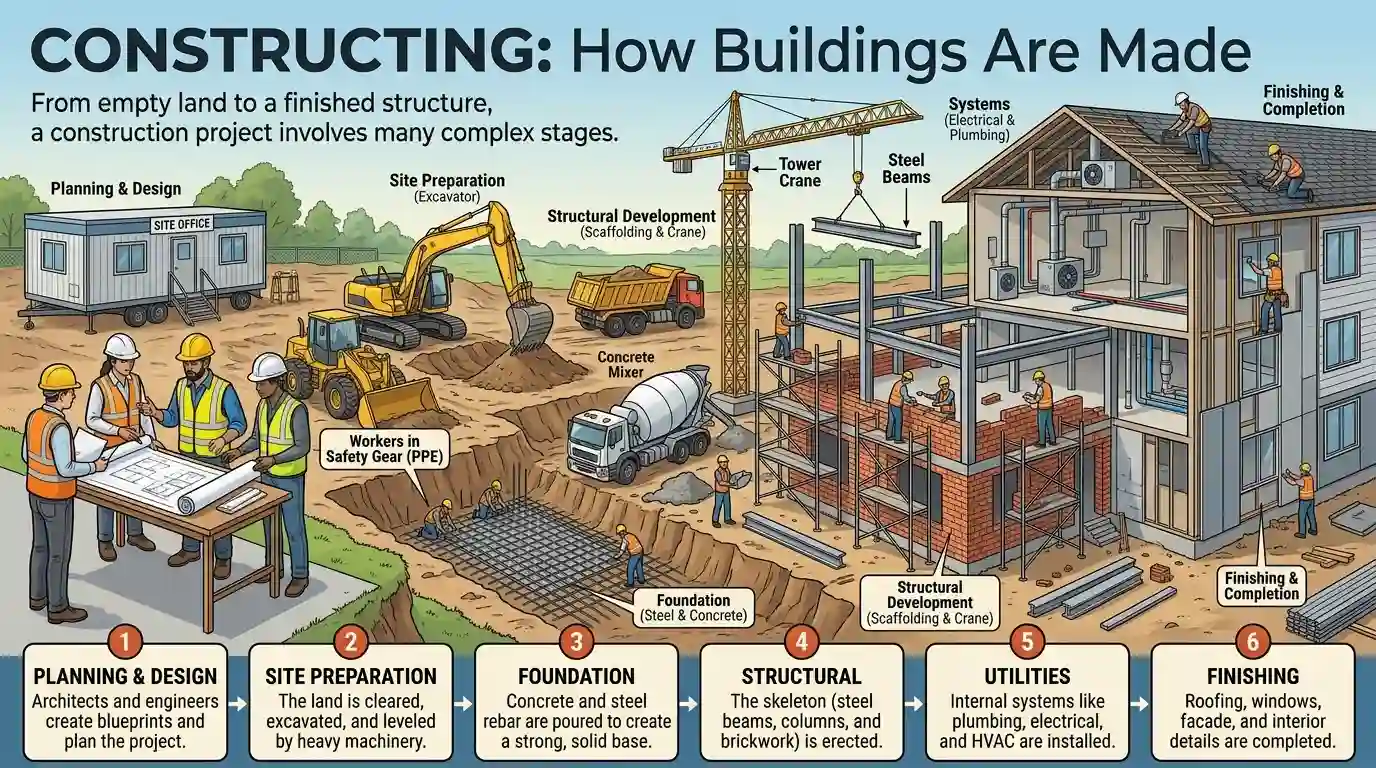
Synonyms of constructing include building, creating, making, assembling, developing, forming, erecting, designing, and producing. These words describe the process of putting materials, ideas, or different elements together to create something new.
Imagine a team building a new office. One person might say they are constructing a building, while another might describe the same activity as developing or creating a new structure. Different words can express the same basic action with slightly different meanings.
The word constructing appears in everyday conversations, professional discussions, academic writing, and technical descriptions. It helps explain how people build physical objects and develop ideas.
Learning synonyms of constructing can make your English more natural and expressive. Students, bloggers, and content writers can use these alternatives to avoid repetition and communicate their ideas clearly.
What Does “Constructing” Really Mean?
Constructing means building, creating, or putting different parts together to make something complete. It can describe physical activities, such as building a house, or mental activities, such as developing an argument.
The word comes from the verb construct. It describes an action that involves planning, arranging, and combining different elements.
Native English speakers commonly use constructing in building projects, engineering, education, business, and creative work.
Part of Speech
Constructing is the present participle and gerund form of the verb construct.
- Verb: Construct
- Present participle: Constructing
- Past tense: Constructed
- Past participle: Constructed
Simple Definition: Constructing means putting materials, parts, or ideas together to build or create something.
Examples
- The workers are constructing a new bridge.
- She is constructing a strong argument for her research paper.
Connotative Meaning of Constructing
(Connotation refers to the feelings, associations, or impressions that a word creates beyond its literal definition.)
Positive Tone
Constructing often suggests progress, creativity, teamwork, and achievement. It can describe activities that improve communities or develop useful ideas.
Negative Tone
The word can sometimes suggest disruption, expense, or difficulty, especially when construction work creates noise or delays.
Neutral Tone
In most situations, constructing simply describes the process of building or creating something. It does not express a strong emotional judgment.
Etymology of Constructing
The word constructing comes from the Latin verb construere, which means to build, arrange, or put together.
It combines the prefix con- (together) with struere (to pile up or build).
Old English Period (450–1100)
The modern word constructing did not exist in Old English. However, English speakers used native words related to building, making, and arranging things.
Middle English Period (1100–1500)
English vocabulary developed through contact with French and Latin. Words associated with building and creating became more common in formal communication.
Modern English Period (1500–Present)
Construct and its related forms became established in English. Today, constructing describes physical building activities as well as the development of arguments, systems, relationships, and ideas.
Pronunciation of Constructing
- US: /kənˈstrʌk.tɪŋ/
- UK: /kənˈstrʌk.tɪŋ/
Syllables
con-struct-ing (3 syllables)
Affixation Pattern of Constructing
Root: Struct (related to building or arranging)
Prefix: Con- (together)
Suffix: -ing (indicates an ongoing action or gerund form)
The word develops from construct by adding the suffix -ing.
Synonyms List
The following alternatives describe building, creating, assembling, developing, or organizing something. Some work best for physical structures, while others suit ideas, plans, and systems. Always consider the sentence before choosing a replacement.
1. Building (Verb) — US: /ˈbɪl.dɪŋ/ | UK: /ˈbɪl.dɪŋ/
Meaning: Building means creating a structure by putting materials and different parts together.
Tone/Register: Neutral, everyday, professional.
Examples:
The company is building a new shopping center.
They are building a small house near the lake.
2. Creating (Verb) — US: /kriˈeɪ.tɪŋ/ | UK: /kriˈeɪ.tɪŋ/
Meaning: Creating means bringing something new into existence through effort or imagination.
Tone/Register: Neutral, creative, professional.
Examples:
She is creating a new website for her business.
The artist is creating beautiful designs for the exhibition.
3. Making (Verb) — US: /ˈmeɪ.kɪŋ/ | UK: /ˈmeɪ.kɪŋ/
Meaning: Making means producing or forming something through physical or creative effort.
Tone/Register: Informal, everyday.
Examples:
My brother is making a wooden chair.
We are making a model for our science project.
4. Assembling (Verb) — US: /əˈsem.blɪŋ/ | UK: /əˈsem.blɪŋ/
Meaning: Assembling means joining separate parts to create a complete object or system.
Tone/Register: Technical, neutral, professional.
Examples:
The workers are assembling the new machines.
I am assembling a desk for my home office.
5. Developing (Verb) — US: /dɪˈvel.ə.pɪŋ/ | UK: /dɪˈvel.ə.pɪŋ/
Meaning: Developing means gradually creating or improving something through planning and effort.
Tone/Register: Professional, academic, business.
Examples:
The company is developing a new communication system.
Researchers are developing a better learning method.
6. Erecting (Verb) — US: /ɪˈrek.tɪŋ/ | UK: /ɪˈrek.tɪŋ/
Meaning: Erecting means putting up a building, wall, tower, or other upright structure.
Tone/Register: Formal, technical.
Examples:
The engineers are erecting a tall communication tower.
Workers are erecting a fence around the property.
7. Forming (Verb) — US: /ˈfɔːr.mɪŋ/ | UK: /ˈfɔː.mɪŋ/
Meaning: Forming means giving something a particular shape, structure, or arrangement.
Tone/Register: Neutral, academic, professional.
Examples:
The students are forming a study group.
The artist is forming a sculpture from clay.
8. Fabricating (Verb) — US: /ˈfæb.rɪ.keɪ.tɪŋ/ | UK: /ˈfæb.rɪ.keɪ.tɪŋ/
Meaning: Fabricating means manufacturing or creating an object by combining or shaping materials.
Tone/Register: Technical, industrial, professional.
Examples:
The factory is fabricating metal components.
The workers are fabricating custom parts for the machine.
9. Producing (Verb) — US: /prəˈduː.sɪŋ/ | UK: /prəˈdjuː.sɪŋ/
Meaning: Producing means making or generating something through a particular process.
Tone/Register: Neutral, business, industrial.
Examples:
The company is producing new electric vehicles.
The team is producing a detailed research report.
10. Crafting (Verb) — US: /ˈkræf.tɪŋ/ | UK: /ˈkrɑːf.tɪŋ/
Meaning: Crafting means making something carefully with skill, attention, and creativity.
Tone/Register: Creative, informal, professional.
Examples:
She is crafting a beautiful wooden table.
The writer is crafting an interesting story.
11. Designing (Verb) — US: /dɪˈzaɪ.nɪŋ/ | UK: /dɪˈzaɪ.nɪŋ/
Meaning: Designing means planning the appearance, structure, or function of something before creating it.
Tone/Register: Professional, creative, technical.
Examples:
The architect is designing a modern office building.
They are designing a new mobile application.
12. Engineering (Verb) — US: /ˌen.dʒɪˈnɪr.ɪŋ/ | UK: /ˌen.dʒɪˈnɪə.rɪŋ/
Meaning: Engineering means designing or developing something through scientific and technical knowledge.
Tone/Register: Technical, academic, professional.
Examples:
The team is engineering a safer transportation system.
Scientists are engineering a new medical device.
13. Establishing (Verb) — US: /ɪˈstæb.lɪ.ʃɪŋ/ | UK: /ɪˈstæb.lɪ.ʃɪŋ/
Meaning: Establishing means creating an organization, system, institution, or lasting arrangement.
Tone/Register: Formal, business, academic.
Examples:
The university is establishing a new research center.
They are establishing better communication policies.
14. Setting Up (Phrasal Verb) — US: /ˌset ˈʌp/ | UK: /ˌset ˈʌp/
Meaning: Setting up means arranging or creating something so it becomes ready for use.
Tone/Register: Informal, everyday, professional.
Examples:
We are setting up a new office downtown.
She is setting up a small business with her friend.
15. Shaping (Verb) — US: /ˈʃeɪ.pɪŋ/ | UK: /ˈʃeɪ.pɪŋ/
Meaning: Shaping means giving something a particular form, direction, or structure.
Tone/Register: Neutral, creative, academic.
Examples:
The sculptor is shaping a piece of stone.
Education is shaping the future of young people.
16. Composing (Verb) — US: /kəmˈpoʊ.zɪŋ/ | UK: /kəmˈpəʊ.zɪŋ/
Meaning: Composing means creating something by arranging different elements into a complete work.
Tone/Register: Creative, academic, formal.
Examples:
She is composing a new song for the event.
The student is composing an essay about climate change.
17. Devising (Verb) — US: /dɪˈvaɪ.zɪŋ/ | UK: /dɪˈvaɪ.zɪŋ/
Meaning: Devising means inventing or developing a plan, method, or solution through careful thought.
Tone/Register: Formal, academic, professional.
Examples:
The researchers are devising a new experiment.
We are devising a practical solution to the problem.
18. Manufacturing (Verb) — US: /ˌmæn.jəˈfæk.tʃɚ.ɪŋ/ | UK: /ˌmæn.jʊˈfæk.tʃər.ɪŋ/
Meaning: Manufacturing means producing goods or products, usually through industrial processes.
Tone/Register: Industrial, technical, business.
Examples:
The factory is manufacturing electronic equipment.
They are manufacturing furniture for local stores.
19. Generating (Verb) — US: /ˈdʒen.ə.reɪ.tɪŋ/ | UK: /ˈdʒen.ə.reɪ.tɪŋ/
Meaning: Generating means producing or creating something, such as energy, ideas, or information.
Tone/Register: Neutral, technical, academic.
Examples:
The system is generating useful reports.
The team is generating fresh ideas for the project.
20. Organizing (Verb) — US: /ˈɔːr.ɡə.naɪ.zɪŋ/ | UK: /ˈɔː.ɡə.naɪ.zɪŋ/
Meaning: Organizing means arranging different elements into a structured and coordinated whole.
Tone/Register: Neutral, professional, everyday.
Examples:
She is organizing the information for her presentation.
The manager is organizing a new training program.
21. Preparing (Verb) — US: /prɪˈper.ɪŋ/ | UK: /prɪˈpeə.rɪŋ/
Meaning: Preparing means arranging materials or information for a particular purpose.
Tone/Register: Neutral, everyday, professional.
Examples:
The students are preparing a science project.
He is preparing a detailed business proposal.
22. Compiling (Verb) — US: /kəmˈpaɪ.lɪŋ/ | UK: /kəmˈpaɪ.lɪŋ/
Meaning: Compiling means collecting and arranging information or materials into one organized whole.
Tone/Register: Academic, technical, professional.
Examples:
The researcher is compiling information for the report.
She is compiling a list of useful vocabulary words.
23. Drafting (Verb) — US: /ˈdræf.tɪŋ/ | UK: /ˈdrɑːf.tɪŋ/
Meaning: Drafting means preparing an initial version of a document, plan, or design.
Tone/Register: Professional, academic, formal.
Examples:
The lawyer is drafting a new agreement.
I am drafting an article about English vocabulary.
24. Framing (Verb) — US: /ˈfreɪ.mɪŋ/ | UK: /ˈfreɪ.mɪŋ/
Meaning: Framing means creating or arranging the basic structure of something.
Tone/Register: Neutral, professional, academic.
Examples:
The carpenter is framing the walls of the house.
The researcher is framing a new question for the study.
25. Originating (Verb) — US: /əˈrɪdʒ.ə.neɪ.tɪŋ/ | UK: /əˈrɪdʒ.ɪ.neɪ.tɪŋ/
Meaning: Originating means creating or starting something for the first time.
Tone/Register: Formal, academic.
Examples:
The designer is originating a new concept.
The company is originating an innovative business idea.
26. Founding (Verb) — US: /ˈfaʊn.dɪŋ/ | UK: /ˈfaʊn.dɪŋ/
Meaning: Founding means establishing an organization, institution, or company.
Tone/Register: Formal, business, historical.
Examples:
They are founding a nonprofit organization.
The entrepreneurs are founding a technology company.
27. Instituting (Verb) — US: /ˈɪn.stə.tuː.tɪŋ/ | UK: /ˈɪn.stɪ.tjuː.tɪŋ/
Meaning: Instituting means introducing or establishing a formal system, rule, or practice.
Tone/Register: Formal, academic, professional.
Examples:
The school is instituting a new attendance policy.
The organization is instituting changes to its training system.
28. Installing (Verb) — US: /ɪnˈstɔː.lɪŋ/ | UK: /ɪnˈstɔː.lɪŋ/
Meaning: Installing means placing equipment, machinery, or software into position so people can use it.
Tone/Register: Technical, professional, everyday.
Examples:
The technicians are installing new security cameras.
We are installing a heating system in the house.
29. Mounting (Verb) — US: /ˈmaʊn.tɪŋ/ | UK: /ˈmaʊn.tɪŋ/
Meaning: Mounting means attaching or placing something securely in a particular position.
Tone/Register: Technical, practical, neutral.
Examples:
The workers are mounting a television on the wall.
The team is mounting equipment inside the control room.
30. Raising (Verb) — US: /ˈreɪ.zɪŋ/ | UK: /ˈreɪ.zɪŋ/
Meaning: Raising means lifting or building something upward, especially a structure or framework.
Tone/Register: Neutral, practical, professional.
Examples:
The workers are raising the walls of the new building.
They are raising a monument in the town square.
31. Laying (Verb) — US: /ˈleɪ.ɪŋ/ | UK: /ˈleɪ.ɪŋ/
Meaning: Laying means placing materials in position as part of a building or construction process.
Tone/Register: Technical, practical.
Examples:
The workers are laying bricks for the garden wall.
The construction team is laying the foundation.
32. Synthesizing (Verb) — US: /ˈsɪn.θə.saɪ.zɪŋ/ | UK: /ˈsɪn.θə.saɪ.zɪŋ/
Meaning: Synthesizing means combining separate ideas, materials, or elements into a unified whole.
Tone/Register: Academic, scientific, technical.
Examples:
The researcher is synthesizing information from several studies.
The scientist is synthesizing a new chemical compound.
33. Configuring (Verb) — US: /kənˈfɪɡ.jɚ.ɪŋ/ | UK: /kənˈfɪɡ.ə.rɪŋ/
Meaning: Configuring means arranging or setting up components to create a working system.
Tone/Register: Technical, professional.
Examples:
The technician is configuring the computer network.
We are configuring the software for the new office.
34. Structuring (Verb) — US: /ˈstrʌk.tʃɚ.ɪŋ/ | UK: /ˈstrʌk.tʃər.ɪŋ/
Meaning: Structuring means arranging different parts into an organized and logical framework.
Tone/Register: Academic, business, professional.
Examples:
The manager is structuring a new training program.
She is structuring her essay into clear sections.
35. Ascribing (Verb) — US: /əˈskraɪ.bɪŋ/ | UK: /əˈskraɪ.bɪŋ/
Meaning: Ascribing means attributing a quality, cause, or characteristic to someone or something.
Tone/Register: Formal, academic.
Examples:
The researcher is ascribing the results to several factors.
The writer is ascribing a symbolic meaning to the character.
Usage note: Ascribing is an alternative for particular abstract contexts, not a general synonym for physical construction.
36. Envisioning (Verb) — US: /ɪnˈvɪʒ.ən.ɪŋ/ | UK: /ɪnˈvɪʒ.ən.ɪŋ/
Meaning: Envisioning means imagining or mentally developing a picture of something that may exist in the future.
Tone/Register: Creative, professional, neutral.
Examples:
The architect is envisioning a modern community center.
She is envisioning a better future for her business.
37. Formulating (Verb) — US: /ˈfɔːr.mjə.leɪ.tɪŋ/ | UK: /ˈfɔː.mjə.leɪ.tɪŋ/
Meaning: Formulating means developing a plan, idea, theory, or strategy through careful thought.
Tone/Register: Academic, formal, professional.
Examples:
The team is formulating a new business strategy.
The scientist is formulating a theory about the results.
38. Assembling Together (Verb Phrase) — US: /əˈsem.blɪŋ təˈɡeð.ɚ/ | UK: /əˈsem.blɪŋ təˈɡeð.ə/
Meaning: Assembling together means bringing separate pieces or people into one organized arrangement.
Tone/Register: Neutral, informal.
Examples:
We are assembling together the parts of the model.
The volunteers are assembling the equipment for the event.
39. Putting Together (Phrasal Verb) — US: /ˌpʊt.ɪŋ təˈɡeð.ɚ/ | UK: /ˌpʊt.ɪŋ təˈɡeð.ə/
Meaning: Putting together means joining different pieces or ideas to create something complete.
Tone/Register: Informal, everyday.
Examples:
I am putting together a new bookshelf.
She is putting together a presentation for tomorrow.
40. Piecing Together (Verb Phrase) — US: /ˌpiː.sɪŋ təˈɡeð.ɚ/ | UK: /ˌpiː.sɪŋ təˈɡeð.ə/
Meaning: Piecing together means joining separate pieces of information or material to form a complete picture.
Tone/Register: Neutral, conversational, investigative.
Examples:
The detective is piecing together the evidence.
I am piecing together the details of the project.
41. Assembling Into (Verb Phrase) — US: /əˈsem.blɪŋ ˈɪn.tuː/ | UK: /əˈsem.blɪŋ ˈɪn.tuː/
Meaning: Assembling into means combining separate elements to form a particular structure or object.
Tone/Register: Technical, neutral.
Examples:
The workers are assembling the pieces into a complete machine.
She is assembling the photographs into a digital album.
42. Building Up (Phrasal Verb) — US: /ˌbɪl.dɪŋ ˈʌp/ | UK: /ˌbɪl.dɪŋ ˈʌp/
Meaning: Building up means gradually developing or increasing something over time.
Tone/Register: Informal, professional, neutral.
Examples:
The company is building up its online presence.
He is building up a strong professional reputation.
43. Working Out (Phrasal Verb) — US: /ˌwɝː.kɪŋ ˈaʊt/ | UK: /ˌwɜː.kɪŋ ˈaʊt/
Meaning: Working out means developing or solving a plan, arrangement, or solution through thought and effort.
Tone/Register: Informal, conversational.
Examples:
We are working out a plan for the new project.
The students are working out a solution to the problem.
44. Putting Up (Phrasal Verb) — US: /ˌpʊt.ɪŋ ˈʌp/ | UK: /ˌpʊt.ɪŋ ˈʌp/
Meaning: Putting up means erecting or installing something, such as a building, wall, or sign.
Tone/Register: Informal, everyday.
Examples:
The workers are putting up a new fence.
They are putting up a temporary stage for the concert.
45. Laying Out (Phrasal Verb) — US: /ˌleɪ.ɪŋ ˈaʊt/ | UK: /ˌleɪ.ɪŋ ˈaʊt/
Meaning: Laying out means arranging or planning the position and structure of different elements.
Tone/Register: Neutral, professional, technical.
Examples:
The architect is laying out the building plans.
She is laying out the main ideas for her presentation.
46. Mapping Out (Phrasal Verb) — US: /ˌmæp.ɪŋ ˈaʊt/ | UK: /ˌmæp.ɪŋ ˈaʊt/
Meaning: Mapping out means planning or arranging the steps and structure of a project.
Tone/Register: Professional, informal, academic.
Examples:
The manager is mapping out a five-year development plan.
We are mapping out the steps for our research project.
47. Building On (Phrasal Verb) — US: /ˌbɪl.dɪŋ ˈɑːn/ | UK: /ˌbɪl.dɪŋ ˈɒn/
Meaning: Building on means developing something further by using existing ideas, knowledge, or achievements.
Tone/Register: Academic, professional, neutral.
Examples:
The researcher is building on previous scientific findings.
The students are building on their existing knowledge.
48. Putting in Place (Verb Phrase) — US: /ˌpʊt.ɪŋ ɪn ˈpleɪs/ | UK: /ˌpʊt.ɪŋ ɪn ˈpleɪs/
Meaning: Putting in place means establishing or arranging the necessary parts of a system or plan.
Tone/Register: Professional, business, formal.
Examples:
The company is putting new safety measures in place.
The school is putting a better learning system in place.
49. Assembling Components (Verb Phrase) — US: /əˈsem.blɪŋ kəmˈpoʊ.nənts/ | UK: /əˈsem.blɪŋ kəmˈpəʊ.nənts/
Meaning: Assembling components means joining separate parts to produce a functioning object or system.
Tone/Register: Technical, industrial.
Examples:
The engineers are assembling components for the new aircraft.
The technicians are assembling components for the electronic device.
50. Developing From Scratch (Verb Phrase) — US: /dɪˈvel.ə.pɪŋ frəm ˈskrætʃ/ | UK: /dɪˈvel.ə.pɪŋ frəm ˈskrætʃ/
Meaning: Developing from scratch means creating something completely new without relying on an existing finished version.
Tone/Register: Informal, professional, creative.
Examples:
The developers are creating the application from scratch.
She is developing a new educational program from scratch.
Synonyms of Constructing by Tone
Choosing the right alternative depends on the message, audience, and situation. Some words sound technical, while others feel natural in everyday conversation.
Positive Synonyms
These words can communicate creativity, progress, and improvement.
- Creating
- Developing
- Crafting
- Building
- Designing
- Establishing
- Formulating
- Envisioning
Neutral Synonyms
These words describe the process without expressing a strong emotional attitude.
- Making
- Assembling
- Forming
- Producing
- Organizing
- Preparing
- Structuring
- Compiling
Negative Synonyms
Constructing does not have an inherently negative meaning. However, some alternatives can describe activities associated with disruption or false information in particular contexts.
- Fabricating (when referring to inventing false information)
- Manufacturing (when referring to manufacturing a false story)
- Engineering (when referring to engineering a dishonest outcome)
Playful and Informal Synonyms
These alternatives work well in relaxed conversations.
- Putting together
- Putting up
- Building up
- Working out
- Piecing together
- Setting up
Why Does Tone Matter?
Tone helps readers understand the intention behind a sentence. For example, crafting suggests care and creativity, while assembling emphasizes joining separate parts.
Using the right alternative makes your writing more natural and prevents confusion.
Constructing vs. Close Alternatives
Some synonyms have similar meanings but do not work in exactly the same situations.
Constructing vs. Building
Constructing: Usually emphasizes the process of putting materials or elements together to create something.
Building: A more common everyday word for creating physical structures or developing something gradually.
Example:
The engineers are constructing a new highway.
The company is building a new headquarters.
Constructing vs. Assembling
Constructing: Can involve creating a complete structure through several stages.
Assembling: Focuses on joining existing parts into a complete object.
Example:
The workers are constructing a new house.
The technicians are assembling the computer.
Constructing vs. Creating
Constructing: Often emphasizes structure, planning, and organization.
Creating: Has a broader meaning and includes producing something new through imagination or effort.
Example:
The architect is constructing a detailed framework.
The artist is creating a unique painting.
How Constructing Changes by Context
The best synonym depends on what someone is creating and how they want to describe the process.
Daily Conversation
In everyday speech, people usually prefer simple alternatives such as making, building, putting together, and setting up.
For example, instead of saying, “I am constructing a bookshelf,” you can say, “I am putting together a bookshelf.”
Writing and Blogging
Writers can use creating, developing, crafting, and producing to make their content more engaging.
For example, a blogger might say, “I am developing a helpful guide for English learners.”
These alternatives also reduce unnecessary repetition.
Professional and Academic Writing
Formal communication often requires precise vocabulary.
Words such as formulating, establishing, engineering, compiling, and structuring work well in academic papers, business reports, and technical documents.
For example, “The research team is formulating a new hypothesis.”
Creative and Informal Use
Creative writing benefits from expressive words such as crafting, shaping, envisioning, and composing.
For example, “The writer is crafting a story about friendship and courage.”
These words can make descriptions more vivid and meaningful.
Common Mistakes Learners Make
English learners sometimes use synonyms without considering their specific meanings.
Using Every Synonym in the Same Situation
Building, assembling, and formulating are not interchangeable in every sentence.
You can assemble a machine, but you usually formulate a strategy.
Confusing Designing With Constructing
Designing involves planning how something should look or work. Constructing involves creating or putting the planned elements together.
For example, an architect designs a house, while construction workers build it.
Using Fabricating Incorrectly
Fabricating can mean manufacturing something, but it can also mean inventing false information.
For example, “The factory is fabricating metal parts” describes manufacturing. However, “He is fabricating a story” suggests dishonesty.
Overusing Formal Vocabulary
Words such as instituting, synthesizing, and formulating can sound unnatural in simple conversations.
Choose everyday words when your audience needs clear and direct language.
Ignoring Grammar
Some alternatives require different sentence structures.
For example:
- Constructing a house.
- Assembling a machine.
- Formulating a plan.
- Putting together a presentation.
Always check which words naturally fit together.
Register Notes: Formal vs. Informal English
Formal English: Use establishing, formulating, instituting, engineering, and synthesizing in professional and academic writing.
Informal English: Use making, putting together, setting up, and building when speaking with friends or family.
Written English: Choose precise alternatives that explain the exact process.
Spoken English: Prefer familiar words that make your message easy to understand.
Real-Life Examples Using Constructing
Workplace
A construction company is building a new office complex. Meanwhile, the management team is developing a better employee training program.
Social Situations
Friends are putting together a surprise birthday party. They are also creating decorations for the celebration.
Media and Pop Culture
A film director is crafting a new storyline for an upcoming movie. The production team is creating an impressive visual experience.
Writing and Storytelling
A student is constructing an argument for an academic essay. The student is also compiling research to support the main points.
External Learning Resource
For additional definitions, pronunciation guidance, and real-world examples, explore the Merriam-Webster Dictionary.
Conclusion
Learning synonyms of constructing helps you express the same idea in different ways. Words like building, creating, and assembling make your English more flexible.
A strong vocabulary improves your writing, blogging, speaking, and everyday communication. The right word can make even a simple sentence clearer.
Practice these alternatives in emails, essays, assignments, and daily conversations. Notice how each word changes the meaning and tone of your message.
Keep exploring new vocabulary and create your own sentences with these words. Regular practice will help you communicate with greater confidence.
Interactive Practice Quiz: Test Your Knowledge
Choose the most suitable synonym for each situation. Think about the meaning and context before selecting your answer.
Part One
1. The workers are putting bricks together to create a new house. Which word best replaces constructing?
A. Imagining
B. Building
C. Discussing
D. Explaining
2. A student is combining different research findings into one report. Which word fits best?
A. Compiling
B. Erecting
C. Raising
D. Mounting
3. An artist is carefully making a wooden decoration by hand. Which synonym is most suitable?
A. Instituting
B. Configuring
C. Crafting
D. Installing
4. Engineers are joining separate parts to make a working machine. Which word should they use?
A. Assembling
B. Envisioning
C. Originating
D. Attributing
5. A business owner is creating a new strategy after careful planning. Which alternative fits best?
A. Raising
B. Formulating
C. Mounting
D. Laying
6. A company is producing electronic products in a factory. Which word is most appropriate?
A. Envisioning
B. Composing
C. Manufacturing
D. Framing
7. An architect is planning the appearance and structure of a new building. Which word is the best choice?
A. Designing
B. Compiling
C. Producing
D. Installing
Part Two: Context and Practical Usage
8. A school is officially introducing a new attendance policy. Which synonym fits best?
A. Crafting
B. Instituting
C. Piecing together
D. Mounting
9. A technician is preparing a computer network for use. Which word is most suitable?
A. Configuring
B. Erecting
C. Raising
D. Composing
10. A writer is carefully developing a story with interesting characters. Which alternative works best?
A. Manufacturing
B. Laying
C. Crafting
D. Installing
11. A detective is combining separate clues to understand what happened. Which phrase fits best?
A. Putting up
B. Piecing together
C. Setting up
D. Raising
12. A company is gradually increasing its reputation in the market. Which phrase is most suitable?
A. Building up
B. Putting up
C. Laying out
D. Mounting
13. A researcher is combining information from different studies into one explanation. Which word fits best?
A. Erecting
B. Synthesizing
C. Installing
D. Raising
14. A manager is planning the steps of a new business project. Which phrase is most appropriate?
A. Putting up
B. Manufacturing
C. Mapping out
D. Mounting
15. A company is creating a completely new application without using an existing finished version. Which expression fits best?
A. Developing from scratch
B. Putting up
C. Laying bricks
D. Raising
Reflection and Application Task
Choose any three synonyms from this article. Write one original sentence for each word.
Try using one synonym in a professional sentence, one in an everyday conversation, and one in an academic or creative sentence.
Answer Key
1-B | 2-A | 3-C | 4-A | 5-B | 6-C | 7-A | 8-B | 9-A | 10-C | 11-B | 12-A | 13-B | 14-C | 15-A
FAQs
1. What is another word for constructing a building?
Another word for constructing a building is building or erecting. Building is the most common alternative in everyday English. Erecting sounds more formal and usually describes putting up a structure, such as a tower, wall, or large building. You can also use developing when discussing a larger construction project.
2. What is the difference between constructing and creating?
Constructing usually involves putting different parts, materials, or ideas together in an organized way. Creating has a broader meaning and refers to bringing something new into existence. For example, someone constructs a bridge but creates a painting. Both words describe making something, but their contexts differ.
3. What is the best synonym for constructing an argument?
The best alternatives include developing, building, formulating, and crafting. Developing an argument emphasizes adding supporting ideas and evidence. Formulating focuses on organizing thoughts into a clear position. Building an argument suggests gradually strengthening a viewpoint with logical reasons and relevant information.
4. What does constructing mean in academic writing?
In academic writing, constructing often means developing an organized argument, theory, framework, or explanation. For example, a researcher may construct a theoretical framework using existing studies. The word suggests a logical process in which someone combines evidence, concepts, and reasoning to develop a meaningful academic discussion.
5. What is the opposite of constructing?
The opposite of constructing depends on the context. When discussing physical structures, demolishing, dismantling, and destroying can express opposite actions. When discussing ideas or systems, breaking down or deconstructing may work better. These words describe removing, separating, or analyzing something rather than building it.
6. Can creating and constructing be used interchangeably?
Sometimes, but not always. Both words describe making something, although constructing usually emphasizes structure and organization. Creating can describe almost anything new, including artwork, music, stories, and ideas. For example, you can create a painting, but constructing a painting sounds unnatural in ordinary English.
7. Which synonyms of constructing are suitable for professional writing?
Developing, establishing, formulating, engineering, structuring, and designing are useful alternatives in professional writing. The correct choice depends on the subject. Use developing for projects, establishing for systems or organizations, formulating for strategies, and engineering for technical solutions. These choices make professional communication more precise.

Mehtab Yasir is a passionate writer and English language enthusiast dedicated to making vocabulary learning simple, practical, and enjoyable. As an author at SynonymDesk.com, she creates helpful content covering synonyms, antonyms, word meanings, vocabulary, phrases, and everyday English usage. Her goal is to provide clear and easy-to-understand information that helps students, writers, professionals, and English learners choose the right words and communicate with greater confidence. Mehtab believes that a strong vocabulary can improve both writing and communication skills. She enjoys researching new words, exploring their meanings and uses, and turning complex language concepts into useful, reader-friendly content. Through her work, she strives to make SynonymDesk.com a reliable resource for anyone looking to improve their English vocabulary and language skills.